Intonation and Discourse Marking in Oral Presentations Delivered







- Slides: 32
Intonation and Discourse Marking in Oral Presentations Delivered by International Students Mike Cribb <m. cribb@coventry. ac. uk>
Contents • • 1. Overview 2. Examples 3. Interviews 4. Internationalisation
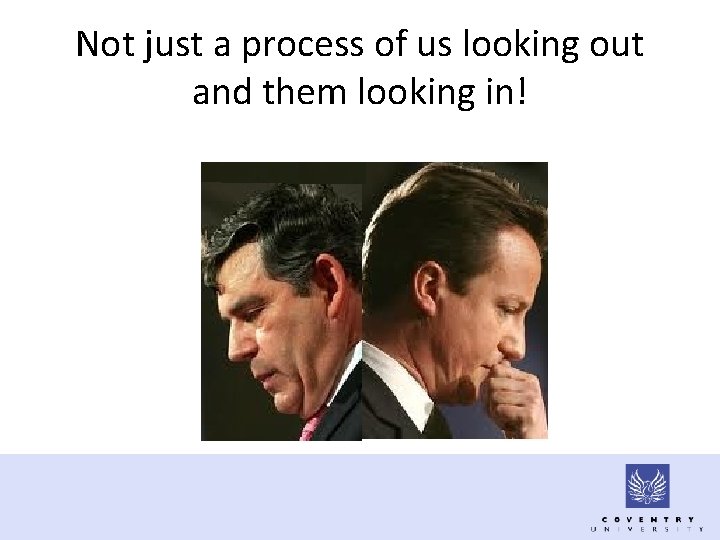
• Abstract: Oral presentations are a common form of assessment at tertiary level and include a performance aspect where students are under pressure to deliver academic monologues to audiences in real-time; unlike an essay, which is mostly concerned with content. For international students, the burden of performing under such conditions means that their English language is tested to the extremes. In particular, East Asian students have problems in delivering natural -sounding monologues and often rely on scripted deliveries. This means that intonation and discourse marking, which are important features for segmenting monologues into manageable chunks and establishing hierarchical relationships between parts, are often under-specified, leading to the talk being perceived as ‘flat’, undifferentiated and even monotonous. In addition, students might only receive minimal feedback on their performance in the form of a mark and a few notes from the tutor which limits their capacity to learn and improve on a skill that is difficult to acquire naturally without intervention. • Participants in the proposed presentation will be able to listen to samples of discourse from international students delivering oral monologues and will be introduced to some basic aspects of intonation analysis. The presentation will also provide space to analyse students’ reactions to delivering oral monologues through the analysis of a series of pre- and post-task interviews. This will highlight some of the intervention strategies tutors can enact to aid feedback to students and develop remedial work. • UK higher educational establishments are diverse multicultural environments and this proposal addresses the needs of a significant proportion of the population who require pro-active intervention strategies in order to improve. Internationalisation is not just a process where native English speakers look out and non-native speakers look in, but one where we align our views.
1. OVERVIEW
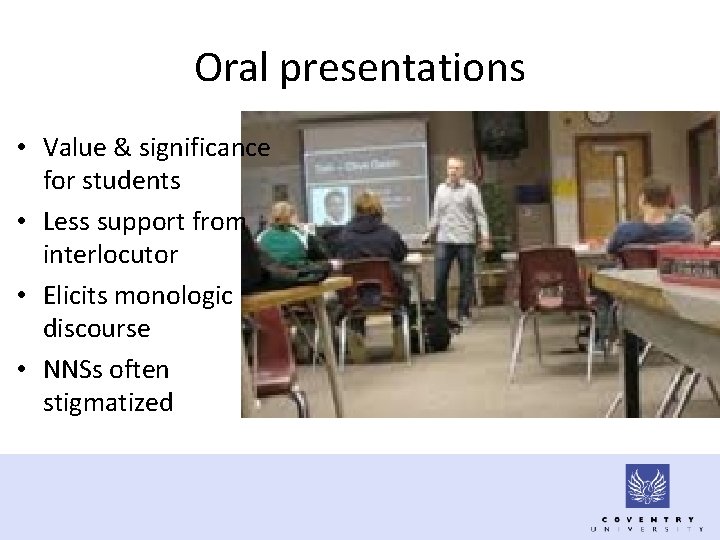
Oral presentations • Value & significance for students • Less support from interlocutor • Elicits monologic discourse • NNSs often stigmatized
Text-structuring Metadiscourse Devices and Intonation Cues • Thompson (2003) has suggested that lengthy monologues require control over the use of textstructuring metadiscourse devices and intonation cues in order for the listener to understand the larger-scale ‘hierarchical organisation’ of the discourse. … For international students who are not native speakers of English, the lack of control over the use of these organisational devices means that their monologues are often perceived as flat and undifferentiated (Tyler & Bro, 1992) by the audience.
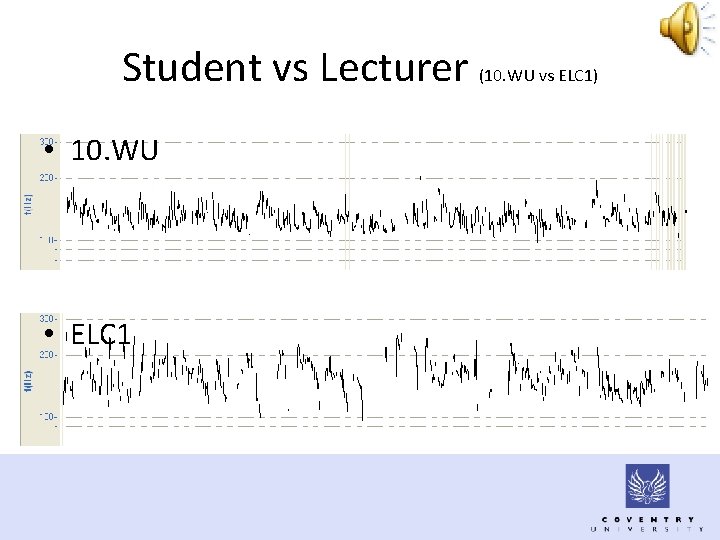
Flat, undifferentiated speech
2. EXAMPLES
Student vs Lecturer (10. WU vs ELC 1) • 10. WU • ELC 1
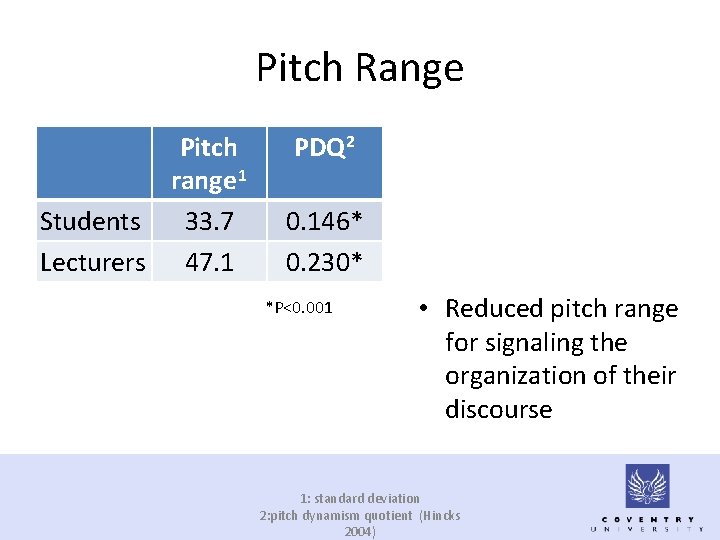
Pitch Range Pitch range 1 Students 33. 7 Lecturers 47. 1 PDQ 2 0. 146* 0. 230* *P<0. 001 • Reduced pitch range for signaling the organization of their discourse 1: standard deviation 2: pitch dynamism quotient (Hincks 2004)
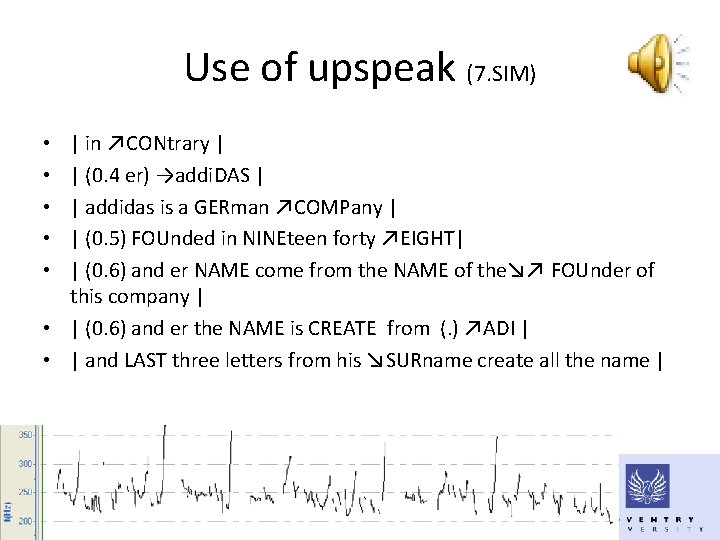
Use of upspeak (7. SIM) | in ↗CONtrary | | (0. 4 er) →addi. DAS | | addidas is a GERman ↗COMPany | | (0. 5) FOUnded in NINEteen forty ↗EIGHT| | (0. 6) and er NAME come from the NAME of the↘↗ FOUnder of this company | • | (0. 6) and er the NAME is CREATE from (. ) ↗ADI | • | and LAST three letters from his ↘SURname create all the name | • • •
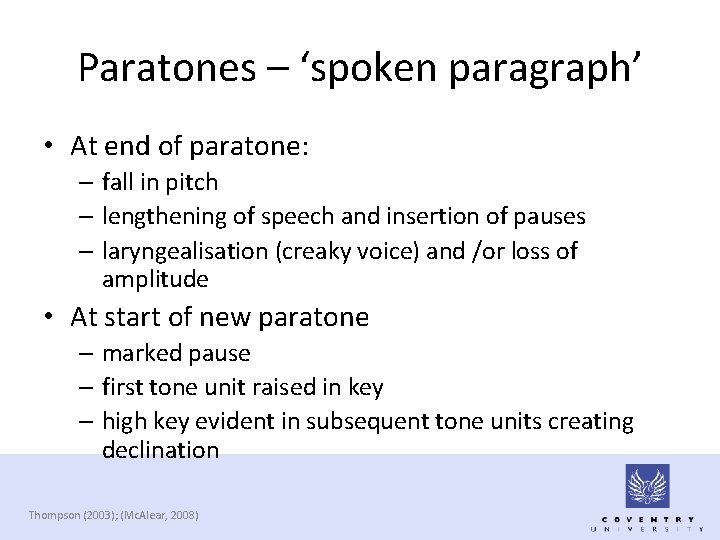
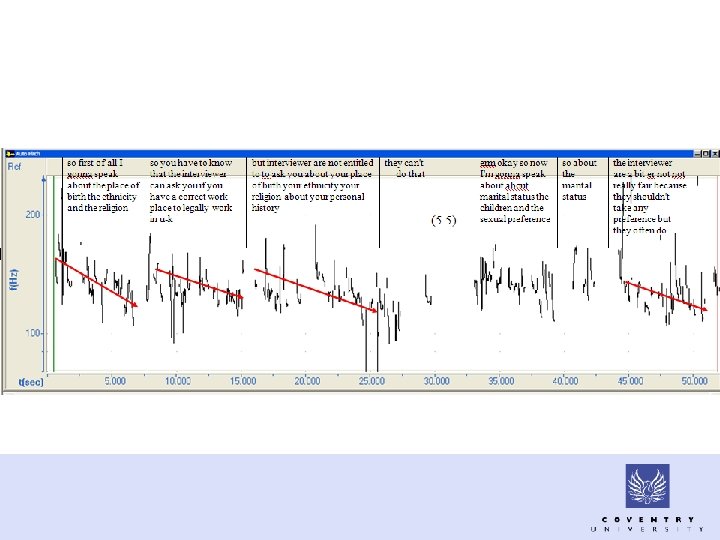
Paratones – ‘spoken paragraph’ • At end of paratone: – fall in pitch – lengthening of speech and insertion of pauses – laryngealisation (creaky voice) and /or loss of amplitude • At start of new paratone – marked pause – first tone unit raised in key – high key evident in subsequent tone units creating declination Thompson (2003); (Mc. Alear, 2008)
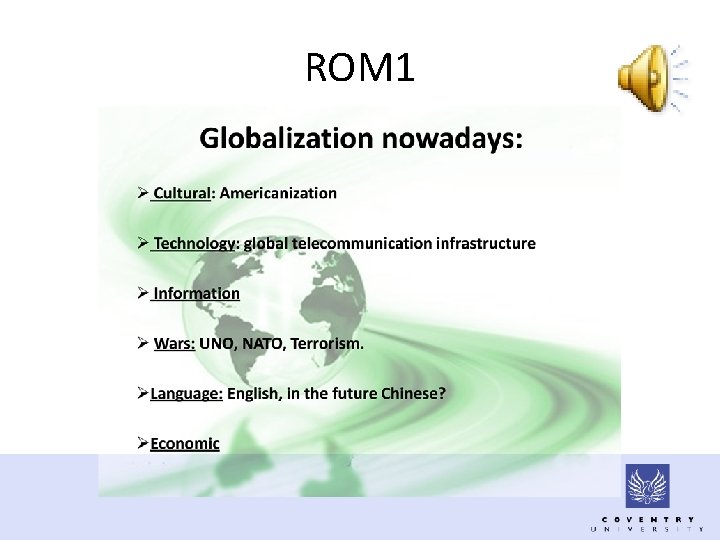
ROM 1
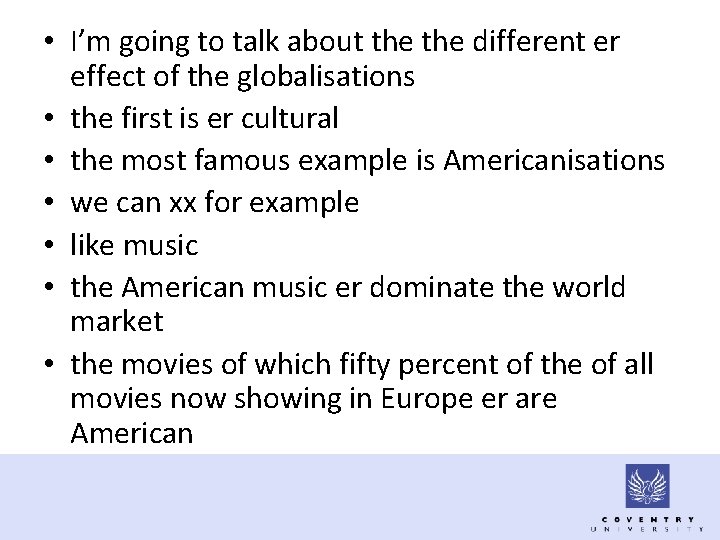
• I’m going to talk about the different er effect of the globalisations • the first is er cultural • the most famous example is Americanisations • we can xx for example • like music • the American music er dominate the world market • the movies of which fifty percent of the of all movies now showing in Europe er are American
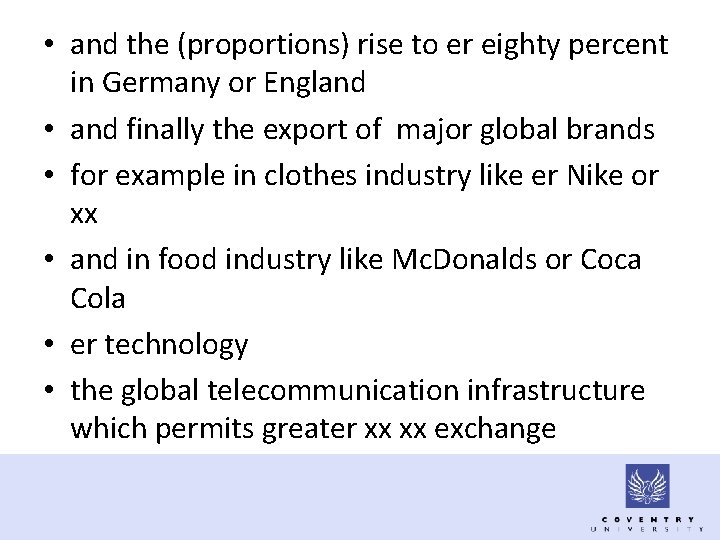
• and the (proportions) rise to er eighty percent in Germany or England • and finally the export of major global brands • for example in clothes industry like er Nike or xx • and in food industry like Mc. Donalds or Coca Cola • er technology • the global telecommunication infrastructure which permits greater xx xx exchange
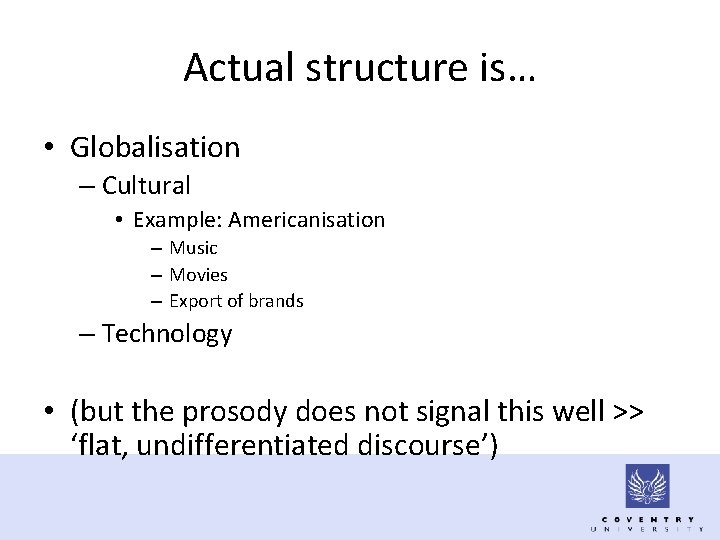
Actual structure is… • Globalisation – Cultural • Example: Americanisation – Music – Movies – Export of brands – Technology • (but the prosody does not signal this well >> ‘flat, undifferentiated discourse’)
PIE 1
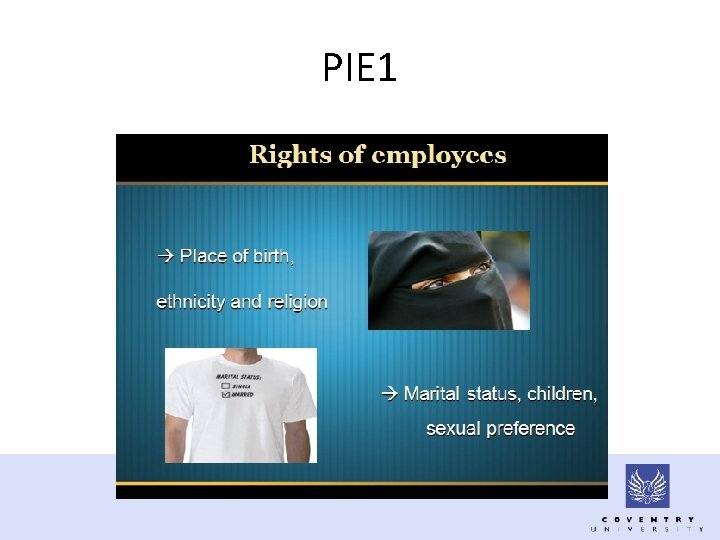
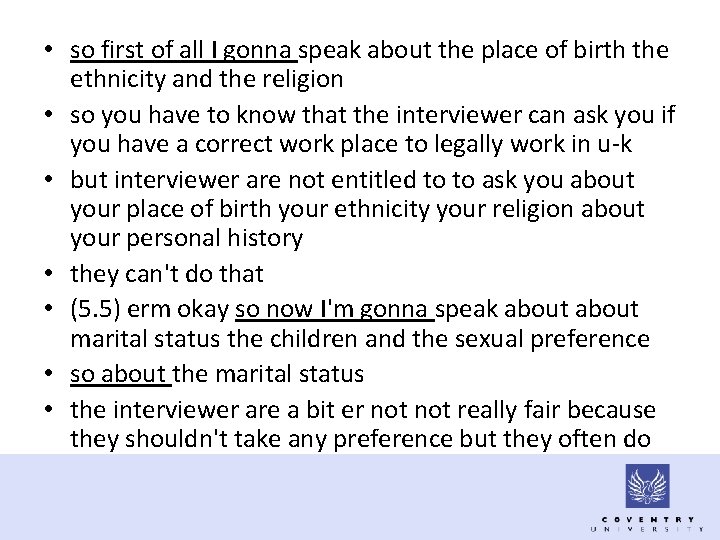
• so first of all I gonna speak about the place of birth the ethnicity and the religion • so you have to know that the interviewer can ask you if you have a correct work place to legally work in u-k • but interviewer are not entitled to to ask you about your place of birth your ethnicity your religion about your personal history • they can't do that • (5. 5) erm okay so now I'm gonna speak about marital status the children and the sexual preference • so about the marital status • the interviewer are a bit er not really fair because they shouldn't take any preference but they often do
ALE vs LEO • Good contrast here between hesitant, weak prosodic delivery (ALE) and fluent delivery (LEO) • ALE vs LEO
Consistency & Contrast • Consistency – Use of pitch, pausing and discourse marking needs to be consistently applied over the whole of the presentation • Contrast – Use of pitch, pausing and discourse marking needs to be contrastive to segment the talk into hierarchical units
• A narrow pitch range may not necessarily be a burden on the audience if the student can deploy consistent and contrastive intonation patterns that are explicitly marked
3. INTERVIEWS
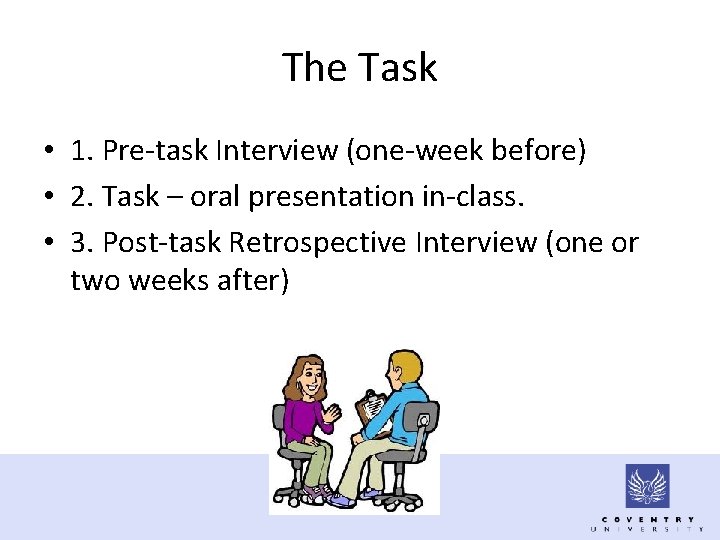
The Task • 1. Pre-task Interview (one-week before) • 2. Task – oral presentation in-class. • 3. Post-task Retrospective Interview (one or two weeks after)
Outcomes - knowledge • In general, European students knew what ‘intonation’ was but Chinese students did not. • However, all failed to mention the discourse structuring aspect of intonation • Discourse markers – students were more familiar with term ‘linking words’ • Most students did not voluntarily identify intonation or discourse marking as important but did so when pushed.
Outcomes – preparation & practice • Most students do a limited amount of some sort of ‘stand-up-and-practice’ • Practice methods tend to be haphazard and eclectic • Carried out in last few days before presentation • Intonation practice and discourse marking do not figure significantly in this
Outcomes – after reviewing • Many surprised after listening to recording – felt it was worse than originally thought • Many commented on pauses, hesitation, repetitions • Intonation – many felt it was weak aspect – a few commented that it is advanced feature beyond them • Discourse marking – felt that this was okay
4. INTERNATIONALISATION
Not just a process of us looking out and them looking in!
Suggestions for teachers • Pro-active intervention strategies • Students need ‘targeted’ assistance with presentations • Particularly Chinese students are going through university ‘under the radar’ • Remedial classes
References • Hincks, R (2004) Processing the prosody of oral presentations. Proceedings of In. STIL/ICALL 2004 – NLP and Speech Technologies in Advanced Language Learning Systems – Venice 17 -19 June, 2004 • Mc. Alear, S (2008) Unpublished MA Dissertation. Univ of Nottingham • Pickering, L. (2004) The structure and function of intonational paragraphs in native and nonnative speaker instructional discourse. English for Specific Purposes; Jan 2004, Vol. 23 Issue 1, p 19, 25 p • Thompson, S. E. (2003) Text-structuring metadiscourse, intonation and the signalling of organisation in academic lectures. Journal of English for Academic Purposes, 2, pp. 5 -20. • Tyler, A. & Bro, J. (1992) Discourse Structure in Nonnative English Discourse: The effect of ordering and interpretive cues on perceptions of comprehensibility. Studies in Second Language Acquisition, 14(1), 71 -86.