Internationalisation Of Higher Education Institutions Through KA 107


- Slides: 26
Internationalisation Of Higher Education Institutions Through KA 107 Transnational Cooperation Activity (TCA) ’ 19 Larnaca, CYPRUS, 6 – 8 November 2019 Associate Professor Konstantinos-Stefanos NIKAS Dr. Mechanical Engineer, Uni. WA Erasmus+/ICM Institutional Coordinator
CONTENTS Ø UNIVERSITY OF WEST ATTICA (UNIWA) Ø ERASMUS+/INTERNATIONAL CREDIT MOBILITY IN UNIWA Ø INTERNATIONALISATION & GLOBALISATION Ø INTERNATIONALISATION IN HIGHER EDUCATION Ø INTERNATIONALISATION STRATEGY PLAN OF A HEI Ø INTERNATIONALISATION OF A HEI (Uni. WA) THROUGH KA 107 • Proposal • Support • Examples Ø CONCLUSIONS
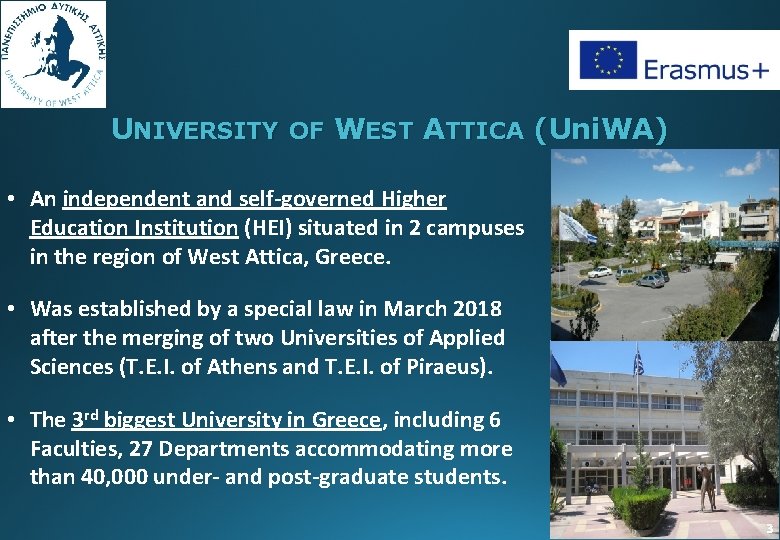
UNIVERSITY OF WEST ATTICA (Uni. WA) • An independent and self-governed Higher Education Institution (HEI) situated in 2 campuses in the region of West Attica, Greece. • Was established by a special law in March 2018 after the merging of two Universities of Applied Sciences (T. E. I. of Athens and T. E. I. of Piraeus). • The 3 rd biggest University in Greece, including 6 Faculties, 27 Departments accommodating more than 40, 000 under- and post-graduate students.
UNIVERSITY OF WEST ATTICA (Uni. WA) • It offers technological, theoretical and practical education directly applied to the needs of the market. • The courses last for ten (10) semesters for the Faculty of Engineering and eight (8) semesters for the rest, including an optional three to six-month period of practical training (internship) and a final-year dissertation following the ECTS system. • The study is provided free of tuition and education material and supervised by the Ministry of Education of Greece. • Uni. WA has been awarded by the EU with ECTS and Diploma Supplement Labels.
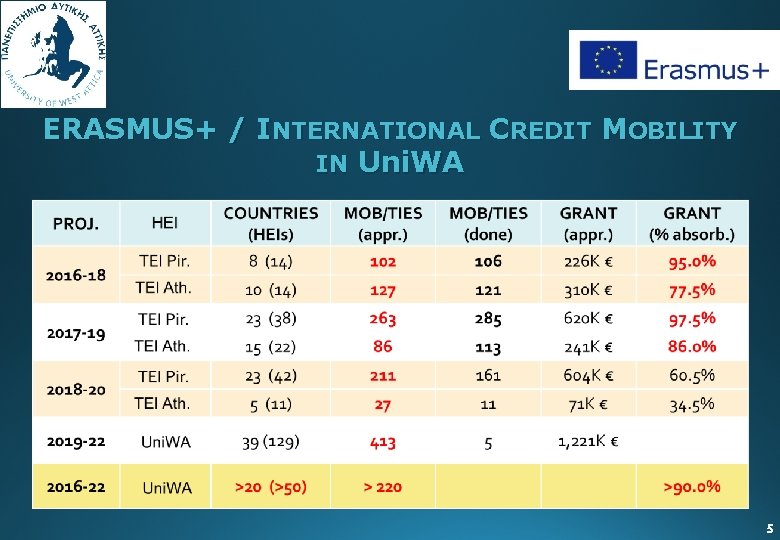
ERASMUS+ / INTERNATIONAL CREDIT MOBILITY IN Uni. WA
INTERNATIONALISATION & GLOBALISATION INTERNATIONALISATION (1) • A corporate strategy that involves making products and services as adaptable as possible, so they can easily enter different national markets. • It often requires the assistance of subject-matter experts, technical experts and people with international experience. • Examples: (a) Products intended for use by speakers of multiple languages typically undergo an internationalisation process. For example, IKEA internationalises the assembly instructions for its furniture by using only diagrams and illustrations, without including any text that would need to be translated; (b) A company that makes hair dryers or other appliances will need to ensure that their products are compatible with the different Voltages used in various countries.
INTERNATIONALISATION & GLOBALISATION INTERNATIONALISATION (2) • The literature identifies 4 broad categories of rationales for internationalisation, which may vary in importance by country and region, and their dominance may change over time: § POLITICAL § ECONOMIC § SOCIAL & CULTURAL and § ACADEMIC • At the present time, economic rationales are considered to be more dominant than the other three. In relation to these, academic rationales such as strategic alliances, status and profile are also becoming more dominant.
INTERNATIONALISATION & GLOBALISATION • It is frequently confused with internationalisation, but is in fact something totally different. • It is the process in which people, ideas and goods spread throughout the world, spurring more interaction and integration between the world's cultures, governments and economies. • It refers to global economic integration of many formerly national economies into one global economy, mainly by free trade and free capital mobility, but also by easy or uncontrolled migration. It is the effective erasure of national boundaries for economic purposes. • Example: Many large restaurant chains, like Mc. Donald’s, operate in dozens of countries. With franchises in more than one hundred countries and diners around the world, Mc. Donald’s are recognised by its brand logo.
INTERNATIONALISATION & GLOBALISATION INTERNATIONALISATION vs GLOBALISATION • Some use the term globalisation more broadly, applying it to the movement of people, knowledge and technology across international borders; some also apply it to the free flow of cultural, environmental and political discourse. • INTER-NATIONAL means between or among nations. The basic unit remains the nation, even as relations among nations become increasingly necessary and important. • Internationalisation is a broader and more international participation, but diverse and equitable. In globalisation, one single world form absorbs, assimilates and integrates all others. • BE CAREFUL: We define globalisation as the reality shaped by an increasingly integrated world economy, new information and communications technology, the emergence of an international knowledge network, the role of English language and other forces beyond the control of academic institutions.
INTERNATIONALISATION IN HIGHER EDUCATION DEFINITION • “The intentional process of integrating an international, intercultural, or global dimension into the purpose, functions or delivery of post-secondary education, in order to enhance the quality of education and research for all students and staff, and to make a meaningful contribution to society” (European Parliament’s (2015) revision of Knight (2003) definition). • Internationalisation in Higher Education is defined as the variety of policies and programs that Universities and governments implement to respond to globalisation. • There are two interdependent pillars of internationalisation in HEIs: (a) At Home or Campus-based and (b) Abroad / Cross-border education
INTERNATIONALISATION IN HIGHER EDUCATION WHY? (1) • The internationalisation of a HEI has become crucial for its competitiveness and sustainability. Universities are paying great attention to it – as both a concept and an agenda. • Although internationalisation can be considered to be an input to various other activities in a university, including teaching and research, it has become increasingly important as a performance measure. This is reflected in various international league tables such as the Times Higher Education, the Shanghai Jiao Tong index and the QS star system. • As a consequence, Universities have begun to develop strategies, policies, programmes and infrastructure which have converted them into Institutions that take internationalisation seriously; however, they are still facing problems in identification of basic steps through which transformation of higher education to internationalisation is possible.
INTERNATIONALISATION IN HIGHER EDUCATION WHY? (2) Benefits for Students!!! 1. Internationalisation is a necessary means of “self-transformation”. Contact with international students enables people to see the world from vantage points that reach beyond their own backgrounds – and this allows them to learn about new cultures and countries. 2. Successful internationalisation means training students to approach their own cultures, texts, and traditions in different ways and through comparative perspectives. 3. It gives students and scholars the opportunity – and indeed the pressure – to view themselves and their cultures in new ways.
INTERNATIONALISATION STRATEGY PLAN OF A HEI A variety of internationalisation policies and practices have been employed and developed in HEIs, on their home campuses and abroad, to implement their internationalisation plans, such as: ü recruiting international students, ü internationalising the curricula, ü promoting international research mobility, ü integrating international students and promoting intercultural capabilities, ü students, staff and scholars exchange programs and ü opening up of branch campuses in other countries which are designed to attract students who are not able to travel overseas for education.
INTERNATIONALISATION STRATEGY PLAN OF A HEI STEPS – PARAMETERS (1) 1. Formalise the strategic process § The first key to success for an international strategy is having one! The University must decide where in the world it should concentrate its efforts, with which partners, and for what types of activities. § Analyse the University’s strengths in education and research, existing relationships, and the available means to achieve its objectives within a set time frame. If the University is ranked high internationally, define how to capitalise on that ranking. If it’s not, study the different rankings’ internationalisation criteria to help its strategy. § A solid three-year international development plan is a good start. 2. Define the scope of the internationalisation strategy § Formal international relationships have traditionally focused more on student and faculty exchange. Enlarge the scope of the University’s international development to include collaborative research, joint academic programme design and delivery, innovation & entrepreneurship, and activities with companies.
INTERNATIONALISATION STRATEGY PLAN OF A HEI STEPS – PARAMETERS (2) 3. Input from stakeholders § Involve representatives from across the University community in the strategic process. Establish a framework and ask for input from faculty, staff, local and international students, alumni, corporate partners, ministries, diplomats, and international partners. 4. Select key projects and programs § Make a short list of the University’s core projects and programmes that can be highlighted in order new partnerships worldwide to be established. 5. Determine strategic countries § It’s neither possible nor desirable to try to be everywhere. A maximum of five or six strategic countries will suffice. Combine a bottom-up and top-down approach. § Take a closer look at countries in which the university is not active but perhaps should be. The criteria could be fast-paced economic growth, student quality, research output and the number of major companies from the home country doing business there.
INTERNATIONALISATION STRATEGY PLAN OF A HEI STEPS – PARAMETERS (3) 6. Refine strategic partnerships § Select strategic partners by capitalising on current successful relationships. Target Universities considered as peers in terms of quality, research output, reputation, and international outreach. § Determine the number of strategic partners by evaluating the University’s capacity to sustain the relationships. 7. Establish a professional international team § International strategy must be incarnated by the president or the rector. A vicepresident/rector and/or director of international affairs must build a team that will drive the strategy, set activities in motion with various departments across the University, and liaise with international partners. 8. Allocate adequate funding § International development is not a cost; it’s an investment! Secure realistic funding to cover travel expenses, finance partnership activities and host international delegations.
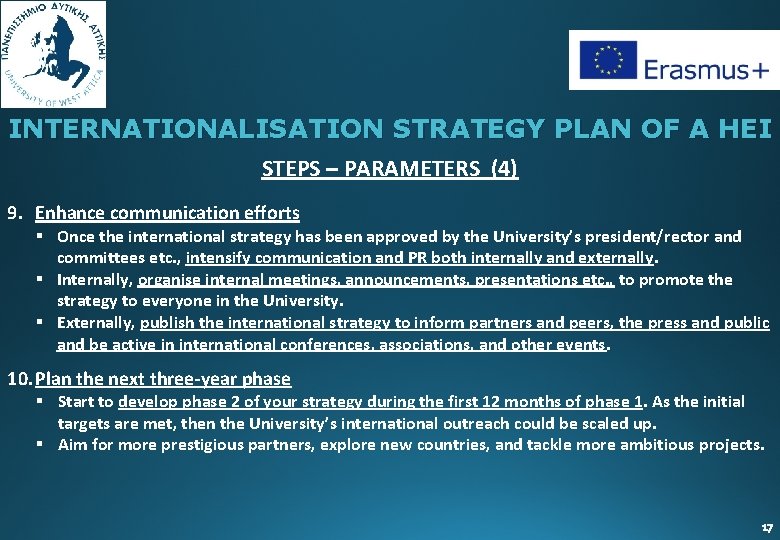
INTERNATIONALISATION STRATEGY PLAN OF A HEI STEPS – PARAMETERS (4) 9. Enhance communication efforts § Once the international strategy has been approved by the University’s president/rector and committees etc. , intensify communication and PR both internally and externally. § Internally, organise internal meetings, announcements, presentations etc. , to promote the strategy to everyone in the University. § Externally, publish the international strategy to inform partners and peers, the press and public and be active in international conferences, associations, and other events. 10. Plan the next three-year phase § Start to develop phase 2 of your strategy during the first 12 months of phase 1. As the initial targets are met, then the University’s international outreach could be scaled up. § Aim for more prestigious partners, explore new countries, and tackle more ambitious projects.
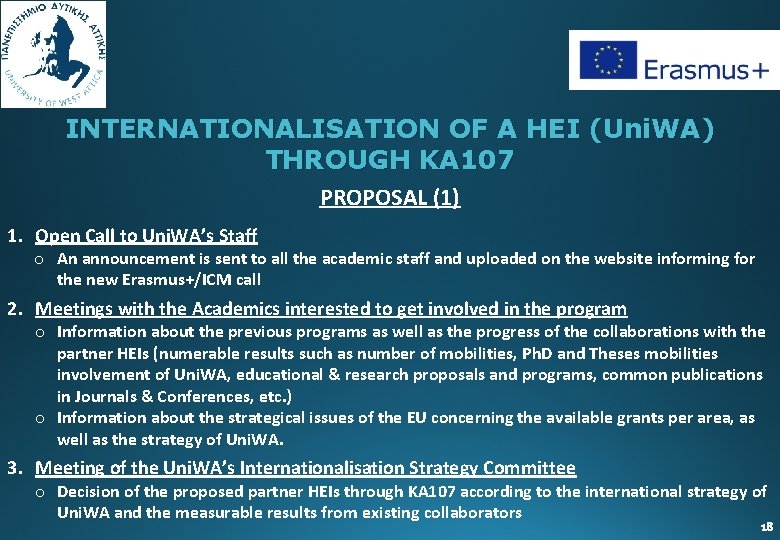
INTERNATIONALISATION OF A HEI (Uni. WA) THROUGH KA 107 PROPOSAL (1) 1. Open Call to Uni. WA’s Staff o An announcement is sent to all the academic staff and uploaded on the website informing for the new Erasmus+/ICM call 2. Meetings with the Academics interested to get involved in the program o Information about the previous programs as well as the progress of the collaborations with the partner HEIs (numerable results such as number of mobilities, Ph. D and Theses mobilities involvement of Uni. WA, educational & research proposals and programs, common publications in Journals & Conferences, etc. ) o Information about the strategical issues of the EU concerning the available grants per area, as well as the strategy of Uni. WA. 3. Meeting of the Uni. WA’s Internationalisation Strategy Committee o Decision of the proposed partner HEIs through KA 107 according to the international strategy of Uni. WA and the measurable results from existing collaborators
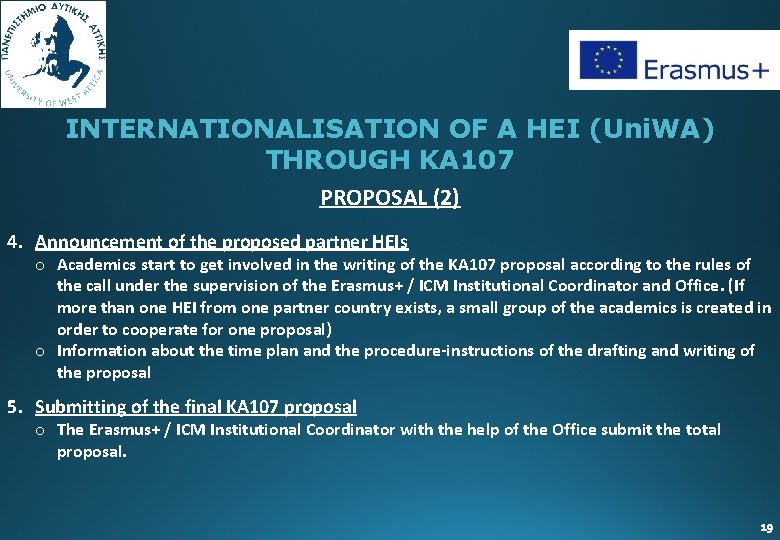
INTERNATIONALISATION OF A HEI (Uni. WA) THROUGH KA 107 PROPOSAL (2) 4. Announcement of the proposed partner HEIs o Academics start to get involved in the writing of the KA 107 proposal according to the rules of the call under the supervision of the Erasmus+ / ICM Institutional Coordinator and Office. (If more than one HEI from one partner country exists, a small group of the academics is created in order to cooperate for one proposal) o Information about the time plan and the procedure-instructions of the drafting and writing of the proposal 5. Submitting of the final KA 107 proposal o The Erasmus+ / ICM Institutional Coordinator with the help of the Office submit the total proposal.
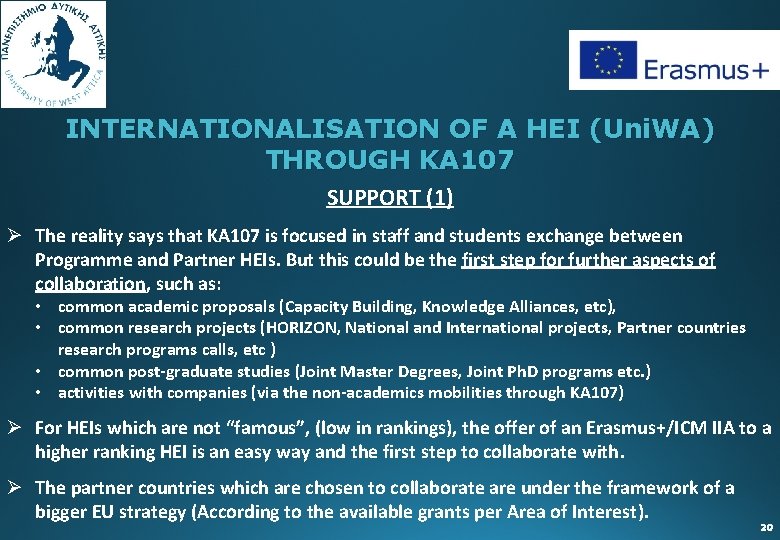
INTERNATIONALISATION OF A HEI (Uni. WA) THROUGH KA 107 SUPPORT (1) Ø The reality says that KA 107 is focused in staff and students exchange between Programme and Partner HEIs. But this could be the first step for further aspects of collaboration, such as: • common academic proposals (Capacity Building, Knowledge Alliances, etc), • common research projects (HORIZON, National and International projects, Partner countries research programs calls, etc ) • common post-graduate studies (Joint Master Degrees, Joint Ph. D programs etc. ) • activities with companies (via the non-academics mobilities through KA 107) Ø For HEIs which are not “famous”, (low in rankings), the offer of an Erasmus+/ICM IIA to a higher ranking HEI is an easy way and the first step to collaborate with. Ø The partner countries which are chosen to collaborate are under the framework of a bigger EU strategy (According to the available grants per Area of Interest).
INTERNATIONALISATION OF A HEI (Uni. WA) THROUGH KA 107 SUPPORT (2) Ø Provides funding for students and staff mobilities. Ø The existence of the Erasmus+/ICM to Uni. WA helps our Institution members to raise the visibility of Internationalisation easily and get involved to the procedures. Ø Creates opportunities for migrant education (students from US, China, Azerbaijan, Jordan are interested for short and long term courses and degrees, summers chools, etc). Ø Extend the modules given in English language and trying to involve Greek students to attend in the classrooms (Internationalization at Home). Ø Liaison of Greek students with ethnic and local groups of research and scholarly activities (common projects).
INTERNATIONALISATION OF A HEI (Uni. WA) THROUGH KA 107 SUPPORT (3) Ø Organises of International Weeks every 1 -2 years gathering Programme and Partner collaborating HEIs in order to strengthen joint initiatives among them. Ø Creates consortia-networks including several countries of the same area of interest and submits proposals in high-grant calls. Ø Creates partneships with specific organisations or companies which are connected with partner HEIs (e. g. We. Afri. Hug, SOCAR, etc. ) Ø Easier way to build relationships of mutual trust and respect with other partner HEIs. Ø The dissemination of good cooperation between partner countries expands the partnerships and attracts new ones.
INTERNATIONALISATION OF A HEI (Uni. WA) THROUGH KA 107 EXAMPLES (1) Ø Collaboration in EU projects - As stakeholders, members of the advisory board or collaborating with non EU partners (USA (Purdue), Japan (KIT), Azerbaijan (BHOS)) • TRILLION, STORM, joint publications, workshops, Participation in Ph. D candidates evaluation committees, Co-organisation of summer school Ø Tokyo University of the Arts (Japan) • Initial collaboration expanded with students mobilities in common Ph. Ds, research proposals for cultural property in Greek and Japanese calls Ø Jean Monnet Networks Program in Social and Cultural integration in tourism • HEIs from 8 collaborating partner countries such as Russia, Uzbekistan, Tajikistan, Kyrgyzstan, … Ø Strategic Actions in Cyber Security (Moldova, Georgia, Russia etc) • New Curricula at Partner Universities, Accredited 4 Bachelor and 4 Master Programs, Pole of Excellence and Resources
INTERNATIONALISATION OF A HEI (Uni. WA) THROUGH KA 107 EXAMPLES (2) Ø Research Activities in VIS-NIR and Raman Spectroscopy Techniques (South Africa and Malaysia) • Common publications, common MSc Dissertations & Ph. D Theses Ø Multi-disciplinary Activities (Uzbekistan, India, Morocco, Tunisia, etc) • New Curricula in Textiles and Electronics Depts, Liaison Office, Distance Learning, common publications, common Ph. D programs Ø Joint programs, Protocols and Patents (Egypt and Jordan) • Development of protocol for the documentation and storage of Artworks and Mosaic Conservation Joint Program, Joint Workshops Ø KA 2 Capacity Building - Coordinators (Indonesia, Malaysia and Pakistan) • Curriculum Development - Modernisation of curriculum by developing new and innovative courses and methodologies in Textile engineering
CONCLUSIONS q Higher Education Internationalisation can play a major role in developing Universities & students' capacities and their opportunities broadly throughout the world. q Irrespective of contextual differences within and between countries, nearly all Higher Education Institutions worldwide must be engaged in international activities and seeking to expand them. q The International Mobility Action of the Erasmus+ Programme could largely support the Internationalisation Strategy of a Higher Education Institution! Knight: “Higher Education Internationalisation has fundamentally transformed the World of Education and has dramatically changed itself”