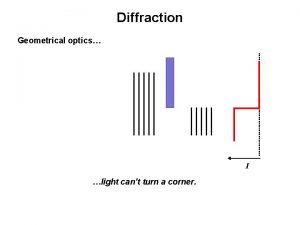
Interference and Diffraction Huygens Principle Any wave including
- Slides: 25
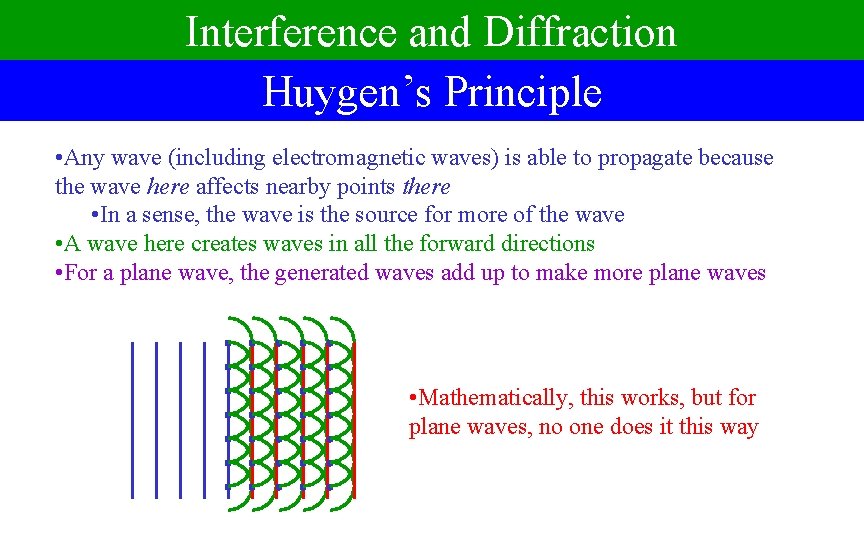
Interference and Diffraction Huygen’s Principle • Any wave (including electromagnetic waves) is able to propagate because the wave here affects nearby points there • In a sense, the wave is the source for more of the wave • A wave here creates waves in all the forward directions • For a plane wave, the generated waves add up to make more plane waves • Mathematically, this works, but for plane waves, no one does it this way
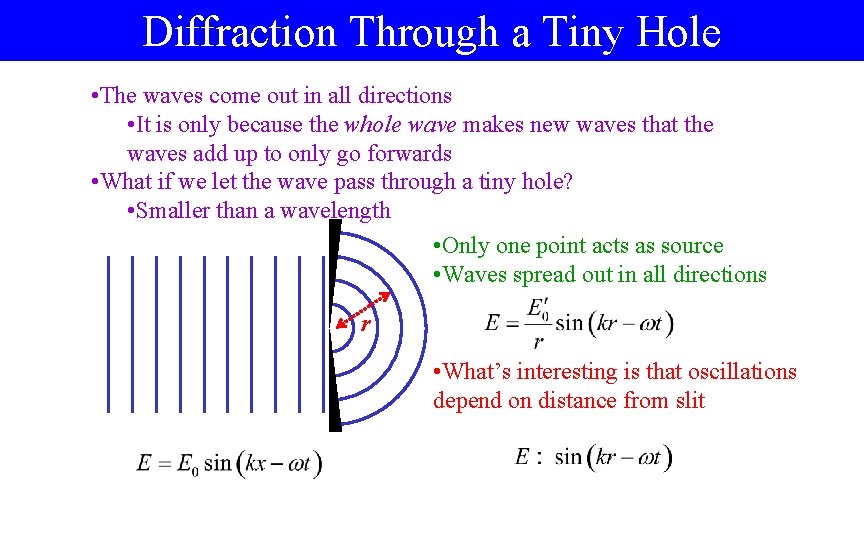
Diffraction Through a Tiny Hole • The waves come out in all directions • It is only because the whole wave makes new waves that the waves add up to only go forwards • What if we let the wave pass through a tiny hole? • Smaller than a wavelength • Only one point acts as source • Waves spread out in all directions r • What’s interesting is that oscillations depend on distance from slit
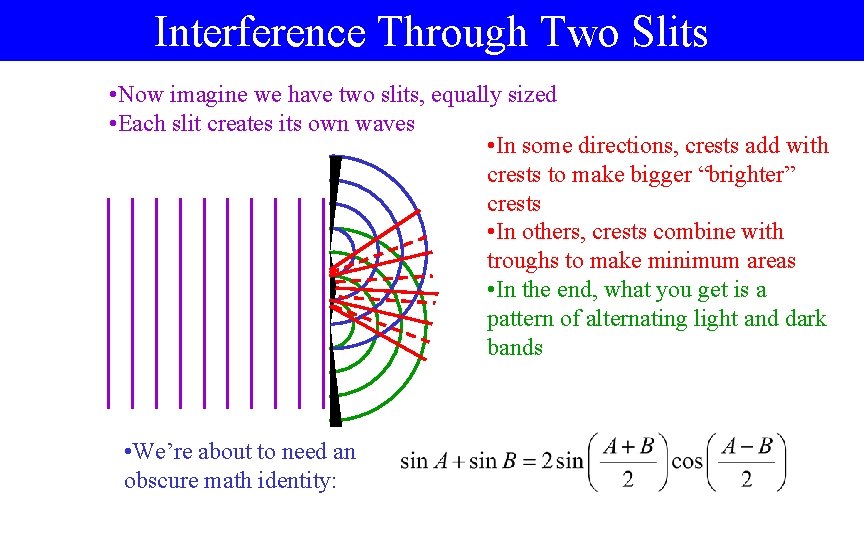
Interference Through Two Slits • Now imagine we have two slits, equally sized • Each slit creates its own waves • In some directions, crests add with crests to make bigger “brighter” crests • In others, crests combine with troughs to make minimum areas • In the end, what you get is a pattern of alternating light and dark bands • We’re about to need an obscure math identity:
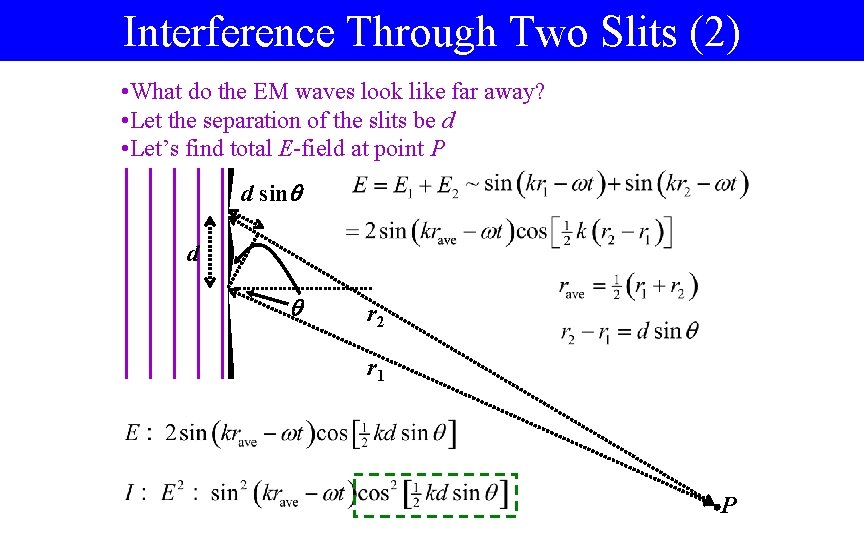
Interference Through Two Slits (2) • What do the EM waves look like far away? • Let the separation of the slits be d • Let’s find total E-field at point P d sin d r 2 r 1 P
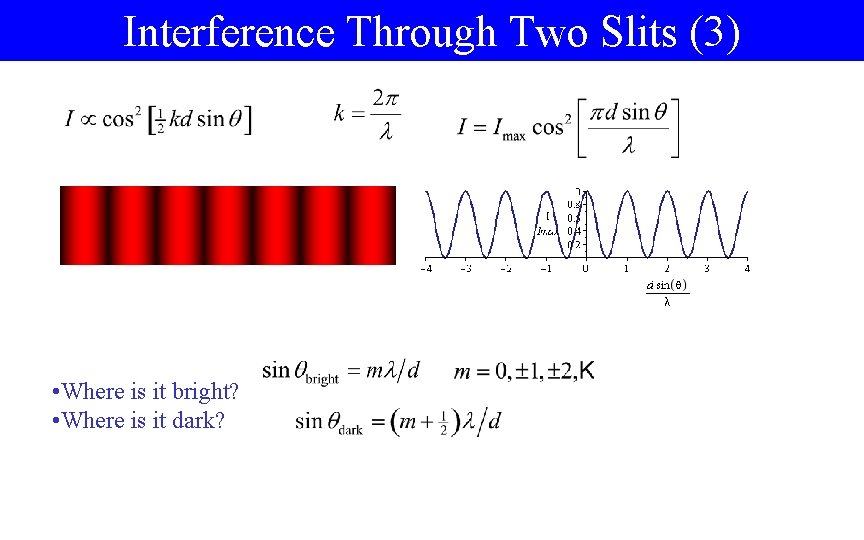
Interference Through Two Slits (3) • Where is it bright? • Where is it dark?
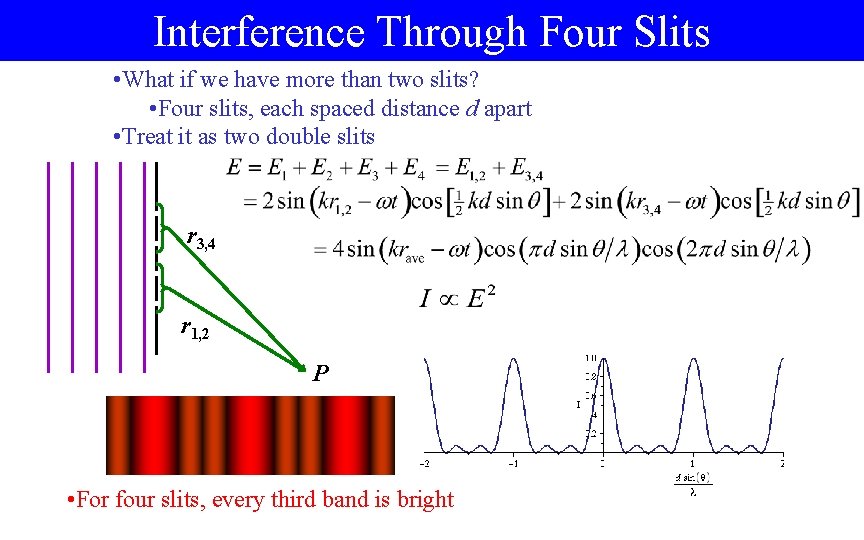
Interference Through Four Slits • What if we have more than two slits? • Four slits, each spaced distance d apart • Treat it as two double slits r 3, 4 r 1, 2 P • For four slits, every third band is bright
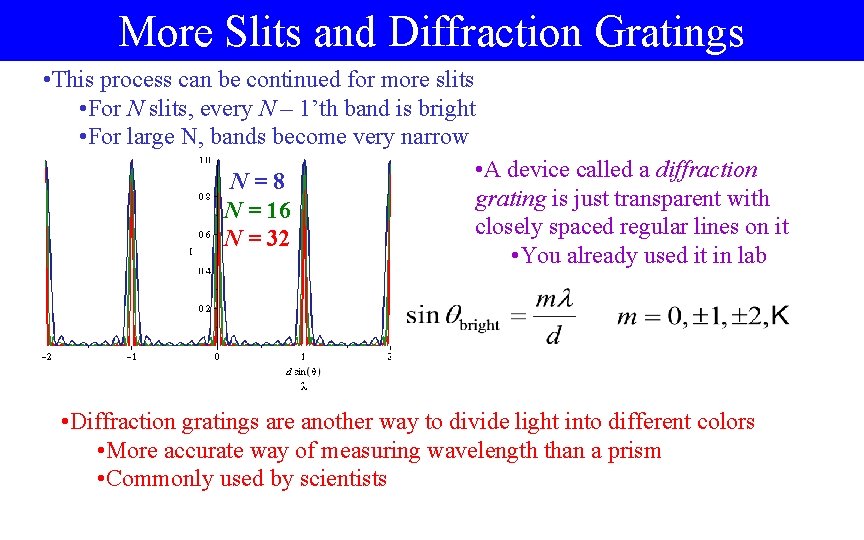
More Slits and Diffraction Gratings • This process can be continued for more slits • For N slits, every N – 1’th band is bright • For large N, bands become very narrow • A device called a diffraction N=8 grating is just transparent with N = 16 closely spaced regular lines on it N = 32 • You already used it in lab • Diffraction gratings are another way to divide light into different colors • More accurate way of measuring wavelength than a prism • Commonly used by scientists
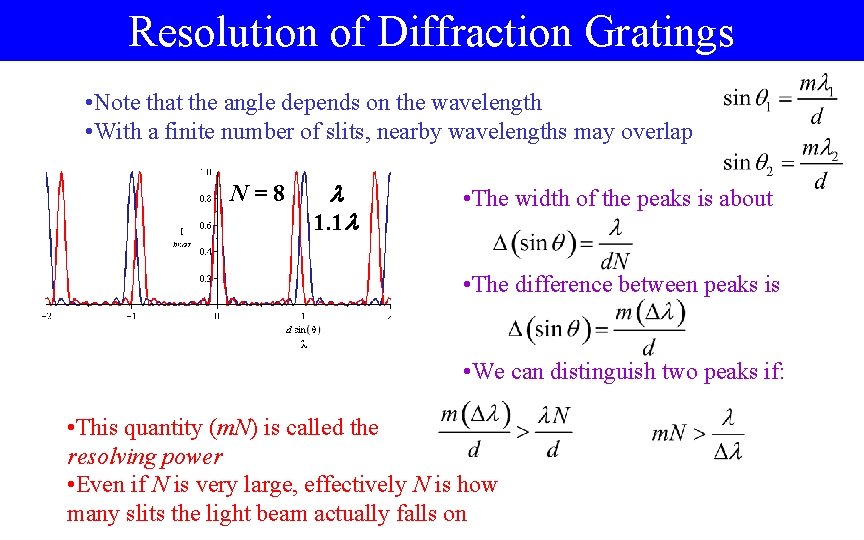
Resolution of Diffraction Gratings • Note that the angle depends on the wavelength • With a finite number of slits, nearby wavelengths may overlap N=8 1. 1 • The width of the peaks is about • The difference between peaks is • We can distinguish two peaks if: • This quantity (m. N) is called the resolving power • Even if N is very large, effectively N is how many slits the light beam actually falls on
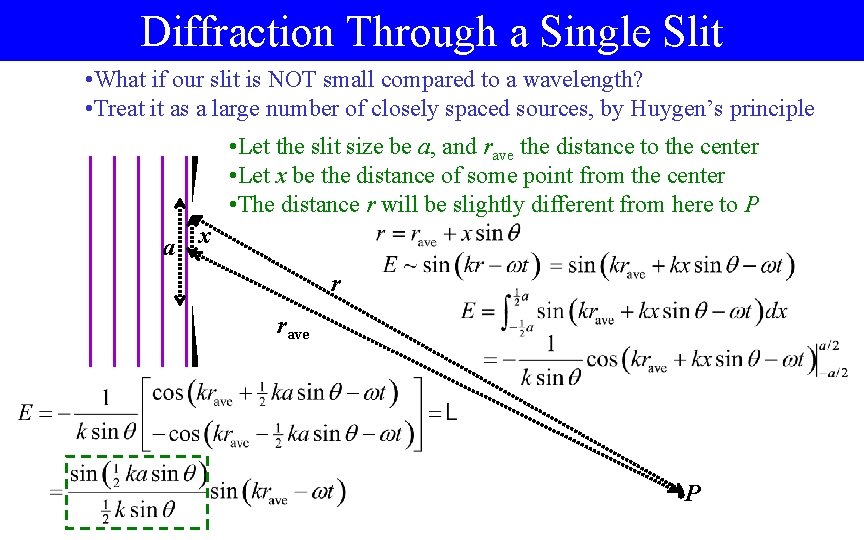
Diffraction Through a Single Slit • What if our slit is NOT small compared to a wavelength? • Treat it as a large number of closely spaced sources, by Huygen’s principle • Let the slit size be a, and rave the distance to the center • Let x be the distance of some point from the center • The distance r will be slightly different from here to P a x r rave P
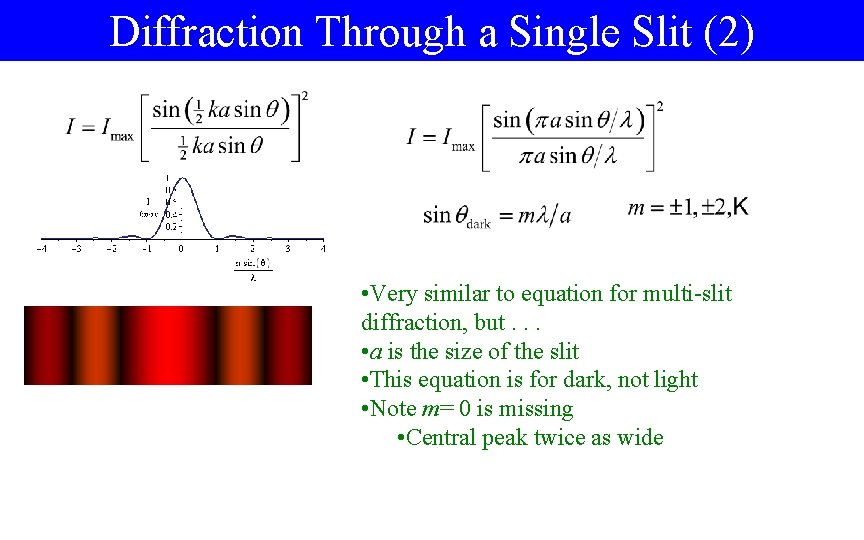
Diffraction Through a Single Slit (2) • Very similar to equation for multi-slit diffraction, but. . . • a is the size of the slit • This equation is for dark, not light • Note m= 0 is missing • Central peak twice as wide
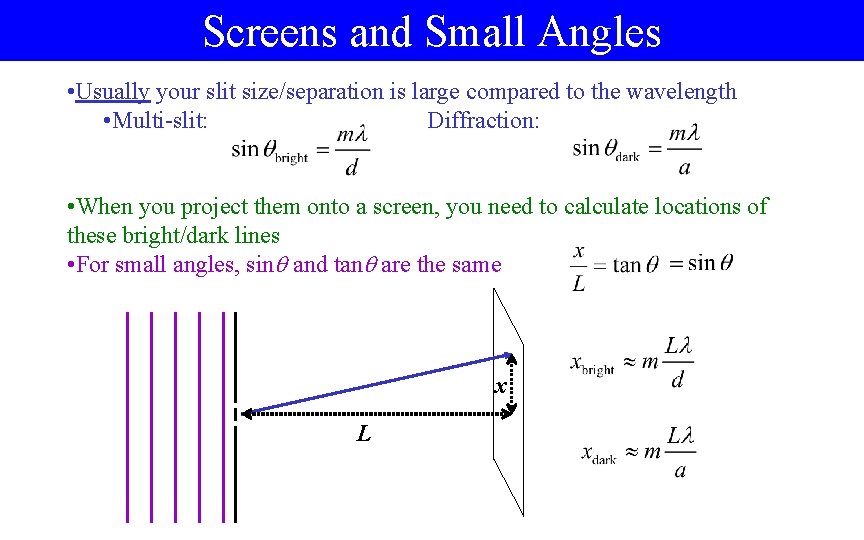
Screens and Small Angles • Usually your slit size/separation is large compared to the wavelength • Multi-slit: Diffraction: • When you project them onto a screen, you need to calculate locations of these bright/dark lines • For small angles, sin and tan are the same x L
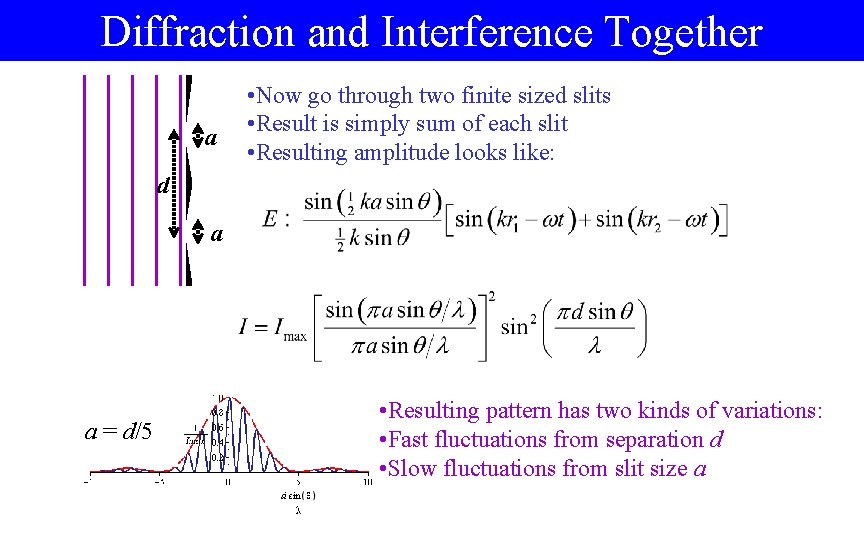
Diffraction and Interference Together a • Now go through two finite sized slits • Result is simply sum of each slit • Resulting amplitude looks like: d a a = d/5 • Resulting pattern has two kinds of variations: • Fast fluctuations from separation d • Slow fluctuations from slit size a
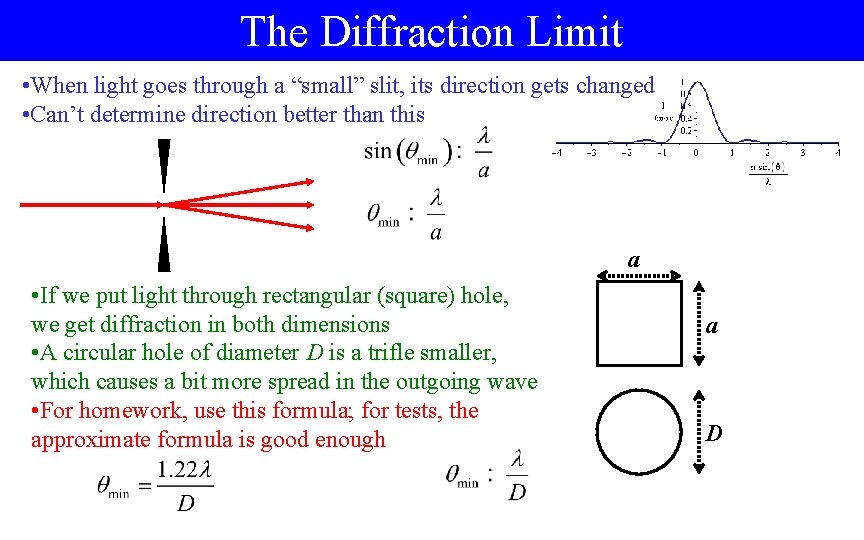
The Diffraction Limit • When light goes through a “small” slit, its direction gets changed • Can’t determine direction better than this a • If we put light through rectangular (square) hole, we get diffraction in both dimensions • A circular hole of diameter D is a trifle smaller, which causes a bit more spread in the outgoing wave • For homework, use this formula; for tests, the approximate formula is good enough a D
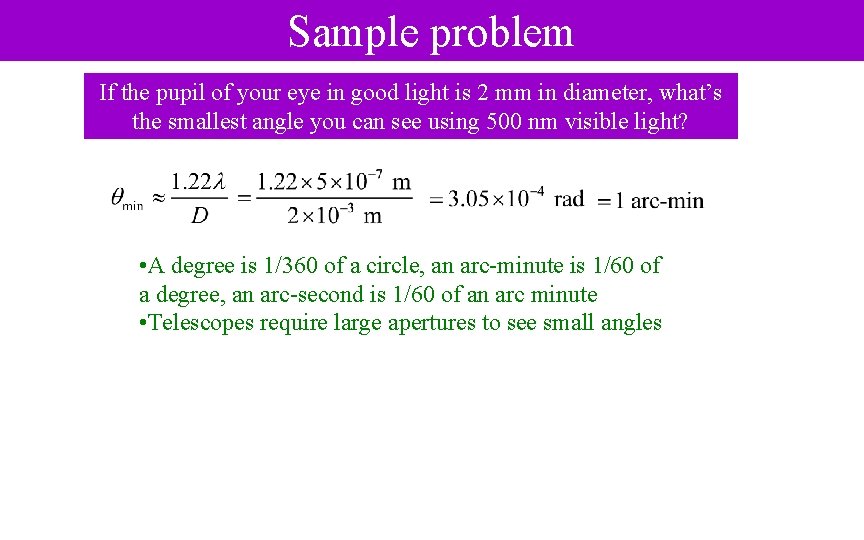
Sample problem If the pupil of your eye in good light is 2 mm in diameter, what’s the smallest angle you can see using 500 nm visible light? • A degree is 1/360 of a circle, an arc-minute is 1/60 of a degree, an arc-second is 1/60 of an arc minute • Telescopes require large apertures to see small angles
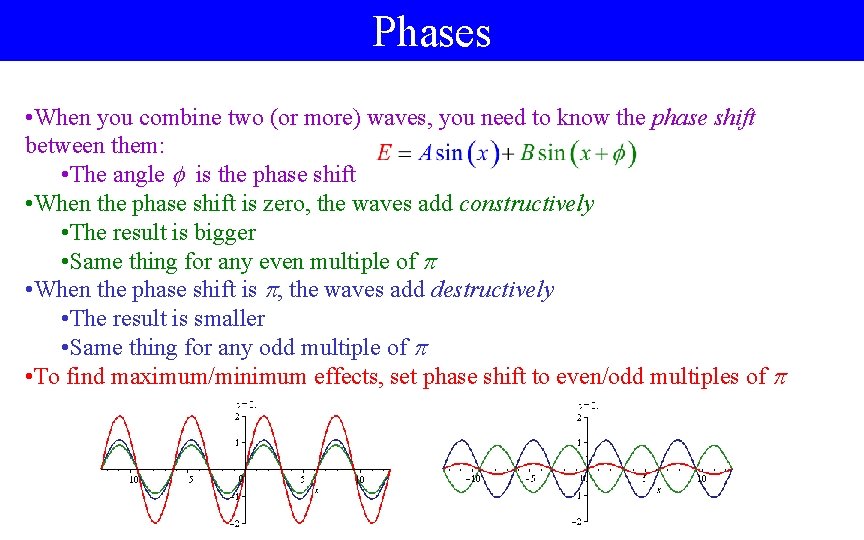
Phases • When you combine two (or more) waves, you need to know the phase shift between them: • The angle is the phase shift • When the phase shift is zero, the waves add constructively • The result is bigger • Same thing for any even multiple of • When the phase shift is , the waves add destructively • The result is smaller • Same thing for any odd multiple of • To find maximum/minimum effects, set phase shift to even/odd multiples of
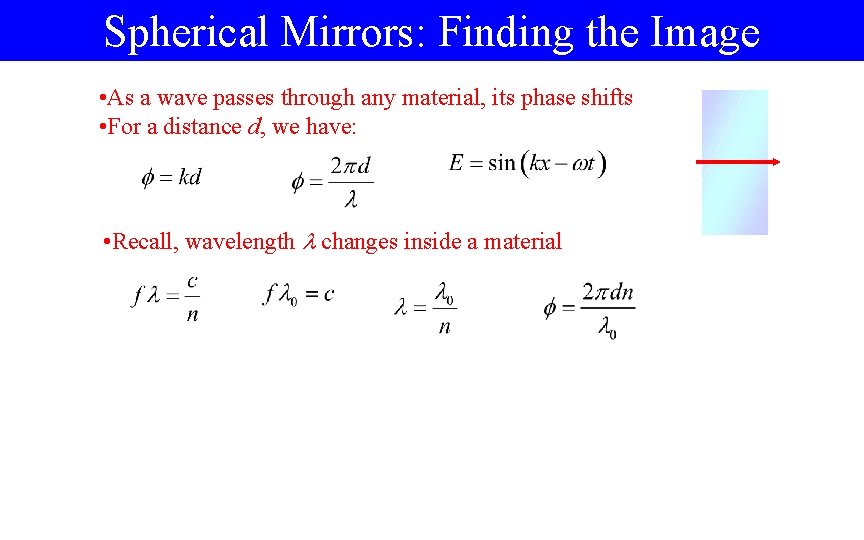
Spherical Mirrors: Finding the Image • As a wave passes through any material, its phase shifts • For a distance d, we have: • Recall, wavelength changes inside a material
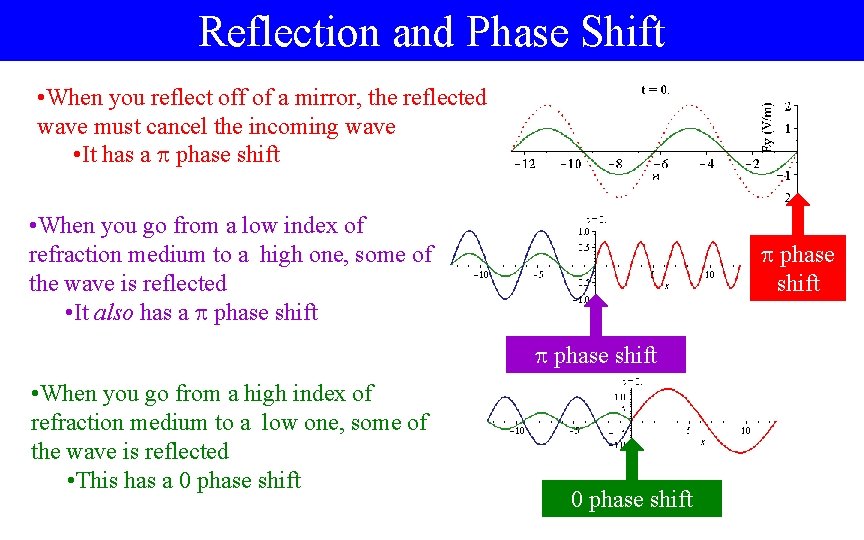
Reflection and Phase Shift • When you reflect off of a mirror, the reflected wave must cancel the incoming wave • It has a phase shift • When you go from a low index of refraction medium to a high one, some of the wave is reflected • It also has a phase shift • When you go from a high index of refraction medium to a low one, some of the wave is reflected • This has a 0 phase shift
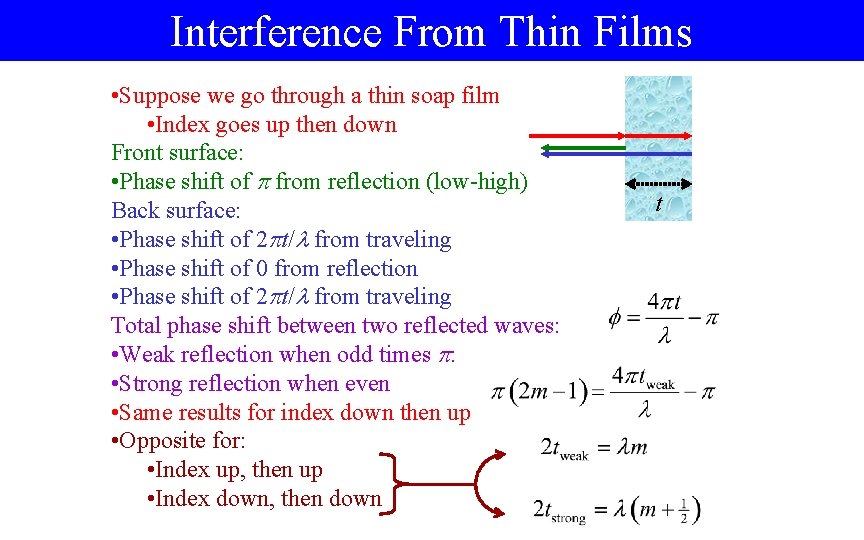
Interference From Thin Films • Suppose we go through a thin soap film • Index goes up then down Front surface: • Phase shift of from reflection (low-high) Back surface: • Phase shift of 2 t/ from traveling • Phase shift of 0 from reflection • Phase shift of 2 t/ from traveling Total phase shift between two reflected waves: • Weak reflection when odd times : • Strong reflection when even • Same results for index down then up • Opposite for: • Index up, then up • Index down, then down t
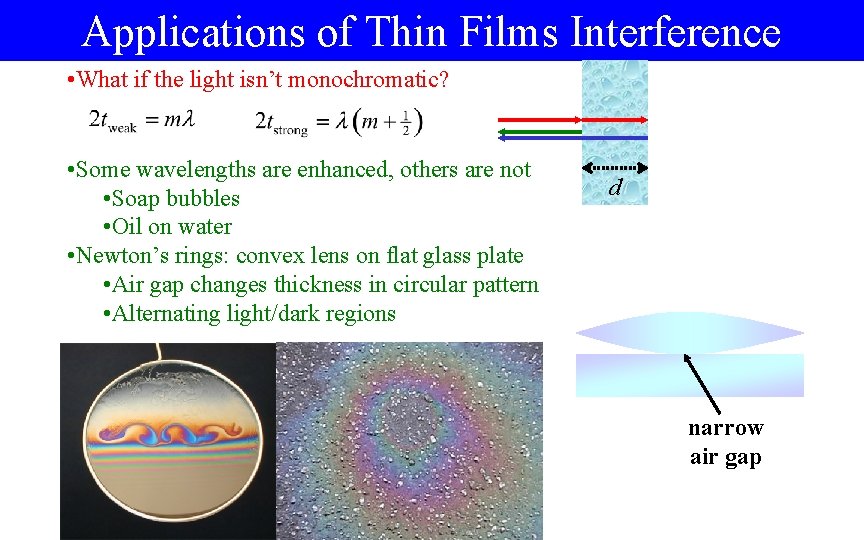
Applications of Thin Films Interference • What if the light isn’t monochromatic? • Some wavelengths are enhanced, others are not • Soap bubbles • Oil on water • Newton’s rings: convex lens on flat glass plate • Air gap changes thickness in circular pattern • Alternating light/dark regions d narrow air gap
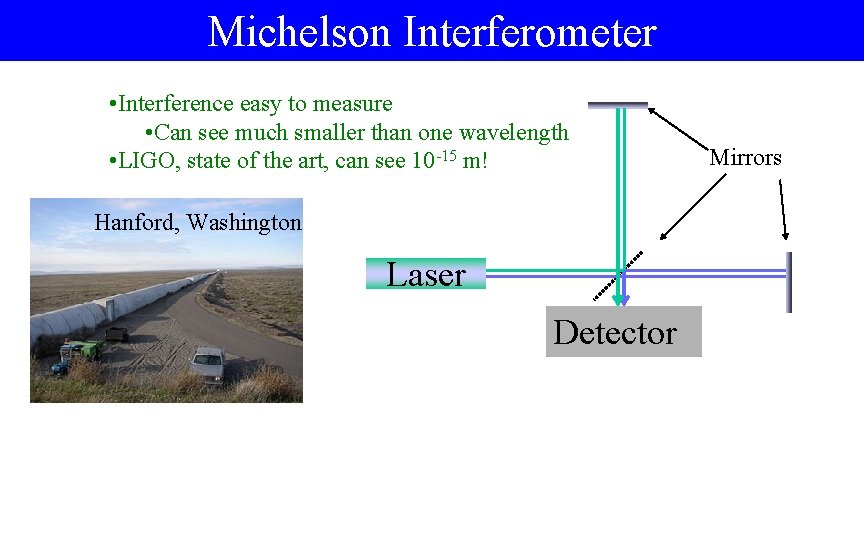
Michelson Interferometer • Interference easy to measure • Can see much smaller than one wavelength • LIGO, state of the art, can see 10 -15 m! Hanford, Washington Laser Detector Mirrors
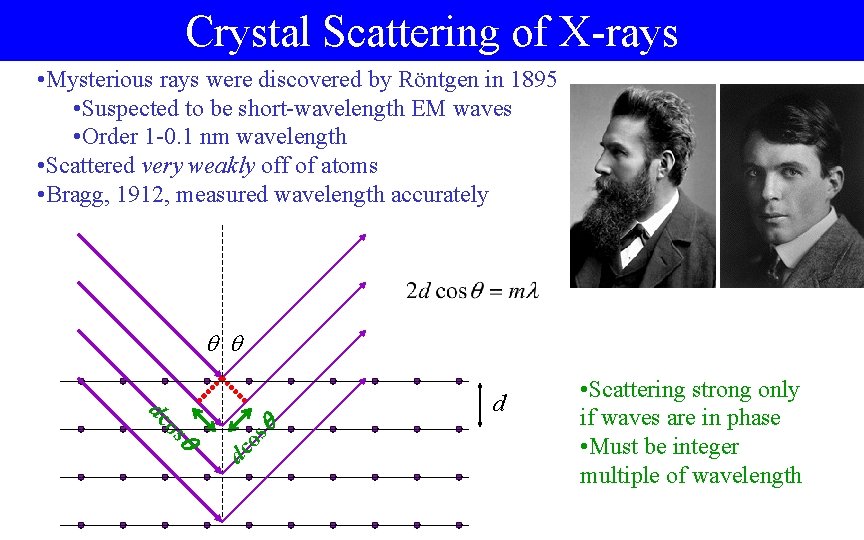
Crystal Scattering of X-rays • Mysterious rays were discovered by Röntgen in 1895 • Suspected to be short-wavelength EM waves • Order 1 -0. 1 nm wavelength • Scattered very weakly off of atoms • Bragg, 1912, measured wavelength accurately dc o os dc s d • Scattering strong only if waves are in phase • Must be integer multiple of wavelength
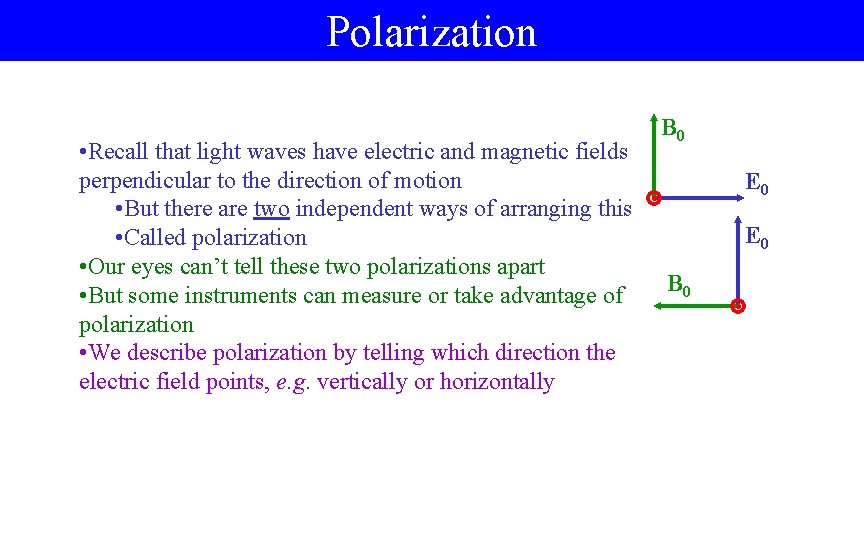
Polarization • Recall that light waves have electric and magnetic fields perpendicular to the direction of motion • But there are two independent ways of arranging this • Called polarization • Our eyes can’t tell these two polarizations apart • But some instruments can measure or take advantage of polarization • We describe polarization by telling which direction the electric field points, e. g. vertically or horizontally B 0 E 0 B 0
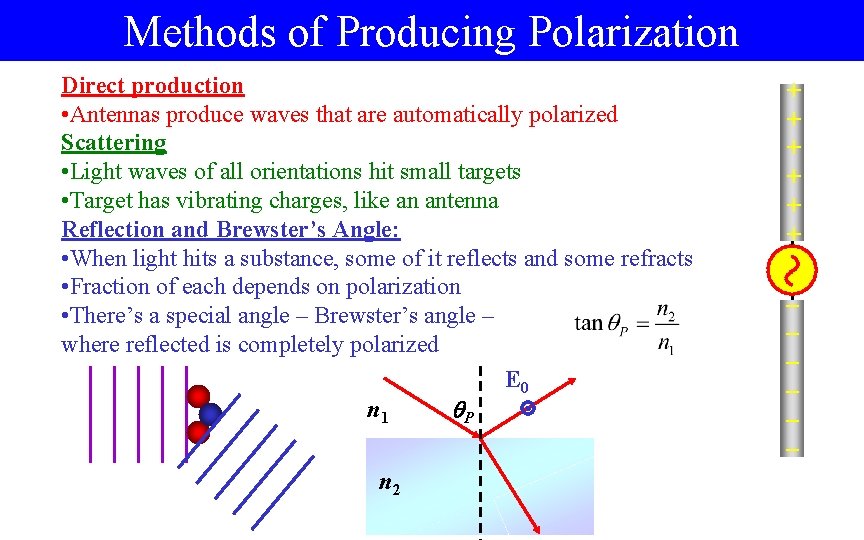
Methods of Producing Polarization Direct production • Antennas produce waves that are automatically polarized Scattering • Light waves of all orientations hit small targets • Target has vibrating charges, like an antenna Reflection and Brewster’s Angle: • When light hits a substance, some of it reflects and some refracts • Fraction of each depends on polarization • There’s a special angle – Brewster’s angle – where reflected is completely polarized E 0 n 1 P n 2 + + + – – –
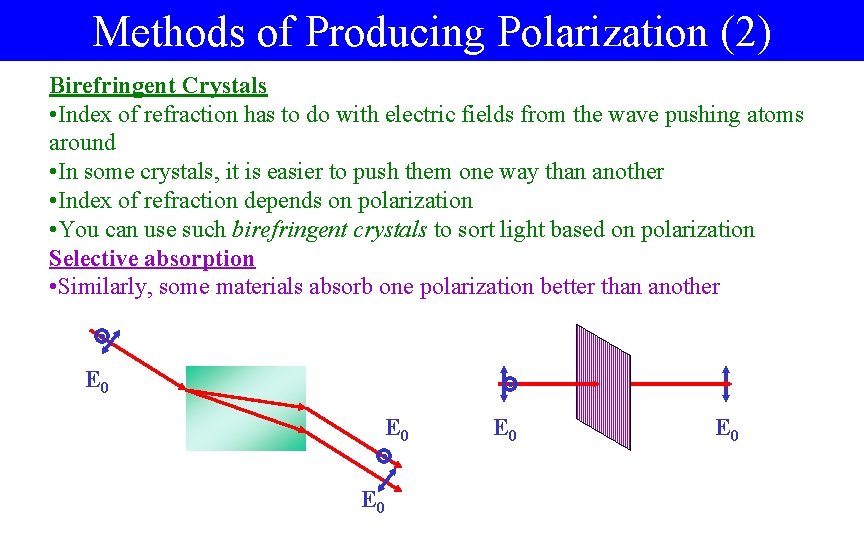
Methods of Producing Polarization (2) Birefringent Crystals • Index of refraction has to do with electric fields from the wave pushing atoms around • In some crystals, it is easier to push them one way than another • Index of refraction depends on polarization • You can use such birefringent crystals to sort light based on polarization Selective absorption • Similarly, some materials absorb one polarization better than another E 0 E 0 E 0
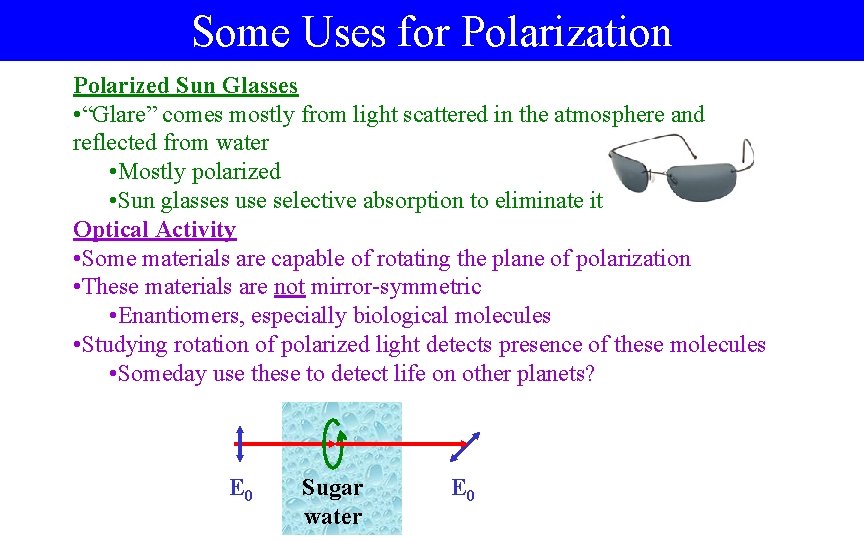
Some Uses for Polarization Polarized Sun Glasses • “Glare” comes mostly from light scattered in the atmosphere and reflected from water • Mostly polarized • Sun glasses use selective absorption to eliminate it Optical Activity • Some materials are capable of rotating the plane of polarization • These materials are not mirror-symmetric • Enantiomers, especially biological molecules • Studying rotation of polarized light detects presence of these molecules • Someday use these to detect life on other planets? E 0 Sugar water E 0