Geometric Optics A PHY 2054 Chapter 25 A

- Slides: 40
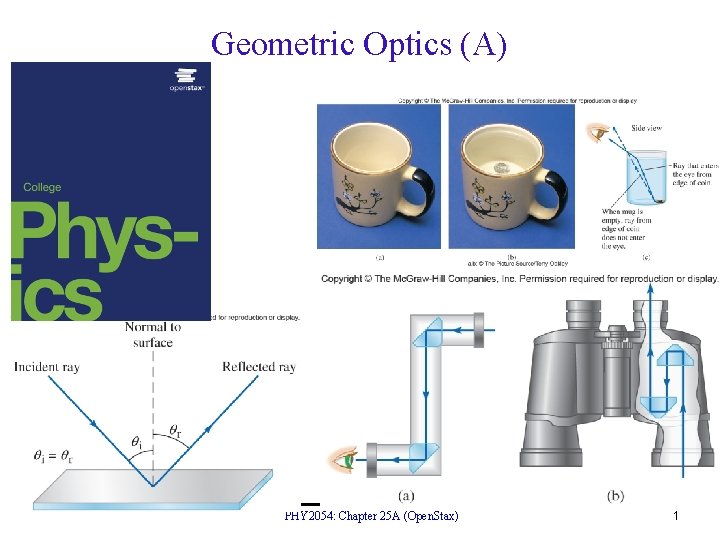
Geometric Optics (A) PHY 2054: Chapter 25 A (Open. Stax) 1
Chapter 25 Contents 1. The ray aspect of light 2. Reflection of light 3. Refraction of light: Snell’s law 4. Total internal reflection 5. Dispersion: Rainbows and lenses 6. Images from lenses 7. Images from mirrors Will do in opposite order PHY 2054: Chapter 25 A (Open. Stax) 2
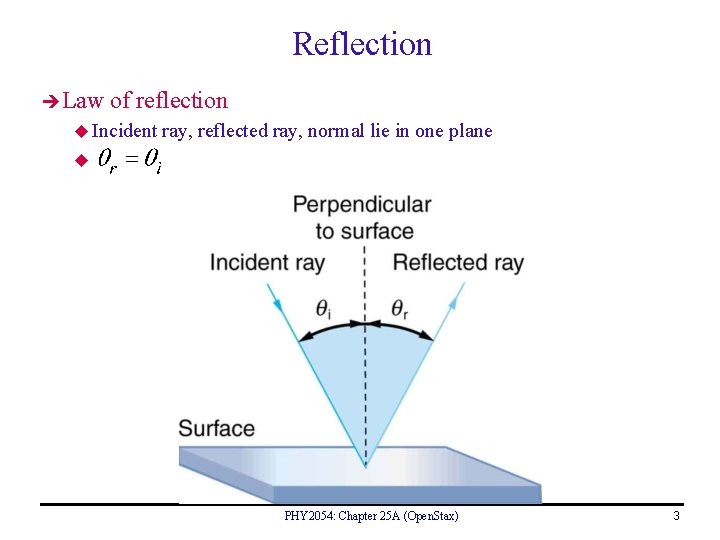
Reflection èLaw of reflection u Incident ray, reflected ray, normal lie in one plane u PHY 2054: Chapter 25 A (Open. Stax) 3
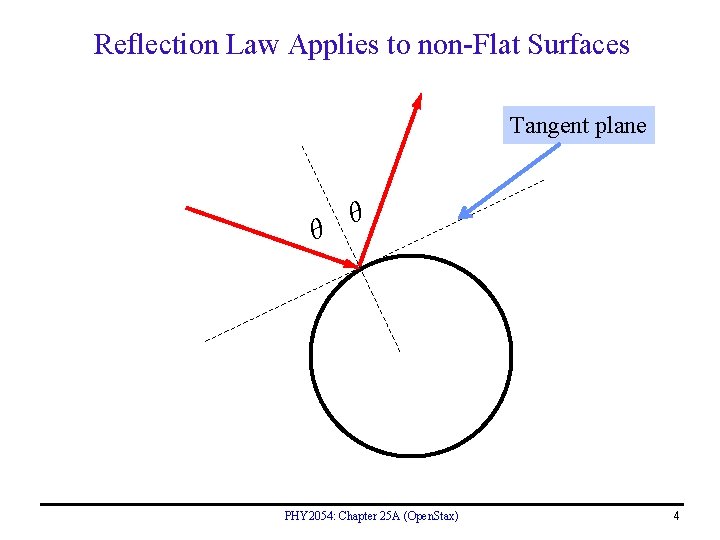
Reflection Law Applies to non-Flat Surfaces Tangent plane θ θ PHY 2054: Chapter 25 A (Open. Stax) 4
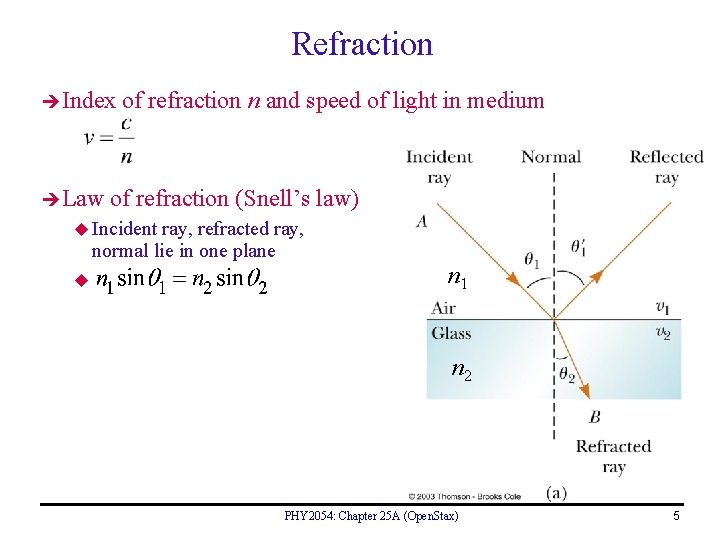
Refraction èIndex èLaw of refraction n and speed of light in medium of refraction (Snell’s law) u Incident ray, refracted ray, normal lie in one plane u n 1 n 2 PHY 2054: Chapter 25 A (Open. Stax) 5
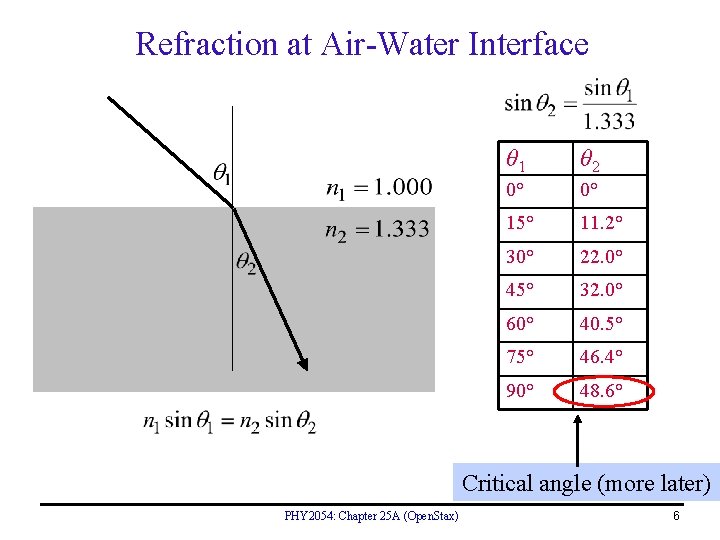
Refraction at Air-Water Interface θ 1 θ 2 0° 0° 15° 11. 2° 30° 22. 0° 45° 32. 0° 60° 40. 5° 75° 46. 4° 90° 48. 6° Critical angle (more later) PHY 2054: Chapter 25 A (Open. Stax) 6
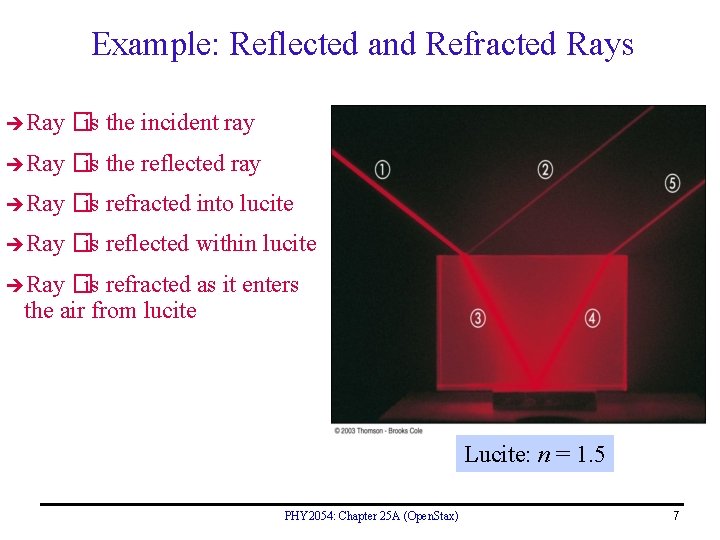
Example: Reflected and Refracted Rays èRay �is the incident ray èRay �is the reflected ray èRay �is refracted into lucite èRay �is reflected within lucite èRay �is refracted as it enters the air from lucite Lucite: n = 1. 5 PHY 2054: Chapter 25 A (Open. Stax) 7
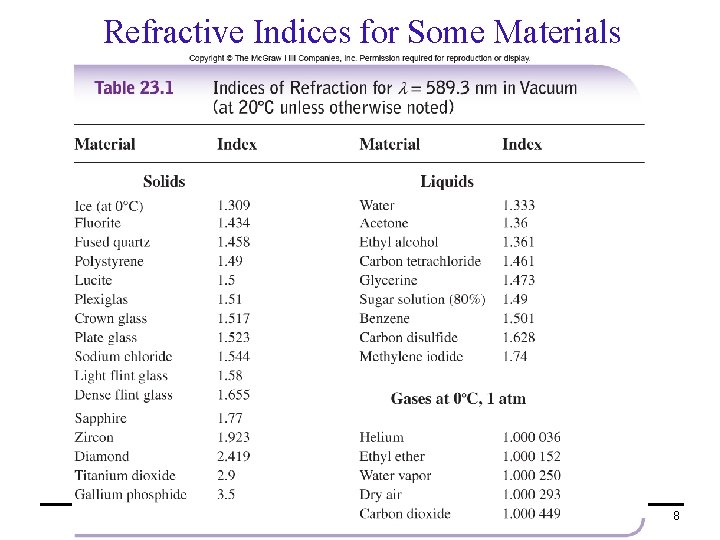
Refractive Indices for Some Materials PHY 2054: Chapter 25 A (Open. Stax) 8
Chapter Quiz èSnell’s Law describes: u (a) Huygens’ construction u (b) Magnification u (c) Reflection u (d) Refraction PHY 2054: Chapter 25 A (Open. Stax) 9
Chapter Quiz èSnell’s Law describes: u (a) Huygens’ construction u (b) Magnification u (c) Reflection u (d) Refraction PHY 2054: Chapter 25 A (Open. Stax) 10
Chapter Quiz èFor refracted light rays, the angle of refraction: u (a) is always equal to the incident angle u (b) is always greater than the incident angle u (c) is always less than the incident angle u (d) is always equal to the critical angle u (e) can be less than, greater than, or equal to angle of incidence PHY 2054: Chapter 25 A (Open. Stax) 11
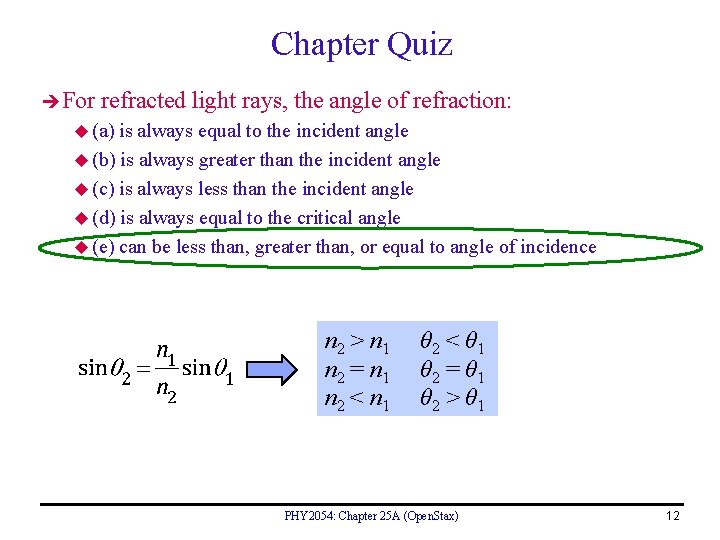
Chapter Quiz èFor refracted light rays, the angle of refraction: u (a) is always equal to the incident angle u (b) is always greater than the incident angle u (c) is always less than the incident angle u (d) is always equal to the critical angle u (e) can be less than, greater than, or equal to angle of incidence n 2 > n 1 n 2 = n 1 n 2 < n 1 θ 2 < θ 1 θ 2 = θ 1 θ 2 > θ 1 PHY 2054: Chapter 25 A (Open. Stax) 12
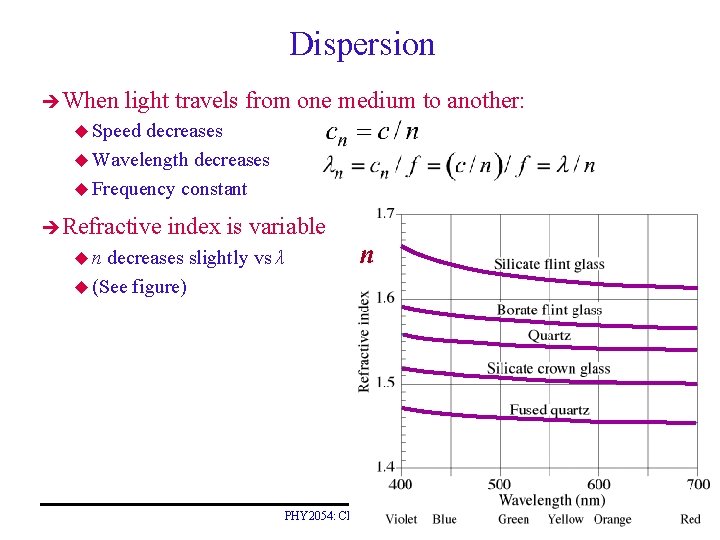
Dispersion èWhen light travels from one medium to another: u Speed decreases u Wavelength decreases u Frequency constant èRefractive un index is variable decreases slightly vs λ u (See figure) n PHY 2054: Chapter 25 A (Open. Stax) 13
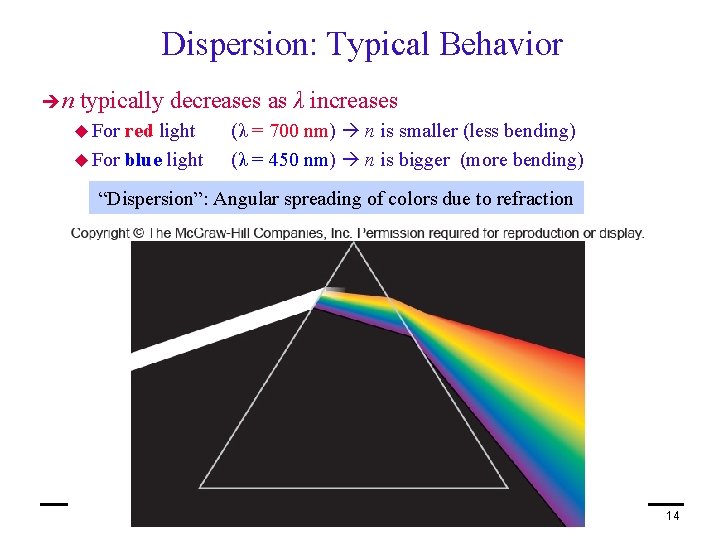
Dispersion: Typical Behavior èn typically decreases as λ increases u For red light u For blue light (λ = 700 nm) n is smaller (less bending) (λ = 450 nm) n is bigger (more bending) “Dispersion”: Angular spreading of colors due to refraction PHY 2054: Chapter 25 A (Open. Stax) 14
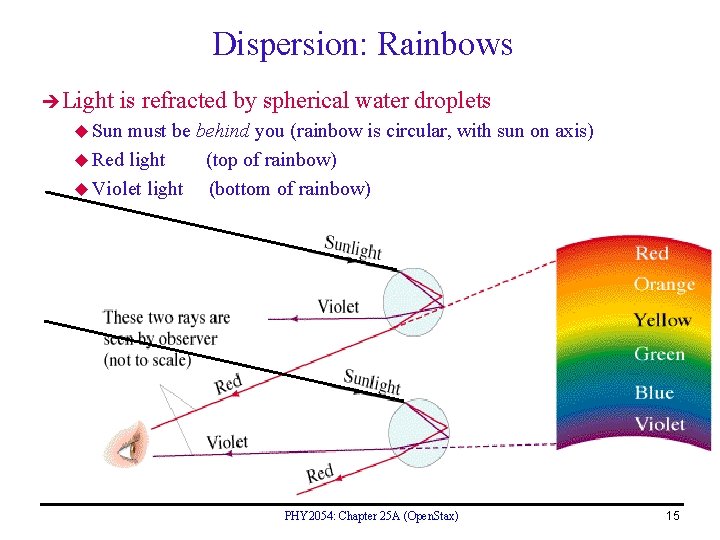
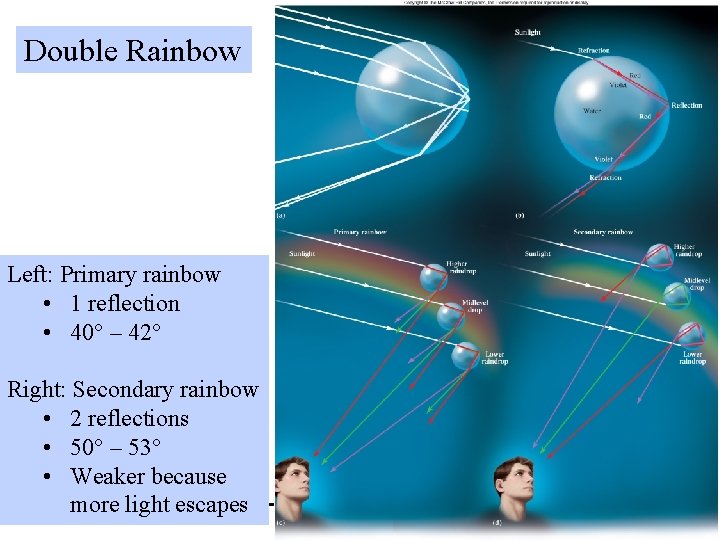
Dispersion: Rainbows èLight is refracted by spherical water droplets u Sun must be behind you (rainbow is circular, with sun on axis) u Red light (top of rainbow) u Violet light (bottom of rainbow) PHY 2054: Chapter 25 A (Open. Stax) 15
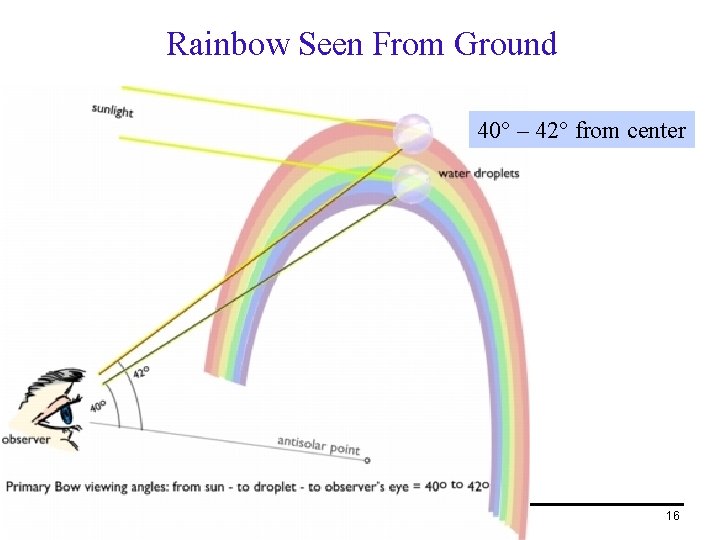
Rainbow Seen From Ground 40° – 42° from center PHY 2054: Chapter 25 A (Open. Stax) 16
Double Rainbow! PHY 2054: Chapter 25 A (Open. Stax) 17
Double Rainbow Left: Primary rainbow • 1 reflection • 40° – 42° Right: Secondary rainbow • 2 reflections • 50° – 53° • Weaker because more light escapes PHY 2054: Chapter 25 A (Open. Stax) 18
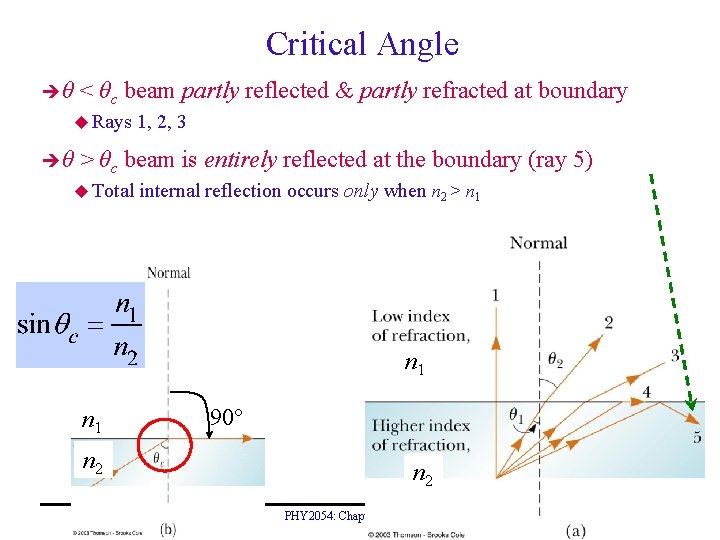
Critical Angle èθ < θc beam partly reflected & partly refracted at boundary u Rays èθ 1, 2, 3 > θc beam is entirely reflected at the boundary (ray 5) u Total internal reflection occurs only when n 2 > n 1 n 1 n 2 90° n 2 PHY 2054: Chapter 25 A (Open. Stax) 19
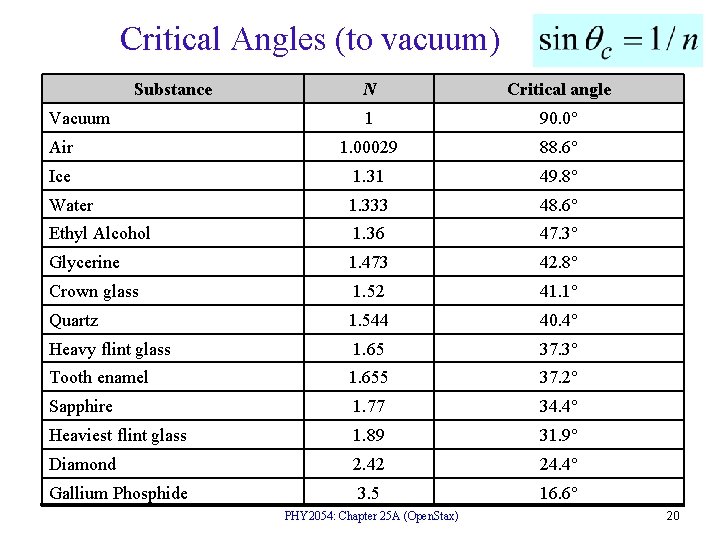
Critical Angles (to vacuum) Substance N Critical angle 1 90. 0° Air 1. 00029 88. 6° Ice 1. 31 49. 8° Water 1. 333 48. 6° Ethyl Alcohol 1. 36 47. 3° Glycerine 1. 473 42. 8° Crown glass 1. 52 41. 1° Quartz 1. 544 40. 4° Heavy flint glass 1. 65 37. 3° Tooth enamel 1. 655 37. 2° Sapphire 1. 77 34. 4° Heaviest flint glass 1. 89 31. 9° Diamond 2. 42 24. 4° Gallium Phosphide 3. 5 16. 6° Vacuum PHY 2054: Chapter 25 A (Open. Stax) 20
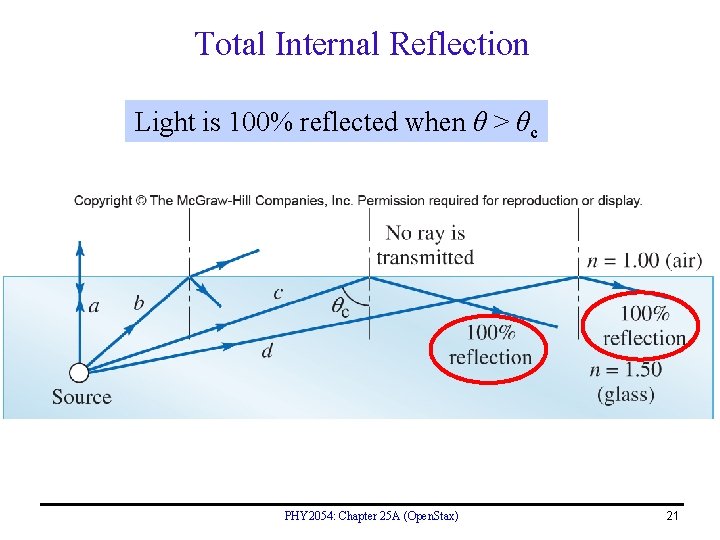
Total Internal Reflection Light is 100% reflected when θ > θc PHY 2054: Chapter 25 A (Open. Stax) 21
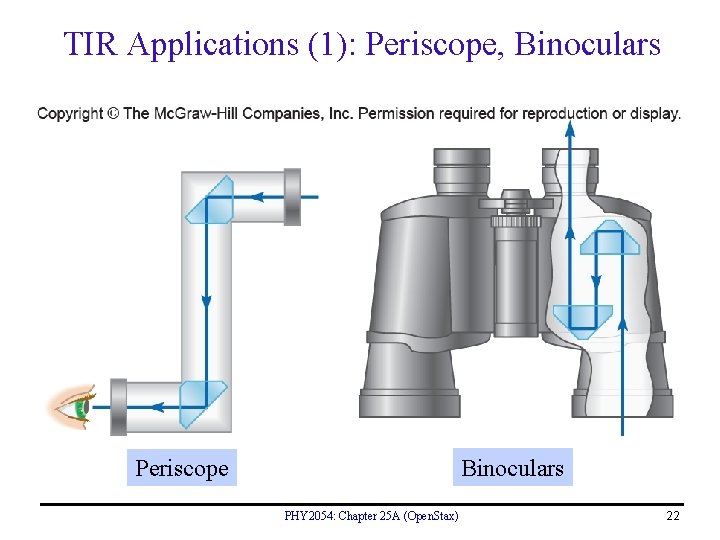
TIR Applications (1): Periscope, Binoculars Periscope PHY 2054: Chapter 25 A (Open. Stax) 22
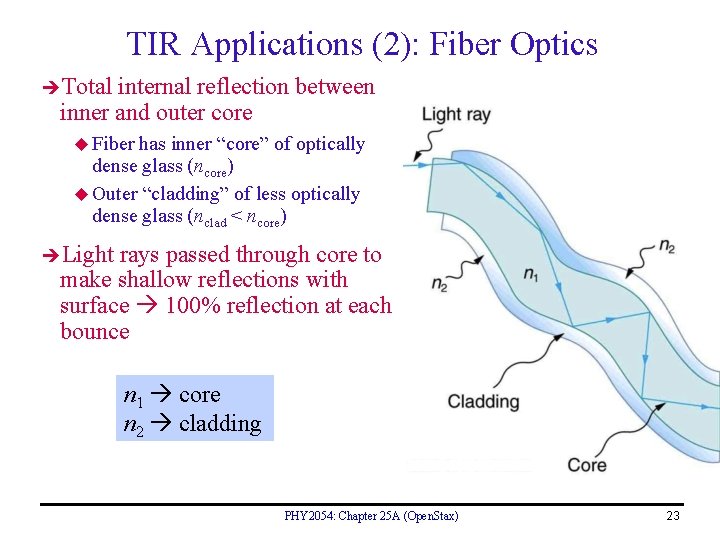
TIR Applications (2): Fiber Optics èTotal internal reflection between inner and outer core u Fiber has inner “core” of optically dense glass (ncore) u Outer “cladding” of less optically dense glass (nclad < ncore) èLight rays passed through core to make shallow reflections with surface 100% reflection at each bounce n 1 core n 2 cladding PHY 2054: Chapter 25 A (Open. Stax) 23
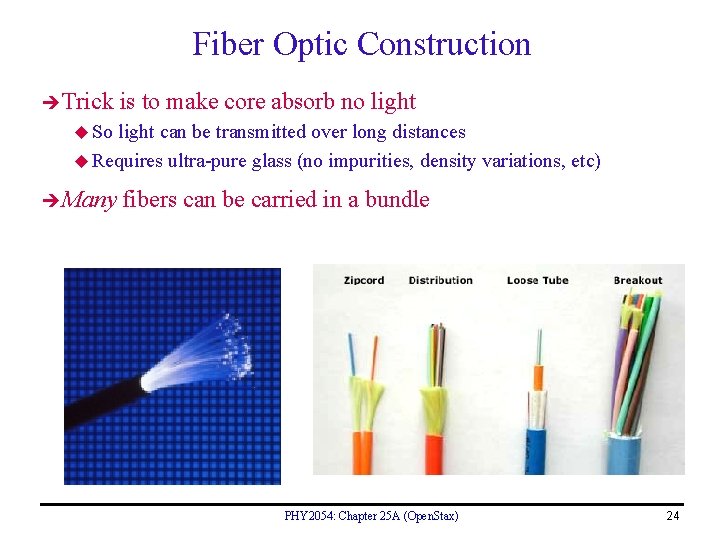
Fiber Optic Construction èTrick is to make core absorb no light u So light can be transmitted over long distances u Requires ultra-pure glass (no impurities, density variations, etc) èMany fibers can be carried in a bundle PHY 2054: Chapter 25 A (Open. Stax) 24
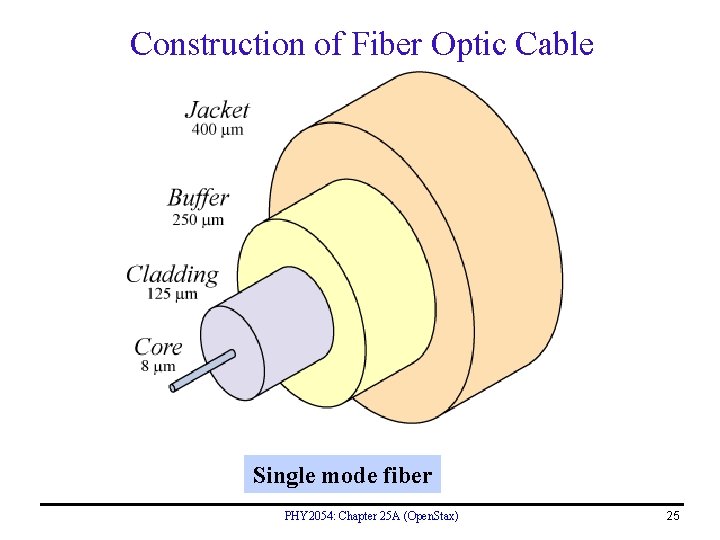
Construction of Fiber Optic Cable Single mode fiber PHY 2054: Chapter 25 A (Open. Stax) 25
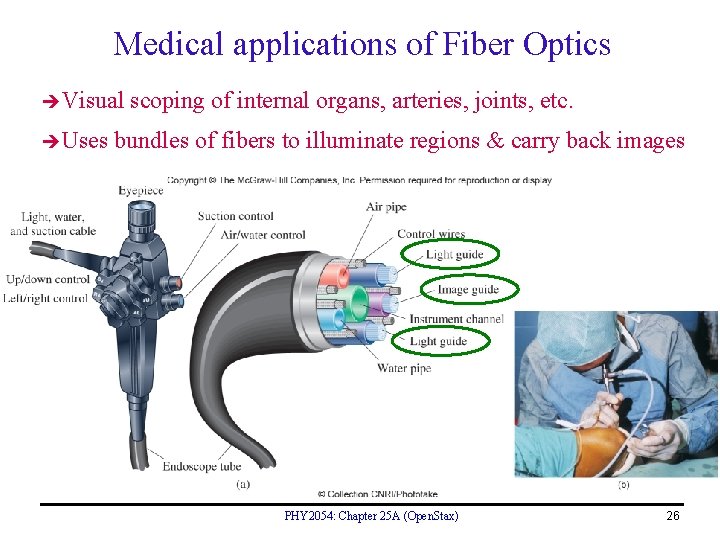
Medical applications of Fiber Optics èVisual èUses scoping of internal organs, arteries, joints, etc. bundles of fibers to illuminate regions & carry back images PHY 2054: Chapter 25 A (Open. Stax) 26
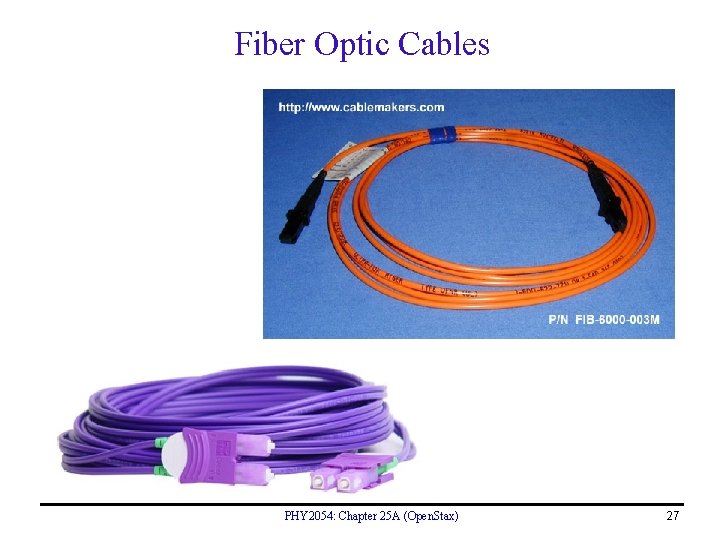
Fiber Optic Cables PHY 2054: Chapter 25 A (Open. Stax) 27
Communications Applications èOptical fibers can carry digital information u Telephone, èHigh local networks, Internet frequency of light high rate of information transfer u Very high “bandwidth”, several Terabits/s over single fiber! u This is what makes the internet possible (data, xfer, video streaming, etc) èSignals u Not can travel ~ 100 km before needing boost susceptible to electrical noise èReplacing copper wires for long distance communication PHY 2054: Chapter 25 A (Open. Stax) 28
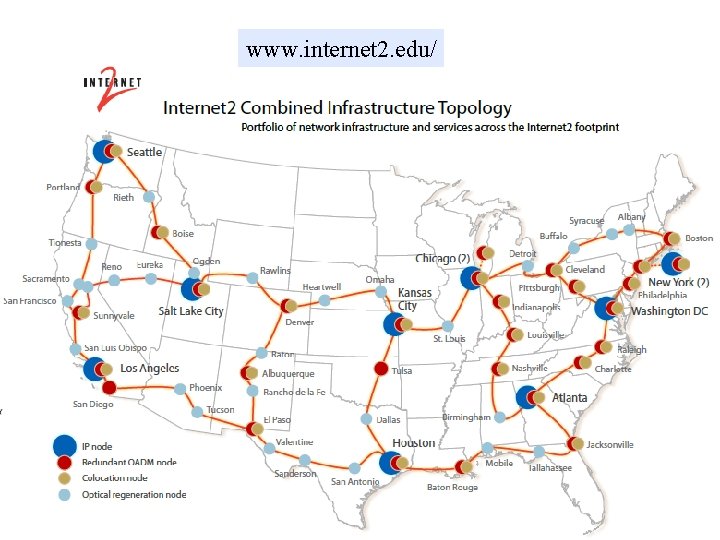
www. internet 2. edu/ PHY 2054: Chapter 25 A (Open. Stax) 29
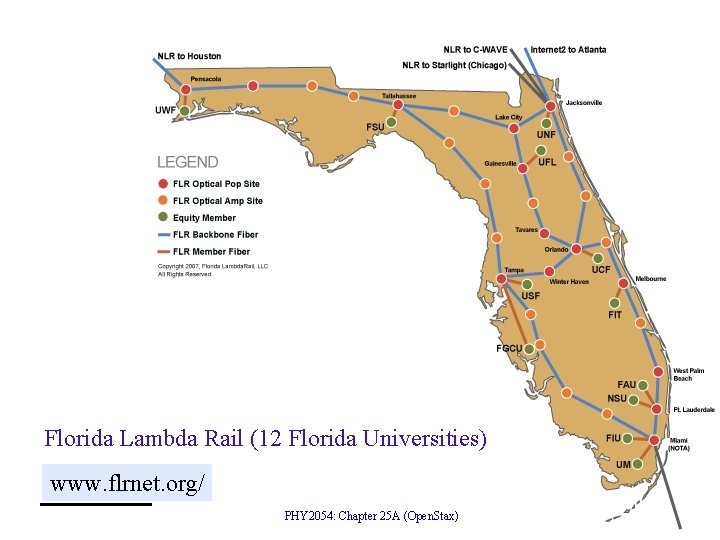
Florida Lambda Rail (12 Florida Universities) www. flrnet. org/ PHY 2054: Chapter 25 A (Open. Stax) 30
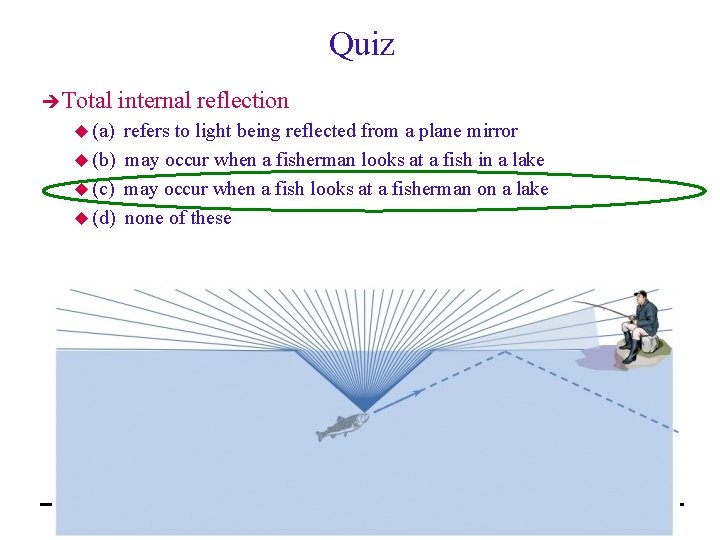
Quiz èTotal internal reflection u (a) refers to light being reflected from a plane mirror u (b) may occur when a fisherman looks at a fish in a lake u (c) may occur when a fish looks at a fisherman on a lake u (d) none of these PHY 2054: Chapter 25 A (Open. Stax) 31
Quiz èTotal internal reflection u (a) refers to light being reflected from a plane mirror u (b) may occur when a fisherman looks at a fish in a lake u (c) may occur when a fish looks at a fisherman on a lake u (d) none of these PHY 2054: Chapter 25 A (Open. Stax) 32
Extra Slides PHY 2054: Chapter 25 A (Open. Stax) 33
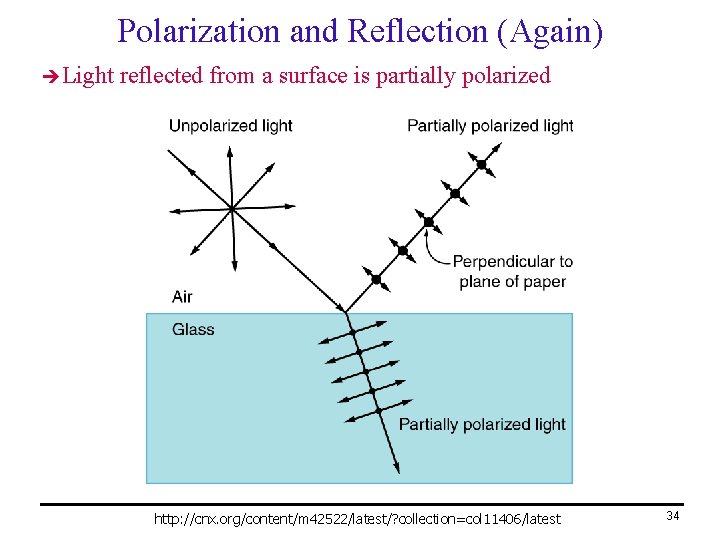
Polarization and Reflection (Again) èLight reflected from a surface is partially polarized PHY 2054: Chapter 25 A (Open. Stax) http: //cnx. org/content/m 42522/latest/? collection=col 11406/latest 34
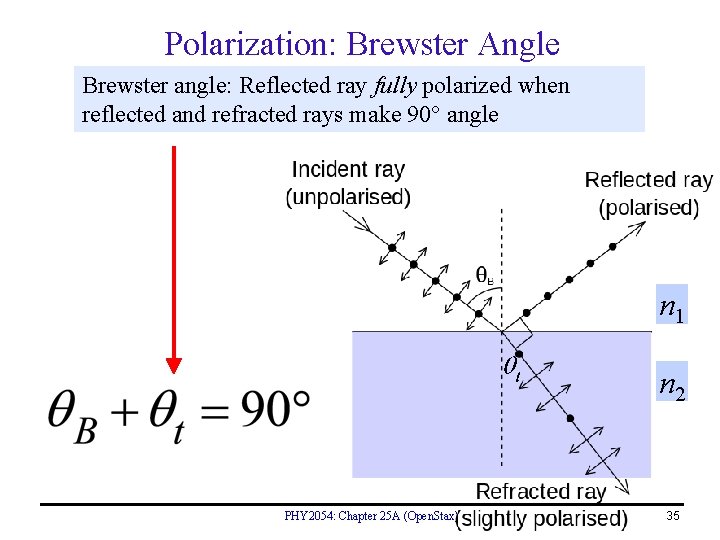
Polarization: Brewster Angle Brewster angle: Reflected ray fully polarized when reflected and refracted rays make 90° angle n 1 n 2 PHY 2054: Chapter 25 A (Open. Stax) 35
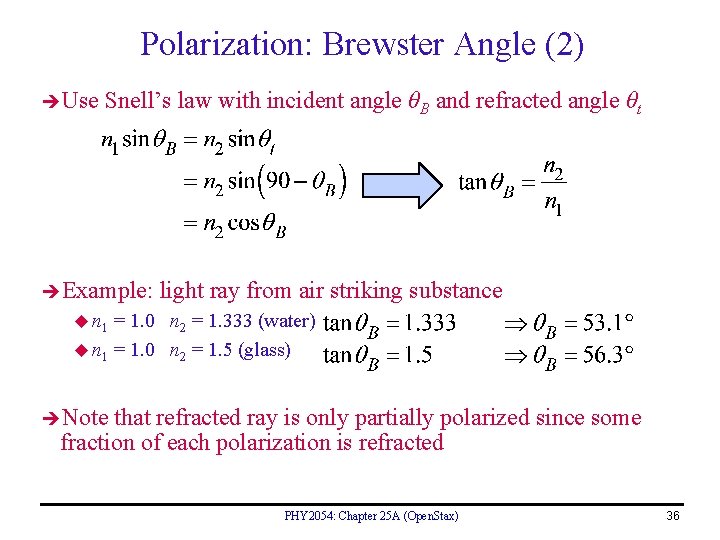
Polarization: Brewster Angle (2) èUse Snell’s law with incident angle θB and refracted angle θt èExample: light ray from air striking substance u n 1 = 1. 0 n 2 = 1. 333 (water) u n 1 = 1. 0 n 2 = 1. 5 (glass) èNote that refracted ray is only partially polarized since some fraction of each polarization is refracted PHY 2054: Chapter 25 A (Open. Stax) 36
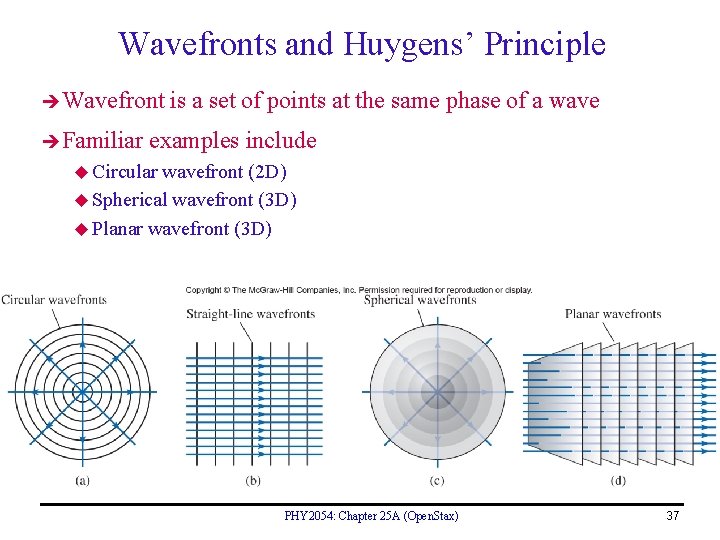
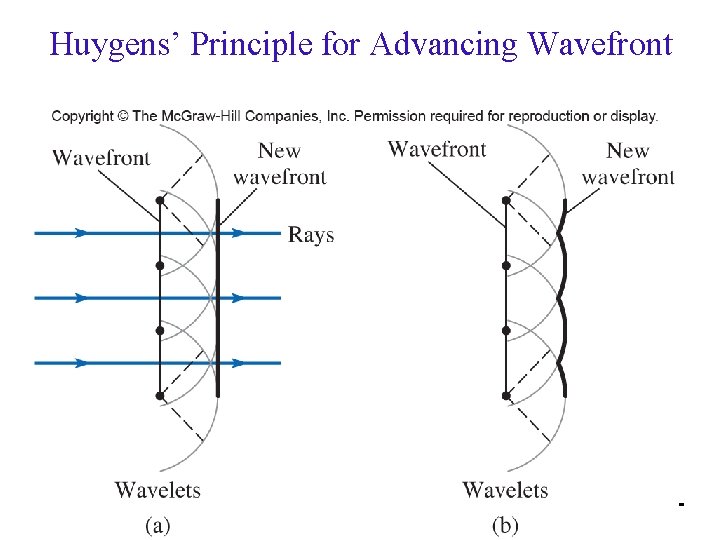
Wavefronts and Huygens’ Principle èWavefront èFamiliar is a set of points at the same phase of a wave examples include u Circular wavefront (2 D) u Spherical wavefront (3 D) u Planar wavefront (3 D) PHY 2054: Chapter 25 A (Open. Stax) 37
Huygens’ Principle for Advancing Wavefront PHY 2054: Chapter 25 A (Open. Stax) 38
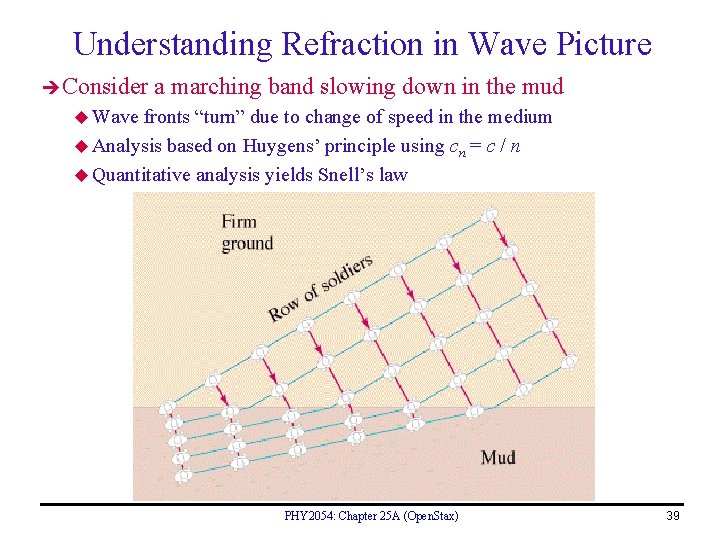
Understanding Refraction in Wave Picture èConsider a marching band slowing down in the mud u Wave fronts “turn” due to change of speed in the medium u Analysis based on Huygens’ principle using cn = c / n u Quantitative analysis yields Snell’s law PHY 2054: Chapter 25 A (Open. Stax) 39
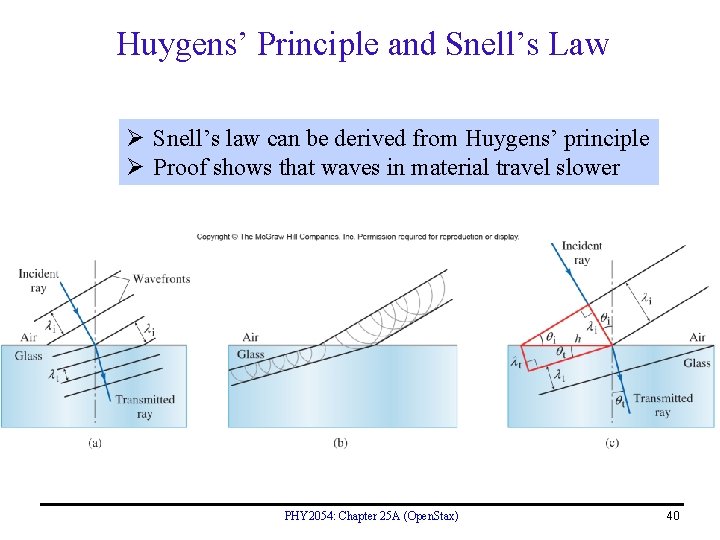
Huygens’ Principle and Snell’s Law Ø Snell’s law can be derived from Huygens’ principle Ø Proof shows that waves in material travel slower PHY 2054: Chapter 25 A (Open. Stax) 40