INTERACTION of LIKEKIND EXCHANGES and COST SEGREGATION STUDIES
- Slides: 28
INTERACTION of LIKE-KIND EXCHANGES and COST SEGREGATION STUDIES John Hoffman, Baker Tilly Capital, LLC Joyce Welch, Deloitte Tax LLP
Agenda • • Introduction Like-Kind Exchange Basics Cost Segregation and LKE Deferred Gain Examples How to Depreciate LKE Property Risks Associated with Cost Segs on 1031 Property Questions
Speakers John P. Hoffman, CPA Baker Tilly Capital, LLC Director • Specializes in real estate and fixed asset tax consulting including credits and incentives • Leadership roles in historic tax credits and cost segregation • Past President of ASCSP Joyce L. Welch Managing Director Deloitte Tax LLP Washington National Tax • Specializes in like-kind exchanges and other tax deferral property transactions • Over 25 years of tax planning experience • Member of American Institute of Certified Public Accountants
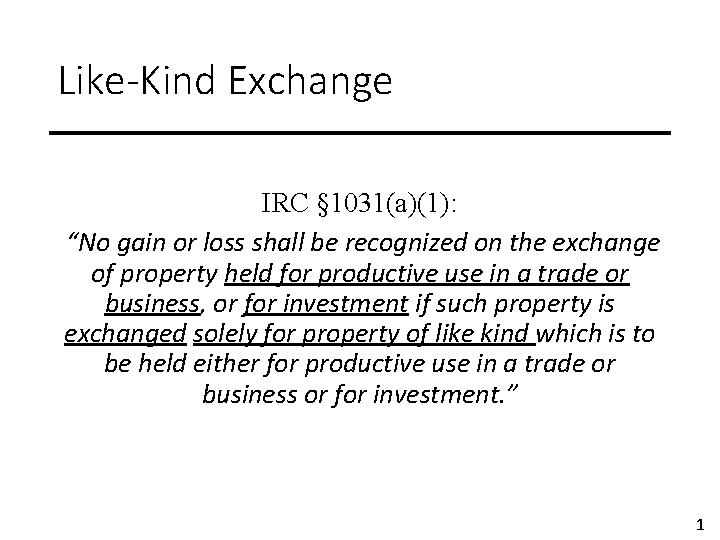
Like-Kind Exchange IRC § 1031(a)(1): “No gain or loss shall be recognized on the exchange of property held for productive use in a trade or business, or for investment if such property is exchanged solely for property of like kind which is to be held either for productive use in a trade or business or for investment. ” 1
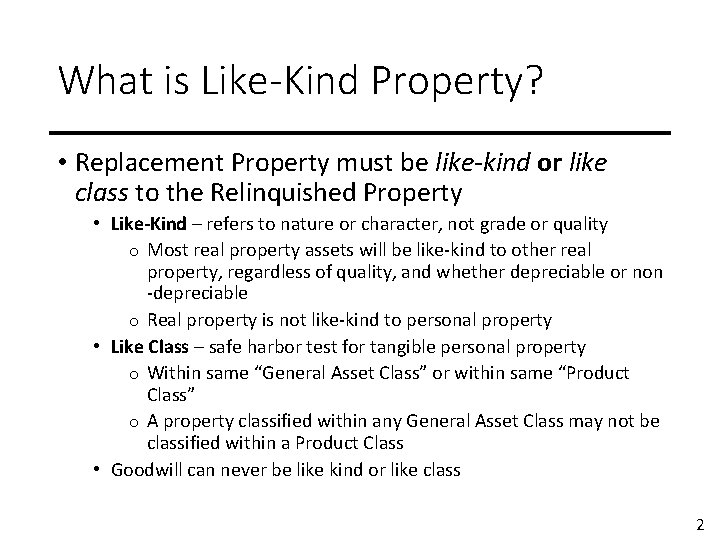
What is Like-Kind Property? • Replacement Property must be like-kind or like class to the Relinquished Property • Like-Kind – refers to nature or character, not grade or quality o Most real property assets will be like-kind to other real property, regardless of quality, and whether depreciable or non -depreciable o Real property is not like-kind to personal property • Like Class – safe harbor test for tangible personal property o Within same “General Asset Class” or within same “Product Class” o A property classified within any General Asset Class may not be classified within a Product Class • Goodwill can never be like kind or like class 2
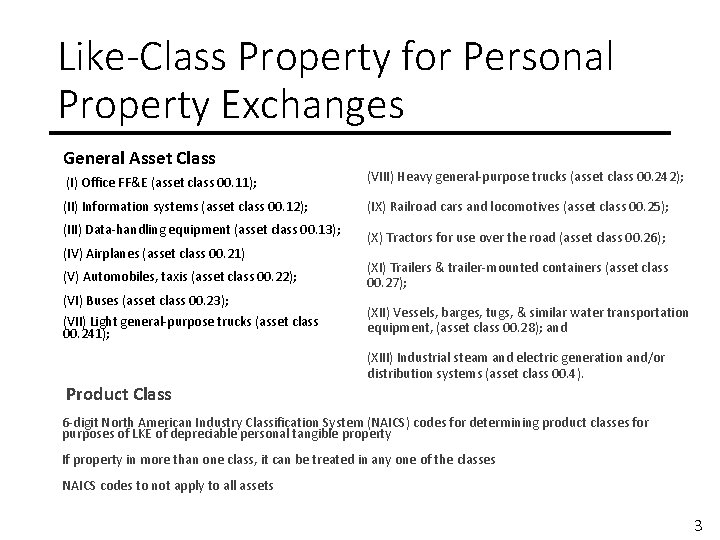
Like-Class Property for Personal Property Exchanges General Asset Class (I) Office FF&E (asset class 00. 11); (VIII) Heavy general-purpose trucks (asset class 00. 242); (II) Information systems (asset class 00. 12); (IX) Railroad cars and locomotives (asset class 00. 25); (III) Data-handling equipment (asset class 00. 13); (IV) Airplanes (asset class 00. 21) (V) Automobiles, taxis (asset class 00. 22); (VI) Buses (asset class 00. 23); (VII) Light general-purpose trucks (asset class 00. 241); (X) Tractors for use over the road (asset class 00. 26); (XI) Trailers & trailer-mounted containers (asset class 00. 27); (XII) Vessels, barges, tugs, & similar water transportation equipment, (asset class 00. 28); and (XIII) Industrial steam and electric generation and/or distribution systems (asset class 00. 4). Product Class 6 -digit North American Industry Classification System (NAICS) codes for determining product classes for purposes of LKE of depreciable personal tangible property If property in more than one class, it can be treated in any one of the classes NAICS codes to not apply to all assets 3
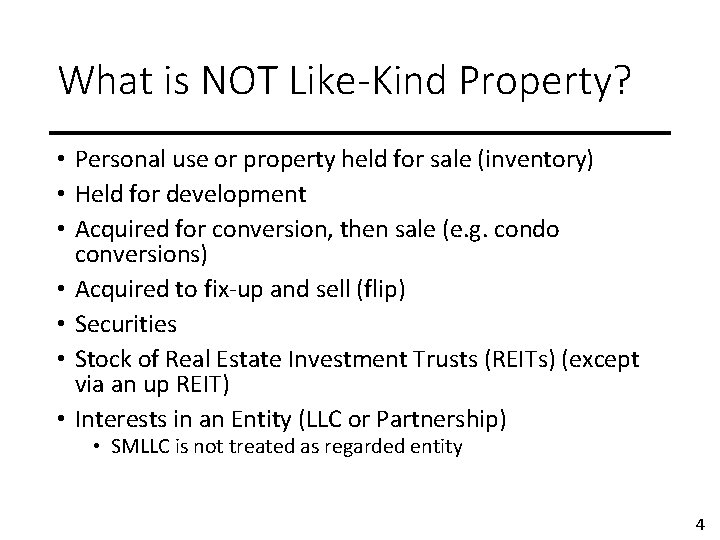
What is NOT Like-Kind Property? • Personal use or property held for sale (inventory) • Held for development • Acquired for conversion, then sale (e. g. condo conversions) • Acquired to fix-up and sell (flip) • Securities • Stock of Real Estate Investment Trusts (REITs) (except via an up REIT) • Interests in an Entity (LLC or Partnership) • SMLLC is not treated as regarded entity 4
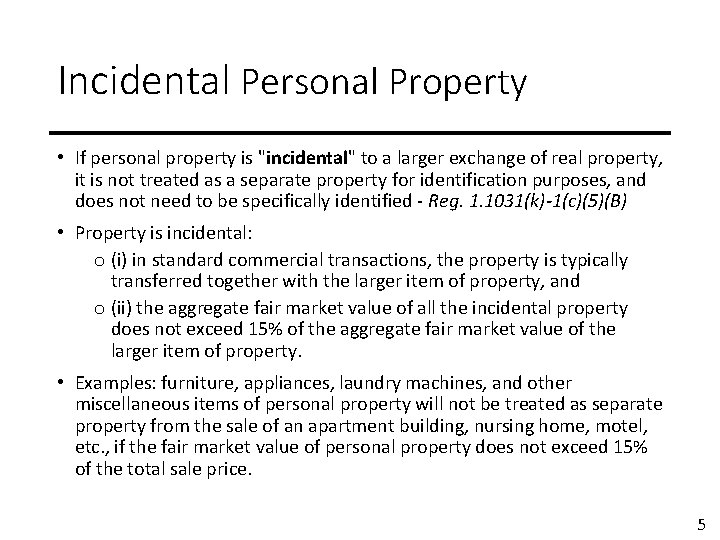
Incidental Personal Property • If personal property is "incidental" to a larger exchange of real property, it is not treated as a separate property for identification purposes, and does not need to be specifically identified - Reg. 1. 1031(k)-1(c)(5)(B) • Property is incidental: o (i) in standard commercial transactions, the property is typically transferred together with the larger item of property, and o (ii) the aggregate fair market value of all the incidental property does not exceed 15% of the aggregate fair market value of the larger item of property. • Examples: furniture, appliances, laundry machines, and other miscellaneous items of personal property will not be treated as separate property from the sale of an apartment building, nursing home, motel, etc. , if the fair market value of personal property does not exceed 15% of the total sale price. 5
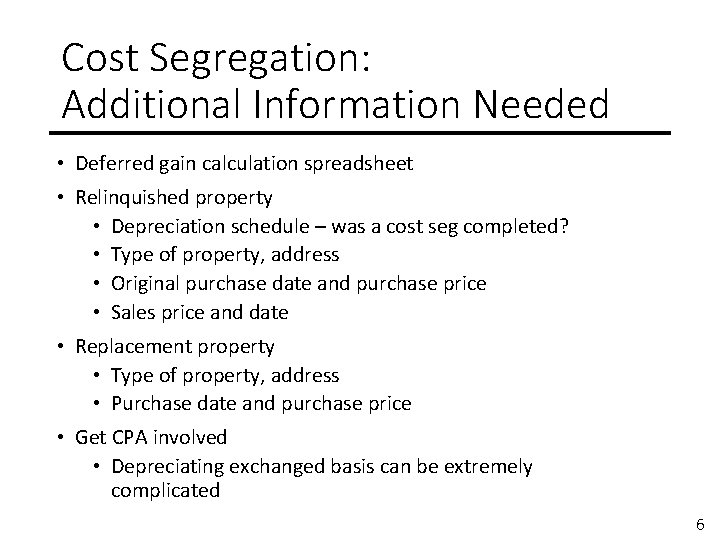
Cost Segregation: Additional Information Needed • Deferred gain calculation spreadsheet • Relinquished property • Depreciation schedule – was a cost seg completed? • Type of property, address • Original purchase date and purchase price • Sales price and date • Replacement property • Type of property, address • Purchase date and purchase price • Get CPA involved • Depreciating exchanged basis can be extremely complicated 6
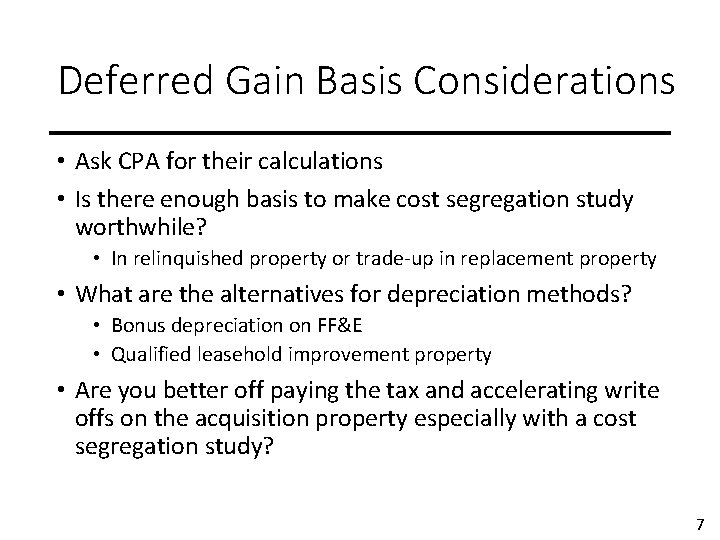
Deferred Gain Basis Considerations • Ask CPA for their calculations • Is there enough basis to make cost segregation study worthwhile? • In relinquished property or trade-up in replacement property • What are the alternatives for depreciation methods? • Bonus depreciation on FF&E • Qualified leasehold improvement property • Are you better off paying the tax and accelerating write offs on the acquisition property especially with a cost segregation study? 7
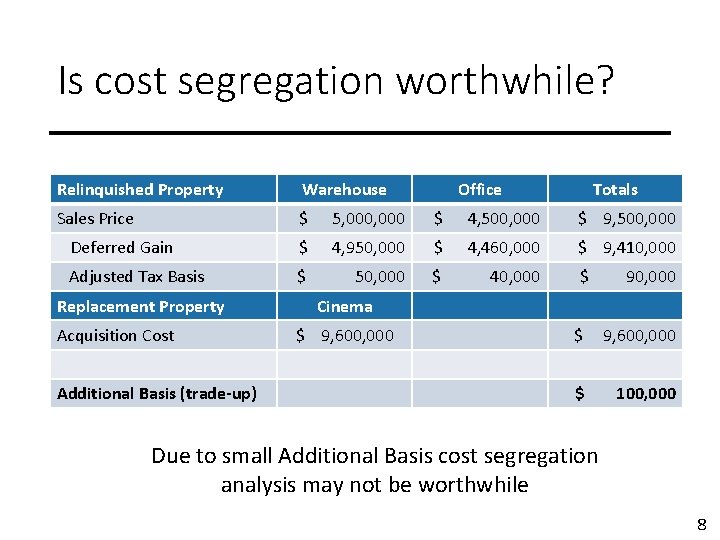
Is cost segregation worthwhile? Relinquished Property Warehouse Sales Price $ 5, 000 $ 4, 500, 000 $ 9, 500, 000 Deferred Gain $ 4, 950, 000 $ 4, 460, 000 $ 9, 410, 000 Adjusted Tax Basis $ 50, 000 $ 40, 000 Replacement Property Acquisition Cost Additional Basis (trade-up) Office Totals $ 90, 000 Cinema $ 9, 600, 000 $ 100, 000 Due to small Additional Basis cost segregation analysis may not be worthwhile 8
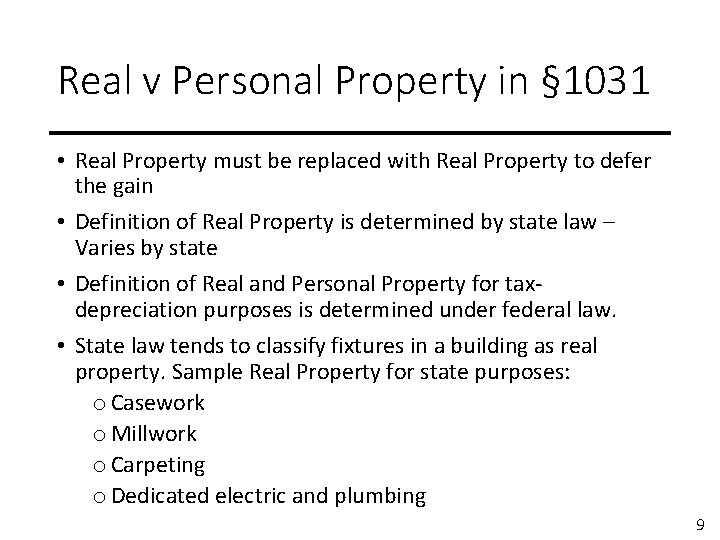
Real v Personal Property in § 1031 • Real Property must be replaced with Real Property to defer the gain • Definition of Real Property is determined by state law – Varies by state • Definition of Real and Personal Property for taxdepreciation purposes is determined under federal law. • State law tends to classify fixtures in a building as real property. Sample Real Property for state purposes: o Casework o Millwork o Carpeting o Dedicated electric and plumbing 9
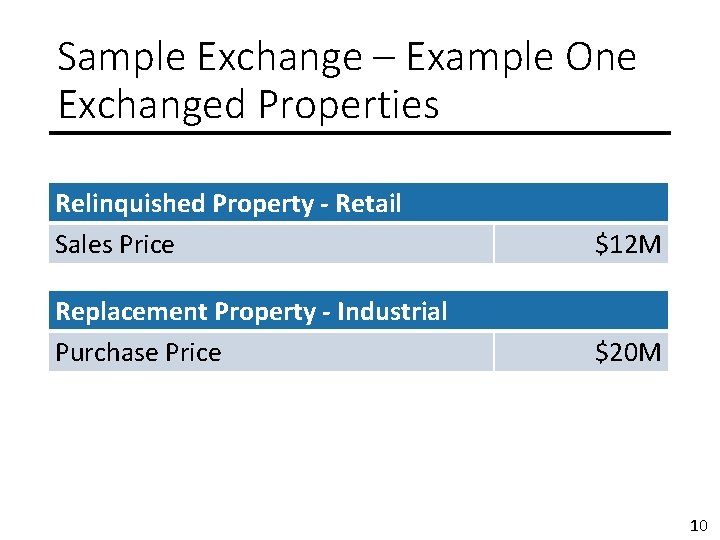
Sample Exchange – Example One Exchanged Properties Relinquished Property - Retail Sales Price $12 M Replacement Property - Industrial Purchase Price $20 M 10
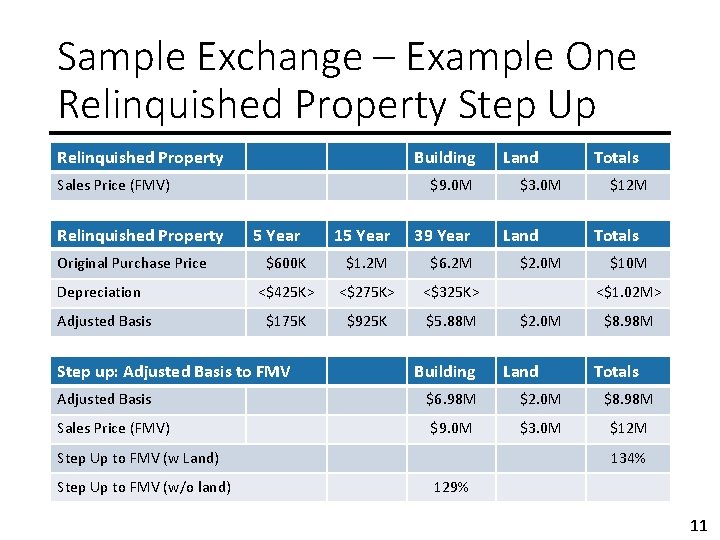
Sample Exchange – Example One Relinquished Property Step Up Relinquished Property Building Sales Price (FMV) Relinquished Property Original Purchase Price Depreciation Adjusted Basis $9. 0 M 5 Year 15 Year 39 Year $600 K $1. 2 M $6. 2 M <$425 K> <$275 K> <$325 K> $175 K $925 K $5. 88 M Step up: Adjusted Basis to FMV Building Land $3. 0 M Land $2. 0 M Totals $12 M Totals $10 M <$1. 02 M> $2. 0 M Land $8. 98 M Totals Adjusted Basis $6. 98 M $2. 0 M $8. 98 M Sales Price (FMV) $9. 0 M $3. 0 M $12 M Step Up to FMV (w Land) Step Up to FMV (w/o land) 134% 129% 11
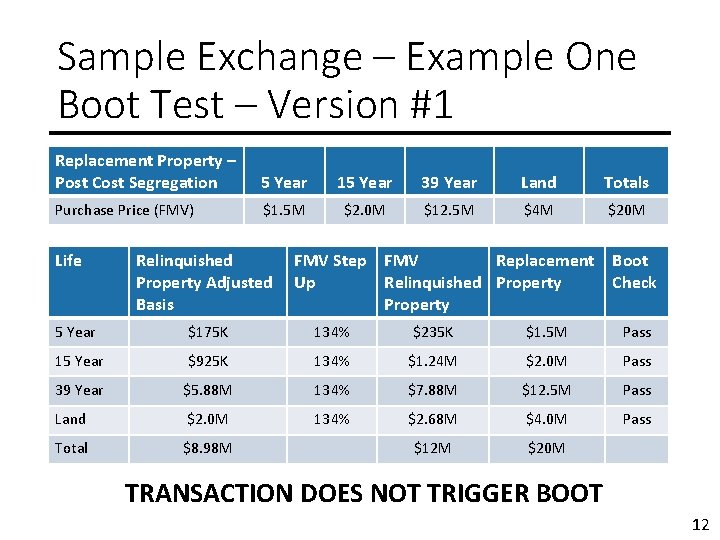
Sample Exchange – Example One Boot Test – Version #1 Replacement Property – Post Cost Segregation 5 Year 15 Year 39 Year Land Totals Purchase Price (FMV) $1. 5 M $2. 0 M $12. 5 M $4 M $20 M Life Relinquished FMV Step FMV Replacement Boot Property Adjusted Up Relinquished Property Check Basis Property 5 Year $175 K 134% $235 K $1. 5 M Pass 15 Year $925 K 134% $1. 24 M $2. 0 M Pass 39 Year $5. 88 M 134% $7. 88 M $12. 5 M Pass Land $2. 0 M 134% $2. 68 M $4. 0 M Pass Total $8. 98 M $12 M $20 M TRANSACTION DOES NOT TRIGGER BOOT 12
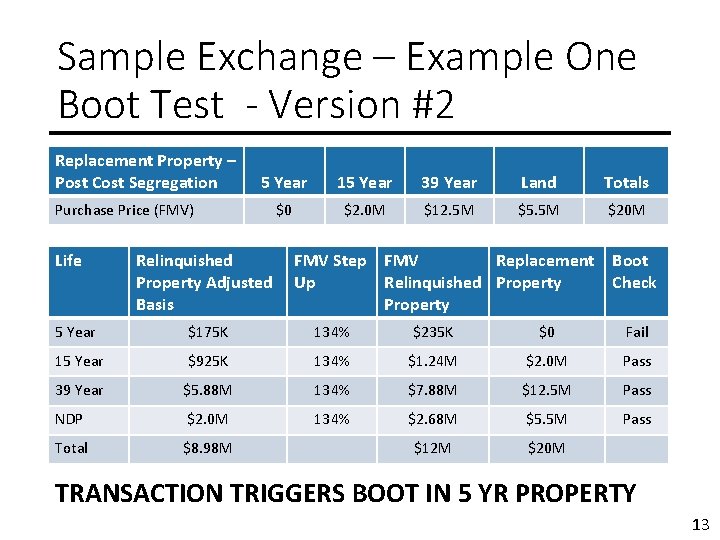
Sample Exchange – Example One Boot Test - Version #2 Replacement Property – Post Cost Segregation Purchase Price (FMV) Life 5 Year 15 Year 39 Year Land Totals $0 $2. 0 M $12. 5 M $5. 5 M $20 M Relinquished FMV Step FMV Replacement Boot Property Adjusted Up Relinquished Property Check Basis Property 5 Year $175 K 134% $235 K $0 Fail 15 Year $925 K 134% $1. 24 M $2. 0 M Pass 39 Year $5. 88 M 134% $7. 88 M $12. 5 M Pass NDP $2. 0 M 134% $2. 68 M $5. 5 M Pass Total $8. 98 M $12 M $20 M TRANSACTION TRIGGERS BOOT IN 5 YR PROPERTY 13
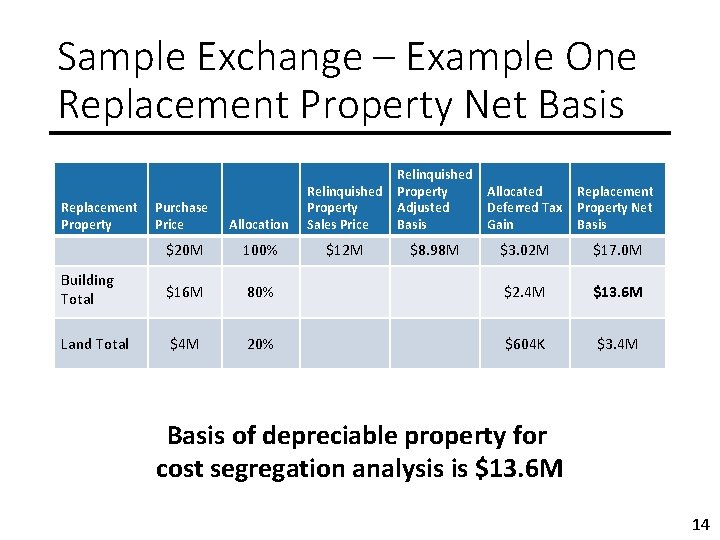
Sample Exchange – Example One Replacement Property Net Basis Replacement Property Purchase Price Allocation $20 M 100% Building Total $16 M Land Total $4 M Relinquished Property Allocated Replacement Adjusted Property Deferred Tax Property Net Basis Sales Price Gain Basis $12 M $8. 98 M $3. 02 M $17. 0 M 80% $2. 4 M $13. 6 M 20% $604 K $3. 4 M Basis of depreciable property for cost segregation analysis is $13. 6 M 14
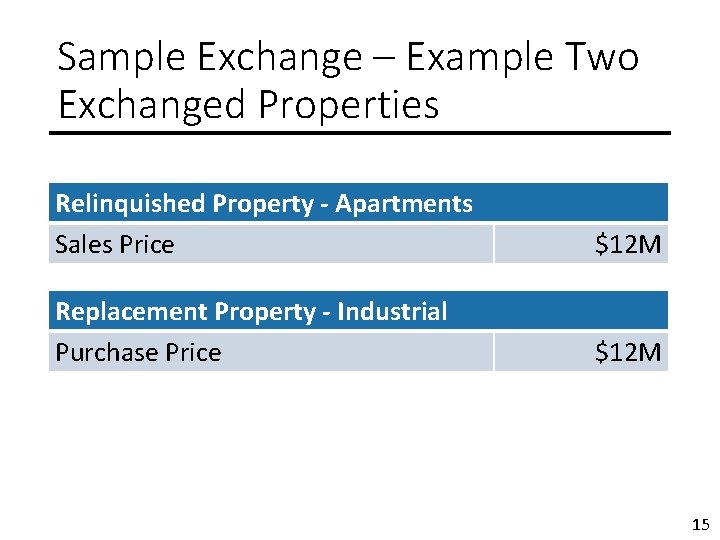
Sample Exchange – Example Two Exchanged Properties Relinquished Property - Apartments Sales Price $12 M Replacement Property - Industrial Purchase Price $12 M 15
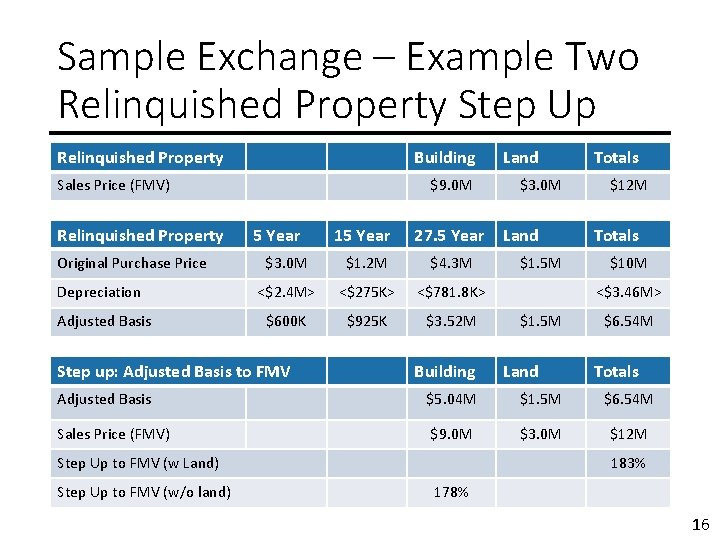
Sample Exchange – Example Two Relinquished Property Step Up Relinquished Property Building Sales Price (FMV) Relinquished Property Original Purchase Price Depreciation Adjusted Basis $9. 0 M 5 Year 15 Year 27. 5 Year $3. 0 M $1. 2 M $4. 3 M <$2. 4 M> <$275 K> <$781. 8 K> $600 K $925 K $3. 52 M Step up: Adjusted Basis to FMV Building Land $3. 0 M Land $1. 5 M Totals $12 M Totals $10 M <$3. 46 M> $1. 5 M Land $6. 54 M Totals Adjusted Basis $5. 04 M $1. 5 M $6. 54 M Sales Price (FMV) $9. 0 M $3. 0 M $12 M Step Up to FMV (w Land) Step Up to FMV (w/o land) 183% 178% 16
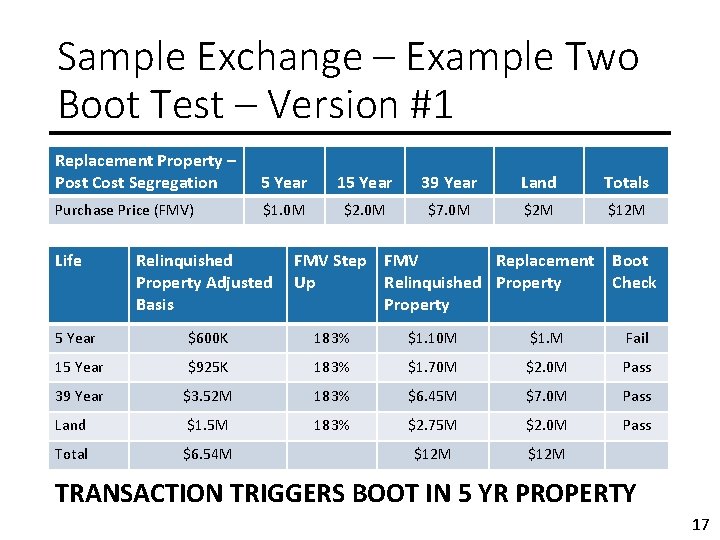
Sample Exchange – Example Two Boot Test – Version #1 Replacement Property – Post Cost Segregation 5 Year 15 Year 39 Year Land Totals Purchase Price (FMV) $1. 0 M $2. 0 M $7. 0 M $2 M $12 M Life Relinquished FMV Step FMV Replacement Boot Property Adjusted Up Relinquished Property Check Basis Property 5 Year $600 K 183% $1. 10 M $1. M Fail 15 Year $925 K 183% $1. 70 M $2. 0 M Pass 39 Year $3. 52 M 183% $6. 45 M $7. 0 M Pass Land $1. 5 M 183% $2. 75 M $2. 0 M Pass Total $6. 54 M $12 M TRANSACTION TRIGGERS BOOT IN 5 YR PROPERTY 17
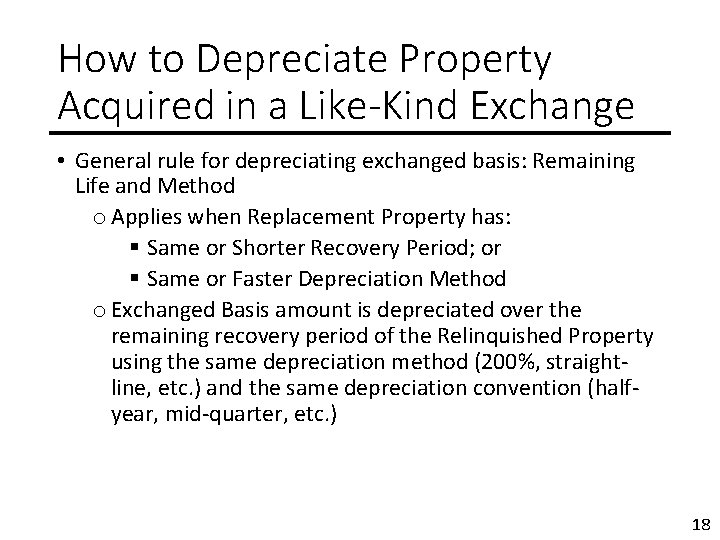
How to Depreciate Property Acquired in a Like-Kind Exchange • General rule for depreciating exchanged basis: Remaining Life and Method o Applies when Replacement Property has: § Same or Shorter Recovery Period; or § Same or Faster Depreciation Method o Exchanged Basis amount is depreciated over the remaining recovery period of the Relinquished Property using the same depreciation method (200%, straightline, etc. ) and the same depreciation convention (halfyear, mid-quarter, etc. ) 18
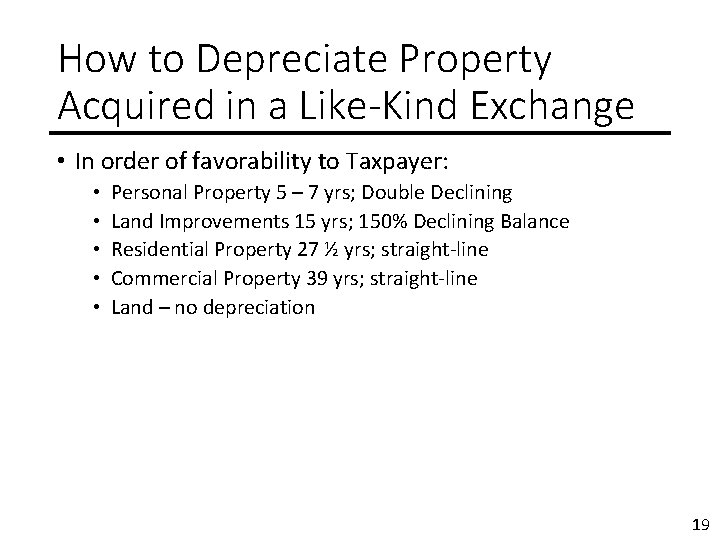
How to Depreciate Property Acquired in a Like-Kind Exchange • In order of favorability to Taxpayer: • • • Personal Property 5 – 7 yrs; Double Declining Land Improvements 15 yrs; 150% Declining Balance Residential Property 27 ½ yrs; straight-line Commercial Property 39 yrs; straight-line Land – no depreciation 19
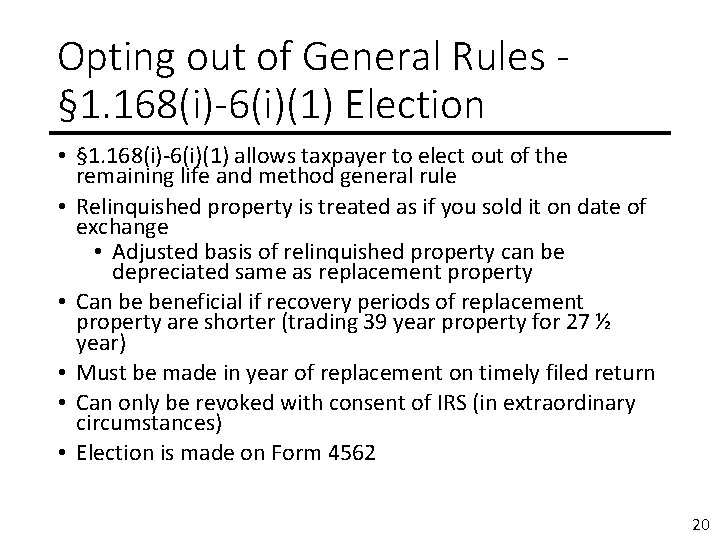
Opting out of General Rules § 1. 168(i)-6(i)(1) Election • § 1. 168(i)-6(i)(1) allows taxpayer to elect out of the remaining life and method general rule • Relinquished property is treated as if you sold it on date of exchange • Adjusted basis of relinquished property can be depreciated same as replacement property • Can be beneficial if recovery periods of replacement property are shorter (trading 39 year property for 27 ½ year) • Must be made in year of replacement on timely filed return • Can only be revoked with consent of IRS (in extraordinary circumstances) • Election is made on Form 4562 20
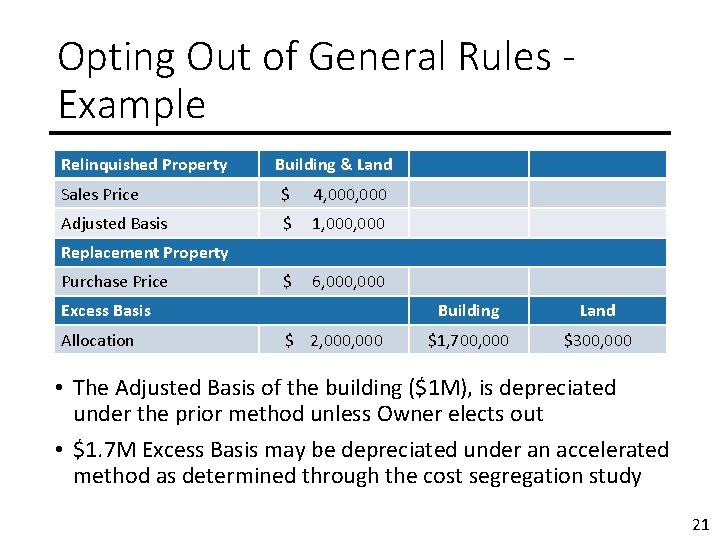
Opting Out of General Rules Example Relinquished Property Building & Land Sales Price $ 4, 000 Adjusted Basis $ 1, 000 $ 6, 000 Replacement Property Purchase Price Excess Basis Allocation $ 2, 000 Building Land $1, 700, 000 $300, 000 • The Adjusted Basis of the building ($1 M), is depreciated under the prior method unless Owner elects out • $1. 7 M Excess Basis may be depreciated under an accelerated method as determined through the cost segregation study 21
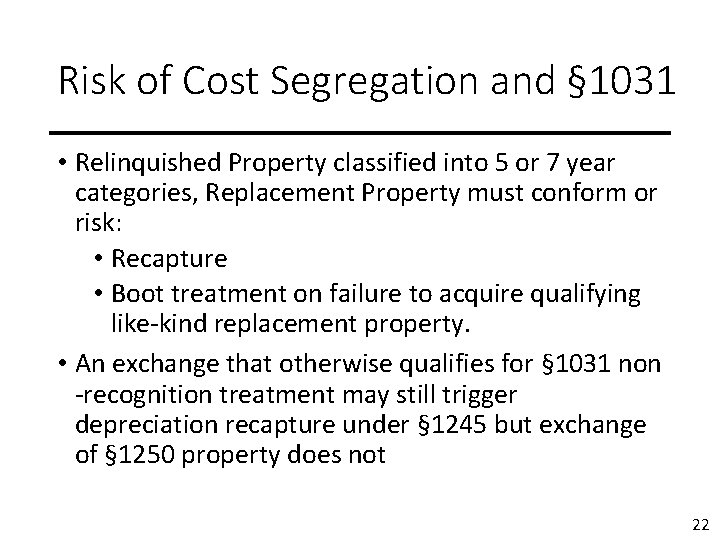
Risk of Cost Segregation and § 1031 • Relinquished Property classified into 5 or 7 year categories, Replacement Property must conform or risk: • Recapture • Boot treatment on failure to acquire qualifying like-kind replacement property. • An exchange that otherwise qualifies for § 1031 non -recognition treatment may still trigger depreciation recapture under § 1245 but exchange of § 1250 property does not 22
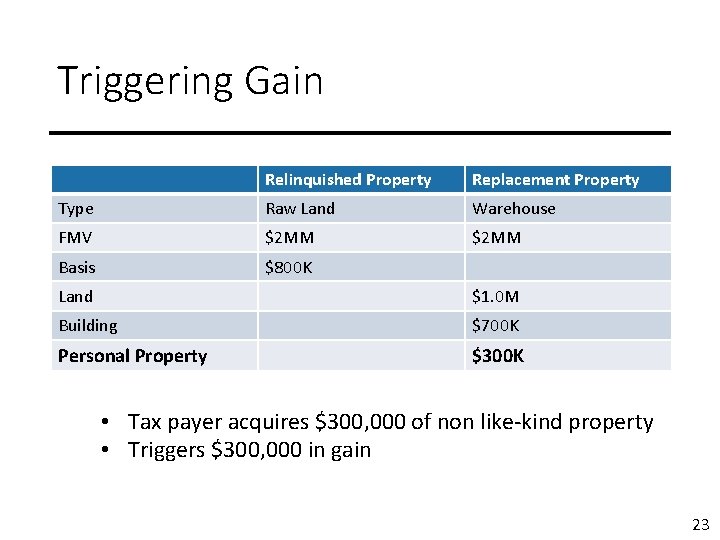
Triggering Gain Relinquished Property Replacement Property Type Raw Land Warehouse FMV $2 MM Basis $800 K Land $1. 0 M Building $700 K Personal Property $300 K • Tax payer acquires $300, 000 of non like-kind property • Triggers $300, 000 in gain 23
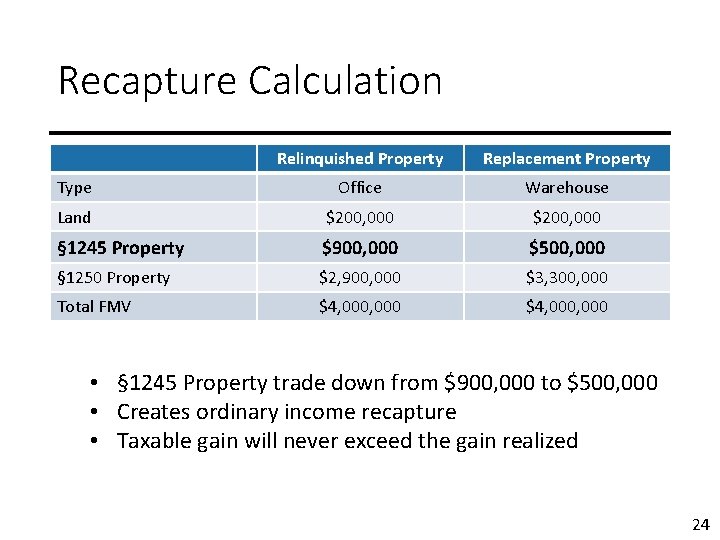
Recapture Calculation Relinquished Property Replacement Property Type Office Warehouse Land $200, 000 § 1245 Property $900, 000 $500, 000 § 1250 Property $2, 900, 000 $3, 300, 000 Total FMV $4, 000, 000 • § 1245 Property trade down from $900, 000 to $500, 000 • Creates ordinary income recapture • Taxable gain will never exceed the gain realized 24
This presentation contains general information only and the respective speakers and their firms are not, by means of this presentation, rendering accounting, business, financial, investment, legal, tax, or other professional advice or services. This presentation is not a substitute for such professional advice or services, nor should it be used as a basis for any decision or action that may affect your business. Before making any decision or taking any action that may affect your business, you should consult a qualified professional advisor. The respective speakers and their firms shall not be responsible for any loss sustained by any person who relies on this presentation.