AUDIT TECHNIQUES GUIDE ATG Travis Mlodzik CCSP AGENDA





- Slides: 27
AUDIT TECHNIQUES GUIDE (ATG) Travis Mlodzik, CCSP
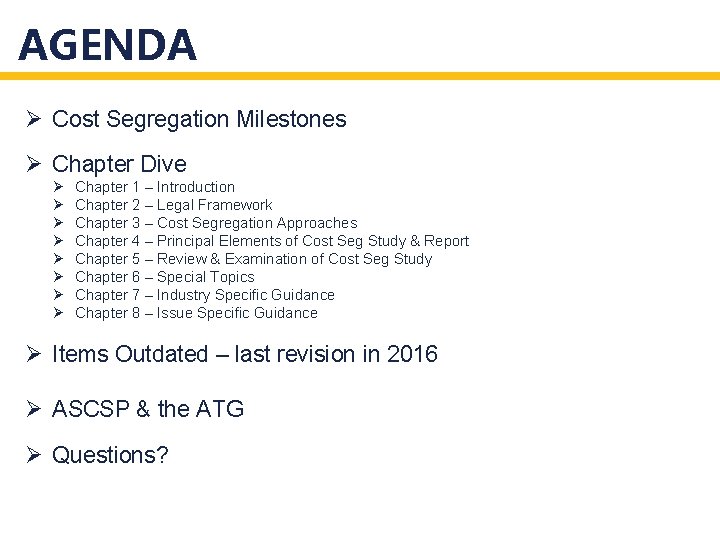
AGENDA Ø Cost Segregation Milestones Ø Chapter Dive Ø Ø Ø Ø Chapter 1 – Introduction Chapter 2 – Legal Framework Chapter 3 – Cost Segregation Approaches Chapter 4 – Principal Elements of Cost Seg Study & Report Chapter 5 – Review & Examination of Cost Seg Study Chapter 6 – Special Topics Chapter 7 – Industry Specific Guidance Chapter 8 – Issue Specific Guidance Ø Items Outdated – last revision in 2016 Ø ASCSP & the ATG Ø Questions?
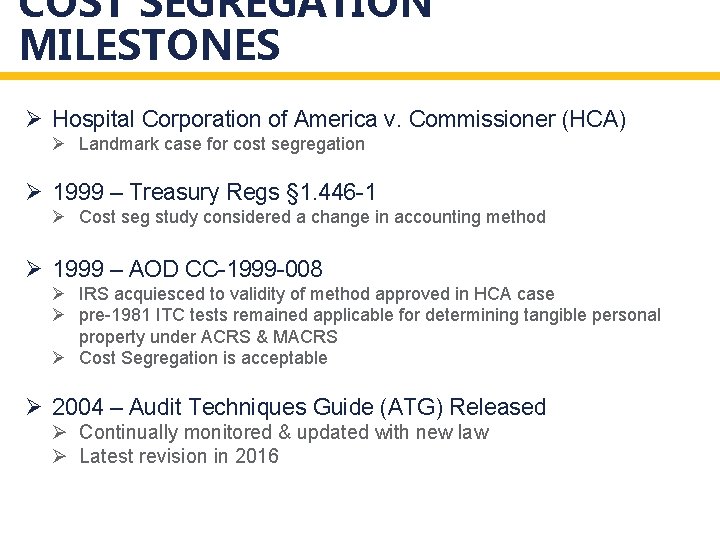
COST SEGREGATION MILESTONES Ø Hospital Corporation of America v. Commissioner (HCA) Ø Landmark case for cost segregation Ø 1999 – Treasury Regs § 1. 446 -1 Ø Cost seg study considered a change in accounting method Ø 1999 – AOD CC-1999 -008 Ø IRS acquiesced to validity of method approved in HCA case Ø pre-1981 ITC tests remained applicable for determining tangible personal property under ACRS & MACRS Ø Cost Segregation is acceptable Ø 2004 – Audit Techniques Guide (ATG) Released Ø Continually monitored & updated with new law Ø Latest revision in 2016
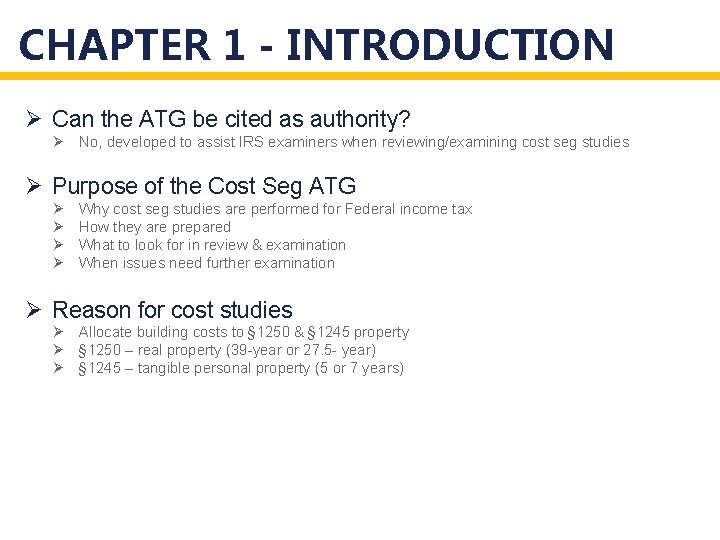
CHAPTER 1 - INTRODUCTION Ø Can the ATG be cited as authority? Ø No, developed to assist IRS examiners when reviewing/examining cost seg studies Ø Purpose of the Cost Seg ATG Ø Ø Why cost seg studies are performed for Federal income tax How they are prepared What to look for in review & examination When issues need further examination Ø Reason for cost studies Ø Allocate building costs to § 1250 & § 1245 property Ø § 1250 – real property (39 -year or 27. 5 - year) Ø § 1245 – tangible personal property (5 or 7 years)
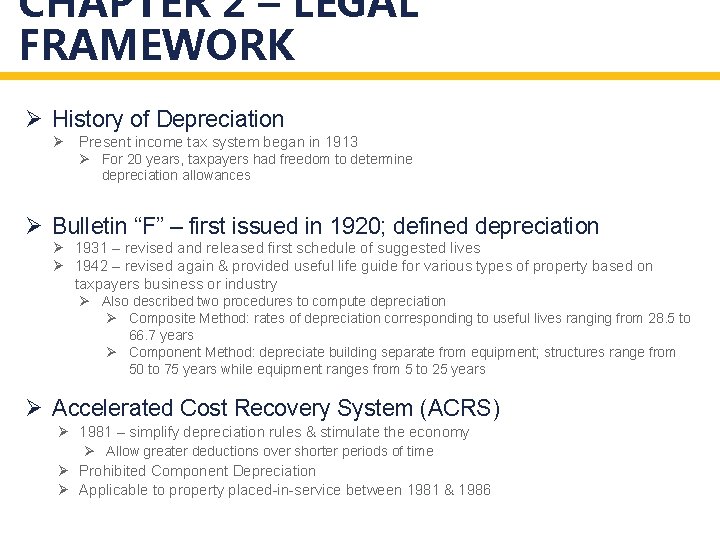
CHAPTER 2 – LEGAL FRAMEWORK Ø History of Depreciation Ø Present income tax system began in 1913 Ø For 20 years, taxpayers had freedom to determine depreciation allowances Ø Bulletin “F” – first issued in 1920; defined depreciation Ø 1931 – revised and released first schedule of suggested lives Ø 1942 – revised again & provided useful life guide for various types of property based on taxpayers business or industry Ø Also described two procedures to compute depreciation Ø Composite Method: rates of depreciation corresponding to useful lives ranging from 28. 5 to 66. 7 years Ø Component Method: depreciate building separate from equipment; structures range from 50 to 75 years while equipment ranges from 5 to 25 years Ø Accelerated Cost Recovery System (ACRS) Ø 1981 – simplify depreciation rules & stimulate the economy Ø Allow greater deductions over shorter periods of time Ø Prohibited Component Depreciation Ø Applicable to property placed-in-service between 1981 & 1986
CHAPTER 2 – LEGAL FRAMEWORK CONT. Ø Modified Accelerated Cost Recovery System (MACRS) Ø Current depreciation system Ø General Depreciation System (GDS) & Alternative Depreciation System (ADS) Ø Cost recovery now based on applicable depreciation method, recovery period & convention Ø Class lives are set forth in Rev. Proc. 87 -56 Ø Asset category (00. 11 through 00. 4) versus Activity category (01. 1 through 80. 0) Ø Incentives for cost segregation & cost recovery Ø Bonus Depreciation (§ 168(k)) Ø Election to expense certain business assets (§ 179) Ø QLIP (§ 168(e)(6)), QRP (§ 168(e)(7)) & QRIP(§ 168(e)(8)) Ø Congress enacted the provisions of § 1250 & § 1245 Ø Investment Tax Credit - § 48 (Repealed in 1986) Ø Inherently Permanent Test (Whiteco Industries, Inc. v. Commissioner) Ø HCA Ø Amerisouth XXXII Ltd. v. Commissioner
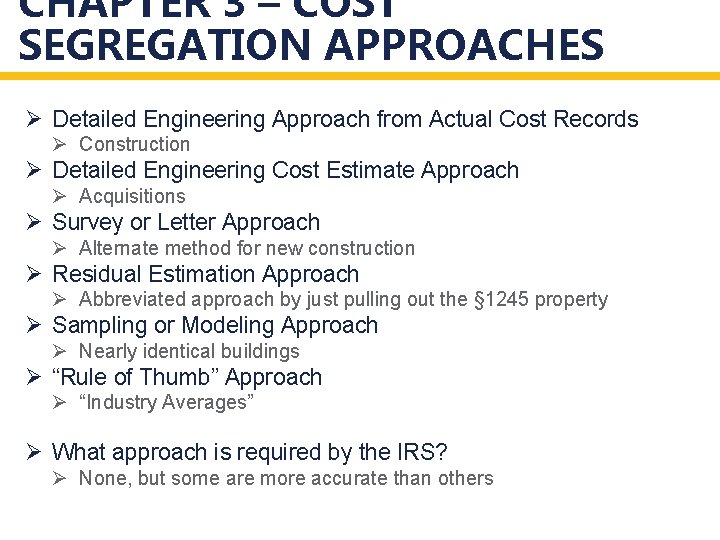
CHAPTER 3 – COST SEGREGATION APPROACHES Ø Detailed Engineering Approach from Actual Cost Records Ø Construction Ø Detailed Engineering Cost Estimate Approach Ø Acquisitions Ø Survey or Letter Approach Ø Alternate method for new construction Ø Residual Estimation Approach Ø Abbreviated approach by just pulling out the § 1245 property Ø Sampling or Modeling Approach Ø Nearly identical buildings Ø “Rule of Thumb” Approach Ø “Industry Averages” Ø What approach is required by the IRS? Ø None, but some are more accurate than others
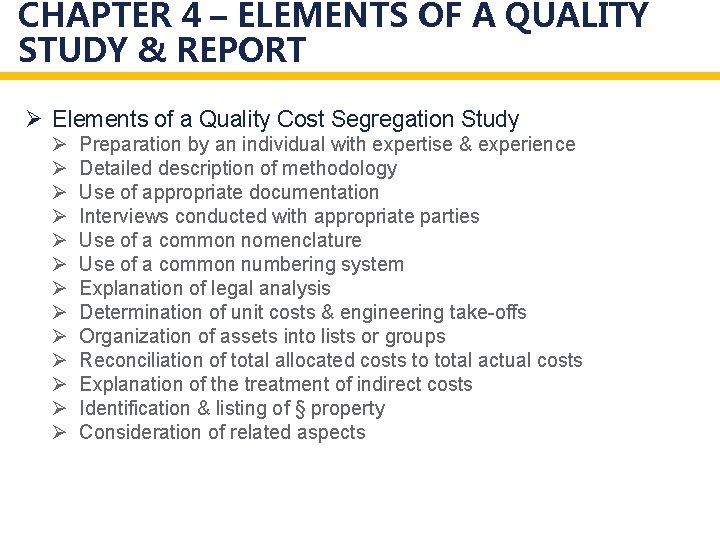
CHAPTER 4 – ELEMENTS OF A QUALITY STUDY & REPORT Ø Elements of a Quality Cost Segregation Study Ø Ø Ø Ø Preparation by an individual with expertise & experience Detailed description of methodology Use of appropriate documentation Interviews conducted with appropriate parties Use of a common nomenclature Use of a common numbering system Explanation of legal analysis Determination of unit costs & engineering take-offs Organization of assets into lists or groups Reconciliation of total allocated costs to total actual costs Explanation of the treatment of indirect costs Identification & listing of § property Consideration of related aspects
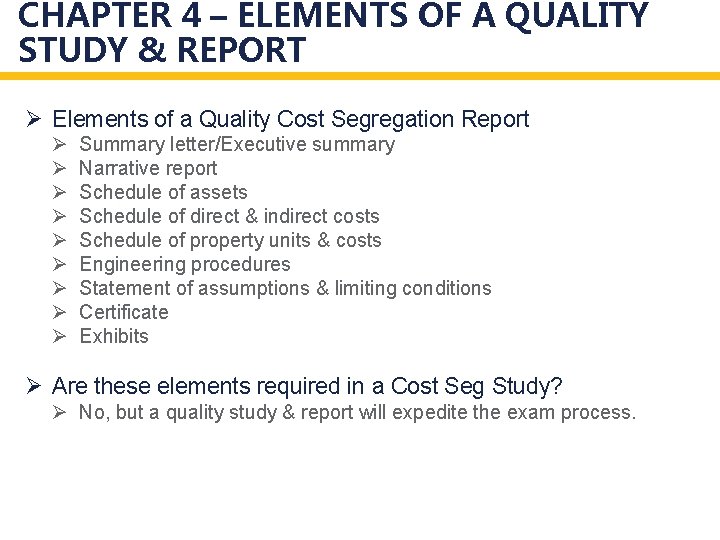
CHAPTER 4 – ELEMENTS OF A QUALITY STUDY & REPORT Ø Elements of a Quality Cost Segregation Report Ø Ø Ø Ø Ø Summary letter/Executive summary Narrative report Schedule of assets Schedule of direct & indirect costs Schedule of property units & costs Engineering procedures Statement of assumptions & limiting conditions Certificate Exhibits Ø Are these elements required in a Cost Seg Study? Ø No, but a quality study & report will expedite the exam process.
CHAPTER 5 – REVIEW & EXAMINATION OF A CSS Ø Steps to examining a study Ø Review for risk analysis purposes Ø Verify the cost basis & reconcile the depreciation to the tax return Ø Conduct initial risk analysis to evaluate audit potential Ø Examination Ø Ø Ø Ø Review for examination purposes Interview the preparer Inspect the property Review and verify the classes of property Research the Tax Law Cost Analysis Summarize the findings & discuss the challenged assets with taxpayer Ø Prepare notice of proposed adjustments Ø Other considerations Ø Perform cost analysis; New construction or Acquired; Review sampling; Consider § 263 A; Consider change in Accounting Method
CHAPTER 6 – SPECIAL TOPICS Ø Chapter 6. 1 – Uniform Capitalization Ø UNICAP – capitalize all direct costs & certain indirect costs allocable to real and tangible personal property produced by the taxpayer § 263 A Ø Capitalization of Costs under § 263 A(a) Ø Indirect Costs Ø Capitalization of Interest under § 263 A(f) Ø Chapter 6. 2 – Change in Accounting Method Ø PECO Food Case Ø Tangible Regulations § 1. 263(a) Ø Revenue Procedures involving Method Changes (Form 3115) Ø Non-automatic – Rev. Proc. 97 -27, 1997 -1 C. B. 680 Ø Automatic – Rev. Proc. 2011 -14, 2011 -1 C. B. 330
CHAPTER 6 – SPECIAL TOPICS Ø Chapter 6. 3 – Depreciation Overview Ø MACRS Ø IRC § 167 provides a depreciation allowance for wear & tear of property used in a trade or business or held for production of income Ø Since 1986, generally determined under § 168 Modified Cost Recovery System Ø Two methods: General Depreciation System (GDS) & Alternative Depreciation System (ADS) Ø Depreciation Periods & Conventions Ø GDS has ten property classes based on recovery periods Ø 3, 5, 7, 10, 15, 20, 25, 27. 5, 39 or 50 years Ø Methods include: 200% declining balance; 150% declining balance; straight line Ø ADS must be used for the following property Ø Ø Ø Property used 50 percent or less for business Tangible property used predominantly outside the US Tax-exempt use property Tax-exempt bond financed property Certain other finite categories of property that are not common
CHAPTER 6 – SPECIAL TOPICS Ø Depreciation Periods & Conventions Cont. Ø Conventions Ø Half-year: applies to property other than residential rental property, nonresidential real property, & railroad grading and tunnel bores Ø Mid-month: applies to residential rental property, nonresidential real property, & railroad grading and tunnel bores Ø Mid-quarter: applies to property (other than residential rental, nonresidential real property & railroad grading and tunnel bores) if more than 40% of aggregate basis is placed in service during the last three months of the tax year Ø Recovery Periods Ø Rev. Proc. 87 -56 Ø Asset Classes 00. 11 to 00. 4 – consist specific assets used in all business activities Ø Asset Classes 01. 1 to 80. 0 – consist of assets used in specific business activities
CHAPTER 6 – SPECIAL TOPICS Ø Chapter 6. 4 – Relevant Court Cases Ø Ameri. South. XXXII: 2012 – Site Prep; Site Electric; Special HVAC; Special Plumbing; Special Electrical; Millwork Ø PPL Corporation: 2010 – Street Lights Ø L. L. Bean, Inc: 1998 – Electrical System; Fire Protection System; Concrete Slab Floor Ø Super. Valu Inc: 1997 – Refrigeration System Ø HCA: 1997 – Vinyl Floor Covering; Patient Corridor Handrails; Carpeting; Acoustical Ceilings Ø Boddie-Noelle Enterprises, Inc: 1996 – Kitchen HVAC; Plumbing to Equipment; Electrical to Equipment Ø La Petite Academy: 1995 – Fencing – Playground; Exterior Façade Lighting; Kitchen Grease Trap; Dumpster Enclosure Ø Morrison, Inc: 1990 – Kitchen Hand Sinks; Eliason Doors; Customer Line Screen; Kitchen Grease Trap
CHAPTER 6 – SPECIAL TOPICS Ø Chapter 6. 4 – Relevant Court Cases Ø Metro National Corp. : 1987 – Partitions; False Ceilings w/Lighting; Exterior Security Lighting; Cabinets & Hardware Ø Piggly Wiggly Southern, Inc. : 1986 – HVAC Units Ø Illinois Cereal Mills, Inc: 1986 – Electrical Distribution System Ø Shoney’s South, Inc. : 1984 – Chandeliers & Lanterns Ø A. C. Monk & Co: 1982 – Louvered Wall; Electrical Distribution System; High Bay Roof; Storage Sheds Ø Scott Paper Co. : 1980 – Electrical Distribution System Ø Whiteco Industries, Inc. : 1975 – Outdoor Signs (Billboards)
CHAPTER 6 – SPECIAL TOPICS Ø Chapter 6. 5 – Inherently Permanent Ø Inherently Permanent under § 168 – Whiteco Ø Inherently Permanent under § 263 A – UNICAP Ø Chapter 6. 6 – Construction Process Ø Cost Segregation Studies are typically completed using information developed for the construction process Ø Ø Ø Concept Contracts & Bid Documents Bidding Construction Field Work Construction Payments Completion
CHAPTER 6 – SPECIAL TOPICS Ø Chapter 6. 7 – Information Document Requests Ø Appropriate documentation is needed to support the conclusions in a cost segregation study Ø Ø Ø Ø Participants & respective roles Specific properties subject to the study Property blueprints & drawings Obtain a copy of the CSS Secure computations Ask specific questions regarding segregated property Request for specific items & amounts in question Ø Chapter 6. 8 – Bonus Depreciation Considerations Ø Ø Ø Eligible Property Qualified Leasehold Improvement Property Acquisition Requirements & Placed in Service Dates Method of Accounting Issues related to Bonus Depreciation Election out of Bonus
CHAPTER 7 – INDUSTRY SPECIFIC GUIDANCE Ø Chapter 7. 1 – Casinos Ø Multiple Asset Classes for property Ø Recreation: Asset Class 79. 0 Ø Distributive Trades & Services: Asset Class 57. 0 Ø Electrical: Ø Main Office Areas; “Back of House”; Hotel Rooms: § 1250 - 39 -years Ø Specifically associated w/equipment in Casino area: § 1245 - 7 -years (79. 0) Ø Specifically associated w/equipment not in Casino/Theater: § 1245 - 5 -years (57. 0) Ø Chapter 7. 2 – Restaurants Ø Mainly uses Asset Class 57. 0 Ø Décor Accessories: § 1245 - 5 -years Ø Non-Structural Theme Elements: § 1245 - 5 -years Ø Restaurant Furniture: § 1245 - 5 -years (other than office furniture); 7 -years (office furniture) (00. 11 – Office FF&E)
CHAPTER 7 – INDUSTRY SPECIFIC GUIDANCE Ø Chapter 7. 3 – Retail Industries Ø Mainly uses Asset Class 57. 0 Ø Kiosks: § 1245 - 5 -years Ø Parking Structures: § 1250 – 39 -years Ø Security Systems: § 1250 – 39 -years (General Building Security); § 1245 – 5 years (Primary purpose to minimize loss due to theft) Ø Chapter 7. 4 – Pharmaceutical & Biotechnology Ø Recovery period is going to depend on use of the property Ø Activity Classes 01. 1 to 80. 0 or “Certain Property for which Recovery Periods Assigned” Ø Land Improvements Ø Some activity classes include Land Improvements which could change § 1245 recovery Ø Many assets are Personal Property with no Class Life Ø Default to 7 -year recovery period
CHAPTER 7 – INDUSTRY SPECIFIC GUIDANCE Ø Chapter 7. 5 – Auto Dealership Industry Ø Primarily Asset Class 57. 0 (5 -year § 1245) Ø Bollards & Guardrails: § 1250, Land Improvements, or § 1245 Ø Floor Pits & Trenches: § 1250 – 39 -years Ø Equipment: § 1245 – 5 -years Ø Security Systems: § 1250 or § 1245 Ø Chapter 7. 6 – Auto Manufacturing Ø Asset Class 37. 11 – Manufacture of Motor Vehicles (7 -year § 1245) Ø Catwalks & Mezzanines: § 1250 (building); § 1245 (7 -years) – only provide access to process machinery or equipment Ø Electrical Distribution Ø Gate House: § 1250 – 39 -years Ø Guard Shack/Booth: § 1245 – 7 -years Ø Loading Dock: § 1250 – 39 -years
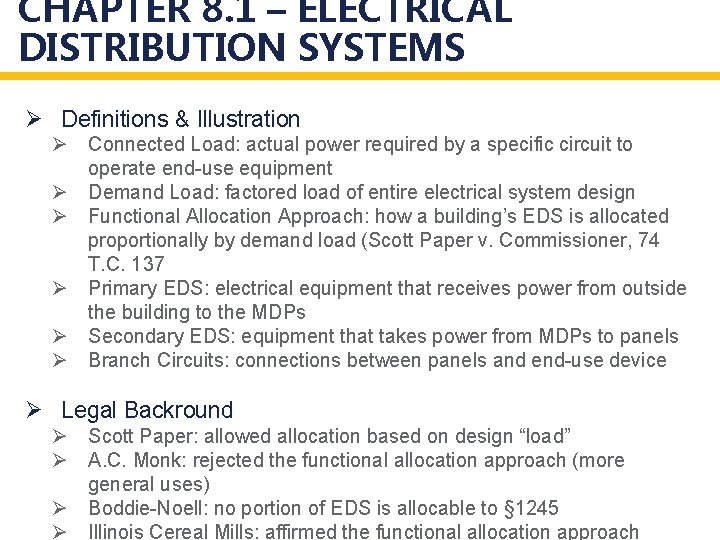
CHAPTER 8. 1 – ELECTRICAL DISTRIBUTION SYSTEMS Ø Definitions & Illustration Ø Connected Load: actual power required by a specific circuit to operate end-use equipment Ø Demand Load: factored load of entire electrical system design Ø Functional Allocation Approach: how a building’s EDS is allocated proportionally by demand load (Scott Paper v. Commissioner, 74 T. C. 137 Ø Primary EDS: electrical equipment that receives power from outside the building to the MDPs Ø Secondary EDS: equipment that takes power from MDPs to panels Ø Branch Circuits: connections between panels and end-use device Ø Legal Backround Ø Scott Paper: allowed allocation based on design “load” Ø A. C. Monk: rejected the functional allocation approach (more general uses) Ø Boddie-Noell: no portion of EDS is allocable to § 1245 Ø Illinois Cereal Mills: affirmed the functional allocation approach
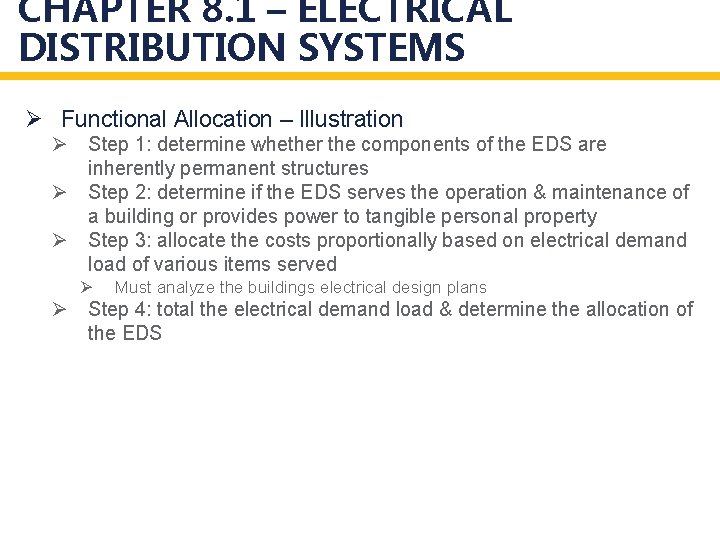
CHAPTER 8. 1 – ELECTRICAL DISTRIBUTION SYSTEMS Ø Functional Allocation – Illustration Ø Step 1: determine whether the components of the EDS are inherently permanent structures Ø Step 2: determine if the EDS serves the operation & maintenance of a building or provides power to tangible personal property Ø Step 3: allocate the costs proportionally based on electrical demand load of various items served Ø Must analyze the buildings electrical design plans Ø Step 4: total the electrical demand load & determine the allocation of the EDS
CHAPTER 8. 2 – STAND-ALONE OPEN-AIR PARKING STRUCTURES Ø Description of Stand-alone open-air parking structures Ø Parties’ Positions Ø Taxpayers: if not connected to the building treated as land improvements; if connected to the building agree that they have 39 year recovery period Ø IRS: fall within the definition of a building as they satisfy the appearance test Ø Function Test – requires structure to provide shelter or housing, provide working, office, parking, display, or sales space Ø Appearance Test: requires structure enclosing a space within its walls and usually covered by a roof Ø Penalty Ø 20% accuracy-related penalty that applies to any substantial understatement of income tax Ø 20% accuracy-related penalty that applies to the portion of any underpayment of tax attributable to negligence or disregard of rules or regulations
OUTDATED ITEMS Ø Bonus Depreciation Ø Tax Cuts & Jobs Act of 2017 Ø 100% bonus Ø Acquired properties now eligible Ø Qualified Improvement Property Ø Need technical correction to 15 -year Ø Qualified Leasehold Improvements Ø Qualified Restaurant Property Ø Qualified Retail Improvements
ASCSP & THE ATG Ø Minimum Quality Standards Manual (MQS) Ø Developed by the ASCSP Technical Standards Committee Ø For use within ASCSP Membership Ø Modeled after the ATG Ø Ø Ø Outlines the principal elements of a cost segregation report Outlines the engineering approaches Lists key Revenue Procedures Lists relevant case law & revenue rulings Additional requirements to stamp or sign report with ASCSP designation
QUESTIONS? This presentation is presented with the understanding that the information contained does not constitute legal, accounting or other professional advice. It is not intended to be responsive to any individual situation or concerns, as the contents of this presentation are intended for general information purposes only. Viewers are urged not to act upon the information contained in this presentation without first consulting competent legal, accounting or other professional advice regarding implications of a particular factual situation. Questions and additional information can be submitted to your Eide Bailly representative, or to the presenter of this session.
THANK YOU Travis Mlodzik, CCSP Senior Manager, National Tax Office tmlodzik@eidebailly. com 612. 253. 6627