
Lesson Learned from CCSP 1 1 Temperature Trends
- Slides: 25
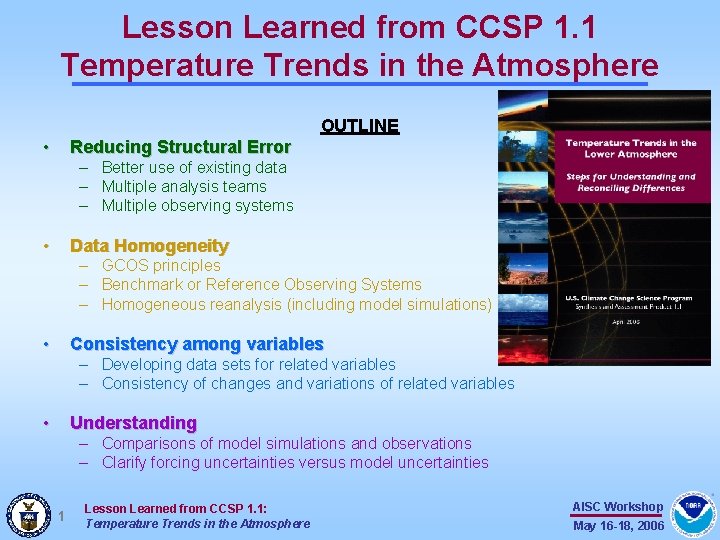
Lesson Learned from CCSP 1. 1 Temperature Trends in the Atmosphere OUTLINE • Reducing Structural Error • Data Homogeneity • Consistency among variables • Understanding – Better use of existing data – Multiple analysis teams – Multiple observing systems – GCOS principles – Benchmark or Reference Observing Systems – Homogeneous reanalysis (including model simulations) – Developing data sets for related variables – Consistency of changes and variations of related variables – Comparisons of model simulations and observations – Clarify forcing uncertainties versus model uncertainties 1 Lesson Learned from CCSP 1. 1: Temperature Trends in the Atmosphere AISC Workshop May 16 -18, 2006
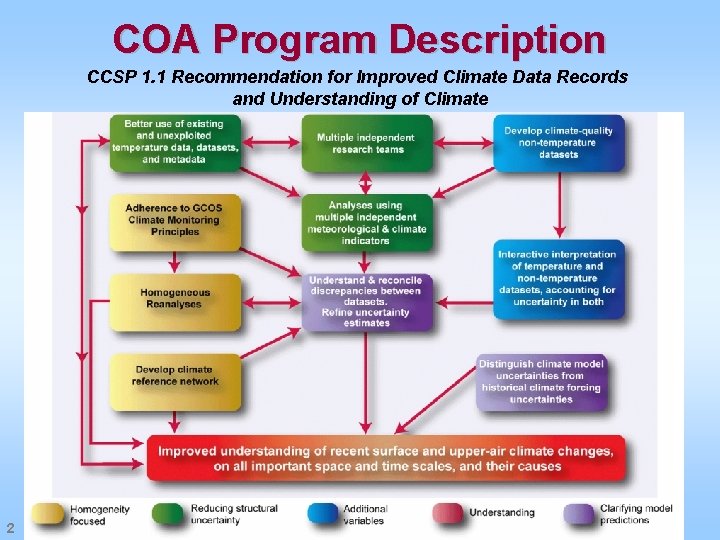
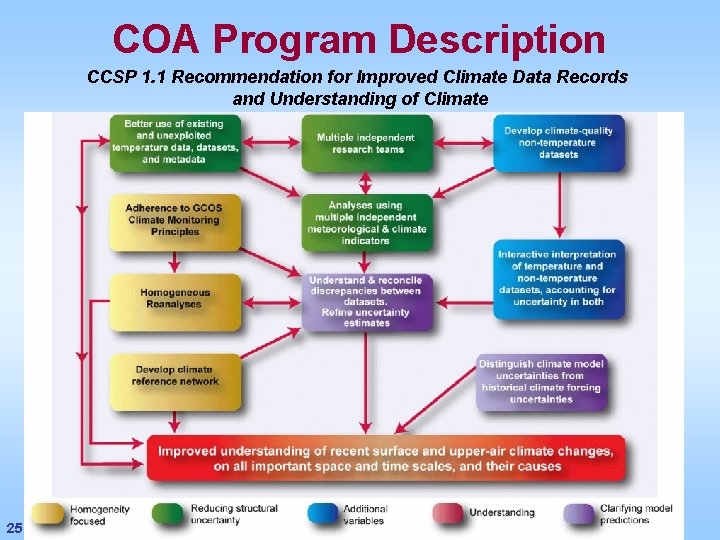
COA Program Description CCSP 1. 1 Recommendation for Improved Climate Data Records and Understanding of Climate 2
Reducing Structural Error – Better use of existing data – Multiple analysis teams – Multiple observing systems 3 Lesson Learned from CCSP 1. 1: Temperature Trends in the Atmosphere AISC Workshop May 16 -18, 2006
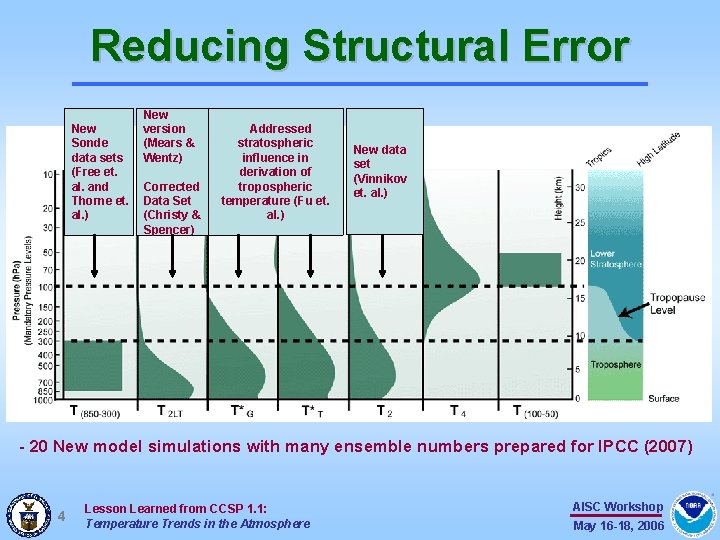
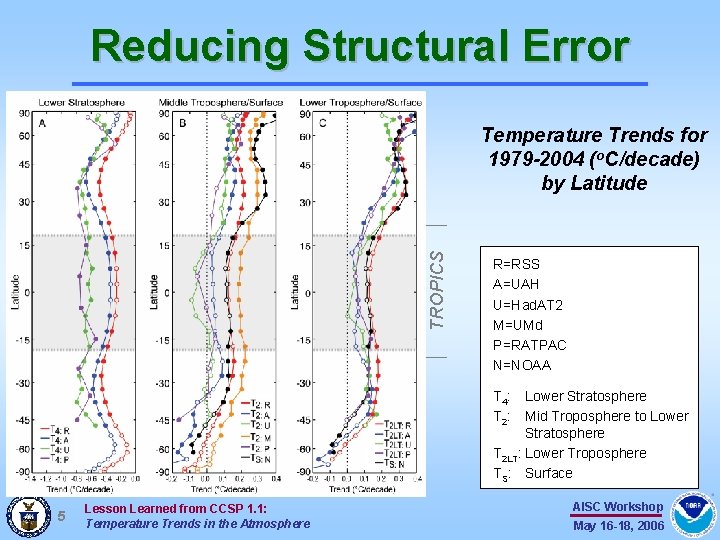
Reducing Structural Error New Sonde data sets (Free et. al. and Thorne et. al. ) New version (Mears & Wentz) Corrected Data Set (Christy & Spencer) Addressed stratospheric influence in derivation of tropospheric temperature (Fu et. al. ) New data set (Vinnikov et. al. ) - 20 New model simulations with many ensemble numbers prepared for IPCC (2007) 4 Lesson Learned from CCSP 1. 1: Temperature Trends in the Atmosphere AISC Workshop May 16 -18, 2006
Reducing Structural Error TROPICS Temperature Trends for 1979 -2004 (o. C/decade) by Latitude R=RSS A=UAH U=Had. AT 2 M=UMd P=RATPAC N=NOAA T 4: T 2: Lower Stratosphere Mid Troposphere to Lower Stratosphere T 2 LT: Lower Troposphere TS: Surface 5 Lesson Learned from CCSP 1. 1: Temperature Trends in the Atmosphere AISC Workshop May 16 -18, 2006
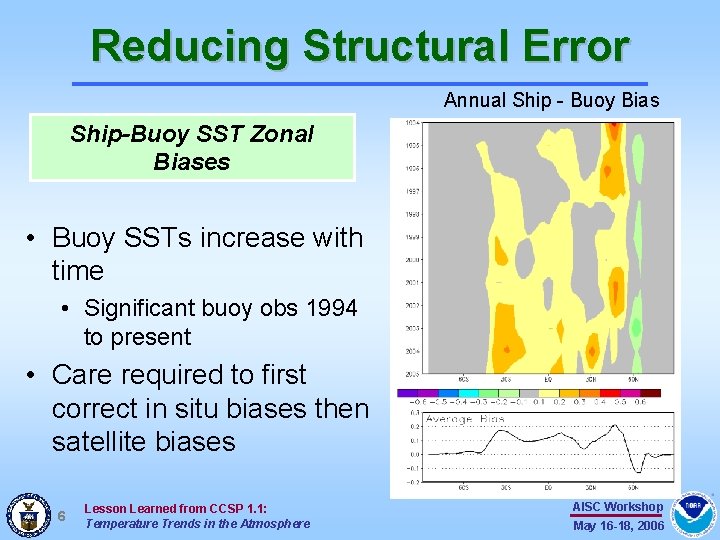
Reducing Structural Error Annual Ship - Buoy Bias Ship-Buoy SST Zonal Biases • Buoy SSTs increase with time • Significant buoy obs 1994 to present • Care required to first correct in situ biases then satellite biases 6 Lesson Learned from CCSP 1. 1: Temperature Trends in the Atmosphere AISC Workshop May 16 -18, 2006
Data Homogeneity – GCOS principles – Benchmark or Reference Observing Systems – Homogeneous reanalysis (including model simulations) 7 Lesson Learned from CCSP 1. 1: Temperature Trends in the Atmosphere AISC Workshop May 16 -18, 2006
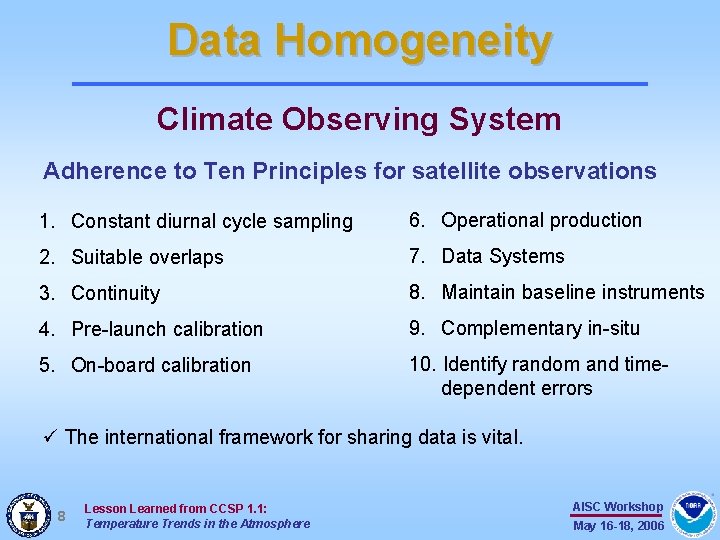
Data Homogeneity Climate Observing System Adherence to Ten Principles for satellite observations 1. Constant diurnal cycle sampling 6. Operational production 2. Suitable overlaps 7. Data Systems 3. Continuity 8. Maintain baseline instruments 4. Pre-launch calibration 9. Complementary in-situ 5. On-board calibration 10. Identify random and timedependent errors ü The international framework for sharing data is vital. 8 Lesson Learned from CCSP 1. 1: Temperature Trends in the Atmosphere AISC Workshop May 16 -18, 2006
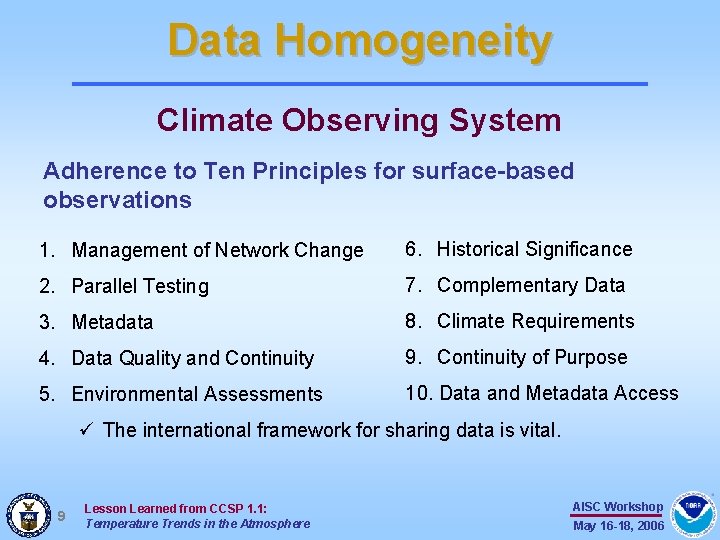
Data Homogeneity Climate Observing System Adherence to Ten Principles for surface-based observations 1. Management of Network Change 6. Historical Significance 2. Parallel Testing 7. Complementary Data 3. Metadata 8. Climate Requirements 4. Data Quality and Continuity 9. Continuity of Purpose 5. Environmental Assessments 10. Data and Metadata Access ü The international framework for sharing data is vital. 9 Lesson Learned from CCSP 1. 1: Temperature Trends in the Atmosphere AISC Workshop May 16 -18, 2006
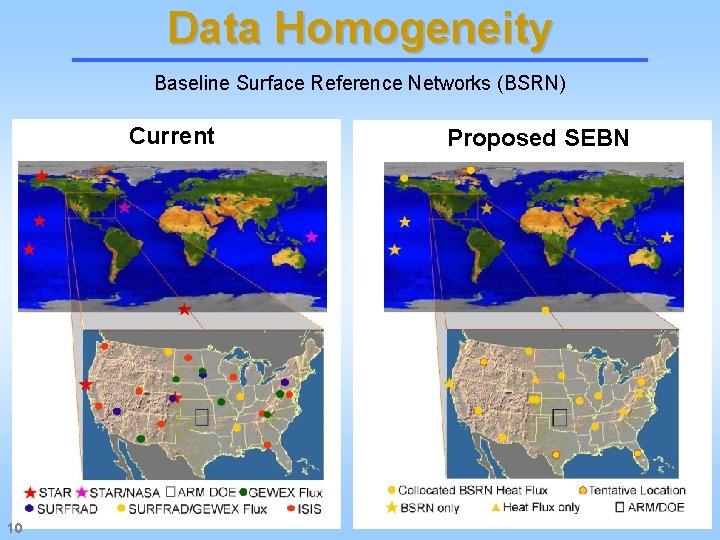
Data Homogeneity Baseline Surface Reference Networks (BSRN) Current 10 Proposed SEBN
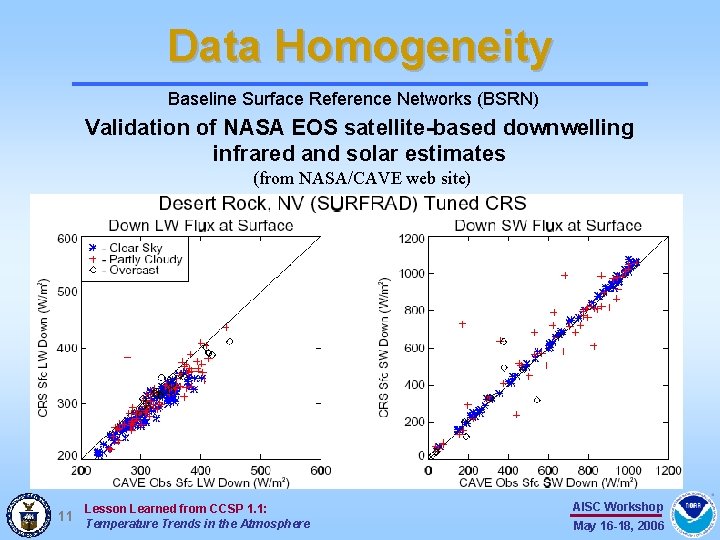
Data Homogeneity Baseline Surface Reference Networks (BSRN) Validation of NASA EOS satellite-based downwelling infrared and solar estimates (from NASA/CAVE web site) Lesson Learned from CCSP 1. 1: 11 Temperature Trends in the Atmosphere AISC Workshop May 16 -18, 2006
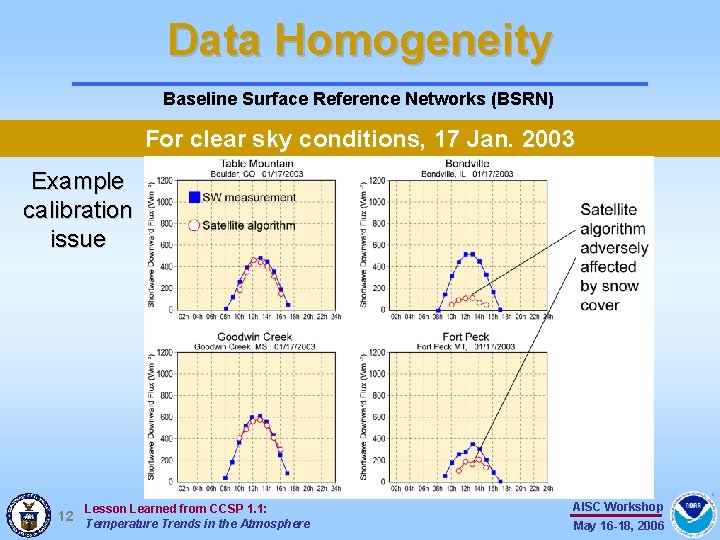
Data Homogeneity Baseline Surface Reference Networks (BSRN) For clear sky conditions, 17 Jan. 2003 Example calibration issue Lesson Learned from CCSP 1. 1: 12 Temperature Trends in the Atmosphere AISC Workshop May 16 -18, 2006
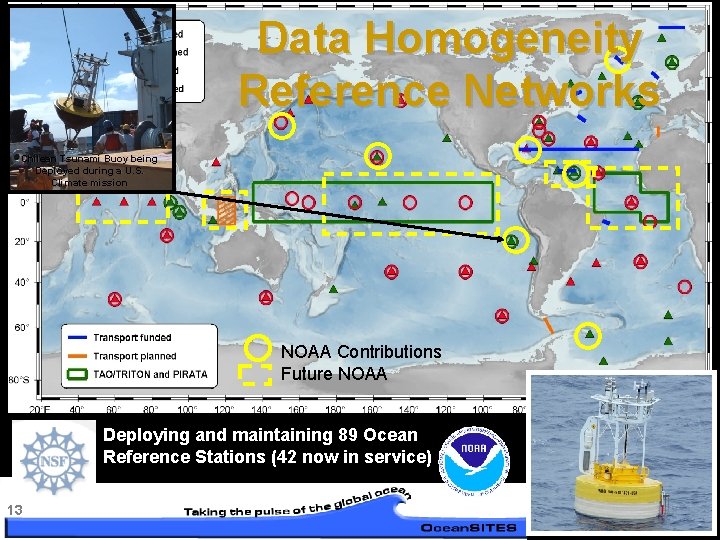
Data Homogeneity Reference Networks Chilean Tsunami Buoy being Deployed during a U. S. Climate mission NOAA Contributions Future NOAA Deploying and maintaining 89 Ocean Reference Stations (42 now in service) 13 Lesson Learned from CCSP 1. 1: 13 Temperature Trends in the Atmosphere AISC Workshop May 16 -18, 2006
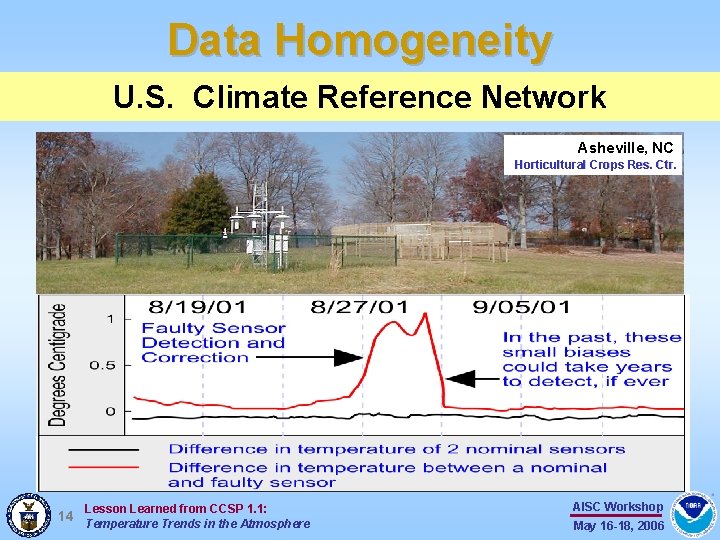
Data Homogeneity U. S. Climate Reference Network Asheville, NC Horticultural Crops Res. Ctr. Lesson Learned from CCSP 1. 1: 14 Temperature Trends in the Atmosphere AISC Workshop May 16 -18, 2006
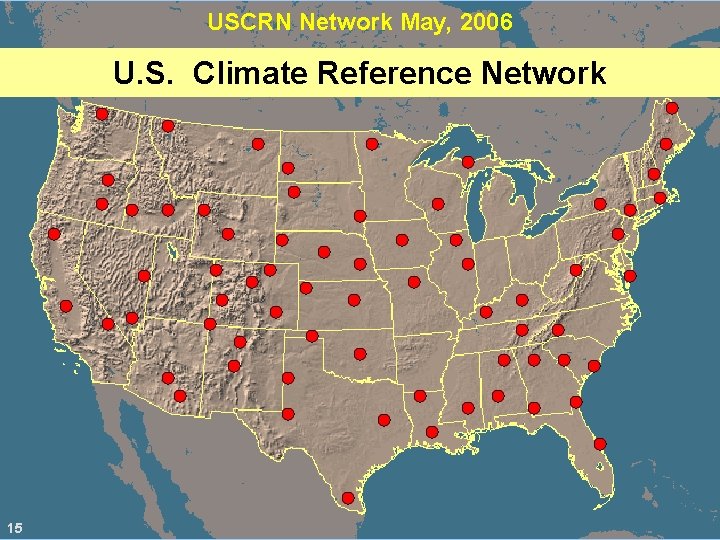
USCRN Network May, 2006 U. S. Climate Reference Network Lesson Learned from CCSP 1. 1: 15 15 Temperature Trends in the Atmosphere AISC Workshop May 16 -18, 2006
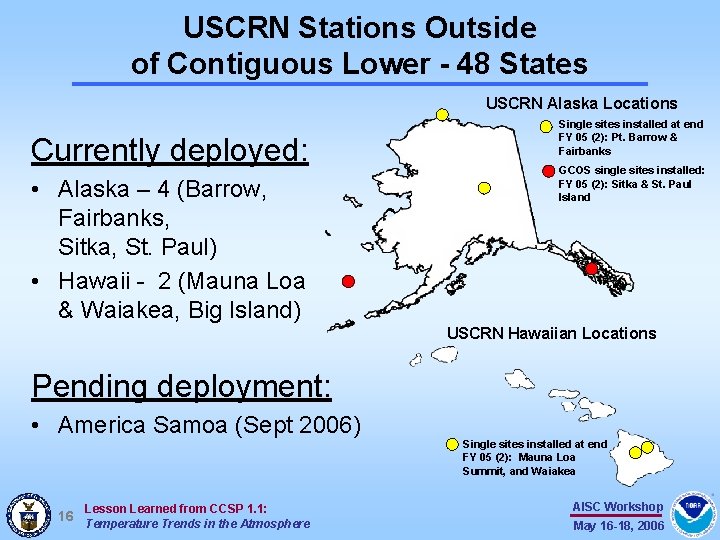
USCRN Stations Outside of Contiguous Lower - 48 States USCRN Alaska Locations Currently deployed: • Alaska – 4 (Barrow, Fairbanks, Sitka, St. Paul) • Hawaii - 2 (Mauna Loa & Waiakea, Big Island) Single sites installed at end FY 05 (2): Pt. Barrow & Fairbanks GCOS single sites installed: FY 05 (2): Sitka & St. Paul Island USCRN Hawaiian Locations Pending deployment: • America Samoa (Sept 2006) Lesson Learned from CCSP 1. 1: 16 Temperature Trends in the Atmosphere Single sites installed at end FY 05 (2): Mauna Loa Summit, and Waiakea AISC Workshop May 16 -18, 2006
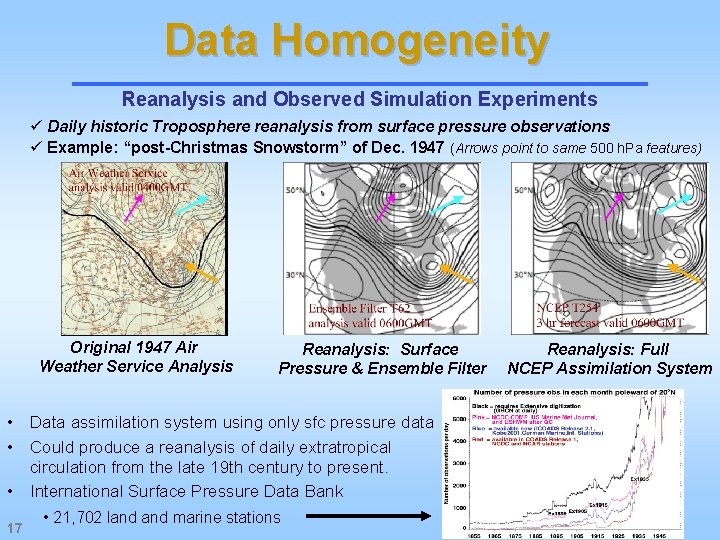
Data Homogeneity Reanalysis and Observed Simulation Experiments ü Daily historic Troposphere reanalysis from surface pressure observations ü Example: “post-Christmas Snowstorm” of Dec. 1947 (Arrows point to same 500 h. Pa features) Original 1947 Air Weather Service Analysis Reanalysis: Surface Pressure & Ensemble Filter • Data assimilation system using only sfc pressure data • Could produce a reanalysis of daily extratropical circulation from the late 19 th century to present. • International Surface Pressure Data Bank 17 • 21, 702 land marine stations Reanalysis: Full NCEP Assimilation System
Consistency Among Variables – Developing data sets for related variables – Consistency of changes and variations of related variables Lesson Learned from CCSP 1. 1: 18 Temperature Trends in the Atmosphere AISC Workshop May 16 -18, 2006
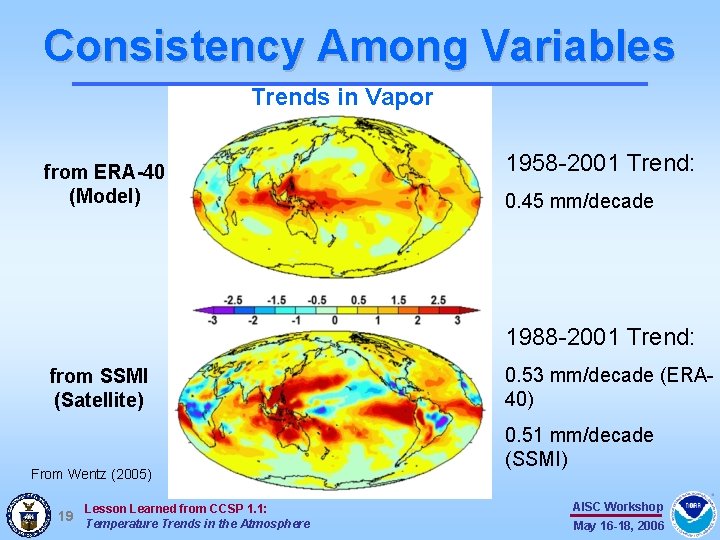
Consistency Among Variables Trends in Vapor from ERA-40 (Model) 1958 -2001 Trend: 0. 45 mm/decade 1988 -2001 Trend: from SSMI (Satellite) From Wentz (2005) Lesson Learned from CCSP 1. 1: 19 Temperature Trends in the Atmosphere 0. 53 mm/decade (ERA 40) 0. 51 mm/decade (SSMI) AISC Workshop May 16 -18, 2006
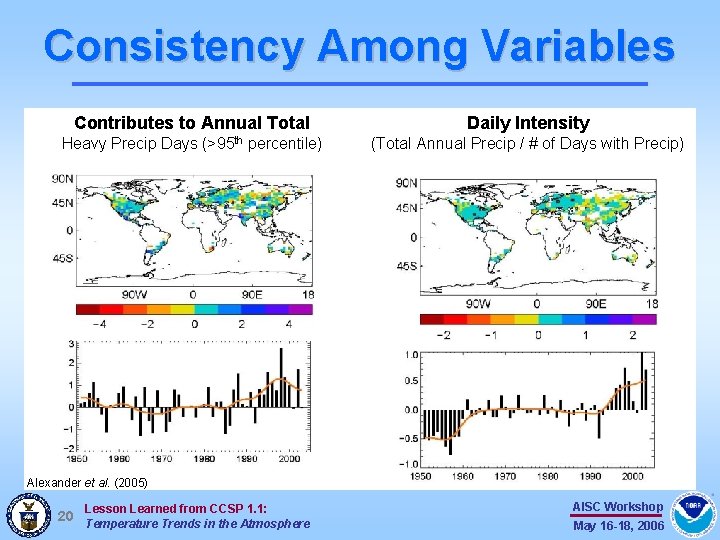
Consistency Among Variables Contributes to Annual Total Heavy Precip Days (>95 th percentile) Daily Intensity (Total Annual Precip / # of Days with Precip) Alexander et al. (2005) Lesson Learned from CCSP 1. 1: 20 Temperature Trends in the Atmosphere AISC Workshop May 16 -18, 2006
Understanding – Comparisons of model simulations and observations – Clarify forcing uncertainties versus model uncertainties Lesson Learned from CCSP 1. 1: 21 Temperature Trends in the Atmosphere AISC Workshop May 16 -18, 2006
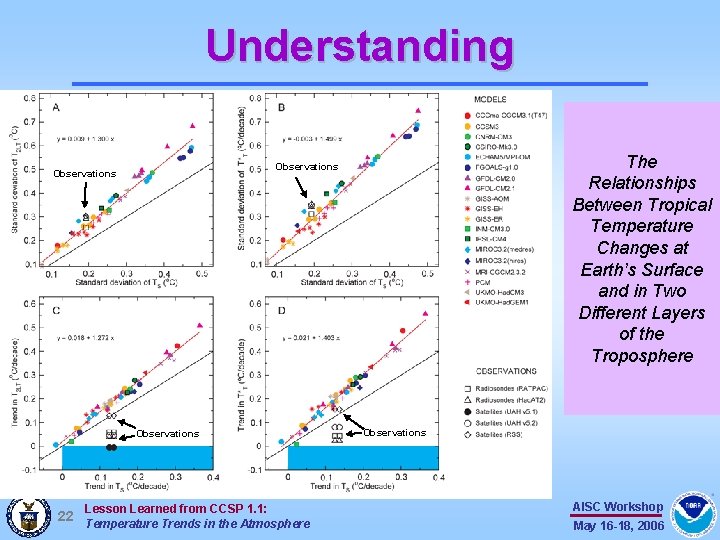
Understanding The Relationships Between Tropical Temperature Changes at Earth’s Surface and in Two Different Layers of the Troposphere Observations Lesson Learned from CCSP 1. 1: 22 Temperature Trends in the Atmosphere Observations AISC Workshop May 16 -18, 2006
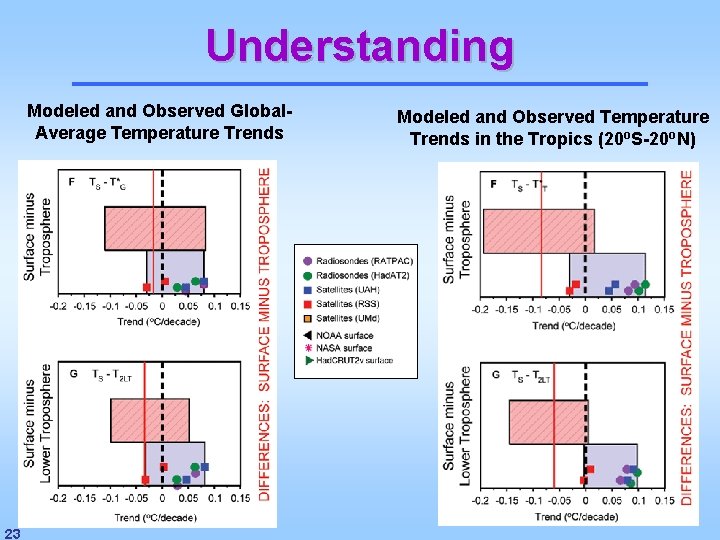
Understanding Modeled and Observed Global. Average Temperature Trends 23 Modeled and Observed Temperature Trends in the Tropics (20 o. S-20 o. N)
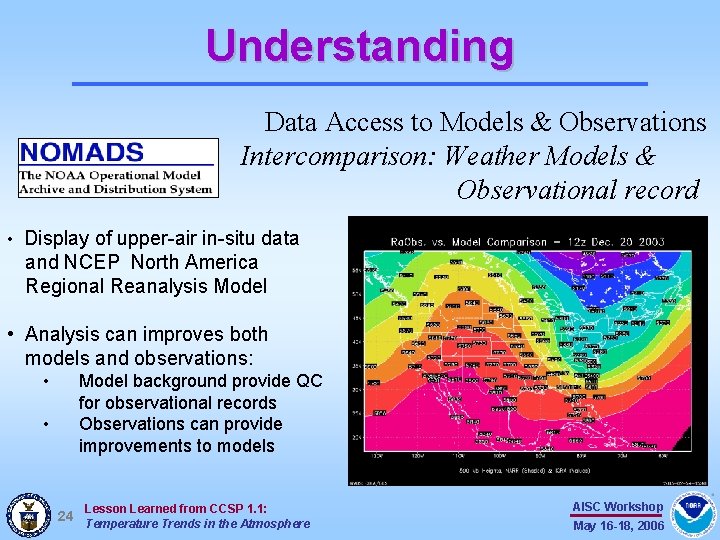
Understanding Data Access to Models & Observations Intercomparison: Weather Models & Observational record • Display of upper-air in-situ data and NCEP North America Regional Reanalysis Model • Analysis can improves both models and observations: • • Model background provide QC for observational records Observations can provide improvements to models Lesson Learned from CCSP 1. 1: 24 Temperature Trends in the Atmosphere AISC Workshop May 16 -18, 2006
COA Program Description CCSP 1. 1 Recommendation for Improved Climate Data Records and Understanding of Climate 25