Integrating 3 G and WLAN Services in NTP








- Slides: 28
Integrating 3 G and WLAN Services in NTP SIP-based Vo. IP Platform Dr. Quincy Wu National Telecommunications Program Office Email: solomon@ipv 6. club. tw 1
Outline • • Introduction to NTP SIP-based Vo. IP Platform NAT Traversal Integrating WLAN and GPRS network • Future Work 2
NTP • National Telecommunications Development Program – Established by the National Science Council (NSC) in May, 1998. – Phase I: from 1998 to 2003. – Total budget: 350 million US$ in 5 years. • Program Focuses – Wireless Communication – Broadband Internet – Application Services • Mission – To conduct R&D in advanced telecommunication technologies, for the promotion and development of telecommunication industry. 3
• Siemens • Microsoft • CCL • Pingtel • Snom • Cisco NTP Vo. IP Platform • IPTel SER • CCL Call Server • Cisco 2621 GW • CCL PSTN GW 4
Academic Researches Support academic researches on NTP Vo. IP Platform • NTU: SIP Signaling Performance Evaluation on SCTP • NTHU: Secure RTP and Location Privacy on Vo. IP System • NDHU: Voice over IP study on All IP networks • NCKU: DNS/ENUM Automatic Updating Mechanism • NCTU: NAT Traversal & WGSN Project for Integrated Wireless Vo. IP Services 5
Simple Traversal of UDP Through Network Address Translators (STUN) 6
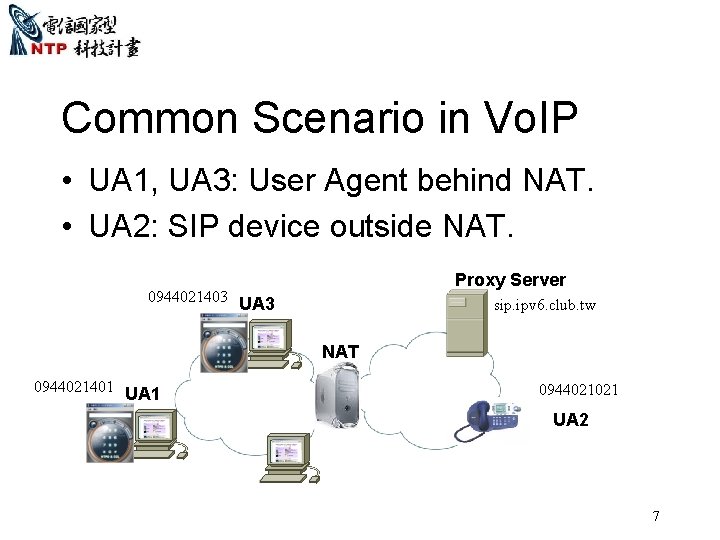
Common Scenario in Vo. IP • UA 1, UA 3: User Agent behind NAT. • UA 2: SIP device outside NAT. 0944021403 Proxy Server UA 3 sip. ipv 6. club. tw IPv 6 only 0944021401 NAT 0944021021 UA 2 IPv 6 only 7
Network Address Translator Computer A IP: 10. 0. 0. 1 Port: 80 IP: 200 Port: 10080 NAT Computer B IP: 10. 0. 0. 2 Port: 80 Public Internet IP: 200 Port: 20080 Public NIC DHCP Client PPPo. E Client Mapping Table 10. 0. 0. 1: 80 <-> 10080 10. 0. 0. 2: 80 <-> 20080 DHCP Server Private NIC 8
The Problem (1/2) • Because of its private address, the Via header and Contact address in SIP messages sent by UA 1 are incorrect. – With incorrect Via header, responses of messages sent by UA 1 cannot be routed back. – With incorrect Contact address in REGISTER messages, call server cannot inform UA 1 the incoming calls. • UA 1 can only act as a calling party. 9
Incorrect REGISTER Message 10
The Problem (2/2) • When UA 1 initiate a call, the connection information for media establishment in SDP are also incorrect. – The IP address in SDP is the private IP address on UA 1. – UA 2 gets a private peer address, the RTP packets from UA 2 cannot be routed to UA 1. – Media can only be sent from UA 1 to UA 2. 11
Incorrect Fields in SDP of INVITE Message 12
STUN (RFC 3489) • A mechanism for a socket behind NAT(s) to get its mapped (IP, port) on Internet. • We build a STUN Server from Vovida’s open source code to answer the queries from STUN clients. – Vovida STUN server 0. 8 RC • Our server is stun. ipv 6. club. tw – We also implemented the “Binding Lifetime Discovery” algorithm in RFC 3489 so that a STUN client can determine how frequently it needs to refresh the binding. • STUN mechanism in our SIP UA is developed from scratch, instead of the open source code. • In addition to calling out, our SIP UA can also receives incoming calls. 13
STUN Server • Allow clients to discover if it is behind a NAT, what type of NAT it is, and the public address & port NAT will use. • A Very Simple Protocol. Easy to implement. Little computing load. Client wants to receive packets at port 5060 Send a query to STUN server from port 5060 Client IP: 10. 0. 0. 1 Port: 5060 NAT STUN Server receives a packet from 200 port 12345 IP: 200 Port: 12345 STUN Server Port: 3478 STUN Server sends a response to client, telling him that his public address is 200 port 12345 14
Use STUN for SIP Registration • Use port 5060 to send a packet to STUN Server • Receive public address & port mapped to client: 5060 from STUN Server • Fill the SIP register message with client’s public address & port, send to proxy server Client IP: 10. 0. 0. 1 Port: 5060 NAT IP: 140. 113. 131. 72 Port: 56540 REGISTER sip: proxy. club. tw SIP/2. 0 Via: SIP/2. 0/UDP 140. 113. 131. 72: 56540 From: Solomon <sip: solomon@proxy. club. tw: 5060> To: Solomon <sip: solomon@proxy. club. tw: 5060> … Contact: Solomon <sip: solomon@140. 113. 131. 72: 56540> … STUN Server Port: 3478 Proxy Server Port: 5060 15
Corrected SIP Message 16
Use STUN for RTP • Send two STUN queries from RTP port (9000 & 9002) to STUN Server • Use replied public address & port in SDP Client IP: 10. 0. 0. 1 RTP Port: 9000 RTP Port: 9002 NAT INVITE … … Content-Type: application/sdp c=IN IP 4 140. 113. 131. 72 m=audio 56539 RTP/AVP 0 8 3 18 m=video 56541 RTP/AVP 34 96 IP: 140. 113. 131. 72 Port: 56539 Port: 56541 STUN Server Port: 3478 Proxy Server Port: 5060 UA RTP Port: 9000 RTP Port: 9002 17
Corrected SDP 18
WLAN-based GPRS Support Node (WGSN) 19
WGSN (WLAN-based GPRS Support Node) Architecture 20
WGSN Features • Service aspects – SIP-based Vo. IP • Access control and security aspects – SIM-based authentication • Roaming aspects – Utilizing the standard UMTS mobility management • Terminal aspects – A Windows laptop equipped with a smart card reader • Naming and address aspects – International Mobile Subscriber Identity (IMSI) • Charging and billing aspects – Offline charging and online charging based on Call Detail Record (CDR) 21
WGSN Protocol Stack EAP-GMM EAP-OL 802. 11 MS EAP-OL 802. 11 EAP MAP RADIUS TCAP UDP SCCP IP IP MTP 3 Ethernet MTP 2 L 1 L 1 AP WGSN HLR (a) WGSN Control Plane (b) WGSN User Plane 22
The MS Architecture 23
The WGSN Node Architecture 24
Future Work • OSA – Open Service Architecture • IMS – IP Multimedia Subsystem • IPv 6 – IP Version 6 25
Application Service Development Platform in Next Year — Open Service Architecture 26
WLAN + Cellular IMS Architecture HLR (HSS) OSA ENUM CSCF WGSN Roaming IP Multimedia Subsystem (IMS) Campus WLAN GPRS/3 G Phase I (now) Phase II Supported by other projects 27
Conclusion • By establishing a nation-wide Vo. IP testbed, NTP wishes to promote the convergence of voice and data services and encourage advanced researches in Taiwan. • SIP coverage in this year is approximately 50, 000 users. NTP plans to double the coverage in 2004, and hopefully extend the connectivity with SIP. edu project in Internet 2. • STUN proves to be a good solution for non-symmetric NAT. We are still surveying mechanisms for traversing symmetric NAT. • WGSN can be plugged in any 3 G core network as being considered as a separate GPRS network. With the adoption of WGSN, it can help mobile operators facilitating the provisioning of WLAN and Vo. IP 28 services.