inflections The regular plural suffix s is added
- Slides: 13
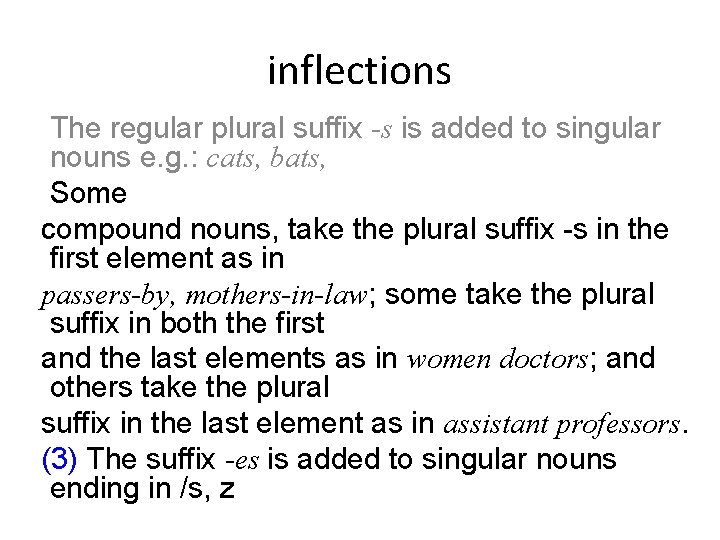
inflections The regular plural suffix -s is added to singular nouns e. g. : cats, bats, Some compound nouns, take the plural suffix -s in the first element as in passers-by, mothers-in-law; some take the plural suffix in both the first and the last elements as in women doctors; and others take the plural suffix in the last element as in assistant professors. (3) The suffix -es is added to singular nouns ending in /s, z
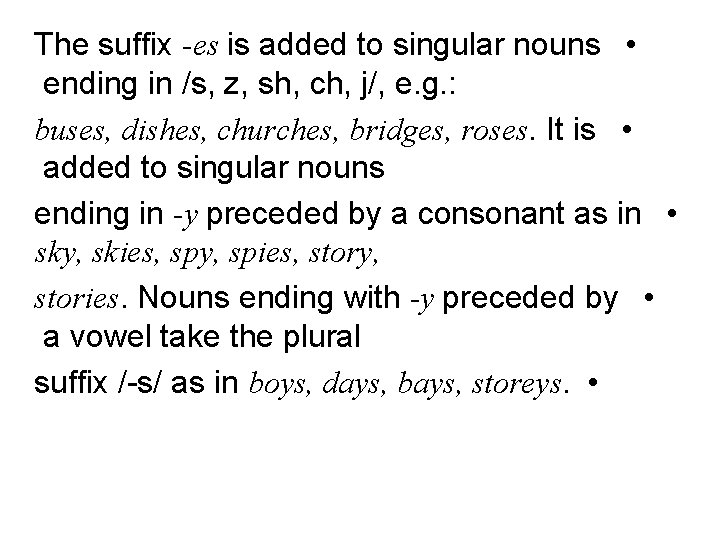
The suffix -es is added to singular nouns • ending in /s, z, sh, ch, j/, e. g. : buses, dishes, churches, bridges, roses. It is • added to singular nouns ending in -y preceded by a consonant as in • sky, skies, spy, spies, story, stories. Nouns ending with -y preceded by • a vowel take the plural suffix /-s/ as in boys, days, bays, storeys. •
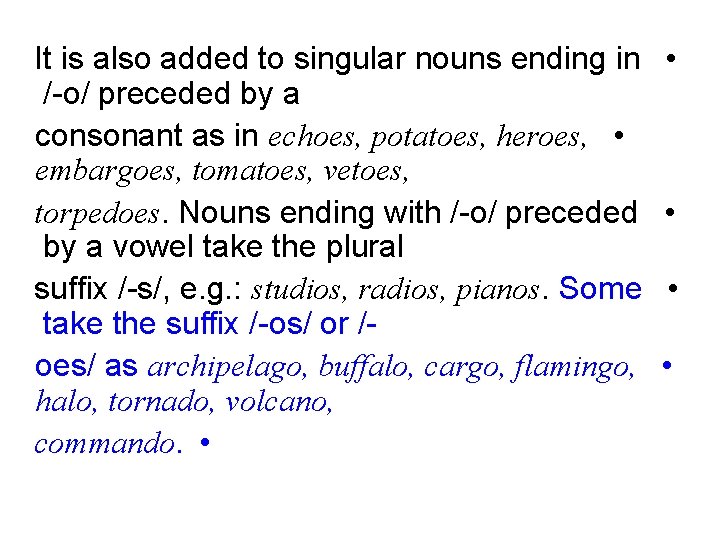
It is also added to singular nouns ending in /-o/ preceded by a consonant as in echoes, potatoes, heroes, • embargoes, tomatoes, vetoes, torpedoes. Nouns ending with /-o/ preceded by a vowel take the plural suffix /-s/, e. g. : studios, radios, pianos. Some take the suffix /-os/ or /oes/ as archipelago, buffalo, cargo, flamingo, halo, tornado, volcano, commando. • • •
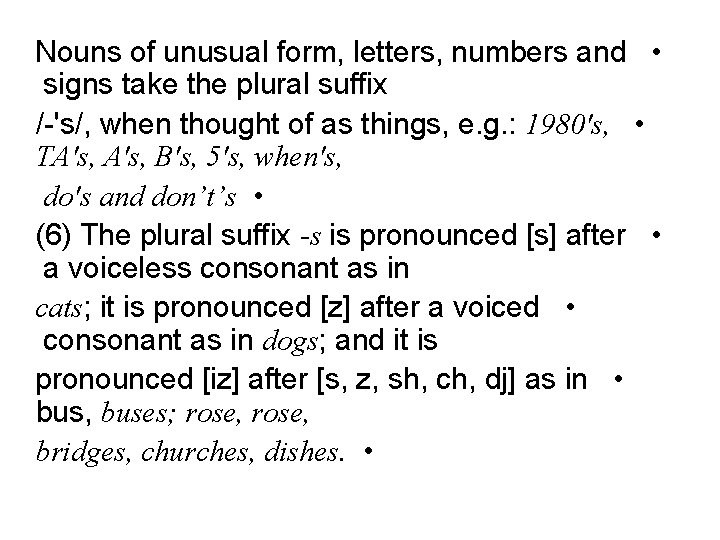
Nouns of unusual form, letters, numbers and • signs take the plural suffix /-'s/, when thought of as things, e. g. : 1980's, • TA's, B's, 5's, when's, do's and don’t’s • (6) The plural suffix -s is pronounced [s] after • a voiceless consonant as in cats; it is pronounced [z] after a voiced • consonant as in dogs; and it is pronounced [iz] after [s, z, sh, ch, dj] as in • bus, buses; rose, bridges, churches, dishes. •
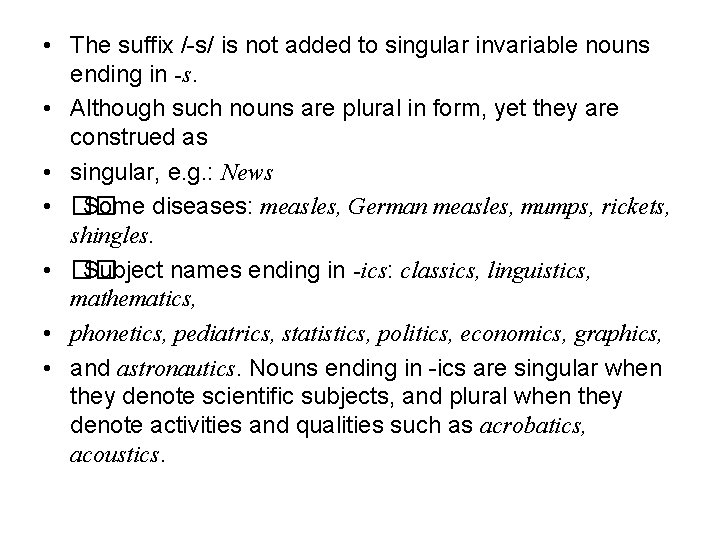
• The suffix /-s/ is not added to singular invariable nouns ending in -s. • Although such nouns are plural in form, yet they are construed as • singular, e. g. : News • �� Some diseases: measles, German measles, mumps, rickets, shingles. • �� Subject names ending in -ics: classics, linguistics, mathematics, • phonetics, pediatrics, statistics, politics, economics, graphics, • and astronautics. Nouns ending in -ics are singular when they denote scientific subjects, and plural when they denote activities and qualities such as acrobatics, acoustics.
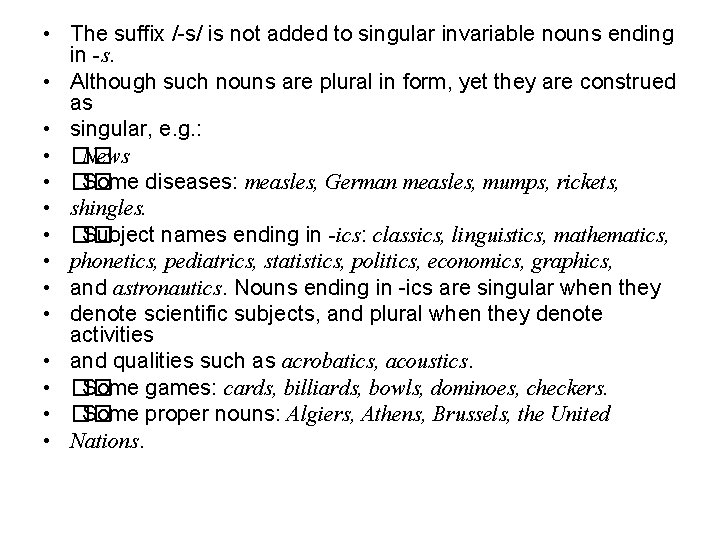
• The suffix /-s/ is not added to singular invariable nouns ending in -s. • Although such nouns are plural in form, yet they are construed as • singular, e. g. : • �� News • �� Some diseases: measles, German measles, mumps, rickets, • shingles. • �� Subject names ending in -ics: classics, linguistics, mathematics, • phonetics, pediatrics, statistics, politics, economics, graphics, • and astronautics. Nouns ending in -ics are singular when they • denote scientific subjects, and plural when they denote activities • and qualities such as acrobatics, acoustics. • �� Some games: cards, billiards, bowls, dominoes, checkers. • �� Some proper nouns: Algiers, Athens, Brussels, the United • Nations.
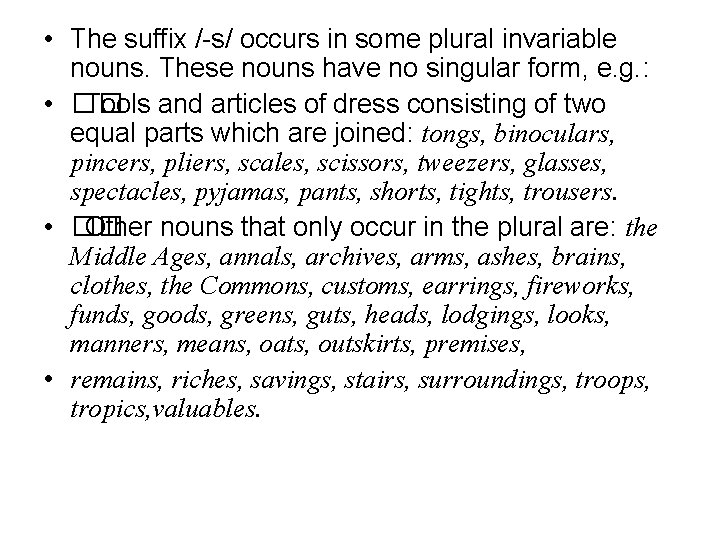
• The suffix /-s/ occurs in some plural invariable nouns. These nouns have no singular form, e. g. : • �� Tools and articles of dress consisting of two equal parts which are joined: tongs, binoculars, pincers, pliers, scales, scissors, tweezers, glasses, spectacles, pyjamas, pants, shorts, tights, trousers. • �� Other nouns that only occur in the plural are: the Middle Ages, annals, archives, arms, ashes, brains, clothes, the Commons, customs, earrings, fireworks, funds, goods, greens, guts, heads, lodgings, looks, manners, means, oats, outskirts, premises, • remains, riches, savings, stairs, surroundings, troops, tropics, valuables.
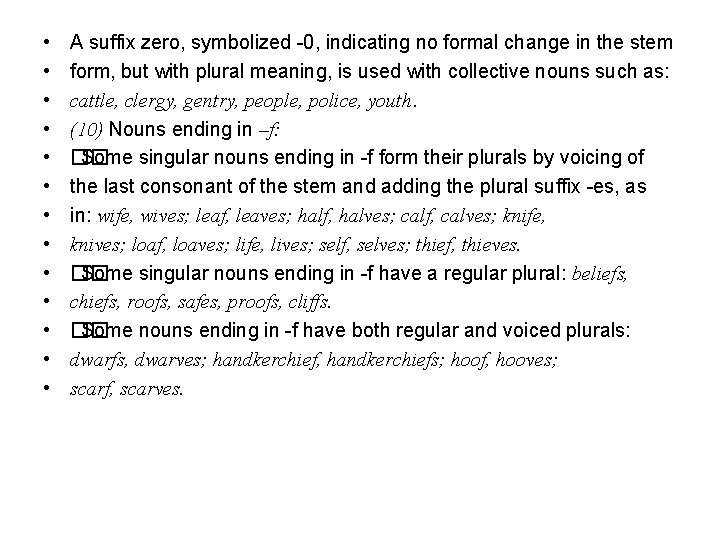
• • • • A suffix zero, symbolized -0, indicating no formal change in the stem form, but with plural meaning, is used with collective nouns such as: cattle, clergy, gentry, people, police, youth. (10) Nouns ending in –f: �� Some singular nouns ending in -f form their plurals by voicing of the last consonant of the stem and adding the plural suffix -es, as in: wife, wives; leaf, leaves; half, halves; calf, calves; knife, knives; loaf, loaves; life, lives; self, selves; thief, thieves. �� Some singular nouns ending in -f have a regular plural: beliefs, chiefs, roofs, safes, proofs, cliffs. �� Some nouns ending in -f have both regular and voiced plurals: dwarfs, dwarves; handkerchief, handkerchiefs; hoof, hooves; scarf, scarves.
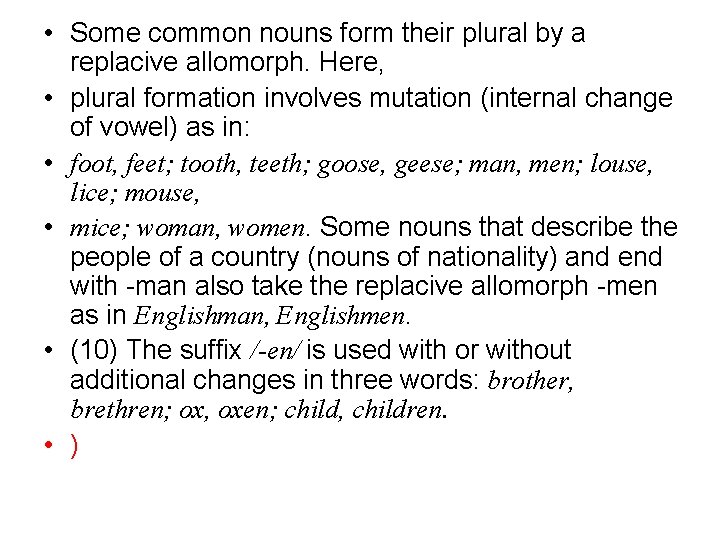
• Some common nouns form their plural by a replacive allomorph. Here, • plural formation involves mutation (internal change of vowel) as in: • foot, feet; tooth, teeth; goose, geese; man, men; louse, lice; mouse, • mice; woman, women. Some nouns that describe the people of a country (nouns of nationality) and end with -man also take the replacive allomorph -men as in Englishman, Englishmen. • (10) The suffix /-en/ is used with or without additional changes in three words: brother, brethren; ox, oxen; child, children. • )
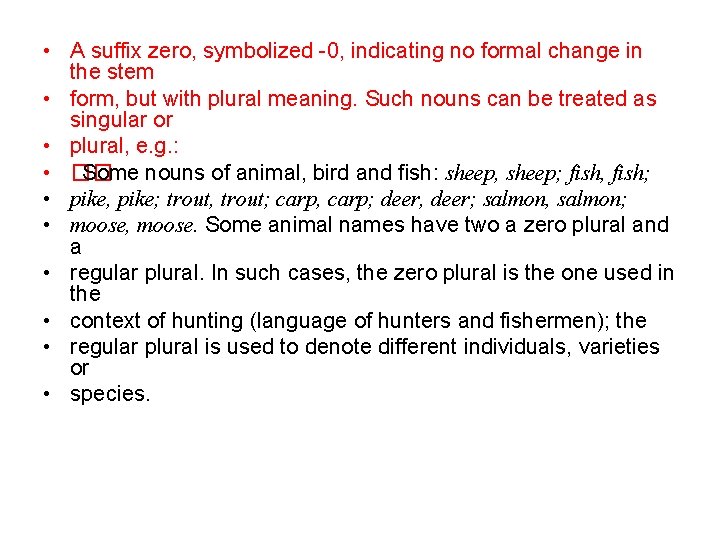
• A suffix zero, symbolized -0, indicating no formal change in the stem • form, but with plural meaning. Such nouns can be treated as singular or • plural, e. g. : • �� Some nouns of animal, bird and fish: sheep, sheep; fish, fish; • pike, pike; trout, trout; carp, carp; deer, deer; salmon, salmon; • moose, moose. Some animal names have two a zero plural and a • regular plural. In such cases, the zero plural is the one used in the • context of hunting (language of hunters and fishermen); the • regular plural is used to denote different individuals, varieties or • species.
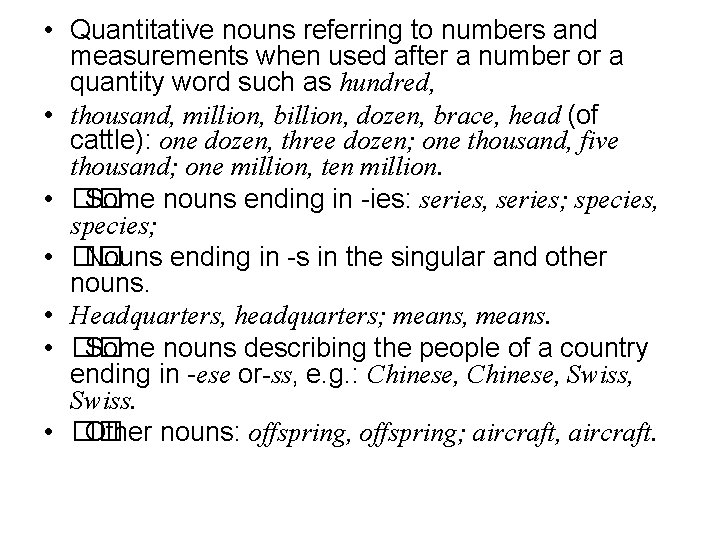
• Quantitative nouns referring to numbers and measurements when used after a number or a quantity word such as hundred, • thousand, million, billion, dozen, brace, head (of cattle): one dozen, three dozen; one thousand, five thousand; one million, ten million. • �� Some nouns ending in -ies: series, series; species, species; • �� Nouns ending in -s in the singular and other nouns. • Headquarters, headquarters; means, means. • �� Some nouns describing the people of a country ending in -ese or-ss, e. g. : Chinese, Swiss, Swiss. • �� Other nouns: offspring, offspring; aircraft, aircraft.
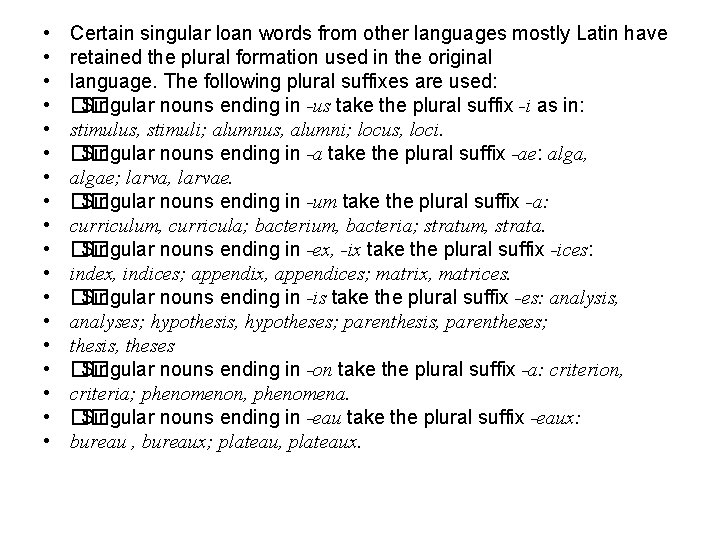
• • • • • Certain singular loan words from other languages mostly Latin have retained the plural formation used in the original language. The following plural suffixes are used: �� Singular nouns ending in -us take the plural suffix -i as in: stimulus, stimuli; alumnus, alumni; locus, loci. �� Singular nouns ending in -a take the plural suffix -ae: alga, algae; larva, larvae. �� Singular nouns ending in -um take the plural suffix -a: curriculum, curricula; bacterium, bacteria; stratum, strata. �� Singular nouns ending in -ex, -ix take the plural suffix -ices: index, indices; appendix, appendices; matrix, matrices. �� Singular nouns ending in -is take the plural suffix -es: analysis, analyses; hypothesis, hypotheses; parenthesis, parentheses; thesis, theses �� Singular nouns ending in -on take the plural suffix -a: criterion, criteria; phenomenon, phenomena. �� Singular nouns ending in -eau take the plural suffix -eaux: bureau , bureaux; plateau, plateaux.
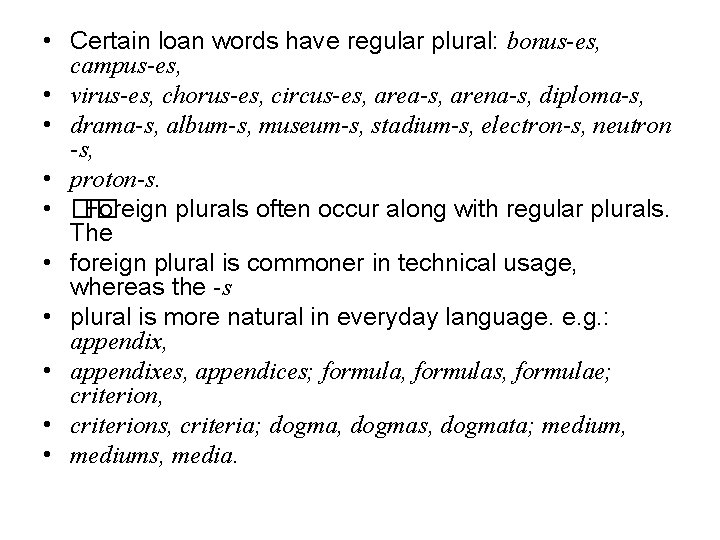
• Certain loan words have regular plural: bonus-es, campus-es, • virus-es, chorus-es, circus-es, area-s, arena-s, diploma-s, • drama-s, album-s, museum-s, stadium-s, electron-s, neutron -s, • proton-s. • �� Foreign plurals often occur along with regular plurals. The • foreign plural is commoner in technical usage, whereas the -s • plural is more natural in everyday language. e. g. : appendix, • appendixes, appendices; formula, formulas, formulae; criterion, • criterions, criteria; dogma, dogmas, dogmata; medium, • mediums, media.