Inequality Economic and Social Perspectives Teresa Meade and



- Slides: 31
Inequality Economic and Social Perspectives Teresa Meade and Eshragh Motahar Fall 2015
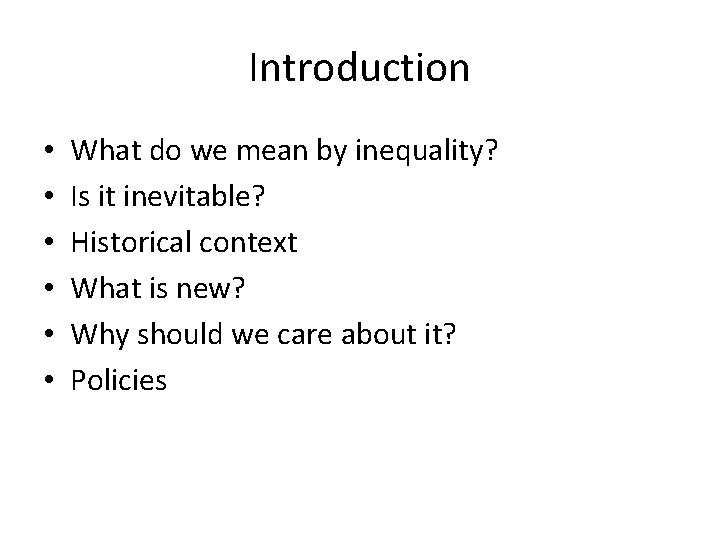
Introduction • • • What do we mean by inequality? Is it inevitable? Historical context What is new? Why should we care about it? Policies
Methodological Issues • “Opinion” vs. evidence-based critical analysis • Correlation vs. causation
Thomas Piketty • Book published in Spring 2014 • Capital in the Twenty-First Century • Piketty mania: how an economics lecture became the hottest gig in town • http: //www. theguardian. com/books/2014/jun/17/thomas-piketty-lse-capitalism-talk
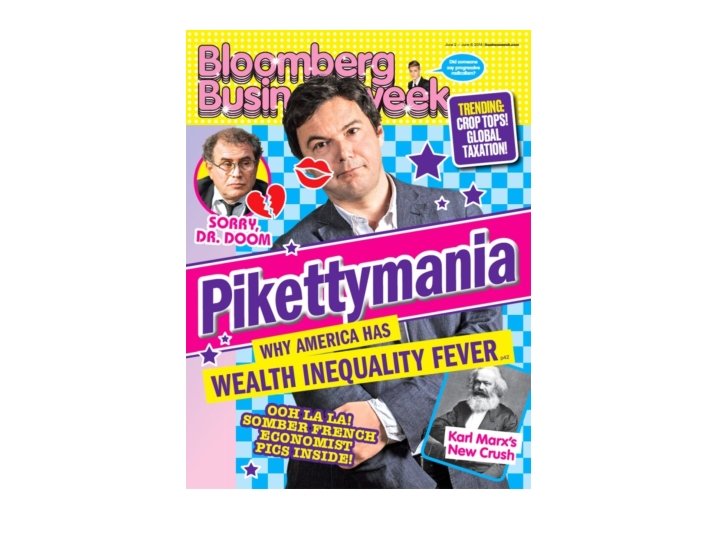
Pikettymania • A specter is haunting Europe and the U. S. —the specter of plutocracy. In Britain, Deputy Prime Minister Nick Clegg has suggested the moment has arrived to consider a wealth tax. In France, which already has one, plans to ease its bite were recently canceled. Even in the more timid precincts of Washington, you cannot swing a V for Vendetta mask without hitting a think tank panel on inequality. Everyone, it seems, is worried we are shortly headed for a world in which a handful of rich people will own everything, and the rest are forced to rent their and water from Mark Zuckerberg. • http: //www. businessweek. com/printer/articles/204120 -pikettys-capital-an-economists-inequality-ideas-are-all-the-rage
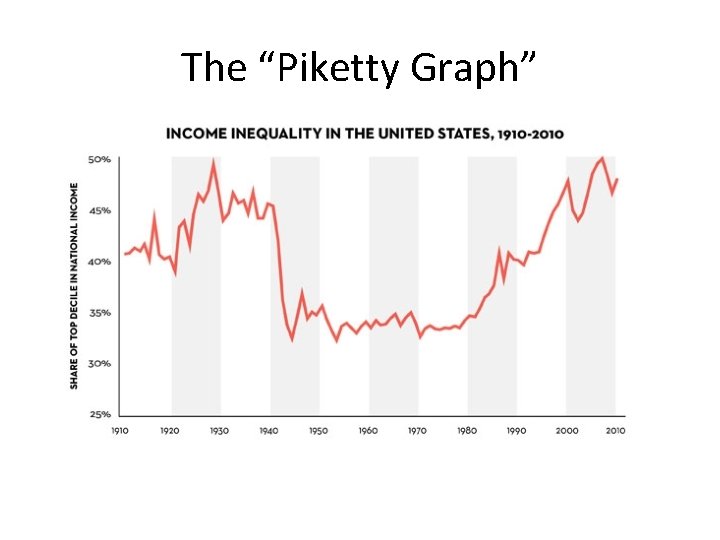
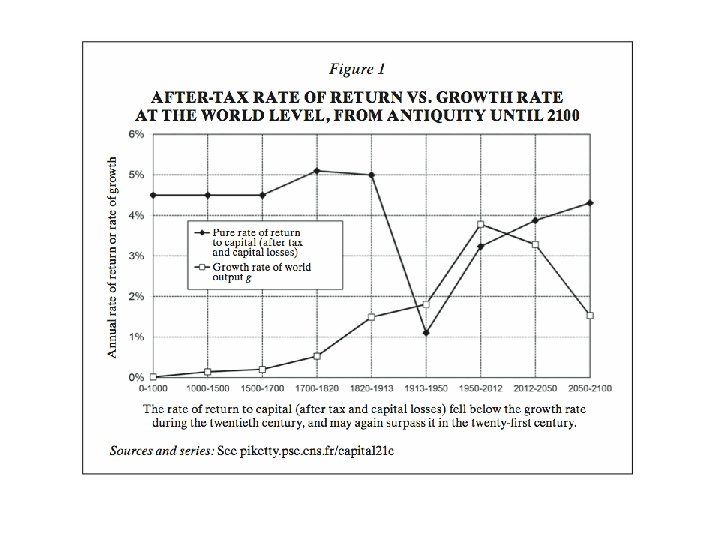
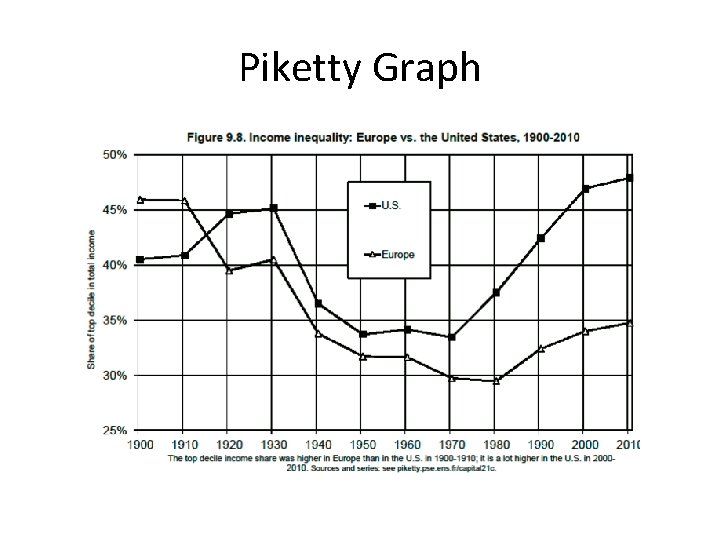
The “Piketty Graph”
Graphs • Piketty on the U. S. (in one graph) • http: //scalar. usc. edu/works/growing-apart-a-political-history-of-american-inequality/index • Other indicators – [scroll down]
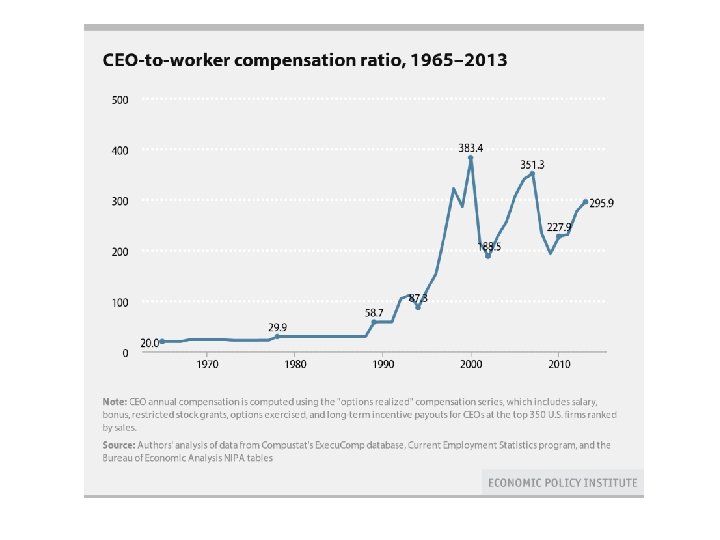
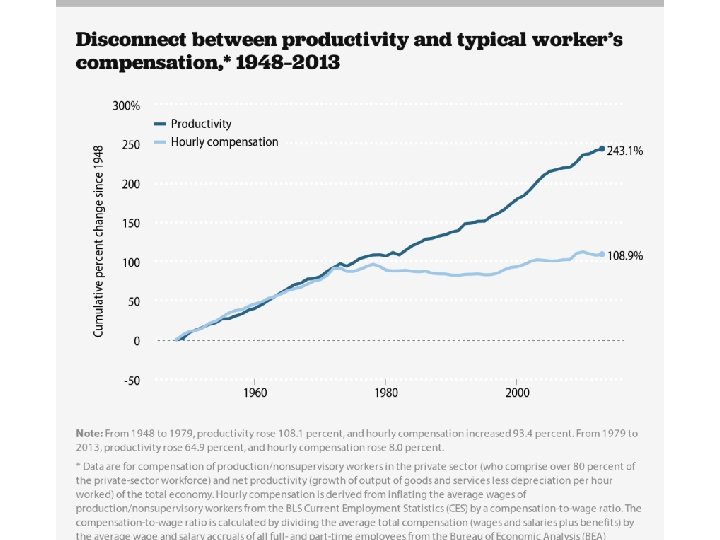
CEO Pay • These U. S. CEOs Make a Lot More Money Than Their Workers • http: //www. bloomberg. com/news/articles/2015 -08 -13/these-ceos-make-the-most-money-compared-with-their-workers • Average CEO pay at the 350 largest U. S. companies by revenue surged 997 percent from 1978 to 2014, while the compensation of non-supervisory employees rose 10. 9 percent, according to the Economic Policy Institute, a research group that advocates for workers.
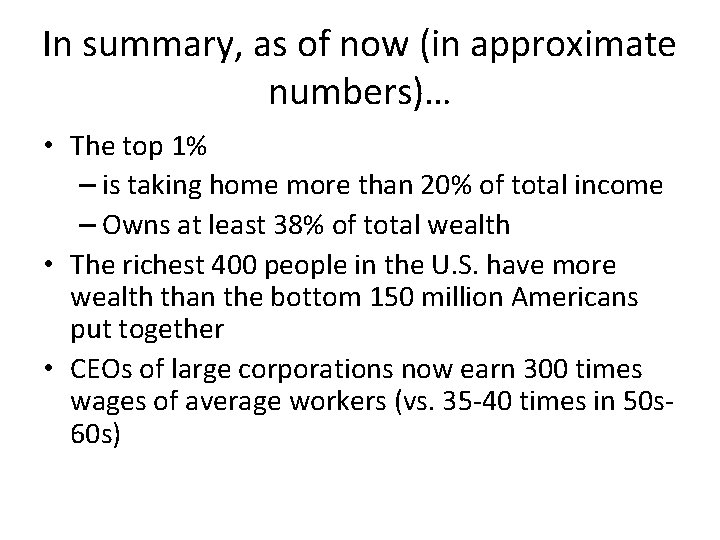
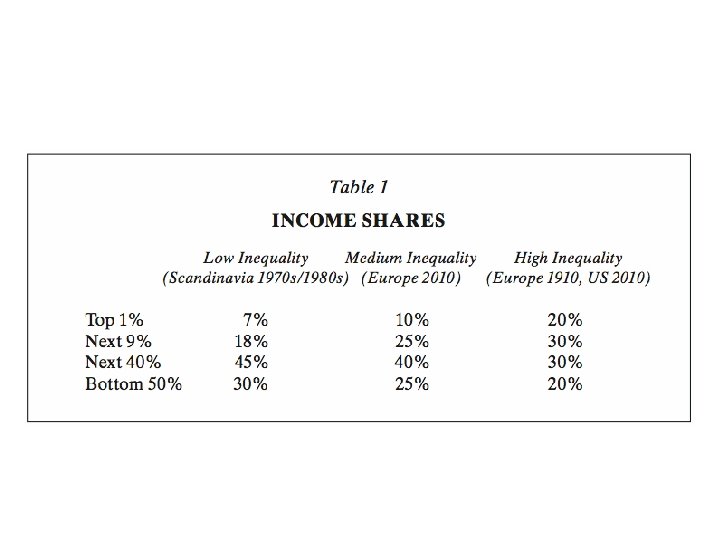
In summary, as of now (in approximate numbers)… • The top 1% – is taking home more than 20% of total income – Owns at least 38% of total wealth • The richest 400 people in the U. S. have more wealth than the bottom 150 million Americans put together • CEOs of large corporations now earn 300 times wages of average workers (vs. 35 -40 times in 50 s 60 s)
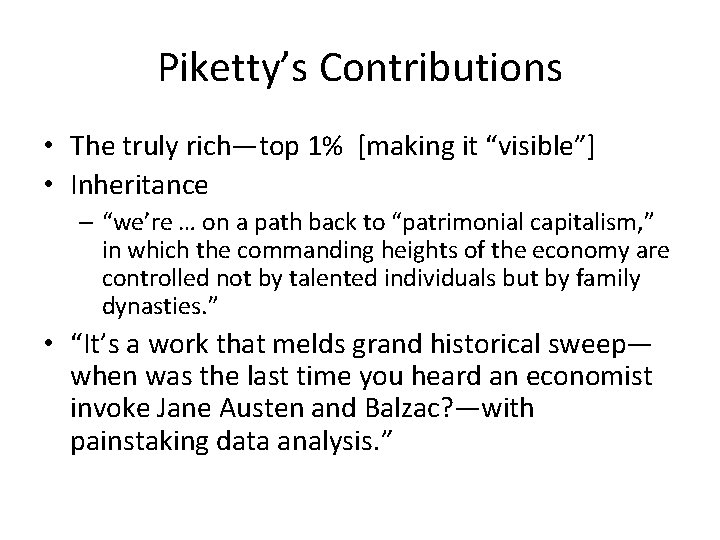
Piketty’s Contributions • The truly rich—top 1% [making it “visible”] • Inheritance – “we’re … on a path back to “patrimonial capitalism, ” in which the commanding heights of the economy are controlled not by talented individuals but by family dynasties. ” • “It’s a work that melds grand historical sweep— when was the last time you heard an economist invoke Jane Austen and Balzac? —with painstaking data analysis. ”
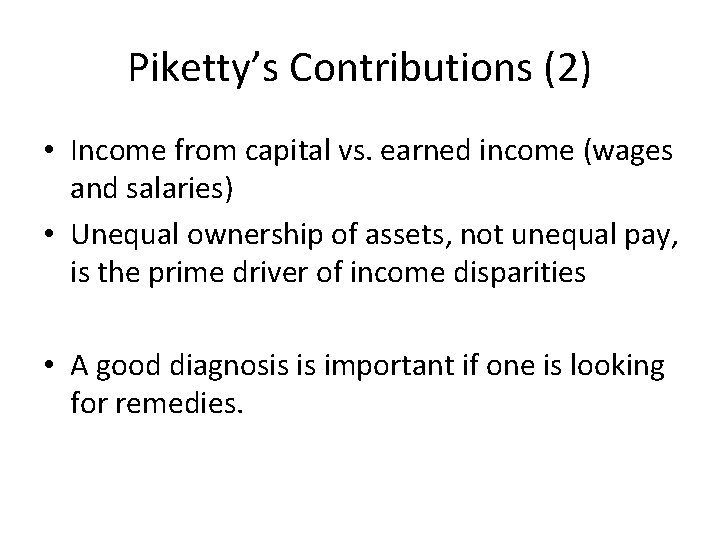
Piketty’s Contributions (2) • Income from capital vs. earned income (wages and salaries) • Unequal ownership of assets, not unequal pay, is the prime driver of income disparities • A good diagnosis is important if one is looking for remedies.
Why does it matter? • “Patrimonial capitalism” • Inequality of opportunity • Oligarchy • Lower growth • More unstable economy
Is U. S. becoming an Oligarchy? • “Fewer than four hundred families are responsible for almost half the money raised in the 2016 presidential campaign, a concentration of political donors that is unprecedented in the modern era. ” – The New York Times, August, 2015
Scholarly Sources (1) • IMF study finds inequality is damaging to economic growth • International Monetary Fund paper dismisses the argument that redistributing incomes is self-defeating
Scholarly Sources (2) We use consumption and balance sheet data disaggregated between the top 5% and the bottom 95% of US households by income to show that the bottom 95% went deeply into debt to mitigate the impact of their stagnant incomes on their consumption. We use micro data to calibrate an intrinsic Keynesian growth model and show that over a range of plausible parameter values, the rise in US household income inequality increased enough between the early 1980 s and 2000 s to cause the entire magnitude of the Great Recession and can explain the slow and prolonged recovery. • Authors Cynamon: Visiting Scholar at the Federal Reserve Bank of St. Louis Center for Household Financial Stability; Fazzari: Departments of Economics and Sociology at Washington University in St. Louis. *
…. and • Income Inequality Hurts Economic Growth – Forbes Magazine
Proposed Policies • Piketty: progressive wealth tax at the global scale, based upon automatic exchange of bank information • Piketty’s critics – Data – Predictions – Policy recommendations
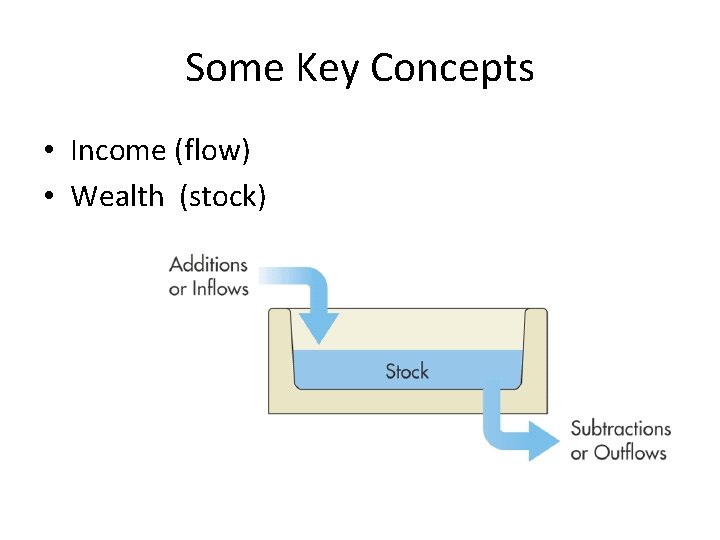
Some Key Concepts • Income (flow) • Wealth (stock)
The T-shirt http: //shop. comedycentral. com/The-Colbert-Report-r-g-Tee/M/B 00 KQ 2 T 9 KY. htm
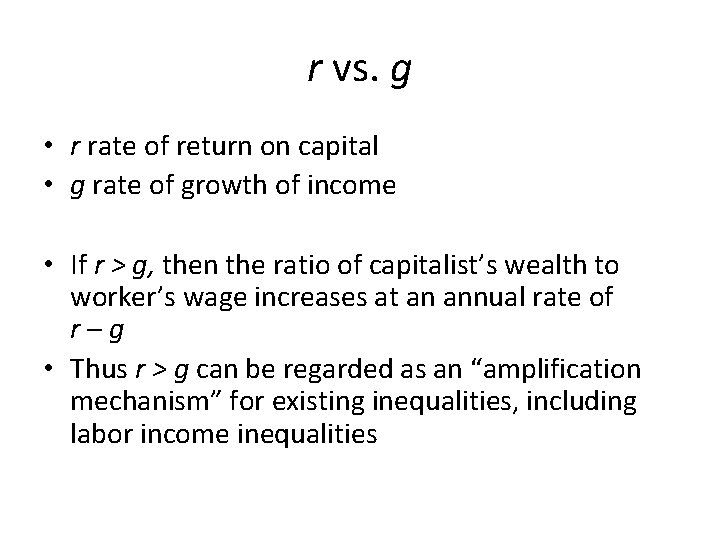
r vs. g • r rate of return on capital • g rate of growth of income • If r > g, then the ratio of capitalist’s wealth to worker’s wage increases at an annual rate of r–g • Thus r > g can be regarded as an “amplification mechanism” for existing inequalities, including labor income inequalities
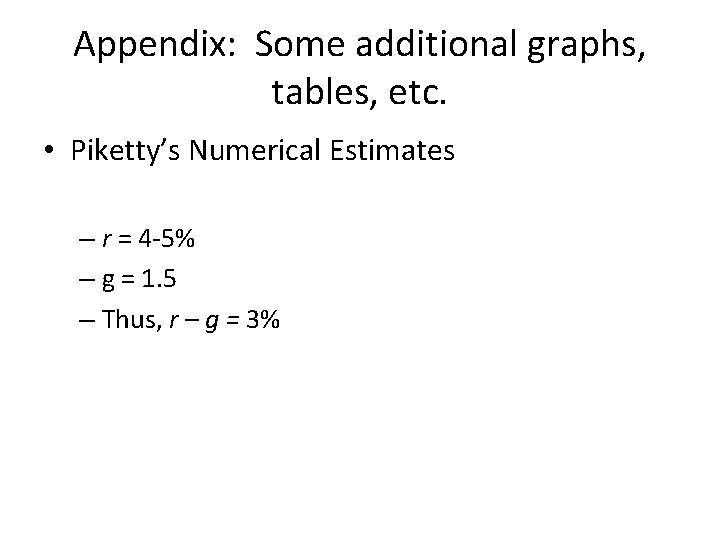
Appendix: Some additional graphs, tables, etc. • Piketty’s Numerical Estimates – r = 4 -5% – g = 1. 5 – Thus, r – g = 3%
CEO Pay • Money to Burn: How CEO Pay is Accelerating Climate Change • IPS: http: //www. ips-dc. org/wp-content/uploads/2015/09/EE 2015 -Money-To-Burn-Upd. pdf
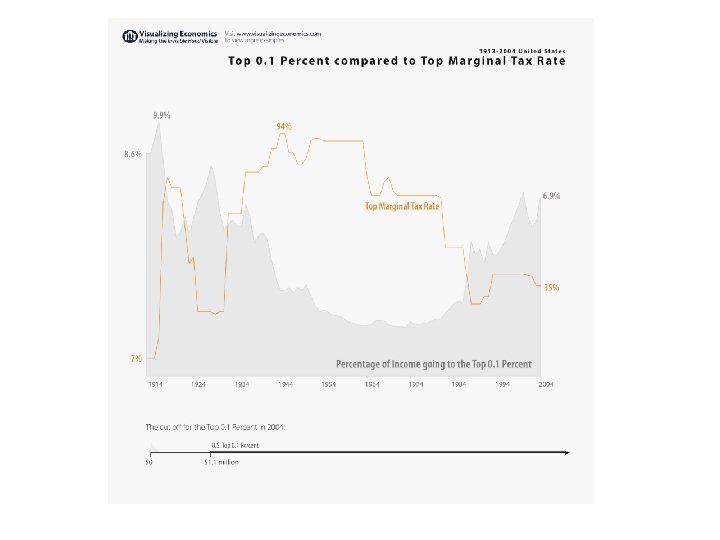
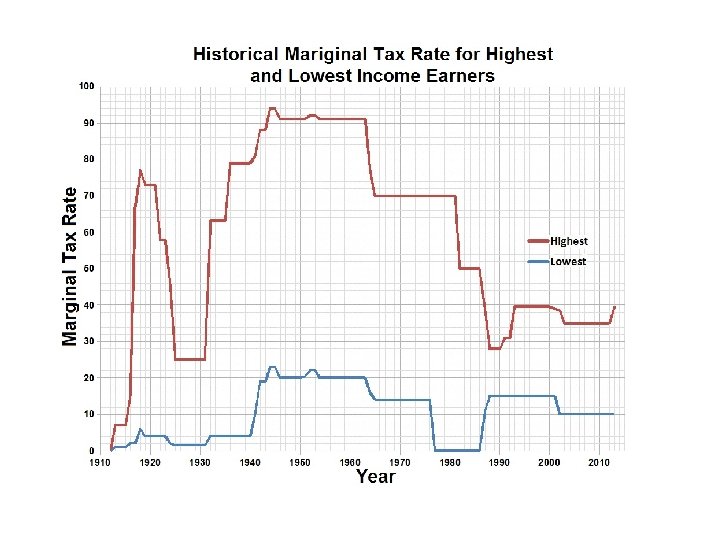
Marginal Tax Rates
Piketty Graph
Some Relevant Sites • http: //topincomes. parisschoolofeconomics. eu/#Graphic: • http: //www. gc. cuny. edu/Page-Elements/Academics-Research-Centers-Initiatives/Centers-and-Institutes/Luxembourg. Income-Study-Center • http: //inequality. org/ • http: //scalar. usc. edu/works/growing-apart-a-political-history-of-american-inequality/index