
The Digital Revolution and its Impact on Business
The Digital Revolution and its Impact on Business Performance November 2017

Introducing the Speakers Meade Monger Randall Eisenberg Digital Transformation Restructuring • Member of Alix leadership team for last 16+ years building technology offerings across all service offerings and markets • Successfully guiding large global companies through complex transformations and turnarounds as a senior advisor and interim officer • Designed and led many digital transformations to increase revenue and productivity, streamline and automate operations, and reduce costs across many industries, including oil & gas, retail, CPG and financial services • Advises management teams, boards of directors, equity sponsors, and creditor constituents in the transformation of stagnant or underperforming companies by way of effective leadership that rebuilds shareholder and stakeholder value. • Served in significant roles among the largest restructuring projects in history, including General Motors, Kmart, and World. Com • Holds a Masters in Management from Northwestern, is a Certified Turnaround Professional and a Certified Public Accountant • MBA, CPA, Masters of IT 2
The Digital Revolution has brought disruption, transformation and restructurings …with more to come Our era Restructuring considerations • The fourth industrial revolution • Is this creating more restructurings? • Born Digital Companies • • Traditional companies must digitally transform in order to compete Is it adding new restructuring considerations? How are traditional businesses impacted? What’s happening? • • Companies that have digitally transformed are more profitable – those that have not are suffering • Impacts coming from major digitally born companies • What are we seeing across industries? • What are some recent examples? There are two primary criteria in order to digitally transform − Operational Excellence – with underlying data platforms − Great Customer Experience – digital interactions/transactions • Many other key characteristics to consider 3
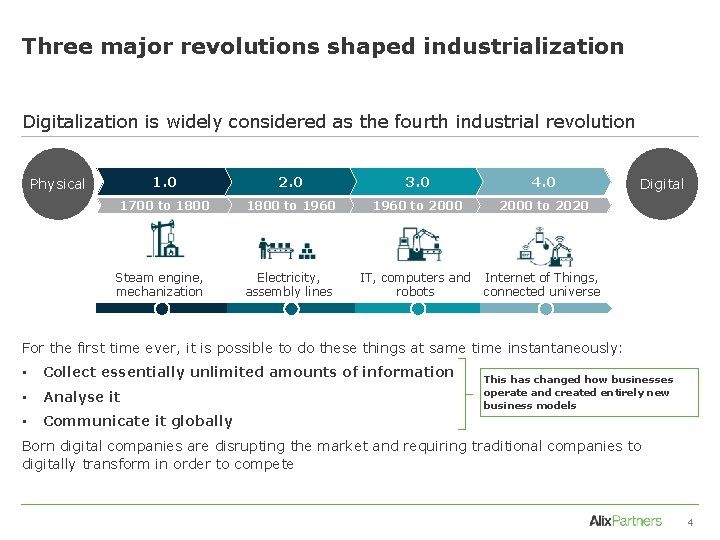
Three major revolutions shaped industrialization Digitalization is widely considered as the fourth industrial revolution 1. 0 2. 0 3. 0 4. 0 1700 to 1800 to 1960 to 2000 to 2020 Steam engine, mechanization Electricity, assembly lines Physical Digital IT, computers and Internet of Things, robots connected universe For the first time ever, it is possible to do these things at same time instantaneously: • Collect essentially unlimited amounts of information • Analyse it • Communicate it globally This has changed how businesses operate and created entirely new business models Born digital companies are disrupting the market and requiring traditional companies to digitally transform in order to compete 4
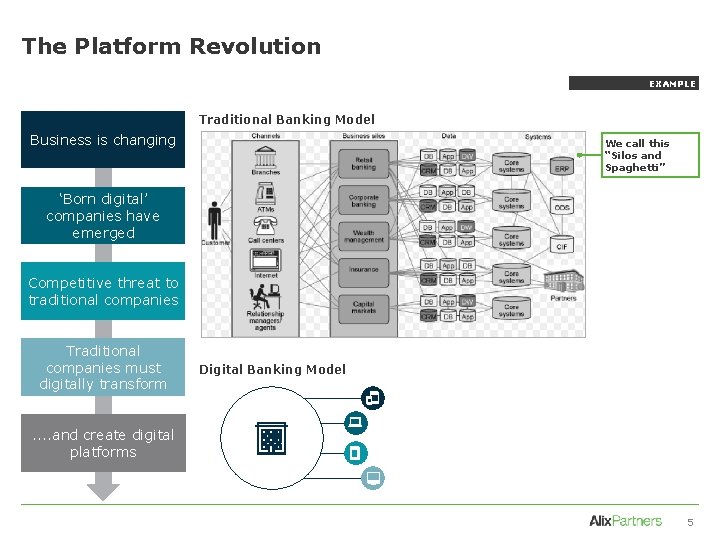
The Platform Revolution EXAMPLE Traditional Banking Model Business is changing We call this “Silos and Spaghetti” ‘Born digital’ companies have emerged Competitive threat to traditional companies Traditional companies must digitally transform Digital Banking Model . . and create digital platforms 5
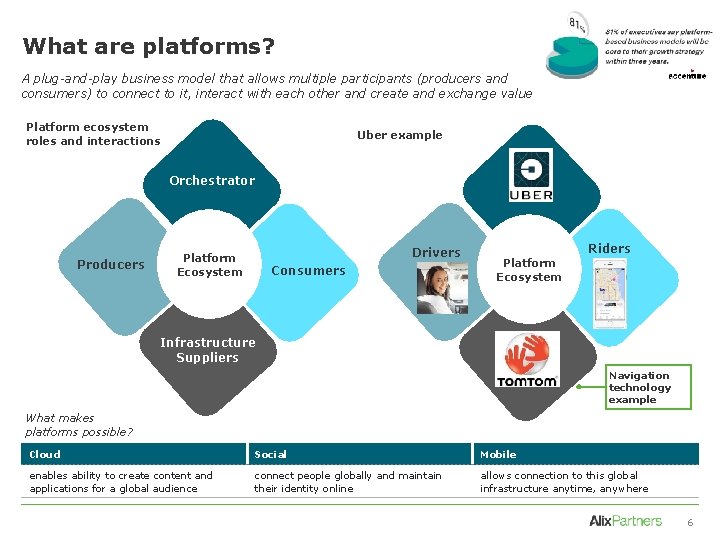
What are platforms? A plug-and-play business model that allows multiple participants (producers and consumers) to connect to it, interact with each other and create and exchange value Platform ecosystem roles and interactions Uber example Orchestrator Producers Drivers Platform Ecosystem Consumers Riders Platform Ecosystem Infrastructure Suppliers Navigation technology example What makes platforms possible? Cloud Social Mobile enables ability to create content and applications for a global audience connect people globally and maintain their identity online allows connection to this global infrastructure anytime, anywhere 6
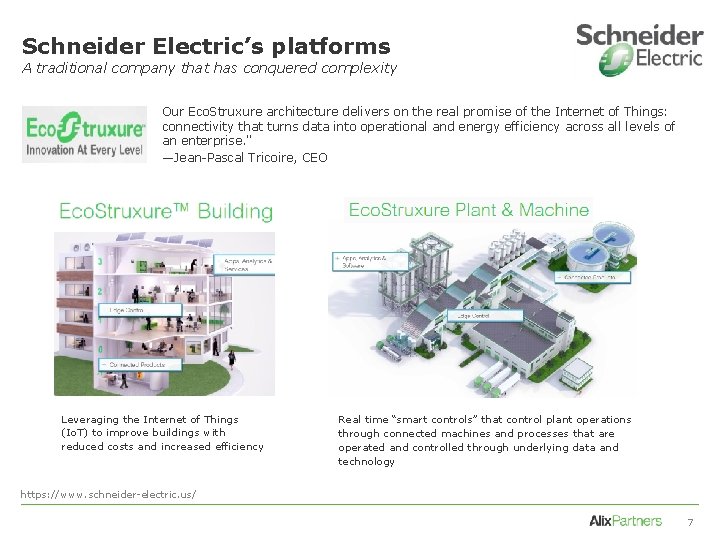
Schneider Electric’s platforms A traditional company that has conquered complexity Our Eco. Struxure architecture delivers on the real promise of the Internet of Things: connectivity that turns data into operational and energy efficiency across all levels of an enterprise. " —Jean-Pascal Tricoire, CEO Leveraging the Internet of Things (Io. T) to improve buildings with reduced costs and increased efficiency Real time “smart controls” that control plant operations through connected machines and processes that are operated and controlled through underlying data and technology https: //www. schneider-electric. us/ 7
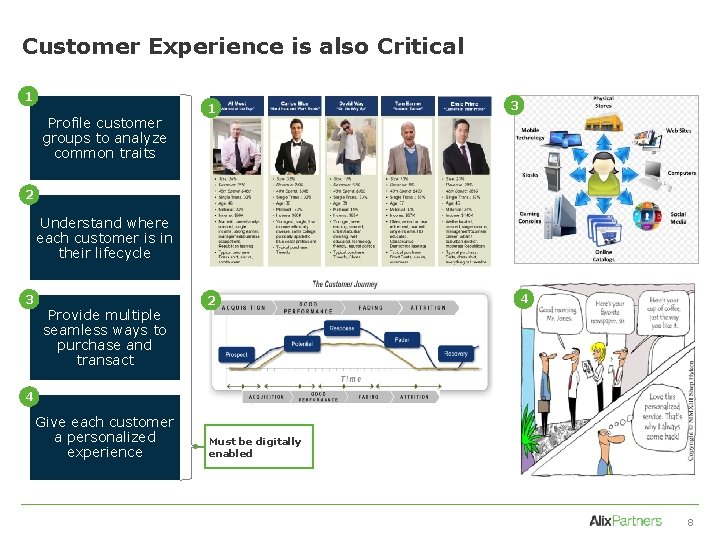
Customer Experience is also Critical 1 Profile customer groups to analyze common traits 1 3 2 Understand where each customer is in their lifecycle 3 Provide multiple seamless ways to purchase and transact 2 4 4 Give each customer a personalized experience Must be digitally enabled 8
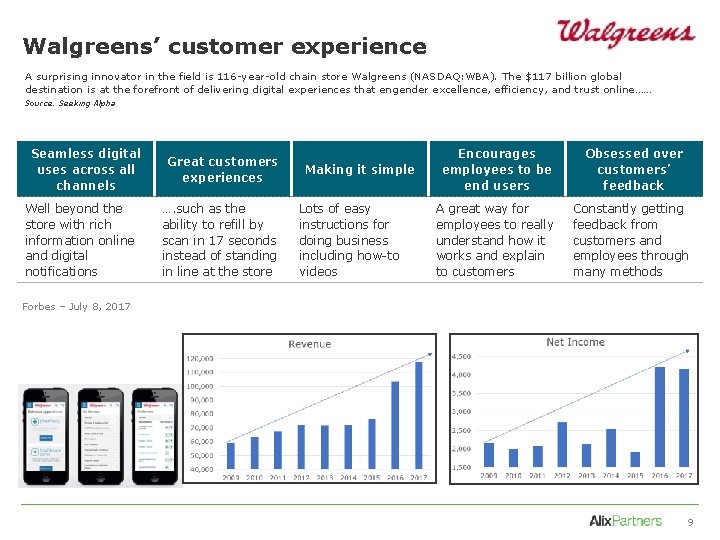
Walgreens’ customer experience A surprising innovator in the field is 116 -year-old chain store Walgreens (NASDAQ: WBA). The $117 billion global destination is at the forefront of delivering digital experiences that engender excellence, efficiency, and trust online…… Source: Seeking Alpha Seamless digital uses across all channels Great customers experiences Well beyond the store with rich information online and digital notifications …. such as the ability to refill by scan in 17 seconds instead of standing in line at the store Making it simple Lots of easy instructions for doing business including how-to videos Encourages employees to be end users Obsessed over customers’ feedback A great way for employees to really understand how it works and explain to customers Constantly getting feedback from customers and employees through many methods Forbes – July 8, 2017 9
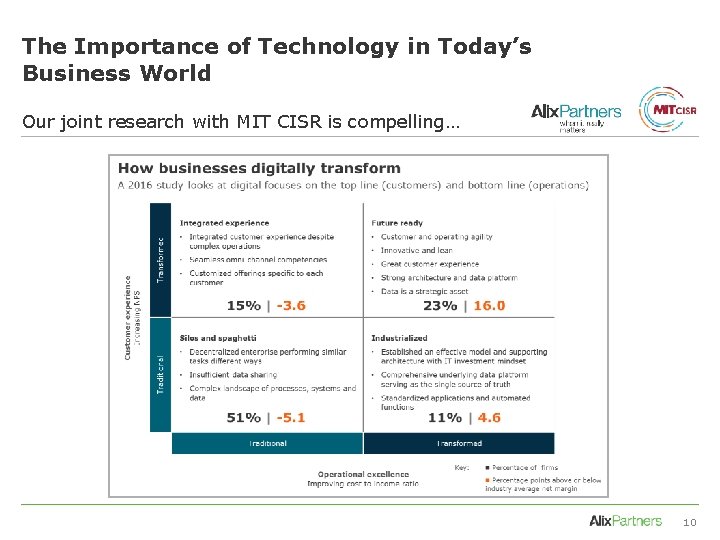
The Importance of Technology in Today’s Business World Our joint research with MIT CISR is compelling… 10
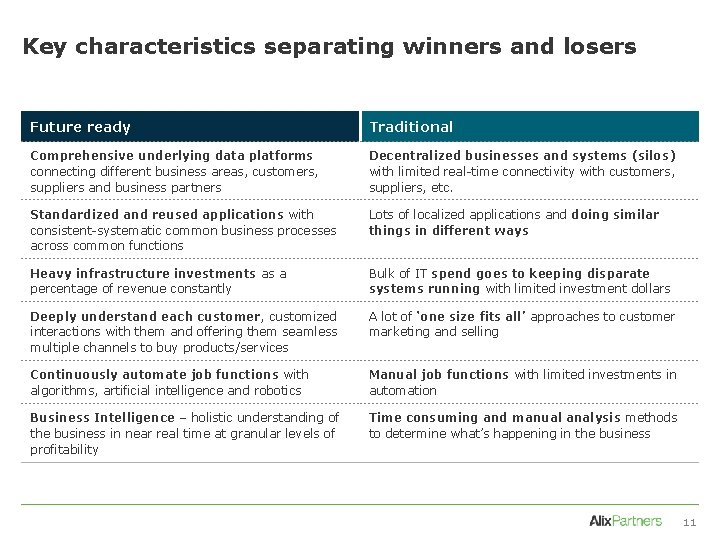
Key characteristics separating winners and losers Future ready Traditional Comprehensive underlying data platforms connecting different business areas, customers, suppliers and business partners Decentralized businesses and systems (silos) with limited real-time connectivity with customers, suppliers, etc. Standardized and reused applications with consistent-systematic common business processes across common functions Lots of localized applications and doing similar things in different ways Heavy infrastructure investments as a percentage of revenue constantly Bulk of IT spend goes to keeping disparate systems running with limited investment dollars Deeply understand each customer, customized interactions with them and offering them seamless multiple channels to buy products/services A lot of ‘one size fits all’ approaches to customer marketing and selling Continuously automate job functions with algorithms, artificial intelligence and robotics Manual job functions with limited investments in automation Business Intelligence – holistic understanding of the business in near real time at granular levels of profitability Time consuming and manual analysis methods to determine what’s happening in the business 11
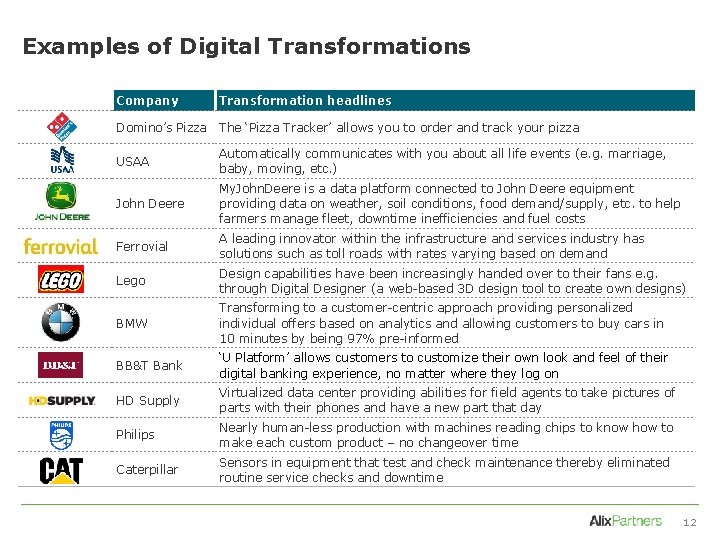
Examples of Digital Transformations Company Transformation headlines Domino’s Pizza The ‘Pizza Tracker’ allows you to order and track your pizza USAA Automatically communicates with you about all life events (e. g. marriage, baby, moving, etc. ) John Deere My. John. Deere is a data platform connected to John Deere equipment providing data on weather, soil conditions, food demand/supply, etc. to help farmers manage fleet, downtime inefficiencies and fuel costs Ferrovial A leading innovator within the infrastructure and services industry has solutions such as toll roads with rates varying based on demand Lego Design capabilities have been increasingly handed over to their fans e. g. through Digital Designer (a web-based 3 D design tool to create own designs) BMW Transforming to a customer-centric approach providing personalized individual offers based on analytics and allowing customers to buy cars in 10 minutes by being 97% pre-informed BB&T Bank ‘U Platform’ allows customers to customize their own look and feel of their digital banking experience, no matter where they log on HD Supply Virtualized data center providing abilities for field agents to take pictures of parts with their phones and have a new part that day Philips Nearly human-less production with machines reading chips to know how to make each custom product – no changeover time Caterpillar Sensors in equipment that test and check maintenance thereby eliminated routine service checks and downtime 12
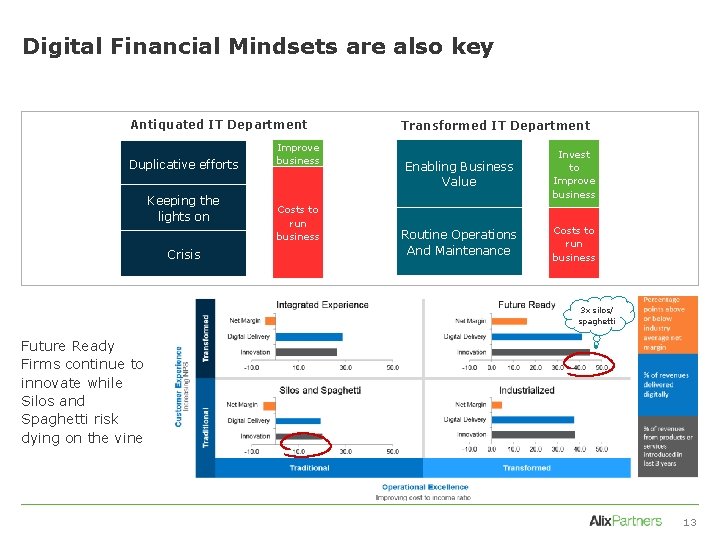
Digital Financial Mindsets are also key Antiquated IT Department Duplicative efforts Keeping the lights on Crisis Improve business Costs to run business Transformed IT Department Enabling Business Value Invest to Improve business Routine Operations And Maintenance Costs to run business 3 x silos/ spaghetti Future Ready Firms continue to innovate while Silos and Spaghetti risk dying on the vine 13
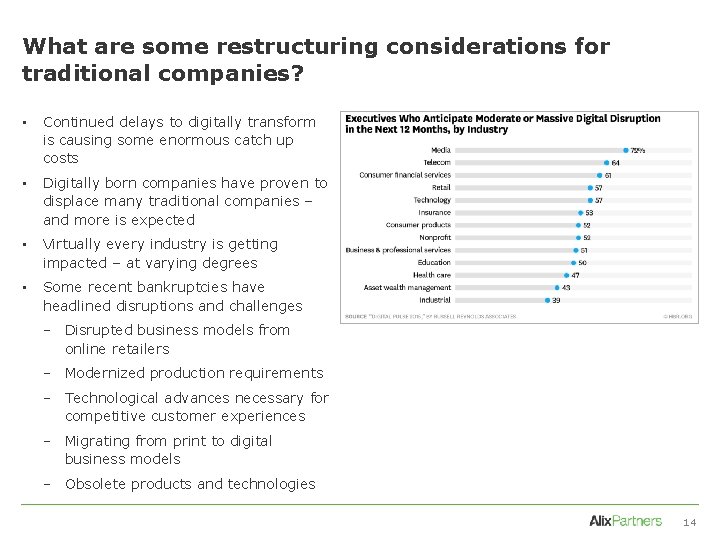
What are some restructuring considerations for traditional companies? • Continued delays to digitally transform is causing some enormous catch up costs • Digitally born companies have proven to displace many traditional companies – and more is expected • Virtually every industry is getting impacted – at varying degrees • Some recent bankruptcies have headlined disruptions and challenges − Disrupted business models from online retailers − Modernized production requirements − Technological advances necessary for competitive customer experiences − Migrating from print to digital business models − Obsolete products and technologies 14
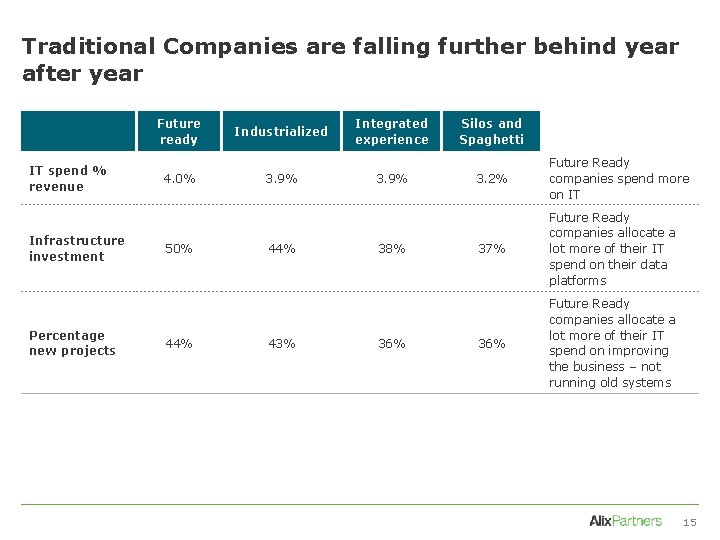
Traditional Companies are falling further behind year after year Future ready IT spend % revenue Infrastructure investment Percentage new projects 4. 0% 50% 44% Industrialized 3. 9% 44% 43% Integrated experience 3. 9% 38% 36% Silos and Spaghetti 3. 2% Future Ready companies spend more on IT 37% Future Ready companies allocate a lot more of their IT spend on their data platforms 36% Future Ready companies allocate a lot more of their IT spend on improving the business – not running old systems 15
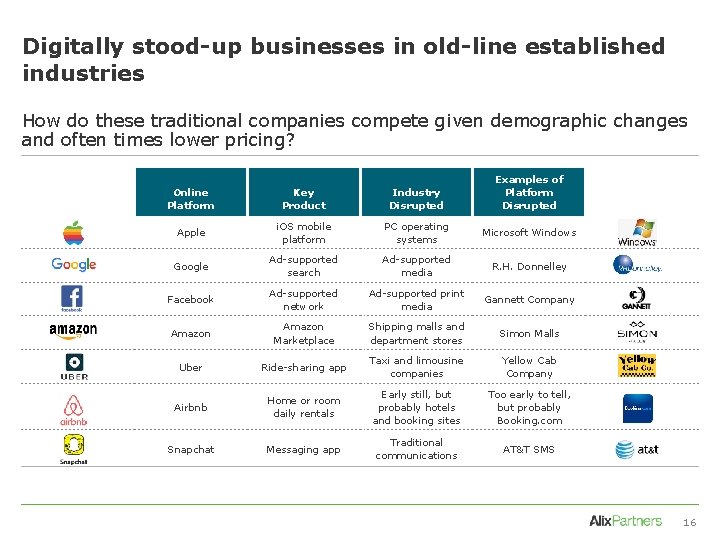
Digitally stood-up businesses in old-line established industries How do these traditional companies compete given demographic changes and often times lower pricing? Examples of Platform Disrupted Online Platform Key Product Industry Disrupted Apple i. OS mobile platform PC operating systems Microsoft Windows Google Ad-supported search Ad-supported media R. H. Donnelley Facebook Ad-supported network Ad-supported print media Gannett Company Amazon Marketplace Shipping malls and department stores Simon Malls Uber Ride-sharing app Taxi and limousine companies Yellow Cab Company Airbnb Home or room daily rentals Early still, but probably hotels and booking sites Too early to tell, but probably Booking. com Snapchat Messaging app Traditional communications AT&T SMS 16
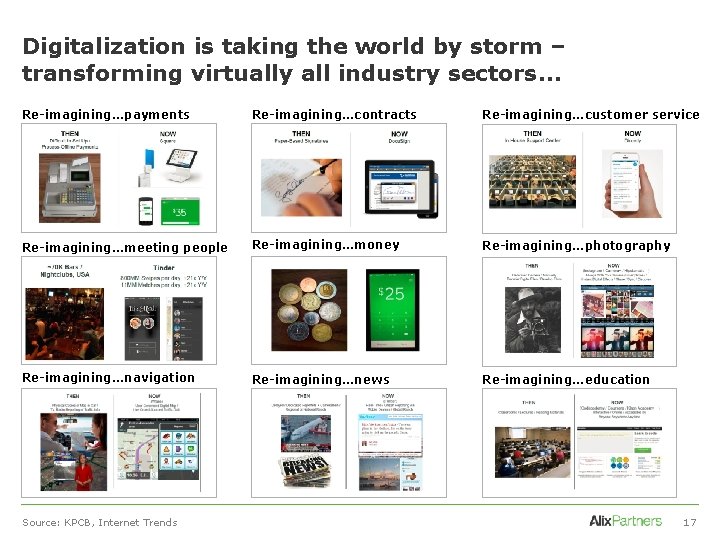
Digitalization is taking the world by storm – transforming virtually all industry sectors… Re-imagining…payments Re-imagining…contracts Re-imagining…customer service Re-imagining…meeting people Re-imagining…money Re-imagining…photography Re-imagining…navigation Re-imagining…news Re-imagining…education Source: KPCB, Internet Trends 17
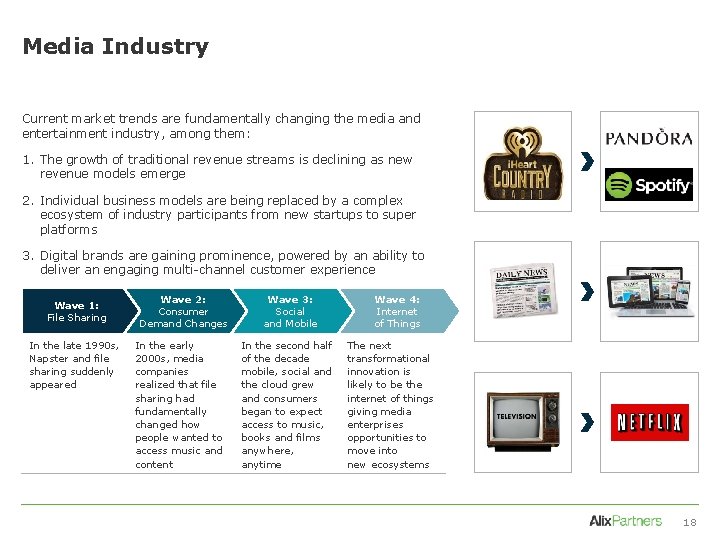
Media Industry Current market trends are fundamentally changing the media and entertainment industry, among them: 1. The growth of traditional revenue streams is declining as new revenue models emerge 2. Individual business models are being replaced by a complex ecosystem of industry participants from new startups to super platforms 3. Digital brands are gaining prominence, powered by an ability to deliver an engaging multi-channel customer experience Wave 1: File Sharing In the late 1990 s, Napster and file sharing suddenly appeared Wave 2: Consumer Demand Changes Wave 3: Social and Mobile In the early 2000 s, media companies realized that file sharing had fundamentally changed how people wanted to access music and content In the second half of the decade mobile, social and the cloud grew and consumers began to expect access to music, books and films anywhere, anytime Wave 4: Internet of Things The next transformational innovation is likely to be the internet of things giving media enterprises opportunities to move into new ecosystems 18
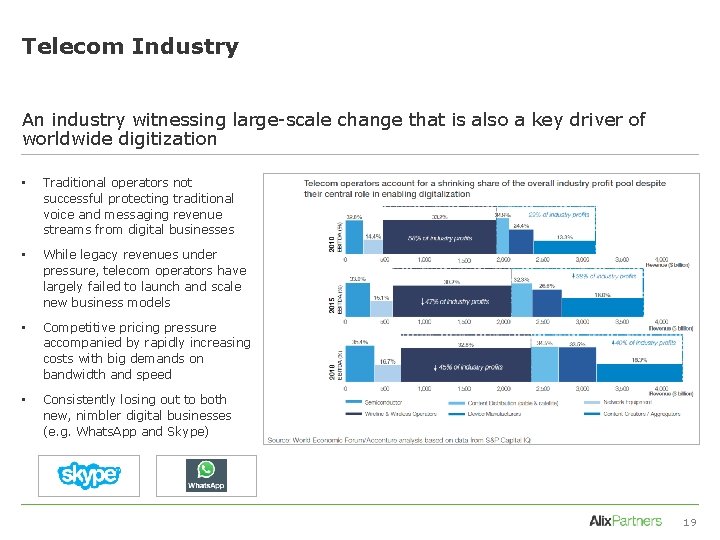
Telecom Industry An industry witnessing large-scale change that is also a key driver of worldwide digitization • Traditional operators not successful protecting traditional voice and messaging revenue streams from digital businesses • While legacy revenues under pressure, telecom operators have largely failed to launch and scale new business models • Competitive pricing pressure accompanied by rapidly increasing costs with big demands on bandwidth and speed • Consistently losing out to both new, nimbler digital businesses (e. g. Whats. App and Skype) 19
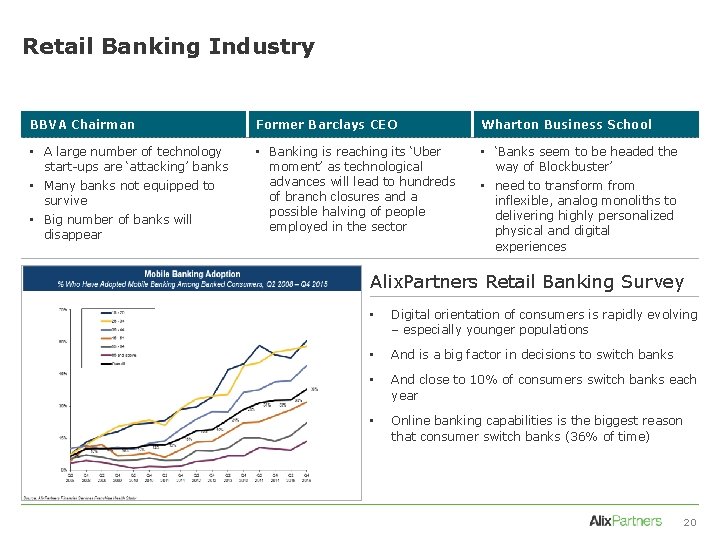
Retail Banking Industry BBVA Chairman Former Barclays CEO Wharton Business School • A large number of technology start-ups are ‘attacking’ banks • Banking is reaching its ‘Uber moment’ as technological advances will lead to hundreds of branch closures and a possible halving of people employed in the sector • ‘Banks seem to be headed the way of Blockbuster’ • Many banks not equipped to survive • Big number of banks will disappear • need to transform from inflexible, analog monoliths to delivering highly personalized physical and digital experiences Alix. Partners Retail Banking Survey • Digital orientation of consumers is rapidly evolving – especially younger populations • And is a big factor in decisions to switch banks • And close to 10% of consumers switch banks each year • Online banking capabilities is the biggest reason that consumer switch banks (36% of time) 20
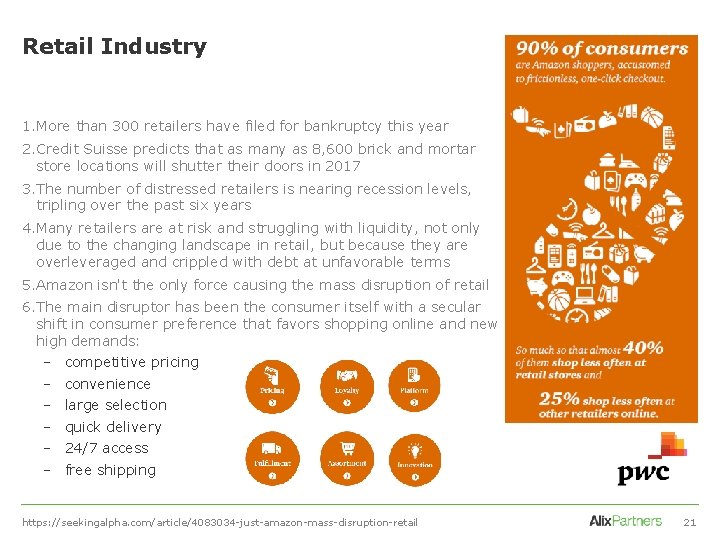
Retail Industry 1. More than 300 retailers have filed for bankruptcy this year 2. Credit Suisse predicts that as many as 8, 600 brick and mortar store locations will shutter their doors in 2017 3. The number of distressed retailers is nearing recession levels, tripling over the past six years 4. Many retailers are at risk and struggling with liquidity, not only due to the changing landscape in retail, but because they are overleveraged and crippled with debt at unfavorable terms 5. Amazon isn't the only force causing the mass disruption of retail 6. The main disruptor has been the consumer itself with a secular shift in consumer preference that favors shopping online and new high demands: − competitive pricing − convenience − large selection − quick delivery − 24/7 access − free shipping https: //seekingalpha. com/article/4083034 -just-amazon-mass-disruption-retail 21
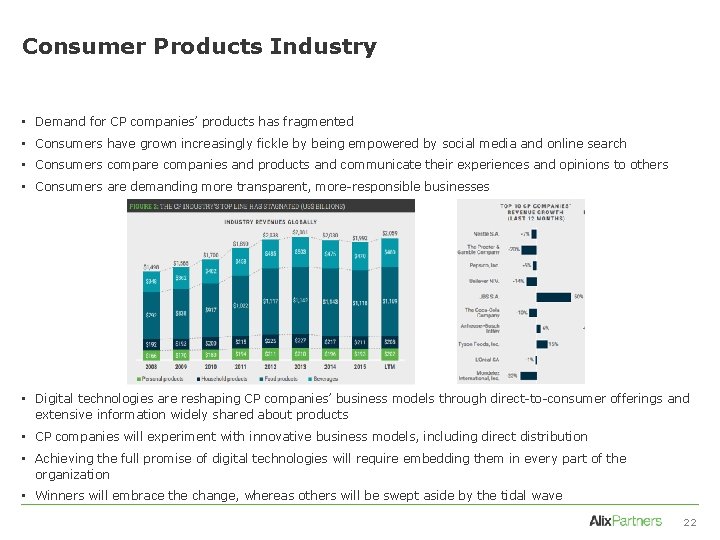
Consumer Products Industry • Demand for CP companies’ products has fragmented • Consumers have grown increasingly fickle by being empowered by social media and online search • Consumers compare companies and products and communicate their experiences and opinions to others • Consumers are demanding more transparent, more-responsible businesses • Digital technologies are reshaping CP companies’ business models through direct-to-consumer offerings and extensive information widely shared about products • CP companies will experiment with innovative business models, including direct distribution • Achieving the full promise of digital technologies will require embedding them in every part of the organization • Winners will embrace the change, whereas others will be swept aside by the tidal wave 22
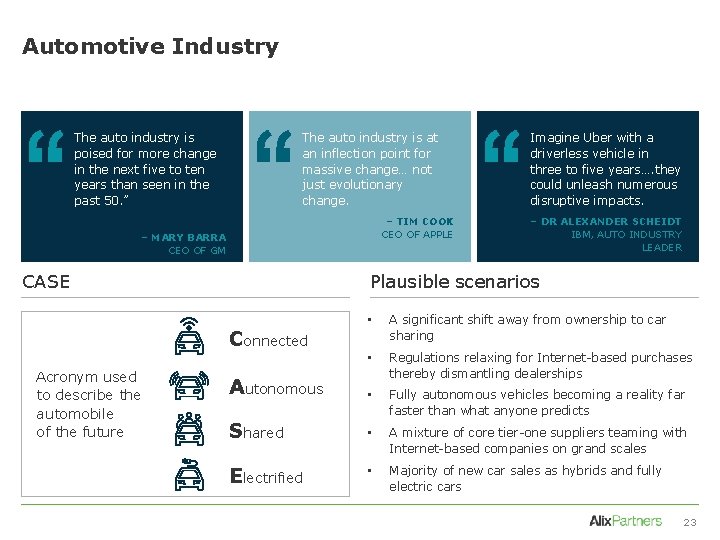
Automotive Industry The auto industry is poised for more change in the next five to ten years than seen in the past 50. ” The auto industry is at an inflection point for massive change… not just evolutionary change. – TIM COOK CEO OF APPLE – MARY BARRA CEO OF GM CASE – DR ALEXANDER SCHEIDT IBM, AUTO INDUSTRY LEADER Plausible scenarios • A significant shift away from ownership to car sharing • Autonomous Regulations relaxing for Internet-based purchases thereby dismantling dealerships • Shared Fully autonomous vehicles becoming a reality far faster than what anyone predicts • A mixture of core tier-one suppliers teaming with Internet-based companies on grand scales Electrified • Majority of new car sales as hybrids and fully electric cars Connected Acronym used to describe the automobile of the future Imagine Uber with a driverless vehicle in three to five years…. they could unleash numerous disruptive impacts. 23
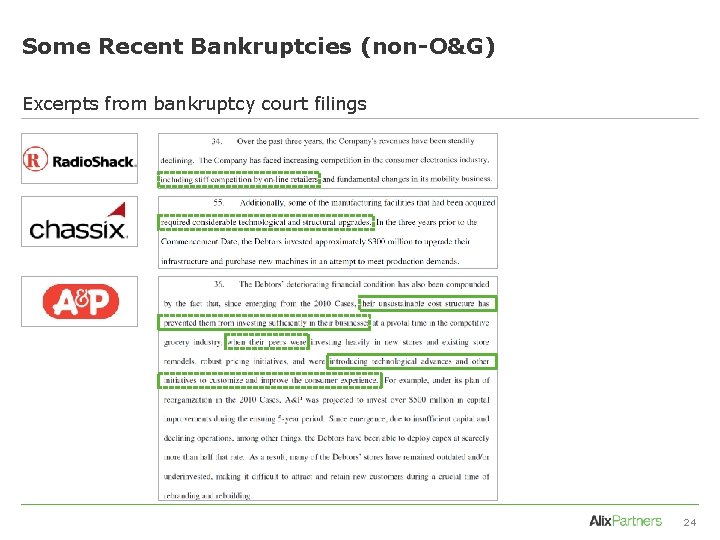
Some Recent Bankruptcies (non-O&G) Excerpts from bankruptcy court filings 24
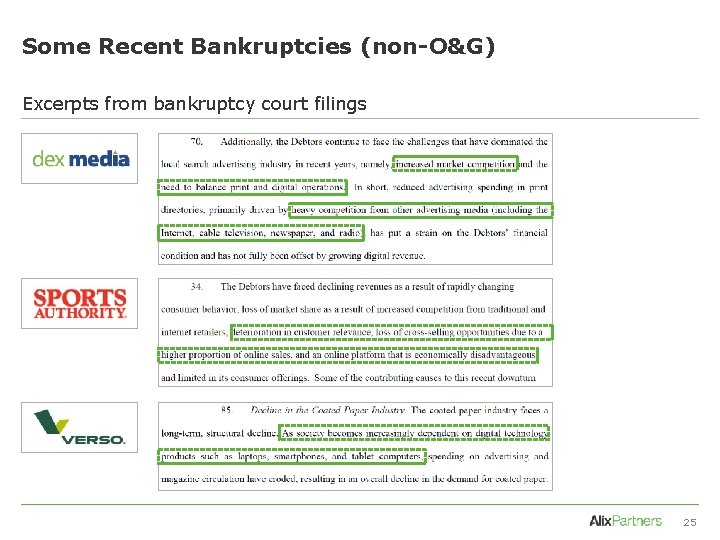
Some Recent Bankruptcies (non-O&G) Excerpts from bankruptcy court filings 25
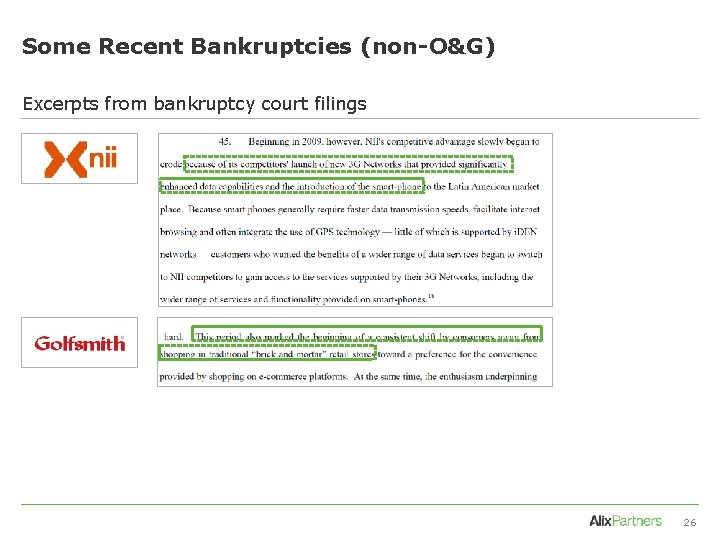
Some Recent Bankruptcies (non-O&G) Excerpts from bankruptcy court filings 26

© 2017 Alix. Partners, LLP.
- Slides: 27