ILITs SLATs GRATs and Other FourLetter Words Presented










- Slides: 42
ILITs, SLATs, GRATs, and Other Four-Letter Words Presented by: Julius H. Giarmarco, J. D. , LL. M. Giarmarco, Mullins & Horton, P. C. 101 W. Big Beaver Road, 10 th Floor Troy, Michigan 48084 (248) 457 -7200 jhg@disinherit-irs. com www. disinherit-irs. com
Introduction Ø The federal estate tax is only vulnerable to lifetime gifting. Ø And there are generally three types of gifts you can make: § Gifts of life insurance. § Gifts that shift or reduce value. § Gifts to charity.
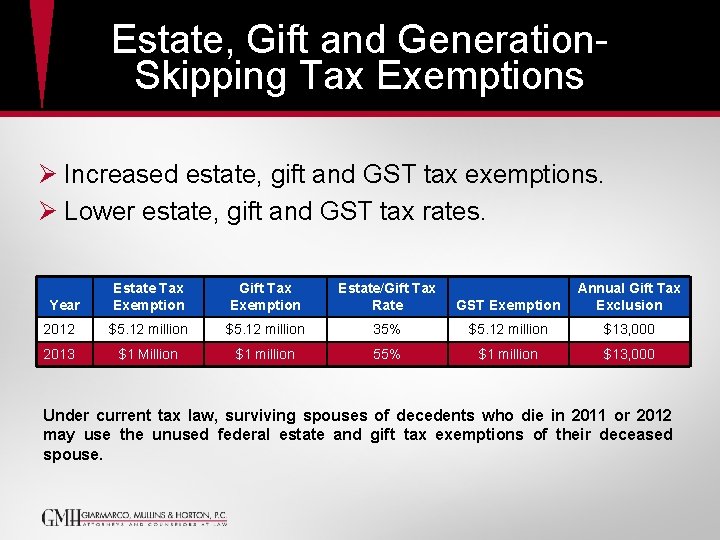
Estate, Gift and Generation. Skipping Tax Exemptions Ø Increased estate, gift and GST tax exemptions. Ø Lower estate, gift and GST tax rates. Estate Tax Exemption Gift Tax Exemption Estate/Gift Tax Rate GST Exemption Annual Gift Tax Exclusion 2012 $5. 12 million 35% $5. 12 million $13, 000 2013 $1 Million $1 million 55% $1 million $13, 000 Year Under current tax law, surviving spouses of decedents who die in 2011 or 2012 may use the unused federal estate and gift tax exemptions of their deceased spouse.
Four Basic Techniques to Minimize Your Estate Tax Liability 1. Pay for your grandchildren’s education. Tuition paid directly to an educational organization is exempt from gift tax. 2. Pay your grandchildren’s medical bills. Medical bills paid directly to the provider are exempt from gift tax. 3. Gift cash. Up to $13, 000 ($26, 000 for couples) per recipient can be gifted without gift tax each year. 4. For people with more than $5. 12 million in assets, start gifting it before 12/31/2012.
Use of $5. 12 Million Gift Tax Exemption Ø Can you afford to give it all away? Ø Is spousal access important? Ø Outright or in trust? Ø Dynasty trust and GST exemption. Ø Leveraging the gifts – FLLCs – discounts are still alive! Ø May not be here after 2012 – sunset.
Eight Advanced Techniques to Minimize Your Estate Tax Liability 1. Dynasty Trusts. 2. Irrevocable Life Insurance Trusts (ILITs). 3. Spousal Lifetime Access Trusts (SLATs). 4. Family Limited Liability Companies (FLLCs).
Eight Advanced Techniques to Minimize Your Estate Tax Liability 5. Grantor Retained Annuity Trusts (GRATs). 6. Intentionally Defective Grantor Trusts (IDGTs). 7. Qualified Personal Residence Trusts (QPRTs). 8. Zero Estate Tax Plans.
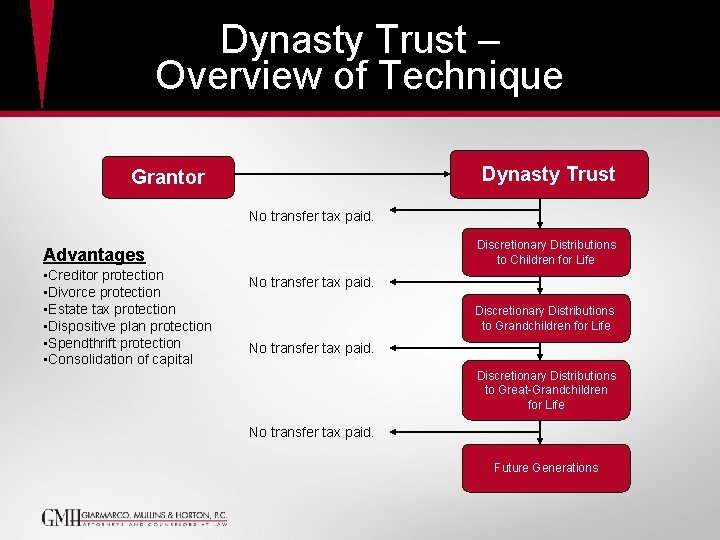
Dynasty Trust – Overview of Technique Dynasty Trust Grantor No transfer tax paid. Discretionary Distributions to Children for Life Advantages • Creditor protection • Divorce protection • Estate tax protection • Dispositive plan protection • Spendthrift protection • Consolidation of capital No transfer tax paid. Discretionary Distributions to Grandchildren for Life No transfer tax paid. Discretionary Distributions to Great-Grandchildren for Life No transfer tax paid. Future Generations
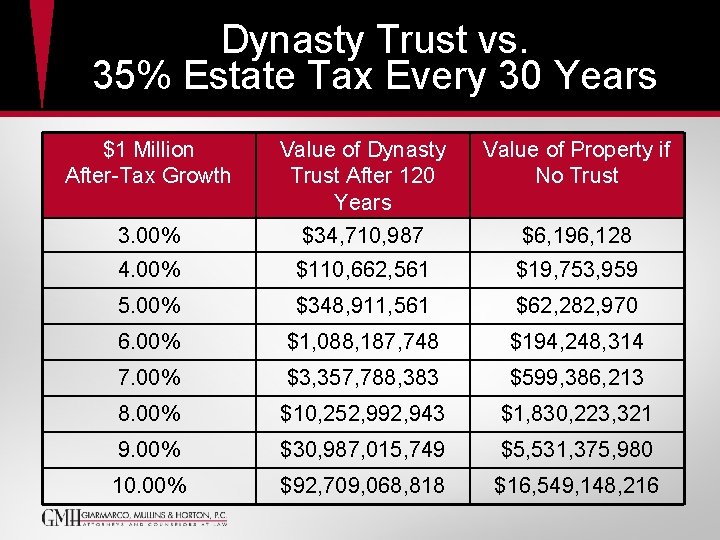
Dynasty Trust vs. 35% Estate Tax Every 30 Years $1 Million After-Tax Growth Value of Dynasty Trust After 120 Years Value of Property if No Trust 3. 00% $34, 710, 987 $6, 196, 128 4. 00% $110, 662, 561 $19, 753, 959 5. 00% $348, 911, 561 $62, 282, 970 6. 00% $1, 088, 187, 748 $194, 248, 314 7. 00% $3, 357, 788, 383 $599, 386, 213 8. 00% $10, 252, 992, 943 $1, 830, 223, 321 9. 00% $30, 987, 015, 749 $5, 531, 375, 980 10. 00% $92, 709, 068, 818 $16, 549, 148, 216
Irrevocable Life Insurance Trusts (“ILITs”)
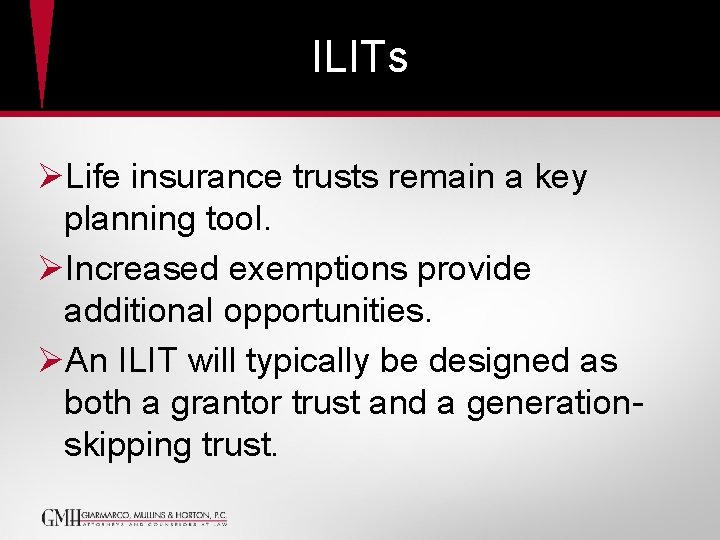
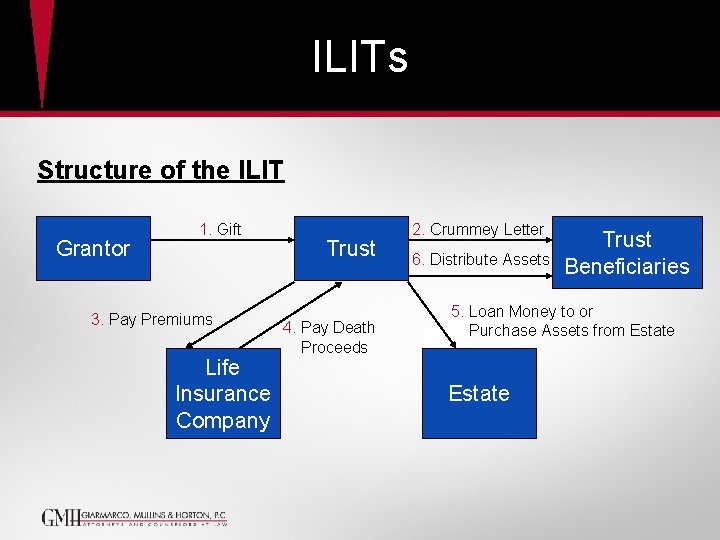
ILITs ØLife insurance trusts remain a key planning tool. ØIncreased exemptions provide additional opportunities. ØAn ILIT will typically be designed as both a grantor trust and a generationskipping trust.
ILITs Structure of the ILIT Grantor 1. Gift 3. Pay Premiums Life Insurance Company Trust 4. Pay Death Proceeds 2. Crummey Letter 6. Distribute Assets Trust Beneficiaries 5. Loan Money to or Purchase Assets from Estate
Spousal Lifetime Access Trusts (“SLATs”)
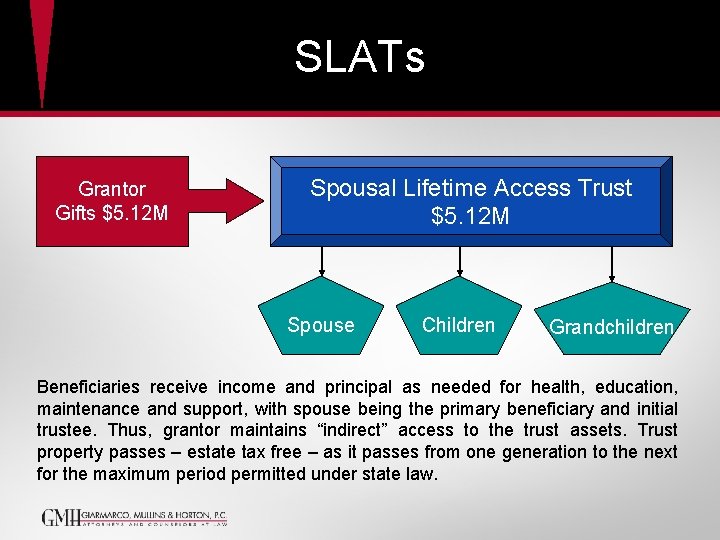
SLATs Grantor Gifts $5. 12 M Spousal Lifetime Access Trust $5. 12 M Spouse Children Grandchildren Beneficiaries receive income and principal as needed for health, education, maintenance and support, with spouse being the primary beneficiary and initial trustee. Thus, grantor maintains “indirect” access to the trust assets. Trust property passes – estate tax free – as it passes from one generation to the next for the maximum period permitted under state law.
Family Limited Liability Companies (“FLLCs”)
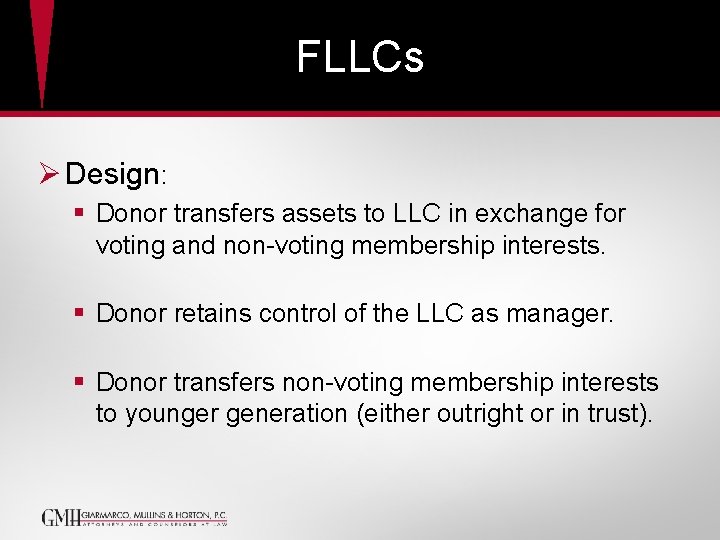
FLLCs Ø Design: § Donor transfers assets to LLC in exchange for voting and non-voting membership interests. § Donor retains control of the LLC as manager. § Donor transfers non-voting membership interests to younger generation (either outright or in trust).
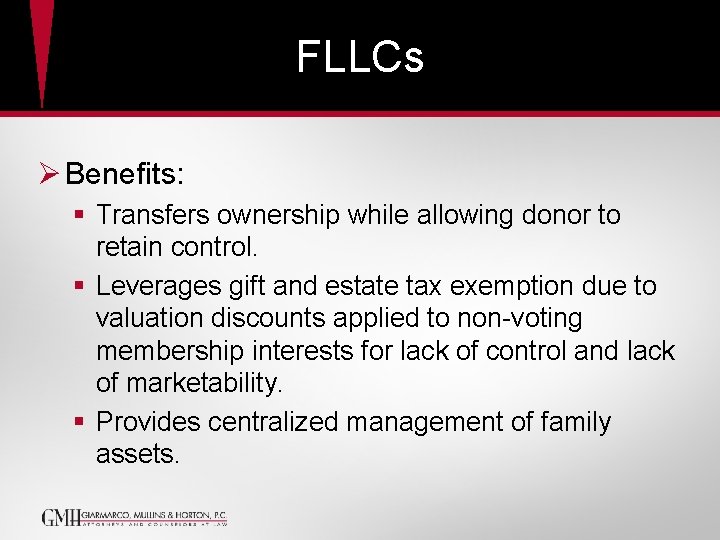
FLLCs Ø Benefits: § Transfers ownership while allowing donor to retain control. § Leverages gift and estate tax exemption due to valuation discounts applied to non-voting membership interests for lack of control and lack of marketability. § Provides centralized management of family assets.
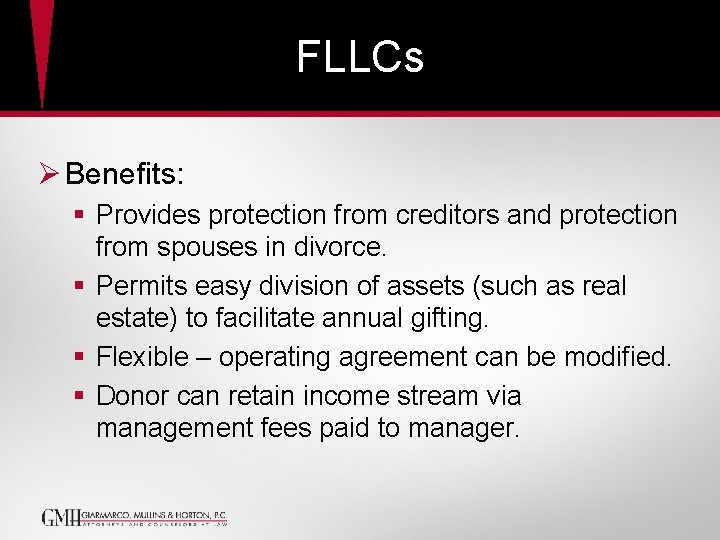
FLLCs Ø Benefits: § Provides protection from creditors and protection from spouses in divorce. § Permits easy division of assets (such as real estate) to facilitate annual gifting. § Flexible – operating agreement can be modified. § Donor can retain income stream via management fees paid to manager.
FLLC Flowchart Family Limited Liability Company Step 1 Donor Assets Step 2 1% Voting Membership Interest (Control Interest) 99% Non-Voting Membership Interest Donor Step 3 Gifts of Membership Interests to Heirs or Trusts for Heirs
Grantor Retained Annuity Trusts (“GRATs”)
GRATs Ø A GRAT is an irrevocable trust in which a grantor transfers property for the benefit of one or more beneficiaries and retains an annuity interest for a term of years. Ø Each year the GRAT will pay the grantor a fixed annual annuity, as defined by the terms of the Trust.
GRATs Ø The amount of the taxable gift for transfer tax purposes is the Fair Market Value of the property transferred minus the value of the grantor’s retained annuity interest. Ø The GRAT may be structured so that the grantor’s retained annuity’s actuarial value is almost equal to the value of the property transferred, therefore resulting in little gift tax consequences. Ø At the end of the GRAT term, any remaining property in the GRAT passes to the remainder beneficiaries with no further gift tax consequences.
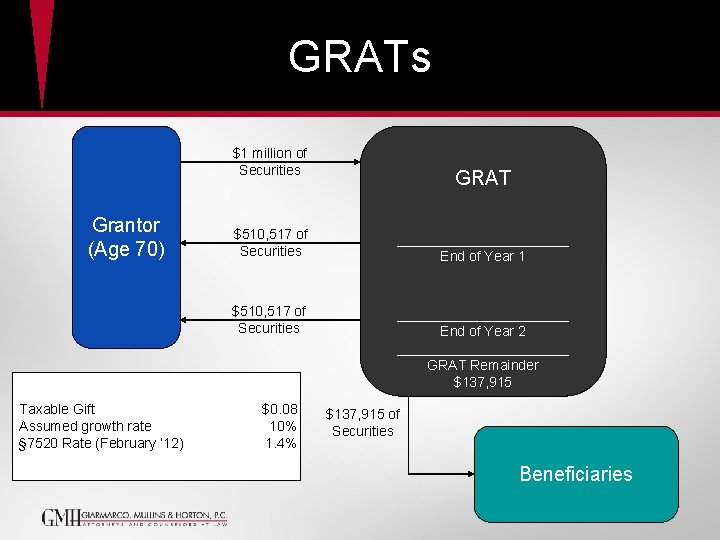
GRATs $1 million of Securities Grantor (Age 70) Taxable Gift Assumed growth rate § 7520 Rate (February ’ 12) GRAT $510, 517 of Securities ___________ End of Year 1 $510, 517 of Securities ___________ End of Year 2 ___________ GRAT Remainder $137, 915 $0. 08 10% 1. 4% $137, 915 of Securities Beneficiaries
Intentionally-Defective Grantor Trusts (“IDGTs”)
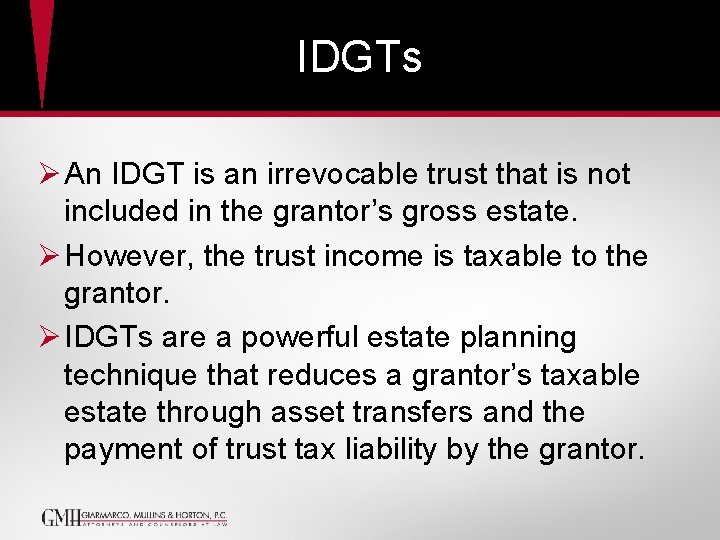
IDGTs Ø An IDGT is an irrevocable trust that is not included in the grantor’s gross estate. Ø However, the trust income is taxable to the grantor. Ø IDGTs are a powerful estate planning technique that reduces a grantor’s taxable estate through asset transfers and the payment of trust tax liability by the grantor.
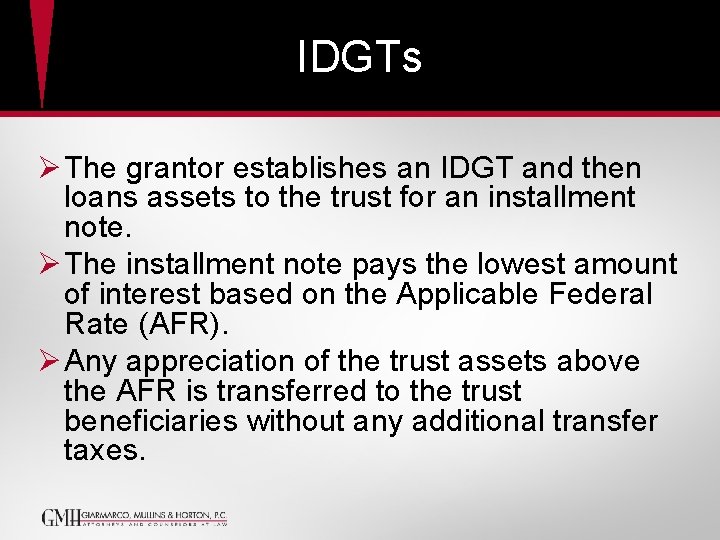
IDGTs Ø The grantor establishes an IDGT and then loans assets to the trust for an installment note. Ø The installment note pays the lowest amount of interest based on the Applicable Federal Rate (AFR). Ø Any appreciation of the trust assets above the AFR is transferred to the trust beneficiaries without any additional transfer taxes.
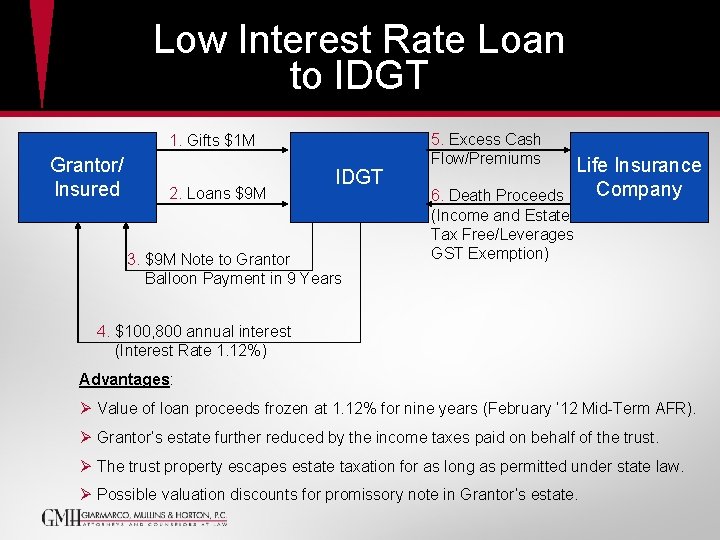
Low Interest Rate Loan to IDGT 1. Gifts $1 M Grantor/ Insured 2. Loans $9 M IDGT 3. $9 M Note to Grantor Balloon Payment in 9 Years 5. Excess Cash Flow/Premiums 6. Death Proceeds (Income and Estate Tax Free/Leverages GST Exemption) Life Insurance Company 4. $100, 800 annual interest (Interest Rate 1. 12%) Advantages: Ø Value of loan proceeds frozen at 1. 12% for nine years (February ’ 12 Mid-Term AFR). Ø Grantor’s estate further reduced by the income taxes paid on behalf of the trust. Ø The trust property escapes estate taxation for as long as permitted under state law. Ø Possible valuation discounts for promissory note in Grantor’s estate.
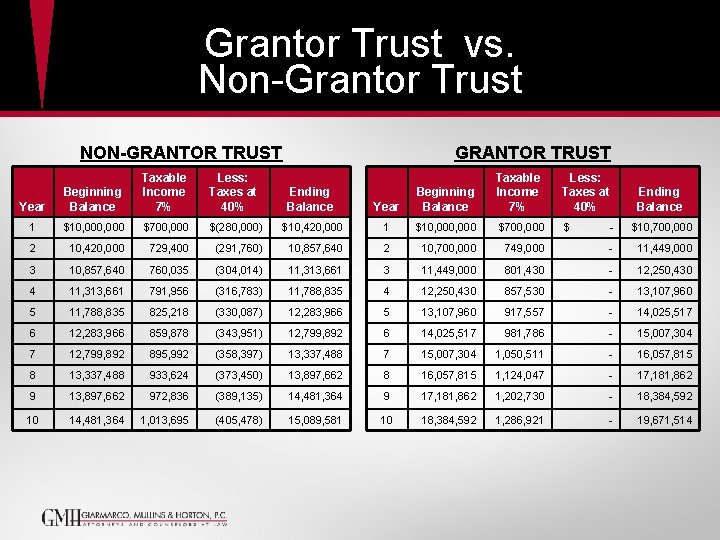
Grantor Trust vs. Non-Grantor Trust NON-GRANTOR TRUST Year Beginning Balance Taxable Income 7% Less: Taxes at 40% Ending Balance Year Beginning Balance Taxable Income 7% Less: Taxes at 40% 1 $10, 000 $700, 000 $(280, 000) $10, 420, 000 1 $10, 000 $700, 000 $ 2 10, 420, 000 729, 400 (291, 760) 10, 857, 640 2 10, 700, 000 3 10, 857, 640 760, 035 (304, 014) 11, 313, 661 3 4 11, 313, 661 791, 956 (316, 783) 11, 788, 835 5 11, 788, 835 825, 218 (330, 087) 6 12, 283, 966 859, 878 7 12, 799, 892 8 Ending Balance - $10, 700, 000 749, 000 - 11, 449, 000 801, 430 - 12, 250, 430 4 12, 250, 430 857, 530 - 13, 107, 960 12, 283, 966 5 13, 107, 960 917, 557 - 14, 025, 517 (343, 951) 12, 799, 892 6 14, 025, 517 981, 786 - 15, 007, 304 895, 992 (358, 397) 13, 337, 488 7 15, 007, 304 1, 050, 511 - 16, 057, 815 13, 337, 488 933, 624 (373, 450) 13, 897, 662 8 16, 057, 815 1, 124, 047 - 17, 181, 862 9 13, 897, 662 972, 836 (389, 135) 14, 481, 364 9 17, 181, 862 1, 202, 730 - 18, 384, 592 10 14, 481, 364 1, 013, 695 (405, 478) 15, 089, 581 10 18, 384, 592 1, 286, 921 - 19, 671, 514
Qualified Personal Residence Trusts (“QPRTs”)
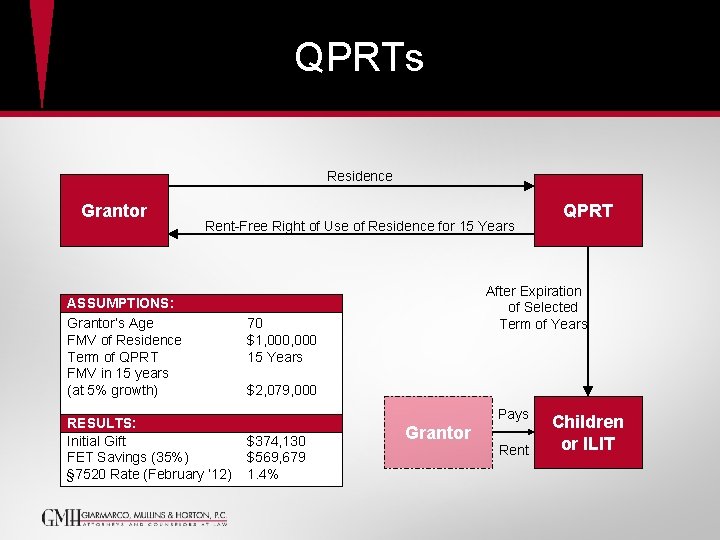
QPRTs Ø A QPRT is an irrevocable trust to which the grantor transfers his or her personal residence or vacation home. Ø The grantor retains the exclusive use of the residence for a term of years specified in the trust instrument. Ø If the grantor survives the term of the trust, the residence is either retained in further trust for or distributed outright to the grantor’s children.
QPRTs Ø The transfer of the residence to the QPRT is a taxable gift by the grantor to the remainder beneficiaries, determined by reference to the IRS actuarial tables. Ø The actual amount of the gift is a function of the grantor’s age, the value of the residence, and the term of the trust.
QPRTs Ø If the grantor survives the term of the QPRT, no further gift or estate tax will be imposed. Ø At the end of the term, the grantor will have the option of paying fair rent for his continued use of the residence. Ø If the grantor dies prior to the expiration of the term, the residence will be included in the grantor’s estate, but any gift tax exemption used will be restored.
QPRTs Residence Grantor Rent-Free Right of Use of Residence for 15 Years ASSUMPTIONS: Grantor’s Age FMV of Residence Term of QPRT FMV in 15 years (at 5% growth) RESULTS: Initial Gift FET Savings (35%) § 7520 Rate (February ‘ 12) QPRT After Expiration of Selected Term of Years 70 $1, 000 15 Years $2, 079, 000 Pays $374, 130 $569, 679 1. 4% Grantor Rent Children or ILIT
Zero Estate Tax Plan
Conventional Estate Planning Projected Gross Estate $10, 000 Credit Shelter Trust Estate of Surviving Spouse or Marital Trust $3, 500, 000 $6, 500, 000 Federal Estate Tax $0 After Tax Estate Federal Estate Tax $5, 150, 000 $1, 350, 000 (13. 5%) Distribution to Heirs After Tax Estate Credit Shelter Trust Total $5, 150, 000 3, 500, 000 $8, 650, 000 Assumes estate tax exemption is $3. 5 million and top tax rate is 45%.
Zero Estate Tax Planning Current Net Estate $10, 000 - Less premiums gifted (600, 000)* Total $9, 400, 000 * Using annual exclusion gifts Credit Shelter Trust Estate of Surviving Spouse or Marital Trust Irrevocable Life Insurance Trust $3, 500, 000 $5, 900, 000 $3, 000 Federal Estate Tax $0 Children Private Foundation or Charity $3, 500, 000 $2, 400, 000 Federal Estate Tax $0 Distribution to Heirs and Charity Private Foundation / Charity $2, 400, 000 Estate Tax Exemptions 7, 000 Life Insurance Trust 3, 000 Total $12, 400, 000 Assumes estate tax exemption is $3. 5 million and top tax rate is 45%.
Reviewing Your Estate Plan is One Resolution You’ll Want to Keep in 2012 Ø The increased exemption in 2012 gives you an unprecedented opportunity to make large gifts to save on estate taxes. Ø The death of a named beneficiary may be reason to review your plan to ensure that his or her share passes to the proper beneficiaries in accordance with your wishes.
Reviewing Your Estate Plan is One Resolution You’ll Want to Keep in 2012 Ø If your family has grown with the addition of grandchildren, you may wish to make special provisions for them, such as ensuring that assets left to minors are done so in trust. Ø You may wish to review those individuals whom you have named as trustees, executors and agents in financial and health care powers of attorney.
Reviewing Your Estate Plan is One Resolution You’ll Want to Keep in 2012 Ø If any of your beneficiaries has been diagnosed with a disability, you may wish to review the manner of disposition to that person. Would disposition in a special needs trust be appropriate? Ø If there has been a marriage or divorce, either by you or by one of your beneficiaries, you may wish to revisit the choices you have made in your estate plan.
Reviewing Your Estate Plan is One Resolution You’ll Want to Keep in 2012 Ø Have your assets experienced significant changes, such as conversion of real estate or a business interest, or through inheritance of additional assets? If so, you may wish to review your plan to make sure these changes have been taken into consideration.
THE END THANK YOU