Identifying Interesting Association Rules with Genetic Algorithms Elnaz
- Slides: 20
Identifying Interesting Association Rules with Genetic Algorithms Elnaz Delpisheh York University Department of Computer Science and Engineering
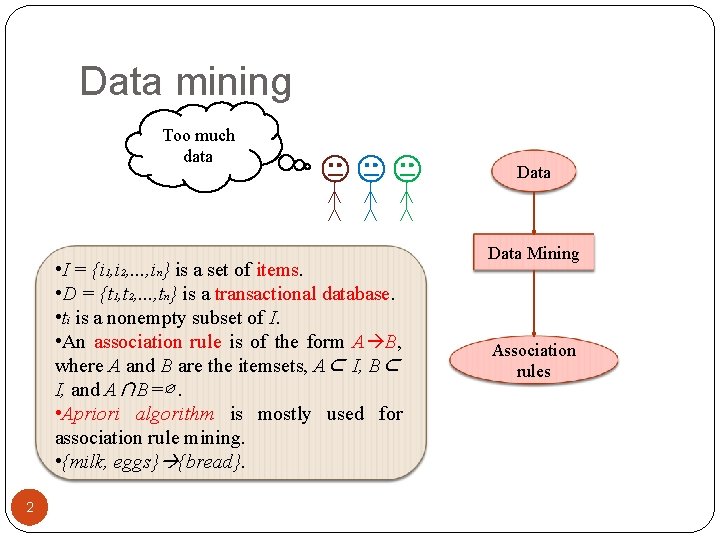
Data mining Too much data • I = {i 1, i 2, . . . , in} is a set of items. • D = {t 1, t 2, . . . , tn} is a transactional database. • ti is a nonempty subset of I. • An association rule is of the form A B, where A and B are the itemsets, A⊂ I, B⊂ I, and A∩B=∅. • Apriori algorithm is mostly used for association rule mining. • {milk, eggs} {bread}. 2 Data Mining Association rules
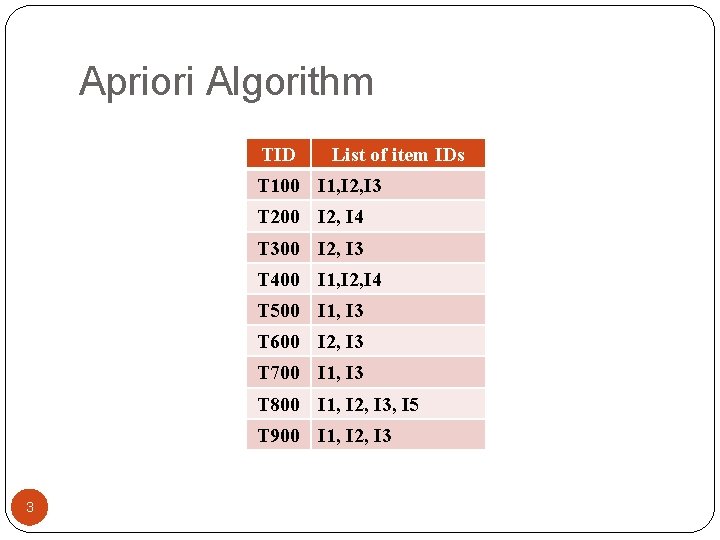
Apriori Algorithm TID List of item IDs T 100 I 1, I 2, I 3 T 200 I 2, I 4 T 300 I 2, I 3 T 400 I 1, I 2, I 4 T 500 I 1, I 3 T 600 I 2, I 3 T 700 I 1, I 3 T 800 I 1, I 2, I 3, I 5 T 900 I 1, I 2, I 3 3
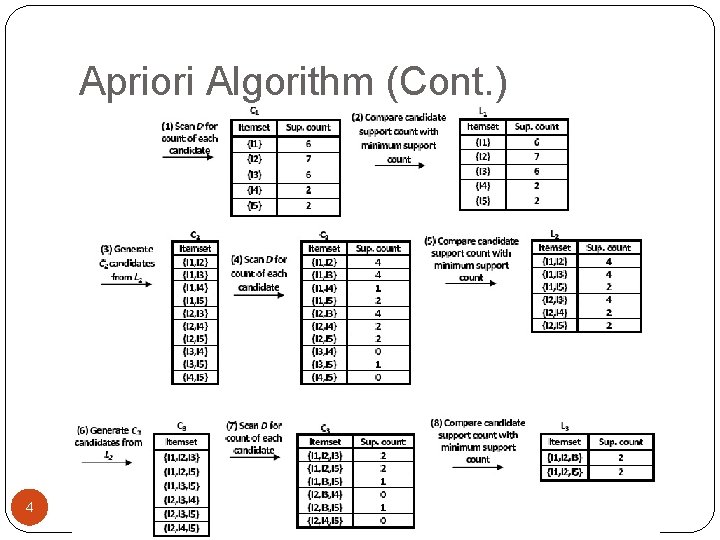
Apriori Algorithm (Cont. ) 4
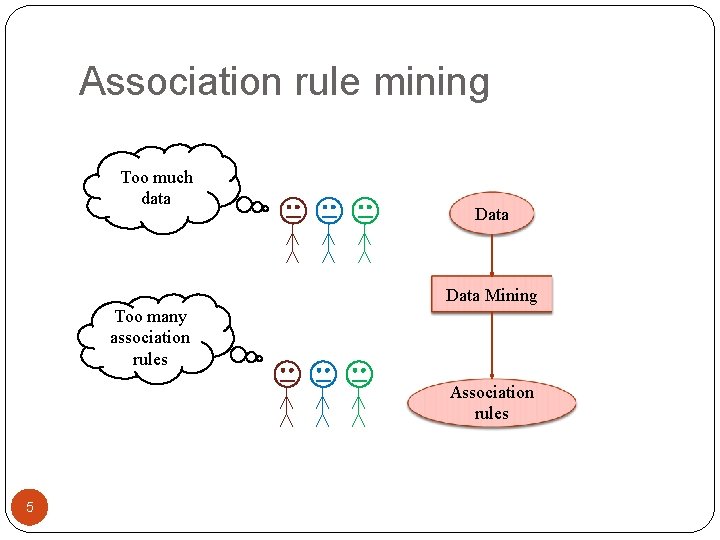
Association rule mining Too much data Data Mining Too many association rules Association rules 5
Interestingness criteria Comprehensibility. Conciseness. Diversity. Generality. Novelty. Utility. . 6
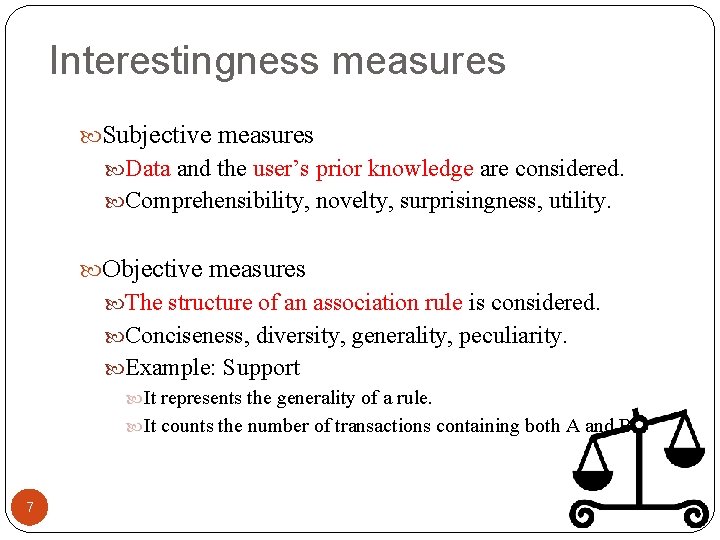
Interestingness measures Subjective measures Data and the user’s prior knowledge are considered. Comprehensibility, novelty, surprisingness, utility. Objective measures The structure of an association rule is considered. Conciseness, diversity, generality, peculiarity. Example: Support It represents the generality of a rule. It counts the number of transactions containing both A and B. 7
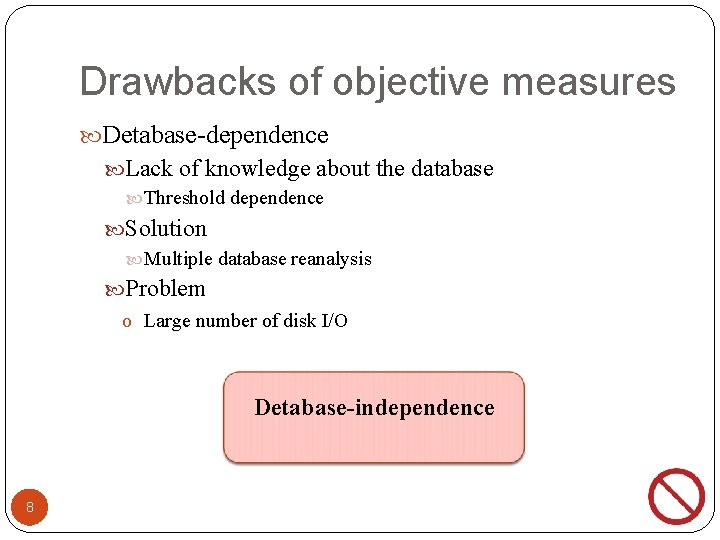
Drawbacks of objective measures Detabase-dependence Lack of knowledge about the database Threshold dependence Solution Multiple database reanalysis Problem o Large number of disk I/O Detabase-independence 8
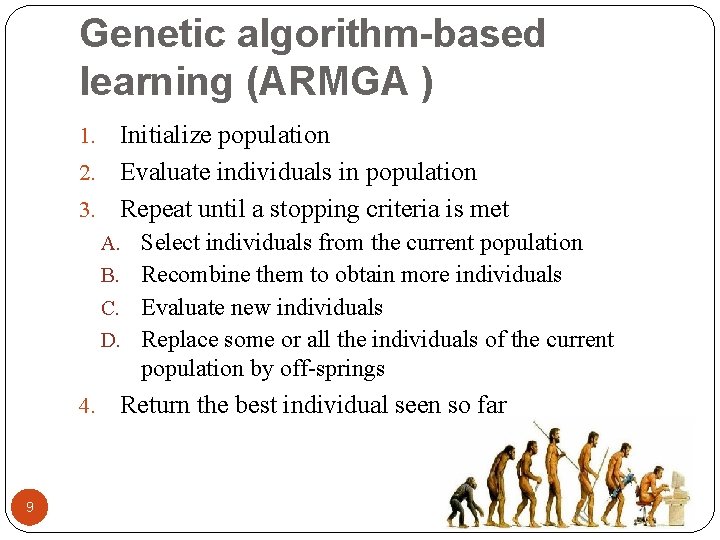
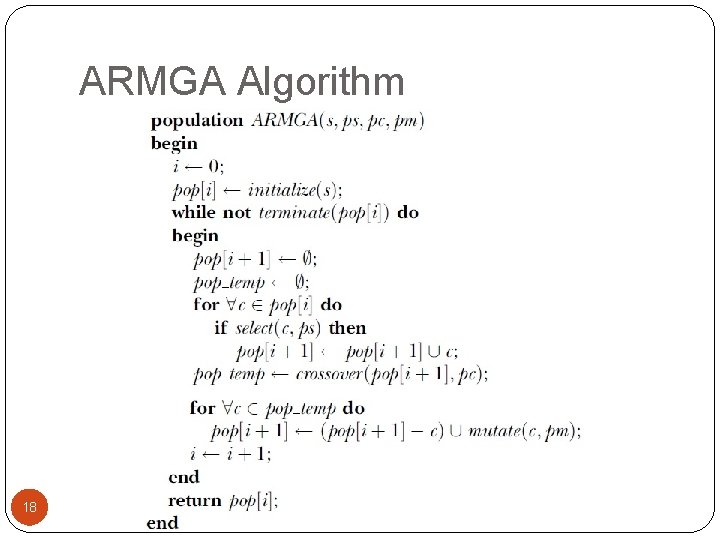
Genetic algorithm-based learning (ARMGA ) Initialize population 2. Evaluate individuals in population 3. Repeat until a stopping criteria is met 1. A. Select individuals from the current population Recombine them to obtain more individuals C. Evaluate new individuals D. Replace some or all the individuals of the current population by off-springs B. 4. 9 Return the best individual seen so far
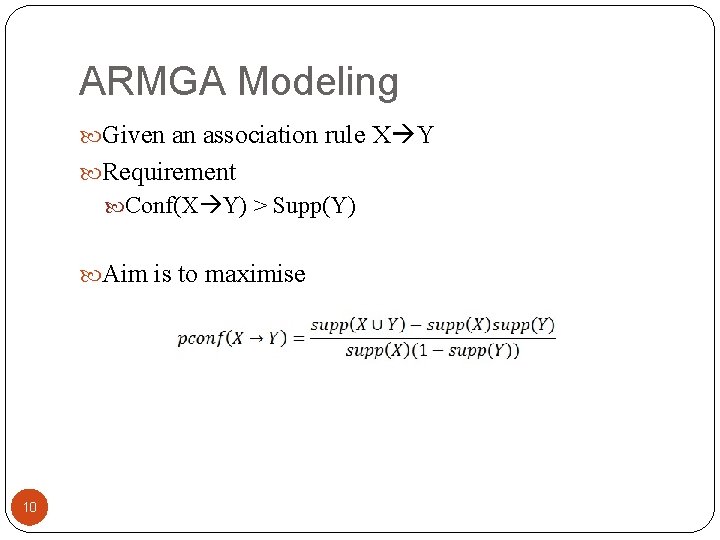
ARMGA Modeling Given an association rule X Y Requirement Conf(X Y) > Supp(Y) Aim is to maximise 10
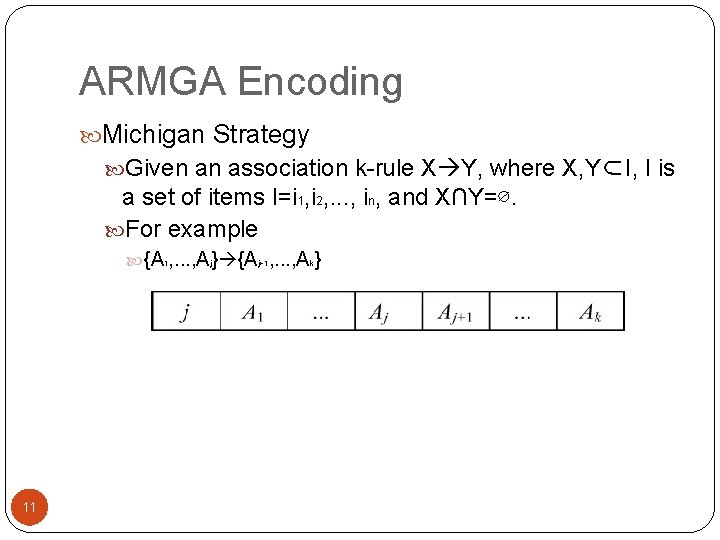
ARMGA Encoding Michigan Strategy Given an association k-rule X Y, where X, Y⊂I, I is a set of items I=i 1, i 2, . . . , in, and X∩Y=∅. For example {A 1, . . . , Aj} {Aj+1, . . . , Ak} 11
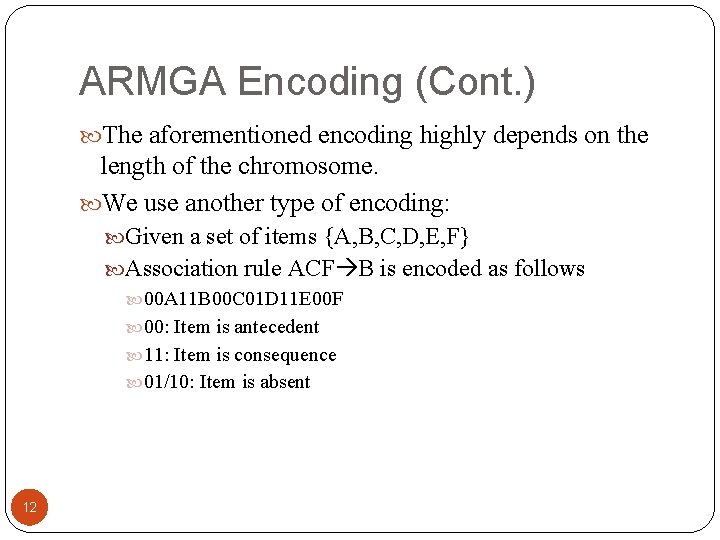
ARMGA Encoding (Cont. ) The aforementioned encoding highly depends on the length of the chromosome. We use another type of encoding: Given a set of items {A, B, C, D, E, F} Association rule ACF B is encoded as follows 00 A 11 B 00 C 01 D 11 E 00 F 00: Item is antecedent 11: Item is consequence 01/10: Item is absent 12
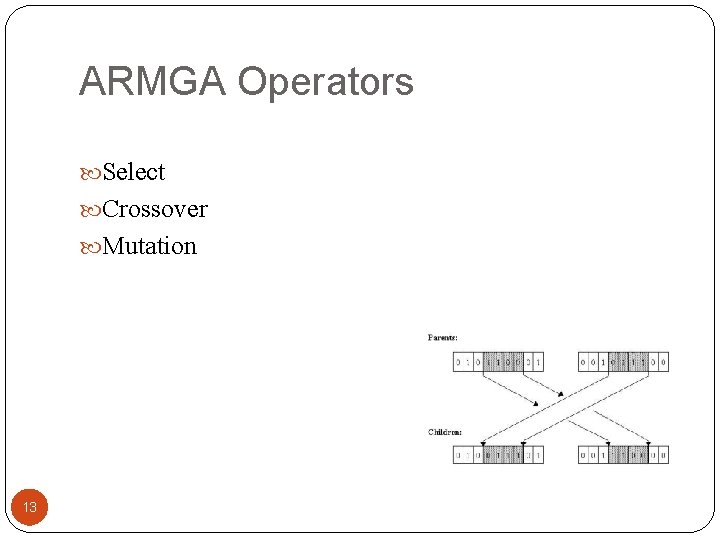
ARMGA Operators Select Crossover Mutation 13
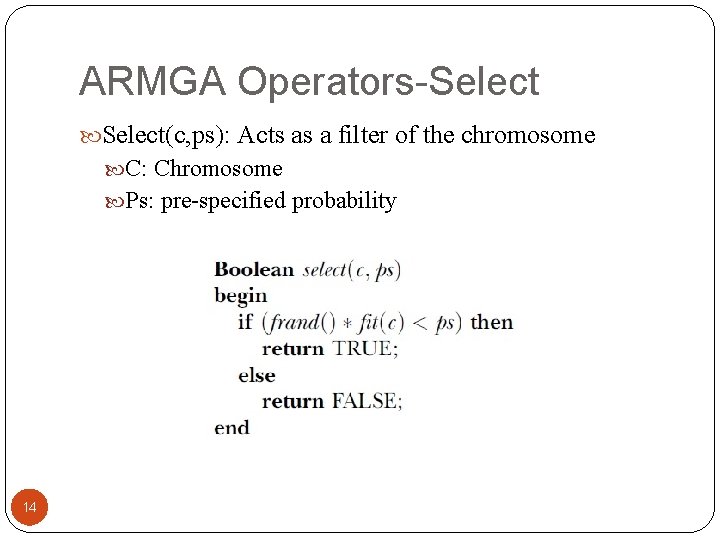
ARMGA Operators-Select(c, ps): Acts as a filter of the chromosome C: Chromosome Ps: pre-specified probability 14
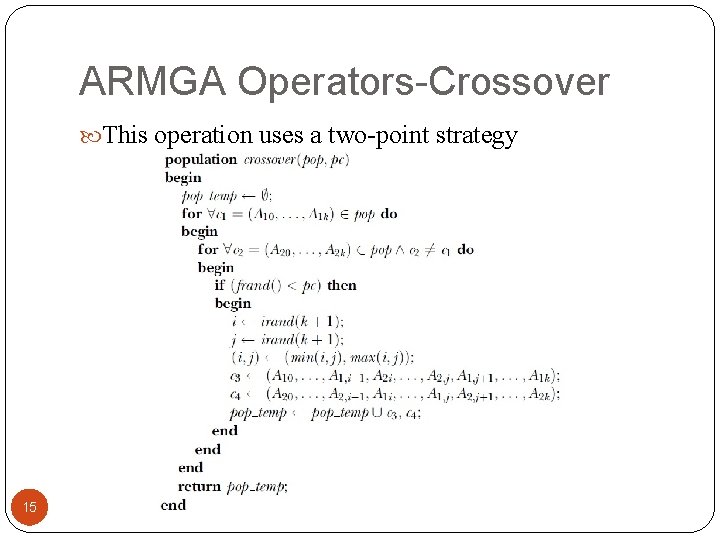
ARMGA Operators-Crossover This operation uses a two-point strategy 15
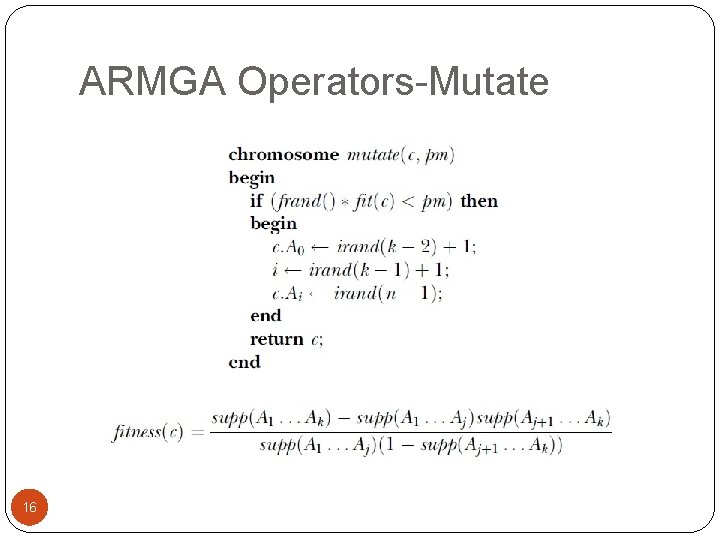
ARMGA Operators-Mutate 16
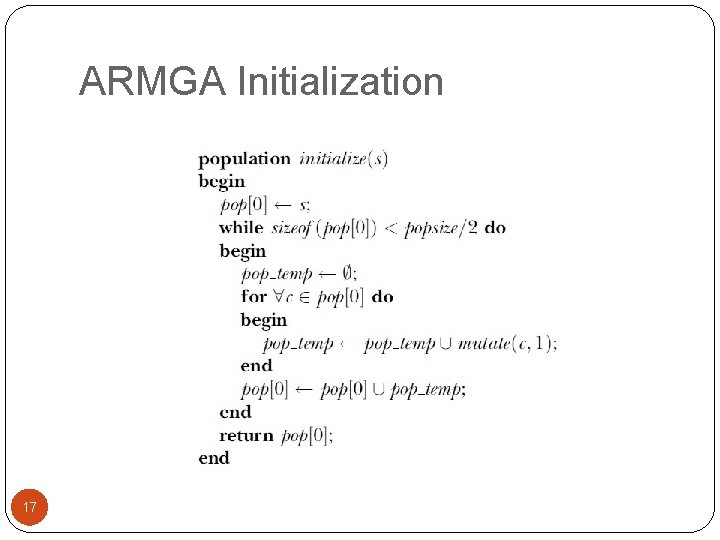
ARMGA Initialization 17
ARMGA Algorithm 18
Empirical studies and Evaluation Implement the entire procedure using Visual C++ Use WEKA to produce interesting association rules Compare the results 19
20