Human Resource Management Advanced HUMAN RESOURCE MANAGEMENT AN

- Slides: 37
Human Resource Management Advanced HUMAN RESOURCE MANAGEMENT: AN OVERVIEW Dr. Angela Clark-Louque EADM 734 CSUSB © 2008 by Prentice Hall 1 -1
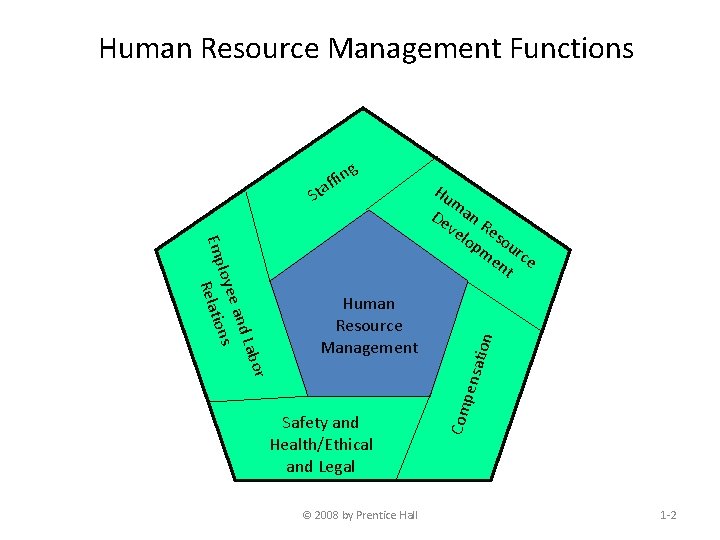
Human Resource Management Functions St ensa Safety and Health/Ethical and Legal © 2008 by Prentice Hall Com p bor d La e an s loye n Emp Relatio Human Resource 1 Management Hu m De an ve Res lop ou me rce nt tion g in aff 1 -2
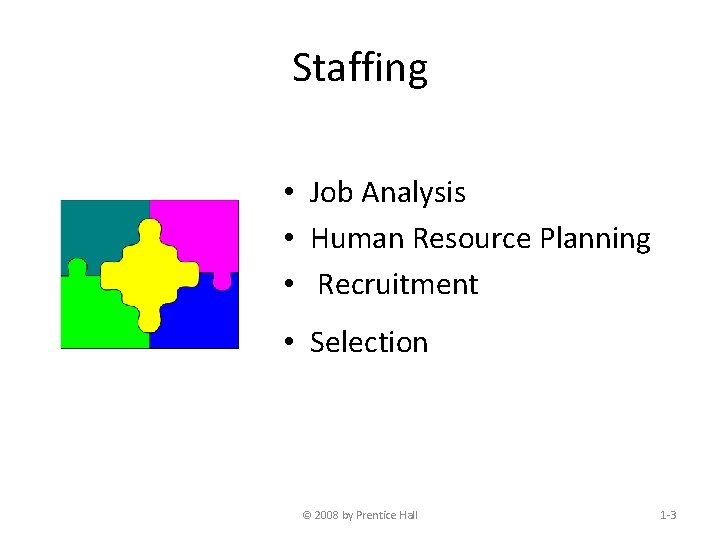
Staffing • Job Analysis • Human Resource Planning • Recruitment • Selection © 2008 by Prentice Hall 1 -3
Staffing (Cont. ) • Staffing - Process through which organization ensures it always has proper number of employees with appropriate skills in right jobs at right time to achieve organizational objectives • Job analysis - Systematic process of determining skills, duties, and knowledge required for performing jobs in organization © 2008 by Prentice Hall 1 -4
Staffing (Cont. ) • Human resource planning - Systematic process of matching the internal and external supply of people with job openings anticipated in the organization over a specified period of time. • Recruitment - Process of attracting individuals on a timely basis, in sufficient numbers, and with appropriate qualifications, to apply for jobs with an organization © 2008 by Prentice Hall 1 -5
Staffing (Cont. ) • Selection - Process of choosing from a group of applicants the individual best suited for a particular position and the organization © 2008 by Prentice Hall 1 -6
Human Resource Development • Training • Development • Career Planning • Career Development • Organizational Development • Performance Management • Performance Appraisal © 2008 by Prentice Hall 1 -7
Human Resource Development (Cont. ) • Training - Designed to provide learners with knowledge and skills needed for their present jobs • Development - Involves learning that goes beyond today's job; it has more long-term focus • Career planning - Ongoing process whereby individual sets career goals and identifies means to achieve them © 2008 by Prentice Hall 1 -8
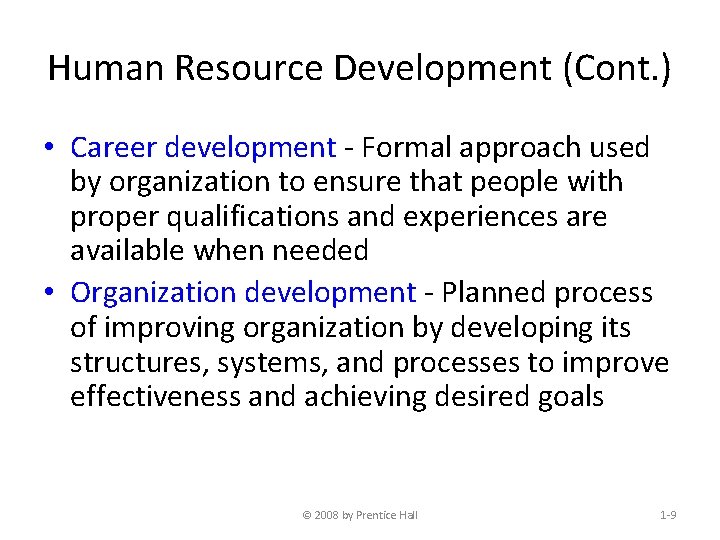
Human Resource Development (Cont. ) • Career development - Formal approach used by organization to ensure that people with proper qualifications and experiences are available when needed • Organization development - Planned process of improving organization by developing its structures, systems, and processes to improve effectiveness and achieving desired goals © 2008 by Prentice Hall 1 -9
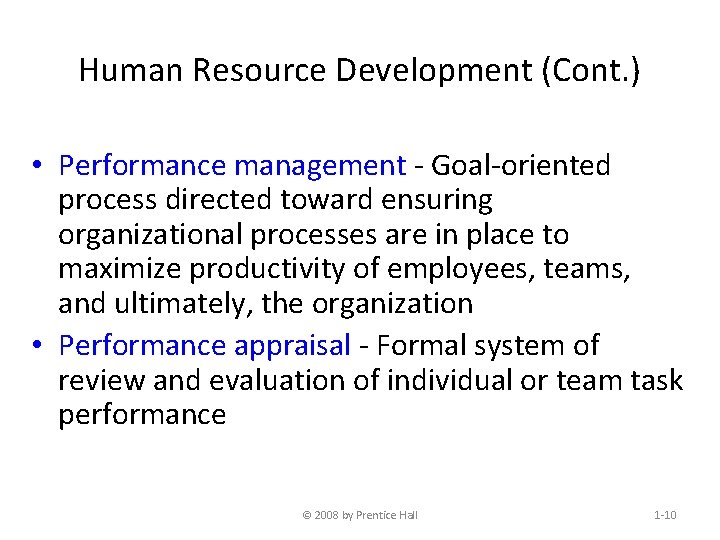
Human Resource Development (Cont. ) • Performance management - Goal-oriented process directed toward ensuring organizational processes are in place to maximize productivity of employees, teams, and ultimately, the organization • Performance appraisal - Formal system of review and evaluation of individual or team task performance © 2008 by Prentice Hall 1 -10
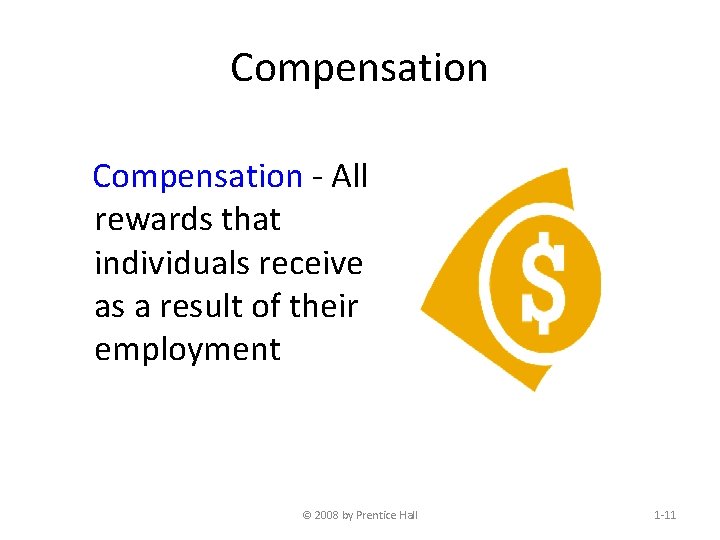
Compensation - All rewards that individuals receive as a result of their employment © 2008 by Prentice Hall 1 -11
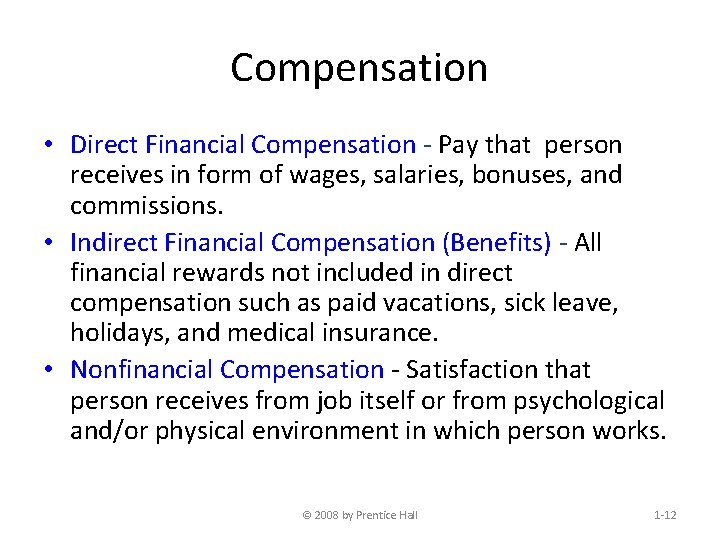
Compensation • Direct Financial Compensation - Pay that person receives in form of wages, salaries, bonuses, and commissions. • Indirect Financial Compensation (Benefits) - All financial rewards not included in direct compensation such as paid vacations, sick leave, holidays, and medical insurance. • Nonfinancial Compensation - Satisfaction that person receives from job itself or from psychological and/or physical environment in which person works. © 2008 by Prentice Hall 1 -12
Safety and Health Employees who work in safe environment and enjoy good health are more likely to be productive and yield long-term benefits to organization. © 2008 by Prentice Hall 1 -13
Safety and Health • Safety - Involves protecting employees from injuries caused by work-related accidents • Health - Refers to employees' freedom from illness and their general physical and mental well being © 2008 by Prentice Hall 1 -14
Employee and Labor Relations • Private-sector union membership has fallen from 39 percent in 1958 to 7. 8 percent in 2005. • Business is required by law to recognize a union and bargain with it in good faith if the firm’s employees want the union to represent them • Human resource activity is often referred to as industrial relations • Most firms today would rather have a union-free environment © 2008 by Prentice Hall 1 -15
Human Resource Research • Human resource research is not a separate function. • It pervades all HR functional areas. © 2008 by Prentice Hall 1 -16
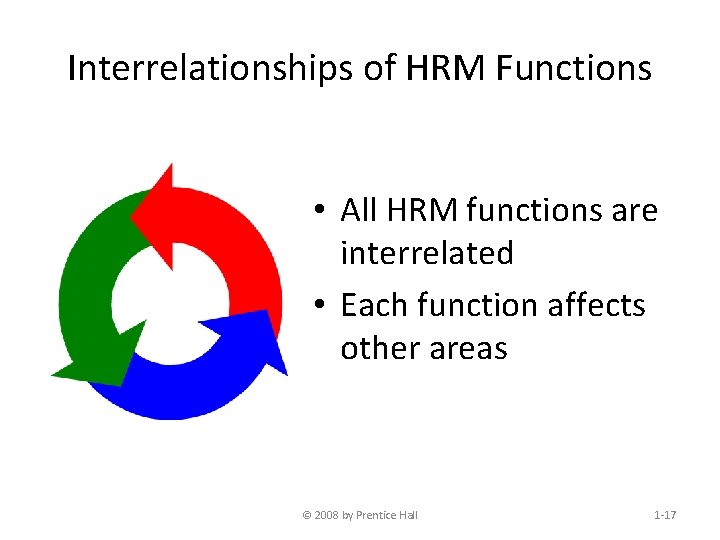
Interrelationships of HRM Functions • All HRM functions are interrelated • Each function affects other areas © 2008 by Prentice Hall 1 -17
Dynamic Human Resource Management Environment © 2008 by Prentice Hall 1 -18
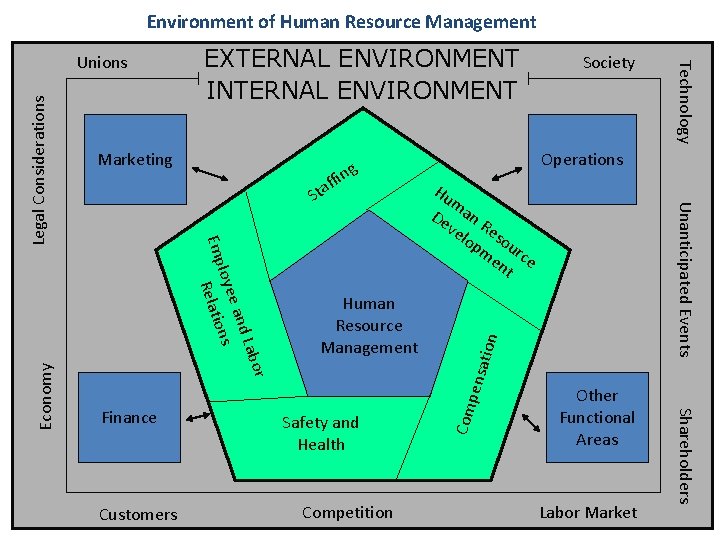
Environment of Human Resource Management Safety and Health Competition © 2008 by Prentice Hall pens ation Hu m De an ve Res lop ou me rce nt Other Functional Areas Labor Market Shareholders Customers Human Resource 1 Management Operations Com f f Sta Finance ing Society Unanticipated Events Legal Considerations Marketing bor d La e an s loye n Emp Relatio Economy EXTERNAL ENVIRONMENT INTERNAL ENVIRONMENT Technology Unions 1 -19
Labor Market • Potential employees located within geographic area from which employees are recruited • Always changing © 2008 by Prentice Hall 1 -20
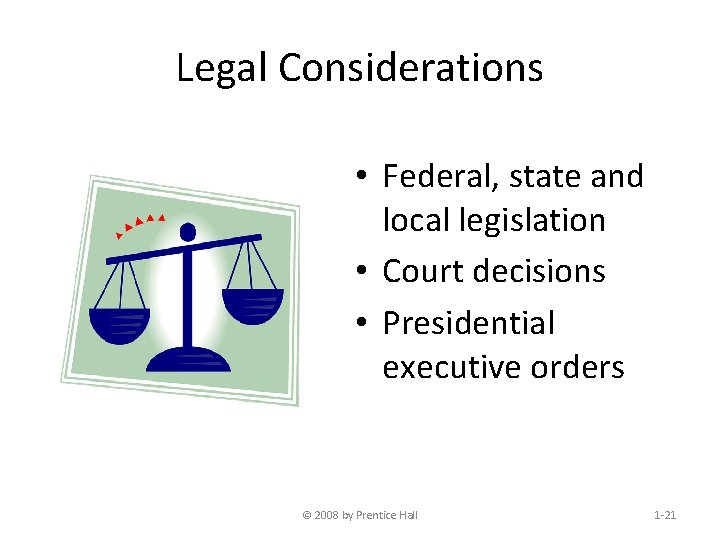
Legal Considerations • Federal, state and local legislation • Court decisions • Presidential executive orders © 2008 by Prentice Hall 1 -21
Society • No longer content to accept, without question, the actions of businesses/schools • Ethics - Discipline dealing with what is good and bad, or right and wrong, or with moral duty and obligation • Social responsibility - Implied, enforced or felt obligation of managers to serve or protect interests of groups other than themselves © 2008 by Prentice Hall 1 -22
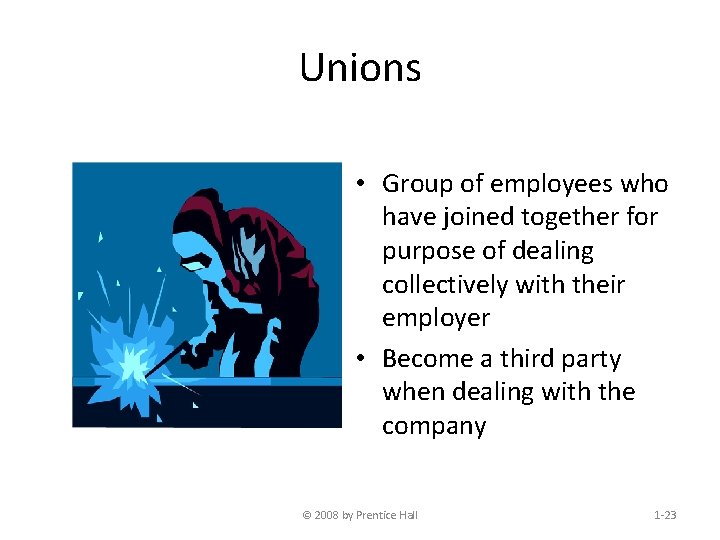
Unions • Group of employees who have joined together for purpose of dealing collectively with their employer • Become a third party when dealing with the company © 2008 by Prentice Hall 1 -23
Technology • The world has never before seen technological changes occur as rapidly as they are today. • Created new roles for HR professionals • Additional pressures on them to keep abreast of technology © 2008 by Prentice Hall 1 -24
Economy • In general, when economy is booming, it is often more difficult to recruit qualified workers. • When a downturn is experienced, more applicants are typically available. © 2008 by Prentice Hall 1 -25
Unanticipated Events • Occurrences in the external environment that could not be foreseen • Every disaster, whether manmade or by nature, requires a tremendous amount of adjustment with regard to human resource management © 2008 by Prentice Hall 1 -26
Cyberwork • Possibility of never-ending workday • Black. Berrys, cell phones, text messaging, and e-mail create endless possibilities for communication • Some workers believe their employer wants them available 24/7 © 2008 by Prentice Hall 1 -27
HR’s Changing Role: Questions That Are Being Asked • Can some HR tasks be performed more efficiently by line managers or outside vendors? • Can some HR tasks be centralized or eliminated altogether? • Can technology perform tasks that were previously done by HR personnel? • Many HR departments continue to get smaller © 2008 by Prentice Hall 1 -28
Human Capital Metrics Measures of HR performance © 2008 by Prentice Hall 1 -29
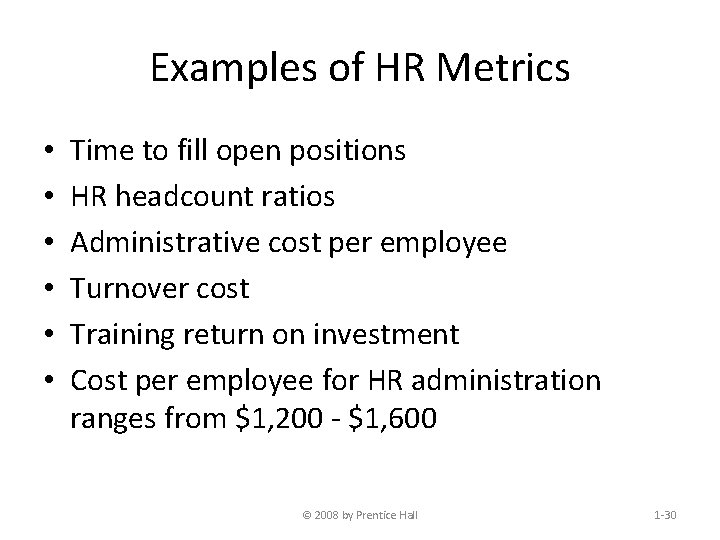
Examples of HR Metrics • • • Time to fill open positions HR headcount ratios Administrative cost per employee Turnover cost Training return on investment Cost per employee for HR administration ranges from $1, 200 - $1, 600 © 2008 by Prentice Hall 1 -30
Evolution Of Human Resource Management © 2008 by Prentice Hall 1 -31
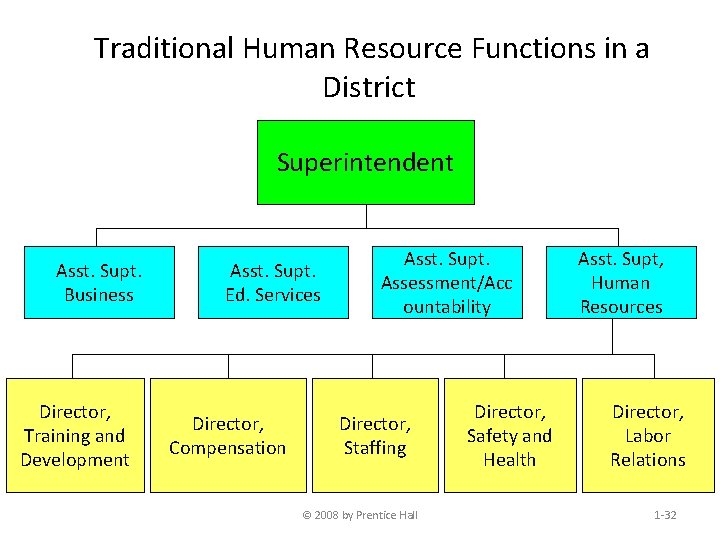
Traditional Human Resource Functions in a District Superintendent Asst. Supt. Business Director, Training and Development Asst. Supt. Ed. Services Director, Compensation Asst. Supt. Assessment/Acc ountability Director, Staffing © 2008 by Prentice Hall Director, Safety and Health Asst. Supt, Human Resources Director, Labor Relations 1 -32
Where in the world is your HR? What is their role/responsibility?
Organization of Human Resource Management PART I. INTRODUCTION • Strategic Human Resource Management: • An Overview • Chapter 1: Organizational Structure • Chapter 2: HR Planning © 2008 by Prentice Hall 1 -34
Organization of Human Resource Management 10 th Edition (Cont. ) PART II. STAFFING • Chapter 3: Recruitment • Chapter 4: Selection • Chapter 5: Placement and Induction © 2008 by Prentice Hall 1 -35
Organization of Human Resource Management 10 th Edition (Cont. ) PART III. HUMAN RESOURCE DEVELOPMENT • Chapter 6: Staff Development • Chapter 7: Performance Evaluation © 2008 by Prentice Hall 1 -36
Organization of Advanced Human Resource Management PART IV. COMPENSATION AND BENEFITS • Chapter 8: Compensation – Benefits, Nonfinancial Rewards, and Other Compensation Issues PART V. COLLECTIVE BARGAINING • Chapter 9: Negotiations PART VI. ETHICAL and LEGAL ISSUES Chapter 10: Ethical and Legal Issues © 2008 by Prentice Hall 1 -37