Hiring and Managing Research Personnel Rita R Alloway


- Slides: 24
Hiring and Managing Research Personnel Rita R. Alloway, Pharm. D Research Professor of Medicine Director, Transplant Clinical Research rita. alloway@uc. edu
Outcomes • Articulate the basic hiring policies and procedures • Engage administrators as collaborators • Identify your staffing and training needs • Incorporate strategies to effectively interview and evaluate candidates
University systems are not typically organized to facilitate research conduct. Advice: • Spend some time learning the “system” to most efficiently work within it. • Don’t waste your time trying to change the system…spend your mental energy on the science. • You must understand the financial structure to garner resources for research conduct. At the end of the day, hopefully you will have been productive.
What “system” is your research conducted within? ? • University of Cincinnati Physicians Company • UC Health
Why is the “system” important? ? • Important research “collaborators” • • Business Administrator – who to hire and financial impact? Human Resources – how to hire (or fire)? • Differences based upon system • • • Business Administrator Human Resources Position Titles Salary Ranges (plus benefits) Hiring policies and procedures
University of Cincinnati • Position Titles • Clinical Research Coordinator • Senior Clinical Research Coordinator • Clinical Research Manager • Clinical Research Director • Research Assistant • Senior Research Assistant • Research Associate • Research Scientist
University of Cincinnati Process to Hire • PI works with Business Administrator/Business Manager funding is available • Contact HR – Provide job duties, minimum requirements, planned salary • HR creates position and advertises • Review applicants, phone screen, in-person interviews • Provide HR with information on all applicants – Why they were not contacted for interview, why they were/were not selected as a finalist – Provide offered salary • HR submits candidate and salary to VP and Compensation for approval • Offer letter drafted and sent to candidate • Current policy requires UC staff to start on Mondays, so they can attend orientation and complete required paperwork (i 9, etc. )
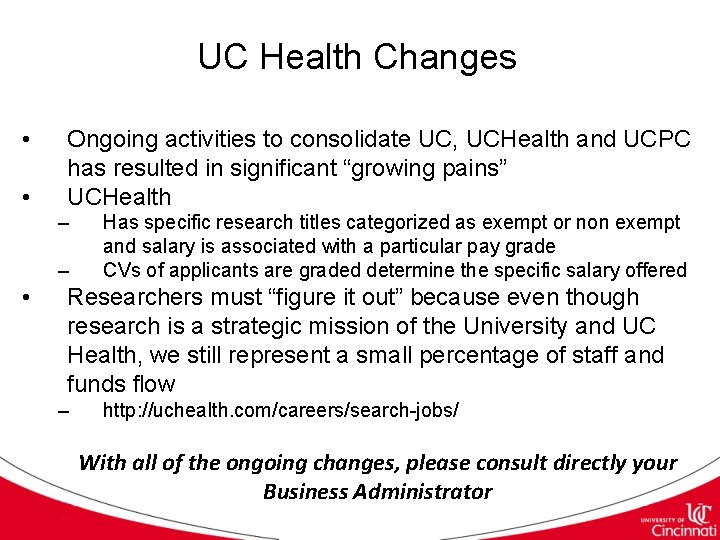
UC Health Changes • • Ongoing activities to consolidate UC, UCHealth and UCPC has resulted in significant “growing pains” UCHealth – – • Has specific research titles categorized as exempt or non exempt and salary is associated with a particular pay grade CVs of applicants are graded determine the specific salary offered Researchers must “figure it out” because even though research is a strategic mission of the University and UC Health, we still represent a small percentage of staff and funds flow – http: //uchealth. com/careers/search-jobs/ With all of the ongoing changes, please consult directly your Business Administrator
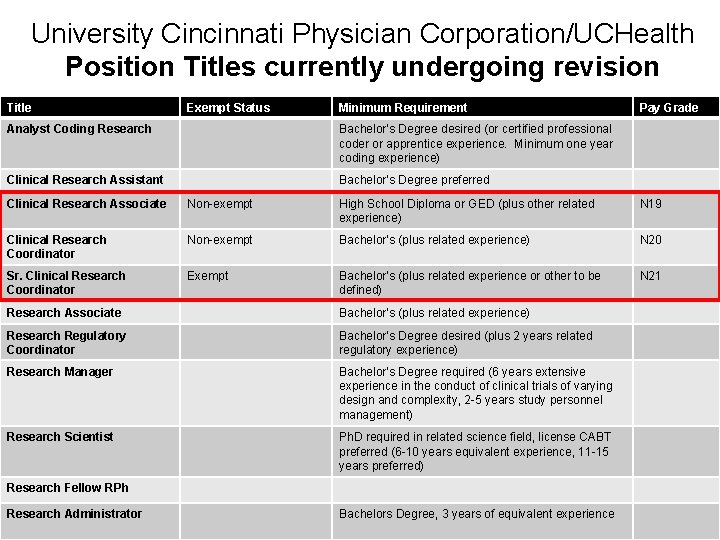
University Cincinnati Physician Corporation/UCHealth Position Titles currently undergoing revision Title Exempt Status Minimum Requirement Analyst Coding Research Bachelor’s Degree desired (or certified professional coder or apprentice experience. Minimum one year coding experience) Clinical Research Assistant Bachelor’s Degree preferred Pay Grade Clinical Research Associate Non-exempt High School Diploma or GED (plus other related experience) N 19 Clinical Research Coordinator Non-exempt Bachelor’s (plus related experience) N 20 Sr. Clinical Research Coordinator Exempt Bachelor’s (plus related experience or other to be defined) N 21 Research Associate Bachelor’s (plus related experience) Research Regulatory Coordinator Bachelor’s Degree desired (plus 2 years related regulatory experience) Research Manager Bachelor’s Degree required (6 years extensive experience in the conduct of clinical trials of varying design and complexity, 2 -5 years study personnel management) Research Scientist Ph. D required in related science field, license CABT preferred (6 -10 years equivalent experience, 11 -15 years preferred) Research Fellow RPh Research Administrator Bachelors Degree, 3 years of equivalent experience
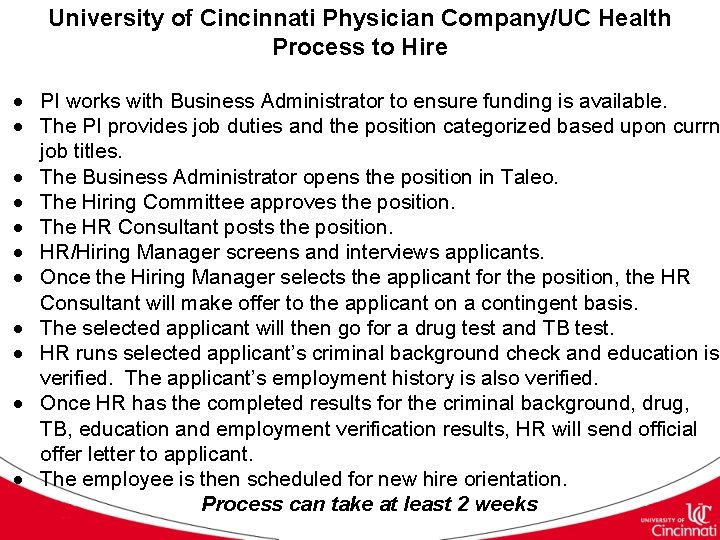
University of Cincinnati Physician Company/UC Health Process to Hire PI works with Business Administrator to ensure funding is available. The PI provides job duties and the position categorized based upon currn job titles. The Business Administrator opens the position in Taleo. The Hiring Committee approves the position. The HR Consultant posts the position. HR/Hiring Manager screens and interviews applicants. Once the Hiring Manager selects the applicant for the position, the HR Consultant will make offer to the applicant on a contingent basis. The selected applicant will then go for a drug test and TB test. HR runs selected applicant’s criminal background check and education is verified. The applicant’s employment history is also verified. Once HR has the completed results for the criminal background, drug, TB, education and employment verification results, HR will send official offer letter to applicant. The employee is then scheduled for new hire orientation. Process can take at least 2 weeks
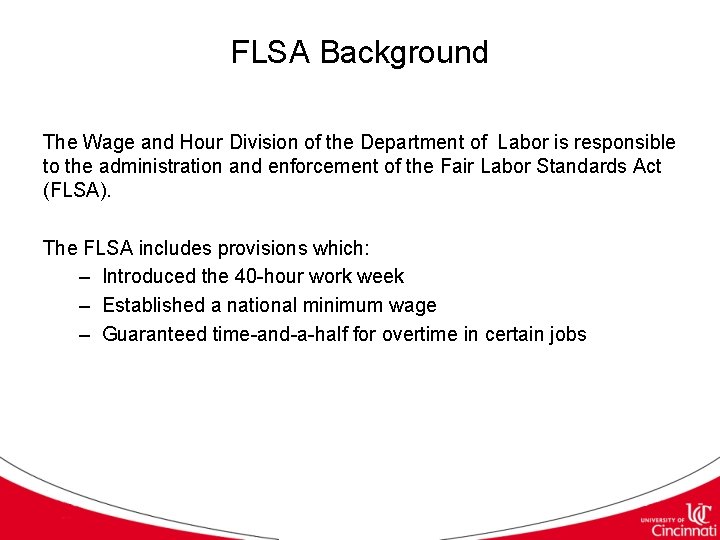
FLSA Background The Wage and Hour Division of the Department of Labor is responsible to the administration and enforcement of the Fair Labor Standards Act (FLSA). The FLSA includes provisions which: – Introduced the 40 -hour work week – Established a national minimum wage – Guaranteed time-and-a-half for overtime in certain jobs
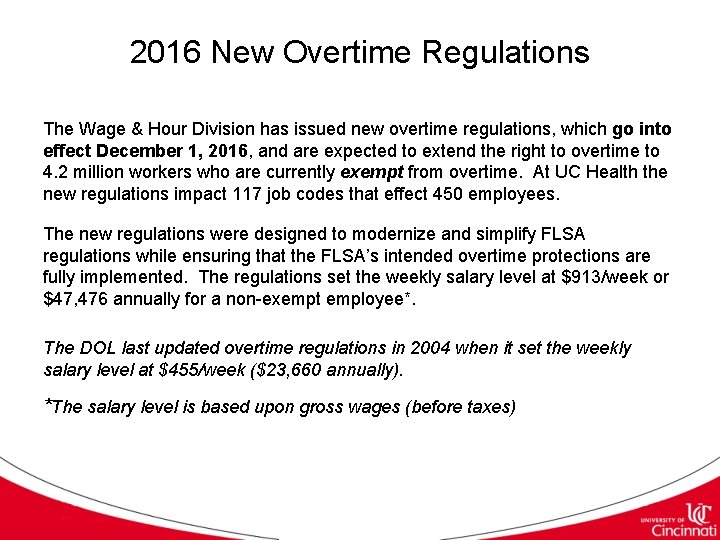
2016 New Overtime Regulations The Wage & Hour Division has issued new overtime regulations, which go into effect December 1, 2016, and are expected to extend the right to overtime to 4. 2 million workers who are currently exempt from overtime. At UC Health the new regulations impact 117 job codes that effect 450 employees. The new regulations were designed to modernize and simplify FLSA regulations while ensuring that the FLSA’s intended overtime protections are fully implemented. The regulations set the weekly salary level at $913/week or $47, 476 annually for a non-exempt employee*. The DOL last updated overtime regulations in 2004 when it set the weekly salary level at $455/week ($23, 660 annually). *The salary level is based upon gross wages (before taxes)
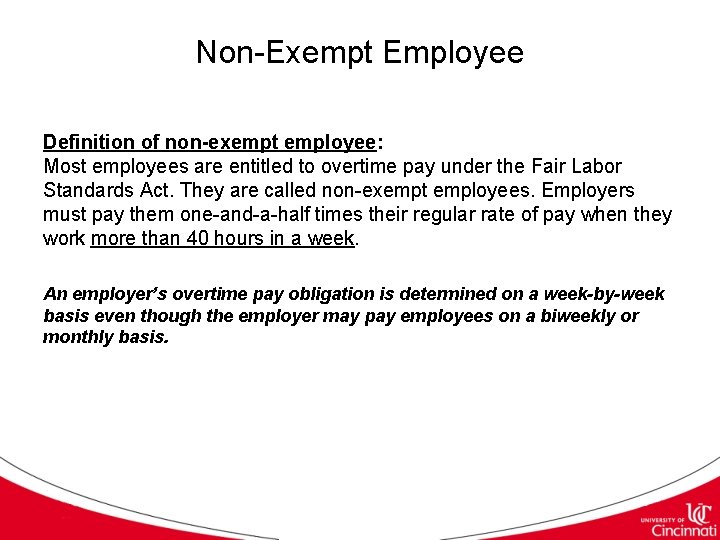
Non-Exempt Employee Definition of non-exempt employee: Most employees are entitled to overtime pay under the Fair Labor Standards Act. They are called non-exempt employees. Employers must pay them one-and-a-half times their regular rate of pay when they work more than 40 hours in a week. An employer’s overtime pay obligation is determined on a week-by-week basis even though the employer may pay employees on a biweekly or monthly basis.
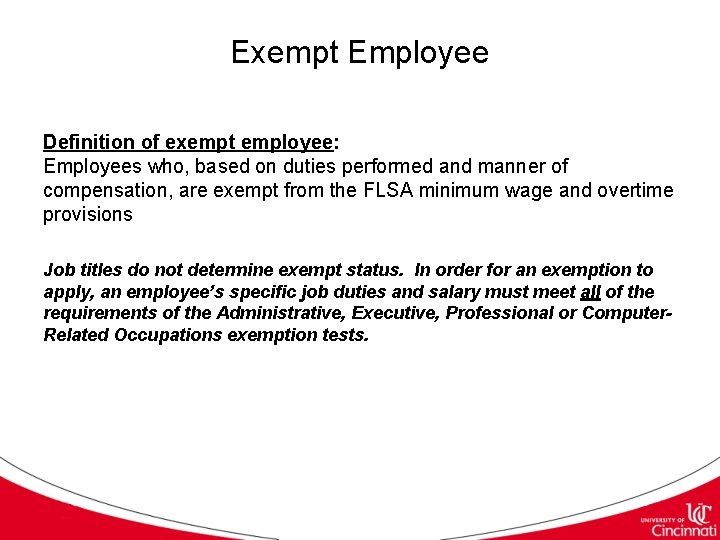
Exempt Employee Definition of exempt employee: Employees who, based on duties performed and manner of compensation, are exempt from the FLSA minimum wage and overtime provisions Job titles do not determine exempt status. In order for an exemption to apply, an employee’s specific job duties and salary must meet all of the requirements of the Administrative, Executive, Professional or Computer. Related Occupations exemption tests.
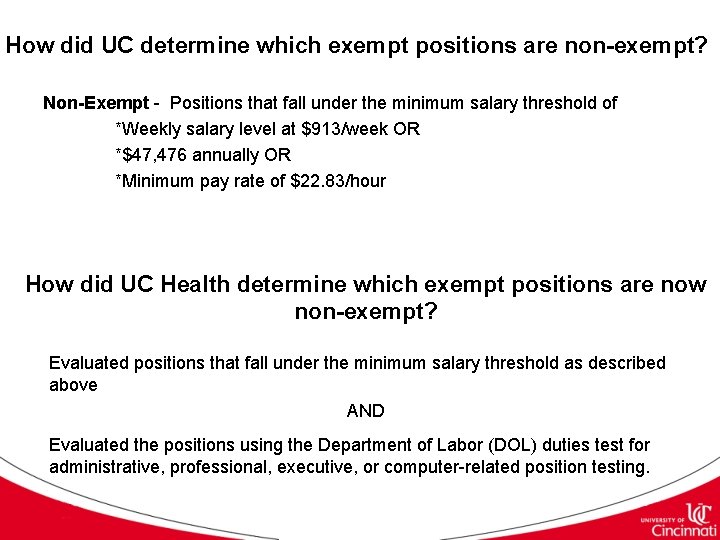
How did UC determine which exempt positions are non-exempt? Non-Exempt - Positions that fall under the minimum salary threshold of *Weekly salary level at $913/week OR *$47, 476 annually OR *Minimum pay rate of $22. 83/hour How did UC Health determine which exempt positions are now non-exempt? Evaluated positions that fall under the minimum salary threshold as described above AND Evaluated the positions using the Department of Labor (DOL) duties test for administrative, professional, executive, or computer-related position testing.
Discuss Worksheet
• • “Catch 22” Federal funded research processed via UC Industry sponsored research processed via UCPC Inability to easily move personnel or money across systems to meet investigator needs Unable to maintain “reserves” to fund ongoing research efforts or unfunded projects
How to effectively interview and evaluate candidates? ? PLEASE TEACH ME!!!
How to effectively interview and evaluate candidates • Important traits • • • Special skill set for study procedures • • • Phlebotomy, EKG, lab skills, etc. Do you need a more expensive provider? PIs must give the team clear direction • • Attention to detail (let the candidate talk) Self starter Weekly faculty meeting to discuss science Weekly staff meeting to discuss implementation Both are very different processes When moving to human subjects research, ALL RULES CHANGE. It is exhausting to team when leader does NOT provide clear direction (or the direction constantly changes). Allow team to feel a sense of accomplishment too.
Management • Use senior colleagues as a resource • Be clear with your intent: let people know why you are having them do what they are doing • Be consistent in your treatment of all staff members • Work with HR on hiring and staffing: it will save you time and agony • Chances are you will have to fire someone: know the rules beforehand so that you can ease the process – – Quickly document observed concerns Work with HR on a corrective action plan Don’t become distracted because it will not “fix itself” As a manager, you will feel “on an island alone”
Management (cont) • Be honest in annual reviews: don’t give all ‘A’s’ unless they are deserved • Instill a team spirit that involves all lab members • Try to keep long-term employees motivated: their interest will wane • Be willing to make tough staffing decisions
Considerations • People are your most valuable resource • The research program will have funding ‘ups’ and ‘downs’: try to staff accordingly – Prioritize staffing to meet anticipated needs – Turnover is not always a bad thing
Successful Investigator of the Future • Silos still exist between clinical and basic research. • Investigator and University need to change the paradigm by integrating faculty and personnel, and change the culture at all levels. • Successful investigator of the future will function in a University where – Human resources mission includes recognizing their role in the conduct of quality research by facilitating proper staffing in addition to assuring University compliance – Business administrators have the flexibility to recognize the individual investigator’s programmatic needs – Investigators realize this is a business, and if the business model doesn’t work, we can’t do the science.
Questions and Discussion