Hesss Law Conservation of Energy The overall enthalpy

- Slides: 7
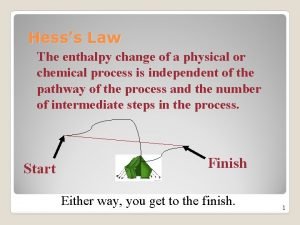
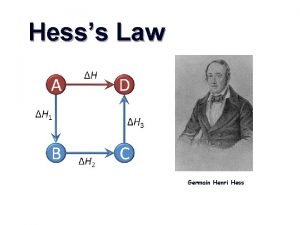
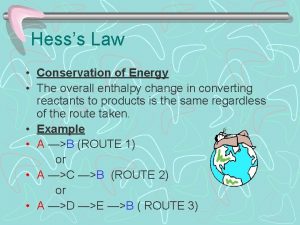
Hess’s Law • Conservation of Energy • The overall enthalpy change in converting reactants to products is the same regardless of the route taken. • Example • A —>B (ROUTE 1) or • A —>C —>B (ROUTE 2) or • A —>D —>E —>B ( ROUTE 3)
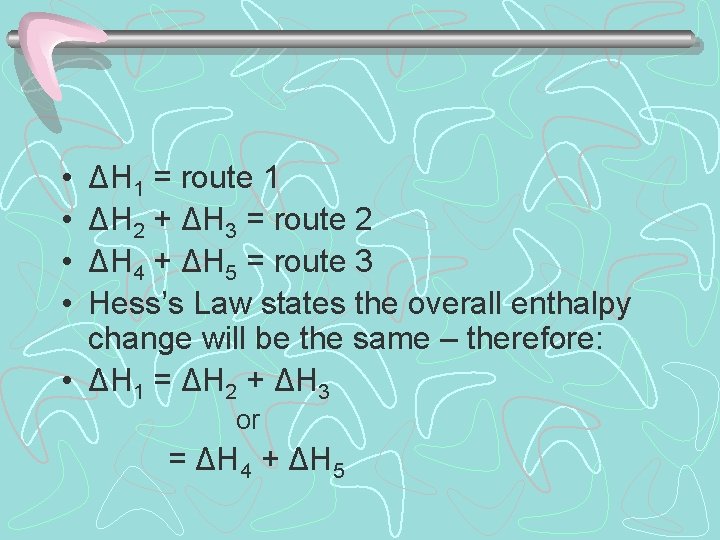
• • ΔH 1 = route 1 ΔH 2 + ΔH 3 = route 2 ΔH 4 + ΔH 5 = route 3 Hess’s Law states the overall enthalpy change will be the same – therefore: • ΔH 1 = ΔH 2 + ΔH 3 or = ΔH 4 + ΔH 5
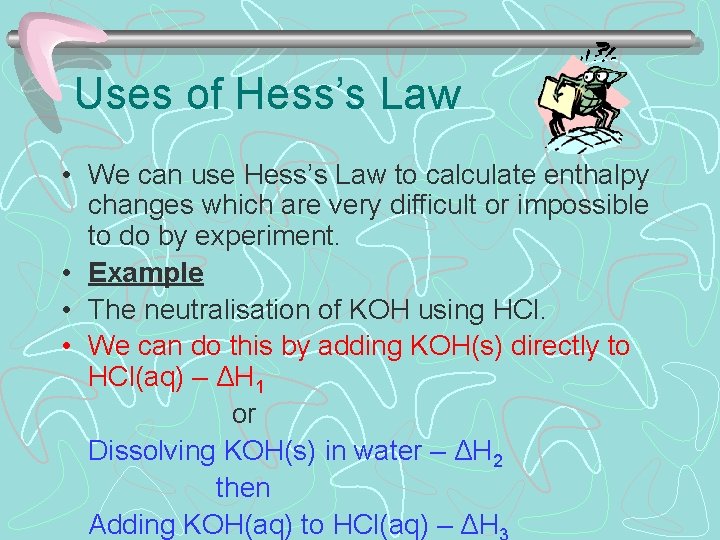
Uses of Hess’s Law • We can use Hess’s Law to calculate enthalpy changes which are very difficult or impossible to do by experiment. • Example • The neutralisation of KOH using HCl. • We can do this by adding KOH(s) directly to HCl(aq) – ΔH 1 or Dissolving KOH(s) in water – ΔH 2 then Adding KOH(aq) to HCl(aq) – ΔH
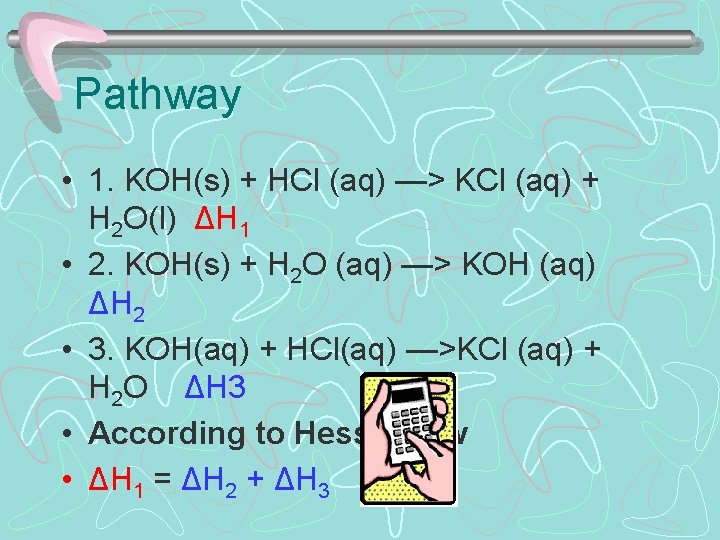
Pathway • 1. KOH(s) + HCl (aq) —> KCl (aq) + H 2 O(l) ΔH 1 • 2. KOH(s) + H 2 O (aq) —> KOH (aq) ΔH 2 • 3. KOH(aq) + HCl(aq) —>KCl (aq) + H 2 O ΔH 3 • According to Hess’s Law • ΔH 1 = ΔH 2 + ΔH 3
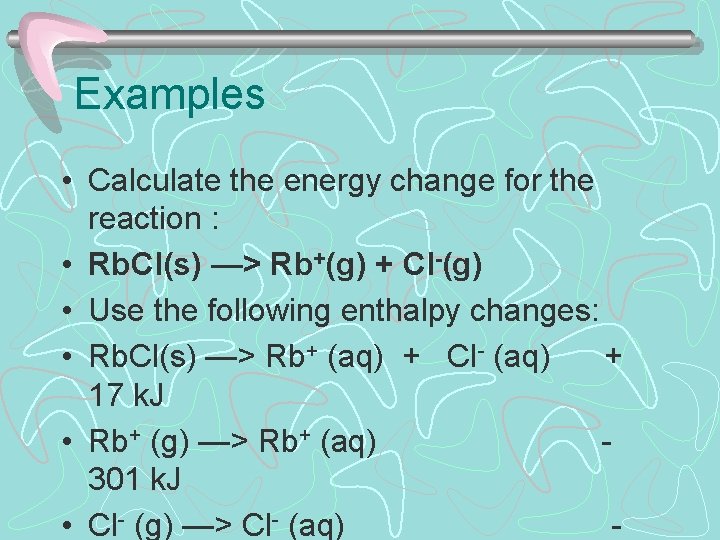
Examples • Calculate the energy change for the reaction : • Rb. Cl(s) —> Rb+(g) + Cl-(g) • Use the following enthalpy changes: • Rb. Cl(s) —> Rb+ (aq) + Cl- (aq) + 17 k. J • Rb+ (g) —> Rb+ (aq) 301 k. J • Cl- (g) —> Cl- (aq) -
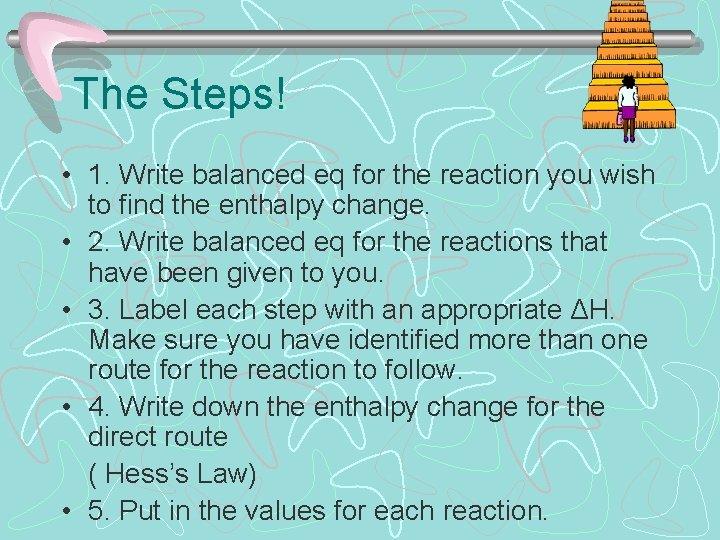
The Steps! • 1. Write balanced eq for the reaction you wish to find the enthalpy change. • 2. Write balanced eq for the reactions that have been given to you. • 3. Label each step with an appropriate ΔH. Make sure you have identified more than one route for the reaction to follow. • 4. Write down the enthalpy change for the direct route ( Hess’s Law) • 5. Put in the values for each reaction.
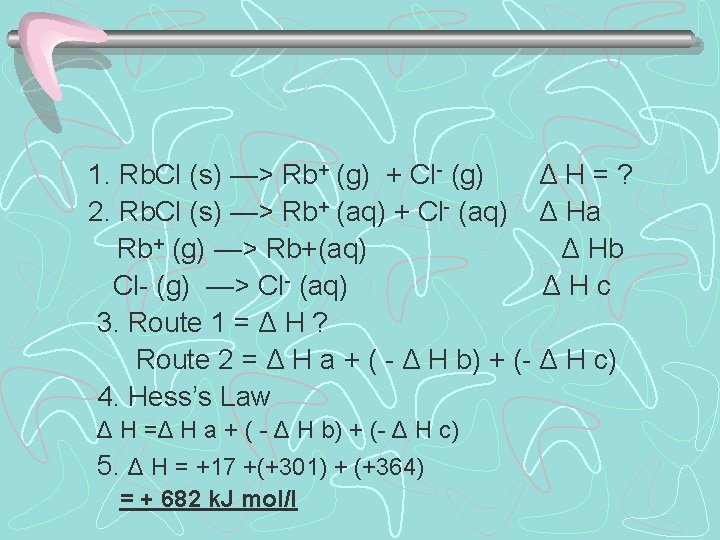
1. Rb. Cl (s) —> Rb+ (g) + Cl- (g) ΔH=? 2. Rb. Cl (s) —> Rb+ (aq) + Cl- (aq) Δ Ha Rb+ (g) —> Rb+(aq) Δ Hb Cl- (g) —> Cl- (aq) ΔHc 3. Route 1 = Δ H ? Route 2 = Δ H a + ( - Δ H b) + (- Δ H c) 4. Hess’s Law Δ H =Δ H a + ( - Δ H b) + (- Δ H c) 5. Δ H = +17 +(+301) + (+364) = + 682 k. J mol/l