Industrial Chemistry Hesss law Index Hesss Law and


- Slides: 14
Industrial Chemistry Hess’s law
Index Hess’s Law and its experimental verification Hess’s Law calculations, 4 examples.
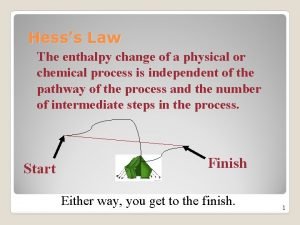
Hess’s Law and calculations Hess’s law states that “enthalpy change is independent of the route taken”
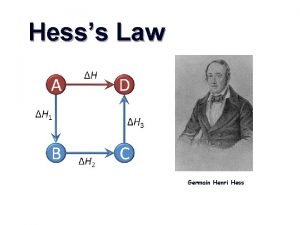
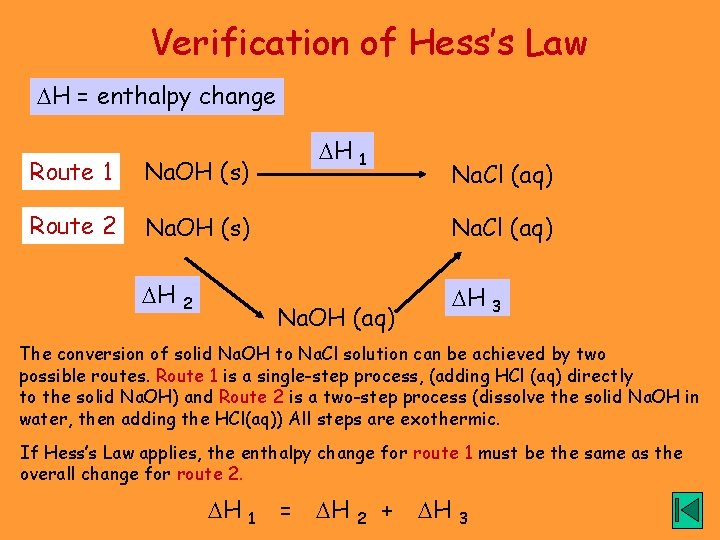
Verification of Hess’s Law H = enthalpy change H 1 Route 1 Na. OH (s) Route 2 Na. OH (s) Na. Cl (aq) H 2 H 3 Na. OH (aq) Na. Cl (aq) The conversion of solid Na. OH to Na. Cl solution can be achieved by two possible routes. Route 1 is a single-step process, (adding HCl (aq) directly to the solid Na. OH) and Route 2 is a two-step process (dissolve the solid Na. OH in water, then adding the HCl(aq)) All steps are exothermic. If Hess’s Law applies, the enthalpy change for route 1 must be the same as the overall change for route 2. H 1 = H 2 + H 3
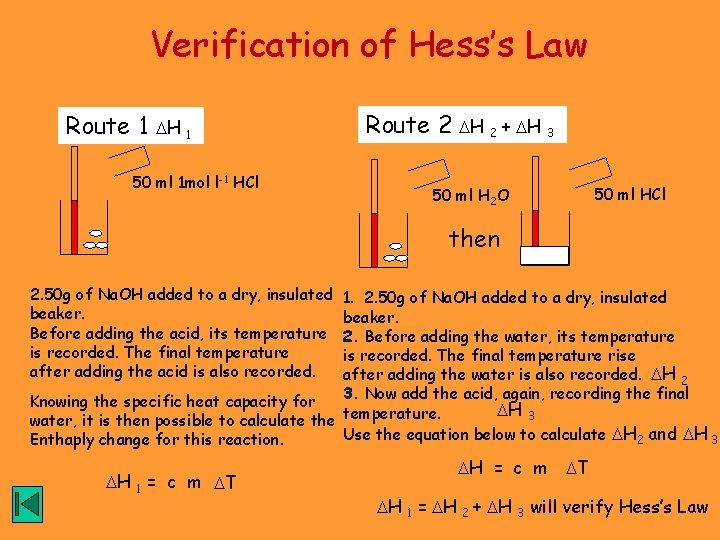
Verification of Hess’s Law Route 1 H 1 50 ml 1 mol l-1 HCl Route 2 H 2 + H 3 50 ml HCl 50 ml H 2 O then 2. 50 g of Na. OH added to a dry, insulated beaker. Before adding the acid, its temperature is recorded. The final temperature after adding the acid is also recorded. 1. 2. 50 g of Na. OH added to a dry, insulated beaker. 2. Before adding the water, its temperature is recorded. The final temperature rise after adding the water is also recorded. H 2 3. Now add the acid, again, recording the final Knowing the specific heat capacity for H 3 water, it is then possible to calculate the temperature. Use the equation below to calculate H 2 and H 3 Enthaply change for this reaction. H 1 = c m T H = c m T H 1 = H 2 + H 3 will verify Hess’s Law
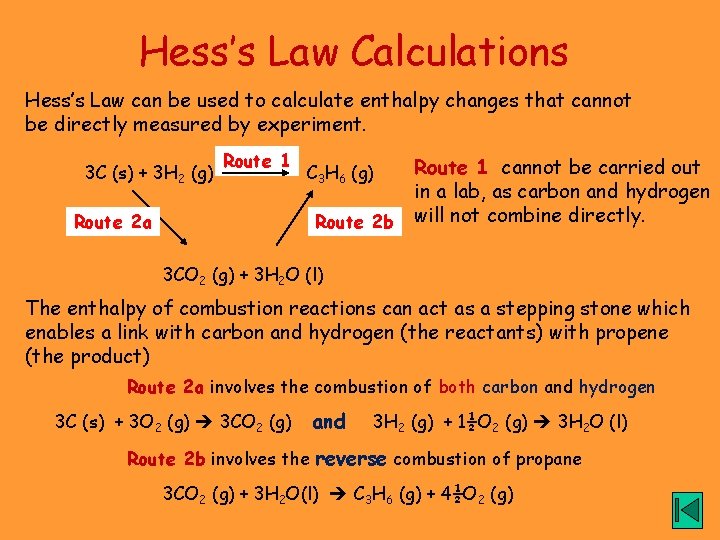
Hess’s Law Calculations Hess’s Law can be used to calculate enthalpy changes that cannot be directly measured by experiment. 3 C (s) + 3 H 2 (g) Route 1 Route 2 a C 3 H 6 (g) Route 2 b Route 1 cannot be carried out in a lab, as carbon and hydrogen will not combine directly. 3 CO 2 (g) + 3 H 2 O (l) The enthalpy of combustion reactions can act as a stepping stone which enables a link with carbon and hydrogen (the reactants) with propene (the product) Route 2 a involves the combustion of both carbon and hydrogen 3 C (s) + 3 O 2 (g) 3 CO 2 (g) and 3 H 2 (g) + 1½O 2 (g) 3 H 2 O (l) Route 2 b involves the reverse combustion of propane 3 CO 2 (g) + 3 H 2 O(l) C 3 H 6 (g) + 4½O 2 (g)
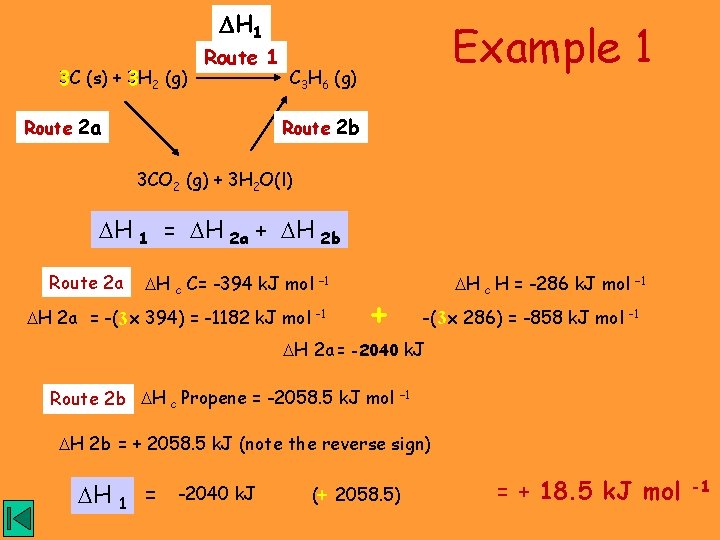
H 1 3 C (s) + 3 3 H 2 (g) 3 Route 1 Route 2 a Example 1 C 3 H 6 (g) Route 2 b 3 CO 2 (g) + 3 H 2 O(l) H 1 = H 2 a + H 2 b Route 2 a H c C= -394 k. J mol – 1 H 2 a = -(3 x 394) = -1182 k. J mol -1 H c H = -286 k. J mol + -( 3 x 286) = -858 k. J mol – 1 -1 H 2 a = -2040 k. J Route 2 b H c Propene = -2058. 5 k. J mol – 1 H 2 b = + 2058. 5 k. J (note the reverse sign) H 1 = -2040 k. J (+ 2058. 5) = + 18. 5 k. J mol -1
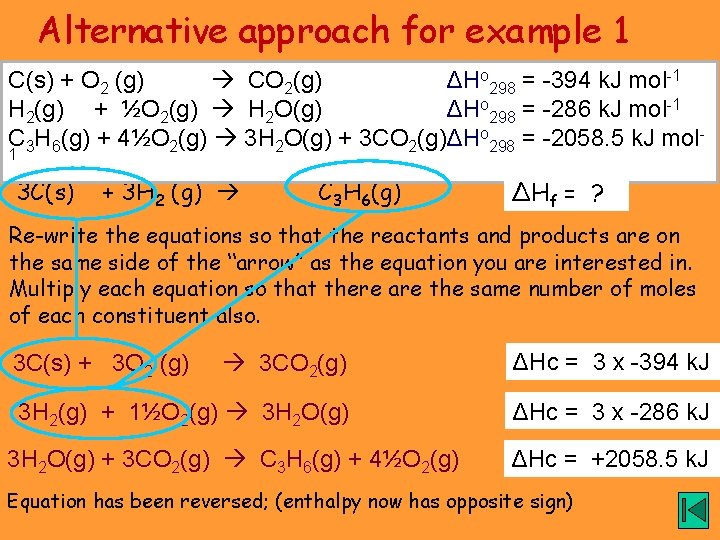
Alternative approach for example 1 C(s) + O 2 (g) CO 2(g) ΔHo 298 = -394 k. J mol-1 H 2(g) + ½O 2(g) H 2 O(g) ΔHo 298 = -286 k. J mol-1 C 3 H 6(g) + 4½O 2(g) 3 H 2 O(g) + 3 CO 2(g)ΔHo 298 = -2058. 5 k. J mol 1 3 C(s) + 3 H 2 (g) C 3 H 6(g) ΔHf = ? Re-write the equations so that the reactants and products are on the same side of the “arrow” as the equation you are interested in. Multiply each equation so that there are the same number of moles of each constituent also. 3 CO 2(g) ΔHc = 3 x -394 k. J 3 H 2(g) + 1½O 2(g) 3 H 2 O(g) ΔHc = 3 x -286 k. J 3 C(s) + 3 O 2 (g) 3 H 2 O(g) + 3 CO 2(g) C 3 H 6(g) + 4½O 2(g) ΔHc = +2058. 5 k. J Equation has been reversed; (enthalpy now has opposite sign)
3 C(graphite) + 3 O 2 (g) 3 CO 2(l) ΔHc = 3 x -394 3 H 2(g) + 1½O 2(g) 3 H 2 O(l) ΔHc = 3 x -286 3 H 2 O(g) + 3 CO 2(g) C 3 H 6(g) + 4½O 2(l) ΔHc = +2058. 5 Now add the equations and also the corresponding enthalpy values 3 C(s) + 3 H 2(g) C 3 H 6(g) ΔHf = (3 x -394) + (3 x -286) + (+2058. 5) ΔHf = +18. 5 k. J mol-1
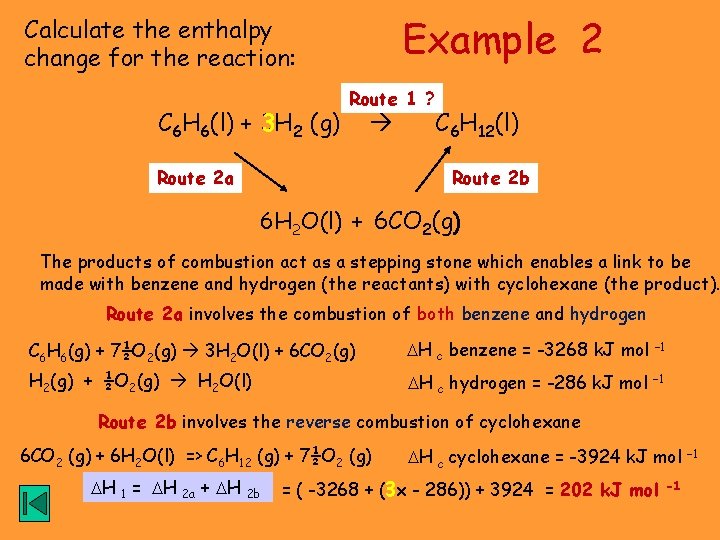
Example 2 Calculate the enthalpy change for the reaction: C 6 H 6(l) + 3 H 3 2 (g) Route 1 ? Route 2 a C 6 H 12(l) Route 2 b 6 H 2 O(l) + 6 CO 2(g) The products of combustion act as a stepping stone which enables a link to be made with benzene and hydrogen (the reactants) with cyclohexane (the product). Route 2 a involves the combustion of both benzene and hydrogen C 6 H 6(g) + 7½O 2(g) 3 H 2 O(l) + 6 CO 2(g) H c benzene = -3268 k. J mol – 1 H 2(g) + ½O 2(g) H 2 O(l) H c hydrogen = -286 k. J mol – 1 Route 2 b involves the reverse combustion of cyclohexane 6 CO 2 (g) + 6 H 2 O(l) => C 6 H 12 (g) + 7½O 2 (g) H 1 = H 2 a + H 2 b H c cyclohexane = -3924 k. J mol = ( -3268 + (3 x - 286)) + 3924 = 202 k. J mol -1 – 1
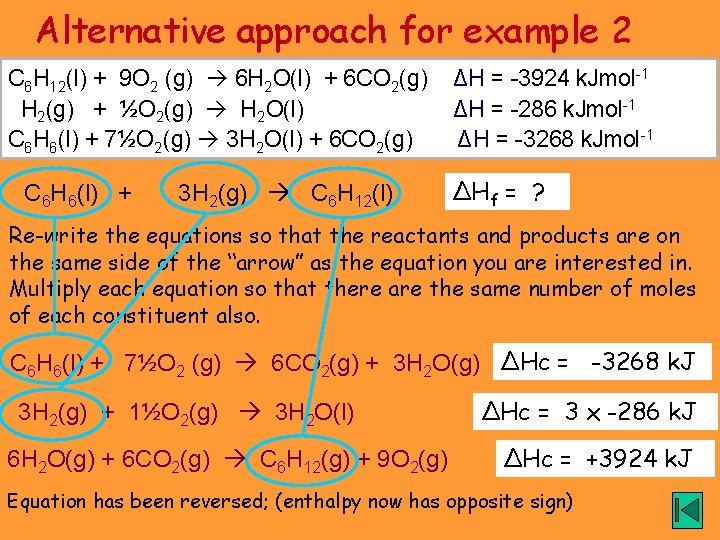
Alternative approach for example 2 C 6 H 12(l) + 9 O 2 (g) 6 H 2 O(l) + 6 CO 2(g) H 2(g) + ½O 2(g) H 2 O(l) C 6 H 6(l) + 7½O 2(g) 3 H 2 O(l) + 6 CO 2(g) C 6 H 6(l) + 3 H 2(g) C 6 H 12(l) ΔH = -3924 k. Jmol-1 ΔH = -286 k. Jmol-1 ΔH = -3268 k. Jmol-1 ΔHf = ? Re-write the equations so that the reactants and products are on the same side of the “arrow” as the equation you are interested in. Multiply each equation so that there are the same number of moles of each constituent also. C 6 H 6(l) + 7½O 2 (g) 6 CO 2(g) + 3 H 2 O(g) ΔHc = -3268 k. J 3 H 2(g) + 1½O 2(g) 3 H 2 O(l) 6 H 2 O(g) + 6 CO 2(g) C 6 H 12(g) + 9 O 2(g) ΔHc = 3 x -286 k. J ΔHc = +3924 k. J Equation has been reversed; (enthalpy now has opposite sign)
C 6 H 6(l) + 7½O 2 (g) 6 CO 2(g) + 3 H 2 O(g) ΔHc = -3268 3 H 2(g) + 1½O 2(g) 3 H 2 O(g) ΔHc = 3 x -286 6 H 2 O(g) + 6 CO 2(g) C 6 H 12(l) + 9 O 2(g) ΔHc = +3924 Now add the equations and also the corresponding enthalpy values C 6 H 6(l) + 3 H 2(g) C 6 H 12(l) ΔH f = -3268 + (3 x -286) + ΔH f = -202 k. J mol-1 3924
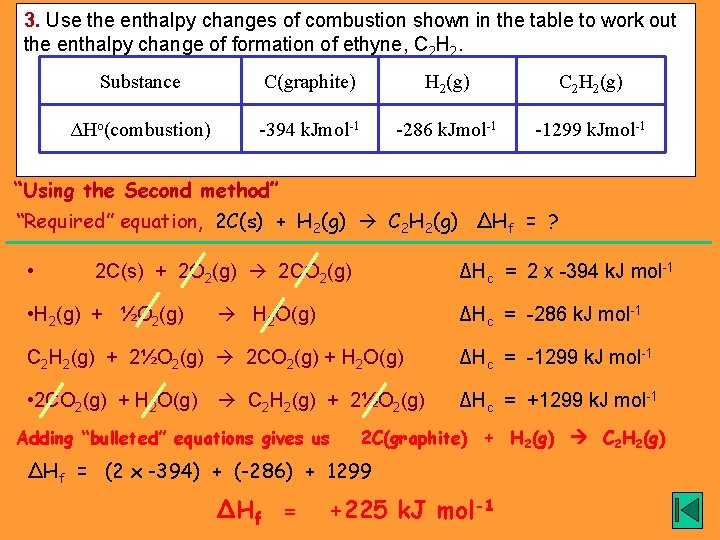
3. Use the enthalpy changes of combustion shown in the table to work out the enthalpy change of formation of ethyne, C 2 H 2. Substance C(graphite) H 2(g) C 2 H 2(g) ΔHo(combustion) -394 k. Jmol-1 -286 k. Jmol-1 -1299 k. Jmol-1 “Using the Second method” “Required” equation, 2 C(s) + H 2(g) C 2 H 2(g) ΔHf = ? • 2 C(s) + 2 O 2(g) 2 CO 2(g) • H 2(g) + ½O 2(g) ΔHc = 2 x -394 k. J mol-1 H 2 O(g) ΔHc = -286 k. J mol-1 C 2 H 2(g) + 2½O 2(g) 2 CO 2(g) + H 2 O(g) ΔHc = -1299 k. J mol-1 • 2 CO 2(g) + H 2 O(g) C 2 H 2(g) + 2½O 2(g) ΔHc = +1299 k. J mol-1 Adding “bulleted” equations gives us 2 C(graphite) + H 2(g) C 2 H 2(g) ΔHf = (2 x -394) + (-286) + 1299 ΔHf = +225 k. J mol-1
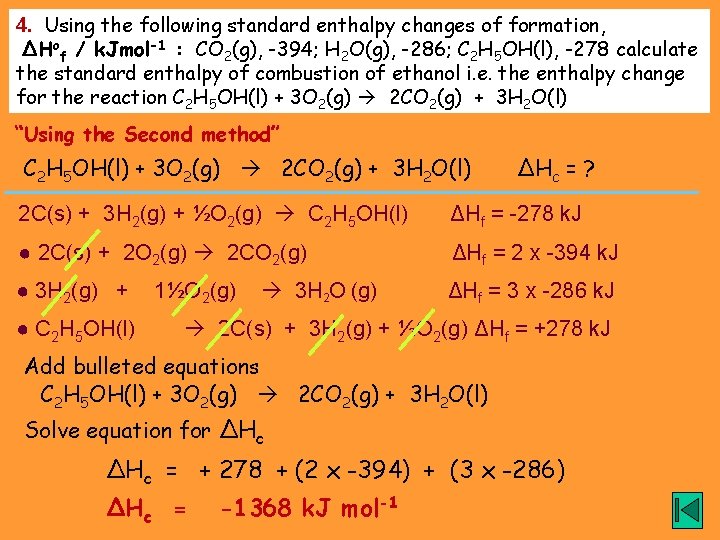
4. Using the following standard enthalpy changes of formation, ΔHof / k. Jmol-1 : CO 2(g), -394; H 2 O(g), -286; C 2 H 5 OH(l), -278 calculate the standard enthalpy of combustion of ethanol i. e. the enthalpy change for the reaction C 2 H 5 OH(l) + 3 O 2(g) 2 CO 2(g) + 3 H 2 O(l) “Using the Second method” C 2 H 5 OH(l) + 3 O 2(g) 2 CO 2(g) + 3 H 2 O(l) ΔHc = ? 2 C(s) + 3 H 2(g) + ½O 2(g) C 2 H 5 OH(l) ΔHf = -278 k. J ● 2 C(s) + 2 O 2(g) 2 CO 2(g) ΔHf = 2 x -394 k. J ● 3 H 2(g) + ΔHf = 3 x -286 k. J ● C 2 H 5 OH(l) 1½O 2(g) 3 H 2 O (g) 2 C(s) + 3 H 2(g) + ½O 2(g) ΔHf = +278 k. J Add bulleted equations C 2 H 5 OH(l) + 3 O 2(g) 2 CO 2(g) + 3 H 2 O(l) Solve equation for ΔHc = + 278 + (2 x -394) + (3 x -286) ΔHc = -1368 k. J mol-1