Head Injuries Do Dr Demet TekdDemirciolu Definition Anyinjury
- Slides: 39
Head Injuries Doç. Dr. Demet. TekdöşDemircioğlu
Definition ➢Anyinjury that results in the trauma to the scalp, skull or brain. ➢Traumatic brain injury (TBI) encompasses a broad range of pathologic injuries to the brain of varying clinical severity that result fromheadtrauma. ➢Head injury and traumatic brain injury are often used interchangeably
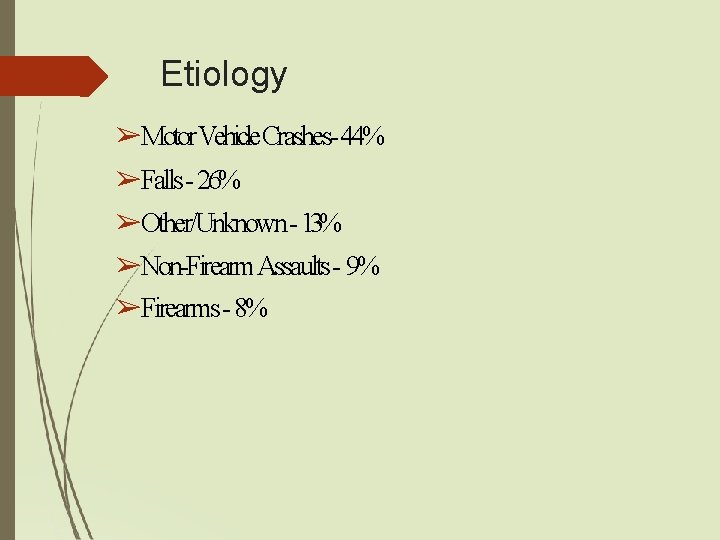
Etiology ➢Motor. Vehicle. Crashes- 44% ➢Falls - 26% ➢Other/Unknown - 13% ➢Non-Firearm Assaults - 9% ➢Firearms - 8%
Pathophysiology ➢Onthe basis ofmechanismofproduction, head injury can be classified as: ➢Impact injuries: It results froman objectstriking the head or the head striking an object. ➢It includes: ❖Scalp injuries ❖Skull fracture ❖Cerebral contusion and laceration ❖Epidural haematoma
➢Acceleration and deceleration injuries: It results essentially as a result ofdifferential movementbetweenskull and cranial content. ➢It includes: Diffuseaxonal injury Sub-dural hematoma
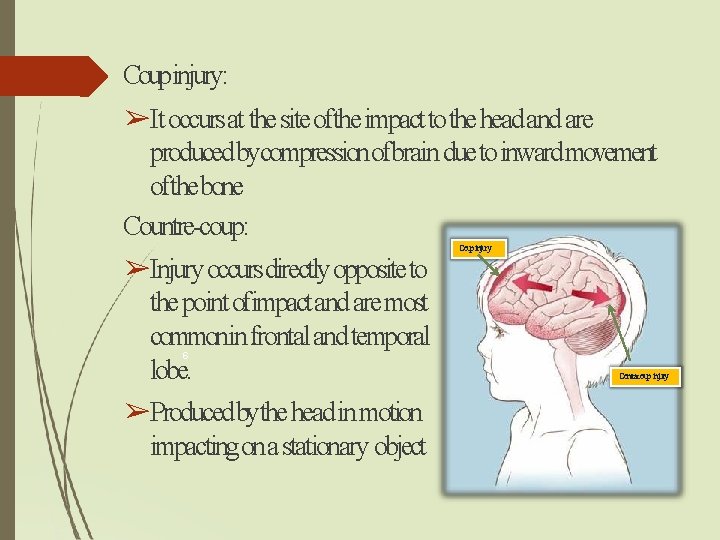
Coupinjury: ➢It occurs at the site ofthe impact to the head and are produced bycompression ofbrain due to inward movement ofthebone Countre-coup: ➢Injury occurs directly opposite to the point ofimpact and are most commonin frontal and temporal lobe. ➢Produced bythe head in motion impacting ona stationary object Coupinjury 6 Contracoup injury
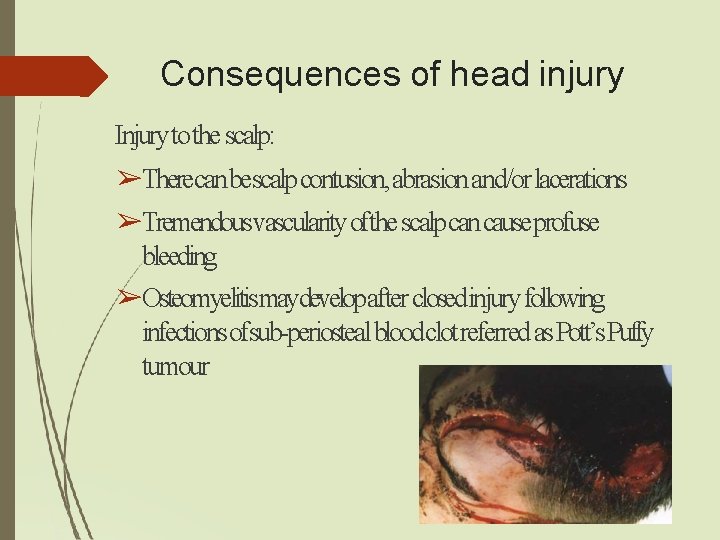
Consequences of head injury Injury to the scalp: ➢Therecan bescalp contusion, abrasion and/or lacerations ➢Tremendousvascularity ofthe scalp can cause profuse bleeding ➢Osteomyelitismaydevelopafter closedinjury following infections ofsub-periosteal bloodclot referred as Pott’s Puffy tumour
Skull Fracture Simplelinearfracture: ➢It is the break in the bonethat transverses the full thickness ofthe skull fromthe outer to inner table ➢Noclinical significance ➢Fracture that transverses a suture line or involvesa venous sinus grooveor vascular grooveshould bedealtcautiously
Depressed Skull Fracture ➢Results fromblunt trauma ➢Inner table extensivelyaffected than the outer table ➢Highrisk ofincreased pressure onthe brain or hemorrhage to the brain that crushes the delicate tissue
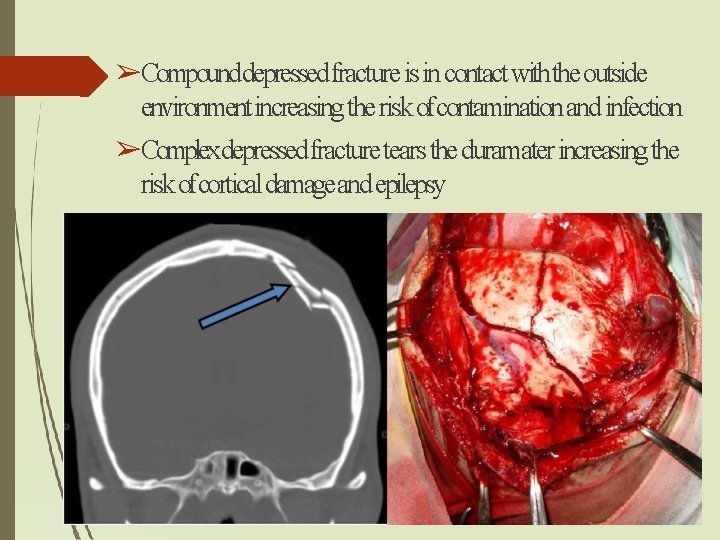
➢Compounddepressed fracture is in contact withthe outside environment increasing the risk ofcontamination and infection ➢Complexdepressed fracture tears the duramater increasing the risk ofcortical damageand epilepsy
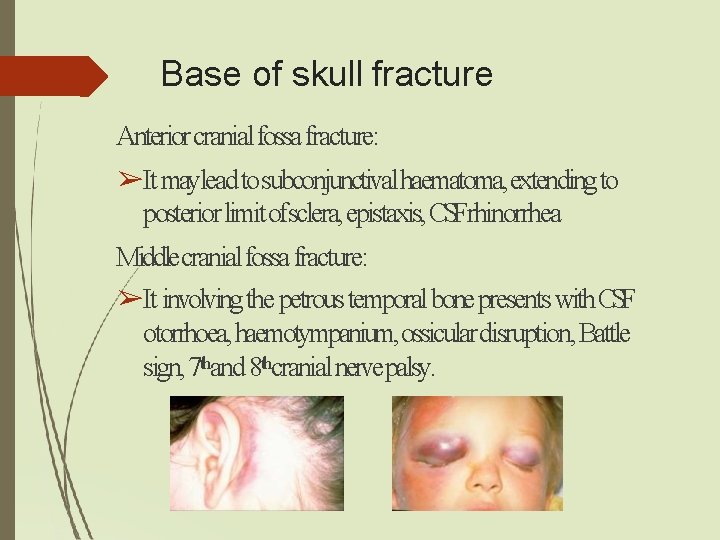
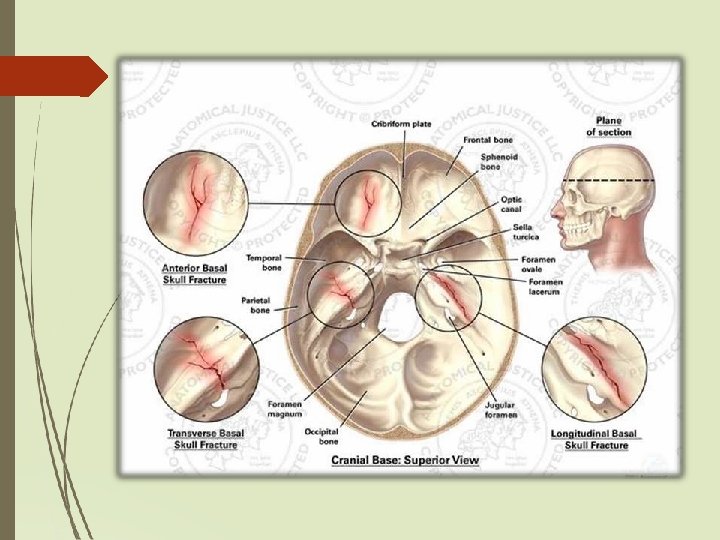
Base of skull fracture Anterior cranial fossa fracture: ➢It maylead to subconjunctival haematoma, extending to posterior limit ofsclera, epistaxis, CSFrhinorrhea Middlecranial fossa fracture: ➢It involving the petrous temporal bone presents with CSF otorrhoea, haemotympanium, ossicular disruption, Battle sign, 7 thand 8 thcranial nerve palsy.
Brain injury Primary brain injury: ➢Injury caused at the time ofimpact ➢Irreversible Secondarybrain injury ➢Subsequent or progressive brain damagearising fromevents developingas a result ofprimary brain injury
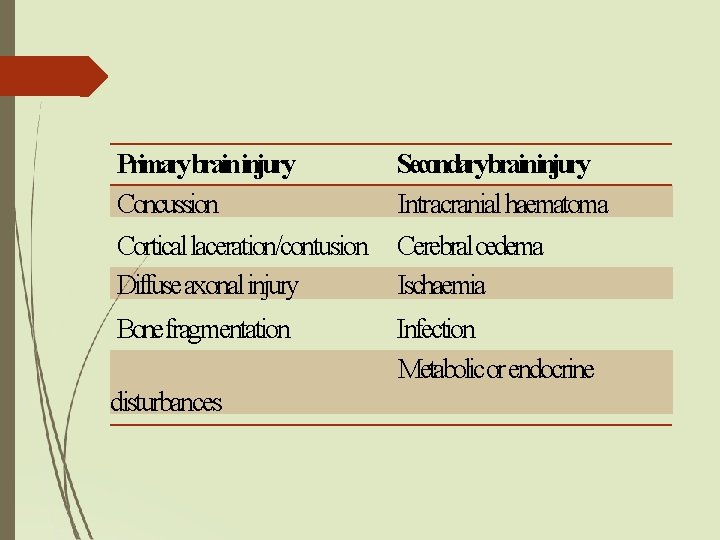
Primarybraininjury Concussion Secondarybraininjury Intracranial haematoma Cortical laceration/contusion Diffuse axonal injury Cerebral oedema Ischaemia Bone fragmentation Infection Metabolicor endocrine disturbances
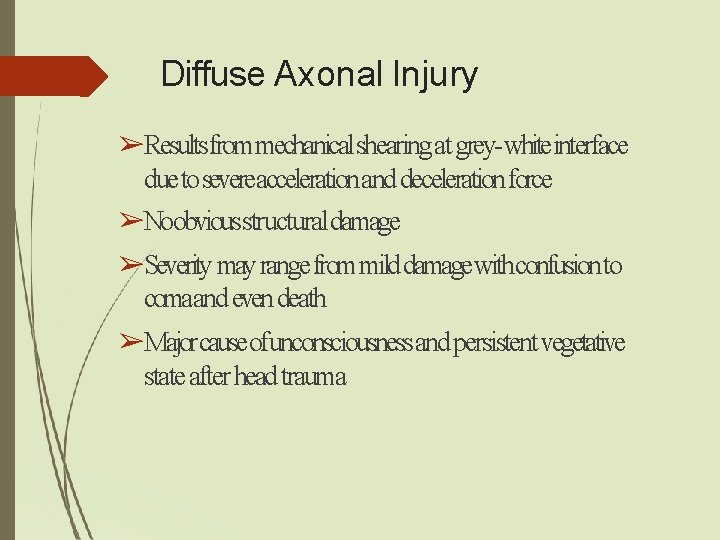
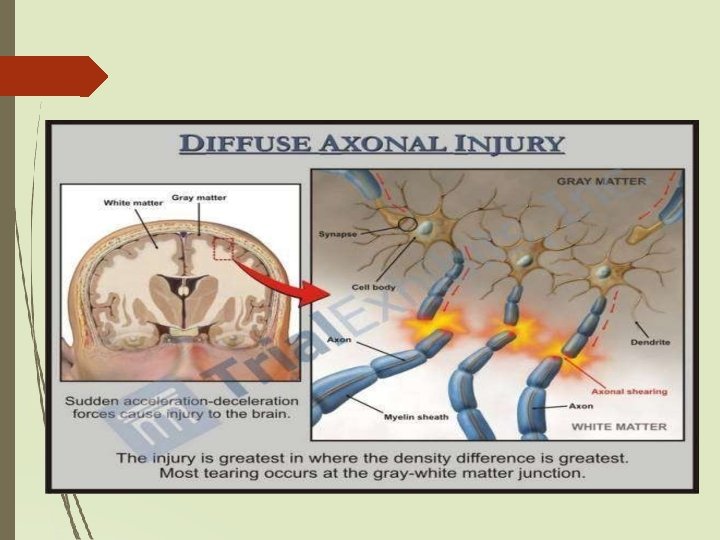
Diffuse Axonal Injury ➢Results frommechanical shearing at grey-whiteinterface due to severeacceleration and deceleration force ➢Noobviousstructural damage ➢Severity may range frommild damagewithconfusion to comaand even death ➢Majorcause ofunconsciousness and persistent vegetative state after head trauma
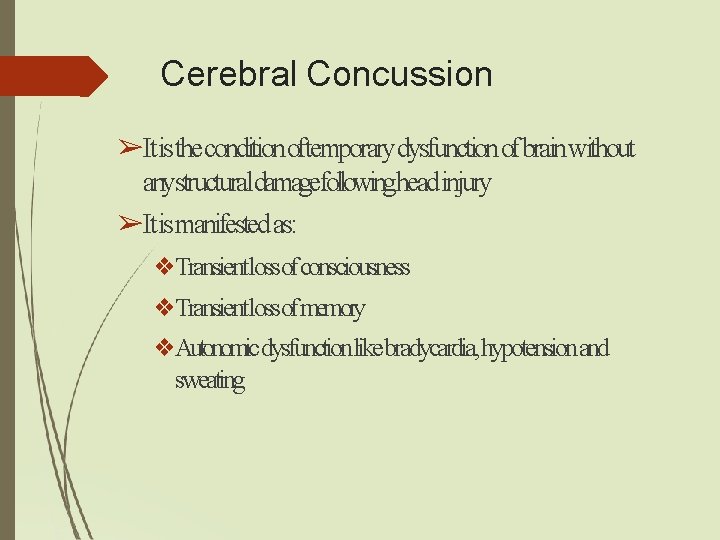
Cerebral Concussion ➢It is the condition oftemporary dysfunction of brain without anystructural damagefollowinghead injury ➢It is manifested as: ❖Transientlossofconsciousness ❖Transientlossofmemory ❖Autonomic dysfunctionlikebradycardia, hypotensionand sweating
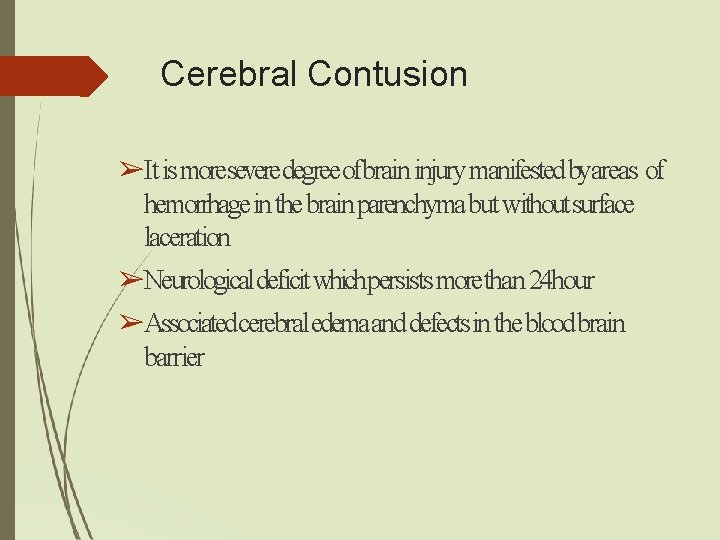
Cerebral Contusion ➢It is moreseveredegree ofbrain injury manifested byareas of hemorrhage in the brain parenchyma but without surface laceration ➢Neurologicaldeficit whichpersists morethan 24 hour ➢Associatedcerebral edemaand defects in the bloodbrain barrier
Cerebral laceration ➢Severedegree ofbrain injury associated witha breach in the surface parenchyma ➢Tearing ofbrain surface maybedue to skull fracture or due to shearing forces ➢Focalneurological defecit maybepresent
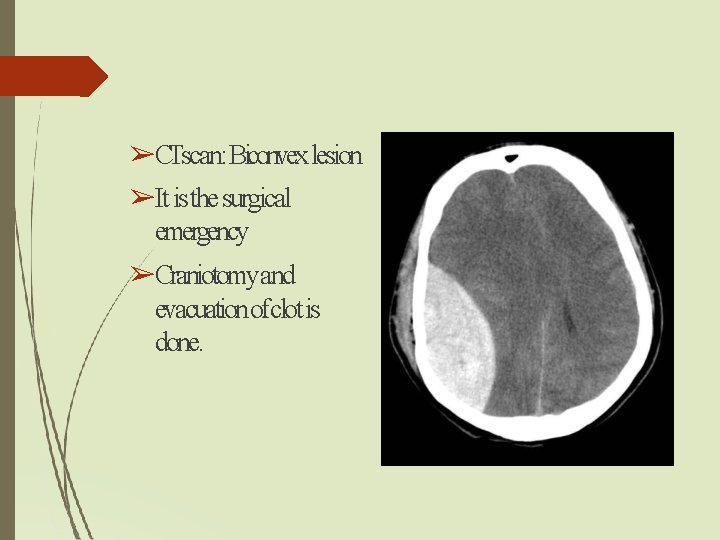
Extradural haematoma ➢Collectionofbloodbetweenthe cranial bonesand duramater ➢It is associated withthe fracture oftemporo-parietal region ➢Commonestvessel: Middlemeningealartery ➢Lucidinterval maybepresent ➢Confusion, irritability, drowsiness, hemiparesis to the sameside of injury ➢Hutchinson’s pupils ➢Features ofraised ICP: hypertension, bradycardia, vomiting
➢CTscan: Biconvex lesion ➢It is the surgical emergency ➢Craniotomyand evacuation ofclot is done.
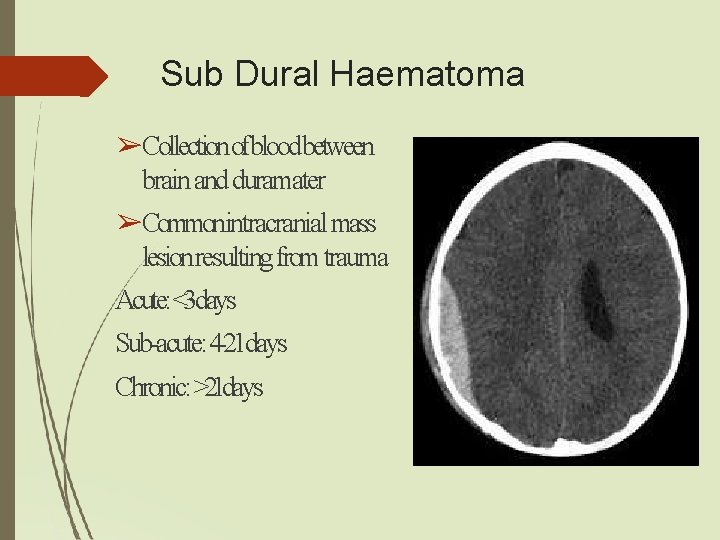
Sub Dural Haematoma ➢Collectionofbloodbetween brain and duramater ➢Commonintracranial mass lesion resulting from trauma Acute: <3 days Sub-acute: 4 -21 days Chronic: >21 days
Sub Dural Haemotama ➢Results fromtorn bridging veinor injury to the cortical artery ➢Haematomaextensiveand diffuse ➢Nolucid interval ➢Lossofconsciousness occurs immediately after trauma and is progressive ➢Features ofraised ICPand focalneurological defecits ➢CTScan: Concavo-convexlesion ➢T/t: surgical decompression bycraniotomy ➢Antibiotics
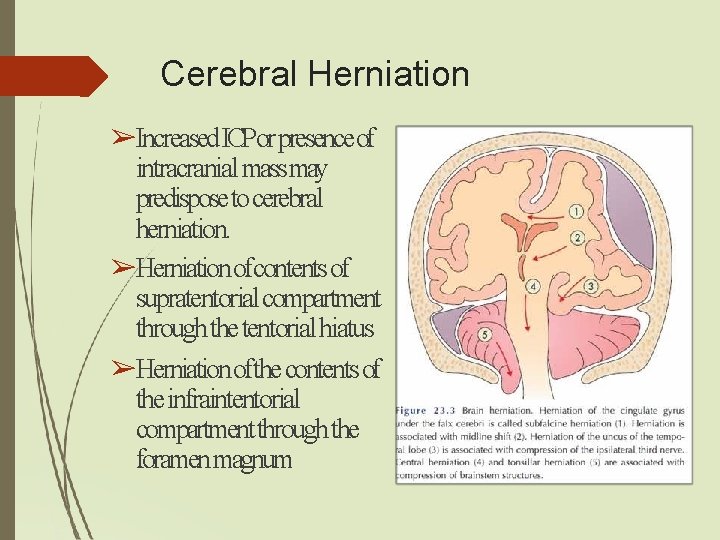
Cerebral Herniation ➢Increased ICPor presence of intracranial massmay predispose to cerebral herniation. ➢Herniation ofcontents of supratentorial compartment through the tentorial hiatus ➢Herniation ofthe contents of the infraintentorial compartment through the foramen magnum
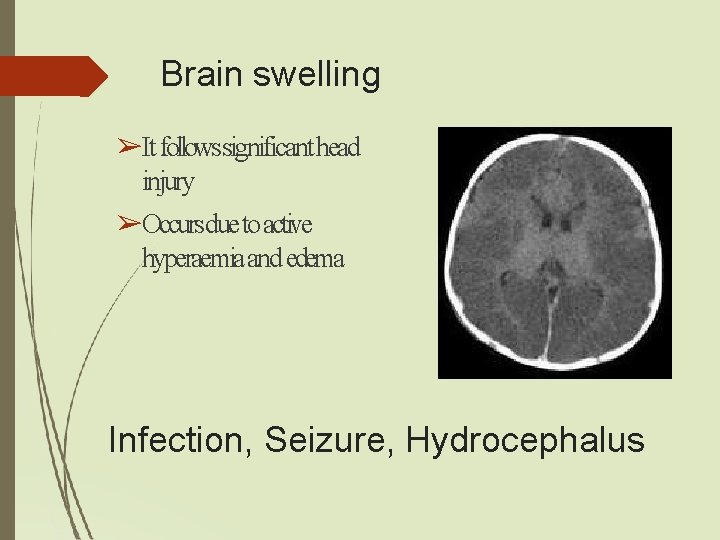
Brain swelling ➢It followssignificant head injury ➢Occursdue to active hyperaemia and edema Infection, Seizure, Hydrocephalus
Approach to Head Trauma ➢Detailed history should besought in all casesofhead trauma. ➢Ifthe patient is unconscious whichis usually the condition, history should beobtained fromthe attendant. ➢Whileonecare provider is taking history, resuscitation should becarried out simultaneously byother care provider.
Ask about: ➢Typeofaccident: ? RTA, ? fall fromheight ? acceleration/deceleration injury during driving a motor car ➢Levelofconsciousness: ? Unconscious, ? semiconscious ➢If unconscious: duration ofunconsciousness, ? immediately after trauma ? lucid interval ➢Post traumatic amnesia
Ask about: ➢Vomiting: ? blood in vomitus? persistent vomiting? sign of recoveryfromcerebral concussion ➢Epileptic fits or seizure: Its nature maygiveclueto localization ofthe site oftrauma ➢Swellingand pain in the head ➢Other complaints: ? bleeding or waterydischarge fromear, noseandmouth
Ask about: ➢Past history: ? fits or similar head injury in the past ? Hypertension ? DM? Renal diseases ➢Personal history: ? unconsciousness due to other cause (alcohol, opiumpoisoning, diabetic coma) ➢Familyhistory: History ofdiabetes, HTN, epilepsyin the family
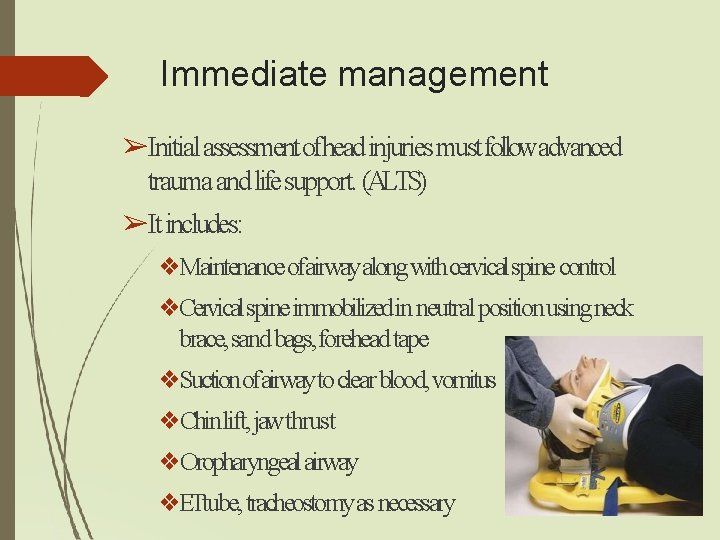
Immediate management ➢Initial assessment ofhead injuries must followadvanced trauma and life support. (ALTS) ➢It includes: ❖Maintenance ofairwayalong with cervical spine control ❖Cervicalspine immobilized in neutral position using neck brace, sand bags, forehead tape ❖Suction ofairwayto clear blood, vomitus ❖Chin lift, jaw thrust ❖Oropharyngeal airway ❖ETtube, tracheostomy as necessary
➢Maintenance of breathing ➢Assessmentofcirculation and control ofhaemorrhage ❖Establish ivaccesswithtwolarge bore ivcannulas ❖IVinfusion of. NS(Avoid 5%Dextroseas it may precipitate cerebral edema) ➢Assessmentofdysfunction of. CNS ➢Exposurein a controlledenvironment ❖Removeall clothes and lookfor anyobviousexternal injury
Physical examination ➢Pulseand blood pressure: ❖Pulsewillberapid, thready withlow. BPin caseofcerebral concussion ❖Pulsebecomesslowand bounding withhigh BPin caseof cerebral irritation ❖Rapid pulse in deeplyunconscious heralds impeding death
➢Temperature: In cerebral concussion, contusion temperature mayremain subnormal With appearance ofcerebral compression, temperature mayrise upto 100˚F Victor. Horsley’ssign
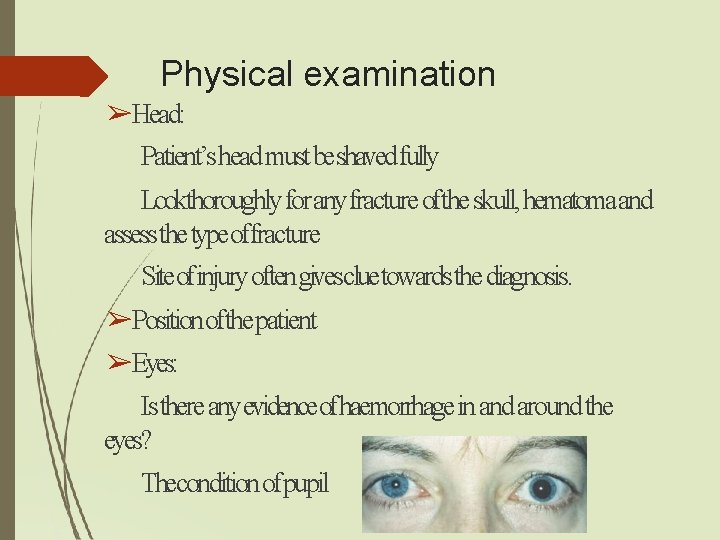
Physical examination ➢Head: Patient’s head must beshaved fully Lookthoroughly for any fracture ofthe skull, hematomaand assess the type offracture Siteofinjury often givescluetowards the diagnosis. ➢Position ofthe patient ➢Eyes: Is there anyevidenceofhaemorrhage in and around the eyes? Thecondition ofpupil
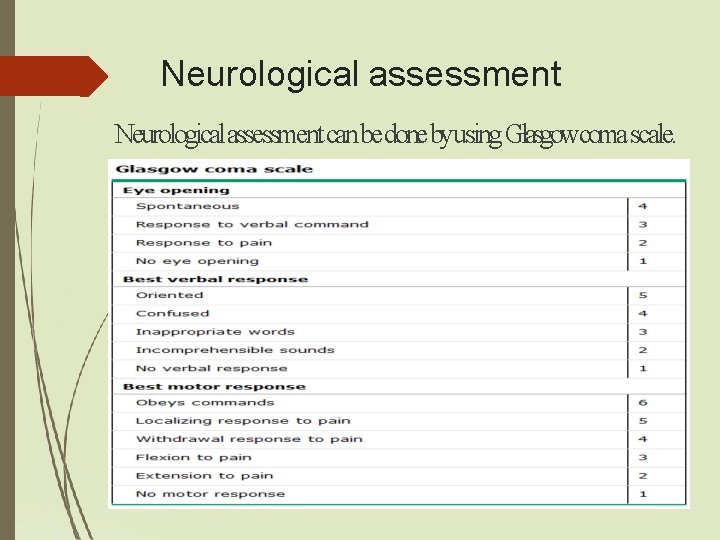
Neurological assessment Neurologicalassessment can bedone byusing Glasgowcoma scale.
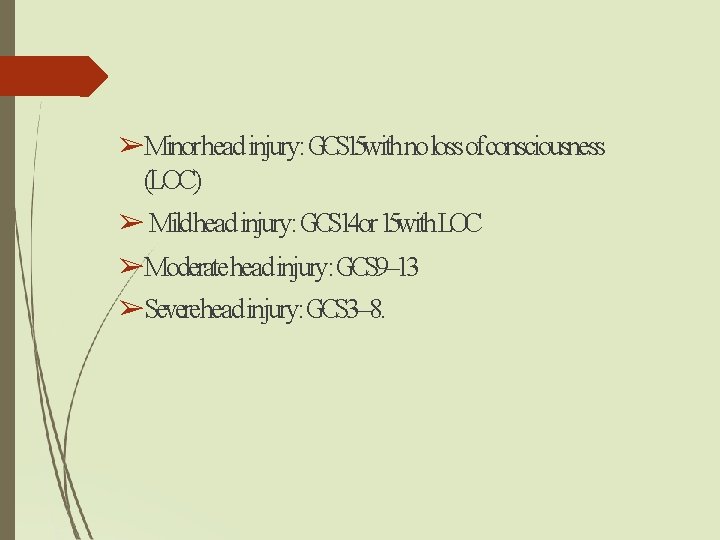
➢Minorhead injury: GCS 15 withno loss ofconsciousness (LOC) ➢ Mildhead injury: GCS 14 or 15 with. LOC ➢Moderatehead injury: GCS 9– 13 ➢Severehead injury: GCS 3– 8.
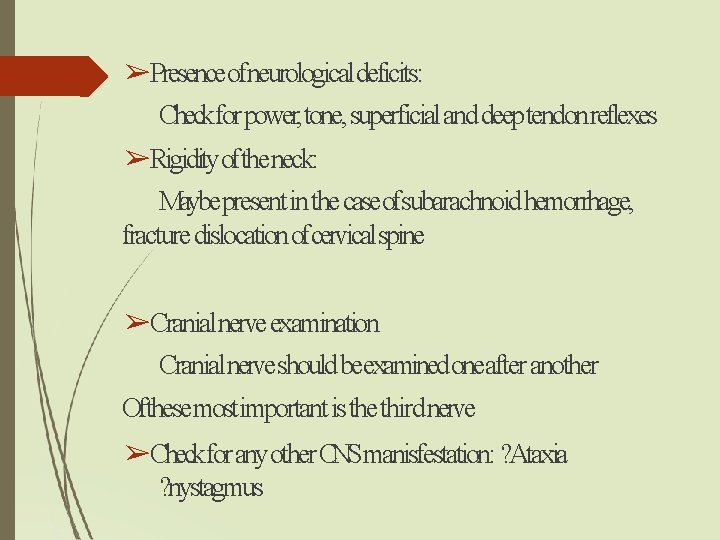
➢Presenceofneurological deficits: Checkfor power, tone, superficial and deep tendon reflexes ➢Rigidity ofthe neck: Maybepresent in the caseofsubarachnoid hemorrhage, fracture dislocation ofcervicalspine ➢Cranial nerve examination Cranial nerveshould beexamined oneafter another Ofthese mostimportant is the third nerve ➢Checkfor anyother CNSmanisfestation: ? Ataxia ? nystagmus
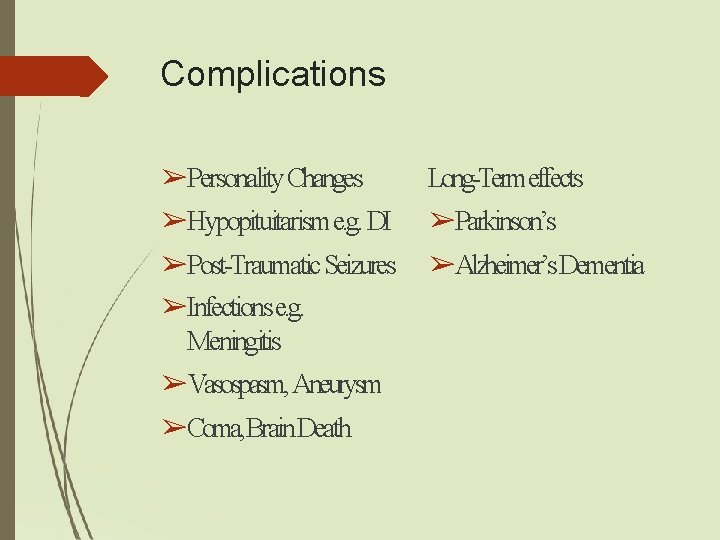
Complications ➢Personality Changes ➢Hypopituitarism e. g. DI Long-Termeffects ➢Post-Traumatic Seizures ➢Infections e. g. Meningitis ➢Alzheimer’s Dementia ➢Vasospasm, Aneurysm ➢Coma, Brain. Death ➢Parkinson’s
Rehabilitation ➢Physiotherapy ➢Occupational Therapy ➢Speechand Language. Therapy ➢Psychologists/Psychiatrists