Grade 11 Forces moment and torque Definition of




- Slides: 26
Grade 11 Forces, moment and torque
Definition of a force A force is an influence which changes or tends to change the state of rest or uniform motion of a body. Remember this definition although it is often more convenient to think of force as a ‘pull’ or a ‘push’. Forces are always measured in Newtons (N). One Newton is the force required to accelerate a mass of 1 kg at 1 m/s 2. Forces are vector quantities and to specify a force fully, it is necessary to state the following: • magnitude (the strength of the force) • line of action (which is the straight line along which the vector acts and indicates direction) • direction along the line of action of the force. (Is the force pushing or pulling? ) Mechanical Technology Curriculum Coordination & Support
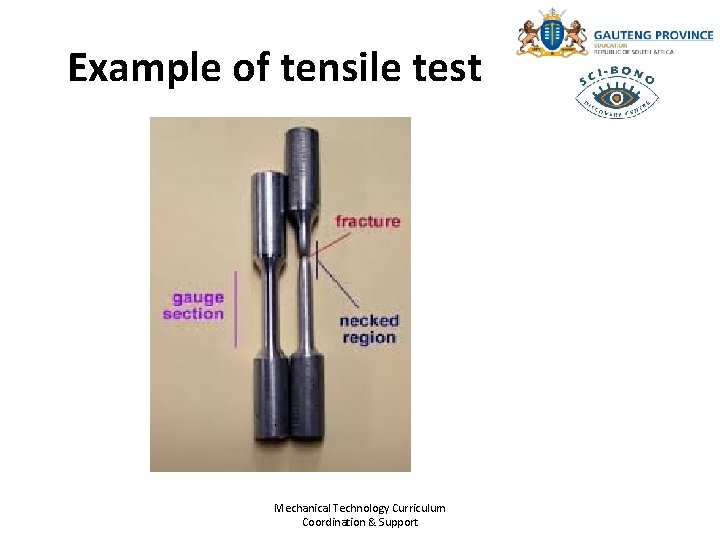
Tensile stress • Tensile stress (or tension) is the stress state leading to expansion; that is, the length of a material or compression member tends to increase in the tensile direction. • Tensile stress is the opposite of compressive stress. • Structural members in direct tension are ropes, soil anchors and nails, bolts, etc. • Beams subjected to bending moments may include tensile stress as well as compressive stress and/or shear stress. Mechanical Technology Curriculum Coordination & Support
Tensile Strength • The tensile strength of a material is the maximum amount of tensile stress that it can be subjected to before failure. • The definition of failure can vary according to material type and design methodology. Mechanical Technology Curriculum Coordination & Support
Example of tensile test Mechanical Technology Curriculum Coordination & Support
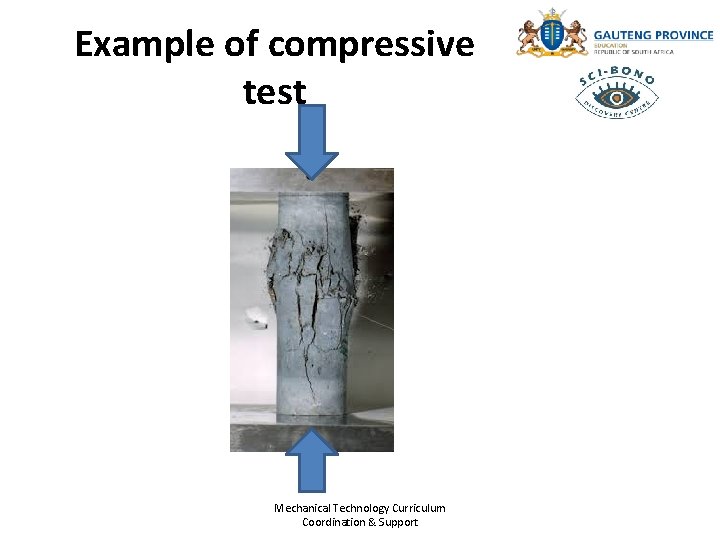
Compressive stress • … applies to materials resulting in their compaction (decrease of volume). • When a material is subjected to compressive stress then this material is under compression. • Usually compressive stress applied to bars, columns, etc. leads to shortening. Mechanical Technology Curriculum Coordination & Support
Example of compressive test Mechanical Technology Curriculum Coordination & Support
Shear • Shear strength in mechanical engineering and structural engineering is a term used to describe the strength against the type of structural failure where a component fails by shearing when it splits into two parts that slide past each other. • The shear strength of a component is most important for beams but also relevant for e. g. plates. • In a reinforced concrete beam, the main purpose of stirrups is to increase the shear strength. Mechanical Technology Curriculum Coordination & Support
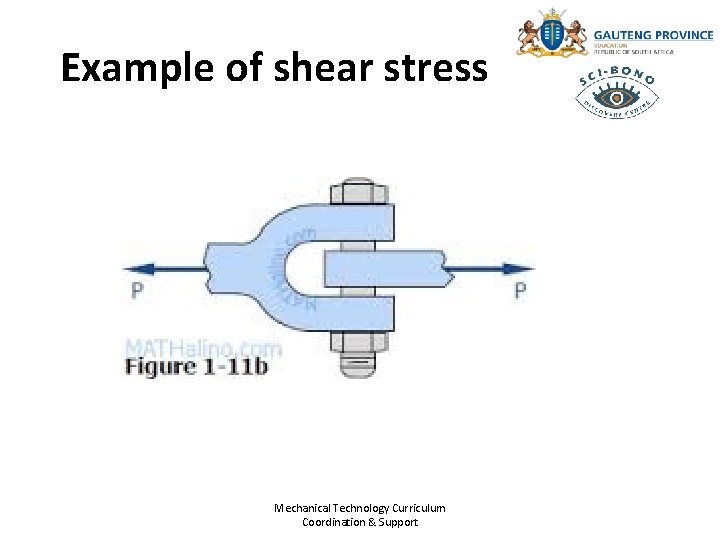
Shear • Riveted and bolted joints may also be mainly subjected to shear stress. • Cantilevers, beams, consoles and column heads are subject to composite loading, consisting of shear, tensile and compressive stress. Mechanical Technology Curriculum Coordination & Support
Example of shear stress Mechanical Technology Curriculum Coordination & Support
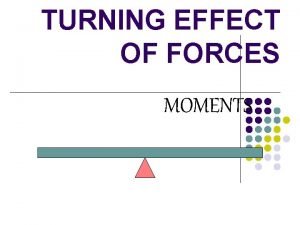
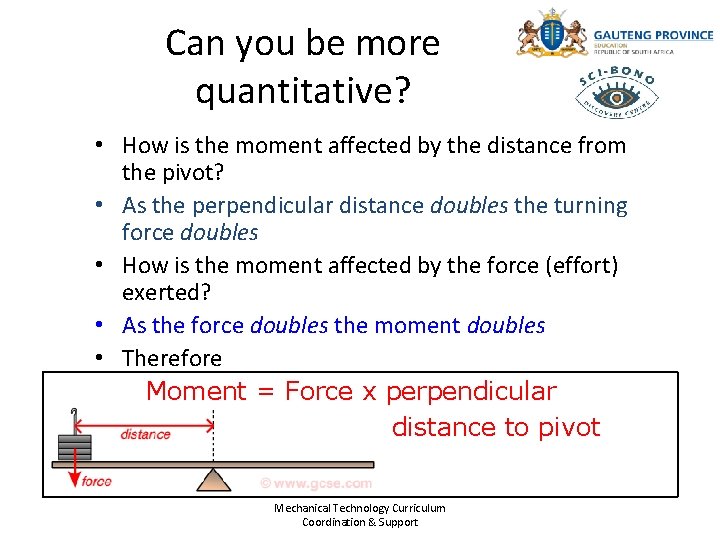
Moments • Definition Ø The moment of a force is defined as: The moment of force at a given point is the product of the force and the perpendicular distance from the point to the line of action of the force. Mechanical Technology Curriculum Coordination & Support
What affects the turning force? distance Force • Hold a rod horizontally and hang a weight on the rod near your hand. • Have your partner move the weight away from your hand, try to keep the rod horizontal. • What happens? • Now try it with a heavier weight. Mechanical Technology Curriculum Coordination & Support
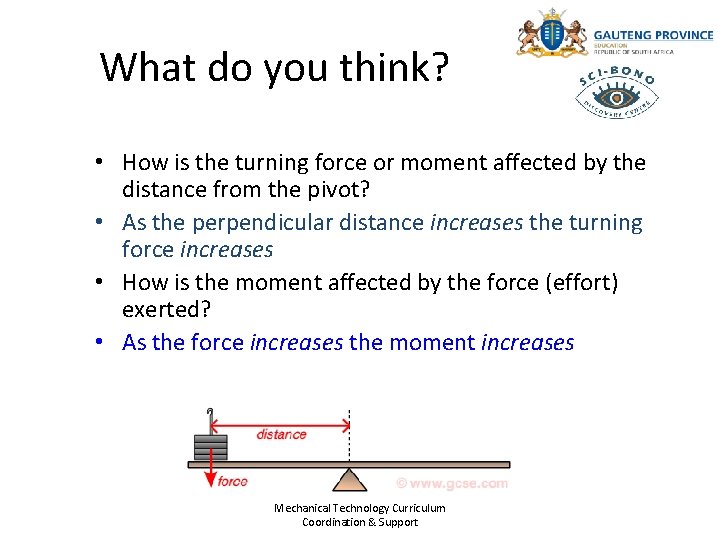
What do you think? • How is the turning force or moment affected by the distance from the pivot? • As the perpendicular distance increases the turning force increases • How is the moment affected by the force (effort) exerted? • As the force increases the moment increases Mechanical Technology Curriculum Coordination & Support
Can you be more quantitative? • How is the moment affected by the distance from the pivot? • As the perpendicular distance doubles the turning force doubles • How is the moment affected by the force (effort) exerted? • As the force doubles the moment doubles • Therefore Moment = Force x perpendicular distance to pivot Mechanical Technology Curriculum Coordination & Support
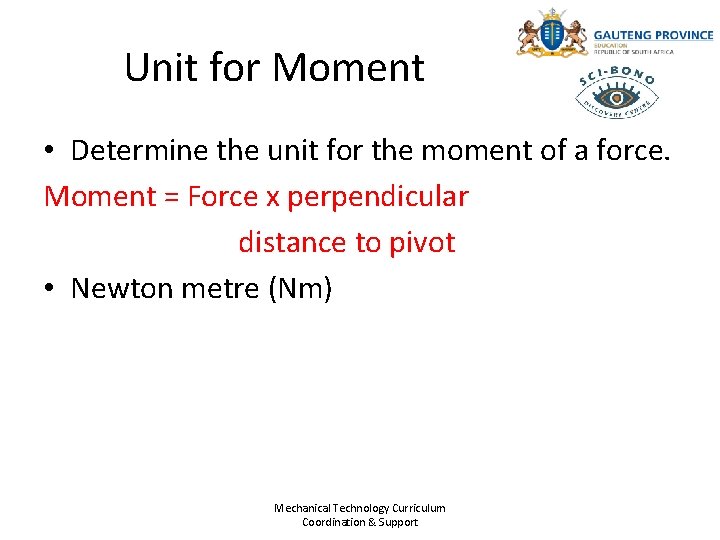
Unit for Moment • Determine the unit for the moment of a force. Moment = Force x perpendicular distance to pivot • Newton metre (Nm) Mechanical Technology Curriculum Coordination & Support
Is Moment a vector quantity? • Does the direction matter? ¡ Calculate the moments below. In which direction are they acting? Clockwise or Anticlockwise? Moments can either be clockwise or anticlockwise. Mechanical Technology Curriculum Coordination & Support
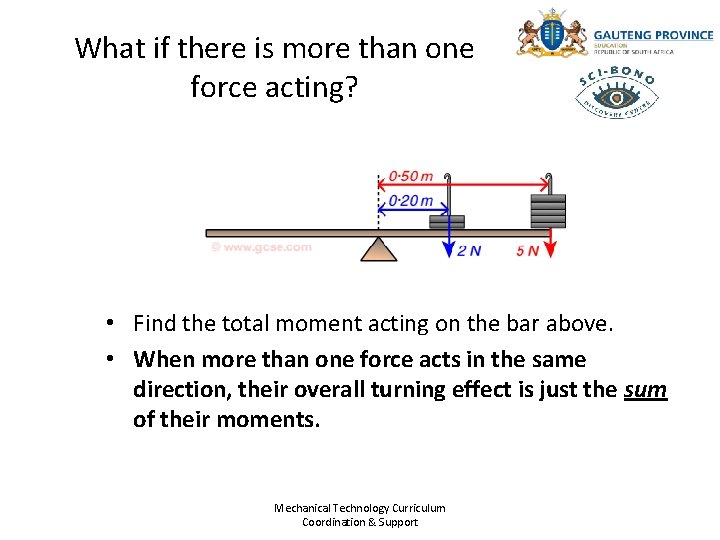
What if there is more than one force acting? • Find the total moment acting on the bar above. • When more than one force acts in the same direction, their overall turning effect is just the sum of their moments. Mechanical Technology Curriculum Coordination & Support
Moments Circus • There are six stations. • Using the sheet provided record the effort used on each object and measure the perpendicular distance to the pivot • Finally, calculate the moment. • Do not forget units!! Mechanical Technology Curriculum Coordination & Support
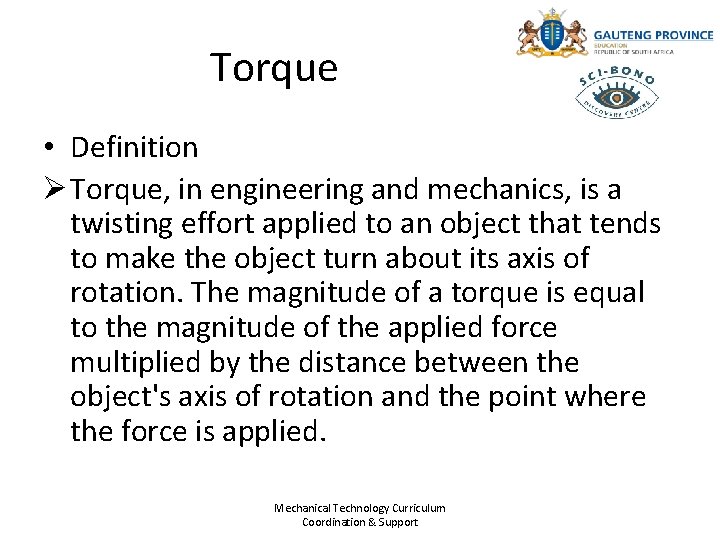
Torque • Definition Ø Torque, in engineering and mechanics, is a twisting effort applied to an object that tends to make the object turn about its axis of rotation. The magnitude of a torque is equal to the magnitude of the applied force multiplied by the distance between the object's axis of rotation and the point where the force is applied. Mechanical Technology Curriculum Coordination & Support
Torque • A torque is an action that causes objects to rotate. • Torque is not the same thing as force. • For rotational motion, the torque is what is most directly related to the motion, not the force. Mechanical Technology Curriculum Coordination & Support
Torque • Motion in which an entire object moves is called translation. • Motion in which an object spins is called rotation. • The point or line about which an object turns is its center of rotation. • An object can rotate and translate. Mechanical Technology Curriculum Coordination & Support
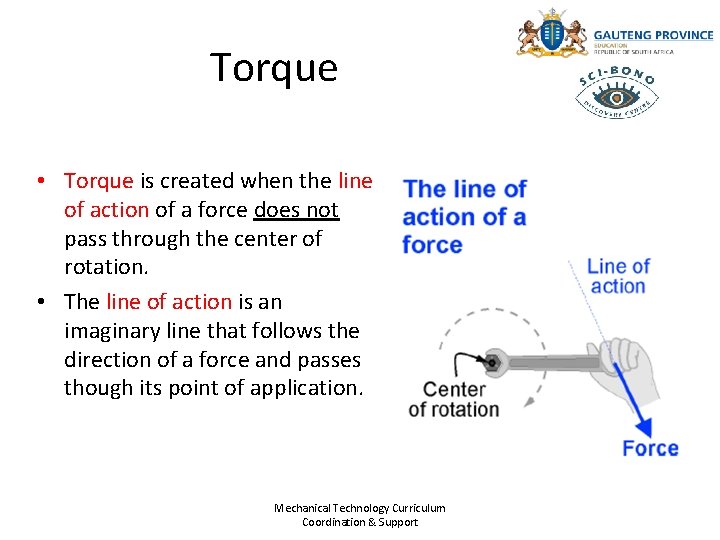
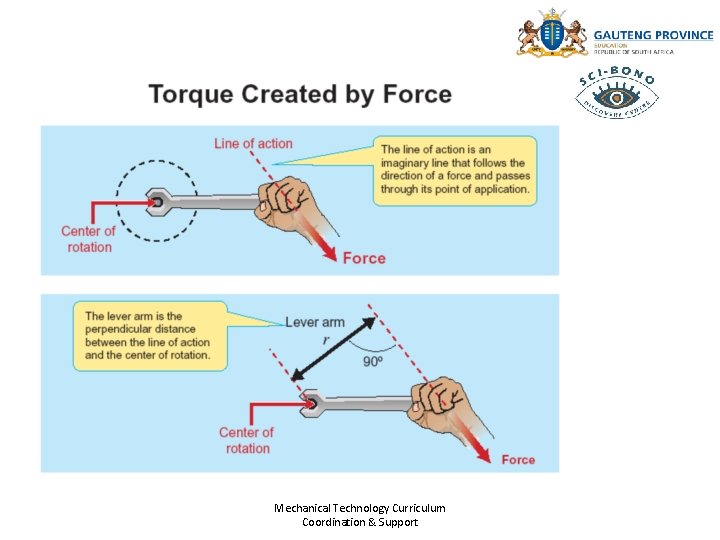
Torque • Torque is created when the line of action of a force does not pass through the center of rotation. • The line of action is an imaginary line that follows the direction of a force and passes though its point of application. Mechanical Technology Curriculum Coordination & Support
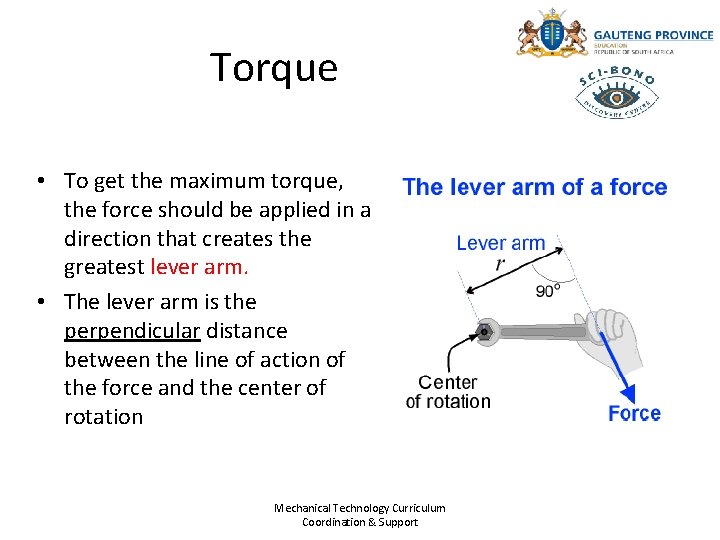
Torque • To get the maximum torque, the force should be applied in a direction that creates the greatest lever arm. • The lever arm is the perpendicular distance between the line of action of the force and the center of rotation Mechanical Technology Curriculum Coordination & Support
Mechanical Technology Curriculum Coordination & Support
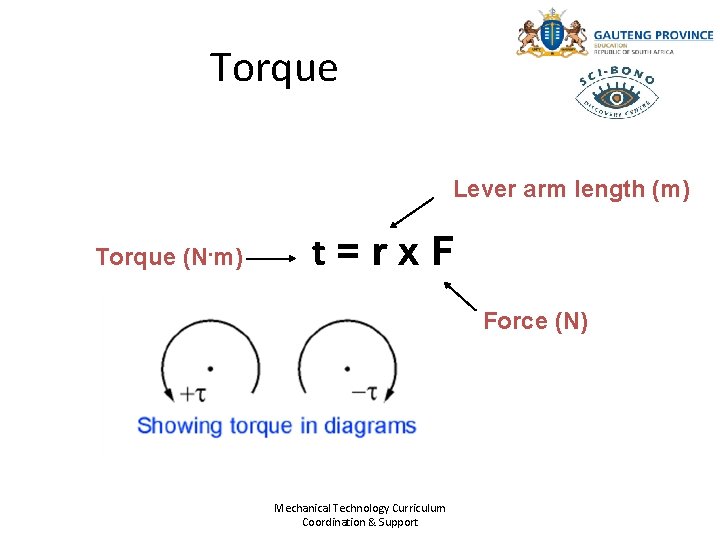
Torque Lever arm length (m) Torque (N. m) t=rx. F Force (N) Mechanical Technology Curriculum Coordination & Support
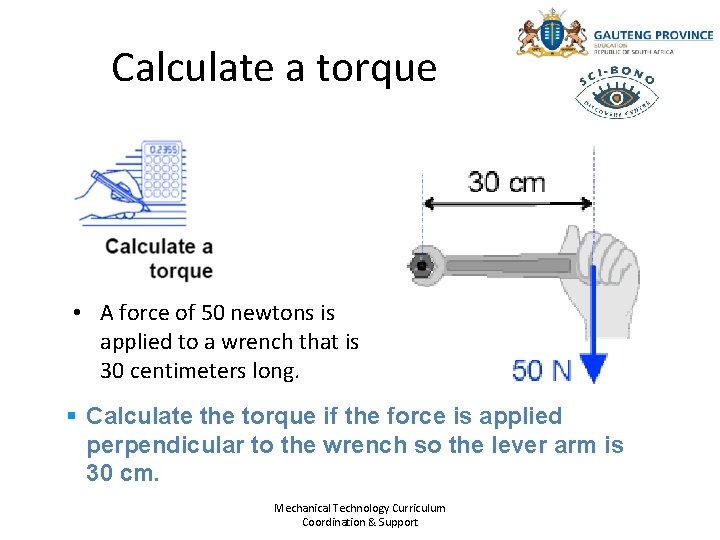
Calculate a torque • A force of 50 newtons is applied to a wrench that is 30 centimeters long. § Calculate the torque if the force is applied perpendicular to the wrench so the lever arm is 30 cm. Mechanical Technology Curriculum Coordination & Support