GNSS Security Todd Humphreys Aerospace Engineering The University

- Slides: 28
GNSS Security Todd Humphreys | Aerospace Engineering The University of Texas at Austin GPS World Webinar | September 18, 2014
Acknowledgements • University of Texas Radionavigation Lab graduate students Jahshan Bhatti, Kyle Wesson, Ken Pesyna, Zak Kassas, Daniel Shepard, Andrew Kerns, and Nathan Green
Security Highlights from ION GNSS+ 2014 (1/2) Interest: There were about 25 presentations on GNSS security, principally from two panel sessions and two regular sessions devoted to the topic—all well attended. Galileo Authentication: F. Diani (European GNSS Agency) reported on a trade study conducted for the EGA that revealed substantial interest in signal-side open-service Galileo authentication via NMA, especially for transport regulation and mobile payments. I. Fernandez-Hernandez (European Commission DG ENTR) presented the current Galileo blueprint for NMA-based signal-side authentication and revealed that they have already conducted initial SIS tests.
Security Highlights from ION GNSS+ 2014 (2/2) GPS Authentication: GPSD, Aerospace Corp. , BAH, and University of Texas engaged in a feasibility study for NMA on GPS L 2 and L 5. No SIS testing yet. Antennas: Stanford, DLR, and Cornell introduced clever antenna-based signal authentication techniques. One Stanford/DLR technique switches polarization in a single element to detect spoofing from below. Others: L. Scott considered “social” approaches to interference deterrence. O. Pozzobon proposed a farterm spreading code authentication for Galileo. G. Gao: Distribute risk of authentication across unreliable peers. J. Curran agreed that NMA on Galileo open service is worthwhile and feasible.
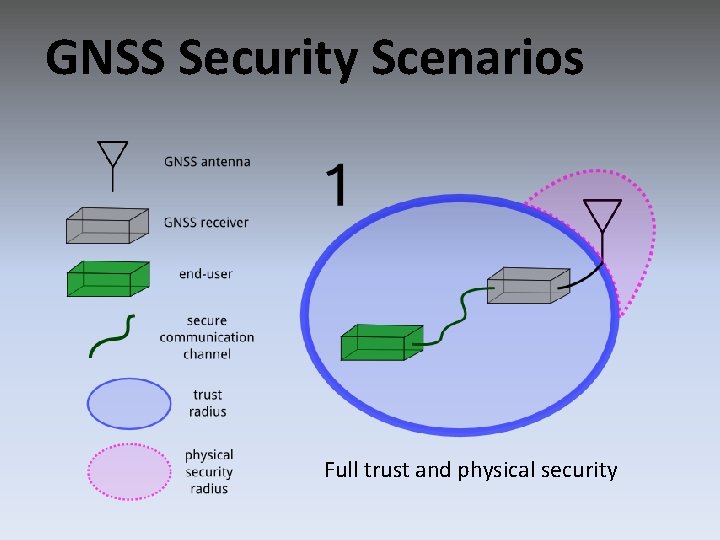
GNSS Security Scenarios Full trust and physical security
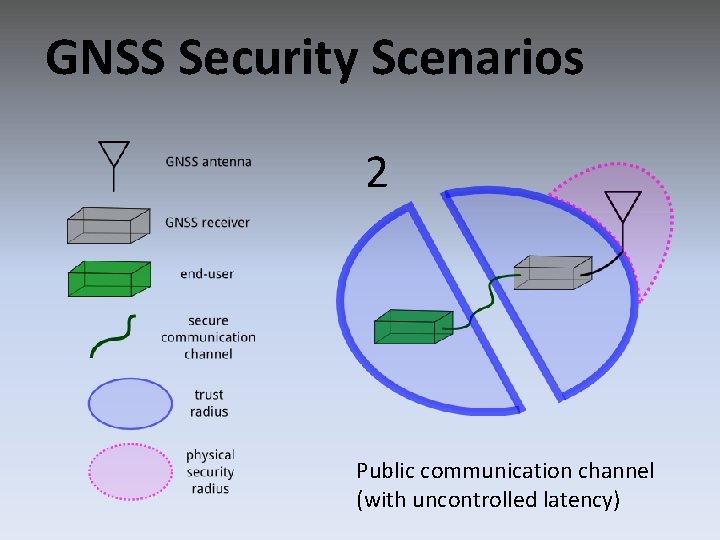
GNSS Security Scenarios 2 Public communication channel (with uncontrolled latency)
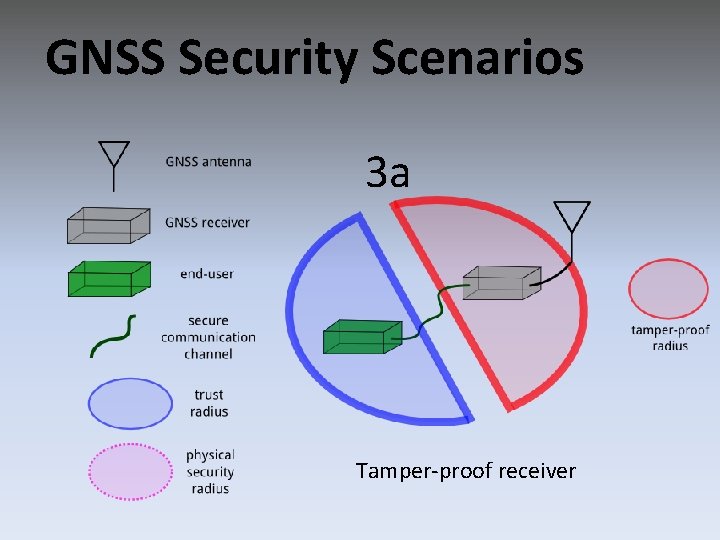
GNSS Security Scenarios 3 a Tamper-proof receiver
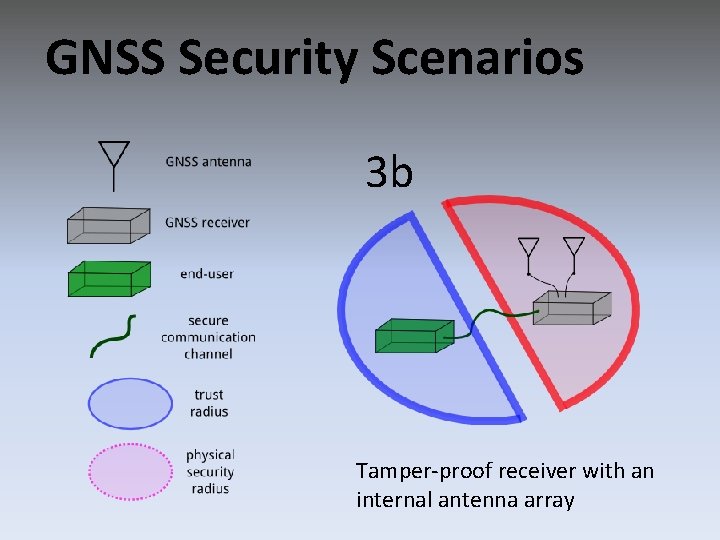
GNSS Security Scenarios 3 b Tamper-proof receiver with an internal antenna array
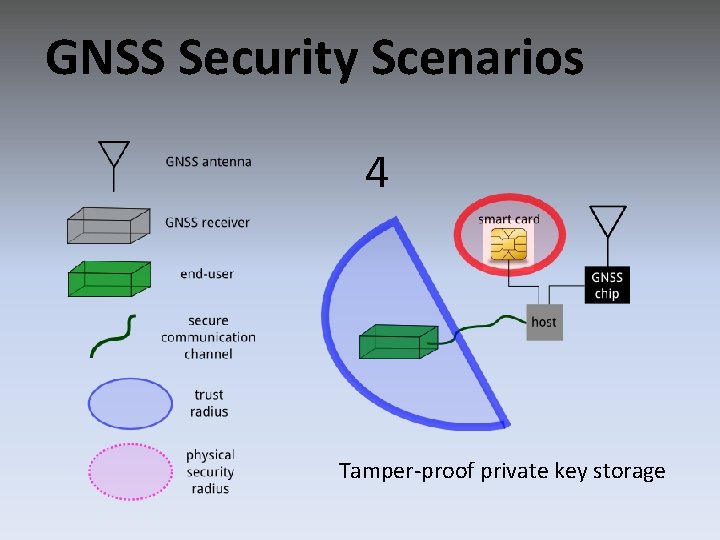
GNSS Security Scenarios 4 Tamper-proof private key storage
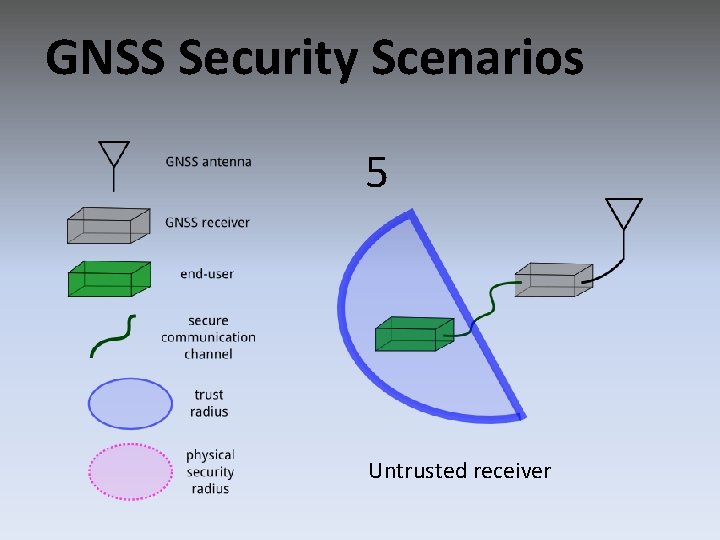
GNSS Security Scenarios 5 Untrusted receiver
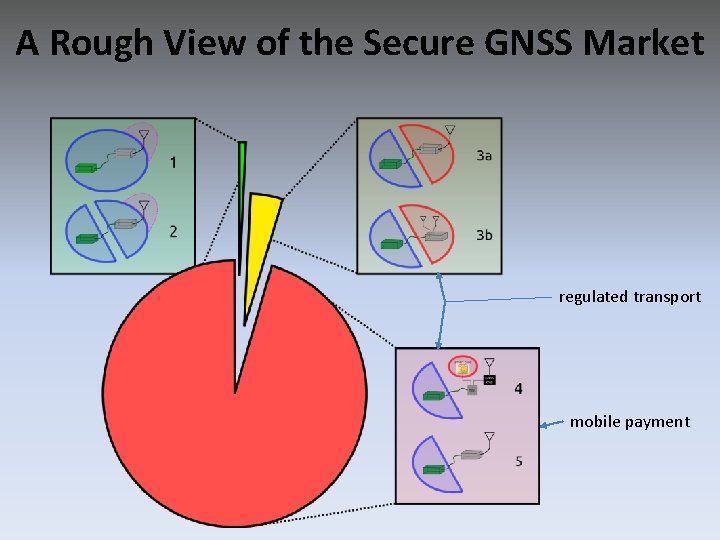
A Rough View of the Secure GNSS Market regulated transport mobile payment
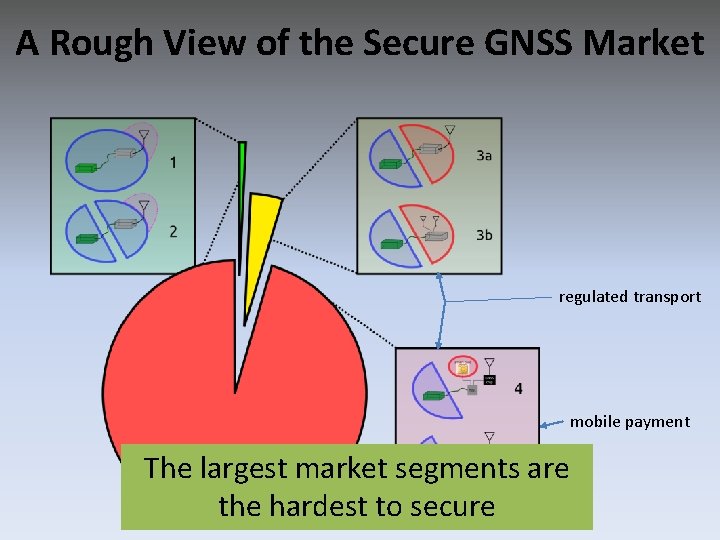
A Rough View of the Secure GNSS Market regulated transport mobile payment The largest market segments are the hardest to secure
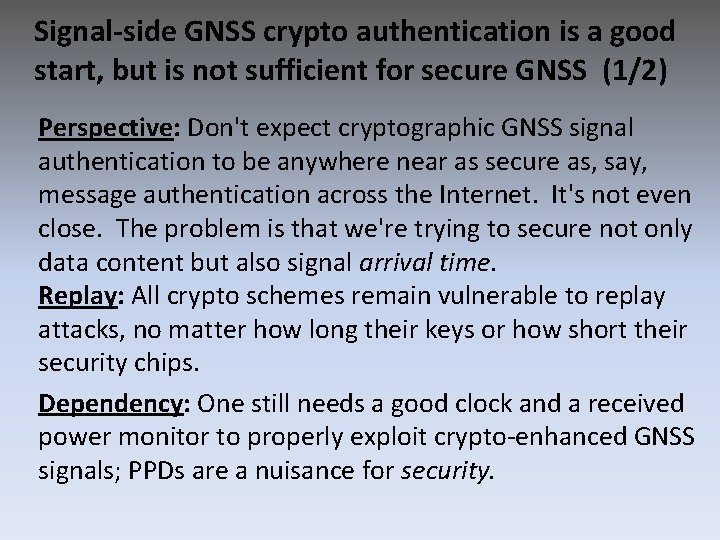
Signal-side GNSS crypto authentication is a good start, but is not sufficient for secure GNSS (1/2) Perspective: Don't expect cryptographic GNSS signal authentication to be anywhere near as secure as, say, message authentication across the Internet. It's not even close. The problem is that we're trying to secure not only data content but also signal arrival time. Replay: All crypto schemes remain vulnerable to replay attacks, no matter how long their keys or how short their security chips. Dependency: One still needs a good clock and a received power monitor to properly exploit crypto-enhanced GNSS signals; PPDs are a nuisance for security.
Signal-side GNSS crypto authentication is a good start, but is not sufficient for secure GNSS (1/2) Overlap: PPDs are also a nuisance for authentication. Proof of location: Where are you? Convince me.
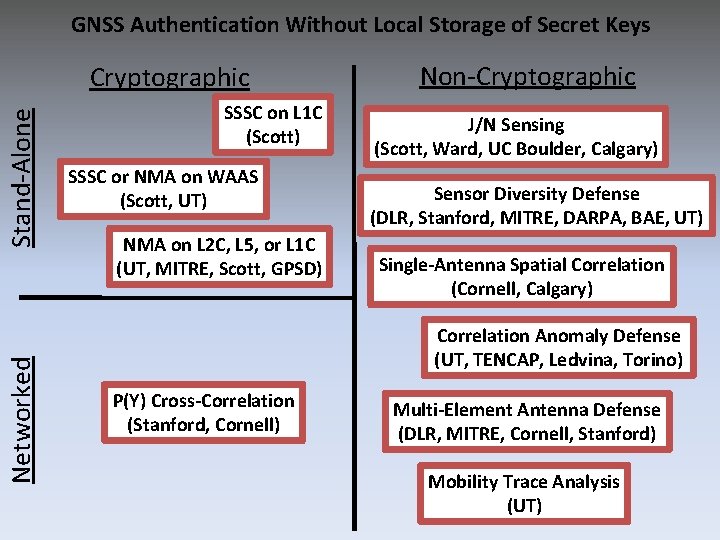
GNSS Authentication Without Local Storage of Secret Keys Networked Stand-Alone Cryptographic SSSC on L 1 C (Scott) SSSC or NMA on WAAS (Scott, UT) NMA on L 2 C, L 5, or L 1 C (UT, MITRE, Scott, GPSD) Non-Cryptographic J/N Sensing (Scott, Ward, UC Boulder, Calgary) Sensor Diversity Defense (DLR, Stanford, MITRE, DARPA, BAE, UT) Single-Antenna Spatial Correlation (Cornell, Calgary) Correlation Anomaly Defense (UT, TENCAP, Ledvina, Torino) P(Y) Cross-Correlation (Stanford, Cornell) Multi-Element Antenna Defense (DLR, MITRE, Cornell, Stanford) Mobility Trace Analysis (UT)
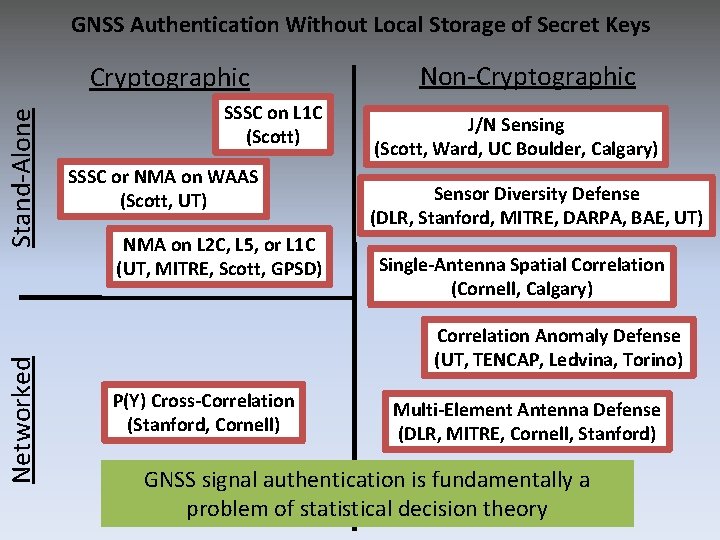
GNSS Authentication Without Local Storage of Secret Keys Networked Stand-Alone Cryptographic SSSC on L 1 C (Scott) SSSC or NMA on WAAS (Scott, UT) NMA on L 2 C, L 5, or L 1 C (UT, MITRE, Scott, GPSD) Non-Cryptographic J/N Sensing (Scott, Ward, UC Boulder, Calgary) Sensor Diversity Defense (DLR, Stanford, MITRE, DARPA, BAE, UT) Single-Antenna Spatial Correlation (Cornell, Calgary) Correlation Anomaly Defense (UT, TENCAP, Ledvina, Torino) P(Y) Cross-Correlation (Stanford, Cornell) Multi-Element Antenna Defense (DLR, MITRE, Cornell, Stanford) GNSS signal authentication is fundamentally a Mobility Trace Analysis (UT) problem of statistical decision theory
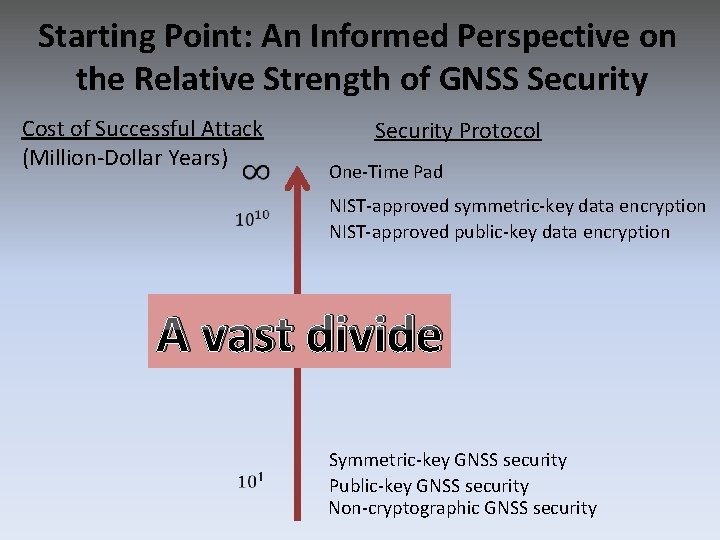
Starting Point: An Informed Perspective on the Relative Strength of GNSS Security Cost of Successful Attack (Million-Dollar Years) Security Protocol One-Time Pad NIST-approved symmetric-key data encryption NIST-approved public-key data encryption A vast divide Symmetric-key GNSS security Public-key GNSS security Non-cryptographic GNSS security
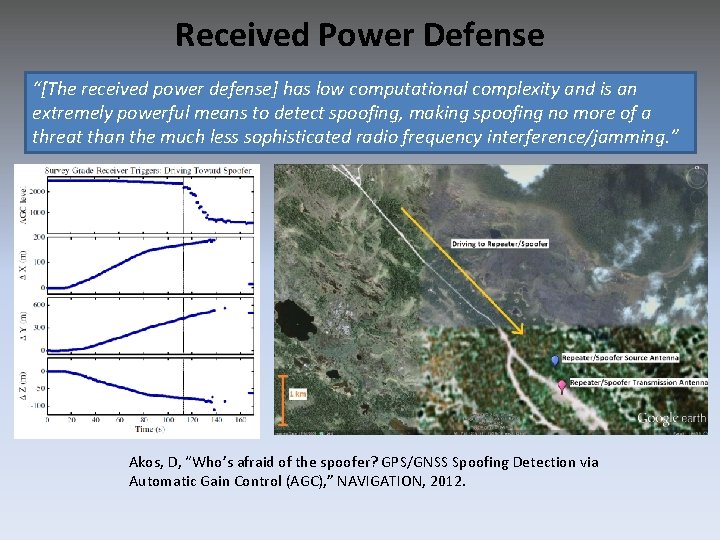
Received Power Defense “[The received power defense] has low computational complexity and is an extremely powerful means to detect spoofing, making spoofing no more of a threat than the much less sophisticated radio frequency interference/jamming. ” Akos, D, “Who’s afraid of the spoofer? GPS/GNSS Spoofing Detection via Automatic Gain Control (AGC), ” NAVIGATION, 2012.
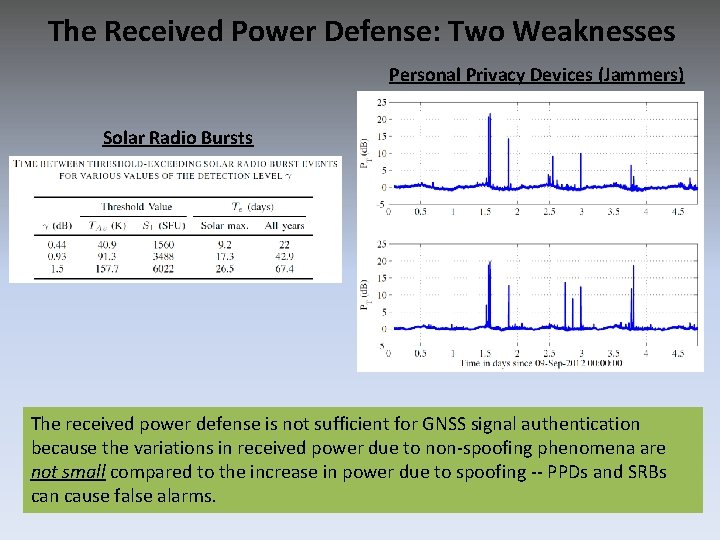
The Received Power Defense: Two Weaknesses Personal Privacy Devices (Jammers) Solar Radio Bursts The received power defense is not sufficient for GNSS signal authentication because the variations in received power due to non-spoofing phenomena are not small compared to the increase in power due to spoofing -- PPDs and SRBs can cause false alarms.
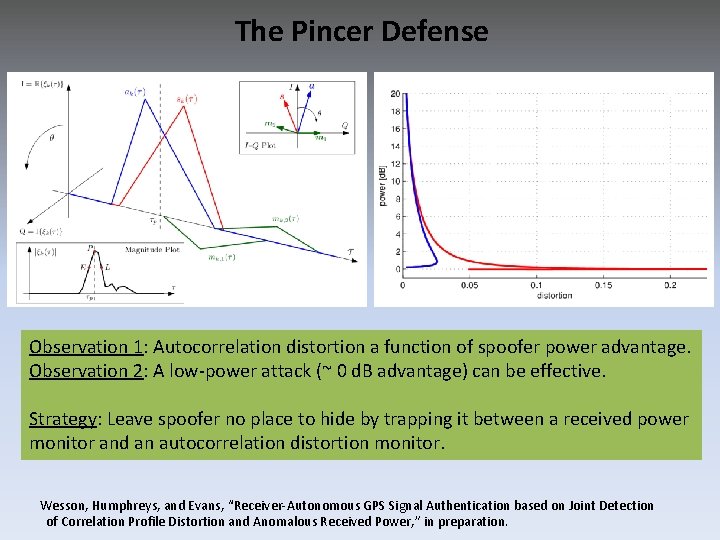
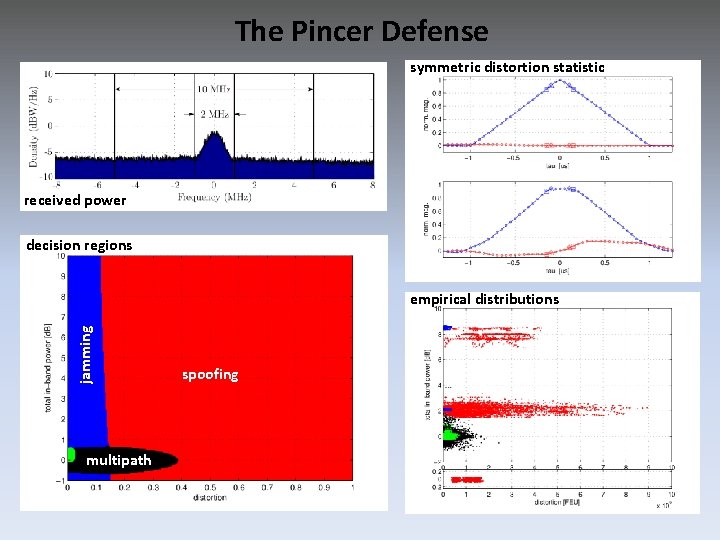
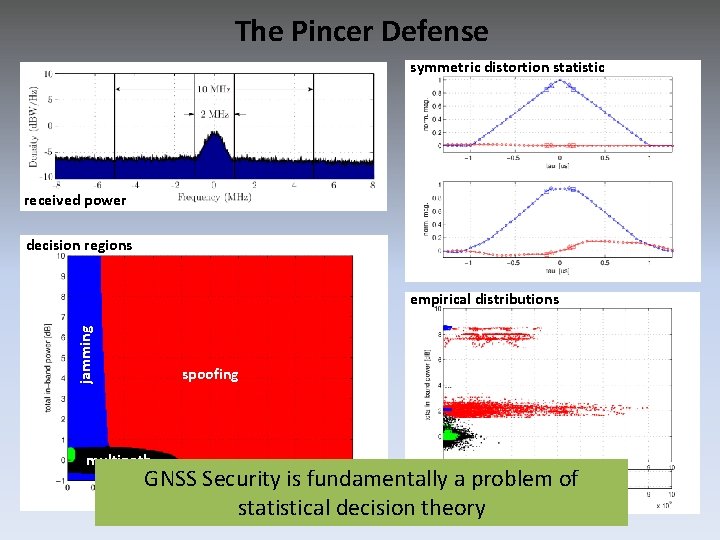
The Pincer Defense Observation 1: Autocorrelation distortion a function of spoofer power advantage. Observation 2: A low-power attack (~ 0 d. B advantage) can be effective. Strategy: Leave spoofer no place to hide by trapping it between a received power monitor and an autocorrelation distortion monitor. Wesson, Humphreys, and Evans, “Receiver-Autonomous GPS Signal Authentication based on Joint Detection of Correlation Profile Distortion and Anomalous Received Power, ” in preparation.
The Pincer Defense symmetric distortion statistic received power decision regions jamming empirical distributions multipath spoofing
The Pincer Defense symmetric distortion statistic received power decision regions jamming empirical distributions spoofing multipath GNSS Security is fundamentally a problem of statistical decision theory
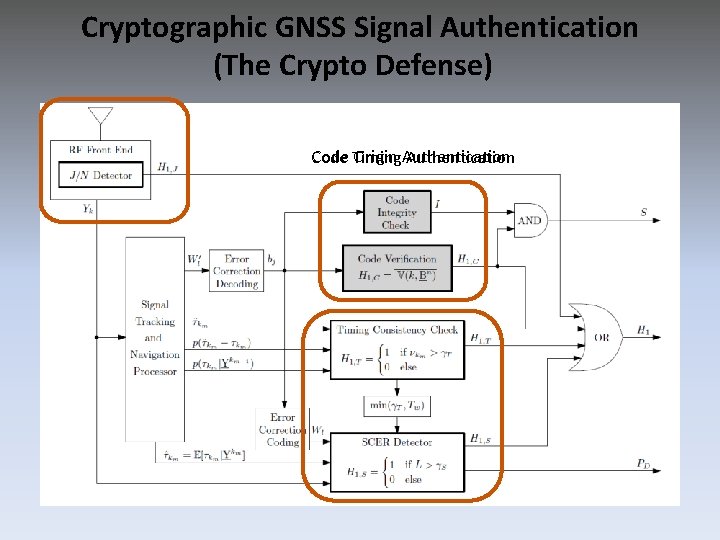
Cryptographic GNSS Signal Authentication (The Crypto Defense) Code Origin Authentication Code Timing Authentication
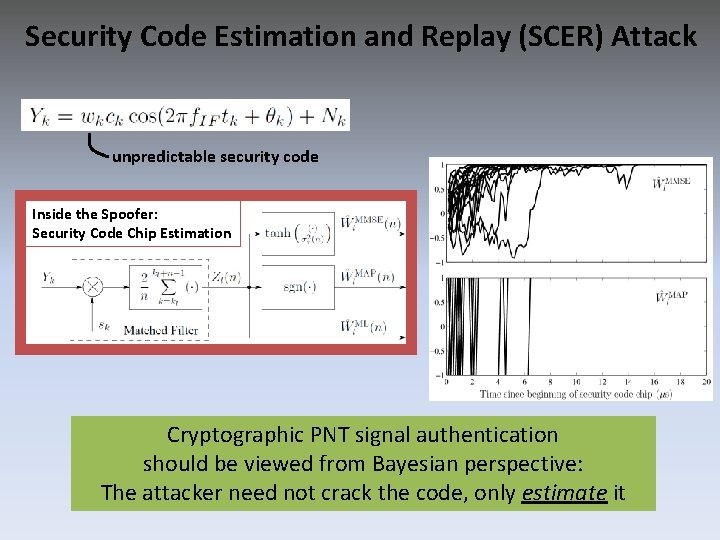
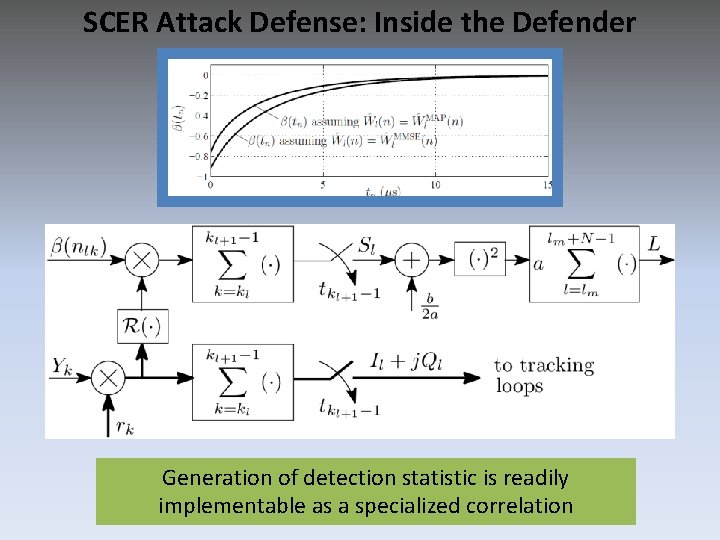
Security Code Estimation and Replay (SCER) Attack unpredictable security code Inside the Spoofer: Security Code Chip Estimation Cryptographic PNT signal authentication should be viewed from Bayesian perspective: The attacker need not crack the code, only estimate it
SCER Attack Defense: Inside the Defender Generation of detection statistic is readily implementable as a specialized correlation
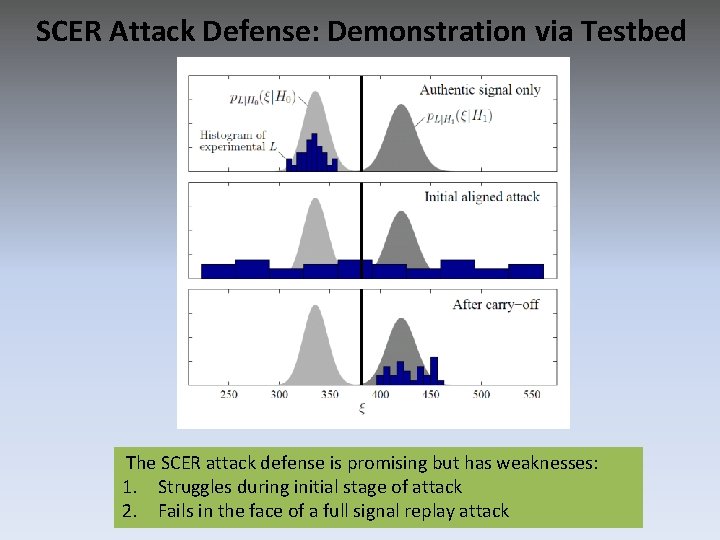
SCER Attack Defense: Demonstration via Testbed The SCER attack defense is promising but has weaknesses: 1. Struggles during initial stage of attack 2. Fails in the face of a full signal replay attack
A looming challenge in PNT security will be providing proof of location or time to a skeptical second party. This problem scales differently than attacks against noncomplicit PNT sensing: A single rogue actor with an inexpensive receiver network (“Dr. No”) could sell forged GNSS-based proofs of location and time to thousands of subscribers.
radionavlab. ae. utexas. edu