ght i r e g th right n
- Slides: 20
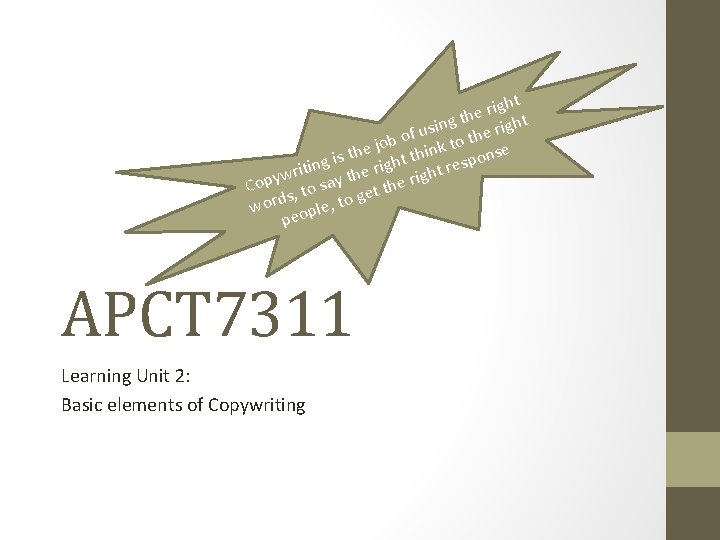
ght i r e g th right n i s of u to the b o j the ht think ponse s i g ritin the right res w y Cop , to say et the s g word ople, to pe APCT 7311 Learning Unit 2: Basic elements of Copywriting
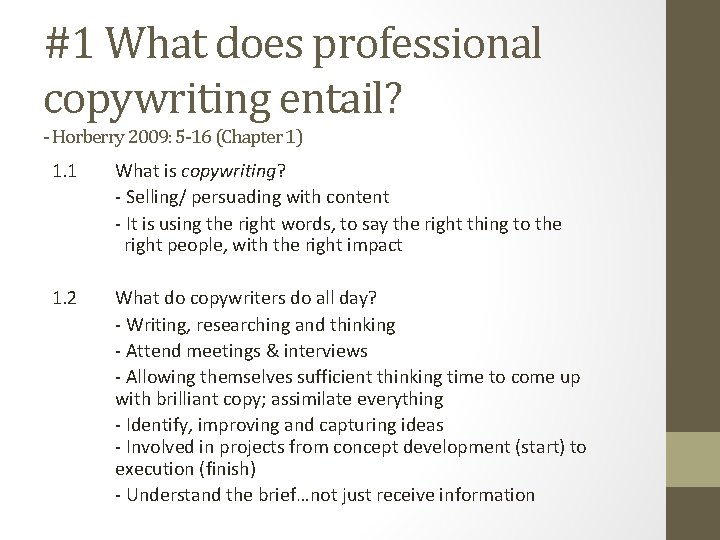
#1 What does professional copywriting entail? - Horberry 2009: 5 -16 (Chapter 1) 1. 1 What is copywriting? - Selling/ persuading with content - It is using the right words, to say the right thing to the right people, with the right impact 1. 2 What do copywriters do all day? - Writing, researching and thinking - Attend meetings & interviews - Allowing themselves sufficient thinking time to come up with brilliant copy; assimilate everything - Identify, improving and capturing ideas - Involved in projects from concept development (start) to execution (finish) - Understand the brief…not just receive information
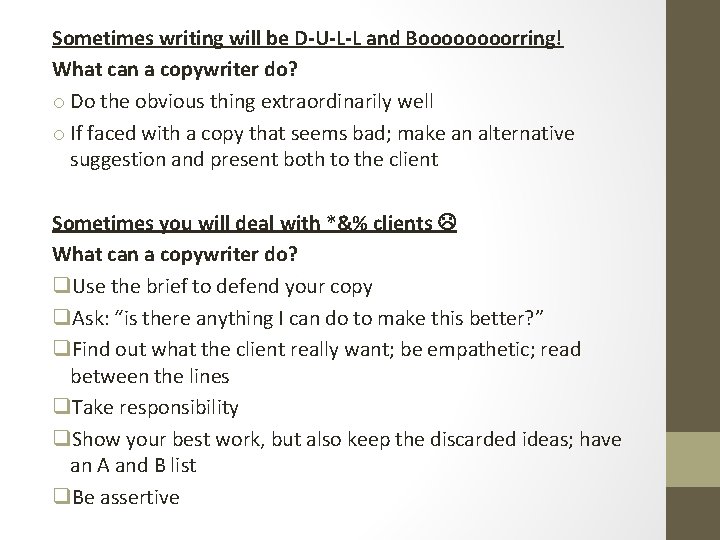
Sometimes writing will be D-U-L-L and Boooorring! What can a copywriter do? o Do the obvious thing extraordinarily well o If faced with a copy that seems bad; make an alternative suggestion and present both to the client Sometimes you will deal with *&% clients What can a copywriter do? q. Use the brief to defend your copy q. Ask: “is there anything I can do to make this better? ” q. Find out what the client really want; be empathetic; read between the lines q. Take responsibility q. Show your best work, but also keep the discarded ideas; have an A and B list q. Be assertive
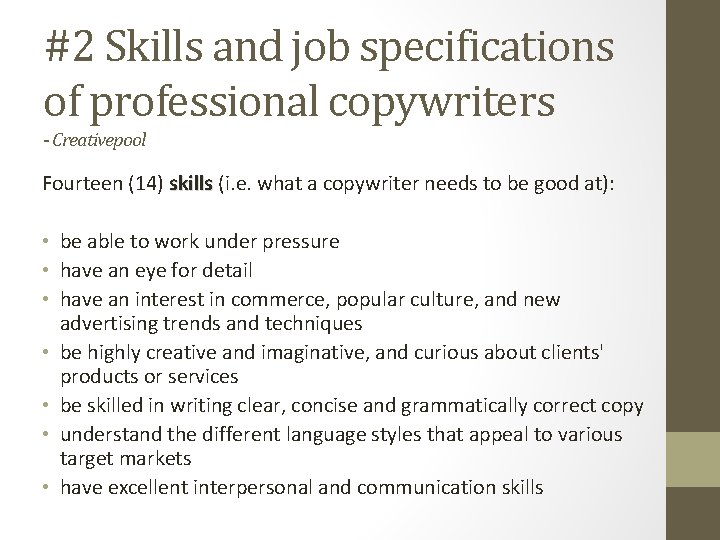
#2 Skills and job specifications of professional copywriters - Creativepool Fourteen (14) skills (i. e. what a copywriter needs to be good at): • be able to work under pressure • have an eye for detail • have an interest in commerce, popular culture, and new advertising trends and techniques • be highly creative and imaginative, and curious about clients' products or services • be skilled in writing clear, concise and grammatically correct copy • understand the different language styles that appeal to various target markets • have excellent interpersonal and communication skills
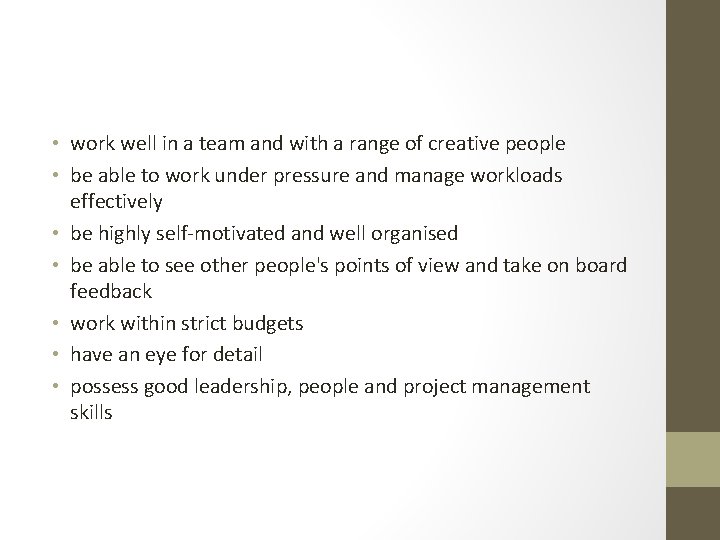
• work well in a team and with a range of creative people • be able to work under pressure and manage workloads effectively • be highly self-motivated and well organised • be able to see other people's points of view and take on board feedback • work within strict budgets • have an eye for detail • possess good leadership, people and project management skills
Job specifications (i. e. what copywriting entails): • meeting with account executives to discuss the client's requirements and core messages • familiarising themselves with the product, target audience and competitor activities in the market • brainstorming ideas and concepts for the visual and words with other members of the creative team • presenting initial ideas to the creative director, some of which may be rejected or developed into workable concepts • writing various copy options, which may be presented to the client as a story board (a consecutive series of frames depicting the script and drawings that may be used) • modifying copy until the client is satisfied • overseeing the production phase, booking and liaising with designers, illustrators, printers, photographers and production companies • casting actors and models to appear in adverts
#4 Three (3) key thoughts aimed at improving copywriting success * - Horberry 2009: 19 -28 Thought No. 1: DON’T BE DULL • Boring is bad because it doesn’t work • No one reads ads; they read what interests them • Most clients would rather outthink their competitors than outspend them • In advertising: “The truth isn’t the truth until people believe you, and they can’t believe you if they don’t know what you’re saying, and they can’t know what you’re saying if they don’t listen to you, and they won’t listen if you’re not interesting, and you won’t be interesting unless you say things imaginatively, originally, freshly”
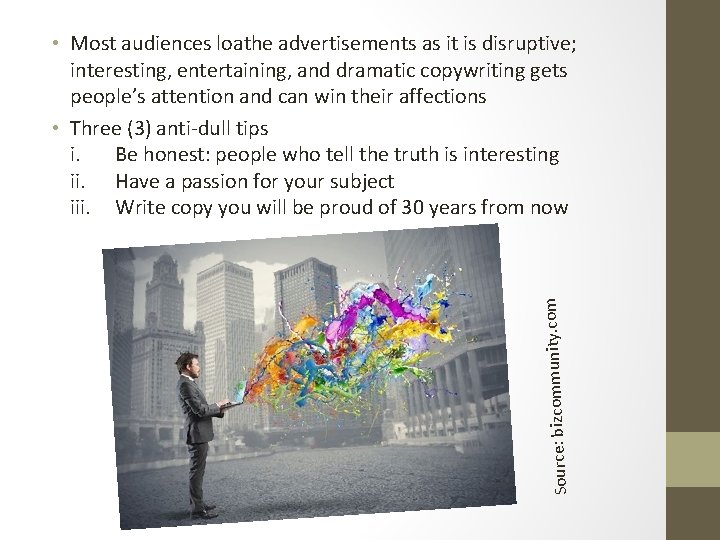
com Source: bizcommunity. • Most audiences loathe advertisements as it is disruptive; interesting, entertaining, and dramatic copywriting gets people’s attention and can win their affections • Three (3) anti-dull tips i. Be honest: people who tell the truth is interesting ii. Have a passion for your subject iii. Write copy you will be proud of 30 years from now
Thought No. 2: Write like you speak • Have a conversation; a conversational approach to copywriting is the most persuasive • Sell stories; true stories offer tangible proof of abstract claims • Presenting information in story form also help make the copy personal • Give your story a bit of bite: add drama and conflict • Don’t write anything you wouldn’t say in person • Adopt strategies from spoken, not written English • Write as if you are having an informal, informative conversation with your audience; tell them the basics, anticipate their questions and offer them something extra
Thought No. 3: Believe you’re brilliant! • Henry Ford: “Whether you think you can or you can’t; you are always right!” • Confidence is everything • Look for connections: To come up with new ideas, look for the relationship between current and classic elements • Tell yourself that you can create ideas; have a loose discussion in your head about what you want to say; write it down when something emerges; draw connections between related ideas • To get unstuck: * Go for a walk (Stephen King hit by a car…wrote About Writing) * Engage the other half of your brain * Change location * Change tools * Do automatic writing * …stare into space
#5 Five (5) stages of generating good copy - Horberry 2009: 28 -30 1) First stage: Gather your raw material (specific & general) 2) Second stage: Mental digestion; Examine the facts 3) Third stage: Forget everything; do something distracting; let the ideas ferment 4) Fourth stage: Eureka! 5) Fifth stage: Make the ideas fit the problem; this is the work stage 6) Extra: “First ideas are usually the best” Individual exercise: Pick a product and write a sales slogan (using what you’ve learned from the three (3) key thoughts of writing. (5 minutes)
#6 Ten (10) brand personality archetypes: branding, the ‘big idea’ & building brand personality - Horberry 2009: 33 -41 What is an archetype? “An original model; a prototype. ” In branding, an archetype refers to a brand qualifier – i. e. the brand personality angle. What is a brand? “…a particular make of goods; an identifying trademark; a characteristic of an business. ” Example: The Virgin brand is energetic, fun and innovative. For a person, place, product or service to qualify as a brand it needs some sort of an emotional aura; something to love. To write for a brand, a copywriter needs to understand the big idea and brand personality.
The Big Idea Brand personality v One word/ sentence describing what Ø A brand’s personality is defined a brand is about through adjectives – e. g. ‘thoughtful’, ‘dynamic’, ‘energetic’, v The big idea helps the organisation etc. stand out and sets it apart from competitors Ø Make you brand a human and you are halfway there v To recognise a good ‘big idea’, as: - Did it make me gasp? Ø To bring a brand’s personality to life, - Do I wish I thought of it myself? try picturing a person with the - Is it unique? personality traits you’re being asked - Does it fit the strategy? to use - Could it still be used in 30 years? v A brand can help an organisation steer its general direction
Ten (10) brand archetypes A brand’s personality can be: i. THE JOKER : fun, playful, gleeful, not serious, humorous ii. SEDUCTRESS : desirable, sexy, alluring, sex iii. REBEL : rebellious, ad hominem, stick-it-to-the-man iv. HERO : adventurous, brave, fearless v. WISE : wise, trustworthy, contemplative, enlightened vi. KING: KING assertive, in control, boss vii. MOTHER : generous, caring, loving, mediator viii. FRIEND : friendly, relational, straightforward ix. MAIDEN: MAIDEN innocent, kind, ingénue, virgin-like x. DREAMER : idealistic, creative, different, aspirational
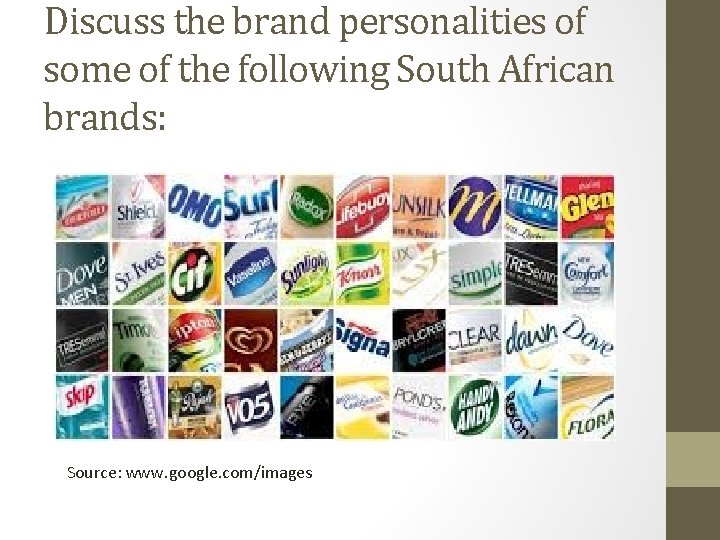
Discuss the brand personalities of some of the following South African brands: Source: www. google. com/images
#7 Importance of branding to copywriters - Horberry 2009: 33 -41; www. smallbusiness. chron. com Company branding is the most efficient way to show potential customers what your business is about. It is reflected visually via the logo and company design elements as well as through verbiage in marketing materials, slogans and informational copy. According to Fast Company magazine, “The brand is a promise of the value you'll receive. ” Uniqueness Utilize your branding to set yourself apart from your competitors. To do this, analyze what you do best and consider you target demographic. Use graphics and word choices that clearly reflect your business to your target audience, hence your brand. Use your branding to deliver clear messages. Target Audience Done correctly, your brand can assist you in getting a stronger foothold in your niche market. Define your unique selling position and consider methods to communicate key messages to your desired audience. Use specific images or phrases to encourage the feel of inclusivity. Let them know the reason your company exists and how it can fulfill their needs. This can connect you to your target audience, engage them and motivate them to buy.
Emotional Connections According to a 2010 study conducted by the world’s largest public relations firm, Edelman, the Y Generation, also known as the Millennials, consider brand identification almost as important as religious preference and ethnic background when defining themselves online. The power of branding has successfully melded into that of personal identification and emotional connection. Message Delivery Having strong branding can evoke trust from your niche market. This can translate to your newsletters, emails and advertisements garnering a greater response, hence increasing sales. As people will already be vested in your brand, they will be confident that they will receive value for time spent reading your messages or researching your product. Consistency Focus on your long-term branding efforts to keep your business consistent. This consistency should transcend messages, product lines and audience appeal. It should enhance your business, adding depth to your company’s presence. This should allow you to grow and keep a loyal following.
#8 Key elements of the copywriting process - Horberry 2009: 12 -16; 49 -71* (1) Management- and/or client briefs The ‘what? ’ ‘how much (budget)? ’ ‘big idea? ’ and all other information allowing the copywriter to execute their function to solve the business’ problem/ need. “What I’m supposed to be doing. ” Get clarity; find the verb (these will tell you what you are being asked to do – e. g. improve customer attitudes; sell the new brand image, etc. ); respond to the brief; and the better the brief the more freedom the copywriter will have. (2) Audience analysis Knowing who the intended destination of the message is. What they look like, where they are; their motivations, etc. Copywriting is about establishing a one-on-one connection between writer and reader; speak directly to the readers emotions – talk to them as if they are sitting right in front of you; remember: it is not about what you want to say, it’s about what they want to hear.
4) Research and planning This elements is all about preparation; “never go: ‘Ready, fire, aim…because you just shoot yourself in the foot”; Look for the ‘who’, ‘what’, ‘where’, ‘when’ of the subject; find out what the piece is really about; have plenty of time to read, digest and understand; and interview key people (use a Dictaphone). 5) Drafting/ Planning Strat mapping. Try taking the collected information and applying it to the problem/ need; write down key facts on Post-It notes or A 3 pages…then group them in different ways…then order themes to create a rough structure. The better the plan, the easier the writing
5) Originality Mimic your heroes, but cut, copy, borrow and reimagine excellent ideas in new and relevant ways; take inspiration from anywhere and everywhere; remember that the solution to most copywriting problems is common sense expressed with genuine enthusiasm 6) Creating headlines from body copy (see Learning Unit 1) - Keep it simple - Don’t automatically dismiss the obvious - Give readers a reason why - Use plenty of subheads - Search your body copy for hidden headlines