
Si SSYFi GHT 3000 Overview Si SSYFi GHT
- Slides: 76
Si. SSYFi. GHT 3000
Overview Si. SSYFi. GHT simulates a playground fight between little girls.
Overview Each girl begins with 10 Self. Esteem chips … and the goal of the game is to reduce your opponents’ selfesteem to ZERO!
Overview When there are only one or two players left with any selfesteem, they win the game!
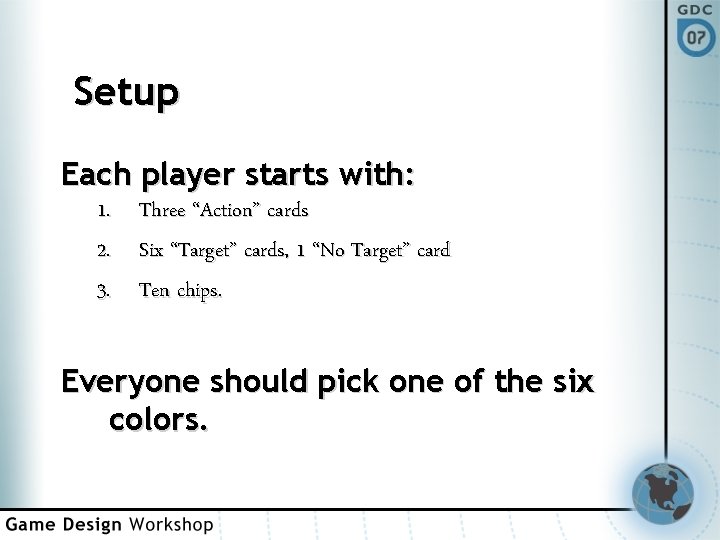
Setup Each player starts with: 1. Three “Action” cards 2. Six “Target” cards, 1 “No Target” card 3. Ten chips. Everyone should pick one of the six colors.
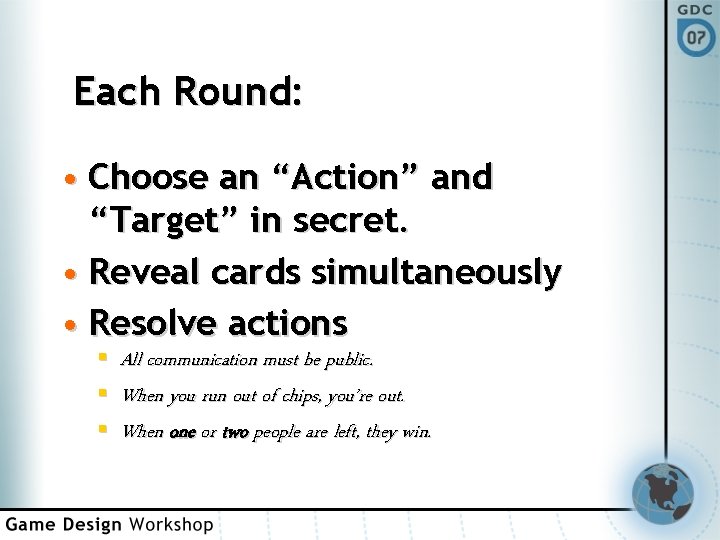
Each Round: • Choose an “Action” and “Target” in secret. • Reveal cards simultaneously • Resolve actions § All communication must be public. § When you run out of chips, you’re out. § When one or two people are left, they win.
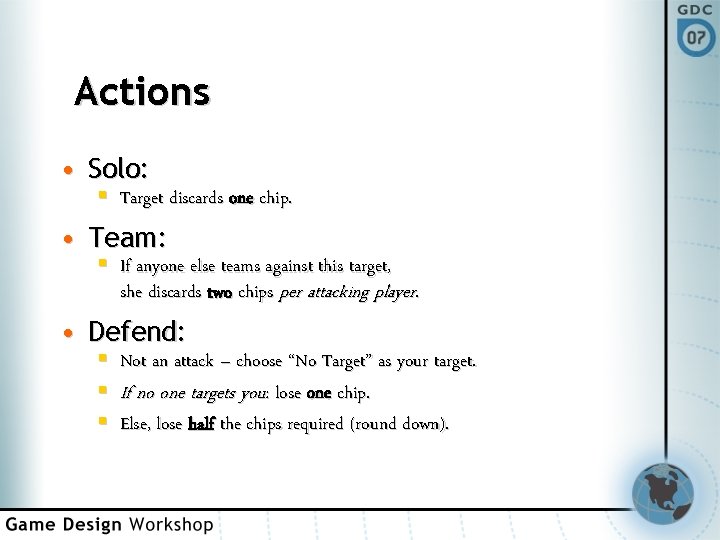
Actions • Solo: § Target discards one chip. • Team: § If anyone else teams against this target, she discards two chips per attacking player. • Defend: § Not an attack – choose “No Target” as your target. § If no one targets you: lose one chip. § Else, lose half the chips required (round down).
Coffee Break at 11: 00 • Play until then • Pick a different classroom § 3001 § 3003 § 3005
General Observations?
What’s fun about Si. SSYFi. GHT? • What kinds of fun did you experience? • Can we get more specific than “fun? ”
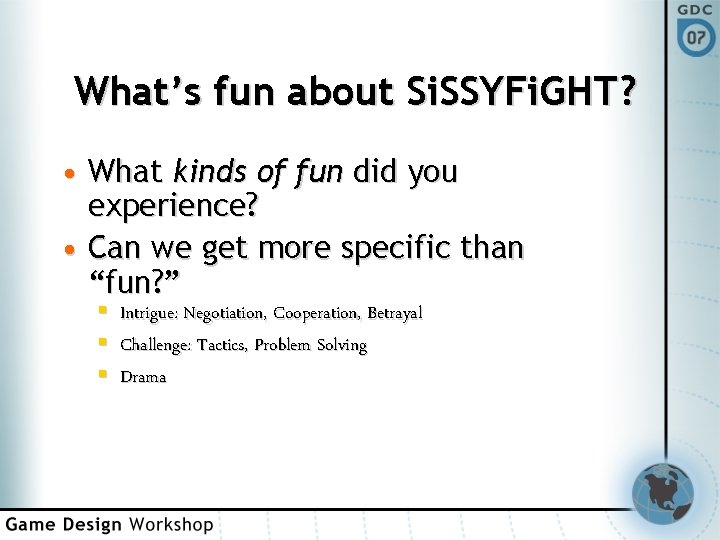
What’s fun about Si. SSYFi. GHT? • What kinds of fun did you experience? • Can we get more specific than “fun? ” § Intrigue: Negotiation, Cooperation, Betrayal § Challenge: Tactics, Problem Solving § Drama
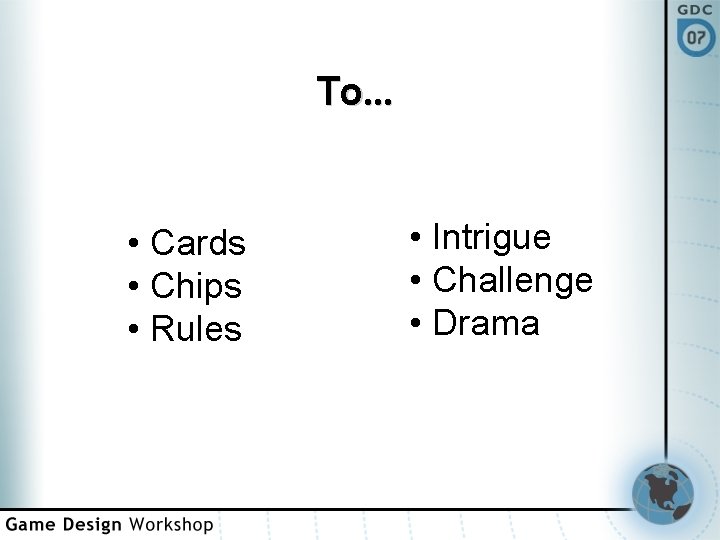
How do we get from… • Cards • Chips • Rules
To… • Cards • Chips • Rules • Intrigue • Challenge • Drama
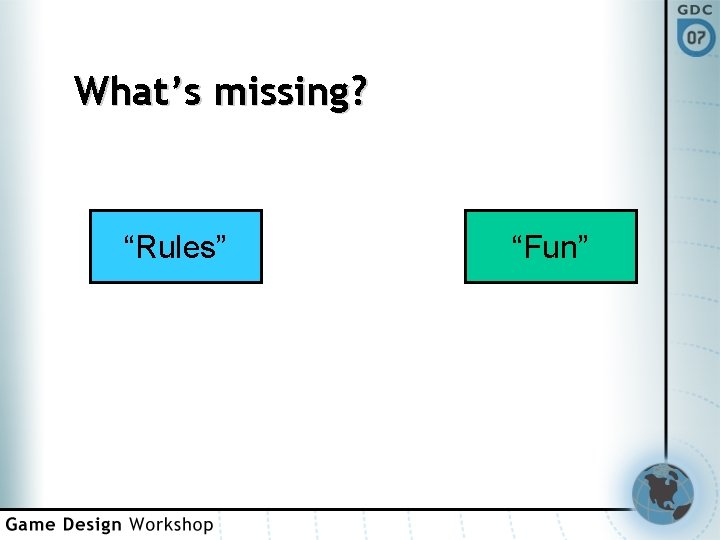
What’s missing? “Rules” “Fun”
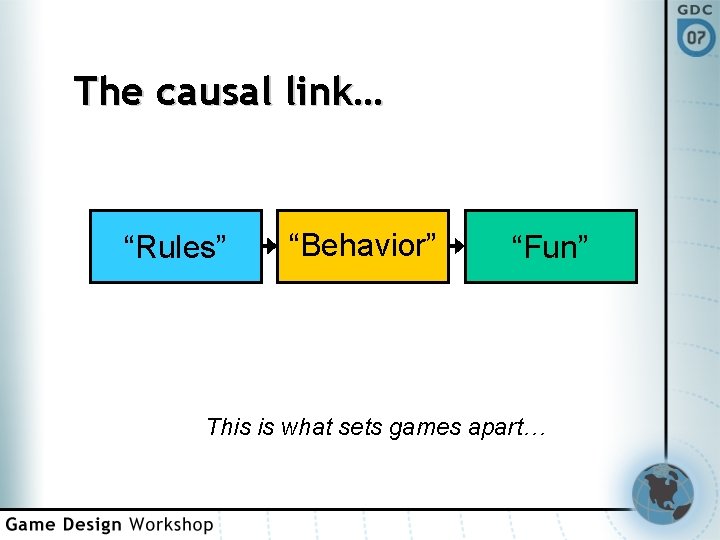
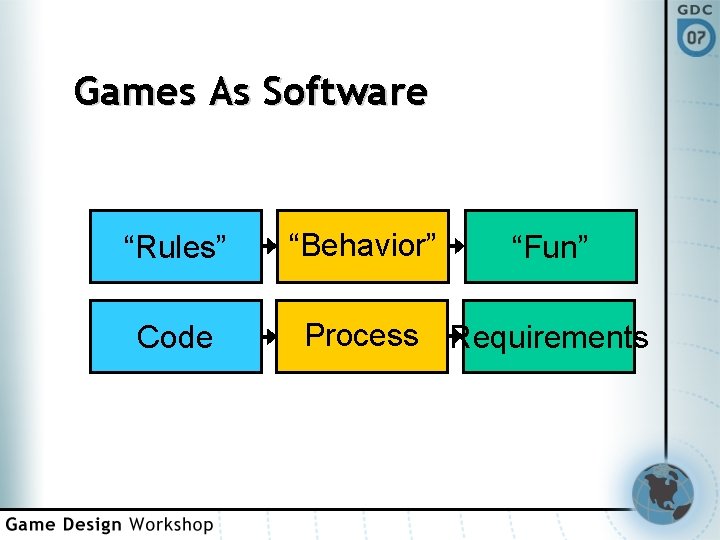
The causal link… “Rules” “Behavior” “Fun” This is what sets games apart…
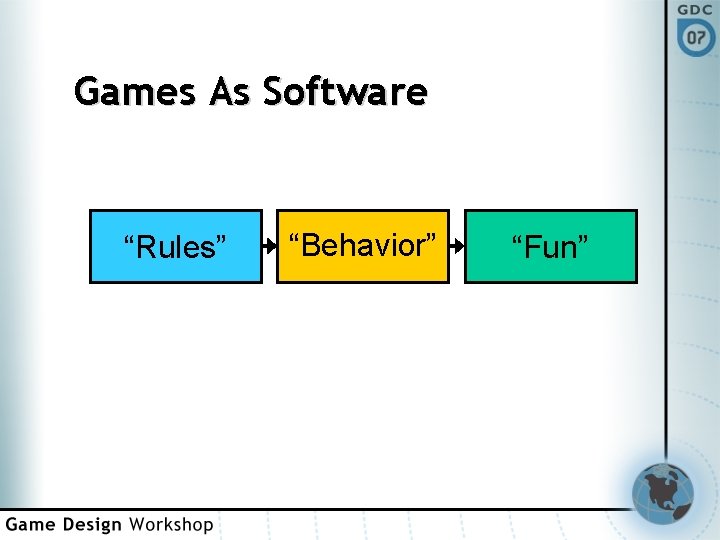
Games As Software “Rules” “Behavior” “Fun”
Games As Software “Rules” Code “Behavior” “Fun” Process Requirements
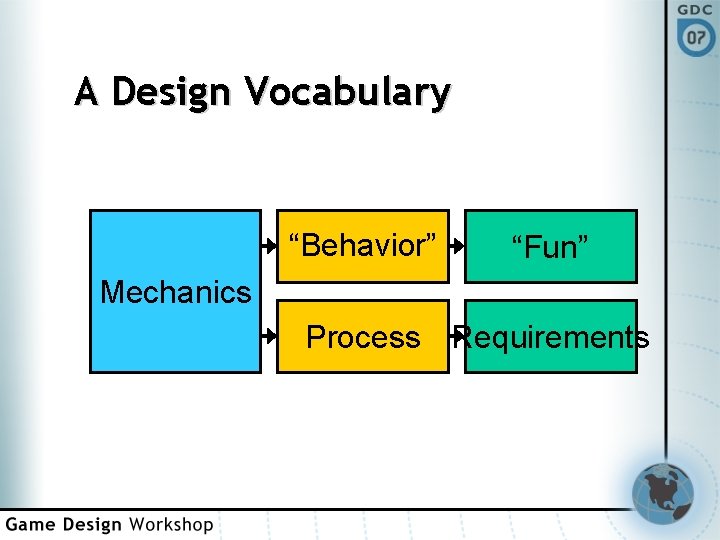
A Design Vocabulary “Behavior” “Fun” Mechanics Process Requirements
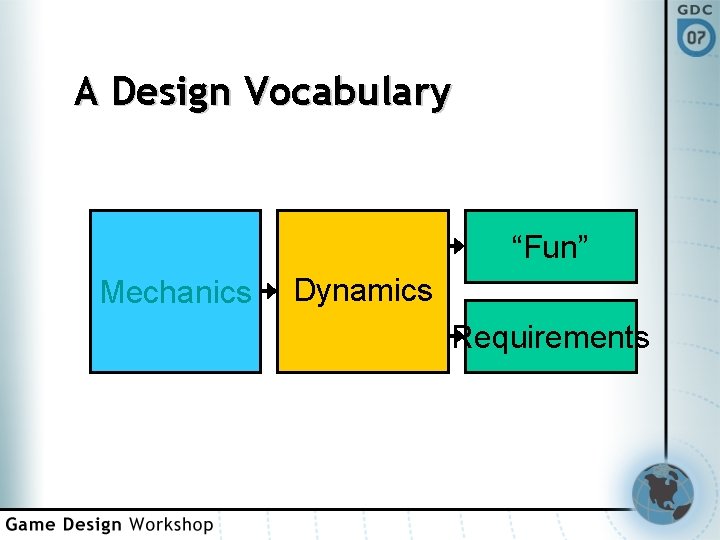
A Design Vocabulary “Fun” Mechanics Dynamics Requirements
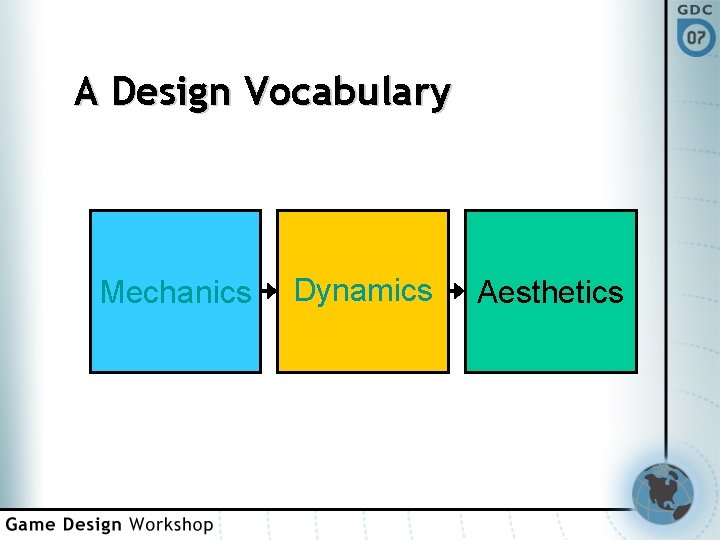
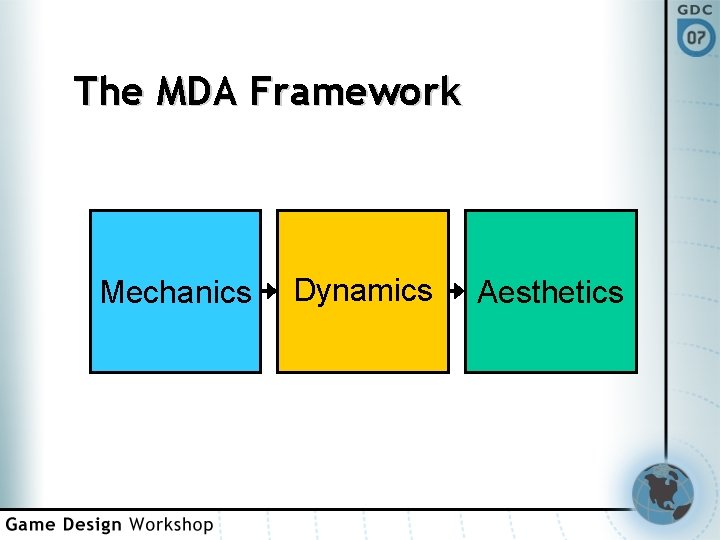
A Design Vocabulary Mechanics Dynamics Aesthetics
The MDA Framework Mechanics Dynamics Aesthetics
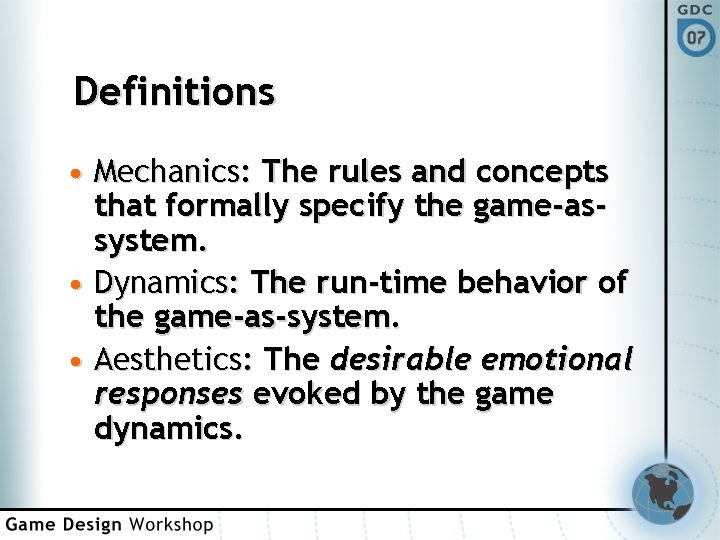
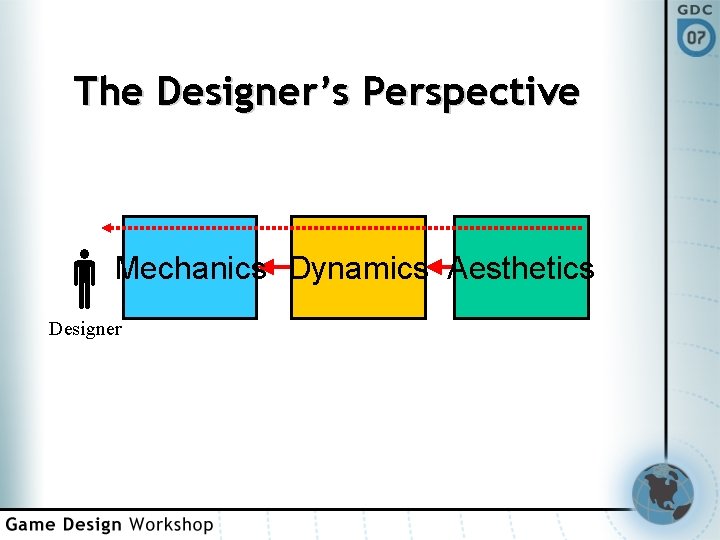
Definitions • Mechanics: The rules and concepts that formally specify the game-assystem. • Dynamics: The run-time behavior of the game-as-system. • Aesthetics: The desirable emotional responses evoked by the game dynamics.
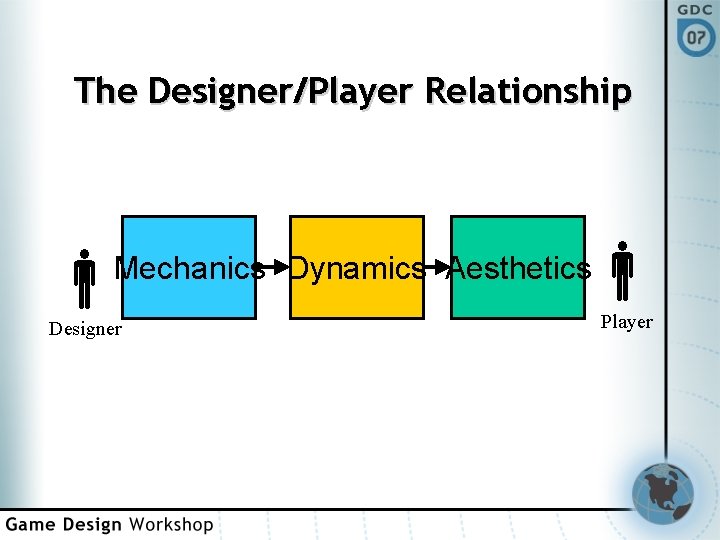
The Designer/Player Relationship Mechanics Dynamics Aesthetics Designer Player
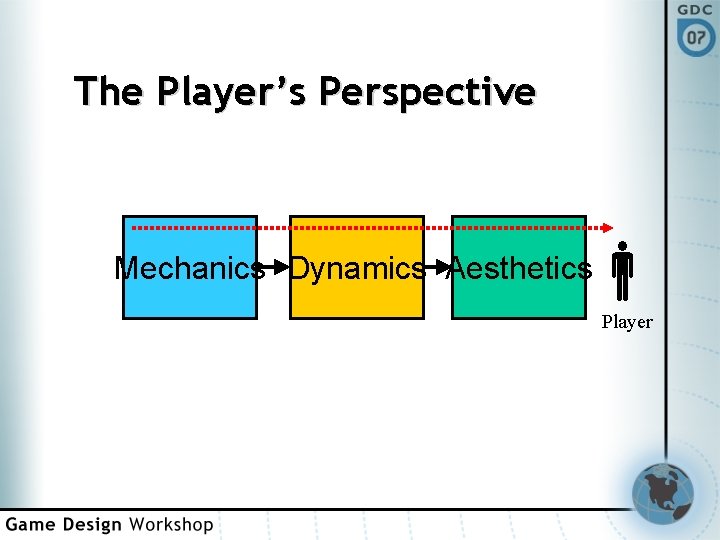
The Player’s Perspective Mechanics Dynamics Aesthetics Player
The Designer’s Perspective Mechanics Dynamics Aesthetics Designer
Understanding Aesthetics • We need to get past words like “fun” and “gameplay. ” • What kinds of “fun” are there? • How will we know a particular kind of “fun” when we see it?
Eight Kinds of “Fun”
Eight Kinds of “Fun” • Sensation Game as art object
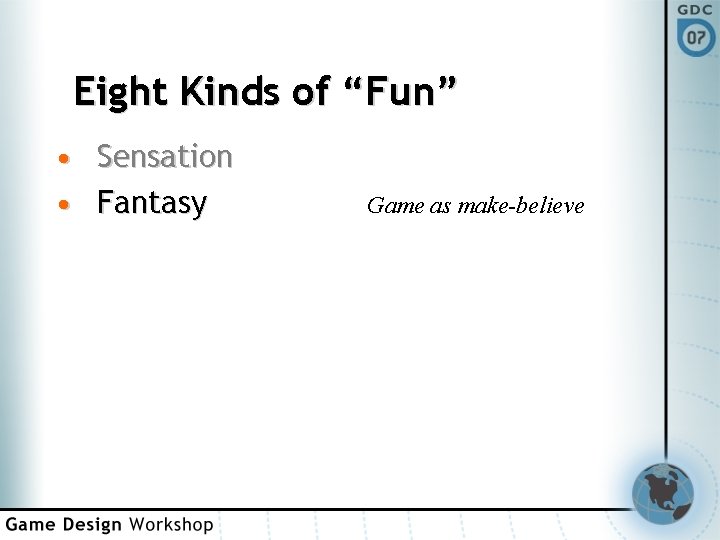
Eight Kinds of “Fun” • Sensation • Fantasy Game as make-believe
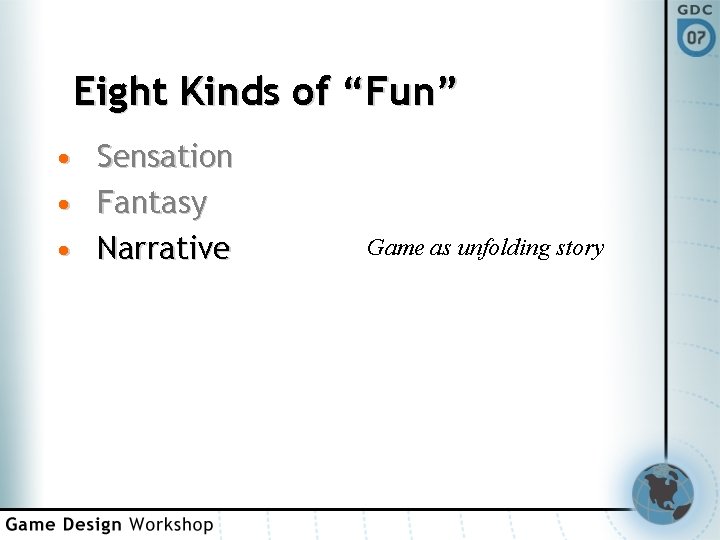
Eight Kinds of “Fun” • • • Sensation Fantasy Narrative Game as unfolding story
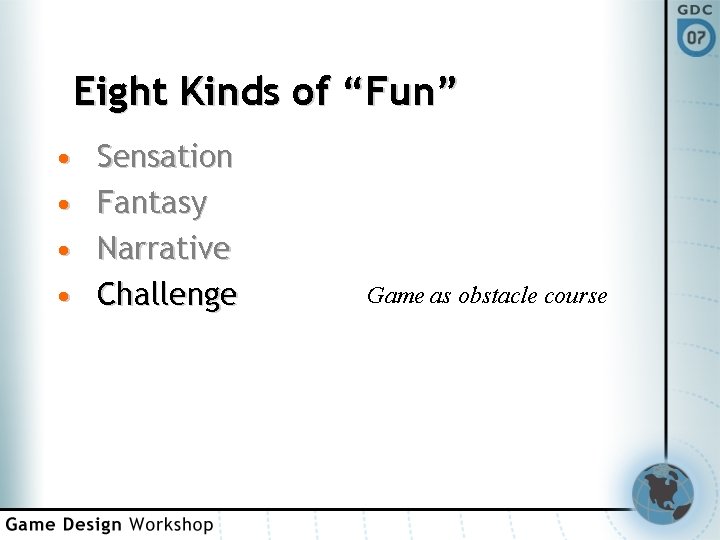
Eight Kinds of “Fun” • • Sensation Fantasy Narrative Challenge Game as obstacle course
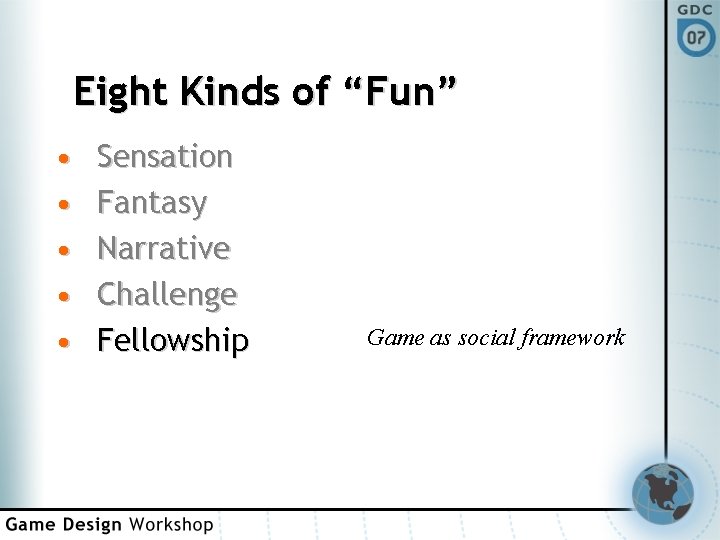
Eight Kinds of “Fun” • • • Sensation Fantasy Narrative Challenge Fellowship Game as social framework
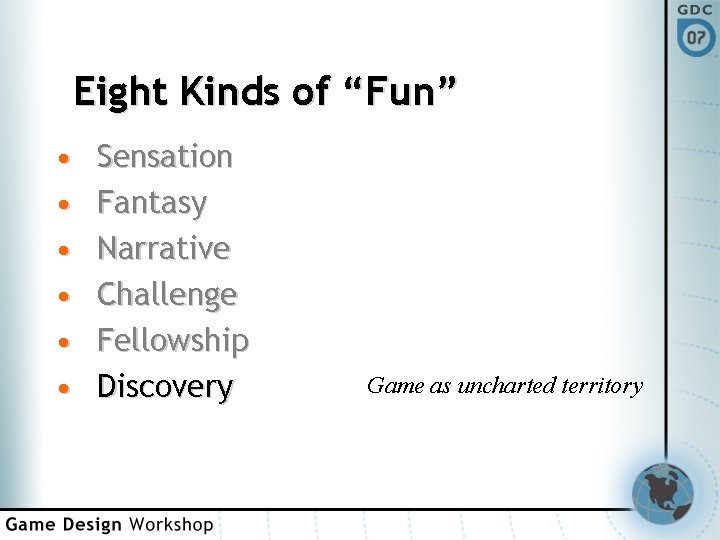
Eight Kinds of “Fun” • • • Sensation Fantasy Narrative Challenge Fellowship Discovery Game as uncharted territory
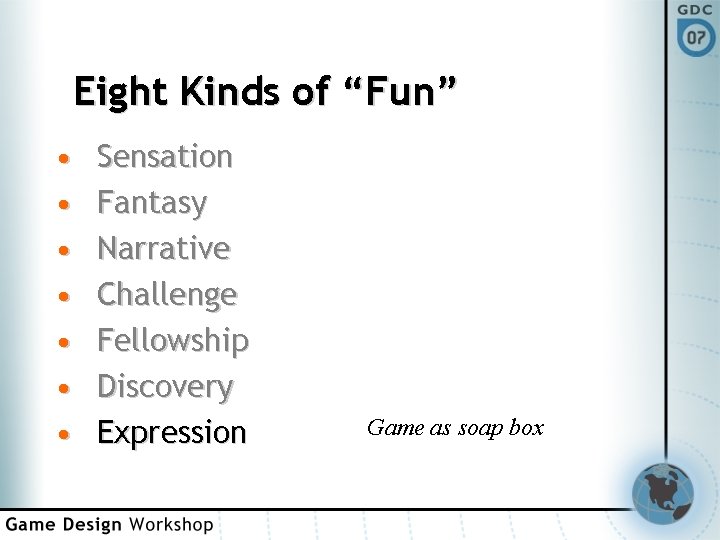
Eight Kinds of “Fun” • • Sensation Fantasy Narrative Challenge Fellowship Discovery Expression Game as soap box
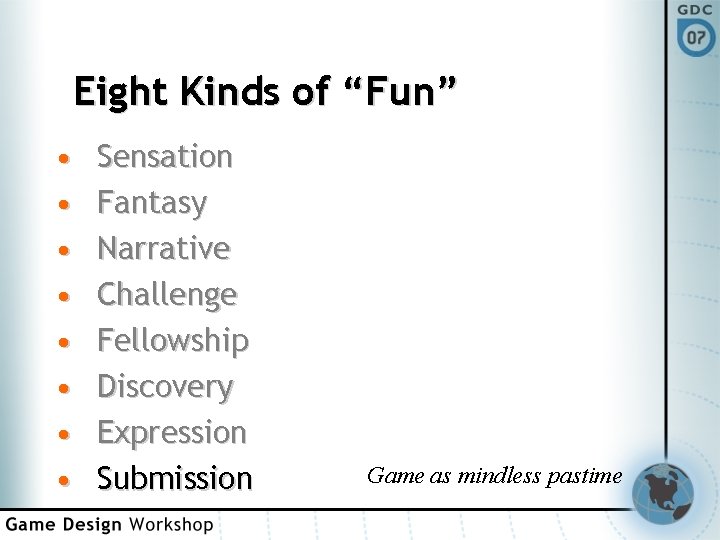
Eight Kinds of “Fun” • • Sensation Fantasy Narrative Challenge Fellowship Discovery Expression Submission Game as mindless pastime
Clarifying Our Aesthetics Charades is “fun” Counter-Strike is “fun” Final Fantasy is “fun”
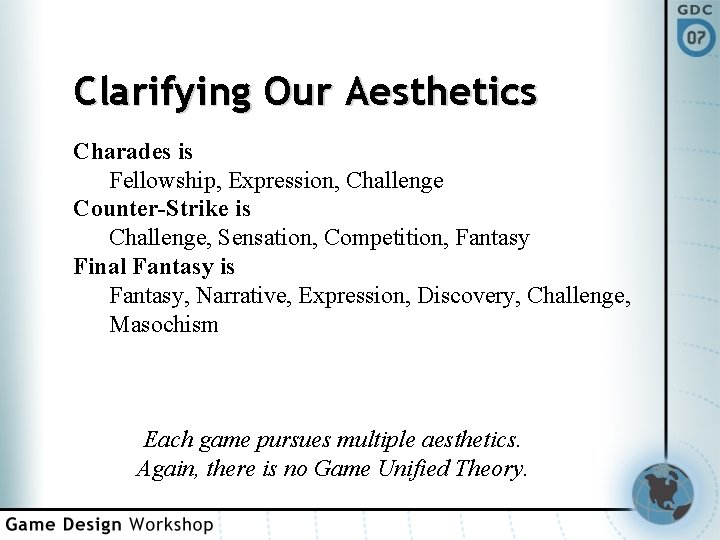
Clarifying Our Aesthetics Charades is Fellowship, Expression, Challenge Counter-Strike is Challenge, Sensation, Competition, Fantasy Final Fantasy is Fantasy, Narrative, Expression, Discovery, Challenge, Masochism Each game pursues multiple aesthetics. Again, there is no Game Unified Theory.
Clarifying Our Goals • As designers, we can choose certain aesthetics as goals for our game design. • We need more than a one-word definition of our goals.
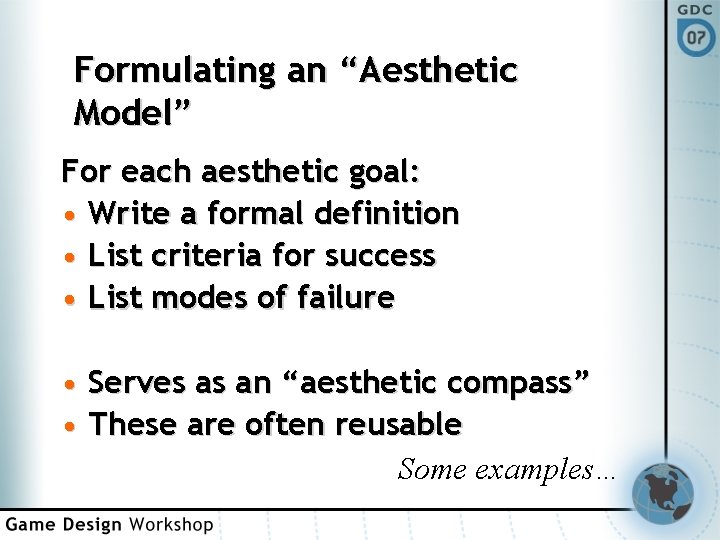
Formulating an “Aesthetic Model” For each aesthetic goal: • Write a formal definition • List criteria for success • List modes of failure • Serves as an “aesthetic compass” • These are often reusable Some examples…
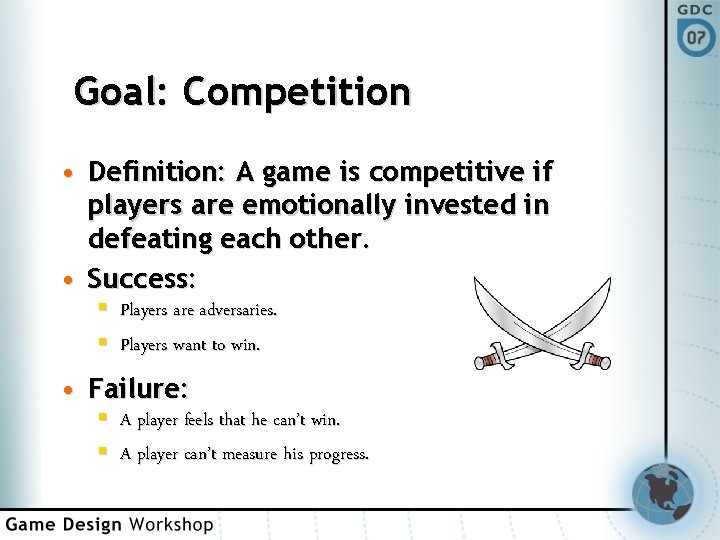
Goal: Competition • Definition: A game is competitive if players are emotionally invested in defeating each other. • Success: § Players are adversaries. § Players want to win. • Failure: § A player feels that he can’t win. § A player can’t measure his progress.
Goal: Pirate Fantasy • Definition: A pirate fantasy conforms to the genre conventions of pirate movies, and permits the player to engage in certain kinds of anti-social pirate behavior.
Goal: Pirate Fantasy • Definition: A pirate fantasy conforms to the genre conventions of pirate movies, and permits the player to engage in certain kinds of anti-social pirate behavior. • Success: § § § Empowerment Independence Greed Treachery Prey upon Weak
Goal: Pirate Fantasy • Definition: A pirate fantasy conforms to the genre conventions of pirate movies, and permits the player to engage in certain kinds of anti-social pirate behavior. • Failure: • Success: § § § Empowerment Independence Greed Treachery Prey upon Weak § Vulnerability § Compassion § Generosity
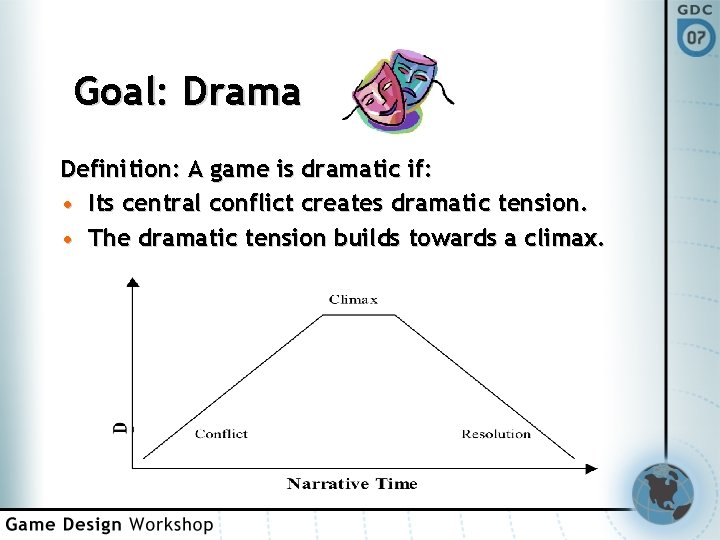
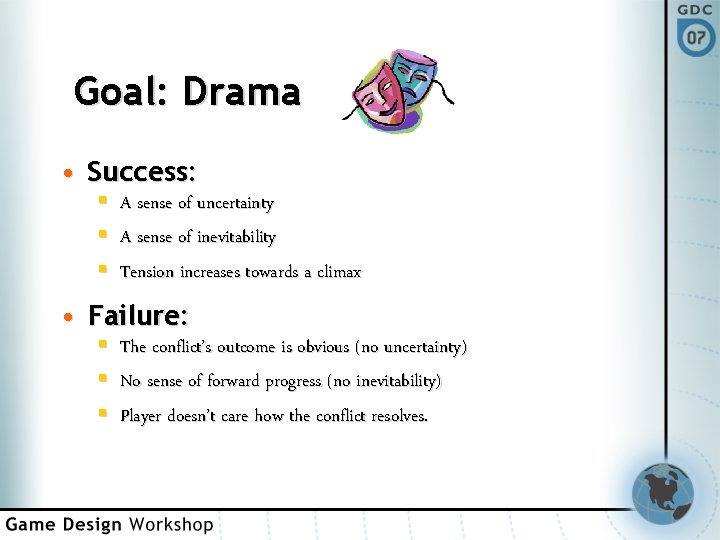
Goal: Drama Definition: A game is dramatic if: • Its central conflict creates dramatic tension. • The dramatic tension builds towards a climax.
Goal: Drama • Success: § § § A sense of uncertainty A sense of inevitability Tension increases towards a climax • Failure: § § § The conflict’s outcome is obvious (no uncertainty) No sense of forward progress (no inevitability) Player doesn’t care how the conflict resolves.
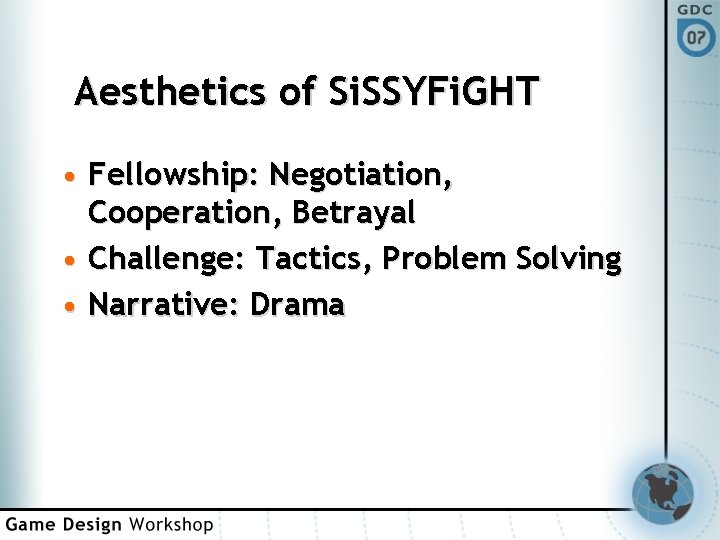
Aesthetics of Si. SSYFi. GHT • Fellowship: Negotiation, Cooperation, Betrayal • Challenge: Tactics, Problem Solving • Narrative: Drama
Understanding Dynamics • What about the game’s behavior can we predict before we go to playtest? • How can we explain the behavior that we observe?
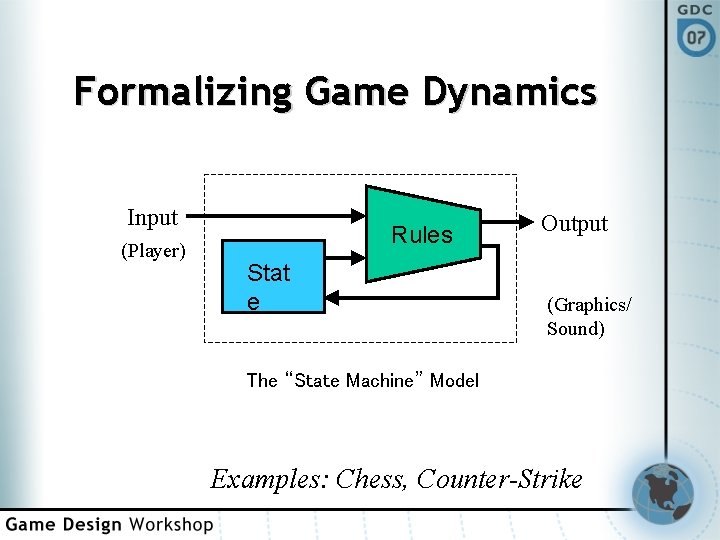
Formalizing Game Dynamics Input (Player) Rules Stat e Output (Graphics/ Sound) The “State Machine” Model Examples: Chess, Counter-Strike
Models of Game Dynamics • Again, no Grand Unified Theory • Instead, a collection of many Dynamic Models. • Dynamics models are analytical in nature. Some examples…
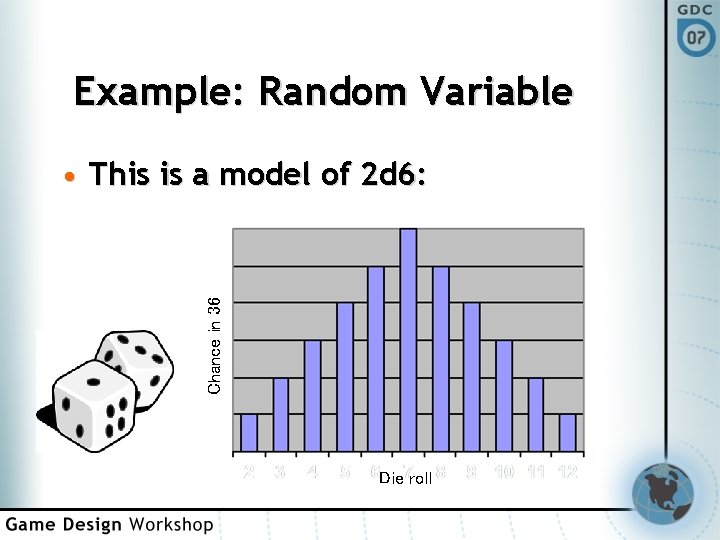
Example: Random Variable Chance in 36 • This is a model of 2 d 6: Die roll
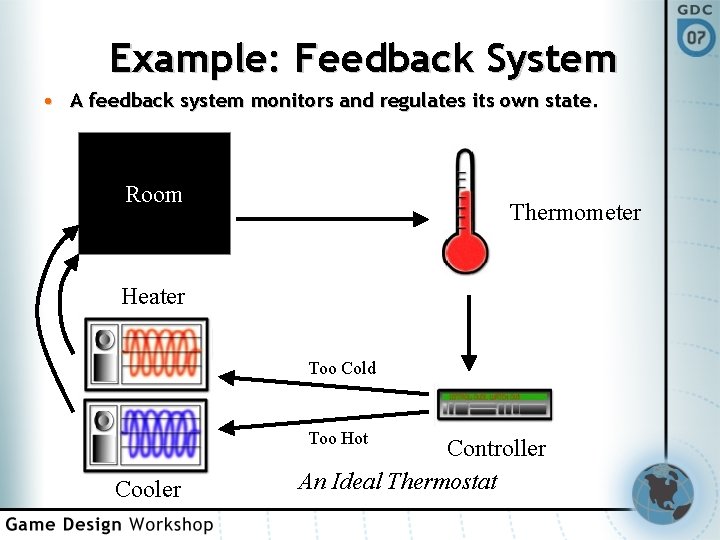
Example: Feedback System • A feedback system monitors and regulates its own state. Room Thermometer Heater Too Cold Too Hot Cooler Controller An Ideal Thermostat
Example: Operant Conditioning • The player is part of the system, too! • Psychology gives us models to explain and predict the player’s behavior.
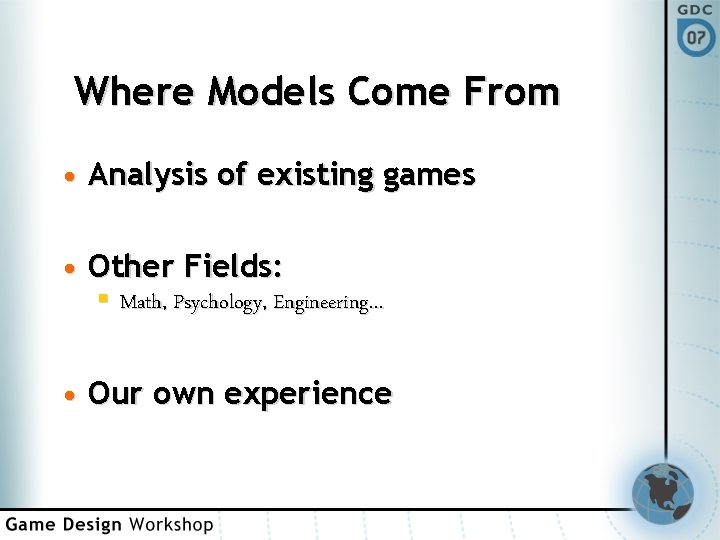
Where Models Come From • Analysis of existing games • Other Fields: § Math, Psychology, Engineering… • Our own experience
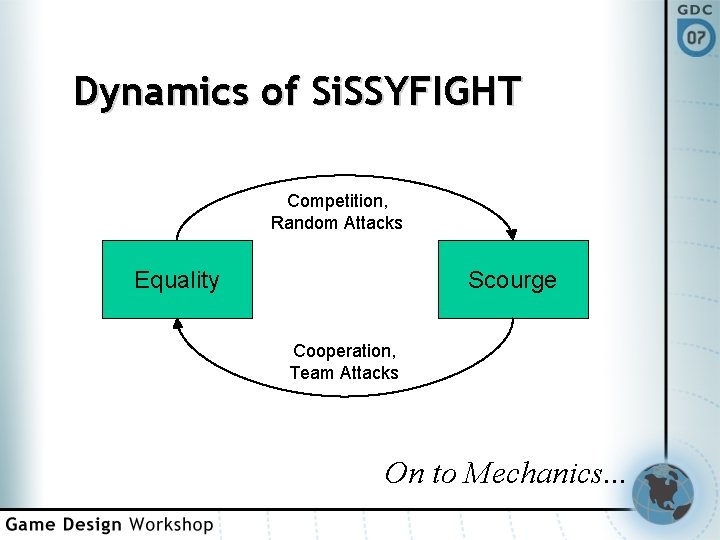
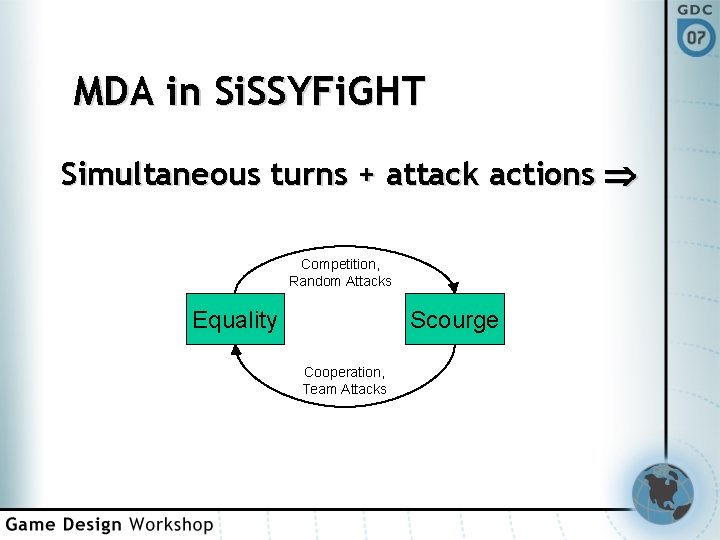
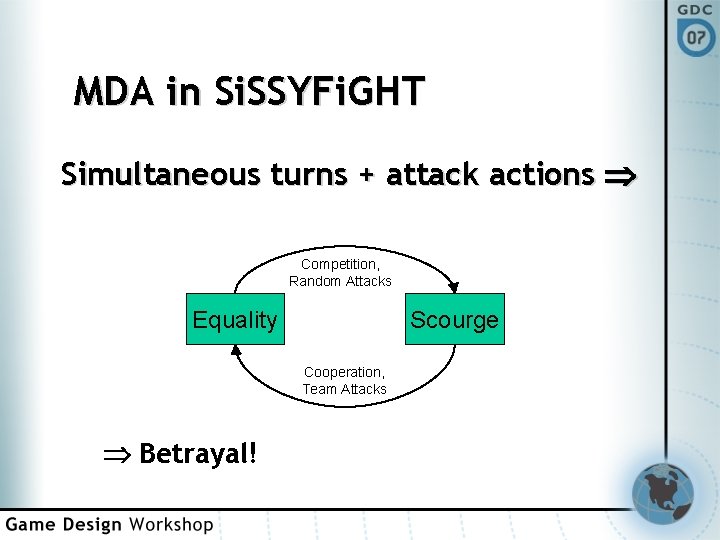
Dynamics of Si. SSYFIGHT Competition, Random Attacks Equality Scourge Cooperation, Team Attacks On to Mechanics. . .
Understanding Mechanics • There’s a vast library of common game mechanics.
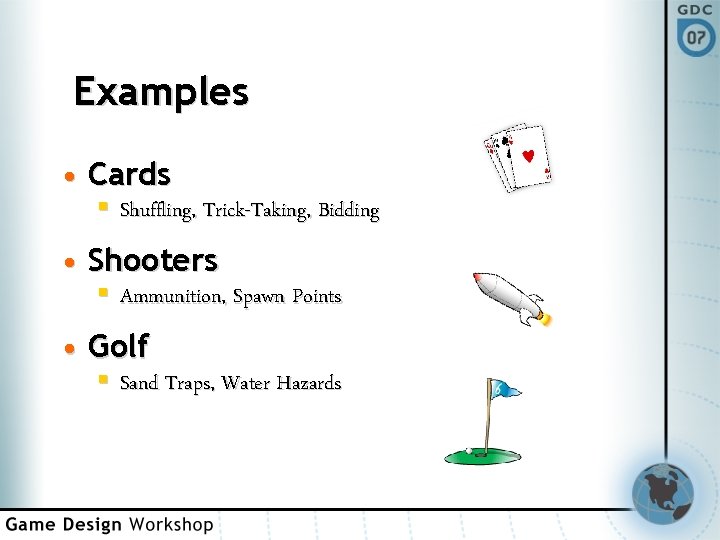
Examples • Cards § Shuffling, Trick-Taking, Bidding • Shooters § Ammunition, Spawn Points • Golf § Sand Traps, Water Hazards
Mechanics of Si. SSYFi. GHT • Turn-based • Hit Points • Public Communication • Simultaneous Action
Mechanics vs. Dynamics • There’s a grey area § Some behaviors are direct consequences of rules. § Others are indirect. § “Dynamics” usually means the latter. • Dynamics and Mechanics are different views of games. • Dynamics emerge from Mechanics.
MDA • A “Taxonomy” of Design Knowledge § Aesthetics § Dynamics § Mechanics § …and the interactions between them.
MDA in Si. SSYFi. GHT Simultaneous turns + attack actions
MDA in Si. SSYFi. GHT Simultaneous turns + attack actions Competition, Random Attacks Equality Scourge Cooperation, Team Attacks
MDA in Si. SSYFi. GHT Simultaneous turns + attack actions Competition, Random Attacks Equality Scourge Cooperation, Team Attacks Betrayal!
Si. SSYFi. GHT Fiction • Does Si. SSYFi. GHT do a good job of conveying its subject matter? • How can it do better?
Si. SSYFi. GHT Fiction What other fictional genre or subject matter could the mechanics of Si. SSYFi. GHT simulate?
Exercise • Choose a fictional genre and/or setting that might fit this game. • Adapt the game to your chosen subject matter. • Keep in mind the aesthetic qualities we identified in the breakdown. • How can the rules of the game be changed to best support your fiction?
Brainstorming • Everyone Grab a Sticky Pad
When I Say “Go…” 1. You will have 90 seconds. 2. Write down as many genre ideas as you can. 3. One to a sticky note. 4. Keep it Short ( 5 words) 5. No idea is too dumb. 6. Work in silence.
Ready? • Go!
Pens Down! With your group: • Get on your feet! • Find some wall space • Stick your ideas to the wall • Put like ideas together • Look for critical mass • Narrow down a fiction to work on.
When your group has picked a subject, you are free to go to lunch. Feel free to get started on your design. Don’t forget to sign up for an elective. We will reconvene at 2: 00.
Welcome Back! • You’ve chosen a setting or fiction for Si. SSYFi. GHT. • Adapt the game to your chosen subject matter. • Keep in mind the aesthetic qualities we identified at the beginning. • How can the rules of the game be changed to best support your fiction?
Discussion • Let’s compare solutions. What different approaches did we take?
Discussion How did the game dynamics support your subject matter? Were the game dynamics and the subject matter ever in conflict? How did your choice of subject matter influence your process?
Any Final Observations?
Coffee! After the break, go to your Elective A room: World of Randomness: 3001 World of Creativity: 3003 World of Rulecraft: 3005
Elective B • Us vs. It: 3001 • Cart Before Horse: 3003 • 3 Musketeers: 3005