Future Nuclear Energy Systems Generation IV Kevan D
- Slides: 24
Future Nuclear Energy Systems: Generation IV Kevan D. Weaver, Ph. D. U. S. System Integration Manager, Gas-Cooled Fast Reactor 50 th Annual Meeting of the Health Physics Society 11 July 2005 - Spokane, Washington, USA
The Legacy of U. S. Energy Leadership Growing world tension over energy supplies. Widening gap between energy haves and have-nots. Increasing air pollution and greenhouse gases in the atmosphere. Diverse, affordable, secure global energy supplies. Growing world prosperity. Protection of the global environment.
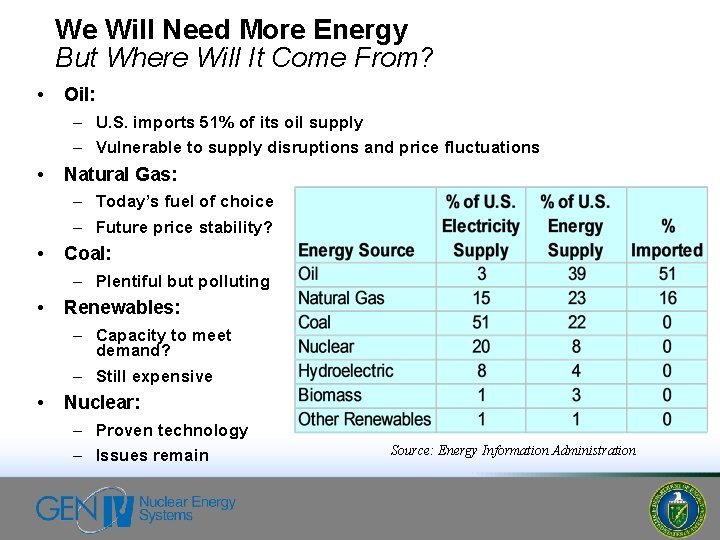
We Will Need More Energy But Where Will It Come From? • Oil: – U. S. imports 51% of its oil supply – Vulnerable to supply disruptions and price fluctuations • Natural Gas: – Today’s fuel of choice – Future price stability? • Coal: – Plentiful but polluting • Renewables: – Capacity to meet demand? – Still expensive • Nuclear: – Proven technology – Issues remain Source: Energy Information Administration
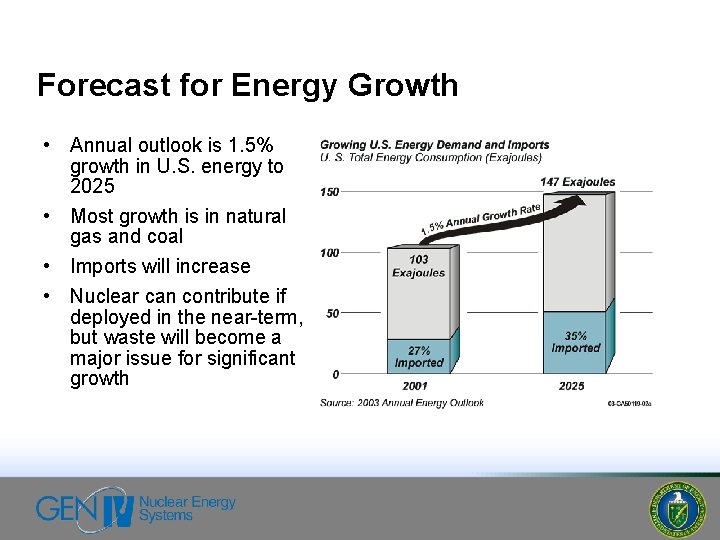
Forecast for Energy Growth • Annual outlook is 1. 5% growth in U. S. energy to 2025 • Most growth is in natural gas and coal • Imports will increase • Nuclear can contribute if deployed in the near-term, but waste will become a major issue for significant growth
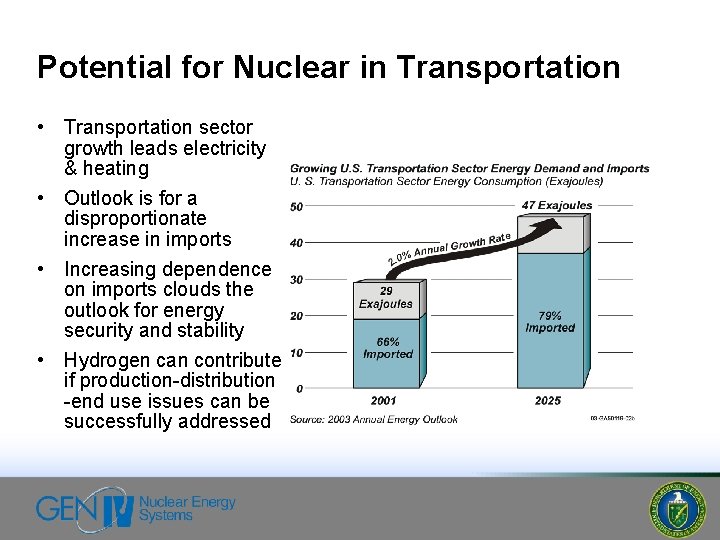
Potential for Nuclear in Transportation • Transportation sector growth leads electricity & heating • Outlook is for a disproportionate increase in imports • Increasing dependence on imports clouds the outlook for energy security and stability • Hydrogen can contribute if production-distribution -end use issues can be successfully addressed
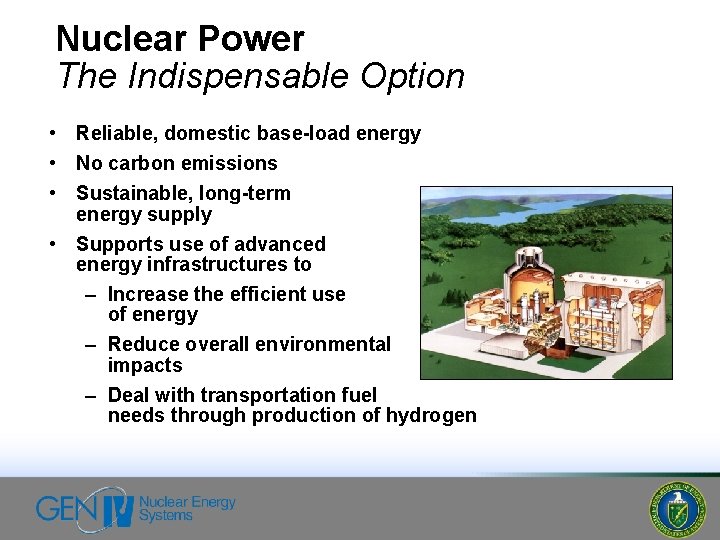
Nuclear Power The Indispensable Option • Reliable, domestic base-load energy • No carbon emissions • Sustainable, long-term energy supply • Supports use of advanced energy infrastructures to – Increase the efficient use of energy – Reduce overall environmental impacts – Deal with transportation fuel needs through production of hydrogen
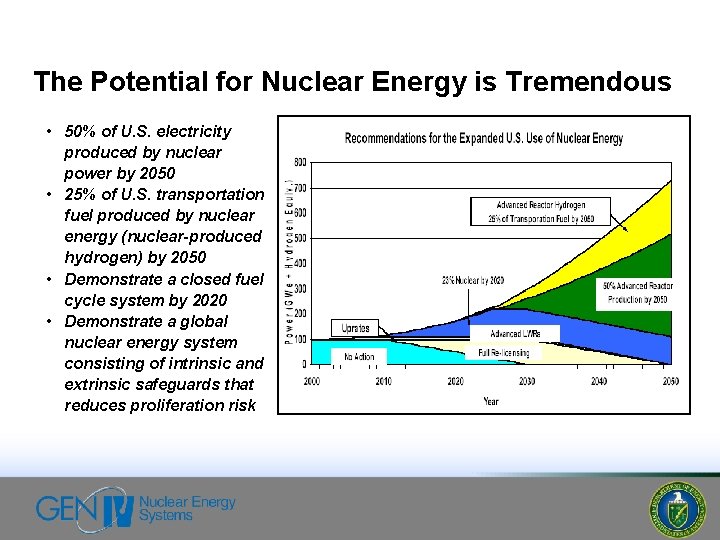
The Potential for Nuclear Energy is Tremendous • 50% of U. S. electricity produced by nuclear power by 2050 • 25% of U. S. transportation fuel produced by nuclear energy (nuclear-produced hydrogen) by 2050 • Demonstrate a closed fuel cycle system by 2020 • Demonstrate a global nuclear energy system consisting of intrinsic and extrinsic safeguards that reduces proliferation risk
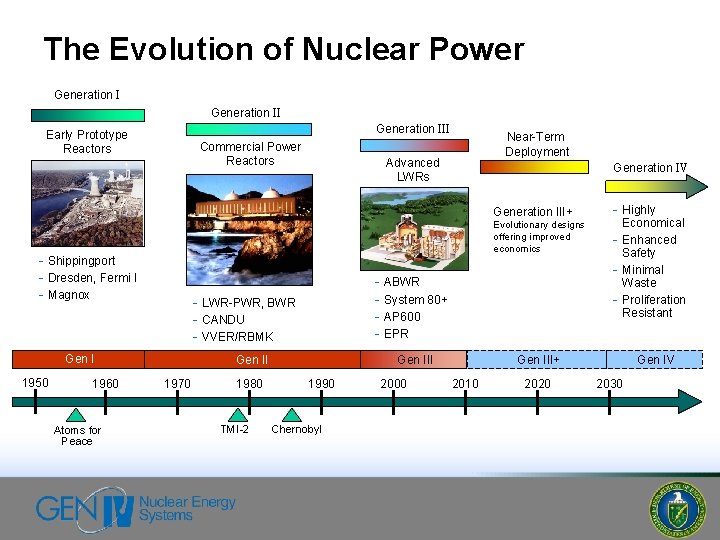
The Evolution of Nuclear Power Generation III Early Prototype Reactors Commercial Power Reactors - Shippingport - Dresden, Fermi I - Magnox 1950 1960 Atoms for Peace Advanced LWRs Gen II 1970 1980 TMI-2 Generation IV Generation III+ - Highly Evolutionary designs offering improved economics - - ABWR - System 80+ - AP 600 - EPR - LWR-PWR, BWR - CANDU - VVER/RBMK Gen I Near-Term Deployment - Gen III 1990 Chernobyl 2000 Economical Enhanced Safety Minimal Waste Proliferation Resistant Gen III+ 2010 2020 Gen IV 2030
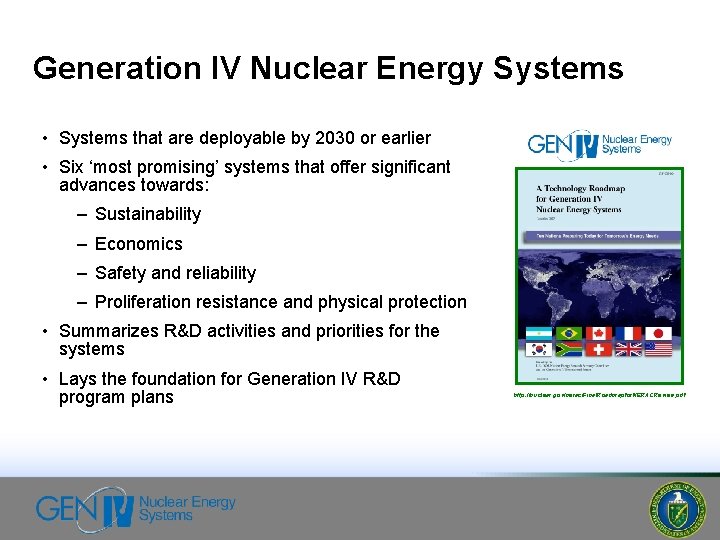
Generation IV Nuclear Energy Systems • Systems that are deployable by 2030 or earlier • Six ‘most promising’ systems that offer significant advances towards: – Sustainability – Economics – Safety and reliability – Proliferation resistance and physical protection • Summarizes R&D activities and priorities for the systems • Lays the foundation for Generation IV R&D program plans http: //nuclear. gov/nerac/Final. Roadmapfor. NERACReview. pdf
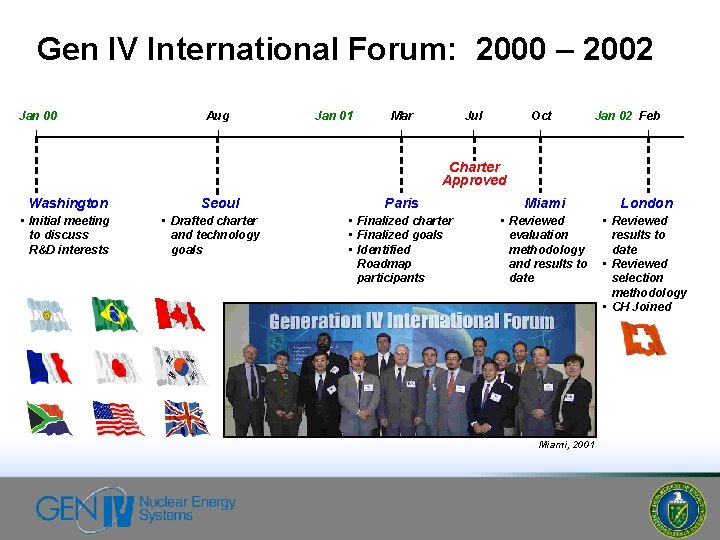
Gen IV International Forum: 2000 – 2002 Jan 00 Aug Jan 01 Mar Jul Oct Jan 02 Feb Charter Approved Washington • Initial meeting to discuss R&D interests Seoul • Drafted charter and technology goals Paris Miami London • Finalized charter • Finalized goals • Identified Roadmap participants • Reviewed evaluation methodology and results to date • Reviewed results to date • Reviewed selection methodology • CH Joined Miami, 2001
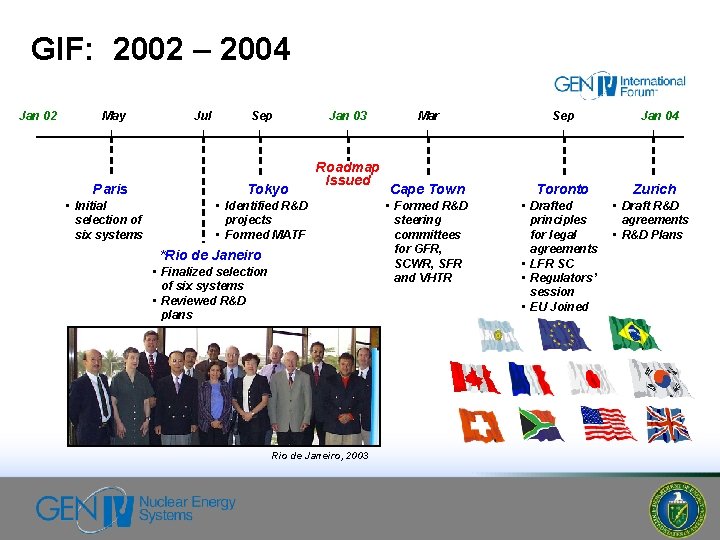
GIF: 2002 – 2004 Jan 02 May Paris • Initial selection of six systems Jul Sep Tokyo Jan 03 Roadmap Issued • Identified R&D projects • Formed MATF *Rio de Janeiro • Finalized selection of six systems • Reviewed R&D plans Rio de Janeiro, 2003 Mar Sep Jan 04 Cape Town Toronto Zurich • Formed R&D steering committees for GFR, SCWR, SFR and VHTR • Drafted principles for legal agreements • LFR SC • Regulators’ session • EU Joined • Draft R&D agreements • R&D Plans
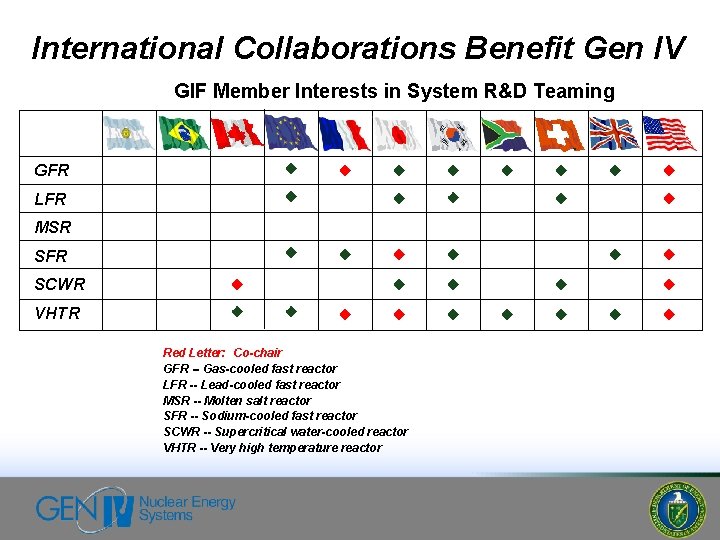
International Collaborations Benefit Gen IV GIF Member Interests in System R&D Teaming GFR LFR MSR SFR SCWR VHTR Red Letter: Co-chair GFR -- Gas-cooled fast reactor LFR -- Lead-cooled fast reactor MSR -- Molten salt reactor SFR -- Sodium-cooled fast reactor SCWR -- Supercritical water-cooled reactor VHTR -- Very high temperature reactor
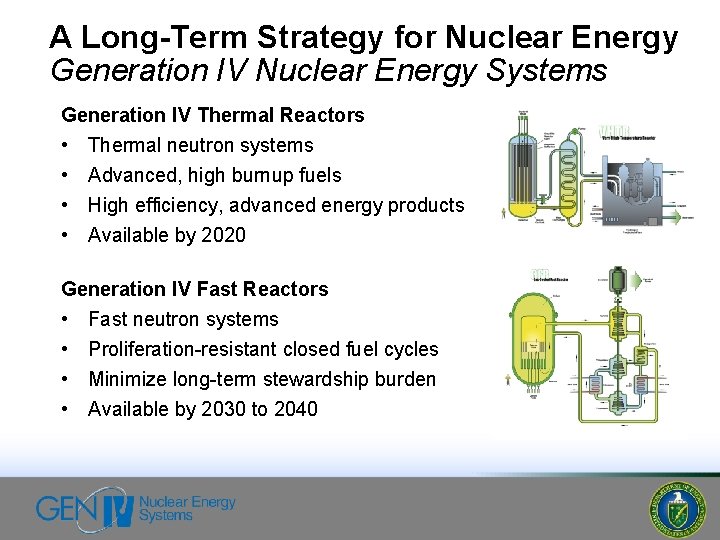
A Long-Term Strategy for Nuclear Energy Generation IV Nuclear Energy Systems Generation IV Thermal Reactors • Thermal neutron systems • Advanced, high burnup fuels • High efficiency, advanced energy products • Available by 2020 Generation IV Fast Reactors • • Fast neutron systems Proliferation-resistant closed fuel cycles Minimize long-term stewardship burden Available by 2030 to 2040
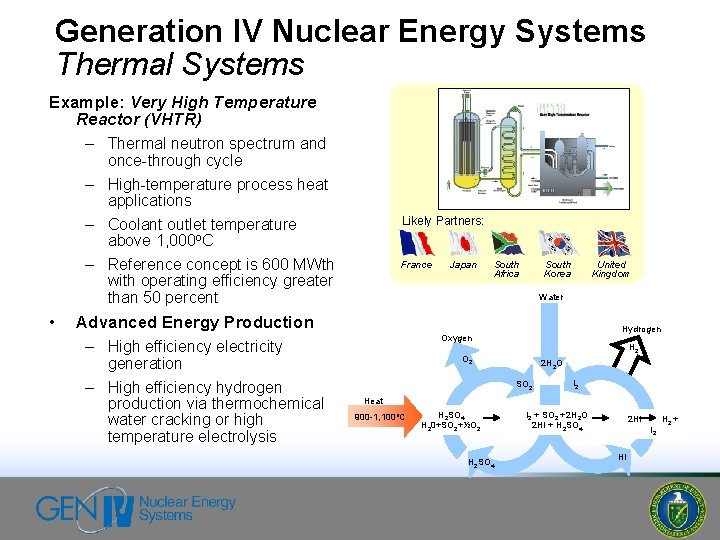
Generation IV Nuclear Energy Systems Thermal Systems Example: Very High Temperature Reactor (VHTR) – Thermal neutron spectrum and once-through cycle – High-temperature process heat applications – Coolant outlet temperature above 1, 000 o. C – Reference concept is 600 MWth with operating efficiency greater than 50 percent • Likely Partners: France South Africa South Korea United Kingdom Water Advanced Energy Production – High efficiency electricity generation – High efficiency hydrogen production via thermochemical water cracking or high temperature electrolysis Japan Hydrogen Oxygen H 2 O 2 2 H 2 O SO 2 I 2 Heat 900 -1, 100 o. C H 2 SO 4 H 20+SO 2+½O 2 H 2 SO 4 I 2 + SO 2 + 2 H 2 O 2 HI + H 2 SO 4 2 HI I 2 HI H 2 +
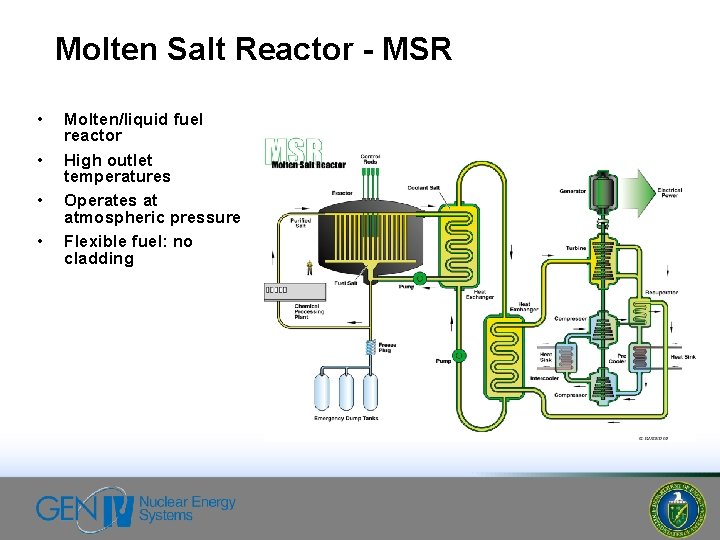
Molten Salt Reactor - MSR • • Molten/liquid fuel reactor High outlet temperatures Operates at atmospheric pressure Flexible fuel: no cladding
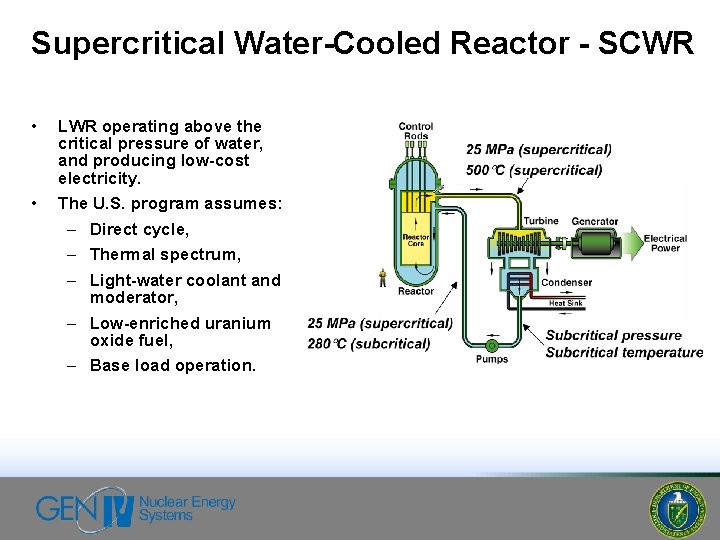
Supercritical Water-Cooled Reactor - SCWR • • LWR operating above the critical pressure of water, and producing low-cost electricity. The U. S. program assumes: – Direct cycle, – Thermal spectrum, – Light-water coolant and moderator, – Low-enriched uranium oxide fuel, – Base load operation.
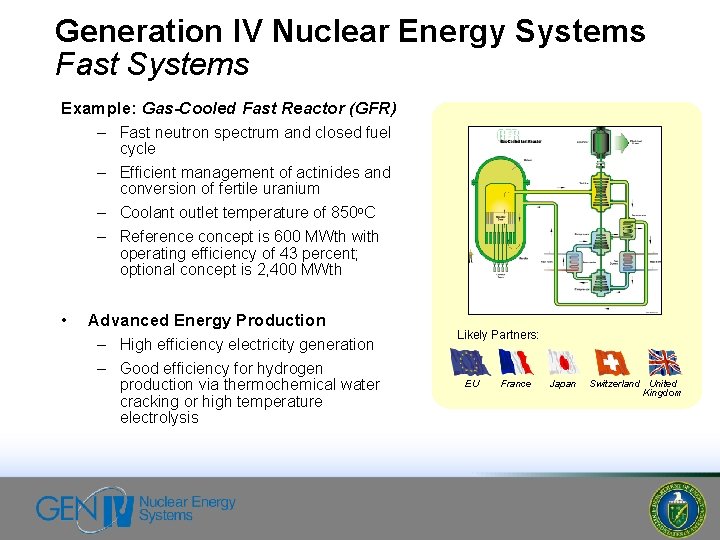
Generation IV Nuclear Energy Systems Fast Systems Example: Gas-Cooled Fast Reactor (GFR) – Fast neutron spectrum and closed fuel cycle – Efficient management of actinides and conversion of fertile uranium – Coolant outlet temperature of 850 o. C – Reference concept is 600 MWth with operating efficiency of 43 percent; optional concept is 2, 400 MWth • Advanced Energy Production – High efficiency electricity generation – Good efficiency for hydrogen production via thermochemical water cracking or high temperature electrolysis Likely Partners: EU France Japan Switzerland United Kingdom
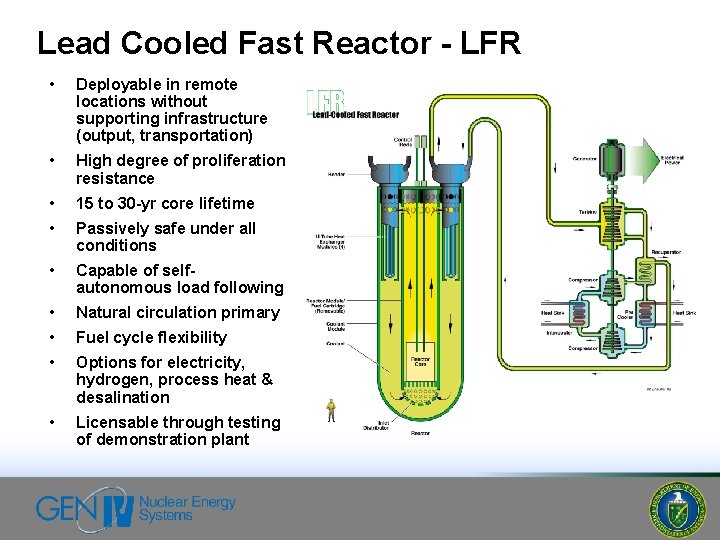
Lead Cooled Fast Reactor - LFR • Deployable in remote locations without supporting infrastructure (output, transportation) • High degree of proliferation resistance • 15 to 30 -yr core lifetime • Passively safe under all conditions • Capable of selfautonomous load following • Natural circulation primary • Fuel cycle flexibility • Options for electricity, hydrogen, process heat & desalination • Licensable through testing of demonstration plant
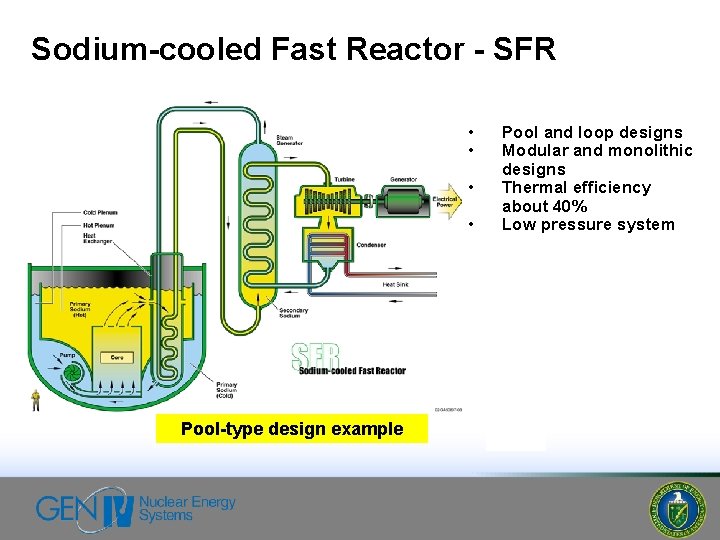
Sodium-cooled Fast Reactor - SFR • • Pool-type design example Pool and loop designs Modular and monolithic designs Thermal efficiency about 40% Low pressure system
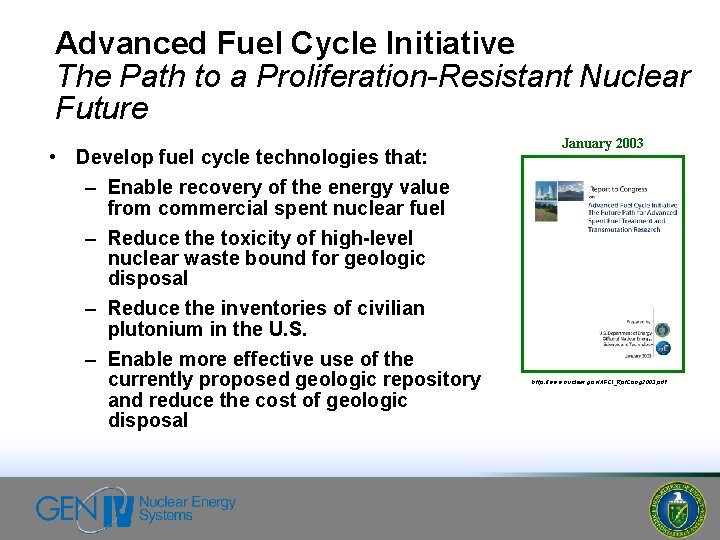
Advanced Fuel Cycle Initiative The Path to a Proliferation-Resistant Nuclear Future • Develop fuel cycle technologies that: – Enable recovery of the energy value from commercial spent nuclear fuel – Reduce the toxicity of high-level nuclear waste bound for geologic disposal – Reduce the inventories of civilian plutonium in the U. S. – Enable more effective use of the currently proposed geologic repository and reduce the cost of geologic disposal January 2003 http: //www. nuclear. gov/AFCI_Rpt. Cong 2003. pdf
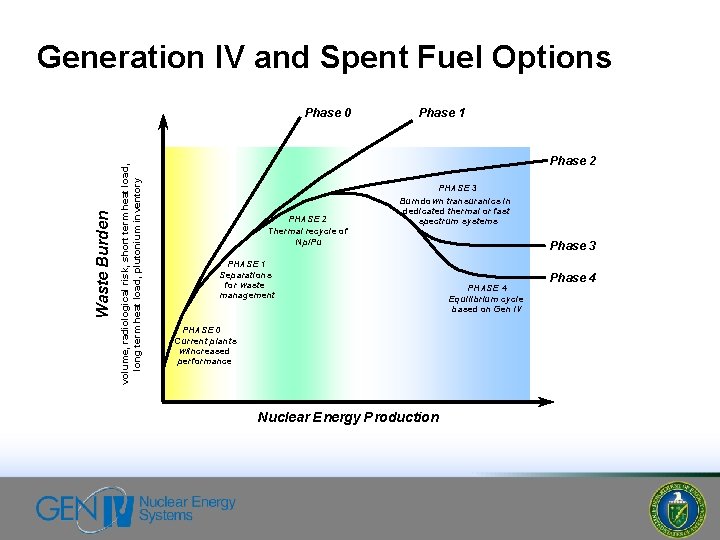
Generation IV and Spent Fuel Options volume, radiological risk, short term heat load, long term heat load, plutonium inventory Waste Burden Phase 0 Phase 1 Phase 2 PHASE 2 Thermal recycle of Np/Pu PHASE 3 Burndown transuranics in dedicated thermal or fast spectrum systems PHASE 1 Separations for waste management PHASE 0 Current plants w/increased performance Nuclear Energy Production Phase 3 PHASE 4 Equilibrium cycle based on Gen IV Phase 4
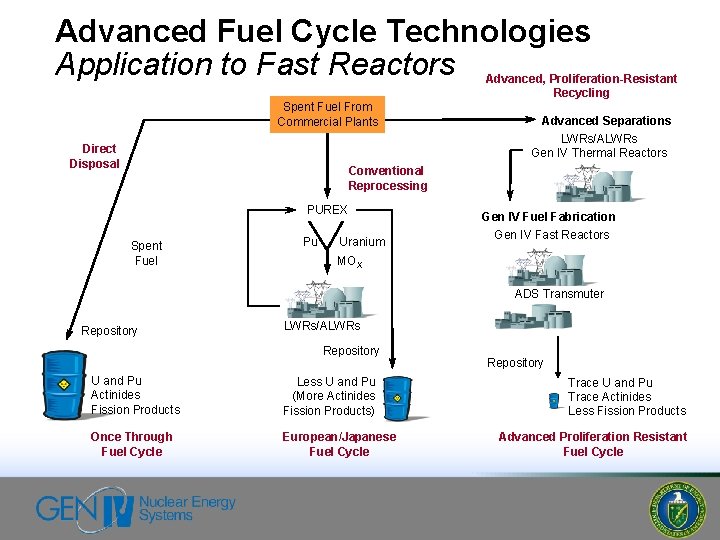
Advanced Fuel Cycle Technologies Application to Fast Reactors Advanced, Proliferation-Resistant Recycling Spent Fuel From Commercial Plants Advanced Separations LWRs/ALWRs Gen IV Thermal Reactors Direct Disposal Conventional Reprocessing PUREX Spent Fuel Pu Uranium Gen IV Fuel Fabrication Gen IV Fast Reactors MOX ADS Transmuter Repository LWRs/ALWRs Repository U and Pu Actinides Fission Products Less U and Pu (More Actinides Fission Products) Once Through Fuel Cycle European/Japanese Fuel Cycle Repository Trace U and Pu Trace Actinides Less Fission Products Advanced Proliferation Resistant Fuel Cycle
Summary • Developing and demonstrating advanced nuclear energy systems that meet future needs for safe, sustainable, environmentally responsible, economical, proliferation-resistant, and physically secure energy – Innovation in nuclear energy systems to meet future needs – A new look at advanced fuel cycles to better manage waste