Frequently Asked Questions FAQ ICH Q 9 QUALITY
- Slides: 16
Frequently Asked Questions (FAQ) ICH Q 9 QUALITY RISK MANAGEMENT Quality Risk Management ICH Q 9 Frequently Asked Questions (FAQ) Disclaimer: This presentation includes the authors views on quality risk management theory and practice. The presentation does not necessarily represent official guidance or policy of authorities or industry. prepared by some members of the ICH Q 9 EWG for example only; not an official policy/guidance July 2006, slide 1
Frequently Asked Questions (FAQ) ICH Q 9 QUALITY RISK MANAGEMENT Purpose of this part · To provide answers to questions that have been frequently asked of members of the ICH Q 9 Expert Working Group. prepared by some members of the ICH Q 9 EWG for example only; not an official policy/guidance July 2006, slide 2
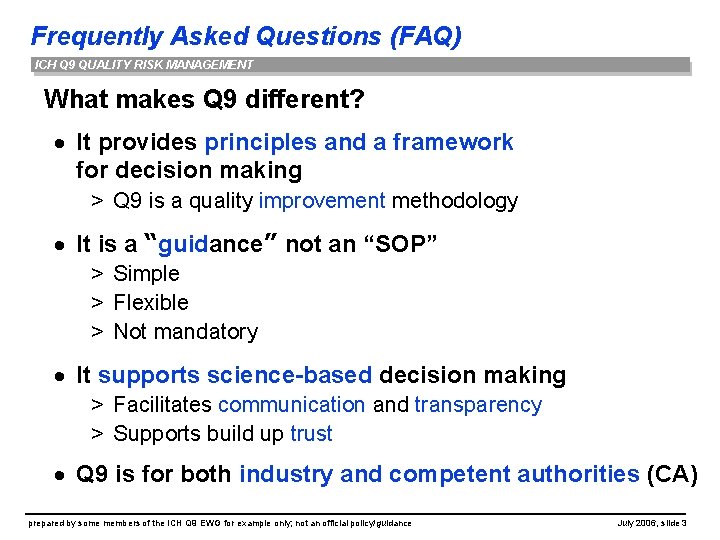
Frequently Asked Questions (FAQ) ICH Q 9 QUALITY RISK MANAGEMENT What makes Q 9 different? · It provides principles and a framework for decision making > Q 9 is a quality improvement methodology · It is a “guidance” not an “SOP” > Simple > Flexible > Not mandatory · It supports science-based decision making > Facilitates communication and transparency > Supports build up trust · Q 9 is for both industry and competent authorities (CA) prepared by some members of the ICH Q 9 EWG for example only; not an official policy/guidance July 2006, slide 3
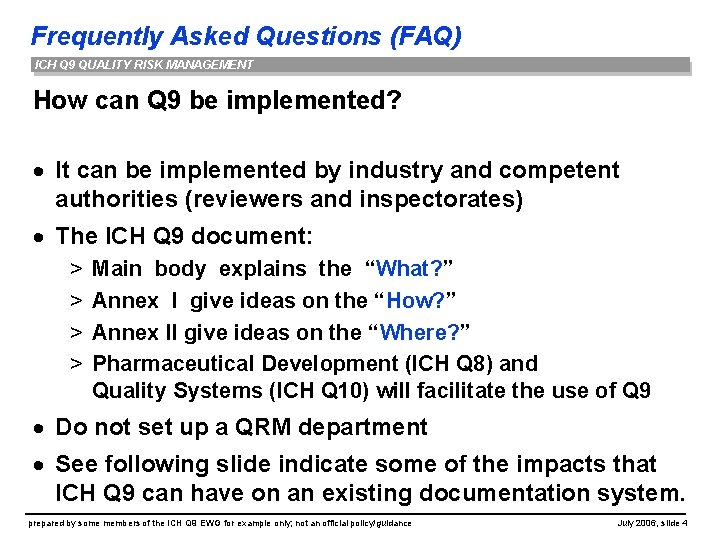
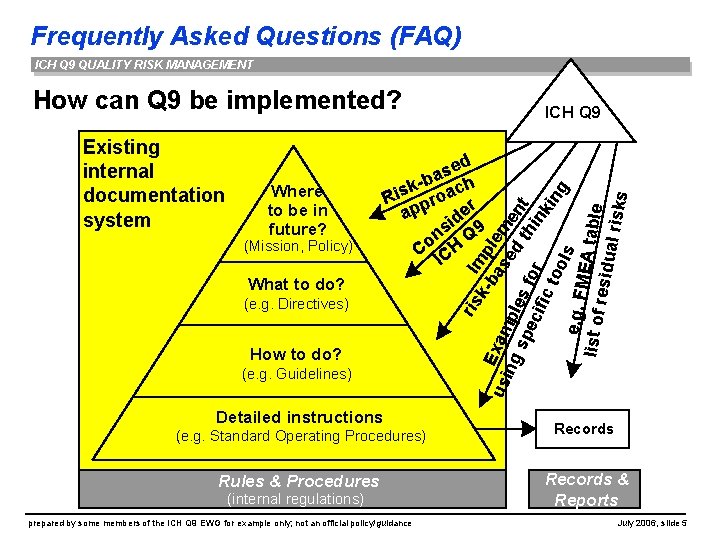
Frequently Asked Questions (FAQ) ICH Q 9 QUALITY RISK MANAGEMENT How can Q 9 be implemented? · It can be implemented by industry and competent authorities (reviewers and inspectorates) · The ICH Q 9 document: > > Main body explains the “What? ” Annex I give ideas on the “How? ” Annex II give ideas on the “Where? ” Pharmaceutical Development (ICH Q 8) and Quality Systems (ICH Q 10) will facilitate the use of Q 9 · Do not set up a QRM department · See following slide indicate some of the impacts that ICH Q 9 can have on an existing documentation system. prepared by some members of the ICH Q 9 EWG for example only; not an official policy/guidance July 2006, slide 4
Frequently Asked Questions (FAQ) ICH Q 9 QUALITY RISK MANAGEMENT How can Q 9 be implemented? (Mission, Policy) What to do? (e. g. Directives) How to do? (e. g. Guidelines) Detailed instructions (e. g. Standard Operating Procedures) Rules & Procedures (internal regulations) prepared by some members of the ICH Q 9 EWG for example only; not an official policy/guidance k- Imp ba le us Exam se me ing ple d nt sp s t h eci for in fic ki ng too l s e. g. FM EA tab list of le residu al risk s Where to be in future? ed s a k-b ach s i R pro r ap de i s Q 9 n Co CH I ris Existing internal documentation system ICH Q 9 Records & Reports July 2006, slide 5
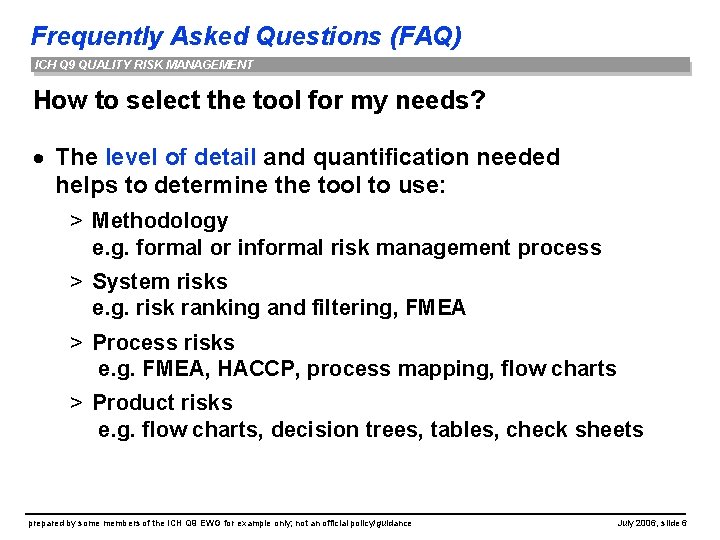
Frequently Asked Questions (FAQ) ICH Q 9 QUALITY RISK MANAGEMENT How to select the tool for my needs? · The level of detail and quantification needed helps to determine the tool to use: > Methodology e. g. formal or informal risk management process > System risks e. g. risk ranking and filtering, FMEA > Process risks e. g. FMEA, HACCP, process mapping, flow charts > Product risks e. g. flow charts, decision trees, tables, check sheets prepared by some members of the ICH Q 9 EWG for example only; not an official policy/guidance July 2006, slide 6
Frequently Asked Questions (FAQ) ICH Q 9 QUALITY RISK MANAGEMENT What is an “acceptable risk”? · This has to be decided in the context of each specific risk management problem · If you put in precise and definite data, you will receive a clear answer. This enables decision makers to make good and transparent decisions · Accept residual risk, where further effort to reduce a risk is disproportional to the protection of the patient · Always remember: The protection of the patient · It’s up to the organization whether they accept risks that meet the principles of QRM prepared by some members of the ICH Q 9 EWG for example only; not an official policy/guidance July 2006, slide 7
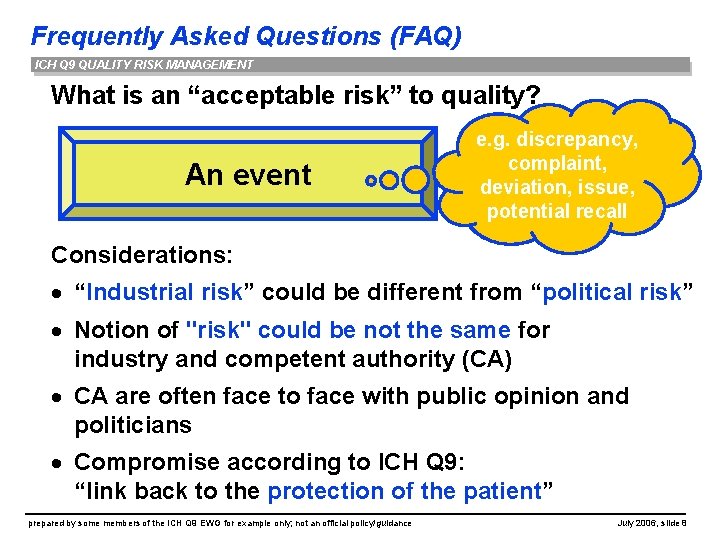
Frequently Asked Questions (FAQ) ICH Q 9 QUALITY RISK MANAGEMENT What is an “acceptable risk” to quality? An event e. g. discrepancy, complaint, deviation, issue, potential recall Considerations: · “Industrial risk” could be different from “political risk” · Notion of "risk" could be not the same for industry and competent authority (CA) · CA are often face to face with public opinion and politicians · Compromise according to ICH Q 9: “link back to the protection of the patient” prepared by some members of the ICH Q 9 EWG for example only; not an official policy/guidance July 2006, slide 8
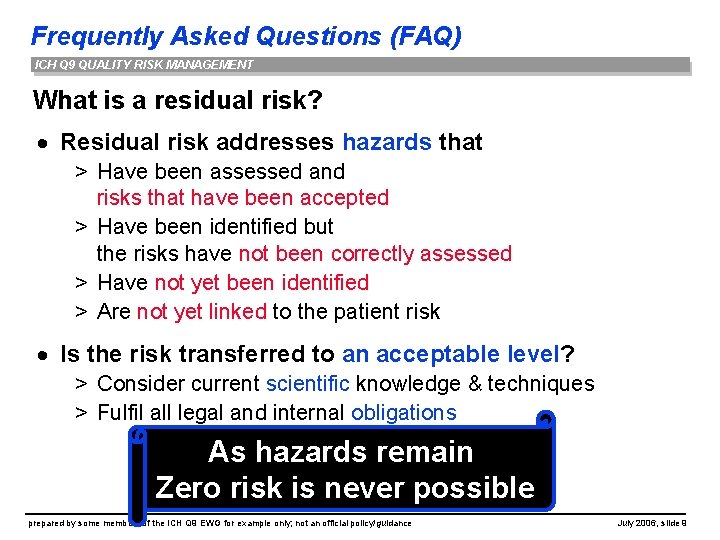
Frequently Asked Questions (FAQ) ICH Q 9 QUALITY RISK MANAGEMENT What is a residual risk? · Residual risk addresses hazards that > Have been assessed and risks that have been accepted > Have been identified but the risks have not been correctly assessed > Have not yet been identified > Are not yet linked to the patient risk · Is the risk transferred to an acceptable level? > Consider current scientific knowledge & techniques > Fulfil all legal and internal obligations As hazards remain Zero risk is never possible prepared by some members of the ICH Q 9 EWG for example only; not an official policy/guidance July 2006, slide 9
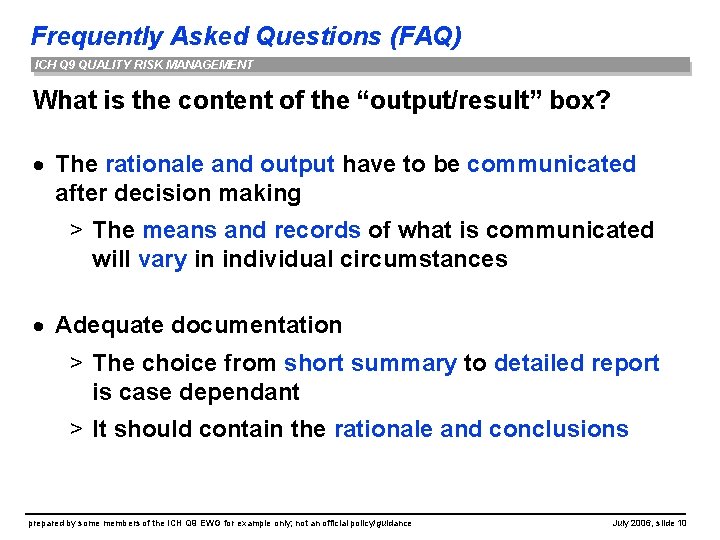
Frequently Asked Questions (FAQ) ICH Q 9 QUALITY RISK MANAGEMENT What is the content of the “output/result” box? · The rationale and output have to be communicated after decision making > The means and records of what is communicated will vary in individual circumstances · Adequate documentation > The choice from short summary to detailed report is case dependant > It should contain the rationale and conclusions prepared by some members of the ICH Q 9 EWG for example only; not an official policy/guidance July 2006, slide 10
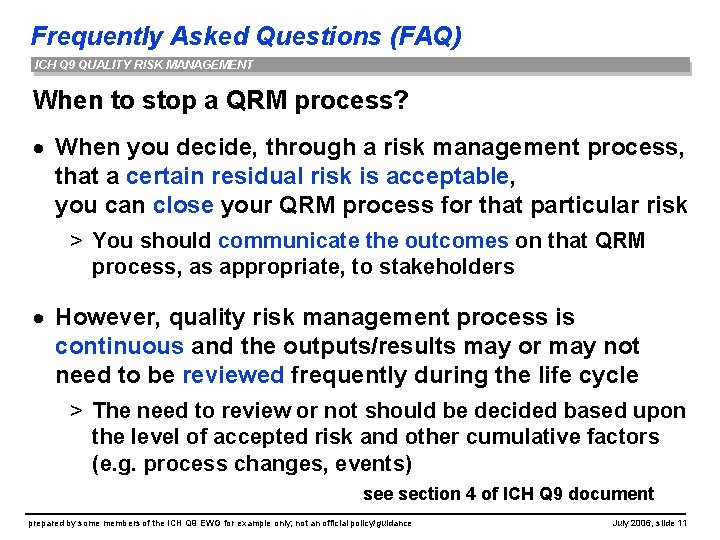
Frequently Asked Questions (FAQ) ICH Q 9 QUALITY RISK MANAGEMENT When to stop a QRM process? · When you decide, through a risk management process, that a certain residual risk is acceptable, you can close your QRM process for that particular risk > You should communicate the outcomes on that QRM process, as appropriate, to stakeholders · However, quality risk management process is continuous and the outputs/results may or may not need to be reviewed frequently during the life cycle > The need to review or not should be decided based upon the level of accepted risk and other cumulative factors (e. g. process changes, events) see section 4 of ICH Q 9 document prepared by some members of the ICH Q 9 EWG for example only; not an official policy/guidance July 2006, slide 11
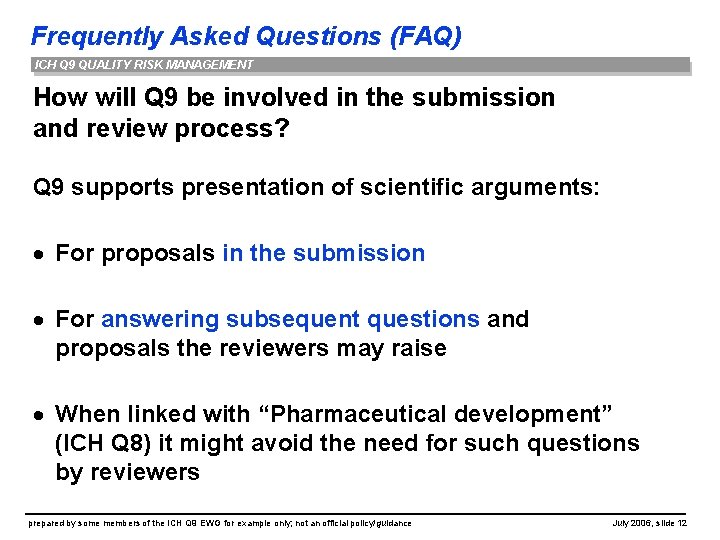
Frequently Asked Questions (FAQ) ICH Q 9 QUALITY RISK MANAGEMENT How will Q 9 be involved in the submission and review process? Q 9 supports presentation of scientific arguments: · For proposals in the submission · For answering subsequent questions and proposals the reviewers may raise · When linked with “Pharmaceutical development” (ICH Q 8) it might avoid the need for such questions by reviewers prepared by some members of the ICH Q 9 EWG for example only; not an official policy/guidance July 2006, slide 12
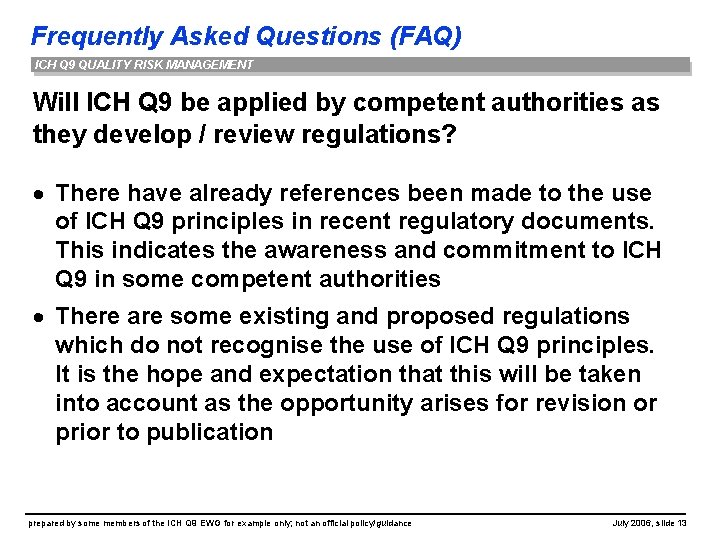
Frequently Asked Questions (FAQ) ICH Q 9 QUALITY RISK MANAGEMENT Will ICH Q 9 be applied by competent authorities as they develop / review regulations? · There have already references been made to the use of ICH Q 9 principles in recent regulatory documents. This indicates the awareness and commitment to ICH Q 9 in some competent authorities · There are some existing and proposed regulations which do not recognise the use of ICH Q 9 principles. It is the hope and expectation that this will be taken into account as the opportunity arises for revision or prior to publication prepared by some members of the ICH Q 9 EWG for example only; not an official policy/guidance July 2006, slide 13
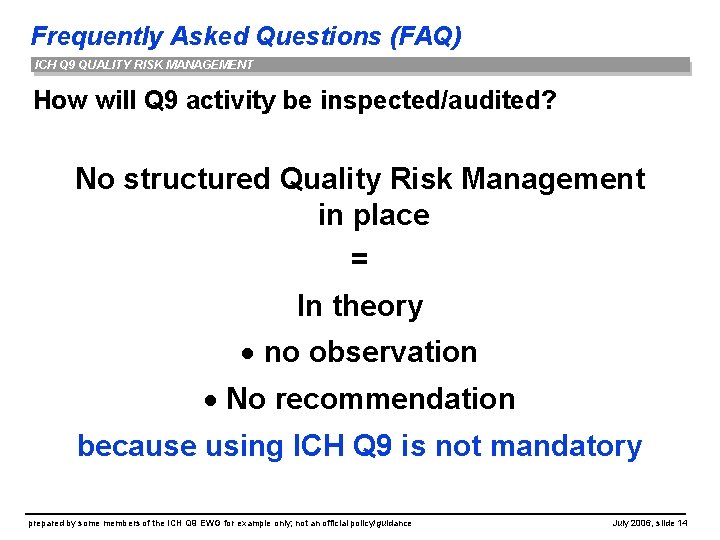
Frequently Asked Questions (FAQ) ICH Q 9 QUALITY RISK MANAGEMENT How will Q 9 activity be inspected/audited? No structured Quality Risk Management in place = In theory · no observation · No recommendation because using ICH Q 9 is not mandatory prepared by some members of the ICH Q 9 EWG for example only; not an official policy/guidance July 2006, slide 14
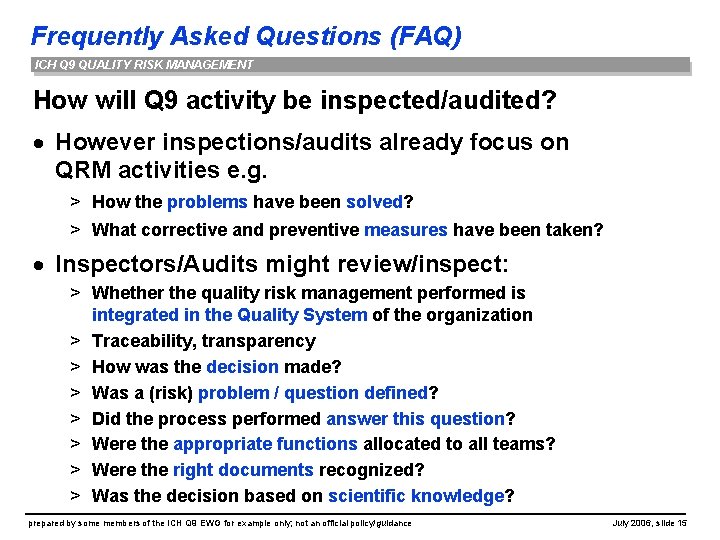
Frequently Asked Questions (FAQ) ICH Q 9 QUALITY RISK MANAGEMENT How will Q 9 activity be inspected/audited? · However inspections/audits already focus on QRM activities e. g. > How the problems have been solved? > What corrective and preventive measures have been taken? · Inspectors/Audits might review/inspect: > Whether the quality risk management performed is integrated in the Quality System of the organization > Traceability, transparency > How was the decision made? > Was a (risk) problem / question defined? > Did the process performed answer this question? > Were the appropriate functions allocated to all teams? > Were the right documents recognized? > Was the decision based on scientific knowledge? prepared by some members of the ICH Q 9 EWG for example only; not an official policy/guidance July 2006, slide 15
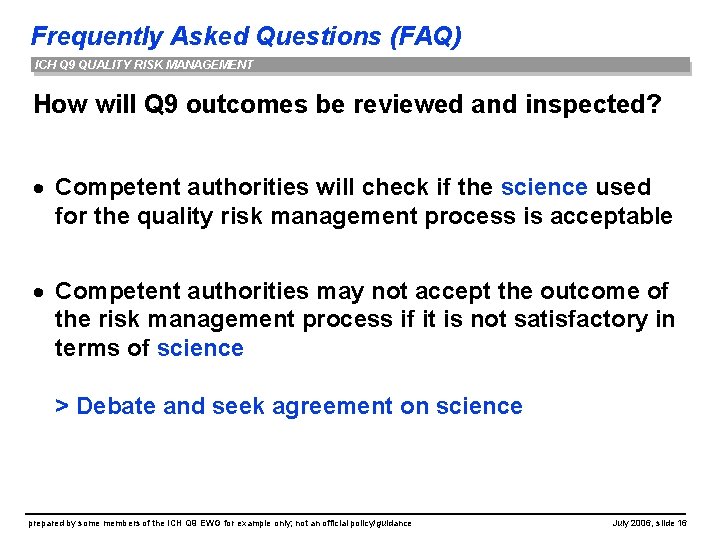
Frequently Asked Questions (FAQ) ICH Q 9 QUALITY RISK MANAGEMENT How will Q 9 outcomes be reviewed and inspected? · Competent authorities will check if the science used for the quality risk management process is acceptable · Competent authorities may not accept the outcome of the risk management process if it is not satisfactory in terms of science > Debate and seek agreement on science prepared by some members of the ICH Q 9 EWG for example only; not an official policy/guidance July 2006, slide 16