Financial and Managerial Accounting Wild Shaw and Chiappetta


- Slides: 43
Financial and Managerial Accounting Wild, Shaw, and Chiappetta Fifth Edition Mc. Graw-Hill/Irwin Copyright © 2013 by The Mc. Graw-Hill Companies, Inc. All rights reserved.
Chapter 17 Activity-Based Costing and Analysis
Conceptual Learning Objectives C 1: Distinguish between the plantwide overhead rate method, the departmental overhead rate method, and the activitybased costing method. C 2: Explain cost flows for activity-based costing. C 3: Describe the four types of activities that cause overhead costs. 17 -3
Analytical Learning Objectives A 1: Identify and assess advantages and disadvantages of the plantwide overhead rate and departmental overhead rate methods. A 2: Identify and assess advantages and disadvantages of activity-based costing. 17 -4
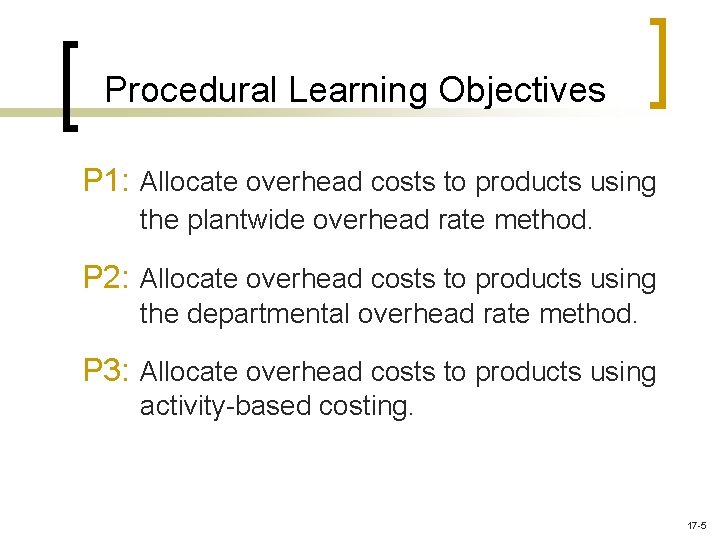
Procedural Learning Objectives P 1: Allocate overhead costs to products using the plantwide overhead rate method. P 2: Allocate overhead costs to products using the departmental overhead rate method. P 3: Allocate overhead costs to products using activity-based costing. 17 -5
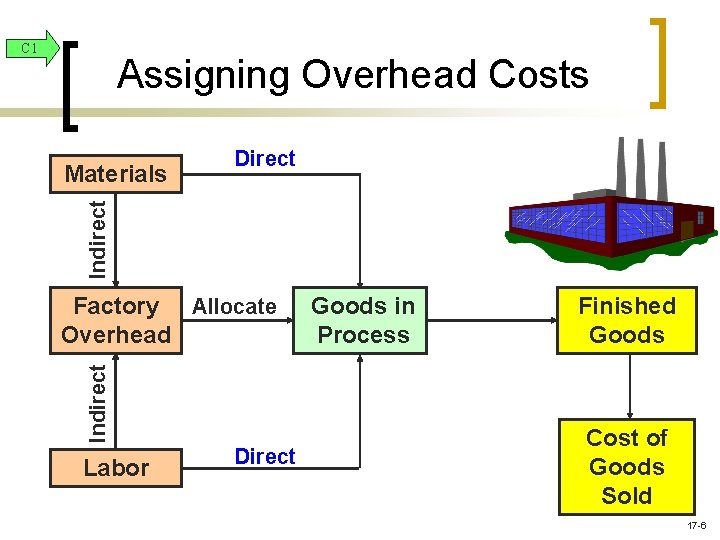
C 1 Assigning Overhead Costs Indirect Materials Direct Indirect Factory Allocate Overhead Labor Direct Goods in Process Finished Goods Cost of Goods Sold 17 -6
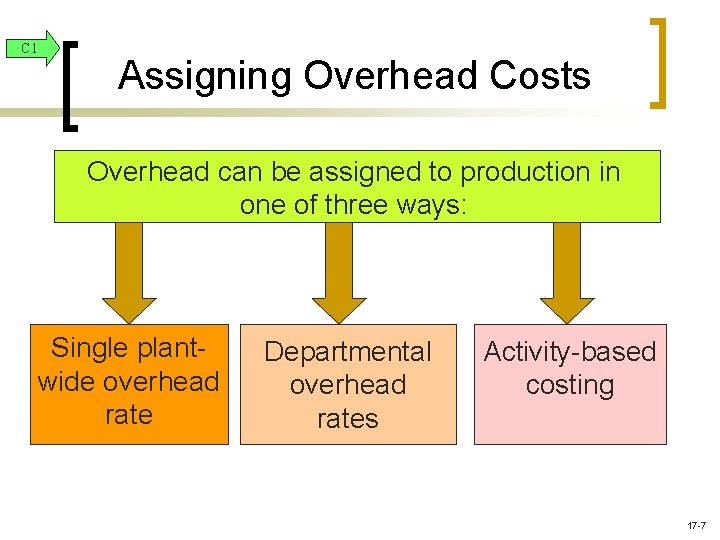
C 1 Assigning Overhead Costs Overhead can be assigned to production in one of three ways: Single plantwide overhead rate Departmental overhead rates Activity-based costing 17 -7
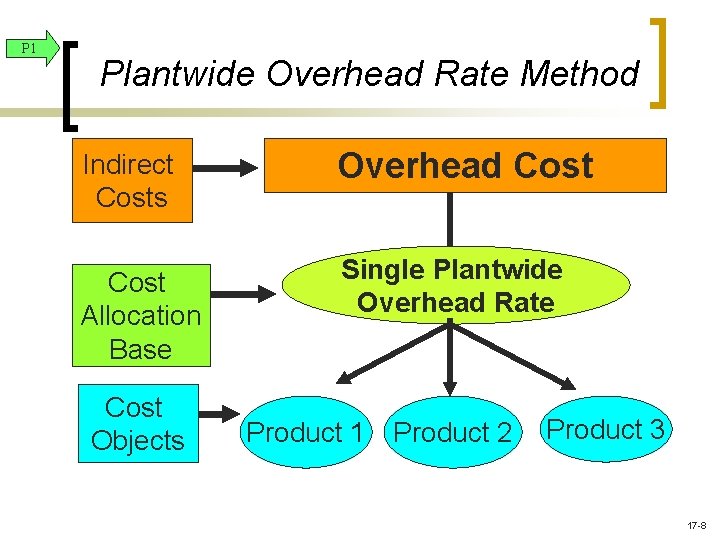
P 1 Plantwide Overhead Rate Method Indirect Costs Overhead Cost Allocation Base Single Plantwide Overhead Rate Cost Objects Product 1 Product 2 Product 3 17 -8
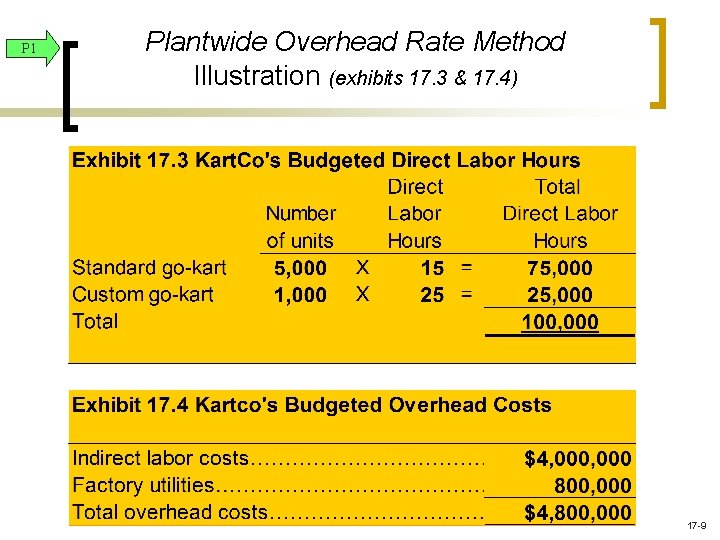
P 1 Plantwide Overhead Rate Method Illustration (exhibits 17. 3 & 17. 4) 17 -9
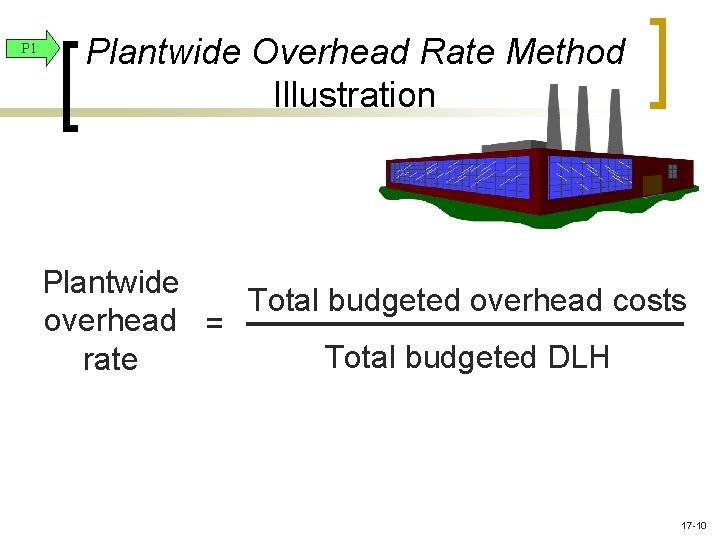
P 1 Plantwide Overhead Rate Method Illustration Plantwide Total budgeted overhead costs overhead = Total budgeted DLH rate 17 -10
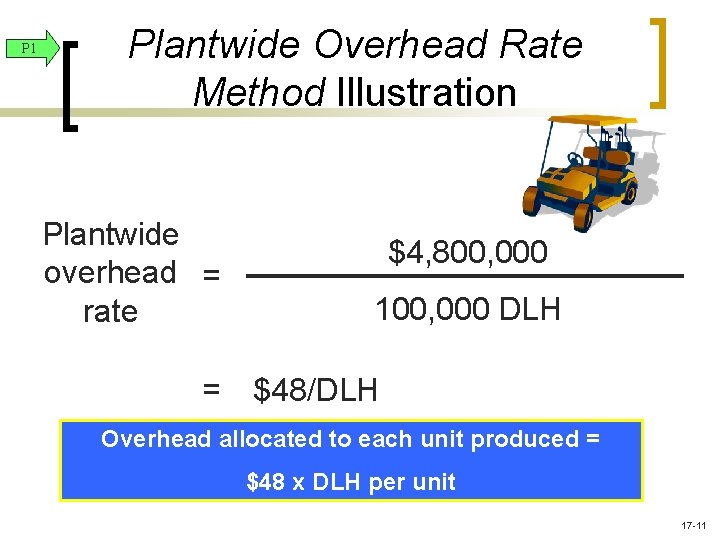
P 1 Plantwide Overhead Rate Method Illustration Plantwide overhead = rate = $4, 800, 000 100, 000 DLH $48/DLH Overhead allocated to each unit produced = $48 x DLH per unit 17 -11
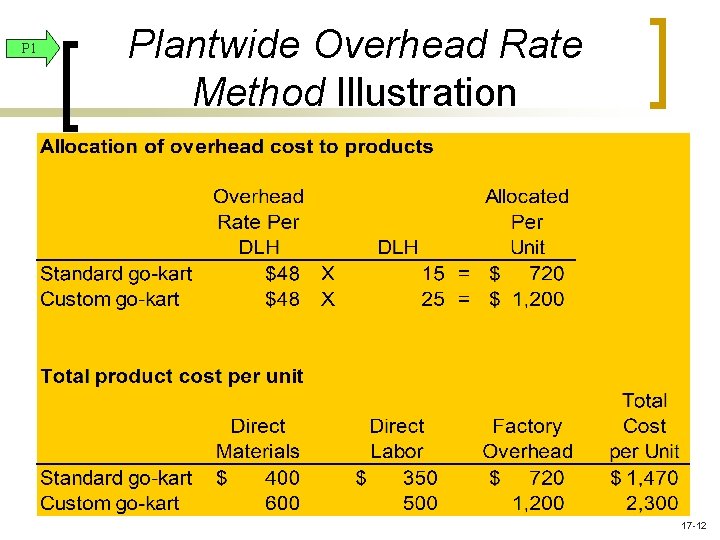
P 1 Plantwide Overhead Rate Method Illustration 17 -12
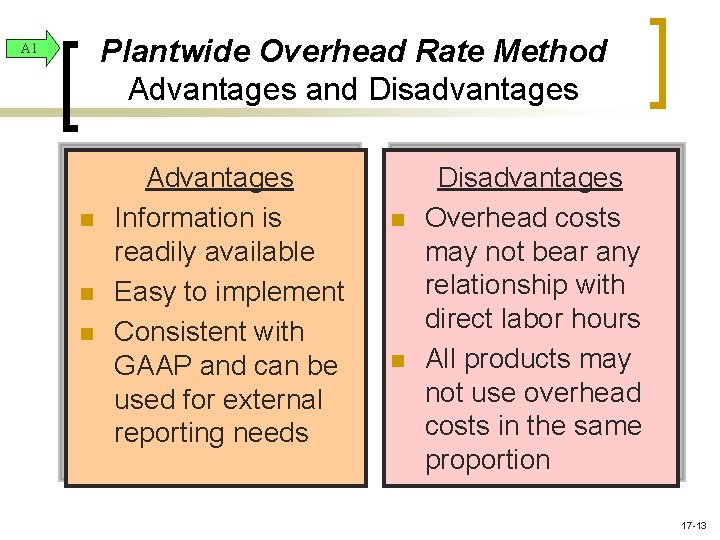
Plantwide Overhead Rate Method Advantages and Disadvantages A 1 n n n Advantages Information is readily available Easy to implement Consistent with GAAP and can be used for external reporting needs n n Disadvantages Overhead costs may not bear any relationship with direct labor hours All products may not use overhead costs in the same proportion 17 -13
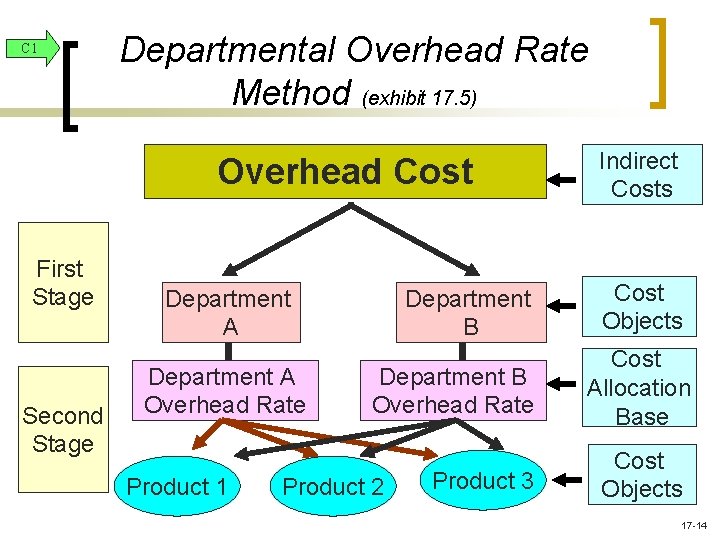
C 1 Departmental Overhead Rate Method (exhibit 17. 5) Overhead Cost First Stage Second Stage Department A Overhead Rate Product 1 Department B Overhead Rate Product 2 Product 3 Indirect Costs Cost Objects Cost Allocation Base Cost Objects 17 -14
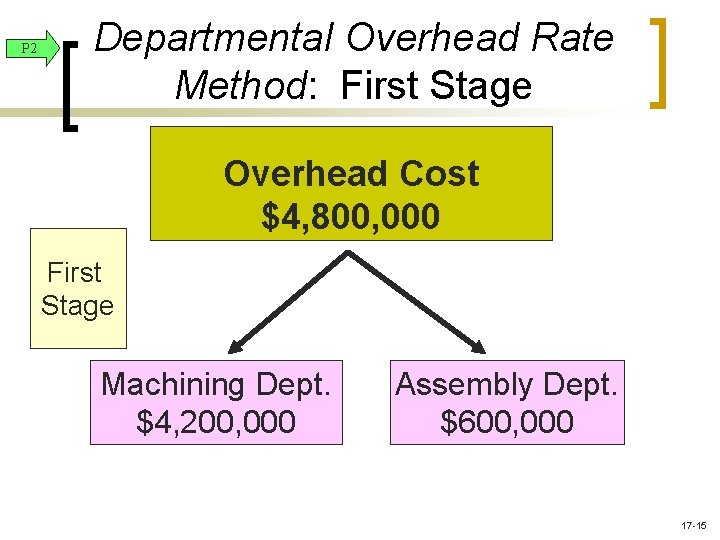
P 2 Departmental Overhead Rate Method: First Stage Overhead Cost $4, 800, 000 First Stage Machining Dept. $4, 200, 000 Assembly Dept. $600, 000 17 -15
P 2 Departmental Overhead Rate Method: Second Stage Department A Overhead Rate Product 1 Product 2 Department B Overhead Rate Product 3 17 -16
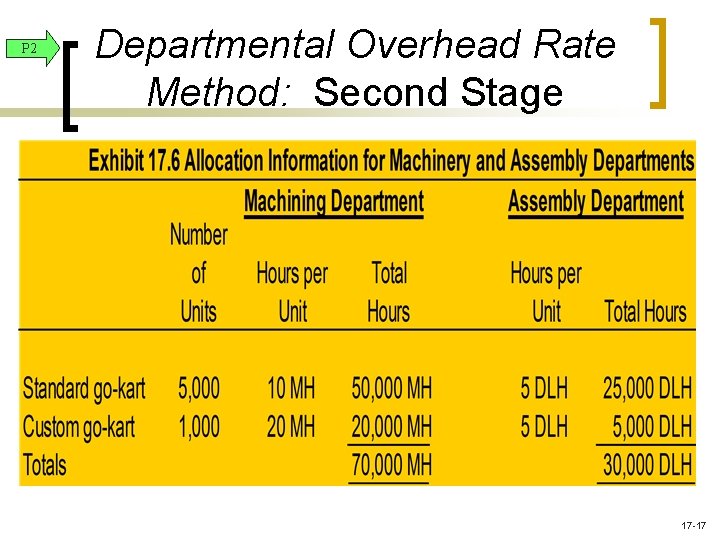
P 2 Departmental Overhead Rate Method: Second Stage 17 -17
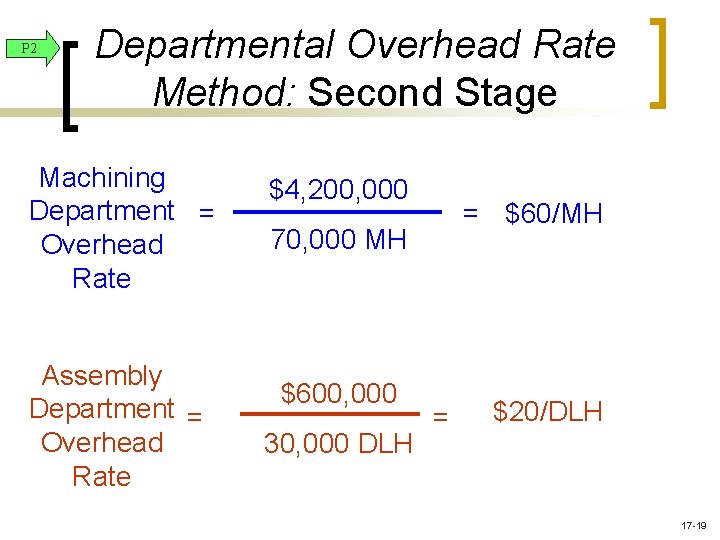
P 2 Departmental Overhead Rate Method: Second Stage Departmental Overhead = Rate Total departmental overhead costs Total unit number in departmental allocation base 17 -18
P 2 Departmental Overhead Rate Method: Second Stage Machining Department = Overhead Rate Assembly Department = Overhead Rate $4, 200, 000 = $60/MH 70, 000 MH $600, 000 30, 000 DLH = $20/DLH 17 -19
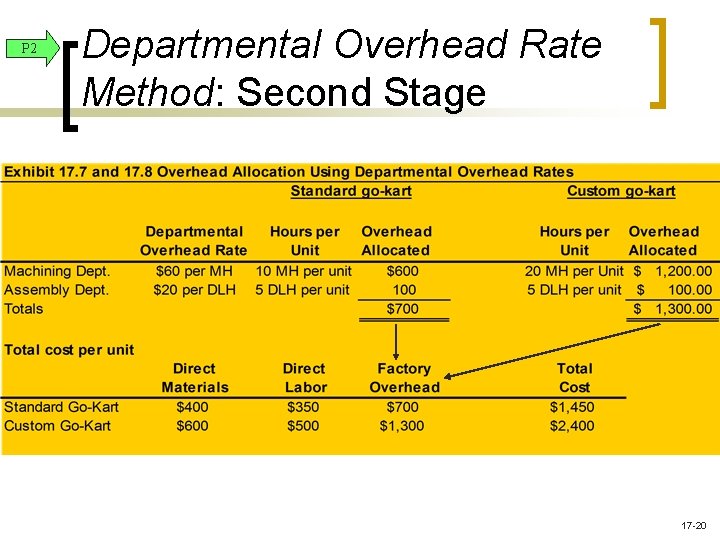
P 2 Departmental Overhead Rate Method: Second Stage 17 -20
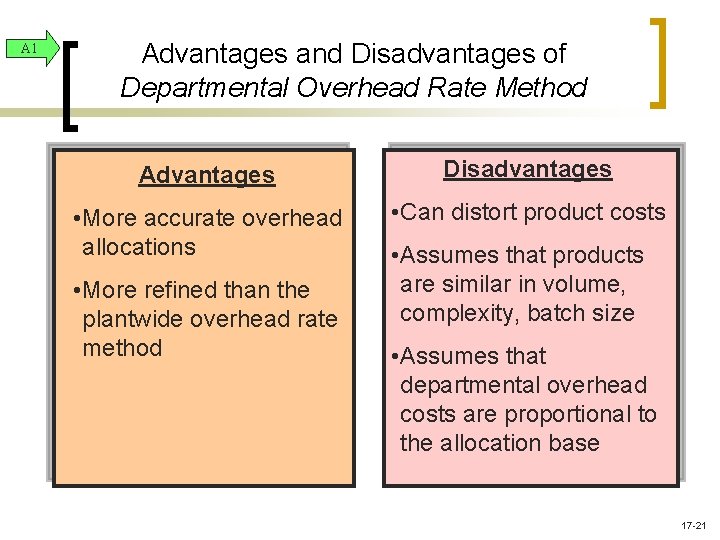
A 1 Advantages and Disadvantages of Departmental Overhead Rate Method Advantages Disadvantages • More accurate overhead allocations • Can distort product costs • More refined than the plantwide overhead rate method • Assumes that products are similar in volume, complexity, batch size • Assumes that departmental overhead costs are proportional to the allocation base 17 -21
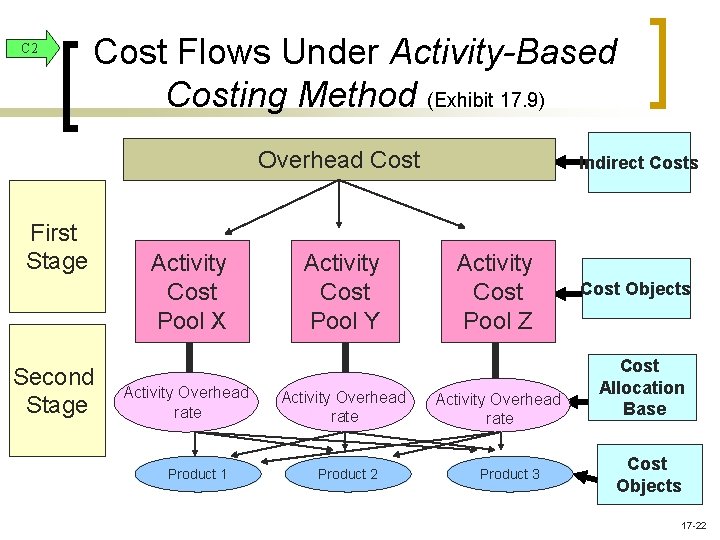
C 2 Cost Flows Under Activity-Based Costing Method (Exhibit 17. 9) Overhead Cost First Stage Second Stage Activity Cost Pool X Activity Overhead rate Product 1 Activity Cost Pool Y Activity Overhead rate Product 2 Indirect Costs Activity Cost Pool Z Activity Overhead rate Product 3 Cost Objects Cost Allocation Base Cost Objects 17 -22
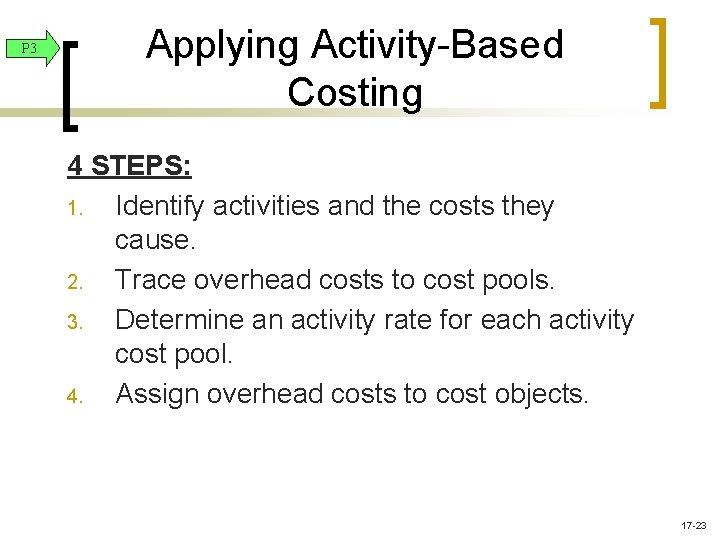
P 3 Applying Activity-Based Costing 4 STEPS: 1. Identify activities and the costs they cause. 2. Trace overhead costs to cost pools. 3. Determine an activity rate for each activity cost pool. 4. Assign overhead costs to cost objects. 17 -23
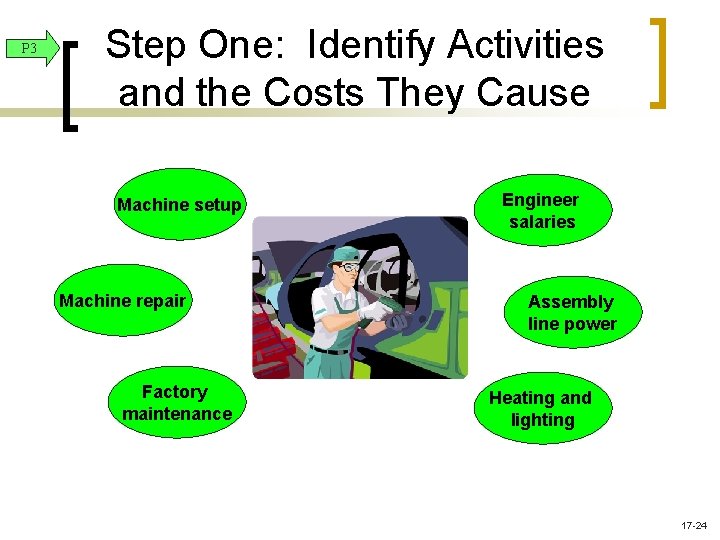
P 3 Step One: Identify Activities and the Costs They Cause Machine setup Machine repair Factory maintenance Engineer salaries Assembly line power Heating and lighting 17 -24
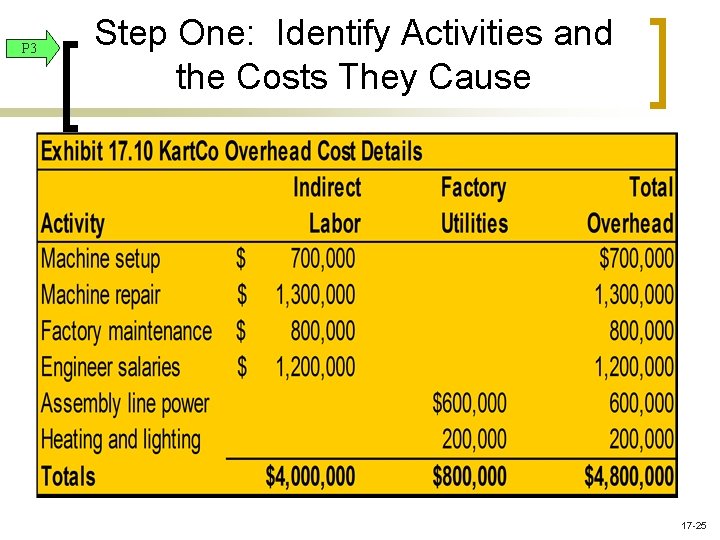
P 3 Step One: Identify Activities and the Costs They Cause 17 -25
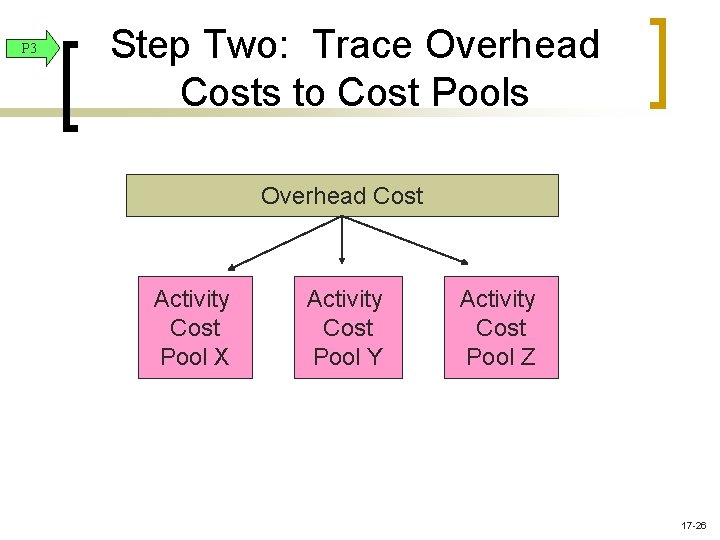
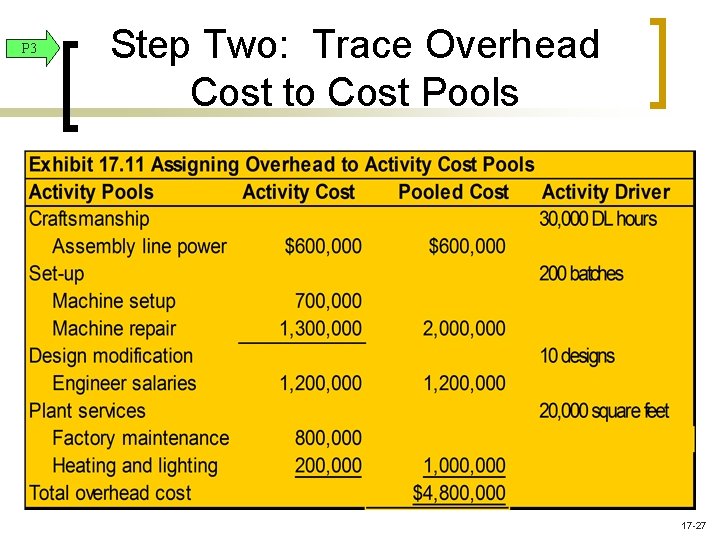
P 3 Step Two: Trace Overhead Costs to Cost Pools Overhead Cost Activity Cost Pool X Activity Cost Pool Y Activity Cost Pool Z 17 -26
P 3 Step Two: Trace Overhead Cost to Cost Pools 17 -27
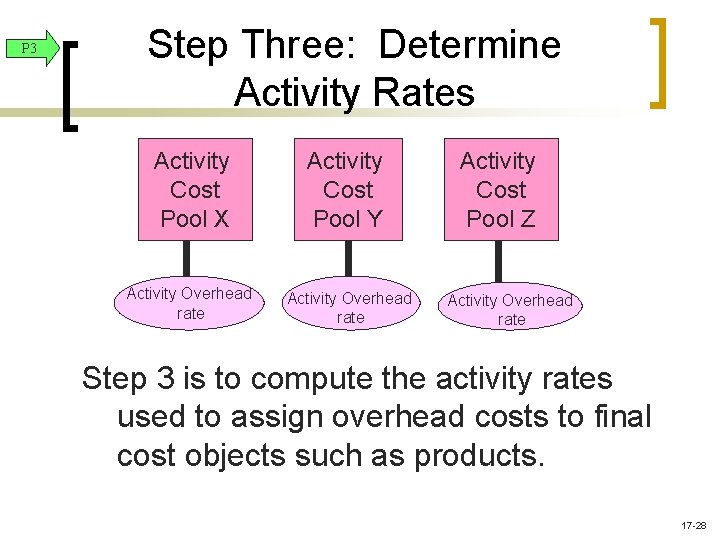
P 3 Step Three: Determine Activity Rates Activity Cost Pool X Activity Cost Pool Y Activity Overhead rate Activity Cost Pool Z Activity Overhead rate Step 3 is to compute the activity rates used to assign overhead costs to final cost objects such as products. 17 -28
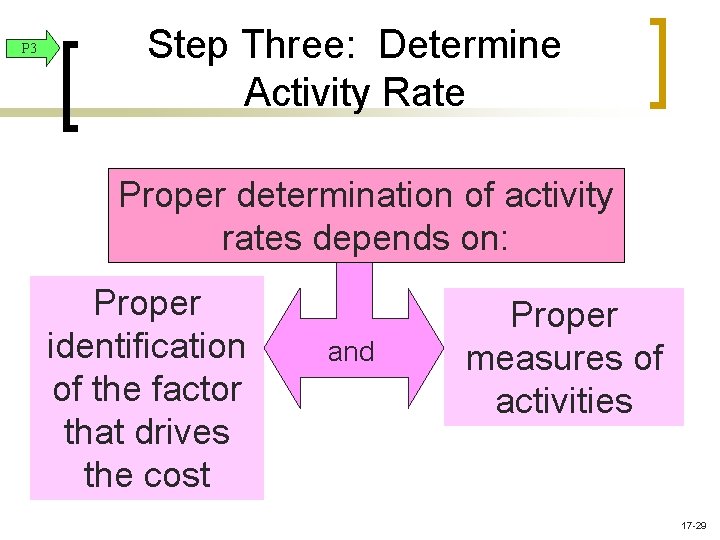
P 3 Step Three: Determine Activity Rate Proper determination of activity rates depends on: Proper identification of the factor that drives the cost and Proper measures of activities 17 -29
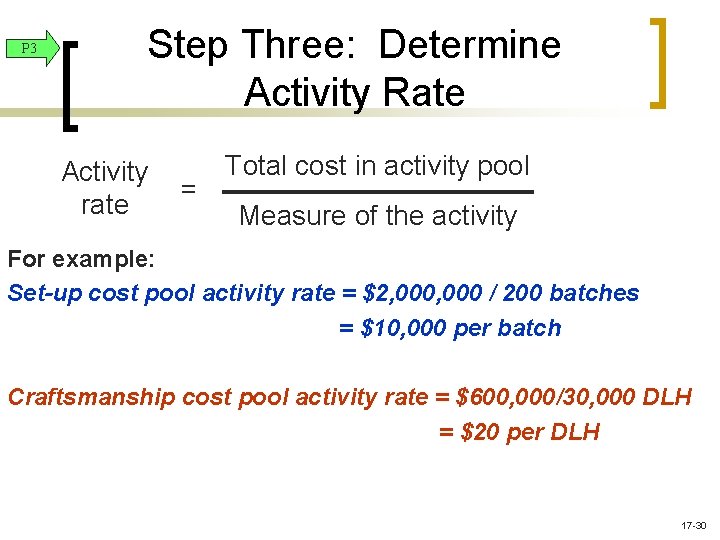
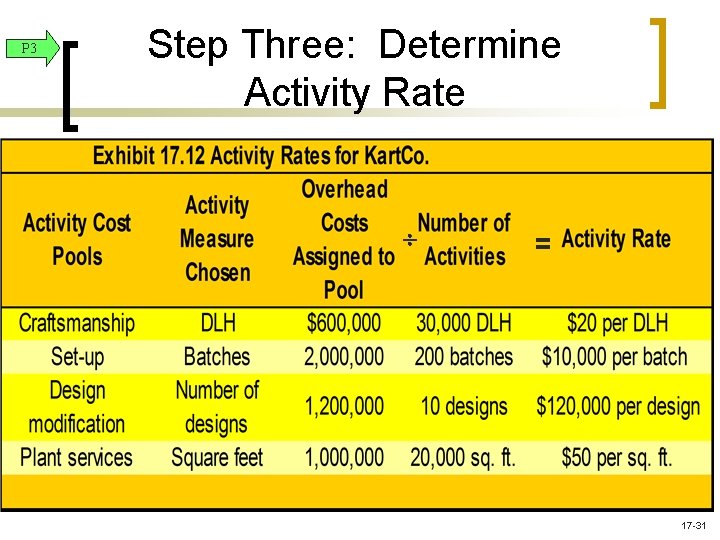
P 3 Step Three: Determine Activity Rate Activity rate = Total cost in activity pool Measure of the activity For example: Set-up cost pool activity rate = $2, 000 / 200 batches = $10, 000 per batch Craftsmanship cost pool activity rate = $600, 000/30, 000 DLH = $20 per DLH 17 -30
P 3 Step Three: Determine Activity Rate = 17 -31
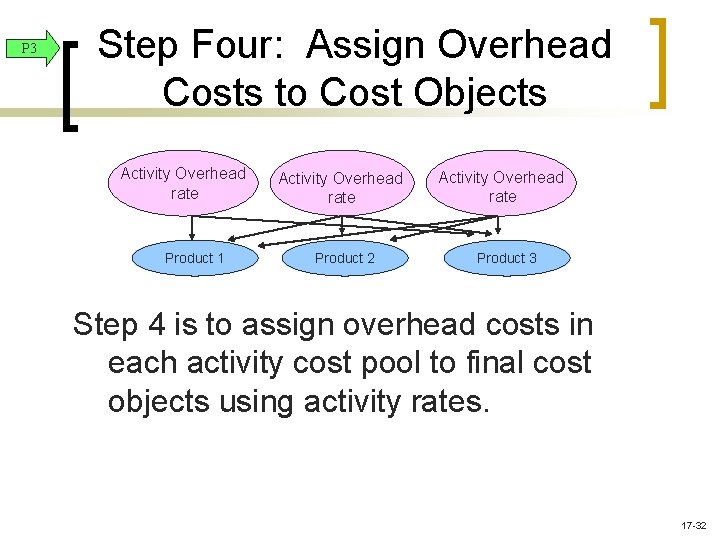
P 3 Step Four: Assign Overhead Costs to Cost Objects Activity Overhead rate Product 1 Activity Overhead rate Product 2 Activity Overhead rate Product 3 Step 4 is to assign overhead costs in each activity cost pool to final cost objects using activity rates. 17 -32
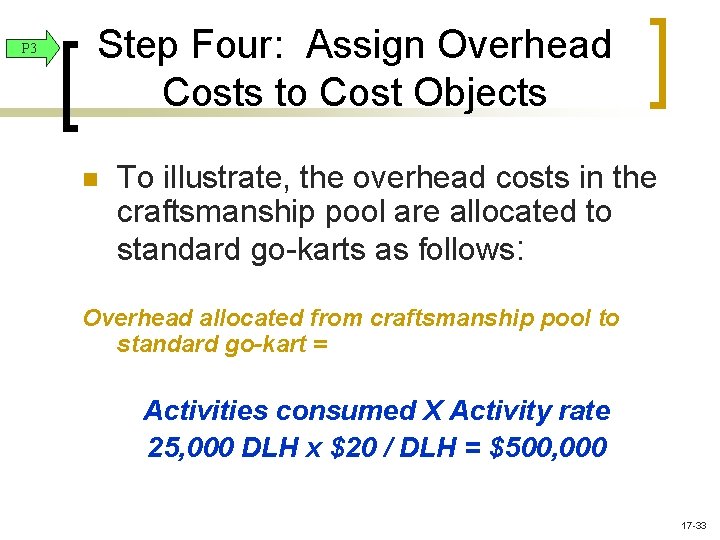
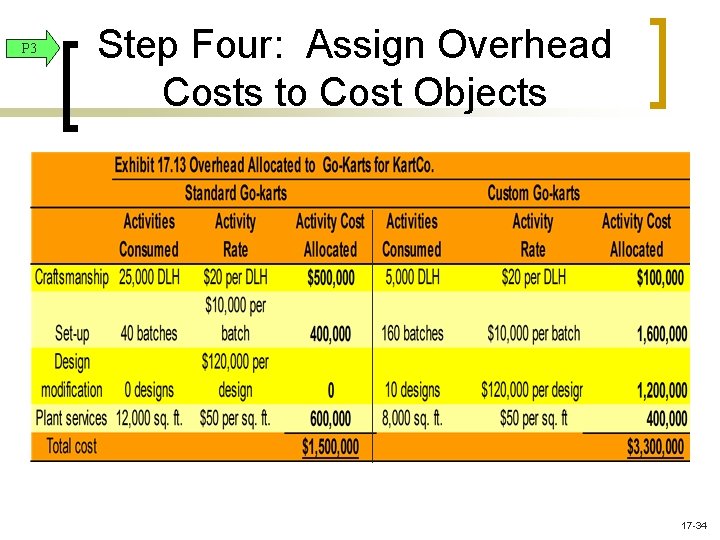
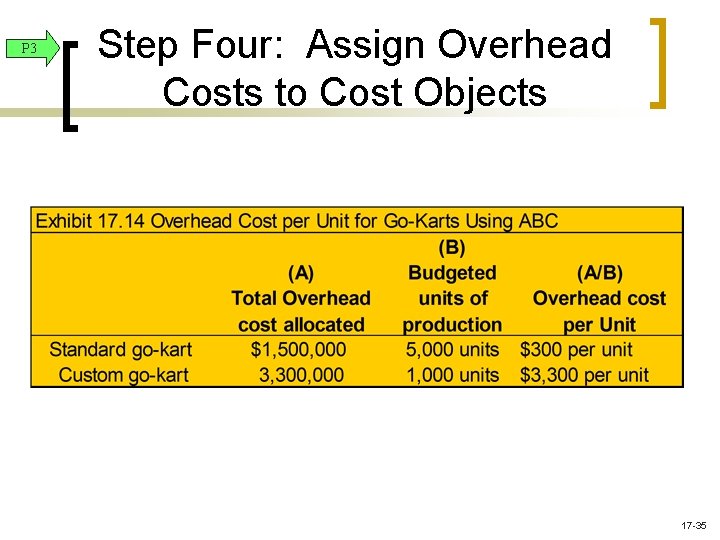
P 3 Step Four: Assign Overhead Costs to Cost Objects n To illustrate, the overhead costs in the craftsmanship pool are allocated to standard go-karts as follows: Overhead allocated from craftsmanship pool to standard go-kart = Activities consumed X Activity rate 25, 000 DLH x $20 / DLH = $500, 000 17 -33
P 3 Step Four: Assign Overhead Costs to Cost Objects 17 -34
P 3 Step Four: Assign Overhead Costs to Cost Objects 17 -35
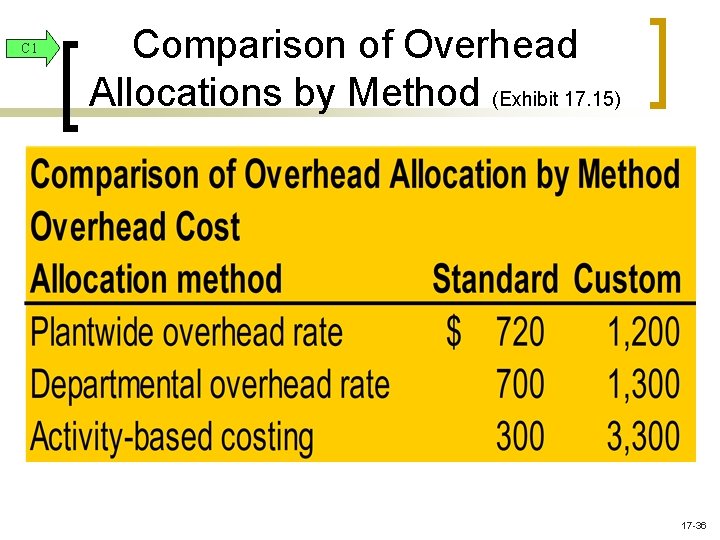
C 1 Comparison of Overhead Allocations by Method (Exhibit 17. 15) 17 -36
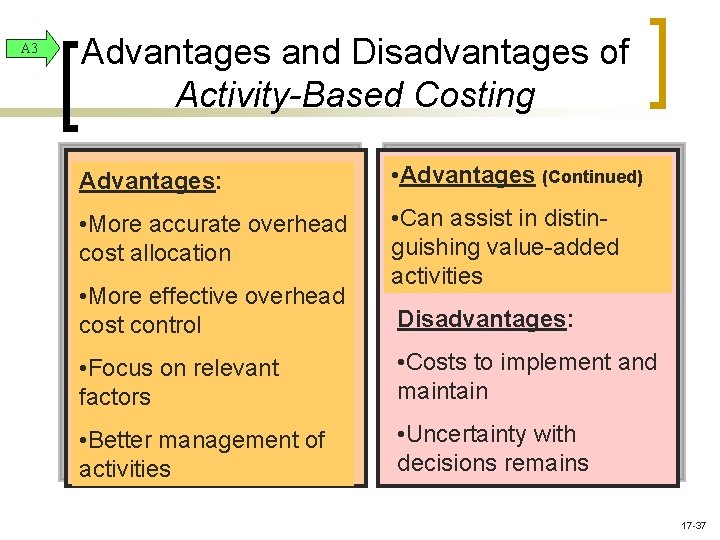
A 3 Advantages and Disadvantages of Activity-Based Costing Advantages: • Advantages (Continued) • More accurate overhead cost allocation • Can assist in distinguishing value-added activities • More effective overhead cost control Disadvantages: • Focus on relevant factors • Costs to implement and maintain • Better management of activities • Uncertainty with decisions remains 17 -37
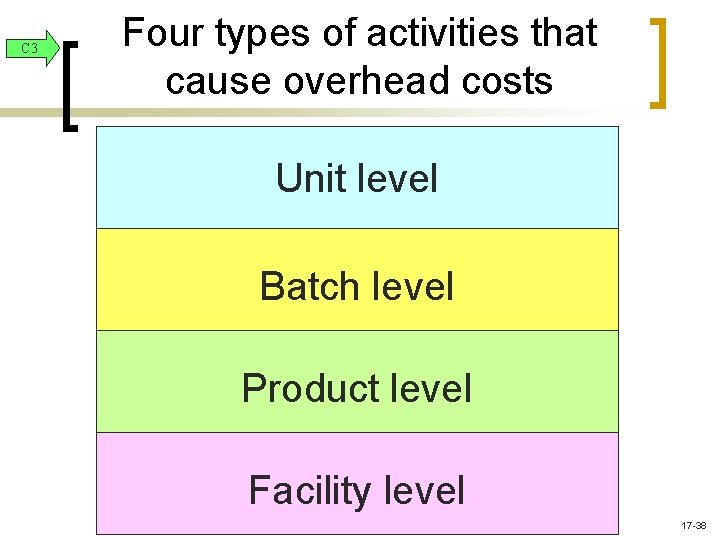
C 3 Four types of activities that cause overhead costs Unit level Batch level Product level Facility level 17 -38
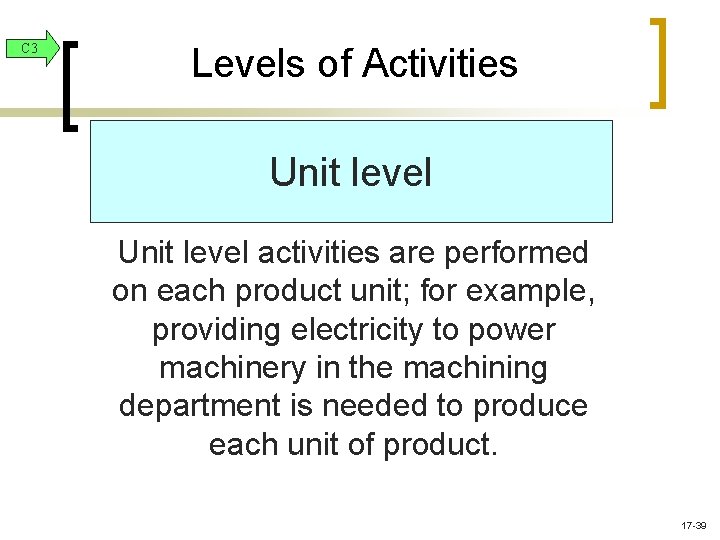
C 3 Levels of Activities Unit level activities are performed on each product unit; for example, providing electricity to power machinery in the machining department is needed to produce each unit of product. 17 -39
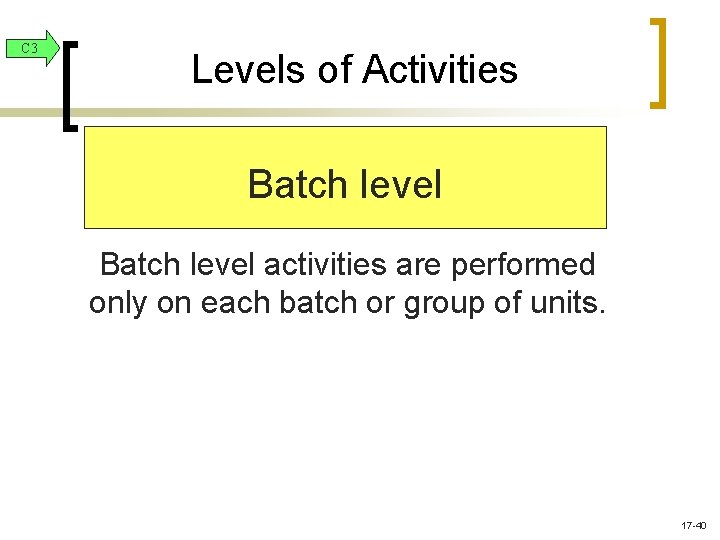
C 3 Levels of Activities Batch level activities are performed only on each batch or group of units. 17 -40
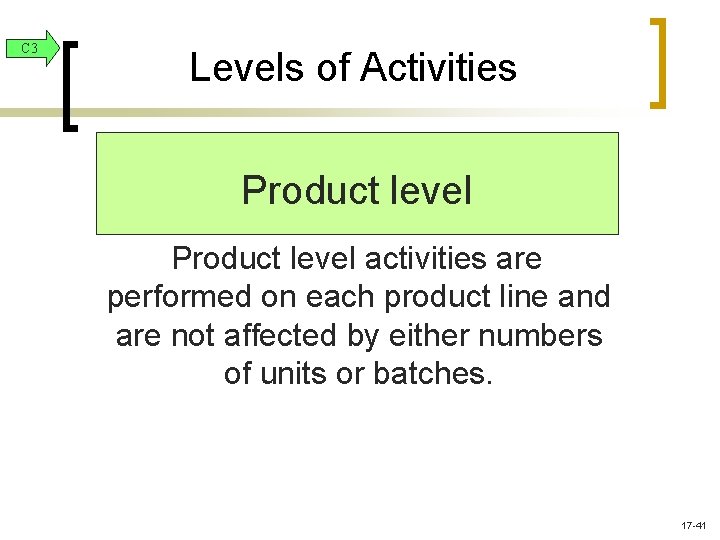
C 3 Levels of Activities Product level activities are performed on each product line and are not affected by either numbers of units or batches. 17 -41
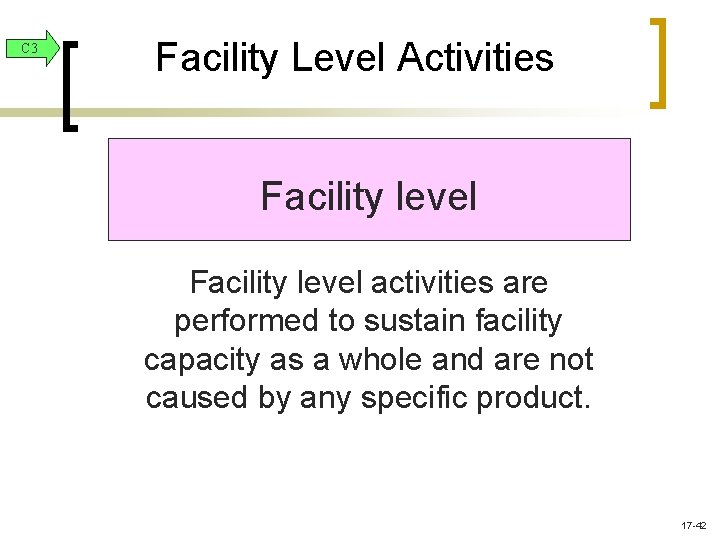
C 3 Facility Level Activities Facility level activities are performed to sustain facility capacity as a whole and are not caused by any specific product. 17 -42
End of Chapter 17 17 -43