FINAL PROJECT PHOTO ESSAY WHAT IS YOUR TASK



- Slides: 21
FINAL PROJECT: PHOTO ESSAY
WHAT IS YOUR TASK WITH A PHOTO ESSAY Your challenge is to go in-depth into a topic we’ve covered in cluster 3. Your topic can be about a person, historical moment, or historical theme You will decide on a topic and create a research question to guide your learning Example: What was the role of animals in the Canadian Corps during the Great War? Using this question, you will research, and analyze, and compile a photo essay that can be used to teach your audience about your subject.
SOME GUIDELINES Can be on Power. Point, Prezi, Movie Maker Must have 15 full picture slides (picture with text), along with an introduction and conclusion slide, followed by a works cited slide Each slide should have about 3 -4 sentences of information Works cited in MLA format, works can be cited from the same website More info on project handout If you use a source for information and not pictures, you can source that without an image number.
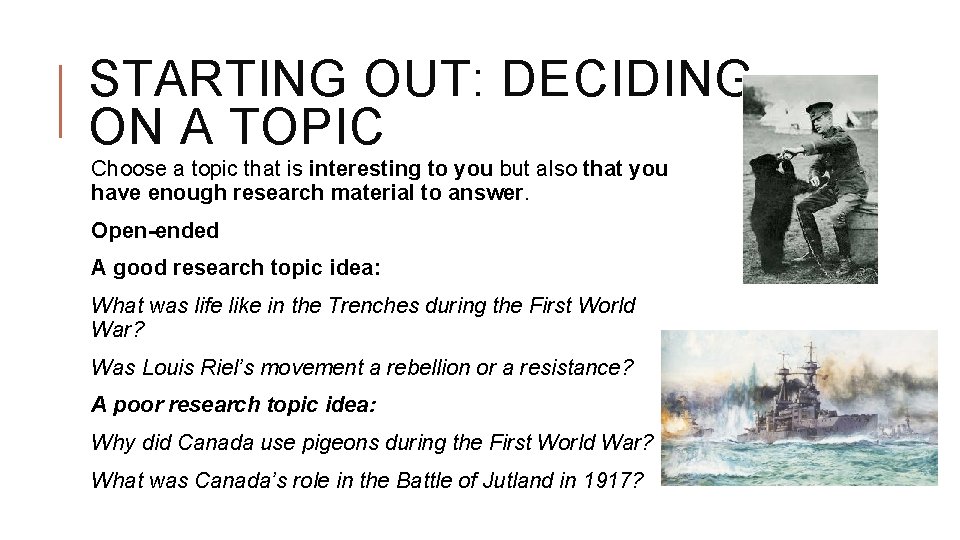
STARTING OUT: DECIDING ON A TOPIC Choose a topic that is interesting to you but also that you have enough research material to answer. Open-ended A good research topic idea: What was life like in the Trenches during the First World War? Was Louis Riel’s movement a rebellion or a resistance? A poor research topic idea: Why did Canada use pigeons during the First World War? What was Canada’s role in the Battle of Jutland in 1917?
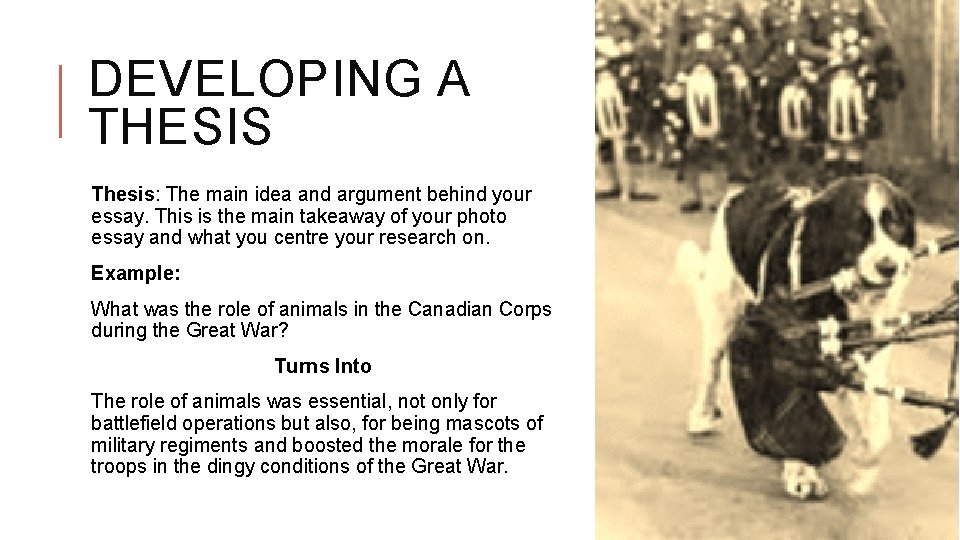
DEVELOPING A THESIS Thesis: The main idea and argument behind your essay. This is the main takeaway of your photo essay and what you centre your research on. Example: What was the role of animals in the Canadian Corps during the Great War? Turns Into The role of animals was essential, not only for battlefield operations but also, for being mascots of military regiments and boosted the morale for the troops in the dingy conditions of the Great War.
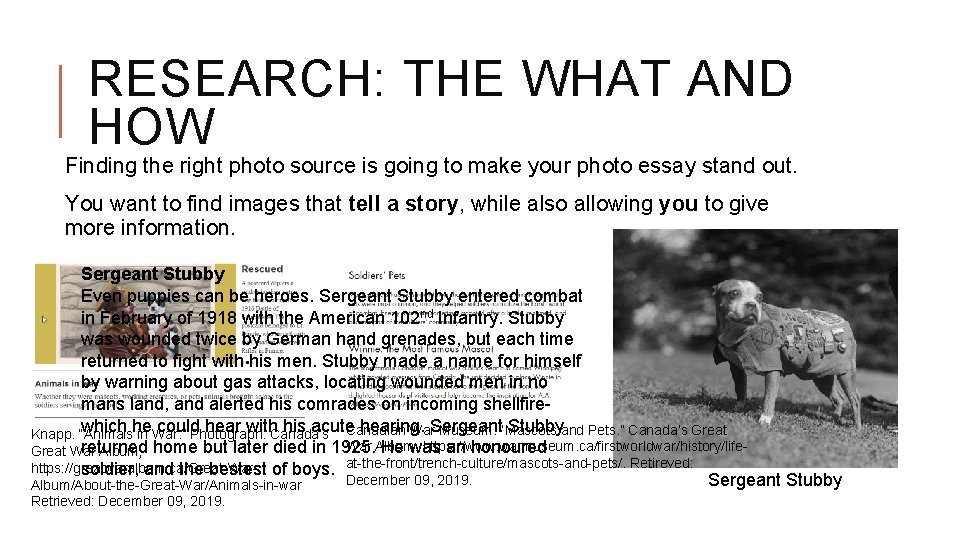
RESEARCH: THE WHAT AND HOW Finding the right photo source is going to make your photo essay stand out. You want to find images that tell a story, while also allowing you to give more information. Sergeant Stubby Even puppies can be heroes. Sergeant Stubby entered combat in February of 1918 with the American 102 nd Infantry. Stubby was wounded twice by German hand grenades, but each time returned to fight with his men. Stubby made a name for himself by warning about gas attacks, locating wounded men in no mans land, and alerted his comrades on incoming shellfirewhich he could hear with his acute hearing. Sergeant Stubby Knapp. “Animals in War. ” Photograph. Canada’s Canadian War Museum. “Mascots and Pets. ” Canada’s Great War Album. https: //www. warmuseum. ca/firstworldwar/history/lifereturned He was an honoured Great War Album, home but later died in 1925. https: //greatwaralbum. ca/Great-Warsoldier, and the bestest of boys. at-the-front/trench-culture/mascots-and-pets/. Retireved: December 09, 2019. Sergeant Stubby Album/About-the-Great-War/Animals-in-war Retrieved: December 09, 2019.
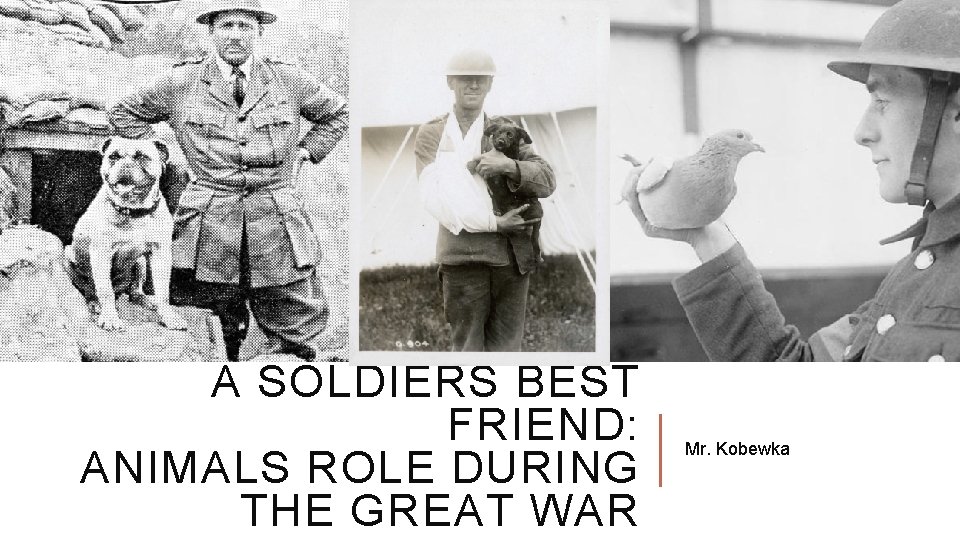
A SOLDIERS BEST FRIEND: ANIMALS ROLE DURING THE GREAT WAR Mr. Kobewka
THESIS STATEMENT The role of animals was essential in the Great War, not only for battlefield operations but also, for being mascots of military regiments and boosted the morale for the troops in the dingy conditions of the trenches. Not only were they essential for bringing supplies to the front lines, but many animals held direct military support roles from the war beginning until its end. From horses to pigeons, and from dogs to cats, all played their role in the great struggle, and many gave their lives in the line of duty.
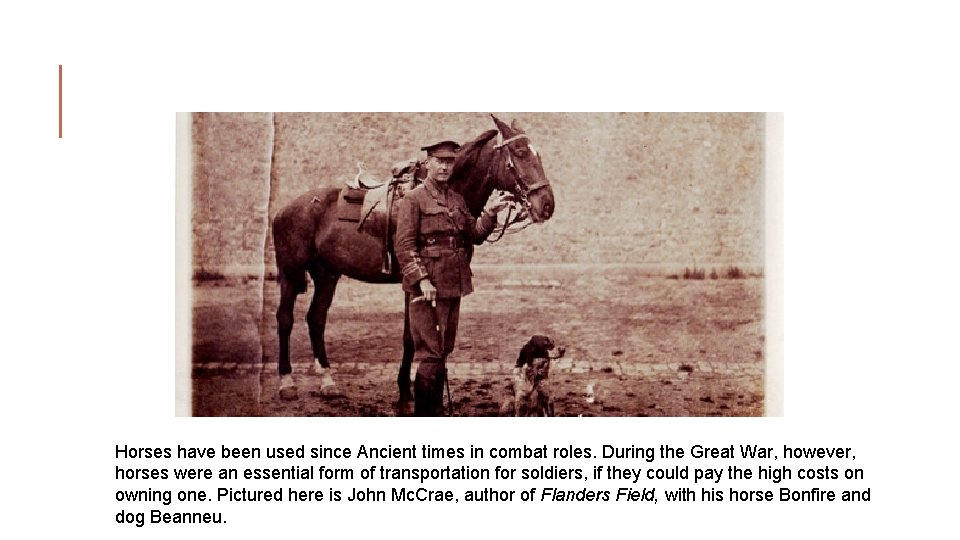
Horses have been used since Ancient times in combat roles. During the Great War, however, horses were an essential form of transportation for soldiers, if they could pay the high costs on owning one. Pictured here is John Mc. Crae, author of Flanders Field, with his horse Bonfire and dog Beanneu.
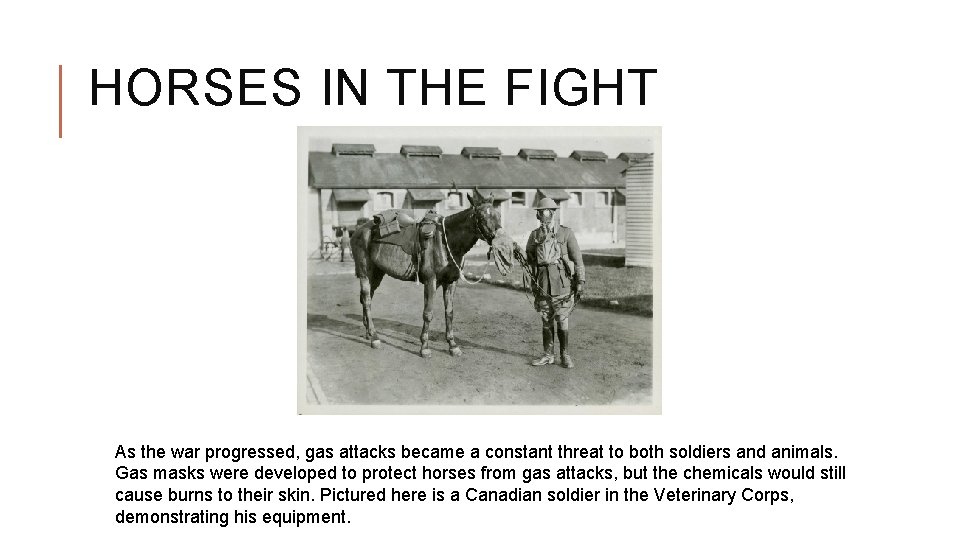
HORSES IN THE FIGHT As the war progressed, gas attacks became a constant threat to both soldiers and animals. Gas masks were developed to protect horses from gas attacks, but the chemicals would still cause burns to their skin. Pictured here is a Canadian soldier in the Veterinary Corps, demonstrating his equipment.
BATTLEFIELD MASCOTS As the war dragged on, pets became a common sight in Canadian trenches. Small dogs and cats were most common, and having a pet around would help cope with the harsh conditions of trench warfare. Pictured here is Gibby, a Canadian Mascot who survived multiple gas attacks.
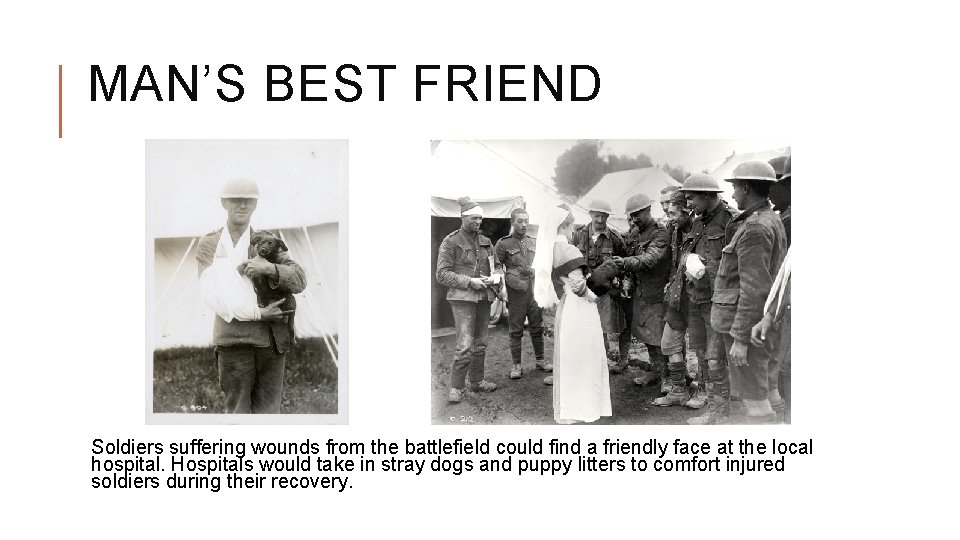
MAN’S BEST FRIEND Soldiers suffering wounds from the battlefield could find a friendly face at the local hospital. Hospitals would take in stray dogs and puppy litters to comfort injured soldiers during their recovery.
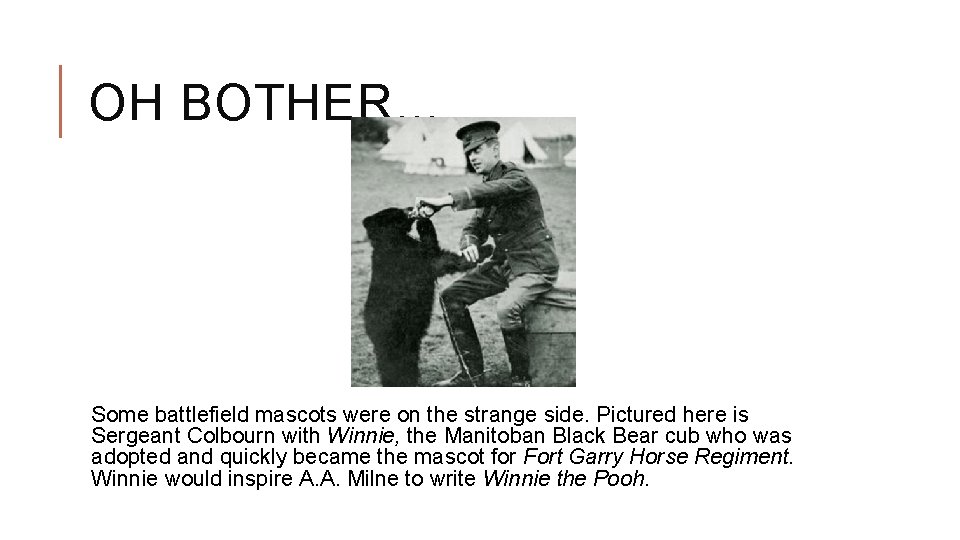
OH BOTHER… Some battlefield mascots were on the strange side. Pictured here is Sergeant Colbourn with Winnie, the Manitoban Black Bear cub who was adopted and quickly became the mascot for Fort Garry Horse Regiment. Winnie would inspire A. A. Milne to write Winnie the Pooh.
CONCLUSION While the Great War had many great leaps in technology, animals were still front and centre in the fight. Whether it was in the combat roles of soldier rescue, bringing supplies through the muddy terrain of the front, or giving company to wounded and hopeless soldiers, you could be sure to find furry friends doing their part.
WORKS CITED Image Number) MLA Citation 1, 6) Author Unknown. Gibby the Canadian Mascot. London News Press. https: //www. agefotostock. com/age/en/Stock. Images/Rights-Managed/MEV-10825981. Retrieved: December 06, 2019 2, 7) Metcalf, G. . Man’s Best Friend. Canadian War Museum. https: //www. warmuseum. ca/firstworldwar/objects-andphotos/photographs/life-at-the-front-photographs/mans-best-friend/? back=306. Retrieved: December 06, 2019. 3, 4) Knapp, J. Animals at War. Canada's Great War Album. https: //greatwaralbum. ca/Great-War-Album/About-the-Great. War/Animals-in-war. Retrieved: December 06, 2019 5, 8) Metcalf, G. Life at the Front. Canadian War Museum. https: //www. warmuseum. ca/firstworldwar/objects-andphotos/photographs/life-at-the-front-photographs/protecting-soldiers-and-horses/. Retrieved: December 07, 2019. 9) Klien, C. The True Story of the Real Life Winnie the Pooh. History. https: //www. history. com/news/the-true-story-of-thereal-life-winnie-the-pooh. Retrieved: December 09, 2019.
WHAT YOU NEED TO DO NOW Use the resources in the room to decide on a research topic. Textbook, Ms. Martin’s Library, or your own personal device Let me know what your topic is, and if you have one, your research question. Use the remainder of class time to do more research on your topic, write down some useful websites.
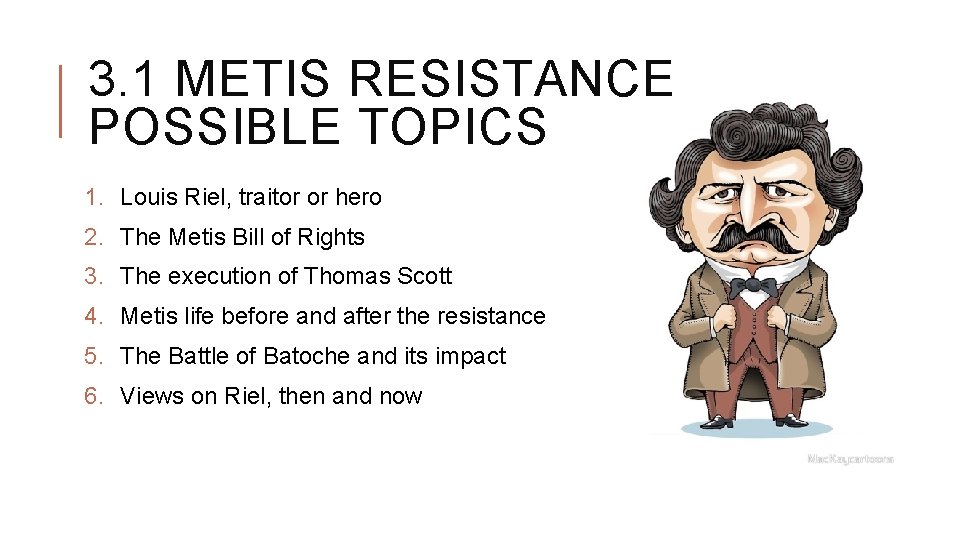
3. 1 METIS RESISTANCE POSSIBLE TOPICS 1. Louis Riel, traitor or hero 2. The Metis Bill of Rights 3. The execution of Thomas Scott 4. Metis life before and after the resistance 5. The Battle of Batoche and its impact 6. Views on Riel, then and now
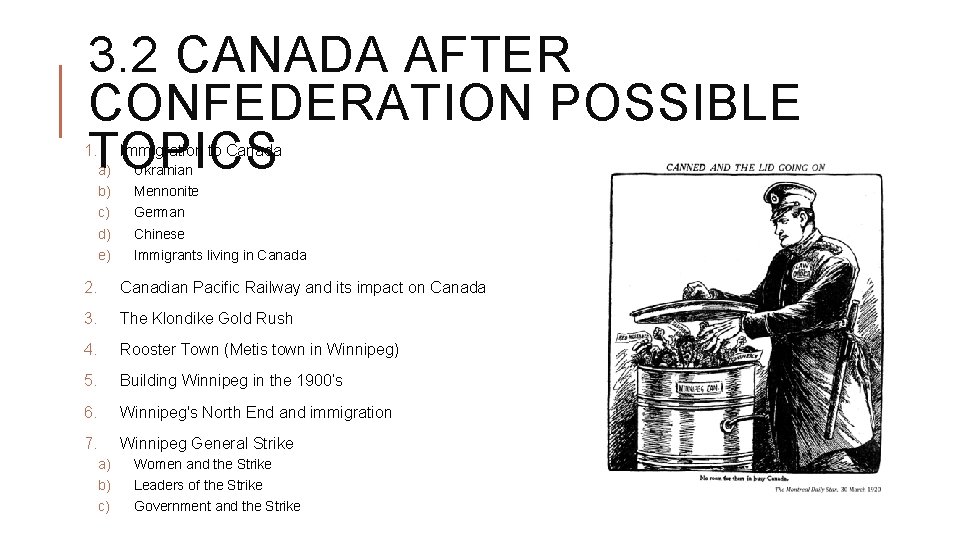
3. 2 CANADA AFTER CONFEDERATION POSSIBLE TOPICS 1. a) b) c) d) e) Immigration to Canada Ukrainian Mennonite German Chinese Immigrants living in Canada 2. Canadian Pacific Railway and its impact on Canada 3. The Klondike Gold Rush 4. Rooster Town (Metis town in Winnipeg) 5. Building Winnipeg in the 1900’s 6. Winnipeg's North End and immigration 7. Winnipeg General Strike a) b) c) Women and the Strike Leaders of the Strike Government and the Strike
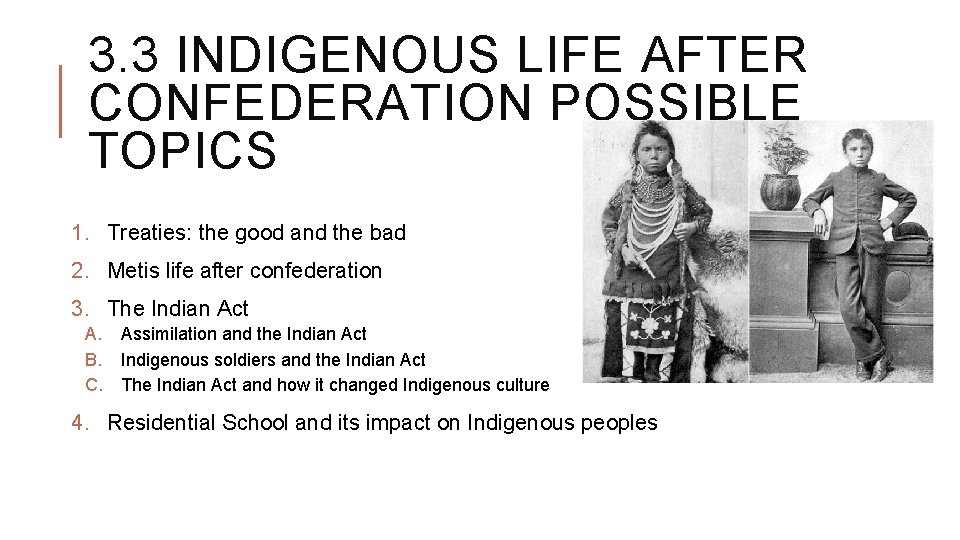
3. 3 INDIGENOUS LIFE AFTER CONFEDERATION POSSIBLE TOPICS 1. Treaties: the good and the bad 2. Metis life after confederation 3. The Indian Act A. Assimilation and the Indian Act B. Indigenous soldiers and the Indian Act C. The Indian Act and how it changed Indigenous culture 4. Residential School and its impact on Indigenous peoples
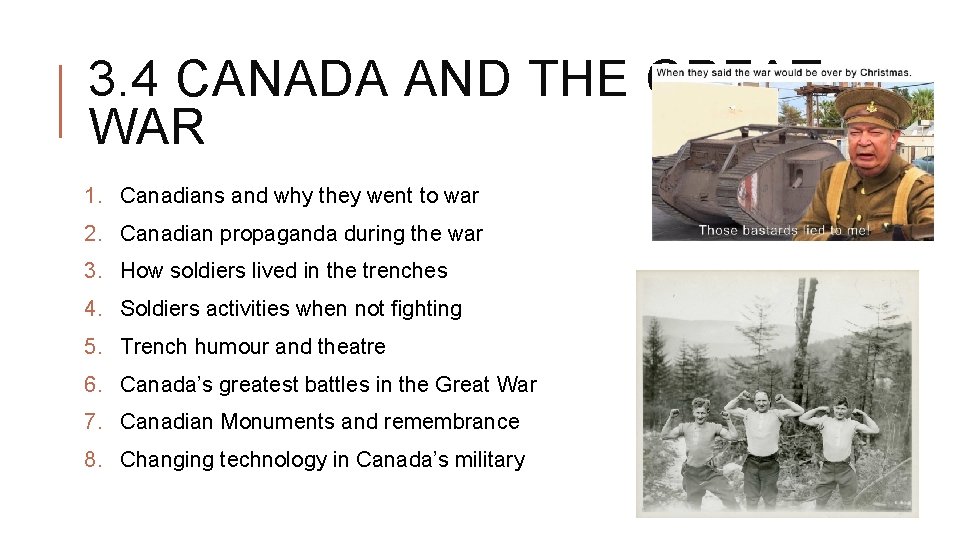
3. 4 CANADA AND THE GREAT WAR 1. Canadians and why they went to war 2. Canadian propaganda during the war 3. How soldiers lived in the trenches 4. Soldiers activities when not fighting 5. Trench humour and theatre 6. Canada’s greatest battles in the Great War 7. Canadian Monuments and remembrance 8. Changing technology in Canada’s military
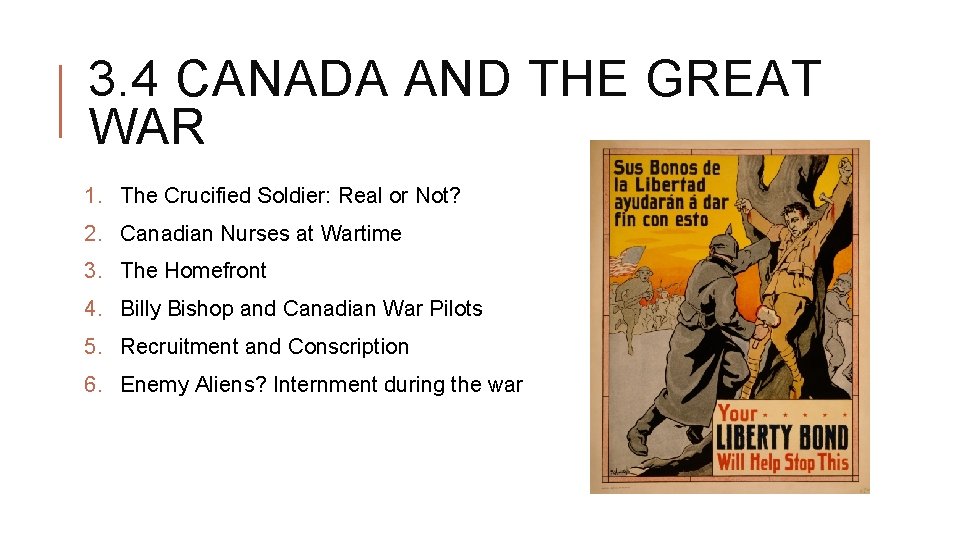
3. 4 CANADA AND THE GREAT WAR 1. The Crucified Soldier: Real or Not? 2. Canadian Nurses at Wartime 3. The Homefront 4. Billy Bishop and Canadian War Pilots 5. Recruitment and Conscription 6. Enemy Aliens? Internment during the war