Ferry Transit Capacity Quality of Service Manual 3
- Slides: 31
Ferry Transit Capacity & Quality of Service Manual, 3 rd Edition
Presentation Overview Learning objectives Ferry facilities and service Vessels Ferry terminals Operations Capacity considerations Transit Capacity & Quality of Service Manual, 3 rd Edition
Learning Objectives Gain an understanding of the wide variety of vessels, service types, and conditions which influence ferry service § Unlike other transit services, ferry services tend to vary widely and have little in common with each other Presentation of vessel access considerations and typical terminal configurations Become familiar with factors affecting ferry capacity: § Berth capacity § Dock capacity § Vessel passenger capacity Transit Capacity & Quality of Service Manual, 3 rd Edition
Changes from the 2 nd Edition Re-organization of chapter for clarity Updated content § Removal of material unnecessarily specific to certain systems § Generalization of other content to increase applicability § Discussion of maritime security (MARSEC) Purpose is to promote a framework for understanding ferry operations and capacity instead of specific approaches for certain system types New spreadsheet tool for helping evaluate ferry transit capacity Transit Capacity & Quality of Service Manual, 3 rd Edition
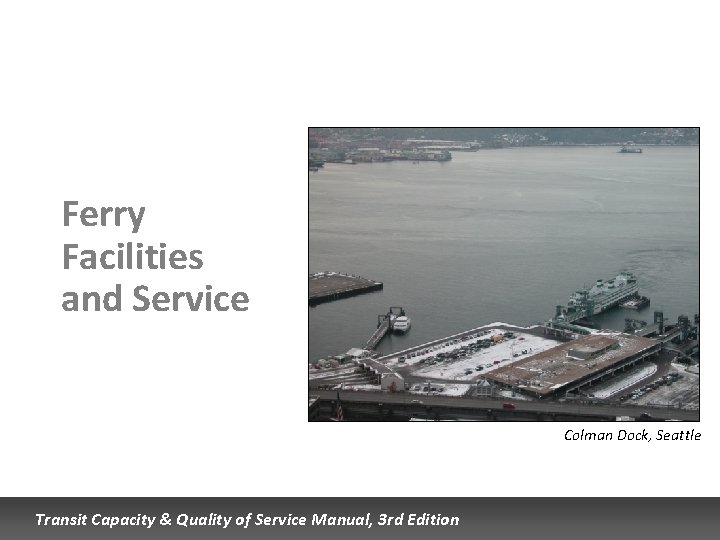
Ferry Facilities and Service Colman Dock, Seattle Transit Capacity & Quality of Service Manual, 3 rd Edition
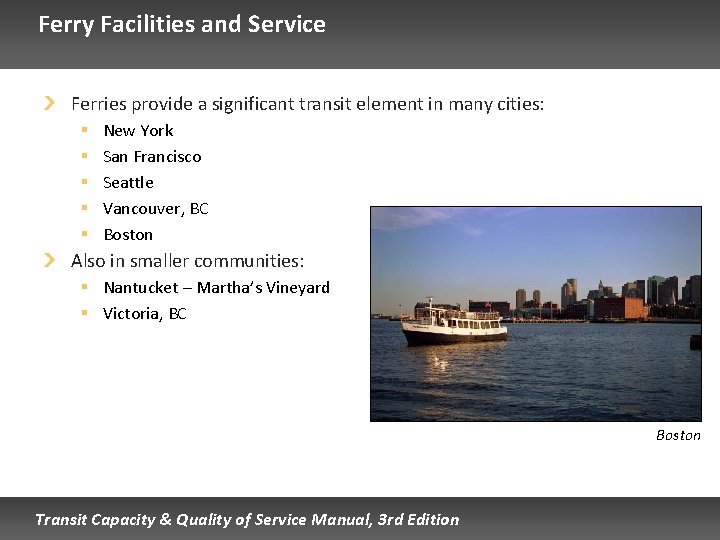
Ferry Facilities and Service Ferries provide a significant transit element in many cities: § § § New York San Francisco Seattle Vancouver, BC Boston Also in smaller communities: § Nantucket – Martha’s Vineyard § Victoria, BC Boston Transit Capacity & Quality of Service Manual, 3 rd Edition
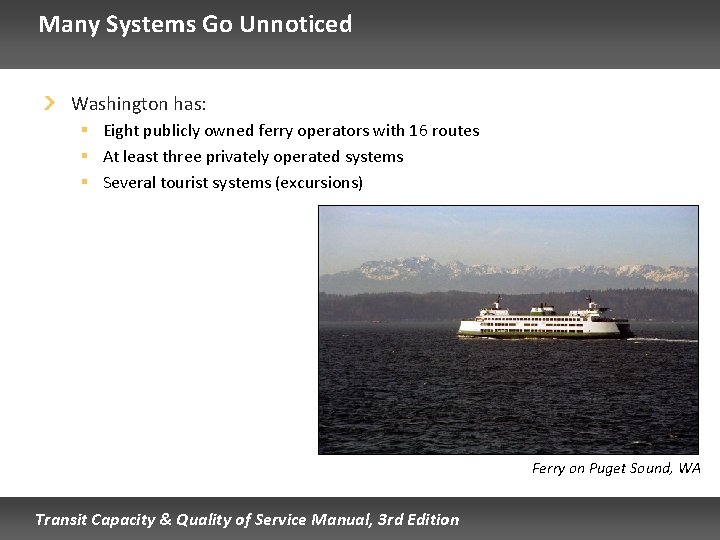
Many Systems Go Unnoticed Washington has: § Eight publicly owned ferry operators with 16 routes § At least three privately operated systems § Several tourist systems (excursions) Ferry on Puget Sound, WA Transit Capacity & Quality of Service Manual, 3 rd Edition
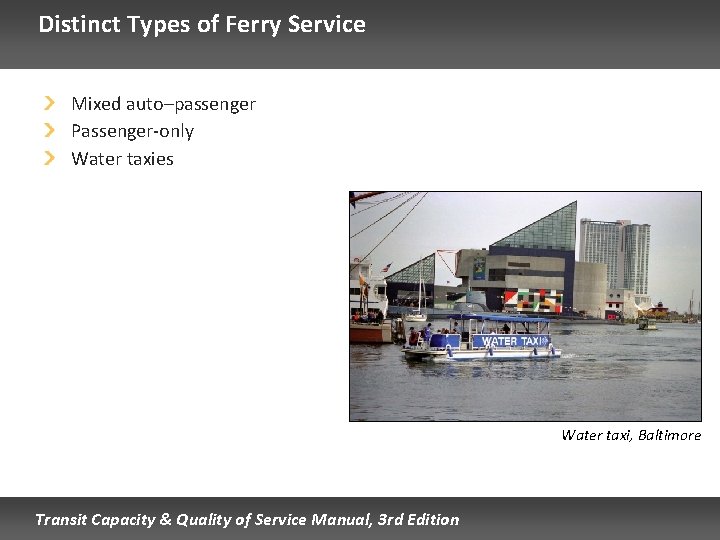
Distinct Types of Ferry Service Mixed auto–passenger Passenger-only Water taxies Water taxi, Baltimore Transit Capacity & Quality of Service Manual, 3 rd Edition
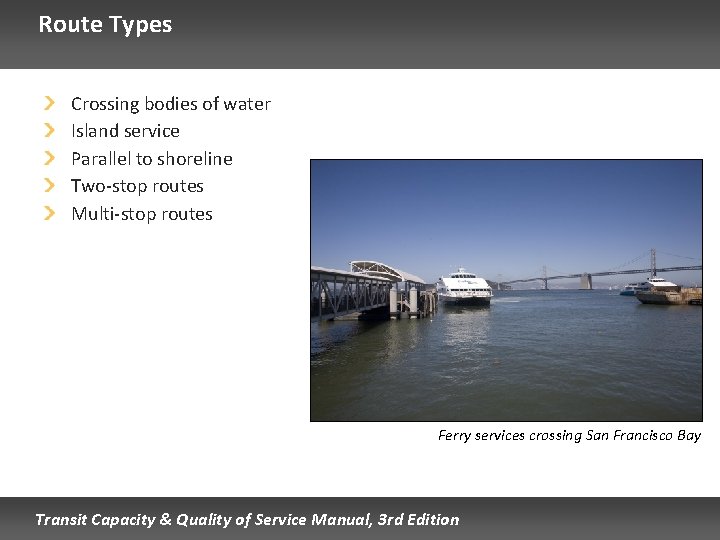
Route Types Crossing bodies of water Island service Parallel to shoreline Two-stop routes Multi-stop routes Ferry services crossing San Francisco Bay Transit Capacity & Quality of Service Manual, 3 rd Edition
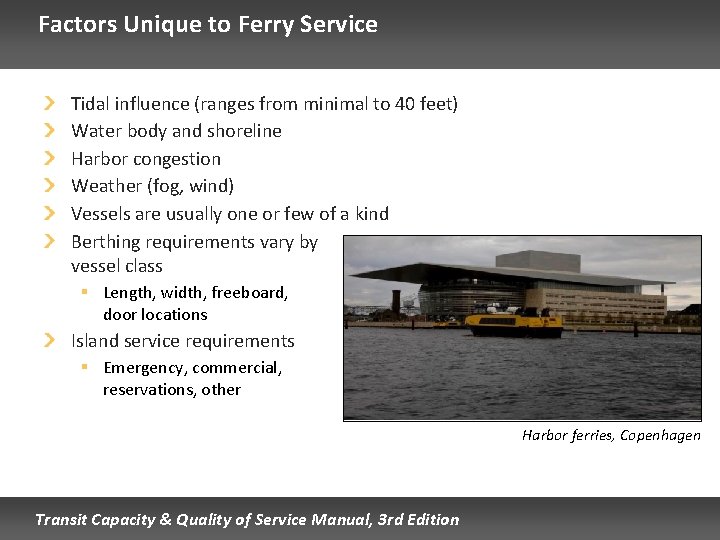
Factors Unique to Ferry Service Tidal influence (ranges from minimal to 40 feet) Water body and shoreline Harbor congestion Weather (fog, wind) Vessels are usually one or few of a kind Berthing requirements vary by vessel class § Length, width, freeboard, door locations Island service requirements § Emergency, commercial, reservations, other Harbor ferries, Copenhagen Transit Capacity & Quality of Service Manual, 3 rd Edition
Factors Unique to Ferry Service (cont’d. ) Most trips are multimodal System lack of spare vessels Operation by non-traditional transit providers Regulatory environment (US Coast Guard) § Certificates of Inspection – Capacity § Crew size (dispatch problems) Security requirements § MARSEC Levels 1, 2, and 3 Transit Capacity & Quality of Service Manual, 3 rd Edition
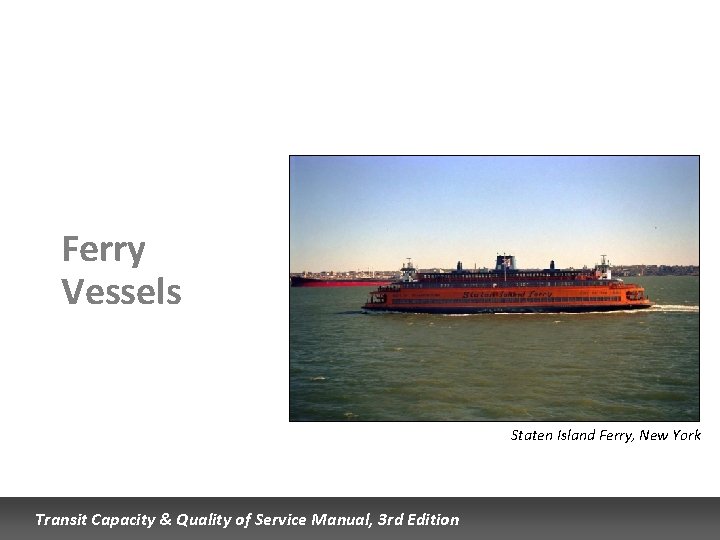
Ferry Vessels Staten Island Ferry, New York Transit Capacity & Quality of Service Manual, 3 rd Edition
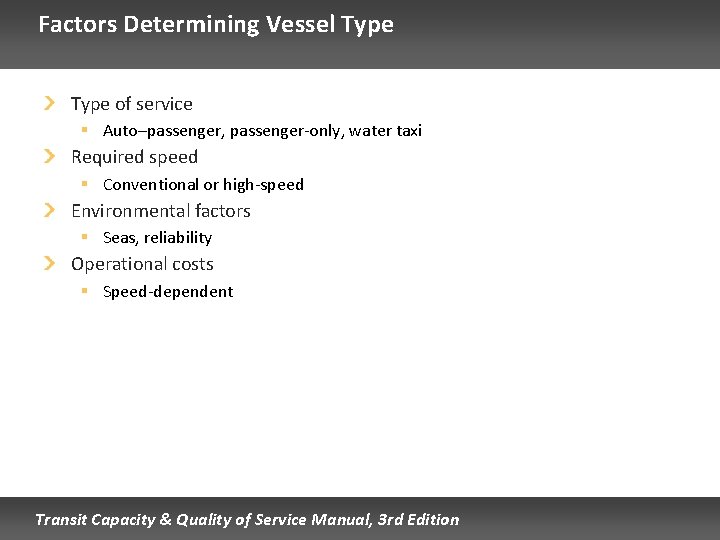
Factors Determining Vessel Type of service § Auto–passenger, passenger-only, water taxi Required speed § Conventional or high-speed Environmental factors § Seas, reliability Operational costs § Speed-dependent Transit Capacity & Quality of Service Manual, 3 rd Edition
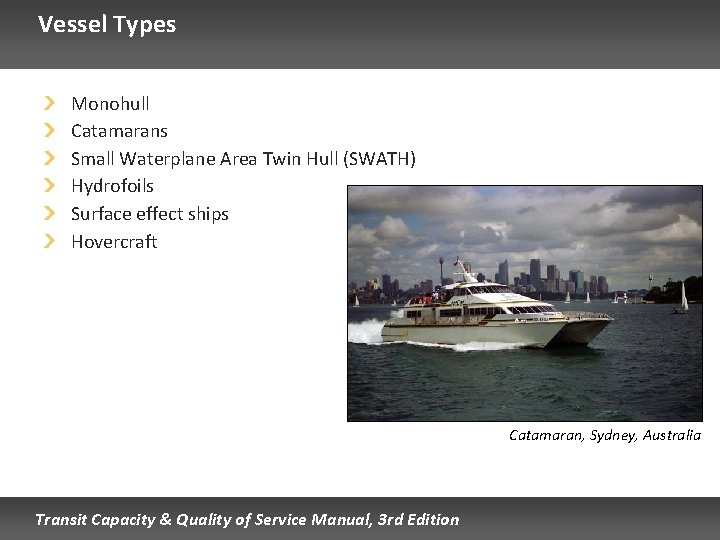
Vessel Types Monohull Catamarans Small Waterplane Area Twin Hull (SWATH) Hydrofoils Surface effect ships Hovercraft Catamaran, Sydney, Australia Transit Capacity & Quality of Service Manual, 3 rd Edition
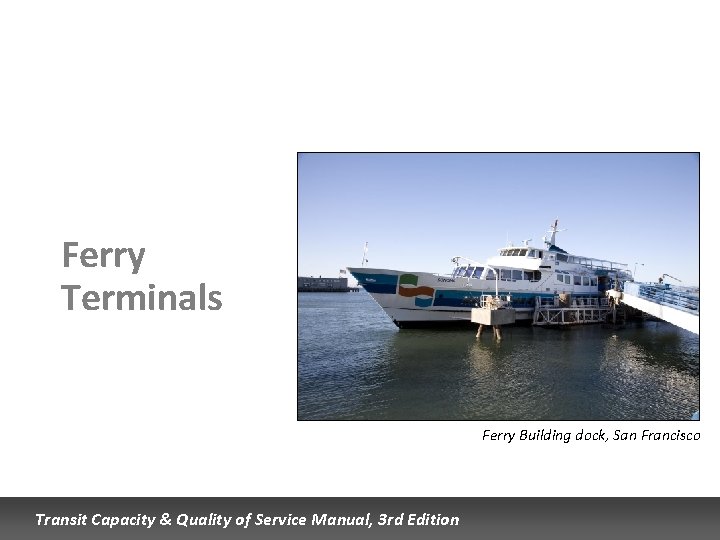
Ferry Terminals Ferry Building dock, San Francisco Transit Capacity & Quality of Service Manual, 3 rd Edition
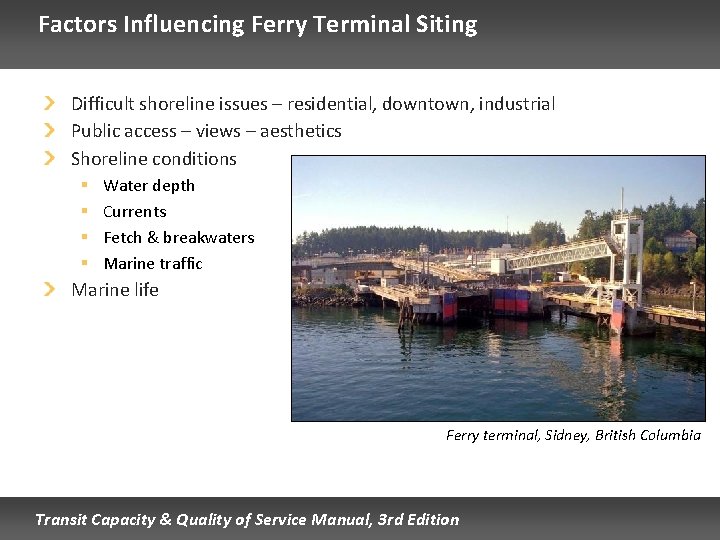
Factors Influencing Ferry Terminal Siting Difficult shoreline issues – residential, downtown, industrial Public access – views – aesthetics Shoreline conditions § § Water depth Currents Fetch & breakwaters Marine traffic Marine life Ferry terminal, Sidney, British Columbia Transit Capacity & Quality of Service Manual, 3 rd Edition
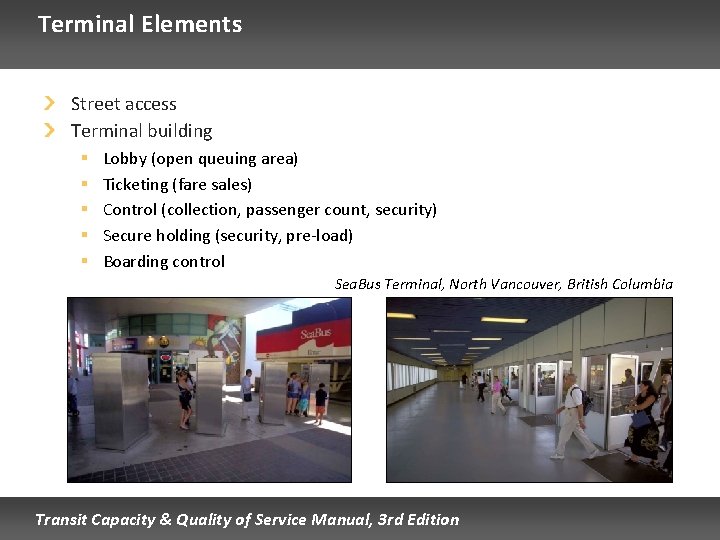
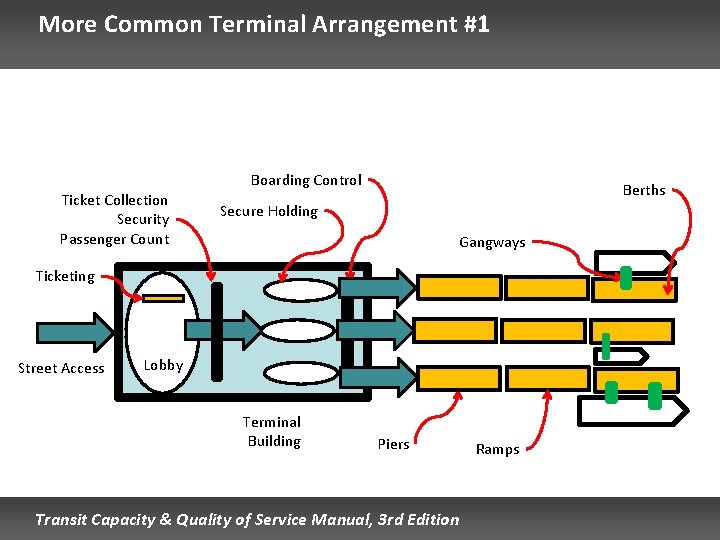
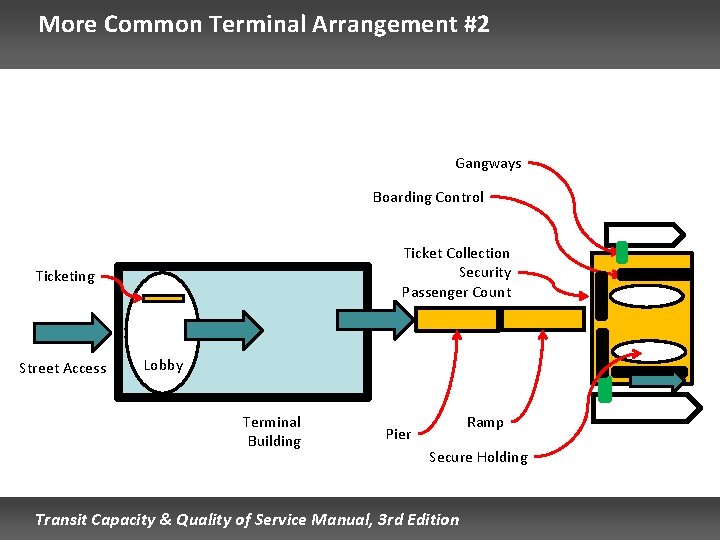
Terminal Elements Street access Terminal building § § § Lobby (open queuing area) Ticketing (fare sales) Control (collection, passenger count, security) Secure holding (security, pre-load) Boarding control Sea. Bus Terminal, North Vancouver, British Columbia Transit Capacity & Quality of Service Manual, 3 rd Edition
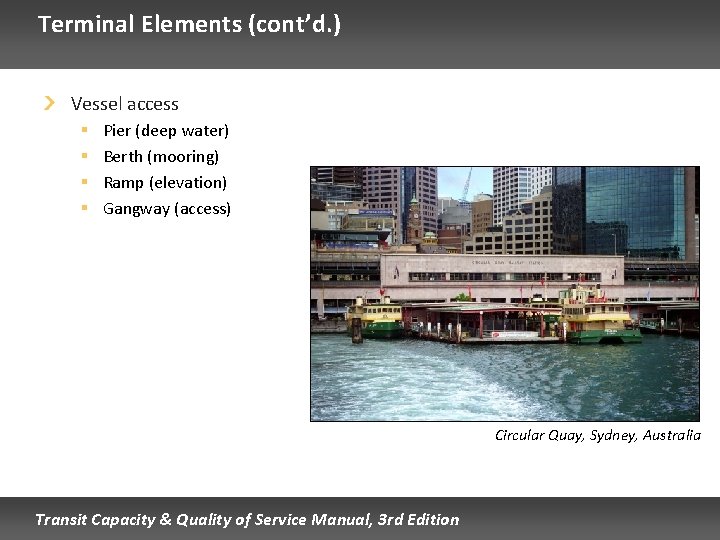
Terminal Elements (cont’d. ) Vessel access § § Pier (deep water) Berth (mooring) Ramp (elevation) Gangway (access) Circular Quay, Sydney, Australia Transit Capacity & Quality of Service Manual, 3 rd Edition
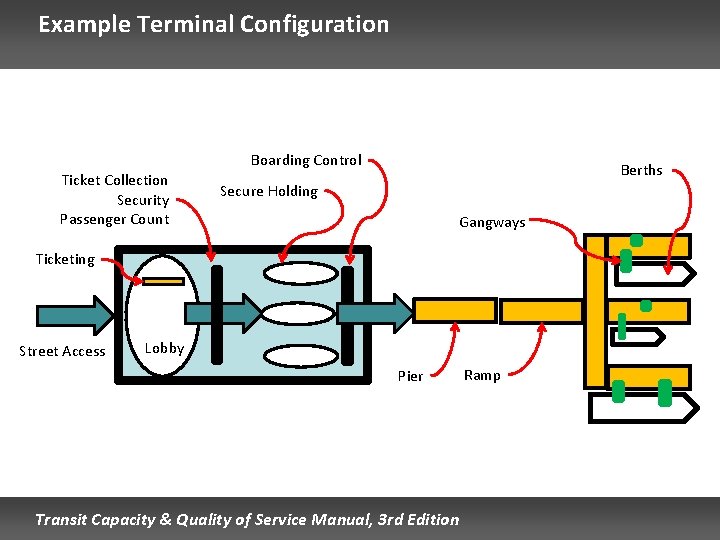
Example Terminal Configuration Boarding Control Ticket Collection Security Passenger Count Berths Secure Holding Gangways Ticketing Street Access Lobby Terminal Building Pier Transit Capacity & Quality of Service Manual, 3 rd Edition Ramp
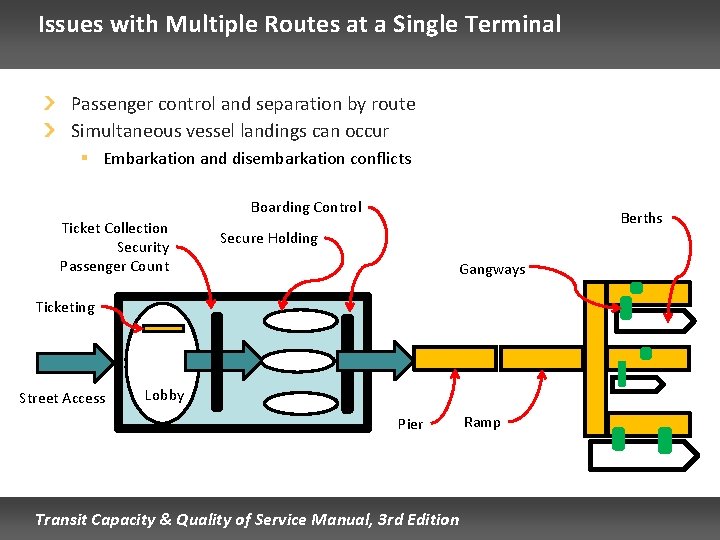
Issues with Multiple Routes at a Single Terminal Passenger control and separation by route Simultaneous vessel landings can occur § Embarkation and disembarkation conflicts Boarding Control Ticket Collection Security Passenger Count Berths Secure Holding Gangways Ticketing Street Access Lobby Terminal Building Pier Transit Capacity & Quality of Service Manual, 3 rd Edition Ramp
More Common Terminal Arrangement #1 Boarding Control Ticket Collection Security Passenger Count Berths Secure Holding Gangways Ticketing Street Access Lobby Terminal Building Piers Transit Capacity & Quality of Service Manual, 3 rd Edition Ramps
More Common Terminal Arrangement #2 Gangways Boarding Control Ticket Collection Security Passenger Count Ticketing Street Access Lobby Terminal Building Ramp Pier Secure Holding Transit Capacity & Quality of Service Manual, 3 rd Edition
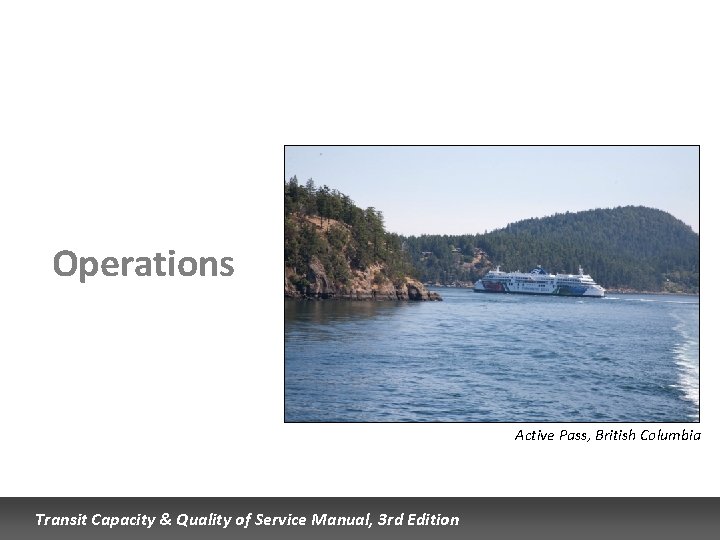
Operations Active Pass, British Columbia Transit Capacity & Quality of Service Manual, 3 rd Edition
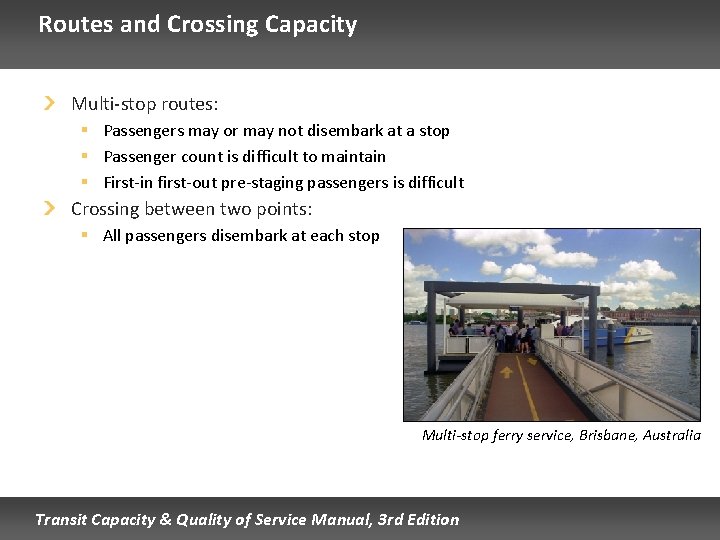
Routes and Crossing Capacity Multi-stop routes: § Passengers may or may not disembark at a stop § Passenger count is difficult to maintain § First-in first-out pre-staging passengers is difficult Crossing between two points: § All passengers disembark at each stop Multi-stop ferry service, Brisbane, Australia Transit Capacity & Quality of Service Manual, 3 rd Edition
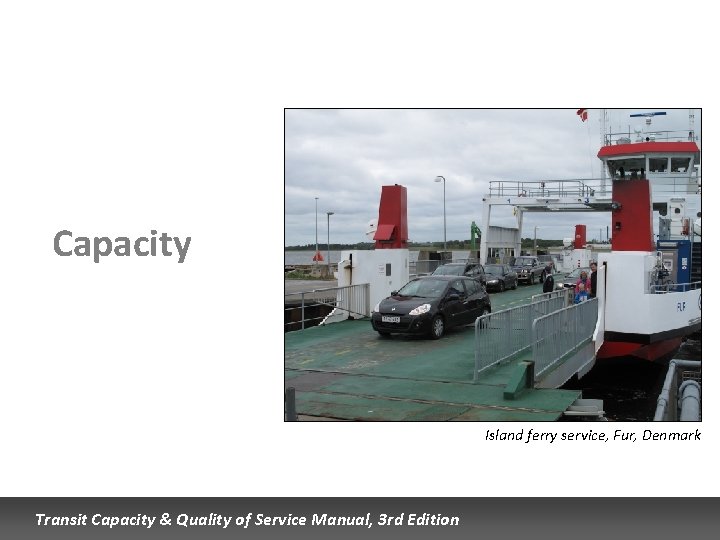
Capacity Island ferry service, Fur, Denmark Transit Capacity & Quality of Service Manual, 3 rd Edition
Berth Capacity Berth capacity: Arrival service time § Vessel clearance time § Maneuver § Tie up § Gangway placement § Disembarking time § Passenger volume – bottleneck location § Passenger walking times (from vessel to holding area access) Transit Capacity & Quality of Service Manual, 3 rd Edition
Berth Capacity (cont’d. ) Berth capacity: Departure service time § Embarking time § Passenger volume – bottleneck location § Passenger walking times (from holding area to vessel) § Vessel clearance time § Gangway removal § Tie up § Maneuver Total of departure service time, arrival service time, and an operating margin to account for delays gives the minimum service time per vessel § These times will be different for different vessels using a berth, and will vary by time of day with passenger volumes These service times determine the maximum number of vessels that can be scheduled to use a berth during an hour Transit Capacity & Quality of Service Manual, 3 rd Edition
Notes on Berth Capacity (cont’d. ) Simultaneous disembarking and embarking § May not be viable due to security requirements § Difficult at best—no control in a hazardous area § Passenger load control is difficult Automobile embarking and disembarking § Procedure included in TCQSM § Not addressed further in this presentation Schedule float/operating margin § Additional time for consideration of uncertain or extreme conditions Transit Capacity & Quality of Service Manual, 3 rd Edition
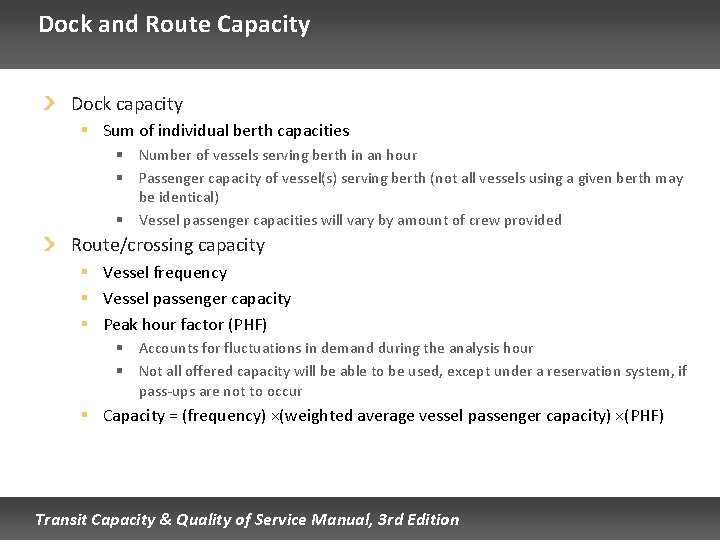
Dock and Route Capacity Dock capacity § Sum of individual berth capacities § Number of vessels serving berth in an hour § Passenger capacity of vessel(s) serving berth (not all vessels using a given berth may be identical) § Vessel passenger capacities will vary by amount of crew provided Route/crossing capacity § Vessel frequency § Vessel passenger capacity § Peak hour factor (PHF) § Accounts for fluctuations in demand during the analysis hour § Not all offered capacity will be able to be used, except under a reservation system, if pass-ups are not to occur § Capacity = (frequency) ×(weighted average vessel passenger capacity) ×(PHF) Transit Capacity & Quality of Service Manual, 3 rd Edition
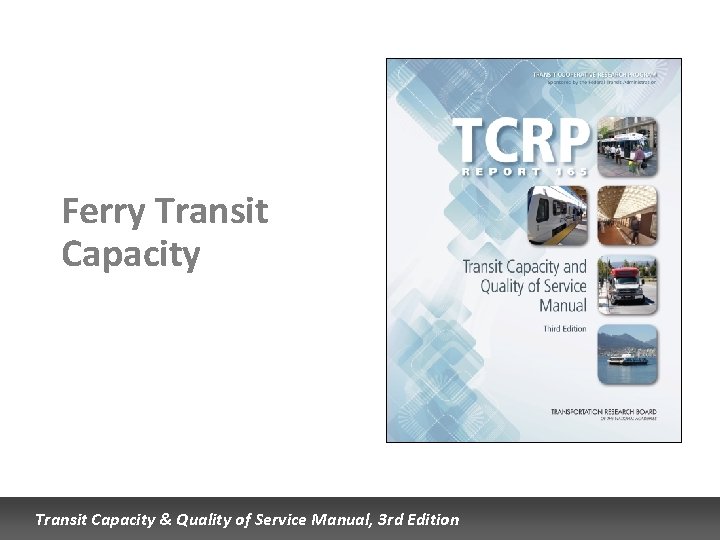
More Information TCRP Report 165: TCQSM—Chapter 9, Ferry Transit Capacity § Ferry capacity spreadsheet included on the CD-ROM TCRP Report 152: Guidelines for Ferry Transportation Services TCRP Synthesis 102: Integrating Passenger Ferry Service with Mass Transit All of these documents are available as: § Free individual printed copies and PDF downloads through the TCRP Dissemination Program http: //www. tcrponline. org § Free PDF downloads directly from TCRP http: //www. trb. org/TCRP/Public/TCRP. aspx (Publications section) or simply do an Internet search for the report number (e. g. , TCRP Report 165) § Individual or multiple copy purchases from the TRB Bookstore http: //books. trbbookstore. org/ Transit Capacity & Quality of Service Manual, 3 rd Edition
Acknowledgments and Permissions Presentation authors § Bill Carter and Ryan Avery (Parsons Brinkerhoff, Quade & Douglass) Photo credits § Colman Dock: Bill Carter § All others: Paul Ryus This presentation was developed through TCRP Project A-15 C § Research team: Kittelson & Associates; Parsons Brinkerhoff, Quade & Douglass; KFH Group; Texas A&M Transportation Institute; and Arup § This presentation and its contents may be freely distributed and used, with appropriate credit to the presentation authors and photographers, and the Transit Cooperative Research Program Transit Capacity & Quality of Service Manual, 3 rd Edition