Fast Handoff for Seamless wireless mesh Networks Yair

- Slides: 25
Fast Handoff for Seamless wireless mesh Networks Yair Amir, Clauiu Danilov, Michael Hilsdale Mobisys’ 06 2006. 09. 12 Jeon, Seung-woo
Contents ▣Introduction ▣The SMesh architecture ▣Fast Handoff Protocol ▣Experimental Results ▣Conclusion 2/25
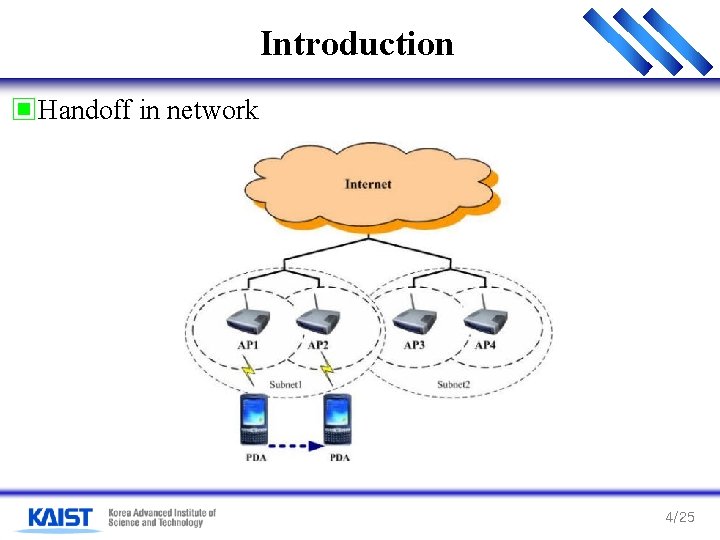
Introduction ▣The handoff § Also called ‘handover’ in Europe region § A service for mobile clients of one access point which is trying to move to another coverage of access point § Before routing packets through new access point, the handoff triggering should occur ▣Requirement § Completely transparent to mobile clients § No interruption in network connectivity (Seamless) § Communication protocols of all mobile clients should not be unchanged 3/25
Introduction ▣Handoff in network 4/25
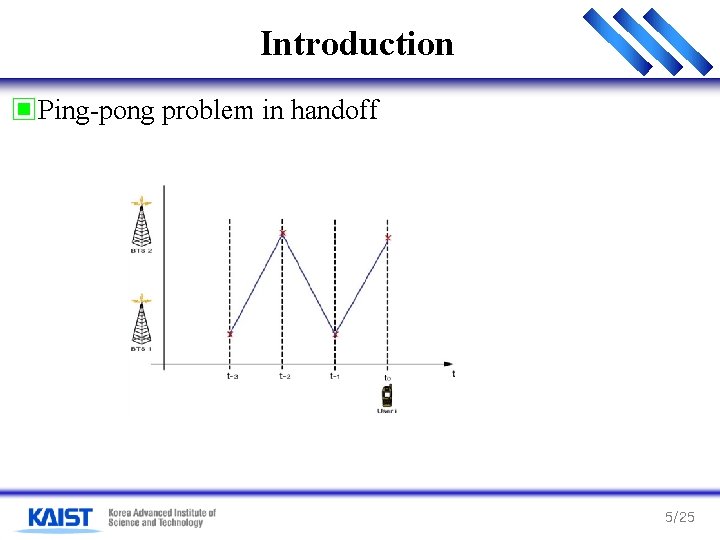
Introduction ▣Ping-pong problem in handoff 5/25
Introduction ▣The handoff in cellular network § Many techniques are suggested for ensuring connectivity • Uses embedded signaling, user location for handoff ▣The handoff in wireless 802. 11 mesh network § There are no efficient, transparent handoff solutions • Required specific modified mobile clients for connectivity • Not sufficient to support real-time application traffic – Voice over IP, video conference – Delay is most significant factor in real time traffic 6/25
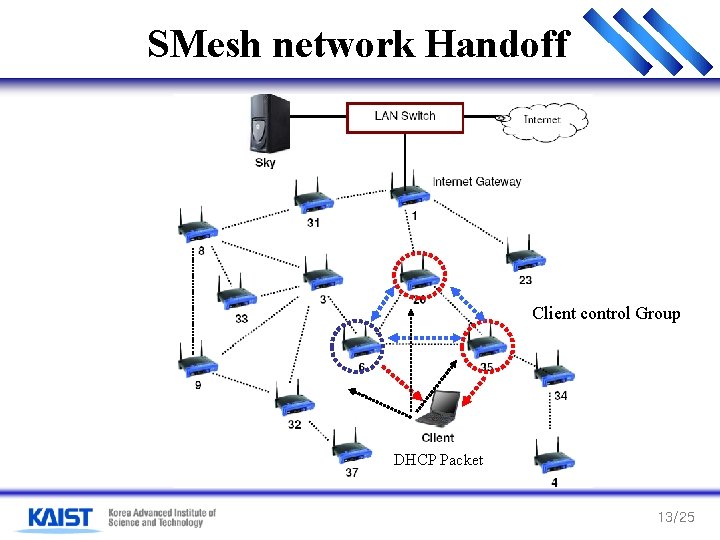
Introduction ▣The SMesh network § Ensures that each clients is served by at least one access point at any time • Creates wireless mesh topology in which only some of the access points may be connected to the Internet § Completely transparent wireless mesh network system • The entire mesh network is seen by the mobile clients as a single, omnipresent access point § Supports peer-to-peer communication between mobile clients • provides automatic routing for clients connected to the mesh 7/25
Introduction ▣The innovative aspects of the handoff techniques § Seamless and fast handoff with supporting real-time applications § Novel use of the DHCP protocol • Monitoring connectivity quality of mobile clients • Creating a single, virtual access point § Novel use of multicast for robust mesh Internet gateway § Novel use of anycast for mobile client to mesh Internet gateway communication 8/25
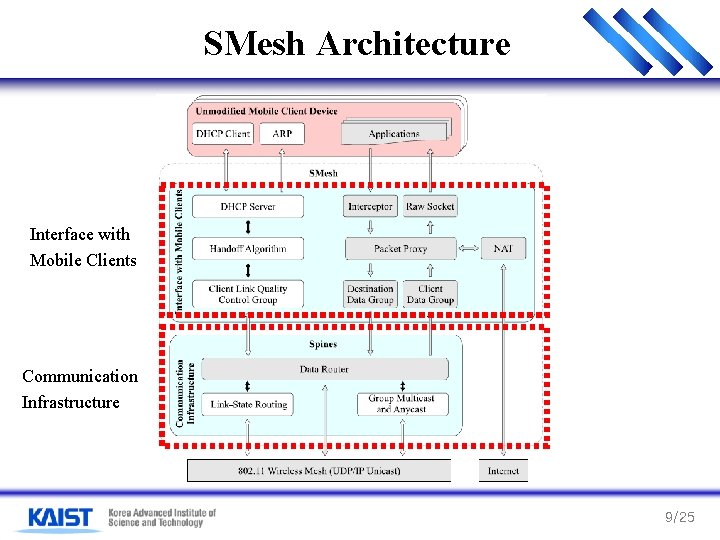
SMesh Architecture Interface with Mobile Clients Communication Infrastructure 9/25
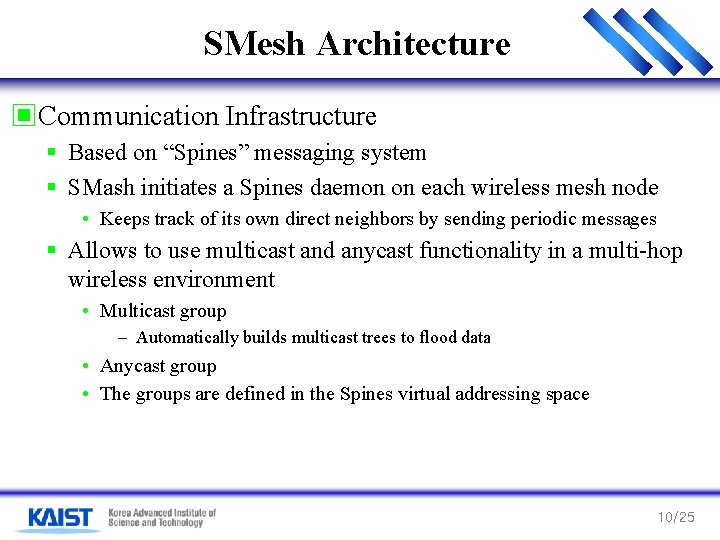
SMesh Architecture ▣Communication Infrastructure § Based on “Spines” messaging system § SMash initiates a Spines daemon on each wireless mesh node • Keeps track of its own direct neighbors by sending periodic messages § Allows to use multicast and anycast functionality in a multi-hop wireless environment • Multicast group – Automatically builds multicast trees to flood data • Anycast group • The groups are defined in the Spines virtual addressing space 10/25
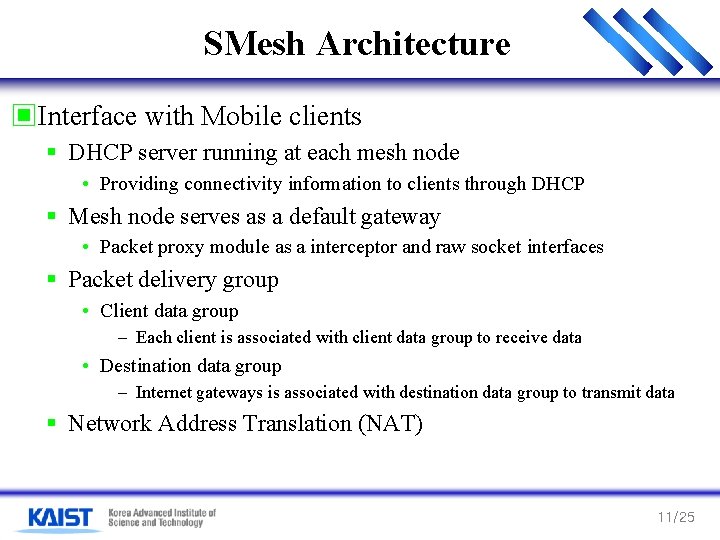
SMesh Architecture ▣Interface with Mobile clients § DHCP server running at each mesh node • Providing connectivity information to clients through DHCP § Mesh node serves as a default gateway • Packet proxy module as a interceptor and raw socket interfaces § Packet delivery group • Client data group – Each client is associated with client data group to receive data • Destination data group – Internet gateways is associated with destination data group to transmit data § Network Address Translation (NAT) 11/25
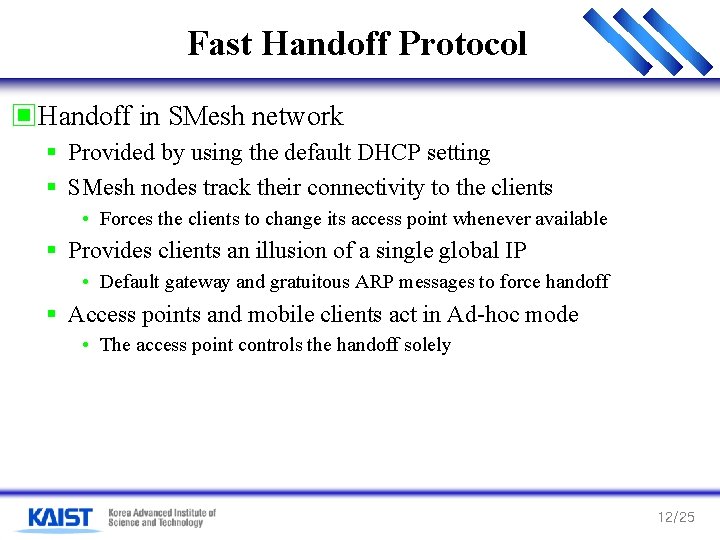
Fast Handoff Protocol ▣Handoff in SMesh network § Provided by using the default DHCP setting § SMesh nodes track their connectivity to the clients • Forces the clients to change its access point whenever available § Provides clients an illusion of a single global IP • Default gateway and gratuitous ARP messages to force handoff § Access points and mobile clients act in Ad-hoc mode • The access point controls the handoff solely 12/25
SMesh network Handoff Client control Group DHCP Packet 13/25
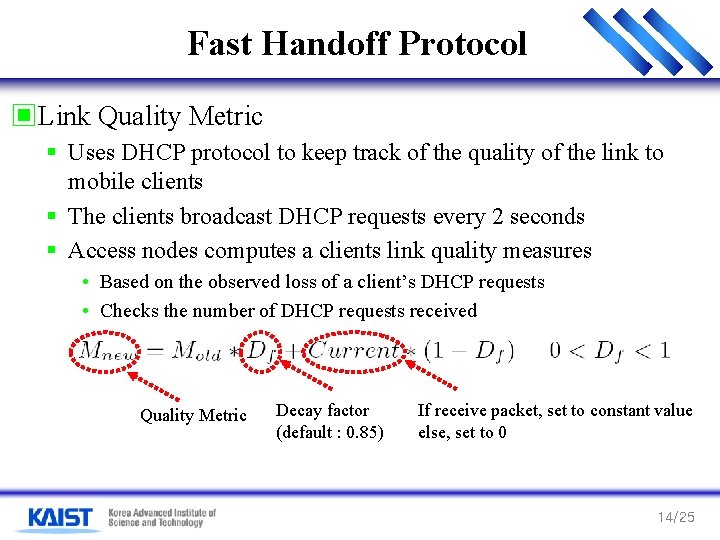
Fast Handoff Protocol ▣Link Quality Metric § Uses DHCP protocol to keep track of the quality of the link to mobile clients § The clients broadcast DHCP requests every 2 seconds § Access nodes computes a clients link quality measures • Based on the observed loss of a client’s DHCP requests • Checks the number of DHCP requests received Quality Metric Decay factor (default : 0. 85) If receive packet, set to constant value else, set to 0 14/25
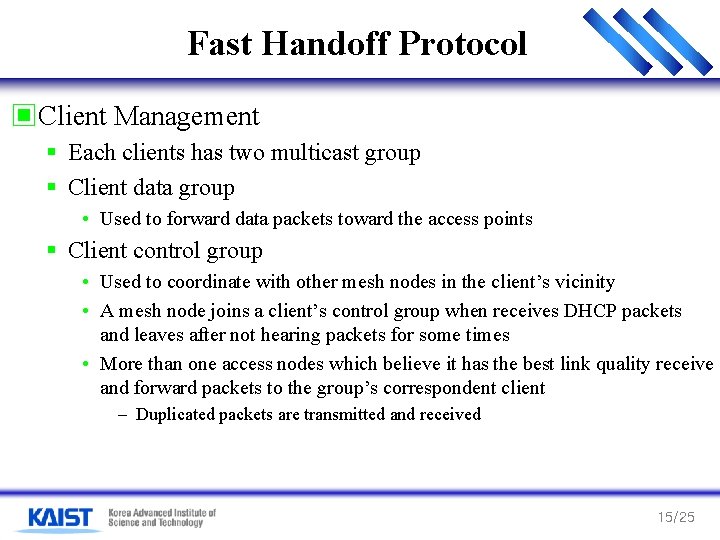
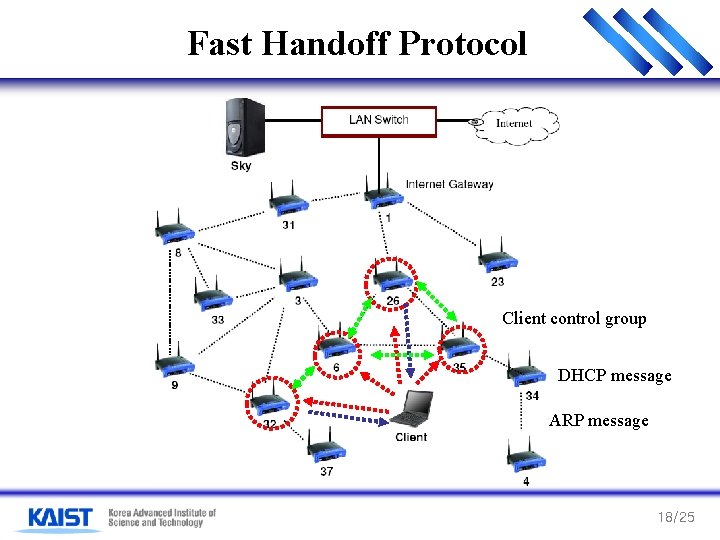
Fast Handoff Protocol ▣Client Management § Each clients has two multicast group § Client data group • Used to forward data packets toward the access points § Client control group • Used to coordinate with other mesh nodes in the client’s vicinity • A mesh node joins a client’s control group when receives DHCP packets and leaves after not hearing packets for some times • More than one access nodes which believe it has the best link quality receive and forward packets to the group’s correspondent client – Duplicated packets are transmitted and received 15/25
Fast Handoff Protocol ▣Data Group Membership § Balances the connectivity and the size of client data group § Mesh nodes Join and leave the data group by measures link quality § Set threshold in order to decrease oscillations of the Data Group membership 16/25
Fast Handoff Protocol ▣Single IP Gateway § Mesh nodes advertise a single virtual gateway IP address to all clients in their DHCP offers and acknowledgements • Mobile clients set their default gateway to this virtual IP address regardless of access points • Mobile clients get the illusion of being connected to a single access point ▣Gratuitous ARP § ARP reply that is not sent as a reply to an ARP request, but rather is broadcasted to the local network voluntarily • Communicates in a client control group by ARP messages • Mesh nodes advertise to clients which node has the best link quality link by ARP messages 17/25
Fast Handoff Protocol Client control group DHCP message ARP message 18/25
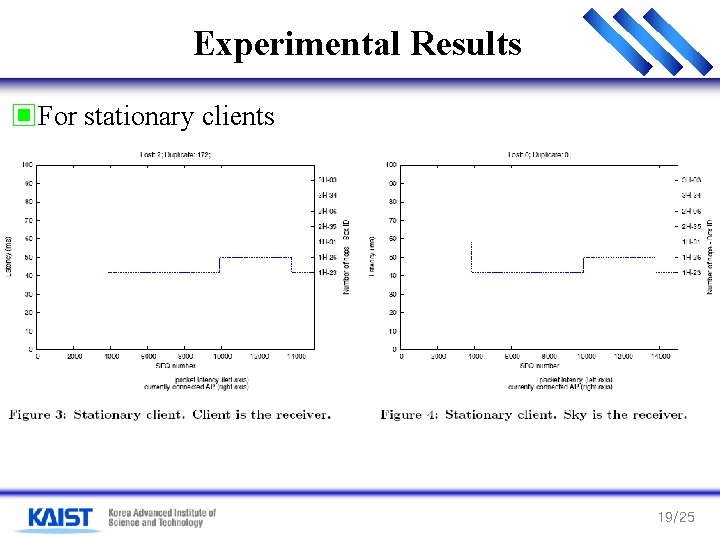
Experimental Results ▣For stationary clients 19/25
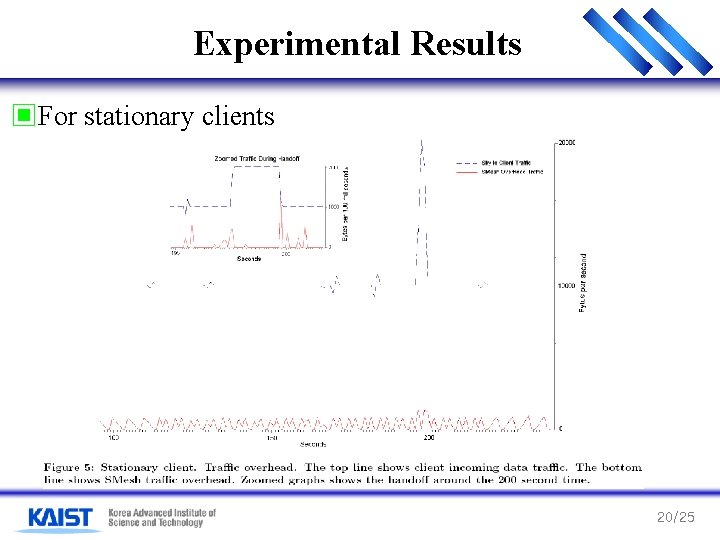
Experimental Results ▣For stationary clients 20/25
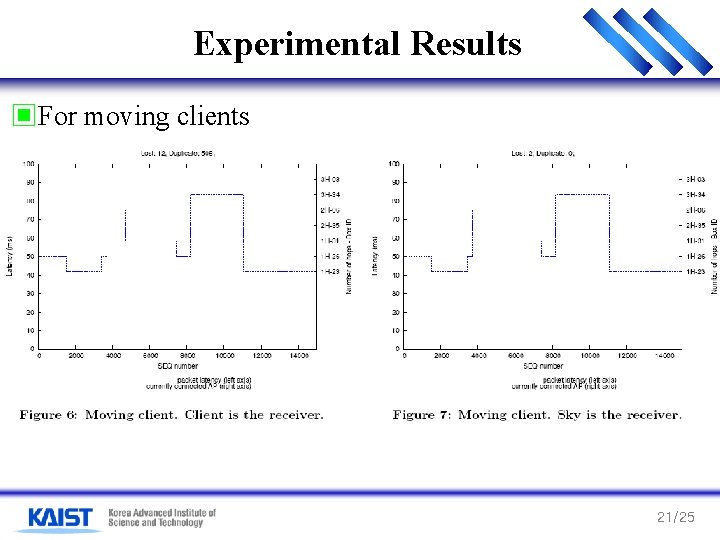
Experimental Results ▣For moving clients 21/25
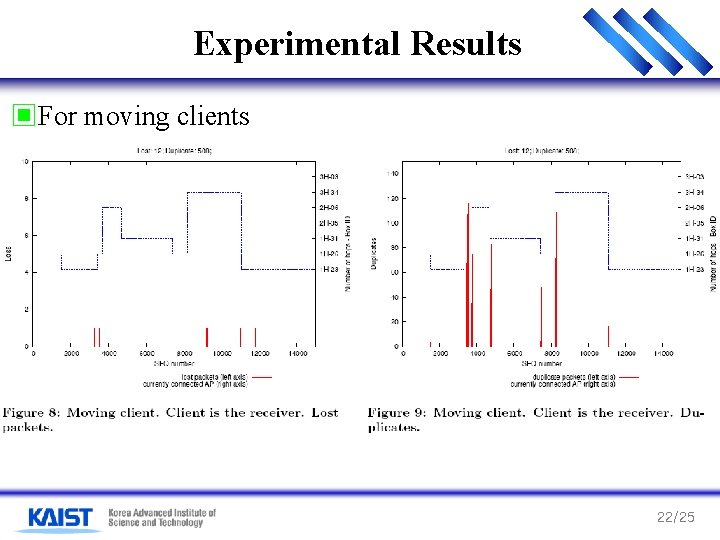
Experimental Results ▣For moving clients 22/25
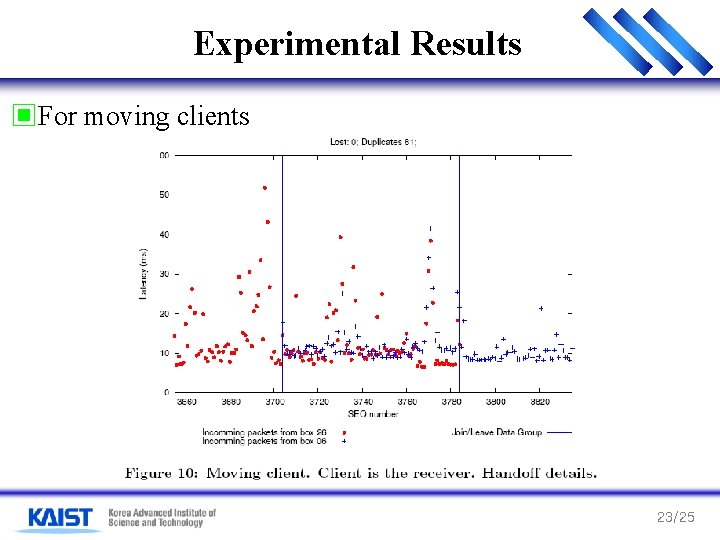
Experimental Results ▣For moving clients 23/25
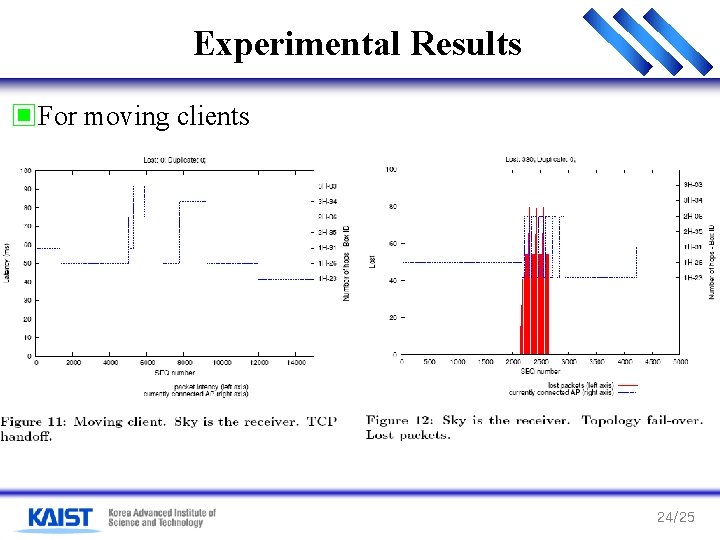
Experimental Results ▣For moving clients 24/25
Conclusion ▣Novel technique for wireless mesh network handoff § Ensure seamless and fast handoff ▣Novel use of DHCP combined ARP messages § Creates single virtual access point § Supports any standard 802. 11 devices ▣What is the problem? 25/25