
Standardizing Hand offs for Patient Safety Objectives Understand

Standardizing Hand offs for Patient Safety
Objectives • Understand the background to National Patient Safety Goal 2 E • Discuss 3 methods of achieving effective Hand-offs • State how strategies developed in high reliability organizations (HROs) can be applied to Hand-offs 2
Institute of Medicine Report • Impact of Error: Federal Action By 5 years: – 44, 000– 98, 000 annual deaths medical errors by 50%, occur as a result of errors nosocomial by 90%, – Medical errors lead followed and eliminate “neverevents” (e. g. , wrong-site by surgical mistakes and surgery) complications – More Americans die from medical errors than from breast cancer, AIDS, or car accidents – 7% of hospital patients experience a serious medication error 3
Institute of Medicine Report Cost associated with medical errors is $8– 29 billion annually. 4
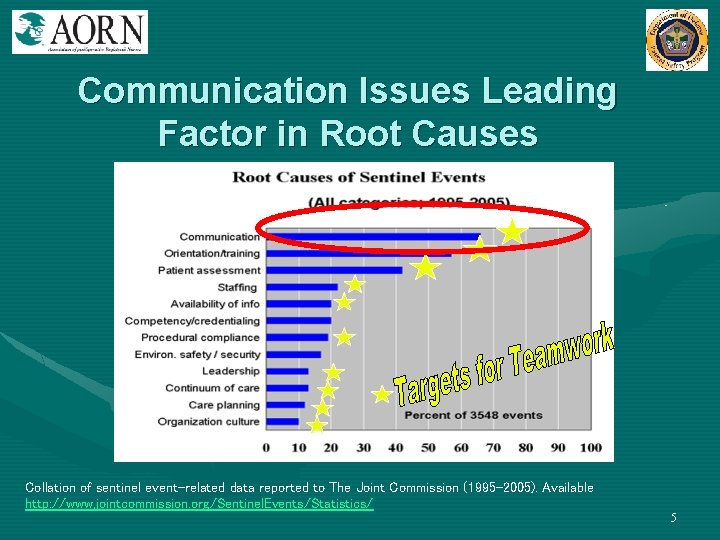
Communication Issues Leading Factor in Root Causes Collation of sentinel event-related data reported to The Joint Commission (1995 -2005). Available http: //www. jointcommission. org/Sentinel. Events/Statistics/ 5
Joint Commission National Patient Safety Goal-2 E • Implement a standardized approach to “hand-off” communications including an opportunity to ask and respond to questions. 6
Joint Commission National Patient Safety Goal-2 E Implementation Expectations: • Interactive communications allowing the opportunity to • ask or respond to questions • Include up to day information regarding: – Care – Treatment – Services – Condition – Recent or anticipated changes 7
Implementation Expectations (cont. ): • • Limited interruptions Sufficient time allocated • Process for verification of the information – Repeat back – Read back • Receiver reviews relevant historical patient data including: – Previous care – Previous treatment – Previous services 8
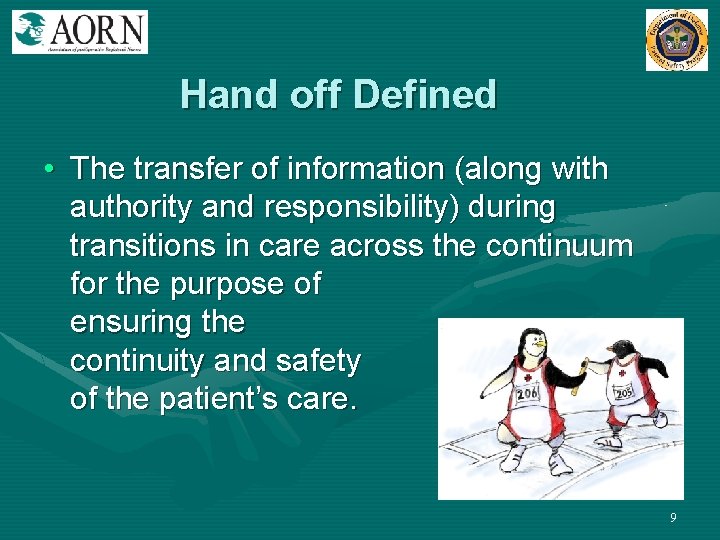
Hand off Defined • The transfer of information (along with authority and responsibility) during transitions in care across the continuum for the purpose of ensuring the continuity and safety of the patient’s care. 9
Types of Hand offs • On call responsibilities • Critical reports (laboratory and imaging ) • Hospital transfers (home, skilled nursing facility) • Other transitions in care (ED, radiology, physical therapy) 10
Types of Hand offs (cont. ) • Patient hand-offs – Level of care (cross coverage) • Nursing shift change/break relief • Physician transferring care – OR to PACU 11
Are Surgical Patients at Risk? • • • Procedure scheduled (clinician's office) Scheduling office Pre-procedure assessment Admitting department Pre operative area/nursing unit 12
Are Surgical Patients at Risk? • • • Procedures – invasive/noninvasive PACU Nursing unit Home Clinician’s office for post procedure evaluation 13
Communication During Transitions in Health Care 14
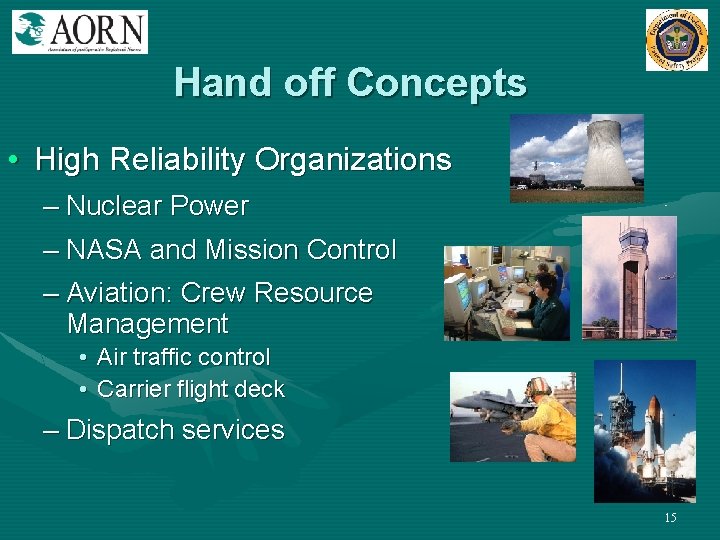
Hand off Concepts • High Reliability Organizations – Nuclear Power – NASA and Mission Control – Aviation: Crew Resource Management • Air traffic control • Carrier flight deck – Dispatch services 15
Barriers to Effective Communication • • Human fallibility Complex systems Limitations of learning & training Continuity gaps Negative impact of fatigue Time constraints Volume of information Confidentiality 16
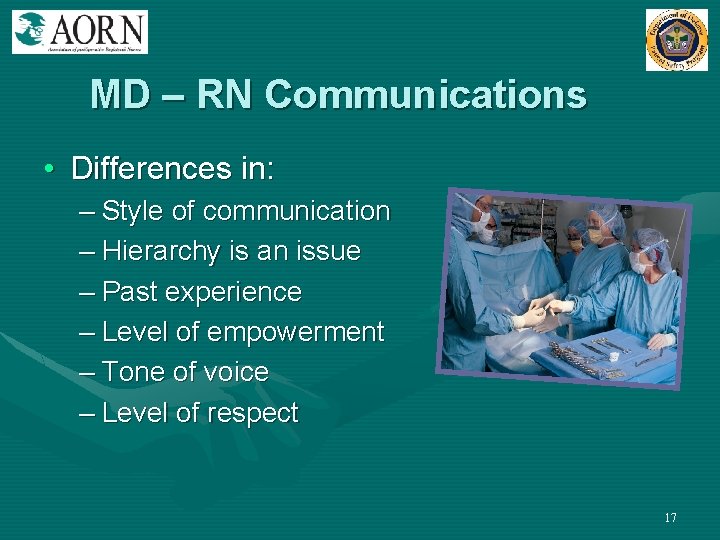
MD – RN Communications • Differences in: – Style of communication – Hierarchy is an issue – Past experience – Level of empowerment – Tone of voice – Level of respect 17
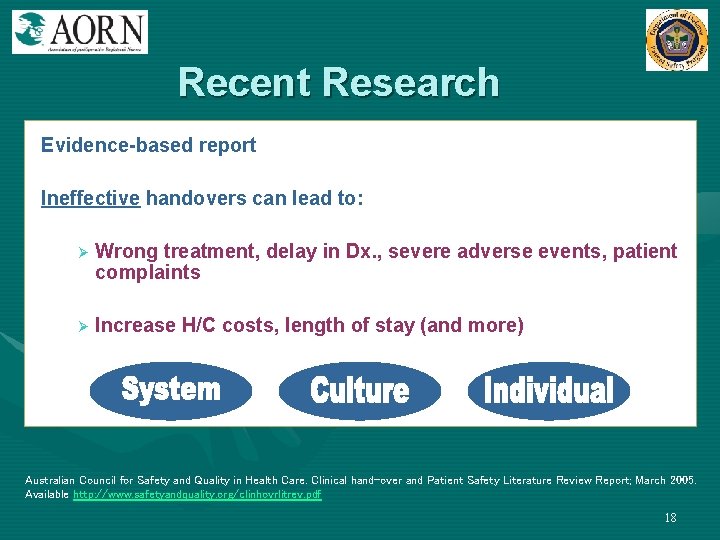
Recent Research Evidence-based report Ineffective handovers can lead to: Ø Wrong treatment, delay in Dx. , severe adverse events, patient complaints Ø Increase H/C costs, length of stay (and more) Australian Council for Safety and Quality in Health Care. Clinical hand-over and Patient Safety Literature Review Report; March 2005. Available http: //www. safetyandquality. org/clinhovrlitrev. pdf 18
Recent Research “How to Study ‘Hard-to-see-things’: Shift Change in the Emergency Department" § Poorly studied, despite importance § Shift change as a source of Failure § Shift change as a source of Recovery Wears R, Roth E, Patterson E, Perry S. "Shift Change Signovers as a Double-Edged Sword: Technical Work Studies in Emergency Medicine". Society for Academic Emergency Medicine, Annual Meeting. New York, NY; May 25 2005. Available http: //www. saem. org/meetings/05 hand/wears. ppt 19
Recent Research 12 Simulated Patients 5 consecutive handover cycles – 3 different styles n Verbal handover resulted in loss of all data n Note taking style resulted in loss of 31% n Form with verbal handover resulted in minimal loss Pothier, D, Monteiro, P, Mooktiar, M, Shaw, A “Pilot study to show the loss of important data in nursing handover”. British Journal of Nursing, 2005, vol 14, No. 20
Implementation Suggestions • • Assess all points where hand offs occur Concurrently monitor process at all points Conduct gap analysis Identify champions, physicians, nurses, leadership 21
Implementation Suggestions • • • Select a consistent approach to hand offs Develop a policy and procedure Educate staff Implement the policy Monitor & report findings 22
Why Consistency is Needed • • • Complicating factors inhibit consistency Differences in styles of communication Gender differences Cultural background Hierarchy of decision making Level of respect between physicians and nurses • Level of empowerment 23
Consistency in Communication • Focuses on the patient and individual needs • Reduces impact of complicating factors • Increases the odds of consistent quality & service to patient • Requires physicians to become more intentional and disciplined in their interaction with employees • Requires employees to become more disciplined in their work with physicians 24
Standardized Communication • Focuses on the patient not the people • Standardized format allows all parties to have common expectations: – What is going to be communicated – How the communication is structured – Required elements 25
Assertive Communication is: • • • Being organized in thought and communication Being competent technically and socially Disavowing perfection while looking for clarification/common understanding • Owned by the entire team – not just a “subordinate” skill set • It must be valued by the receiver to be successful 26
Assertion Is Not • Aggressive/hostile, • Confrontational, • Ambiguous, or • Ridiculing 27
Why is Assertion So Hard? • Hierarchy of decision making • Lack of common mental model • Don’t want to look “stupid” • Not sure I’m right • Culture • Gender 28
Communication Check List • • • Get the person’s attention Make eye contact, face the person Use the person’s name Express concern Use the communication technique (e. g. , I-SBAR) • Re-assert as necessary • Decision reached • Escalate if necessary 29
Sample Communication Tools • I-SBAR • I PASS THE BATON • 5 P’s 30
I - SBAR I – introduction S - ituation (the current issue) B - ackground (brief, related to the point) A - ssessment (what you found/think) R – ecommendation/request (what you want next) 31
Introduction • State your name and unit • I am calling about (patient name) 32
Situation • Patient age • Gender • Pre-op diagnosis • Procedure • Mental status pre-procedure • Patient stable/unstable 33
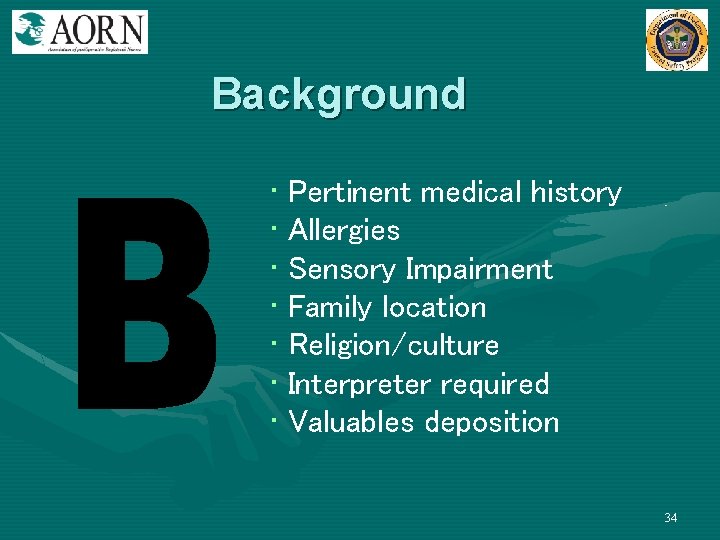
Background • Pertinent medical history • Allergies • Sensory Impairment • Family location • Religion/culture • Interpreter required • Valuables deposition 34
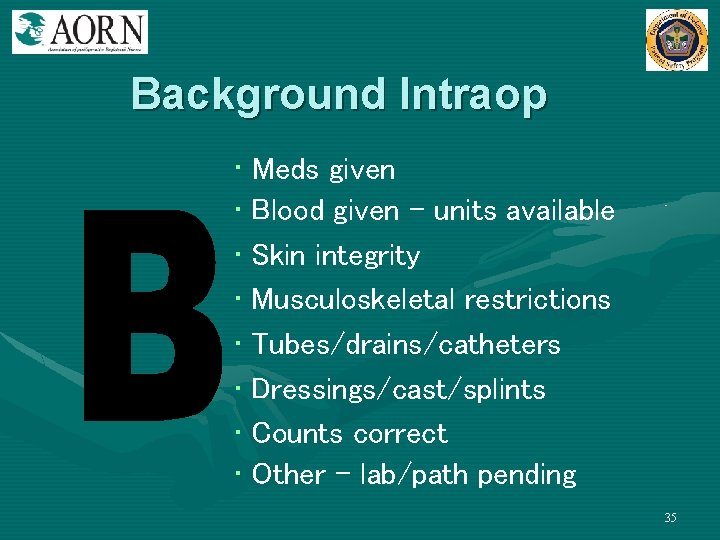
Background Intraop • Meds given • Blood given – units available • Skin integrity • Musculoskeletal restrictions • Tubes/drains/catheters • Dressings/cast/splints • Counts correct • Other – lab/path pending 35
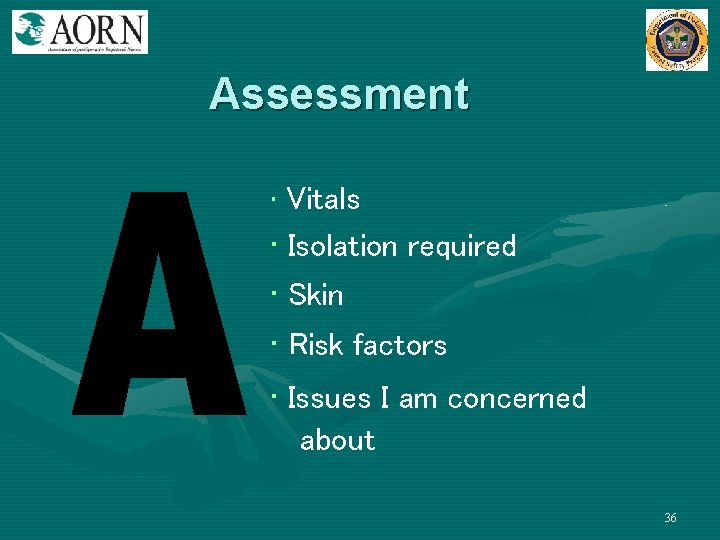
Assessment • Vitals • Isolation required • Skin • Risk factors • Issues I am concerned about 36
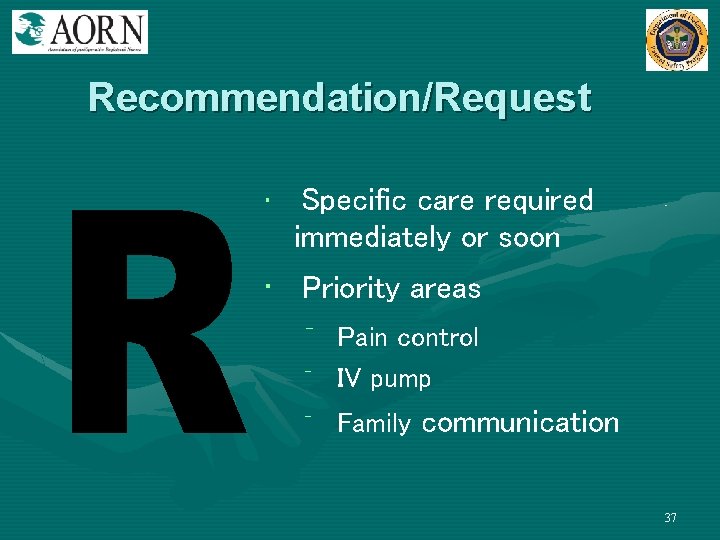
Recommendation/Request • Specific care required immediately or soon • Priority areas ⁻ Pain control ⁻ IV pump ⁻ Family communication 37
I PASS THE BATON 38
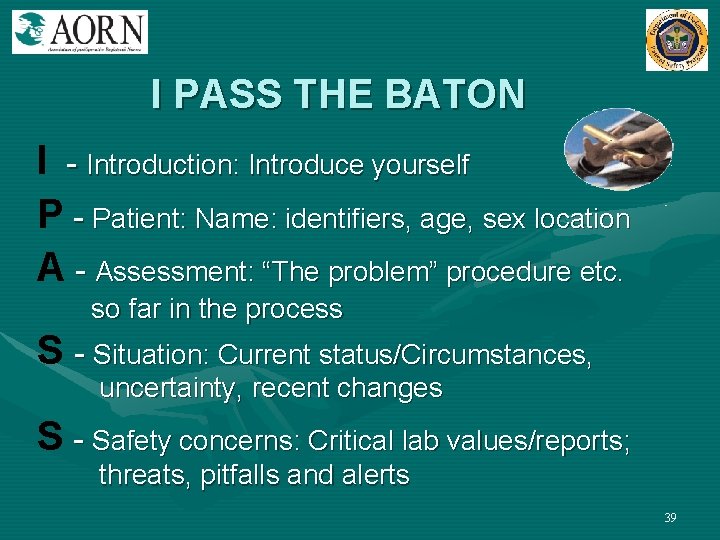
I PASS THE BATON I - Introduction: Introduce yourself P - Patient: Name: identifiers, age, sex location A - Assessment: “The problem” procedure etc. so far in the process S - Situation: Current status/Circumstances, uncertainty, recent changes S - Safety concerns: Critical lab values/reports; threats, pitfalls and alerts 39
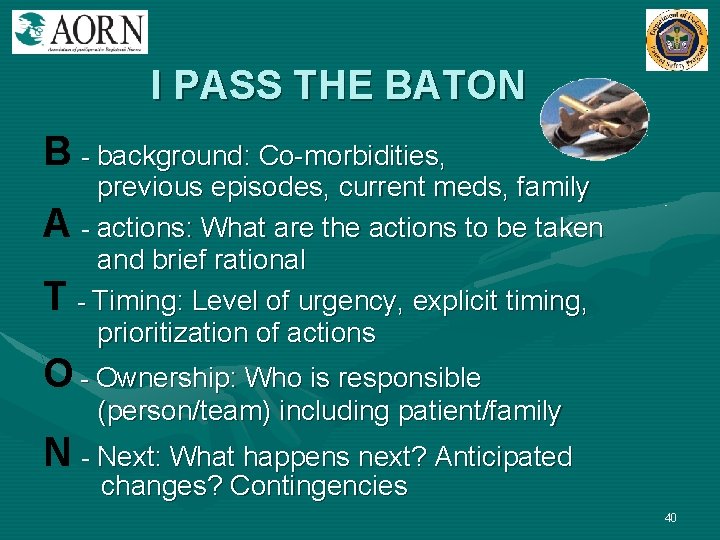
I PASS THE BATON B - background: Co-morbidities, previous episodes, current meds, family A - actions: What are the actions to be taken and brief rational T - Timing: Level of urgency, explicit timing, prioritization of actions O - Ownership: Who is responsible (person/team) including patient/family N - Next: What happens next? Anticipated changes? Contingencies 40
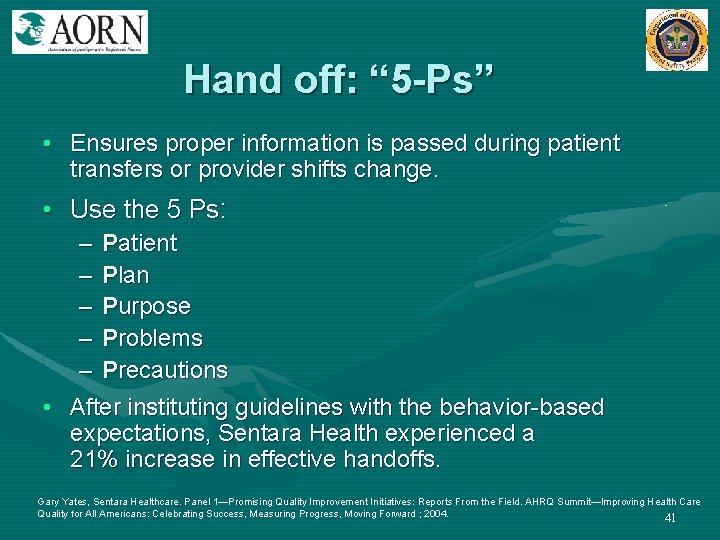
Hand off: “ 5 -Ps” • Ensures proper information is passed during patient transfers or provider shifts change. • Use the 5 Ps: – Patient – Plan – Purpose – Problems – Precautions • After instituting guidelines with the behavior-based expectations, Sentara Health experienced a 21% increase in effective handoffs. Gary Yates, Sentara Healthcare. Panel 1—Promising Quality Improvement Initiatives: Reports From the Field. AHRQ Summit—Improving Health Care Quality for All Americans: Celebrating Success, Measuring Progress, Moving Forward ; 2004. 41
Issues, Dilemma and Tradeoffs • Ineffective methods: unstructured, oneway • Time commitment and process changes required • Extreme variability and uniqueness of hand offs and transitions • Lack of focused research on healthcare hand offs Efficiency Effectiveness 42
Spread of Hand-off Tools • Other ideas: Forms 3 x 5 laminated Check lists pocket cards IT support – - Orientation of new staff (RN, Nursing Notes MD, Residents) • Post hospitalization - Stickers on the phone and Primary Care - Screen savers Provider • • • - Nursing newsletter 43
Conclusions • Transitions in care a prime target for improved patient safety efforts • Sentinel event data creates urgency for change • Strategies developed in high reliability organizations can be applied to health care • The Joint Commission’s National Patient Safety Goals have accelerated the pace of change in applying human factor science to patient care handoffs 44

45
- Slides: 45