Extraterrestrial Life where Do you like This lady



- Slides: 43
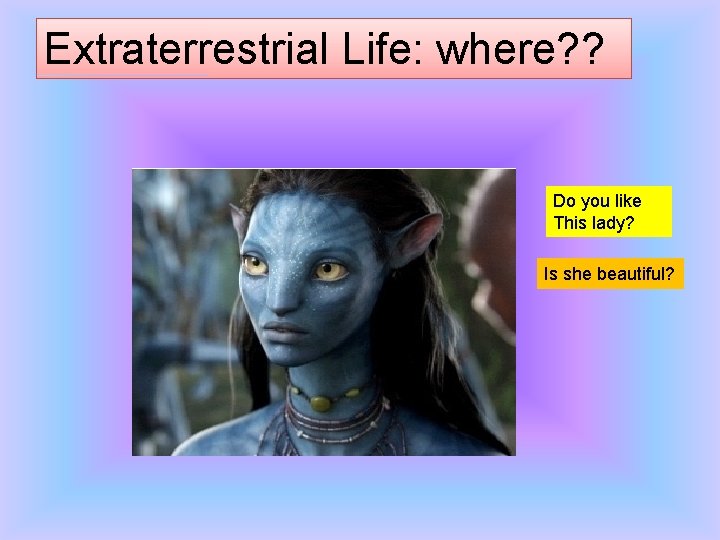
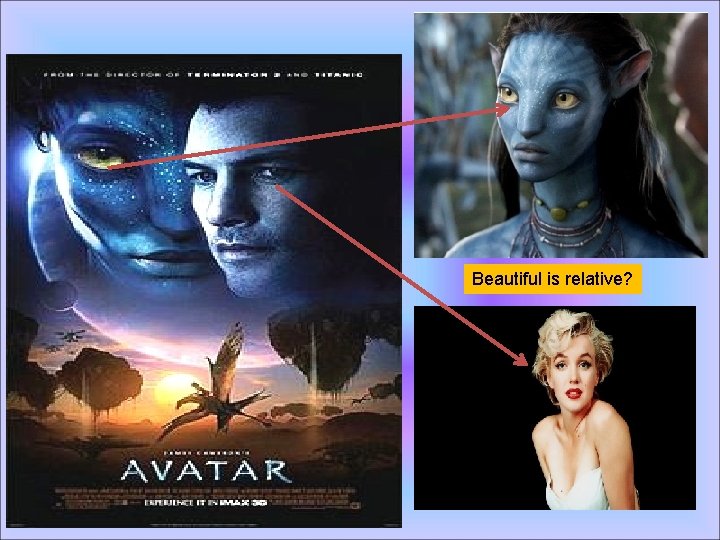
Extraterrestrial Life: where? ? Do you like This lady? Is she beautiful?
Beautiful is relative?
My name: Mounib El Eid ﻣﻨﻴﺐ ﺍﻟﻌﻴﺪ Department of Physics
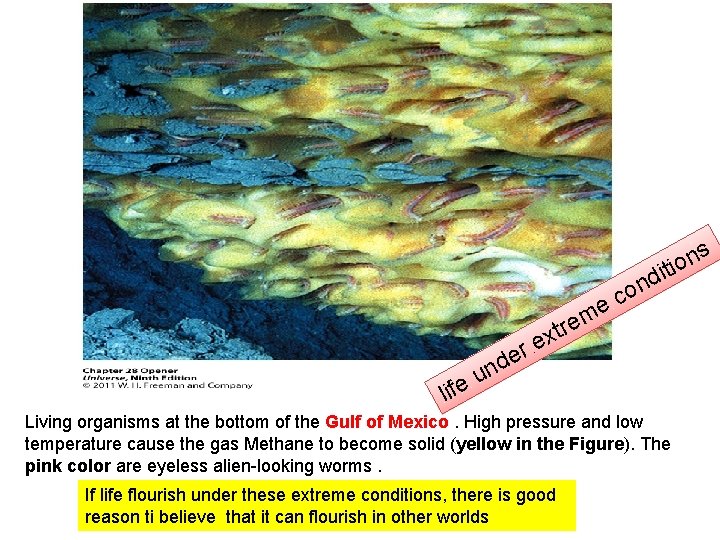
s n ti io d life t x re e d n u e m re n co Living organisms at the bottom of the Gulf of Mexico. High pressure and low temperature cause the gas Methane to become solid (yellow in the Figure). The pink color are eyeless alien-looking worms. If life flourish under these extreme conditions, there is good reason ti believe that it can flourish in other worlds
Stimulation & messages to thhe audience With the help of Astronomy, we try to understand how we fit into the universe. Tens of thousands of past human generations have walked this Earth. Ours is the first generation with technology to study the far reaches of the universe and to search for life elsewhere and to travel beyond our planet. It is up to us to decide whether we will use this technology to advance our species or to destroy it. Just imagine our descendants joining other civilizations. Perhaps, in their history lessons, they will learn of our generation—the generation that history will placed at the turning point and that managed to steer its way past the dangers of self-destruction and onto the path to the stars Certainly not systems like in North Korea (or near to us) are meant in this connection I never understood why people make war, if they are able to discover the beauty of love!
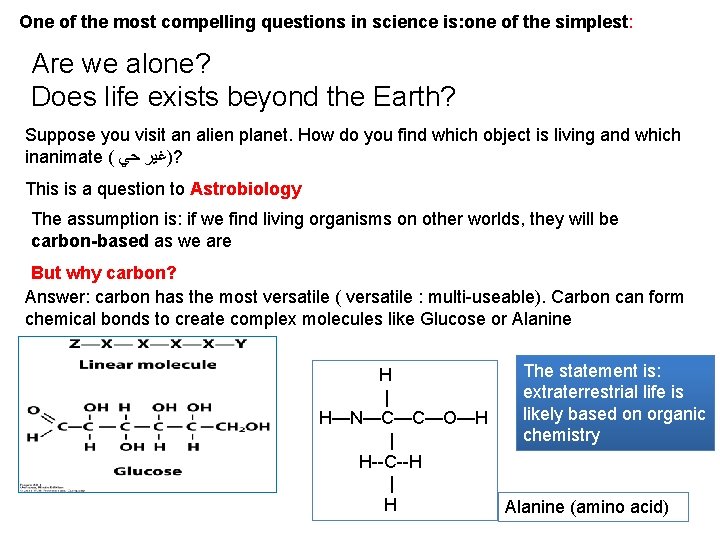
One of the most compelling questions in science is: one of the simplest: Are we alone? Does life exists beyond the Earth? Suppose you visit an alien planet. How do you find which object is living and which inanimate ( ? )ﻏﻴﺮ ﺣﻲ This is a question to Astrobiology The assumption is: if we find living organisms on other worlds, they will be carbon-based as we are But why carbon? Answer: carbon has the most versatile ( versatile : multi-useable). Carbon can form chemical bonds to create complex molecules like Glucose or Alanine The statement is: H extraterrestrial life is | likely based on organic H—N—C—C—O—H chemistry | H--C--H | H Alanine (amino acid)
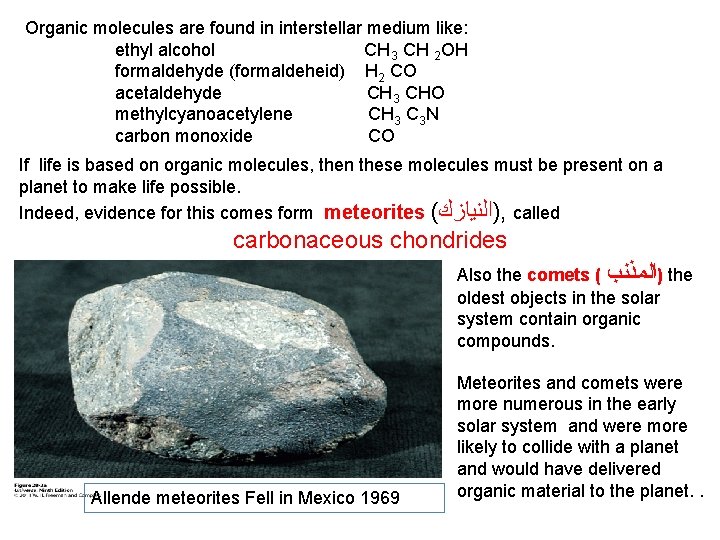
Organic molecules are found in interstellar medium like: ethyl alcohol CH 3 CH 2 OH formaldehyde (formaldeheid) H 2 CO acetaldehyde CH 3 CHO methylcyanoacetylene CH 3 C 3 N carbon monoxide CO If life is based on organic molecules, then these molecules must be present on a planet to make life possible. Indeed, evidence for this comes form meteorites ( )ﺍﻟﻨﻴﺎﺯﻙ , called carbonaceous chondrides Also the comets ( )ﺍﻟﻤﺬﻧﺐ the oldest objects in the solar system contain organic compounds. Allende meteorites Fell in Mexico 1969 Meteorites and comets were more numerous in the early solar system and were more likely to collide with a planet and would have delivered organic material to the planet. .
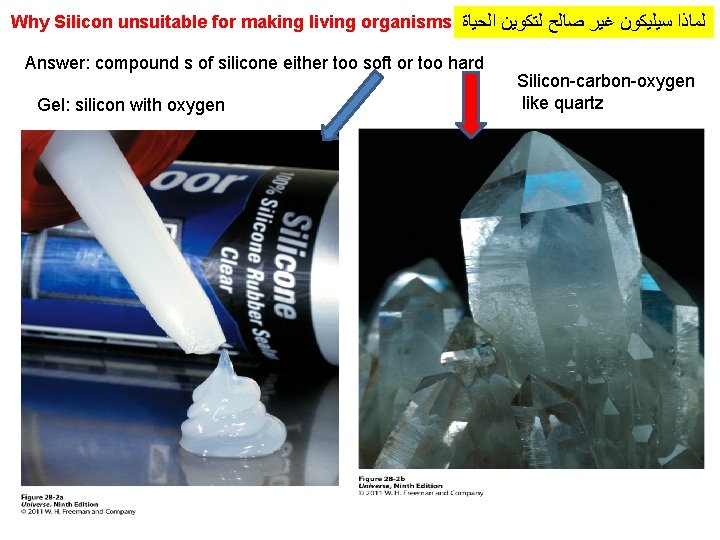
Why Silicon unsuitable for making living organisms ﻟﻤﺎﺫﺍ ﺳﻴﻠﻴﻜﻮﻥ ﻏﻴﺮ ﺻﺎﻟﺢ ﻟﺘﻜﻮﻳﻦ ﺍﻟﺤﻴﺎﺓ Answer: compound s of silicone either too soft or too hard Gel: silicon with oxygen Silicon-carbon-oxygen like quartz
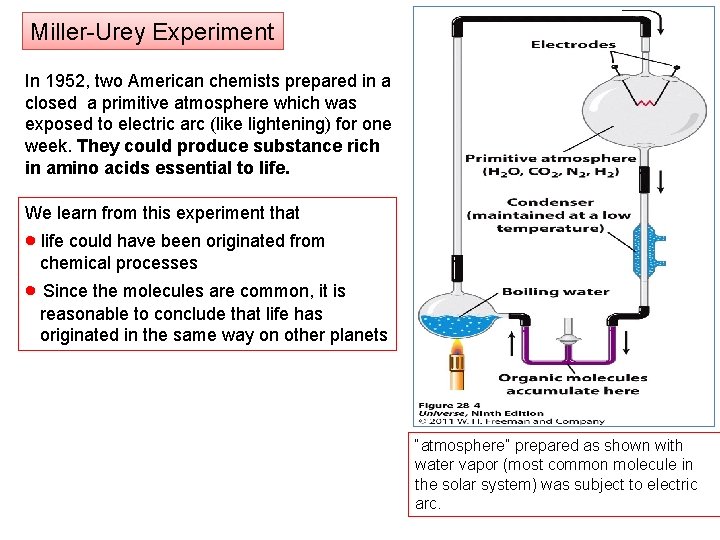
Miller-Urey Experiment In 1952, two American chemists prepared in a closed a primitive atmosphere which was exposed to electric arc (like lightening) for one week. They could produce substance rich in amino acids essential to life. We learn from this experiment that life could have been originated from chemical processes Since the molecules are common, it is reasonable to conclude that life has originated in the same way on other planets “atmosphere” prepared as shown with water vapor (most common molecule in the solar system) was subject to electric arc.
CAUTION ! Scientists have not created life in the a tube. Biologists have to yet figure out how complex molecules collected themselves into cells and developed systems of self -reproduction. But because chemical components of life are easily synthesized under conditions that simulate the early Earth, it seems reasonable to assume that life has originated as a result of chemical processes Another insight: since the molecules that form the compounds are common, it is reasonable to assume that life has originated in the same way on other planets Conclusion: it seems all living organisms have common chemical origin ﻛﻞ ﺍﻟﻜﺎﺋﻨﺎﺕ ﺍﻟﺤﻴﺔ ﻟﻬﺎ ﺗﻜﻮﻳﻦ ﻛﻴﻤﺎﺋﻲ ﻣﺸﺘﺮﻙ We also can say: Chemical evolution preceded biological evolution ﺍﻟﺘﻄﻮﺭ ﺍﻟﻜﻴﻤﻴﺄﺌﻲ ﺳﺒﻖ ﺍﻟﺘﻄﻮﺭ ﺍﻟﺒﻴﻮﻟﻮﺟﻲ
Importance of liquid water Essential for the survival of life. It should not be always pleasant for drinking or taking a shower. Terrestrial organisms have been found in boiling water or ice cold. But it must be liquid which means the temperature cannot be too high or too low. In addition to have water on a planet’s surface, a thick atmosphere must exist. The atmospheric pressure prevents the evaporation of the water. Our Earth has these conditions- we are lucky !! However, there is now evidence that the satellite Europa of Jupiter has an ocean beneath its icy surface Conclusion: We have to look for planets with atmospheres if we search for extraterrestrial life
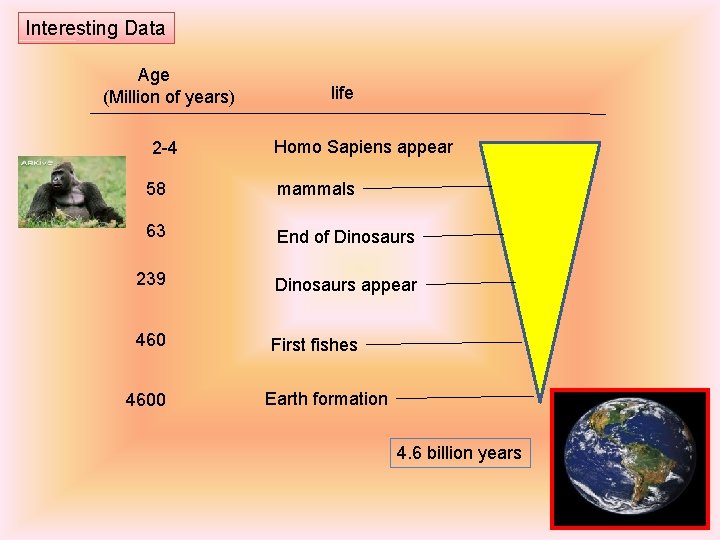
Interesting Data Age (Million of years) 2 -4 life Homo Sapiens appear 58 mammals 63 End of Dinosaurs 239 Dinosaurs appear 460 First fishes 4600 Earth formation 4. 6 billion years
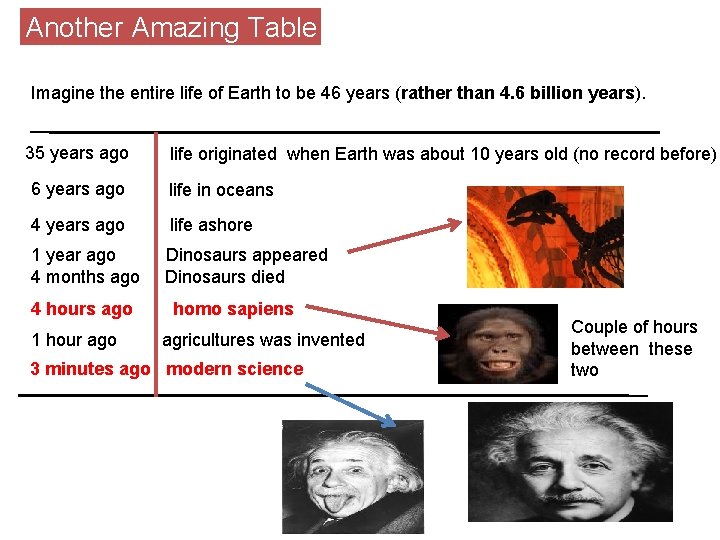
Another Amazing Table Imagine the entire life of Earth to be 46 years (rather than 4. 6 billion years). 35 years ago life originated when Earth was about 10 years old (no record before) 6 years ago life in oceans 4 years ago life ashore 1 year ago 4 months ago Dinosaurs appeared Dinosaurs died 4 hours ago 1 hour ago homo sapiens agricultures was invented 3 minutes ago modern science Couple of hours between these two
How did life arise on Earth? History of life is based o theory of evolution proposed by Charles Darwin Evolution means changing with time. But how do species undergo change Darwin theory says: Evolution proceeds through a process of natural selection. This means: nature select the advantageous track for survival. This is why the process is called “natural”. Some 150 years of research has supported this view of Darwin The strongest support comes from the discovery of the DNA. The DNA is the genetic material of all life. Living organisms reproduce by copying DNA What is a DNA ? See next
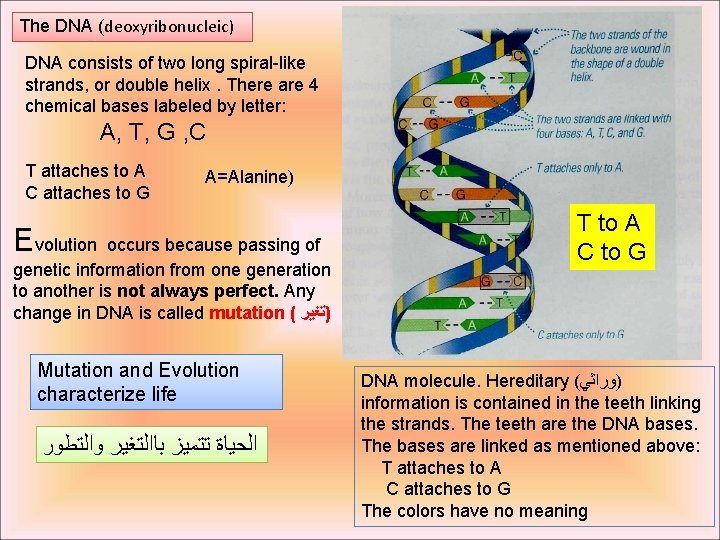
The DNA (deoxyribonucleic) DNA consists of two long spiral-like strands, or double helix. There are 4 chemical bases labeled by letter: A, T, G , C T attaches to A C attaches to G A=Alanine) Evolution occurs because passing of genetic information from one generation to another is not always perfect. Any change in DNA is called mutation ( )ﺗﻐﻴﺮ Mutation and Evolution characterize life ﻭﺍﻟﺘﻄﻮﺭ Fig. 18. 5 Cosmic perspective ﺍﻟﺤﻴﺎﺓ ﺗﺘﻤﻴﺰ ﺑﺎﺍﻟﺘﻐﻴﺮ T to A C to G DNA molecule. Hereditary ( )ﻭﺭﺍﺛﻲ information is contained in the teeth linking the strands. The teeth are the DNA bases. The bases are linked as mentioned above: T attaches to A C attaches to G The colors have no meaning
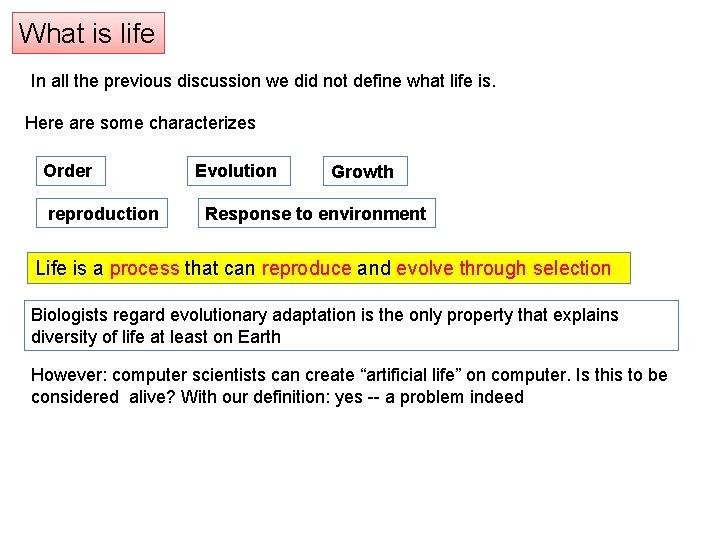
What is life In all the previous discussion we did not define what life is. Here are some characterizes Order reproduction Evolution Growth Response to environment Life is a process that can reproduce and evolve through selection Biologists regard evolutionary adaptation is the only property that explains diversity of life at least on Earth However: computer scientists can create “artificial life” on computer. Is this to be considered alive? With our definition: yes -- a problem indeed
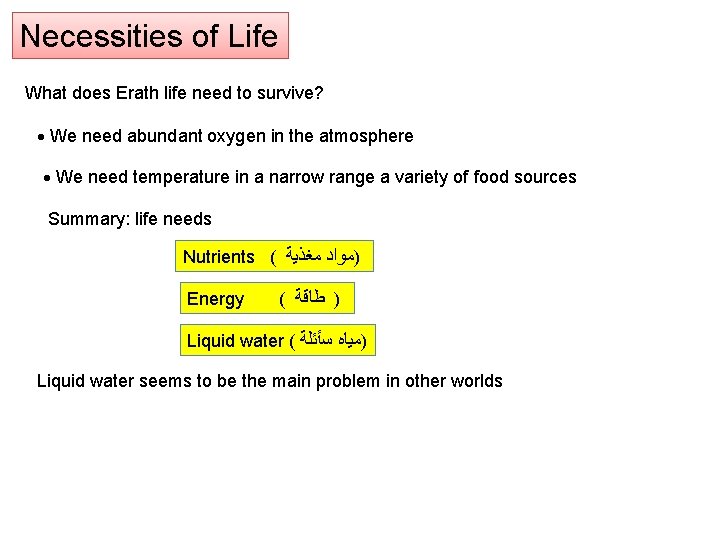
Necessities of Life What does Erath life need to survive? We need abundant oxygen in the atmosphere We need temperature in a narrow range a variety of food sources Summary: life needs Nutrients ( )ﻣﻮﺍﺩ ﻣﻐﺬﻳﺔ Energy ( ) ﻃﺎﻗﺔ Liquid water ( )ﻣﻴﺎﻩ ﺳﺄﺌﻠﺔ Liquid water seems to be the main problem in other worlds
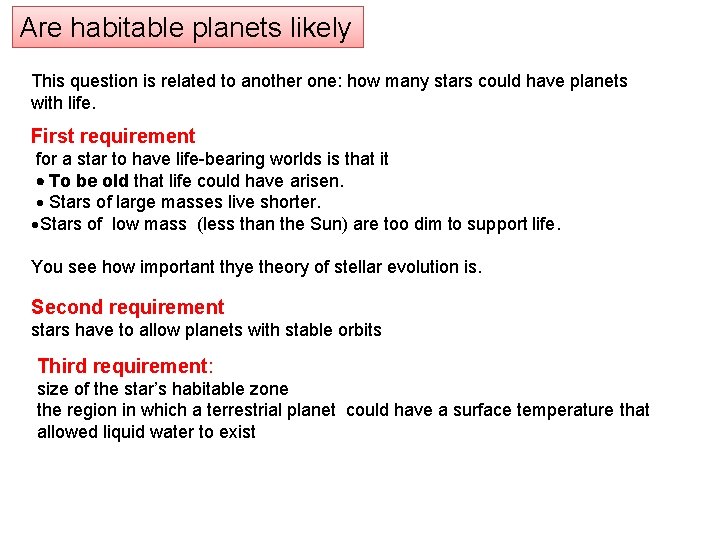
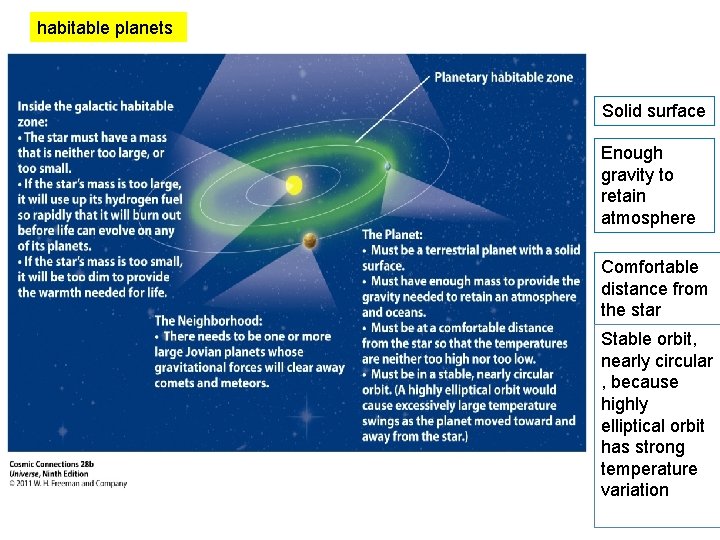
Are habitable planets likely This question is related to another one: how many stars could have planets with life. First requirement for a star to have life-bearing worlds is that it To be old that life could have arisen. Stars of large masses live shorter. Stars of low mass (less than the Sun) are too dim to support life. You see how important thye theory of stellar evolution is. Second requirement stars have to allow planets with stable orbits Third requirement: size of the star’s habitable zone the region in which a terrestrial planet could have a surface temperature that allowed liquid water to exist
habitable planets Solid surface Enough gravity to retain atmosphere Comfortable distance from the star Stable orbit, nearly circular , because highly elliptical orbit has strong temperature variation
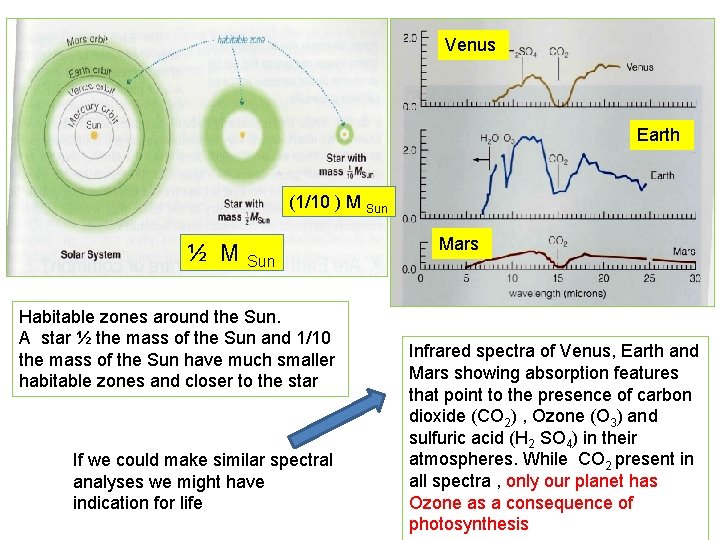
Venus Earth (1/10 ) M Sun ½ M Sun Habitable zones around the Sun. A star ½ the mass of the Sun and 1/10 the mass of the Sun have much smaller habitable zones and closer to the star If we could make similar spectral analyses we might have indication for life Mars Infrared spectra of Venus, Earth and Mars showing absorption features that point to the presence of carbon dioxide (CO 2) , Ozone (O 3) and sulfuric acid (H 2 SO 4) in their atmospheres. While CO 2 present in all spectra , only our planet has Ozone as a consequence of photosynthesis
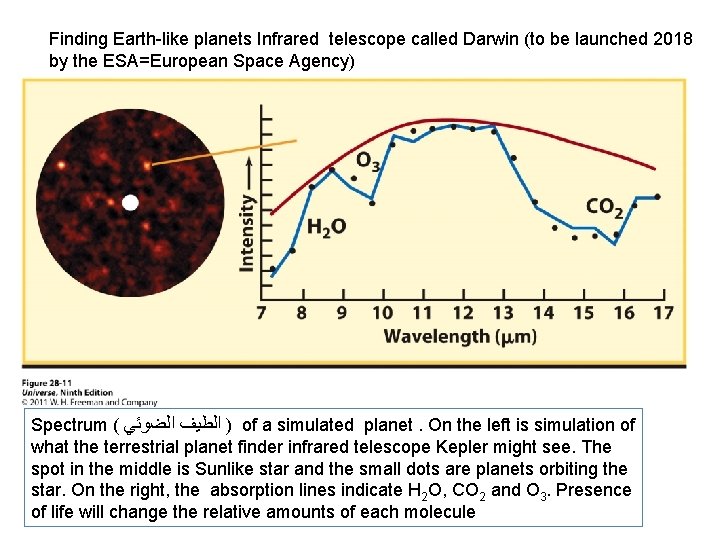
Finding Earth-like planets Infrared telescope called Darwin (to be launched 2018 by the ESA=European Space Agency) Spectrum ( ) ﺍﻟﻄﻴﻒ ﺍﻟﻀﻮﺋﻲ of a simulated planet. On the left is simulation of what the terrestrial planet finder infrared telescope Kepler might see. The spot in the middle is Sunlike star and the small dots are planets orbiting the star. On the right, the absorption lines indicate H 2 O, CO 2 and O 3. Presence of life will change the relative amounts of each molecule
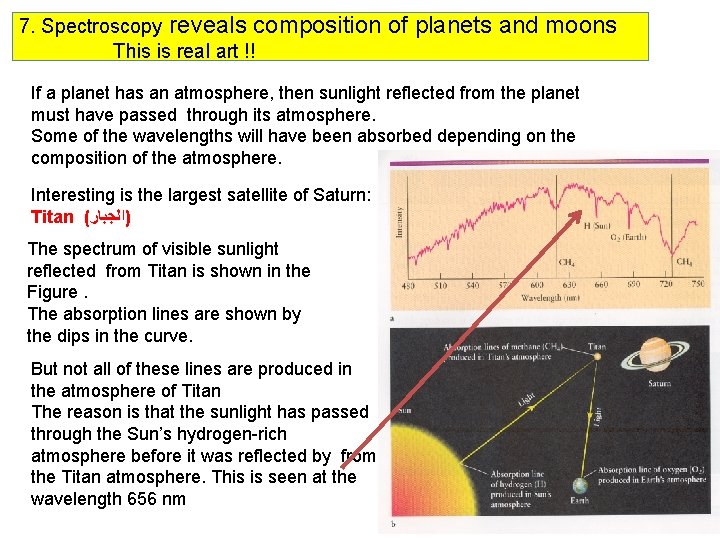
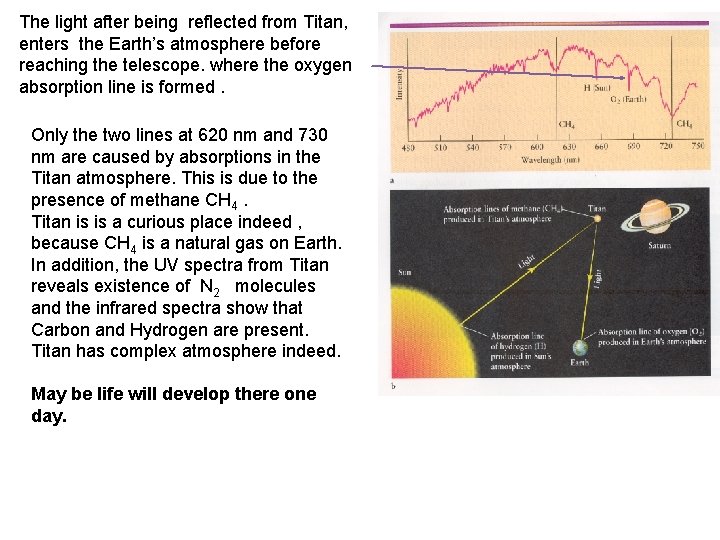
7. Spectroscopy reveals composition This is real art !! of planets and moons If a planet has an atmosphere, then sunlight reflected from the planet must have passed through its atmosphere. Some of the wavelengths will have been absorbed depending on the composition of the atmosphere. Interesting is the largest satellite of Saturn: Titan ( )ﺍﻟﺠﺒﺎﺭ The spectrum of visible sunlight reflected from Titan is shown in the Figure. The absorption lines are shown by the dips in the curve. But not all of these lines are produced in the atmosphere of Titan The reason is that the sunlight has passed through the Sun’s hydrogen-rich atmosphere before it was reflected by from the Titan atmosphere. This is seen at the wavelength 656 nm
The light after being reflected from Titan, enters the Earth’s atmosphere before reaching the telescope. where the oxygen absorption line is formed. Only the two lines at 620 nm and 730 nm are caused by absorptions in the Titan atmosphere. This is due to the presence of methane CH 4. Titan is is a curious place indeed , because CH 4 is a natural gas on Earth. In addition, the UV spectra from Titan reveals existence of N 2 molecules and the infrared spectra show that Carbon and Hydrogen are present. Titan has complex atmosphere indeed. May be life will develop there one day.
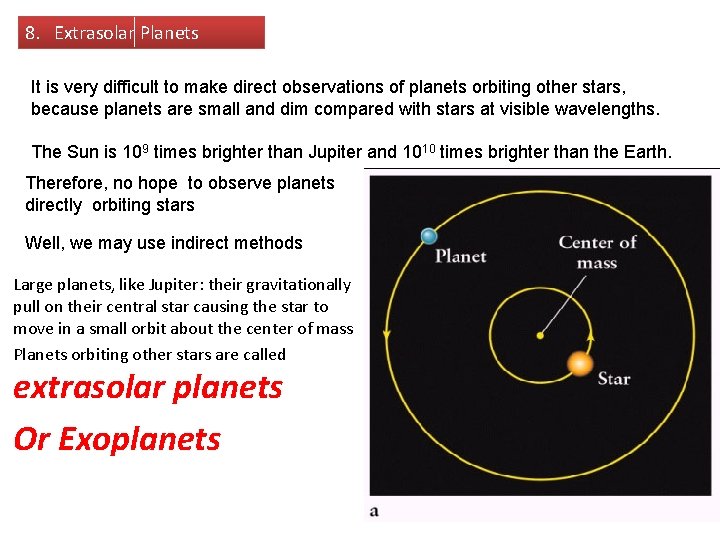
8. Extrasolar Planets It is very difficult to make direct observations of planets orbiting other stars, because planets are small and dim compared with stars at visible wavelengths. The Sun is 109 times brighter than Jupiter and 1010 times brighter than the Earth. Therefore, no hope to observe planets directly orbiting stars Well, we may use indirect methods Large planets, like Jupiter: their gravitationally pull on their central star causing the star to move in a small orbit about the center of mass Planets orbiting other stars are called extrasolar planets Or Exoplanets
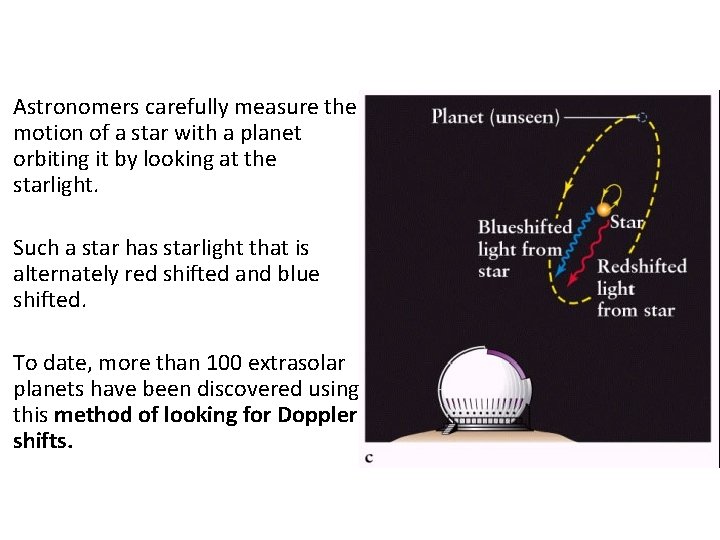
Astronomers carefully measure the motion of a star with a planet orbiting it by looking at the starlight. Such a star has starlight that is alternately red shifted and blue shifted. To date, more than 100 extrasolar planets have been discovered using this method of looking for Doppler shifts.
Planet transit http: //www. astroevents. no/lifesearch. html. AN N O I T A NIM
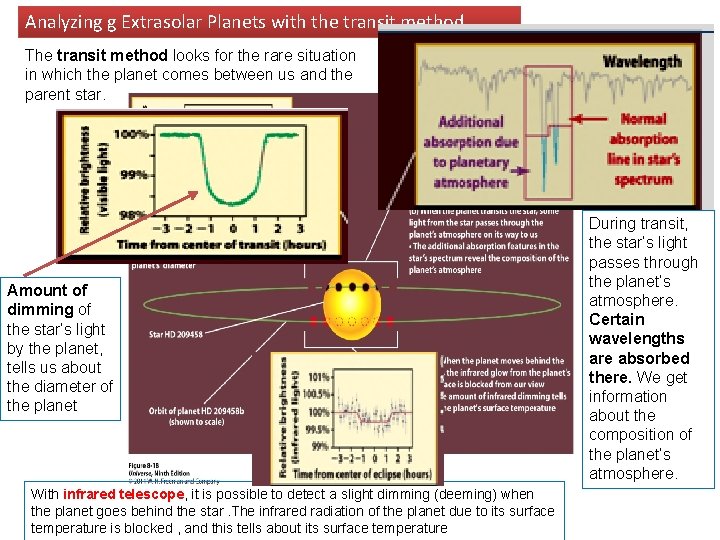
Analyzing g Extrasolar Planets with the transit method The transit method looks for the rare situation in which the planet comes between us and the parent star. Amount of dimming of the star’s light by the planet, tells us about the diameter of the planet With infrared telescope, it is possible to detect a slight dimming (deeming) when the planet goes behind the star. The infrared radiation of the planet due to its surface temperature is blocked , and this tells about its surface temperature During transit, the star’s light passes through the planet’s atmosphere. Certain wavelengths are absorbed there. We get information about the composition of the planet’s atmosphere.
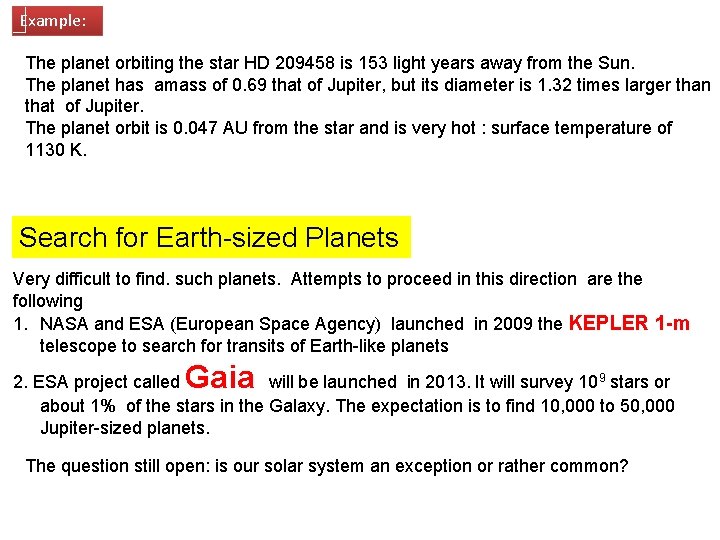
Example: The planet orbiting the star HD 209458 is 153 light years away from the Sun. The planet has amass of 0. 69 that of Jupiter, but its diameter is 1. 32 times larger than that of Jupiter. The planet orbit is 0. 047 AU from the star and is very hot : surface temperature of 1130 K. Search for Earth-sized Planets Very difficult to find. such planets. Attempts to proceed in this direction are the following 1. NASA and ESA (European Space Agency) launched in 2009 the KEPLER 1 -m telescope to search for transits of Earth-like planets Gaia 2. ESA project called will be launched in 2013. It will survey 109 stars or about 1% of the stars in the Galaxy. The expectation is to find 10, 000 to 50, 000 Jupiter-sized planets. The question still open: is our solar system an exception or rather common?
The Fermi Paradox Life in the universe , p. 455 He says: neither we nor our planet should be special. . Or othe civilization may exist capable of space travel Is there a civilization who has colonized the galaxy already? The paradox is that we face two contradictory ideas: We rare not special We should be surrounded by evidence of these civilizations, but we have no idea yet how to find them. This is interesting: if they are somewhere, then, the should have arisen long before we came to the scene. We know the universe is about 14 billion years old, but the Earth is “only” about 4. 5 billion years old. So we have an interval of 9. 5 billion years before the formation of the solar system. Now, since stars were formed early on in the universe and elements Carbon and beyond are formed in stars , it is likely to have Earth-like planets within few billion years of the universe’s birth.
It is reasonable to say that Earth-like planets started to be formed about 5 billion years before our own planet was born, about the age of the galaxy. So, 5 billion years ahead. If intelligent life needed 5 billion years like ours, then they have appeared 5 billion years ahead of us. But what can we say about the number of these civilizations? Let us play LOTTO: One in one million stars would have a planet Earth-like and with intelligent life. In the Galaxy, we have 1011 stars , or we would have 100, 000 civilizations in the Galaxy by now. This is astonishing, especially if we say that these civilizations have arisen at random times during 5 billion years, then on the average a civilization arises every 5 x 10⁹ /100000=50, 000 years Think about this estimation: 1. Even with 1 civilization for 1 million stars, we have 100, 000 civilizations that arose before we came on the galactic scene 2. We re then youngest civilization, and the next youngest civilization has arisen 50, 000 years ago and the third 100, 000 etc…. 3. Even if we take 1 civilization in 100 million stars, we still have 1000 civilizations that would have arisen over the past 5 billion years and the average would be one per 5 million years.
Now, you have a feeling why Fermi asked: where is everybody? Well, if we would meet with them, they will laugh at our technological achievements. Certainly there will not have 6 hours and more cut in electricity as we are enjoying in the high-tech country “ the Cedar Land” , Halleluiah Instead of trying to resolve the Fermi paradox, let us reflect on its implications. 1. We are alone (Lasamah Allah). Then our civilization is a remarkable achievement. At least we were the first civilization to know that the universe exists We are self-aware then, and that gives us a philosophical sense of life, If so, then the destruction of our civilization with all scientific knowledge would put an end to an achievement that took 14 billion years to come out. , and this would be tragic indeed. The message to the “unique species”: put all wars behind us, protect our environments and respect each other
2. Civilizations are common, but no one has colonized the Ga This has terrifying implication : the are ahead of us and did not succeed to make space travel. What hope do we have then? Message here: hopefully this answer is wrong 3. Most intriguing: we are newcomer on the galactic scene Why they are leaving us alone or we are not yet able to find them. In this respect we are like a baby growing and have to learn how to walk. The message We have the ability to destroy our own civilization. If we do so, then our fate is sealed. But if we survive, long enough then we may develop technologies that can take us to the stars I am back to the stimulating words at beginning of this lecture.
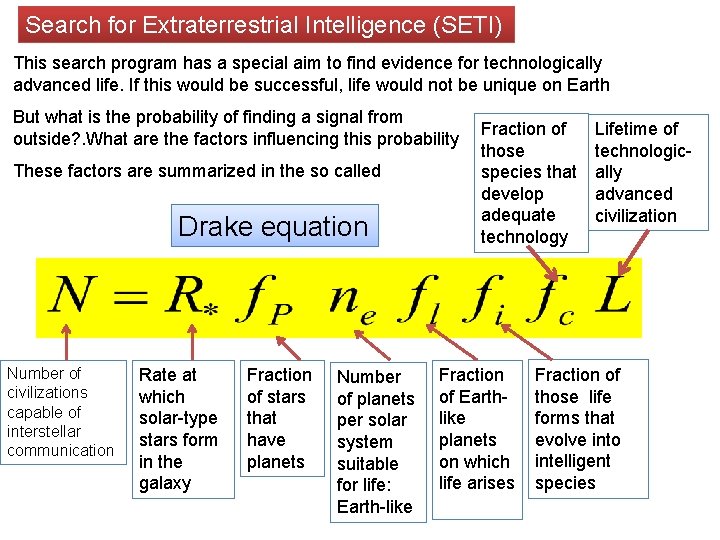
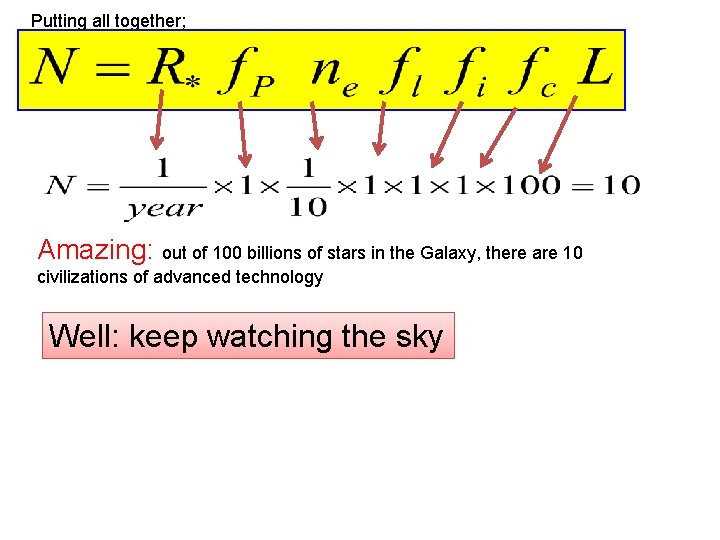
Search for Extraterrestrial Intelligence (SETI) This search program has a special aim to find evidence for technologically advanced life. If this would be successful, life would not be unique on Earth But what is the probability of finding a signal from outside? . What are the factors influencing this probability These factors are summarized in the so called Drake equation Number of civilizations capable of interstellar communication Rate at which solar-type stars form in the galaxy Fraction of stars that have planets Number of planets per solar system suitable for life: Earth-like Fraction of those species that develop adequate technology Fraction of Earthlike planets on which life arises Lifetime of technologically advanced civilization Fraction of those life forms that evolve into intelligent species
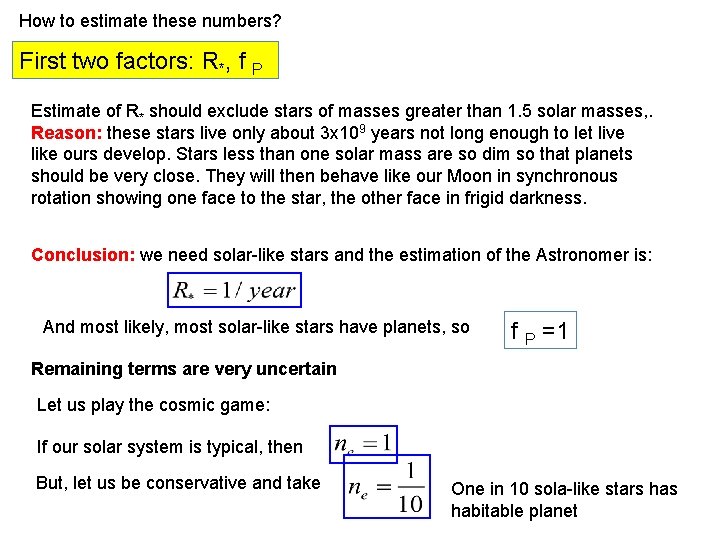
How to estimate these numbers? First two factors: R*, f P Estimate of R* should exclude stars of masses greater than 1. 5 solar masses, . Reason: these stars live only about 3 x 10⁹ years not long enough to let live like ours develop. Stars less than one solar mass are so dim so that planets should be very close. They will then behave like our Moon in synchronous rotation showing one face to the star, the other face in frigid darkness. Conclusion: we need solar-like stars and the estimation of the Astronomer is: And most likely, most solar-like stars have planets, so f P =1 Remaining terms are very uncertain Let us play the cosmic game: If our solar system is typical, then But, let us be conservative and take One in 10 sola-like stars habitable planet
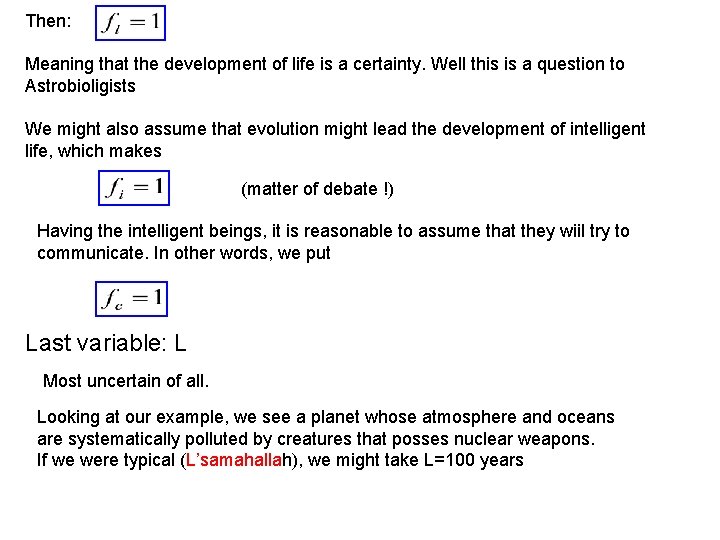
Then: Meaning that the development of life is a certainty. Well this is a question to Astrobioligists We might also assume that evolution might lead the development of intelligent life, which makes (matter of debate !) Having the intelligent beings, it is reasonable to assume that they wiil try to communicate. In other words, we put Last variable: L Most uncertain of all. Looking at our example, we see a planet whose atmosphere and oceans are systematically polluted by creatures that posses nuclear weapons. If we were typical (L’samahallah), we might take L=100 years
Putting all together; Amazing: out of 100 billions of stars in the Galaxy, there are 10 civilizations of advanced technology Well: keep watching the sky
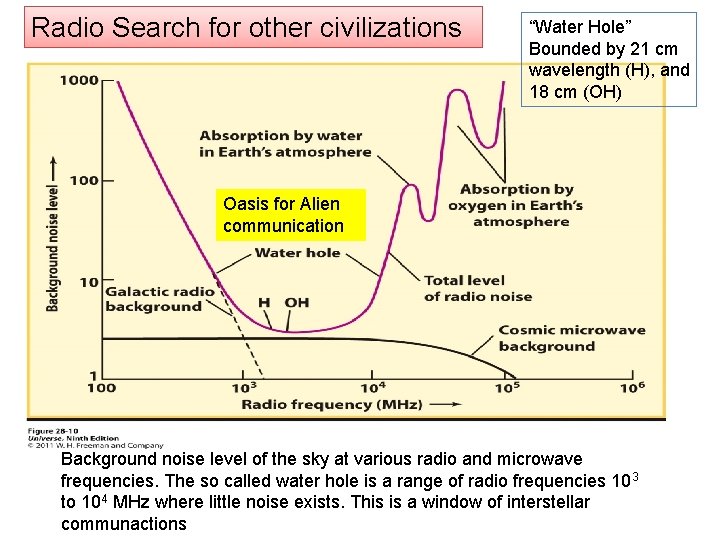
Radio Search for other civilizations “Water Hole” Bounded by 21 cm wavelength (H), and 18 cm (OH) Universe 9 th, p. 757 Oasis for Alien communication Background noise level of the sky at various radio and microwave frequencies. The so called water hole is a range of radio frequencies 103 to 104 MHz where little noise exists. This is a window of interstellar communactions
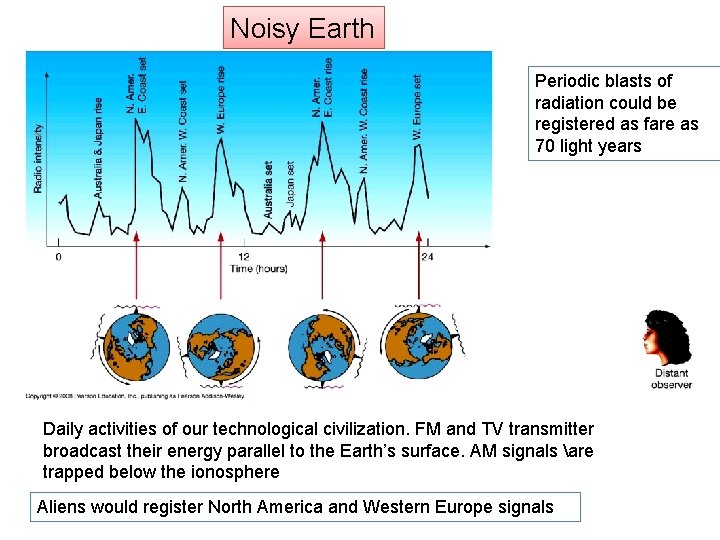
Noisy Earth Periodic blasts of radiation could be registered as fare as 70 light years Daily activities of our technological civilization. FM and TV transmitter broadcast their energy parallel to the Earth’s surface. AM signals are trapped below the ionosphere Aliens would register North America and Western Europe signals
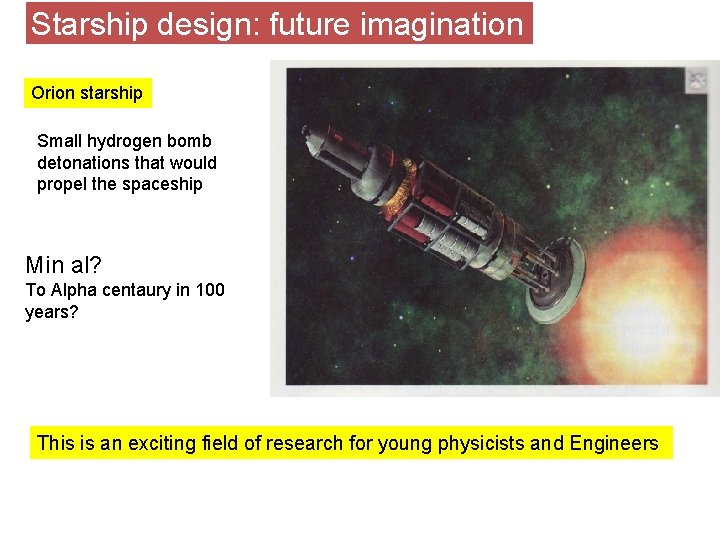
Starship design: future imagination Orion starship Small hydrogen bomb detonations that would propel the spaceship Min al? To Alpha centaury in 100 years? This is an exciting field of research for young physicists and Engineers
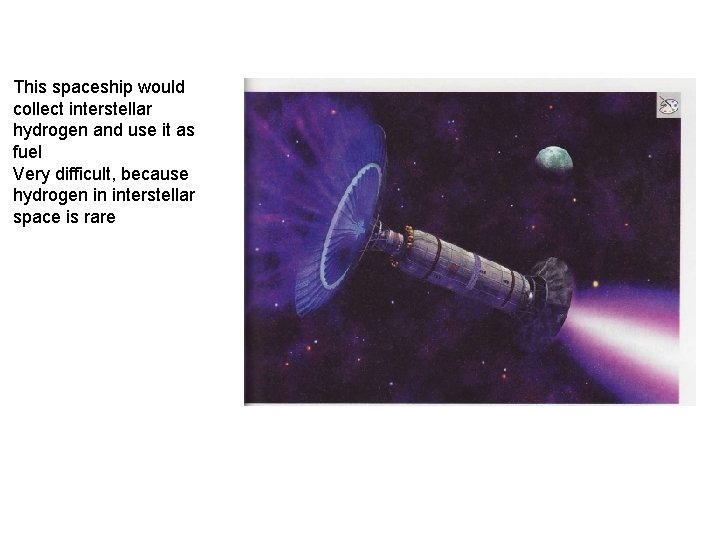
This spaceship would collect interstellar hydrogen and use it as fuel Very difficult, because hydrogen in interstellar space is rare
You can find aliens: join SETI www. seti. org You can participate on the search Another webpage: www. lifeinuniverse. org Planet transit http: //www. astroevents. no/lifesearch. html.
Finally, some nice words
ﻛﻼﻡ ﺟﻤﻴﻞ The scientists does not study nature because it is useful; he/she studies it because he delights in it, and he/she delights in it because it is beautiful. If nature were not beautiful, it would not be worth knowing, and if nature were not worth knowing, life would not be worth living. Guess who said that: Henry Poincare ﺍﻟﻌﺎﻟﻢ ﻻﻳﺪﺭﺱ ﺍﻟﻄﺒﻴﻌﺔ ﻷﻨﻬﺎ ﻣﻔﻴﺪﺓ ﺑﻞ ﻷﻨﻪ ﻳﺠﺪ ﻣﺘﻌﺔ ﺑﺠﻤﺎﻟﻬﺎ ﻟﻮ ﻛﺎﻧﺖ ﺍﻟﻄﺒﻴﻌﺔ ﻏﻴﺮ ﺟﻤﻴﻠﺔ ﻟﻴﺲ ﻣﻦ ﻣﺘﻌﺔ ﻓﻲ ﻣﻌﺮﻓﺘﻬﺎ ﻭﺃﻦ ﻟﻢ ﻧﻜﻦ ﻧﺘﻮﻕ ﻟﻤﻌﺮﻓﺔ ﺍﻟﻄﺒﻴﻌﺔ ﻓﻤﺎ ﻫﻮ ﻣﻌﻨﻰ ﺍﻟﺤﻴﺎﺓ My translation 43