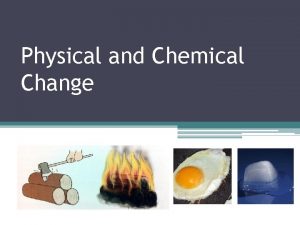
Example 1 1 Physical and Chemical Changes and


- Slides: 25
Example 1. 1 Physical and Chemical Changes and Properties Determine whether each change is physical or chemical. What kind of property (chemical or physical) is demonstrated in each case? a. the evaporation of rubbing alcohol b. the burning of lamp oil c. the bleaching of hair with hydrogen peroxide d. the formation of frost on a cold night Solution a. When rubbing alcohol evaporates, it changes from liquid to gas, but it remains alcohol—this is a physical change. The volatility (the ability to evaporate easily) of alcohol is therefore a physical property. b. Lamp oil burns because it reacts with oxygen in air to form carbon dioxide and water—this is a chemical change. The flammability of lamp oil is therefore a chemical property. c. Applying hydrogen peroxide to hair changes pigment molecules in hair that give it color—this is a chemical change. The susceptibility of hair to bleaching is therefore a chemical property. d. Frost forms on a cold night because water vapor in air changes its state to form solid ice—this is a physical change. The temperature at which water freezes is therefore a physical property. For Practice 1. 1 Determine whether each change is physical or chemical. What kind of property (chemical or physical) is demonstrated in each case? a. A copper wire is hammered flat. b. A nickel dissolves in acid to form a blue-green solution. c. Dry ice sublimes without melting. d. A match ignites when struck on a flint. Chemistry: A Molecular Approach, 4 th Edition Nivaldo J. Tro © 2017 Pearson Education, Inc.
Example 1. 2 Converting between Temperature Scales A sick child has a temperature of 40. 00 ºC. What is the child’s temperature in (a) K and (b) ºF? Solution a. Begin by finding the equation that relates the quantity that is given (ºC) and the quantity you are trying to find (K). K = ºC + 273. 15 Since this equation gives the temperature in K directly, substitute in the correct value for the temperature in ºC and calculate the answer. K = ºC + 273. 15 K = 40. 00 + 273. 15 = 313. 15 K b. To convert from ºC to ºF, first find the equation that relates these two quantities. Since this equation expresses ºC in terms of ºF, solve the equation for ºF. Now substitute ºC into the equation and calculate the answer. Note: The number of digits reported in this answer follows significant figure conventions, covered in Section 1. 7. ºF = 1. 8(ºC) + 32 ºF = 1. 8(40. 00 ºC) + 32 = 104. 00 ºF Chemistry: A Molecular Approach, 4 th Edition Nivaldo J. Tro © 2017 Pearson Education, Inc.
Example 1. 2 Converting between Temperature Scales Continued For Practice 1. 2 Gallium is a solid metal at room temperature but it will melt to a liquid in your hand. The melting point of gallium is 85. 6 ºF. What is this temperature on (a) the Celsius scale and (b) the Kelvin scale? Chemistry: A Molecular Approach, 4 th Edition Nivaldo J. Tro © 2017 Pearson Education, Inc.
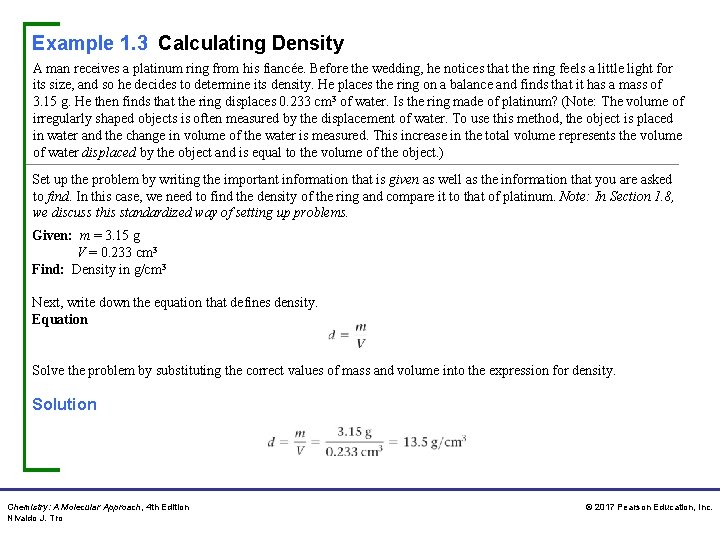
Example 1. 3 Calculating Density A man receives a platinum ring from his fiancée. Before the wedding, he notices that the ring feels a little light for its size, and so he decides to determine its density. He places the ring on a balance and finds that it has a mass of 3. 15 g. He then finds that the ring displaces 0. 233 cm 3 of water. Is the ring made of platinum? (Note: The volume of irregularly shaped objects is often measured by the displacement of water. To use this method, the object is placed in water and the change in volume of the water is measured. This increase in the total volume represents the volume of water displaced by the object and is equal to the volume of the object. ) Set up the problem by writing the important information that is given as well as the information that you are asked to find. In this case, we need to find the density of the ring and compare it to that of platinum. Note: In Section 1. 8, we discuss this standardized way of setting up problems. Given: m = 3. 15 g V = 0. 233 cm 3 Find: Density in g/cm 3 Next, write down the equation that defines density. Equation Solve the problem by substituting the correct values of mass and volume into the expression for density. Solution Chemistry: A Molecular Approach, 4 th Edition Nivaldo J. Tro © 2017 Pearson Education, Inc.
Example 1. 3 Calculating Density Continued The density of the ring is much too low to be platinum (platinum density is 21. 4 g/cm 3), and the ring is therefore a fake. For Practice 1. 3 The woman in Example 1. 3 is shocked that the ring is fake and returns it. She buys a new ring that has a mass of 4. 53 g and a volume of 0. 212 cm 3. Is the new ring genuine? For More Practice 1. 3 A metal cube has an edge that is 11. 4 mm long and a mass of 6. 67 g. Calculate the density of the metal and use Table 1. 4 to determine the likely identity of the metal. Chemistry: A Molecular Approach, 4 th Edition Nivaldo J. Tro © 2017 Pearson Education, Inc.
Example 1. 4 Reporting the Correct Number of Digits The graduated cylinder shown in the right margin has markings every 0. 1 m. L. Report the volume (which is read at the bottom of the meniscus) to the correct number of digits. (Note: The meniscus is the crescent-shaped surface at the top of a column of liquid. ) Solution Since the bottom of the meniscus is between the 4. 5 and 4. 6 m. L markings, mentally divide the space between the markings into ten equal spaces and estimate the next digit. In this case, you should report the result as 4. 57 m. L. What if you estimated a little differently and wrote 4. 56 m. L? In general, a one-unit difference in the last digit is acceptable because the last digit is estimated and different people might estimate it slightly differently. However, if you wrote 4. 63 m. L, you would have misreported the measurement. For Practice 1. 4 Record the temperature on thermometer shown in the right margin to the correct number of digits. Chemistry: A Molecular Approach, 4 th Edition Nivaldo J. Tro © 2017 Pearson Education, Inc.
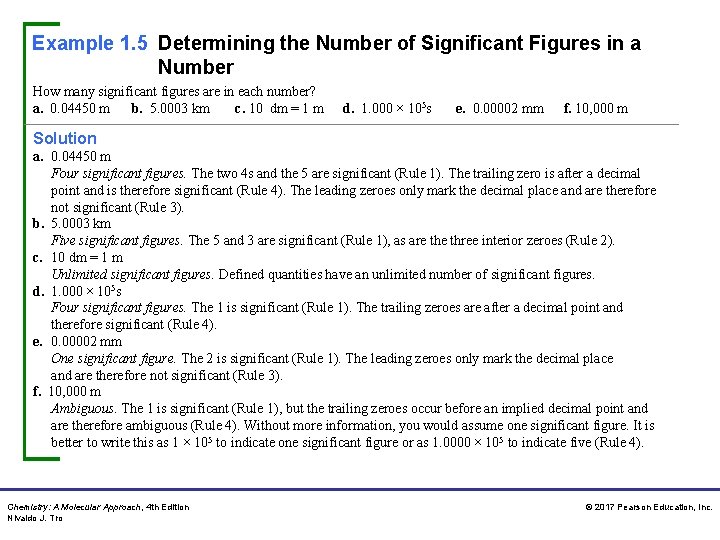
Example 1. 5 Determining the Number of Significant Figures in a Number How many significant figures are in each number? a. 0. 04450 m b. 5. 0003 km c. 10 dm = 1 m d. 1. 000 × 105 s e. 0. 00002 mm f. 10, 000 m Solution a. 0. 04450 m Four significant figures. The two 4 s and the 5 are significant (Rule 1). The trailing zero is after a decimal point and is therefore significant (Rule 4). The leading zeroes only mark the decimal place and are therefore not significant (Rule 3). b. 5. 0003 km Five significant figures. The 5 and 3 are significant (Rule 1), as are three interior zeroes (Rule 2). c. 10 dm = 1 m Unlimited significant figures. Defined quantities have an unlimited number of significant figures. d. 1. 000 × 105 s Four significant figures. The 1 is significant (Rule 1). The trailing zeroes are after a decimal point and therefore significant (Rule 4). e. 0. 00002 mm One significant figure. The 2 is significant (Rule 1). The leading zeroes only mark the decimal place and are therefore not significant (Rule 3). f. 10, 000 m Ambiguous. The 1 is significant (Rule 1), but the trailing zeroes occur before an implied decimal point and are therefore ambiguous (Rule 4). Without more information, you would assume one significant figure. It is better to write this as 1 × 10⁵ to indicate one significant figure or as 1. 0000 × 105 to indicate five (Rule 4). Chemistry: A Molecular Approach, 4 th Edition Nivaldo J. Tro © 2017 Pearson Education, Inc.
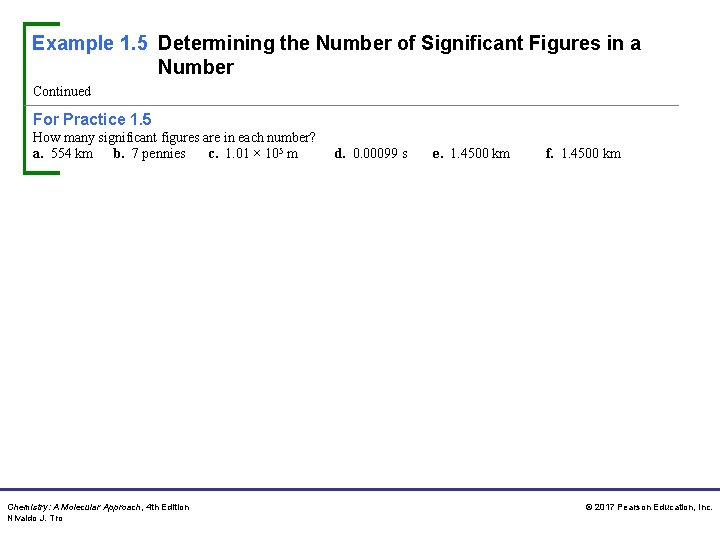
Example 1. 5 Determining the Number of Significant Figures in a Number Continued For Practice 1. 5 How many significant figures are in each number? a. 554 km b. 7 pennies c. 1. 01 × 105 m Chemistry: A Molecular Approach, 4 th Edition Nivaldo J. Tro d. 0. 00099 s e. 1. 4500 km f. 1. 4500 km © 2017 Pearson Education, Inc.
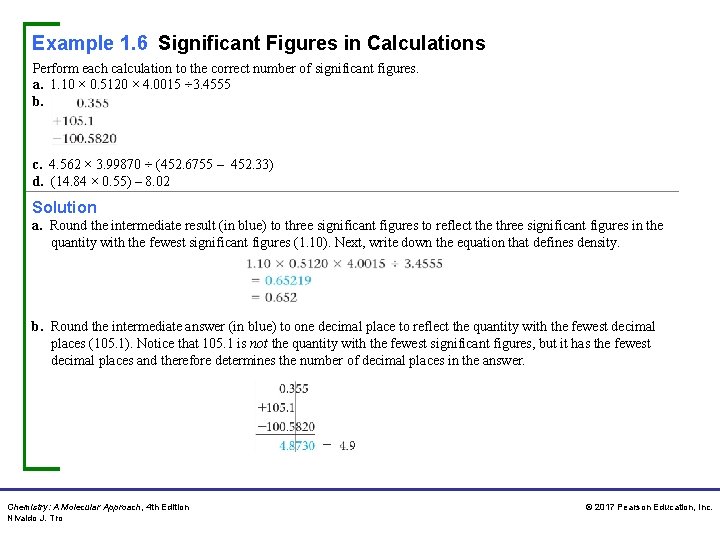
Example 1. 6 Significant Figures in Calculations Perform each calculation to the correct number of significant figures. a. 1. 10 × 0. 5120 × 4. 0015 ÷ 3. 4555 b. c. 4. 562 × 3. 99870 ÷ (452. 6755 – 452. 33) d. (14. 84 × 0. 55) – 8. 02 Solution a. Round the intermediate result (in blue) to three significant figures to reflect the three significant figures in the quantity with the fewest significant figures (1. 10). Next, write down the equation that defines density. b. Round the intermediate answer (in blue) to one decimal place to reflect the quantity with the fewest decimal places (105. 1). Notice that 105. 1 is not the quantity with the fewest significant figures, but it has the fewest decimal places and therefore determines the number of decimal places in the answer. Chemistry: A Molecular Approach, 4 th Edition Nivaldo J. Tro © 2017 Pearson Education, Inc.
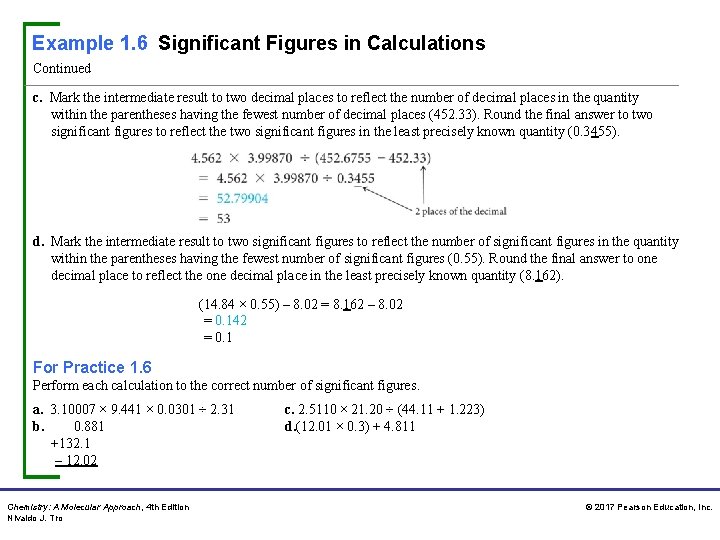
Example 1. 6 Significant Figures in Calculations Continued c. Mark the intermediate result to two decimal places to reflect the number of decimal places in the quantity within the parentheses having the fewest number of decimal places (452. 33). Round the final answer to two significant figures to reflect the two significant figures in the least precisely known quantity (0. 3455). d. Mark the intermediate result to two significant figures to reflect the number of significant figures in the quantity within the parentheses having the fewest number of significant figures (0. 55). Round the final answer to one decimal place to reflect the one decimal place in the least precisely known quantity (8. 162). (14. 84 × 0. 55) – 8. 02 = 8. 162 – 8. 02 = 0. 142 = 0. 1 For Practice 1. 6 Perform each calculation to the correct number of significant figures. a. 3. 10007 × 9. 441 × 0. 0301 ÷ 2. 31 b. 0. 881 +132. 1 – 12. 02 Chemistry: A Molecular Approach, 4 th Edition Nivaldo J. Tro c. 2. 5110 × 21. 20 ÷ (44. 11 + 1. 223) d. (12. 01 × 0. 3) + 4. 811 © 2017 Pearson Education, Inc.
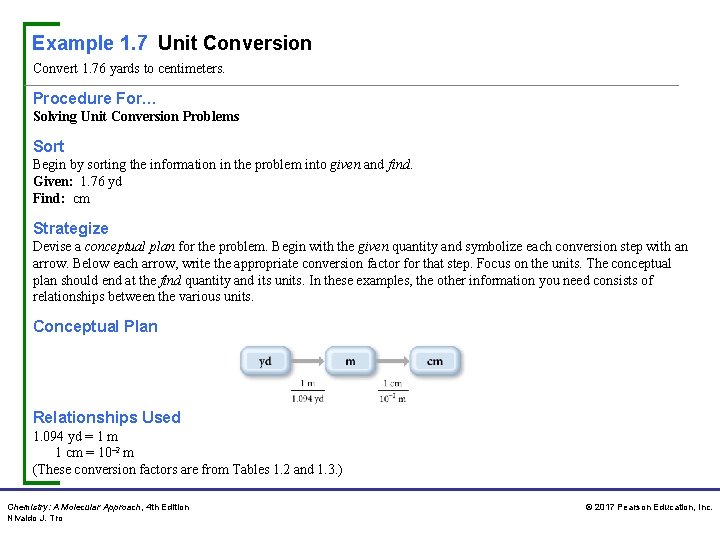
Example 1. 7 Unit Conversion Convert 1. 76 yards to centimeters. Procedure For… Solving Unit Conversion Problems Sort Begin by sorting the information in the problem into given and find. Given: 1. 76 yd Find: cm Strategize Devise a conceptual plan for the problem. Begin with the given quantity and symbolize each conversion step with an arrow. Below each arrow, write the appropriate conversion factor for that step. Focus on the units. The conceptual plan should end at the find quantity and its units. In these examples, the other information you need consists of relationships between the various units. Conceptual Plan Relationships Used 1. 094 yd = 1 m 1 cm = 10– 2 m (These conversion factors are from Tables 1. 2 and 1. 3. ) Chemistry: A Molecular Approach, 4 th Edition Nivaldo J. Tro © 2017 Pearson Education, Inc.
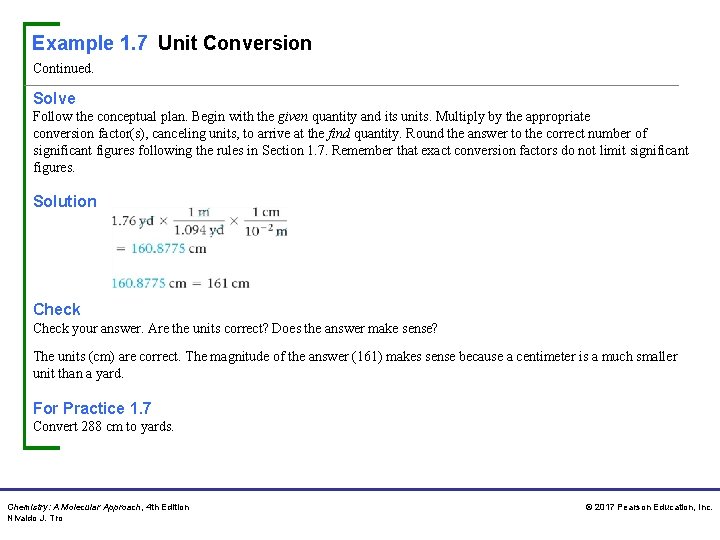
Example 1. 7 Unit Conversion Continued. Solve Follow the conceptual plan. Begin with the given quantity and its units. Multiply by the appropriate conversion factor(s), canceling units, to arrive at the find quantity. Round the answer to the correct number of significant figures following the rules in Section 1. 7. Remember that exact conversion factors do not limit significant figures. Solution Check your answer. Are the units correct? Does the answer make sense? The units (cm) are correct. The magnitude of the answer (161) makes sense because a centimeter is a much smaller unit than a yard. For Practice 1. 7 Convert 288 cm to yards. Chemistry: A Molecular Approach, 4 th Edition Nivaldo J. Tro © 2017 Pearson Education, Inc.
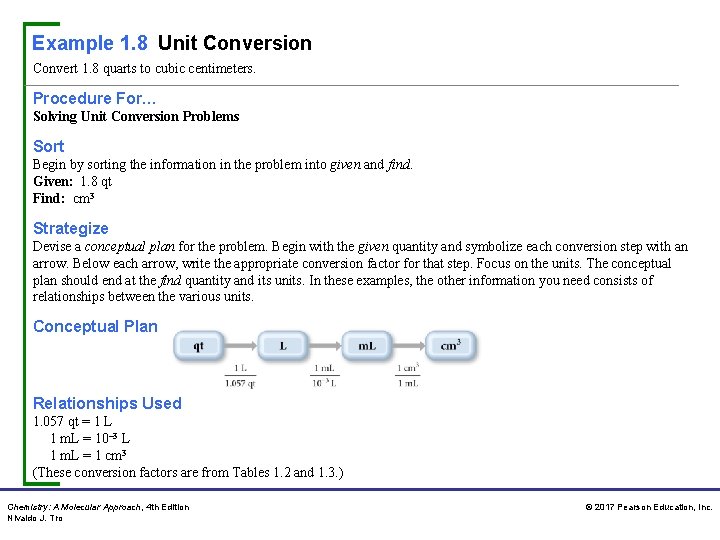
Example 1. 8 Unit Conversion Convert 1. 8 quarts to cubic centimeters. Procedure For… Solving Unit Conversion Problems Sort Begin by sorting the information in the problem into given and find. Given: 1. 8 qt Find: cm 3 Strategize Devise a conceptual plan for the problem. Begin with the given quantity and symbolize each conversion step with an arrow. Below each arrow, write the appropriate conversion factor for that step. Focus on the units. The conceptual plan should end at the find quantity and its units. In these examples, the other information you need consists of relationships between the various units. Conceptual Plan Relationships Used 1. 057 qt = 1 L 1 m. L = 10– 3 L 1 m. L = 1 cm 3 (These conversion factors are from Tables 1. 2 and 1. 3. ) Chemistry: A Molecular Approach, 4 th Edition Nivaldo J. Tro © 2017 Pearson Education, Inc.
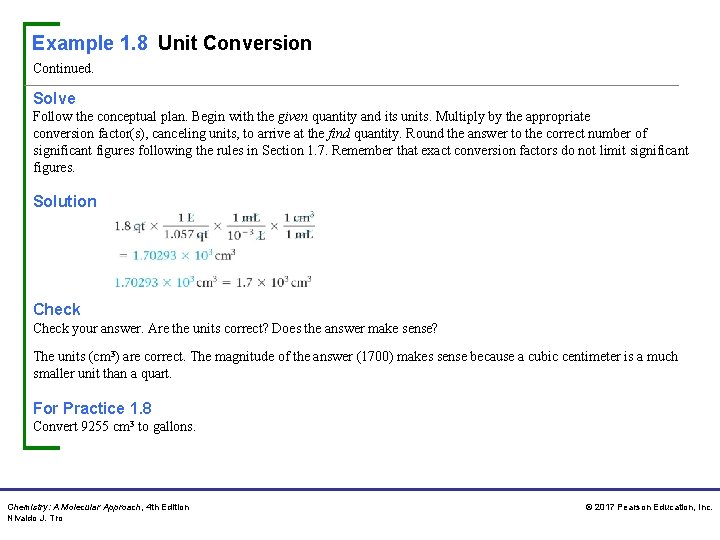
Example 1. 8 Unit Conversion Continued. Solve Follow the conceptual plan. Begin with the given quantity and its units. Multiply by the appropriate conversion factor(s), canceling units, to arrive at the find quantity. Round the answer to the correct number of significant figures following the rules in Section 1. 7. Remember that exact conversion factors do not limit significant figures. Solution Check your answer. Are the units correct? Does the answer make sense? The units (cm 3) are correct. The magnitude of the answer (1700) makes sense because a cubic centimeter is a much smaller unit than a quart. For Practice 1. 8 Convert 9255 cm 3 to gallons. Chemistry: A Molecular Approach, 4 th Edition Nivaldo J. Tro © 2017 Pearson Education, Inc.
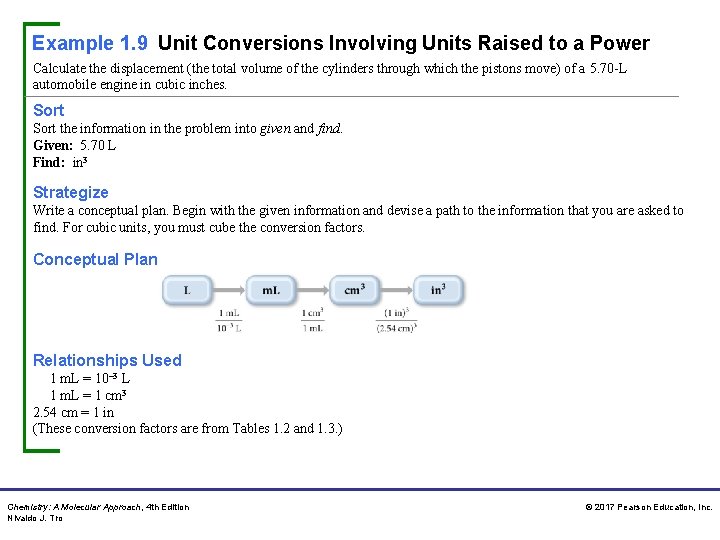
Example 1. 9 Unit Conversions Involving Units Raised to a Power Calculate the displacement (the total volume of the cylinders through which the pistons move) of a 5. 70 -L automobile engine in cubic inches. Sort the information in the problem into given and find. Given: 5. 70 L Find: in 3 Strategize Write a conceptual plan. Begin with the given information and devise a path to the information that you are asked to find. For cubic units, you must cube the conversion factors. Conceptual Plan Relationships Used 1 m. L = 10– 3 L 1 m. L = 1 cm 3 2. 54 cm = 1 in (These conversion factors are from Tables 1. 2 and 1. 3. ) Chemistry: A Molecular Approach, 4 th Edition Nivaldo J. Tro © 2017 Pearson Education, Inc.
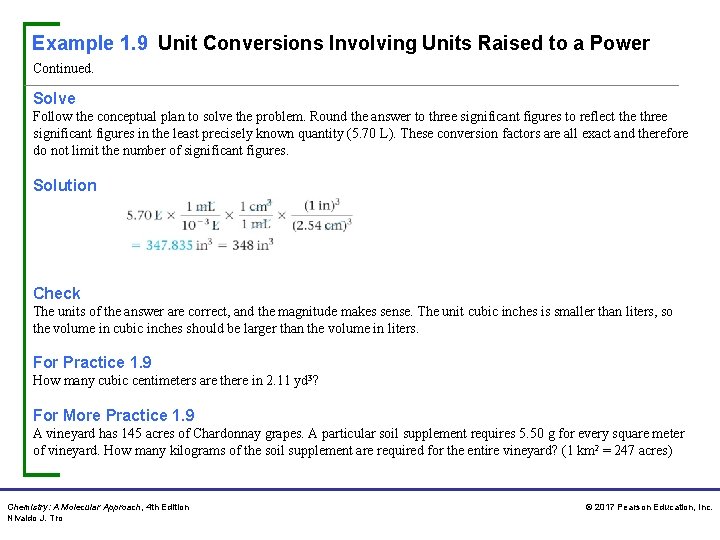
Example 1. 9 Unit Conversions Involving Units Raised to a Power Continued. Solve Follow the conceptual plan to solve the problem. Round the answer to three significant figures to reflect the three significant figures in the least precisely known quantity (5. 70 L). These conversion factors are all exact and therefore do not limit the number of significant figures. Solution Check The units of the answer are correct, and the magnitude makes sense. The unit cubic inches is smaller than liters, so the volume in cubic inches should be larger than the volume in liters. For Practice 1. 9 How many cubic centimeters are there in 2. 11 yd 3? For More Practice 1. 9 A vineyard has 145 acres of Chardonnay grapes. A particular soil supplement requires 5. 50 g for every square meter of vineyard. How many kilograms of the soil supplement are required for the entire vineyard? (1 km 2 = 247 acres) Chemistry: A Molecular Approach, 4 th Edition Nivaldo J. Tro © 2017 Pearson Education, Inc.
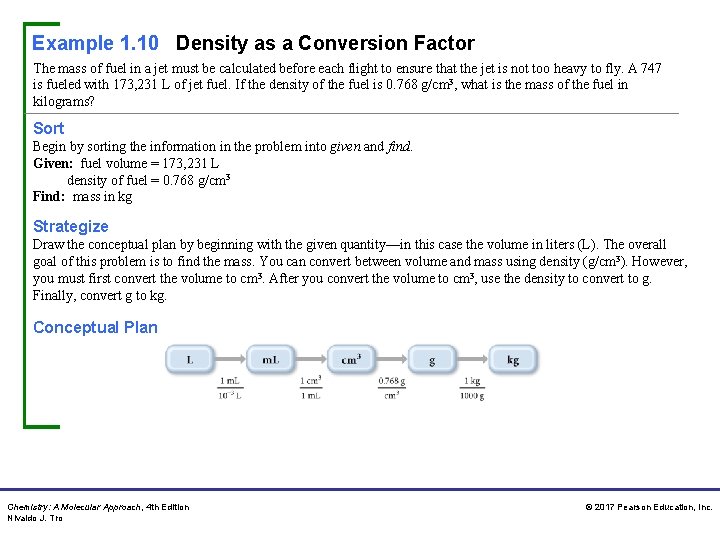
Example 1. 10 Density as a Conversion Factor The mass of fuel in a jet must be calculated before each flight to ensure that the jet is not too heavy to fly. A 747 is fueled with 173, 231 L of jet fuel. If the density of the fuel is 0. 768 g/cm 3, what is the mass of the fuel in kilograms? Sort Begin by sorting the information in the problem into given and find. Given: fuel volume = 173, 231 L density of fuel = 0. 768 g/cm 3 Find: mass in kg Strategize Draw the conceptual plan by beginning with the given quantity—in this case the volume in liters (L). The overall goal of this problem is to find the mass. You can convert between volume and mass using density (g/cm 3). However, you must first convert the volume to cm 3. After you convert the volume to cm 3, use the density to convert to g. Finally, convert g to kg. Conceptual Plan Chemistry: A Molecular Approach, 4 th Edition Nivaldo J. Tro © 2017 Pearson Education, Inc.
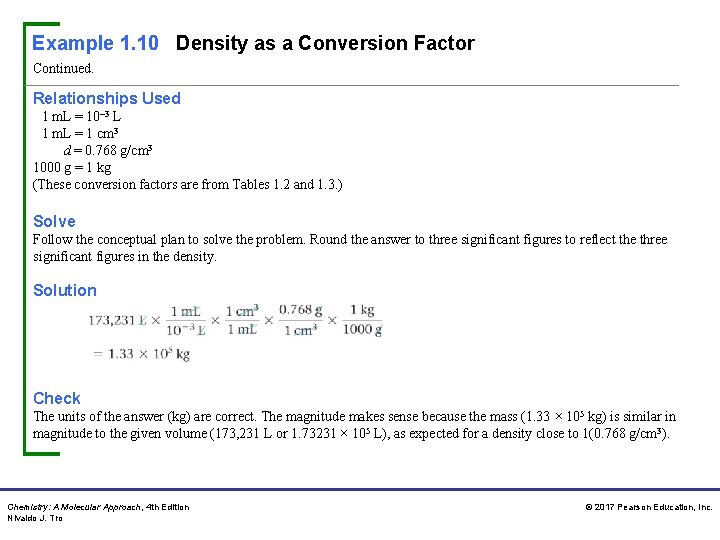
Example 1. 10 Density as a Conversion Factor Continued. Relationships Used 1 m. L = 10– 3 L 1 m. L = 1 cm 3 d = 0. 768 g/cm 3 1000 g = 1 kg (These conversion factors are from Tables 1. 2 and 1. 3. ) Solve Follow the conceptual plan to solve the problem. Round the answer to three significant figures to reflect the three significant figures in the density. Solution Check The units of the answer (kg) are correct. The magnitude makes sense because the mass (1. 33 × 105 kg) is similar in magnitude to the given volume (173, 231 L or 1. 73231 × 105 L), as expected for a density close to 1(0. 768 g/cm 3). Chemistry: A Molecular Approach, 4 th Edition Nivaldo J. Tro © 2017 Pearson Education, Inc.
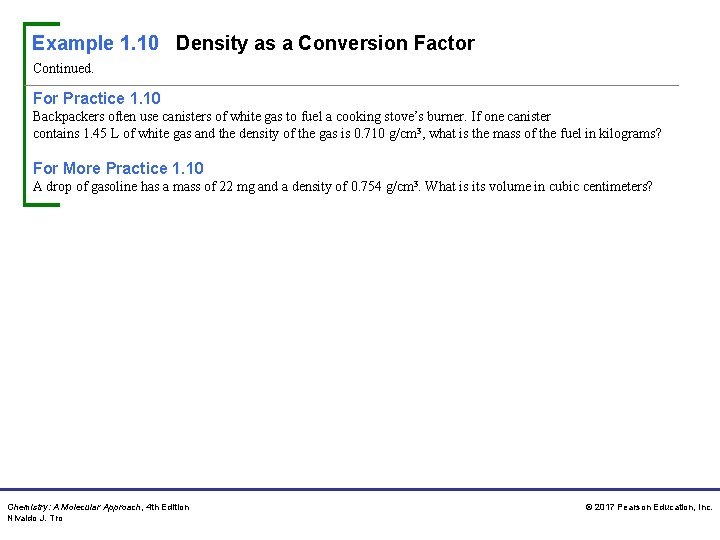
Example 1. 10 Density as a Conversion Factor Continued. For Practice 1. 10 Backpackers often use canisters of white gas to fuel a cooking stove’s burner. If one canister contains 1. 45 L of white gas and the density of the gas is 0. 710 g/cm 3, what is the mass of the fuel in kilograms? For More Practice 1. 10 A drop of gasoline has a mass of 22 mg and a density of 0. 754 g/cm 3. What is its volume in cubic centimeters? Chemistry: A Molecular Approach, 4 th Edition Nivaldo J. Tro © 2017 Pearson Education, Inc.
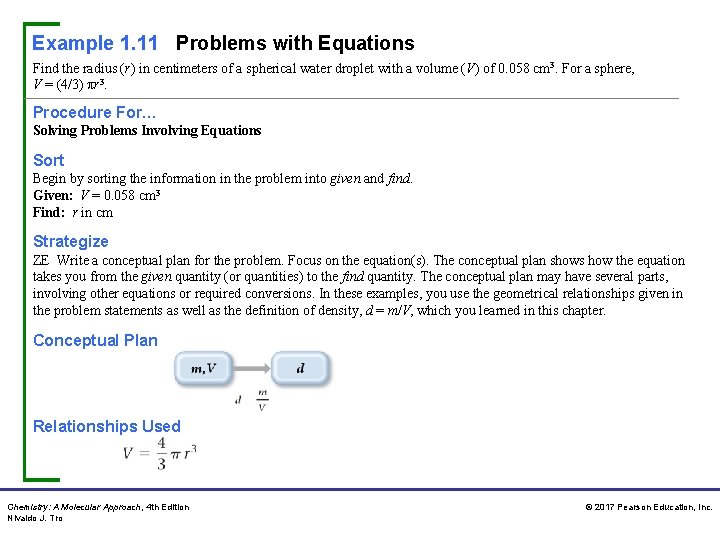
Example 1. 11 Problems with Equations Find the radius (r) in centimeters of a spherical water droplet with a volume (V) of 0. 058 cm 3. For a sphere, V = (4/3) πr 3. Procedure For… Solving Problems Involving Equations Sort Begin by sorting the information in the problem into given and find. Given: V = 0. 058 cm 3 Find: r in cm Strategize ZE Write a conceptual plan for the problem. Focus on the equation(s). The conceptual plan shows how the equation takes you from the given quantity (or quantities) to the find quantity. The conceptual plan may have several parts, involving other equations or required conversions. In these examples, you use the geometrical relationships given in the problem statements as well as the definition of density, d = m/V, which you learned in this chapter. Conceptual Plan Relationships Used Chemistry: A Molecular Approach, 4 th Edition Nivaldo J. Tro © 2017 Pearson Education, Inc.
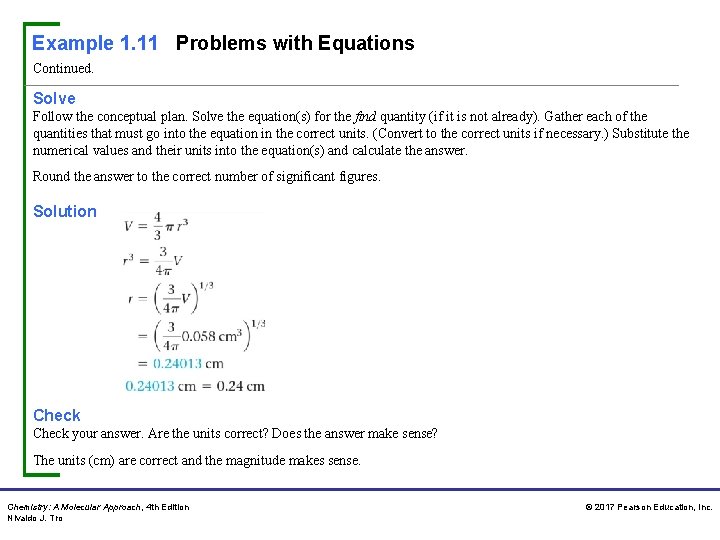
Example 1. 11 Problems with Equations Continued. Solve Follow the conceptual plan. Solve the equation(s) for the find quantity (if it is not already). Gather each of the quantities that must go into the equation in the correct units. (Convert to the correct units if necessary. ) Substitute the numerical values and their units into the equation(s) and calculate the answer. Round the answer to the correct number of significant figures. Solution Check your answer. Are the units correct? Does the answer make sense? The units (cm) are correct and the magnitude makes sense. Chemistry: A Molecular Approach, 4 th Edition Nivaldo J. Tro © 2017 Pearson Education, Inc.
Example 1. 11 Problems with Equations Continued. For Practice 1. 11 Find the radius (r) of an aluminum cylinder that is 2. 00 cm long and has a mass of 12. 4 g. For a cylinder, V = πr 2 l. Chemistry: A Molecular Approach, 4 th Edition Nivaldo J. Tro © 2017 Pearson Education, Inc.
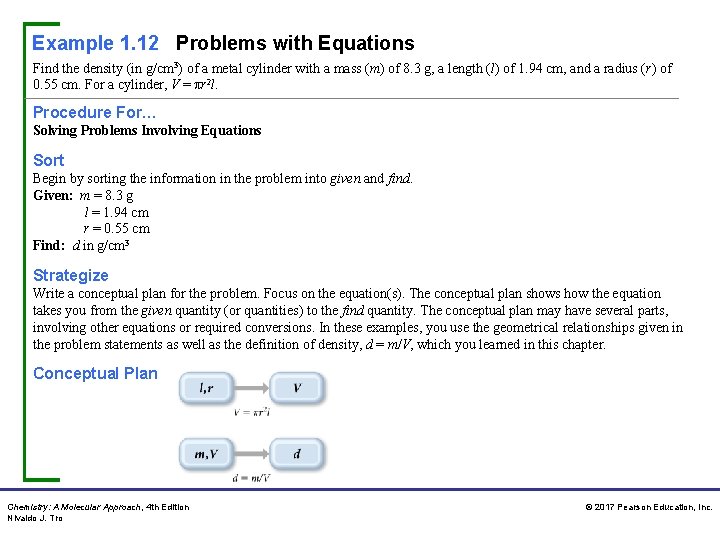
Example 1. 12 Problems with Equations Find the density (in g/cm 3) of a metal cylinder with a mass (m) of 8. 3 g, a length (l) of 1. 94 cm, and a radius (r) of 0. 55 cm. For a cylinder, V = πr 2 l. Procedure For… Solving Problems Involving Equations Sort Begin by sorting the information in the problem into given and find. Given: m = 8. 3 g l = 1. 94 cm r = 0. 55 cm Find: d in g/cm 3 Strategize Write a conceptual plan for the problem. Focus on the equation(s). The conceptual plan shows how the equation takes you from the given quantity (or quantities) to the find quantity. The conceptual plan may have several parts, involving other equations or required conversions. In these examples, you use the geometrical relationships given in the problem statements as well as the definition of density, d = m/V, which you learned in this chapter. Conceptual Plan Chemistry: A Molecular Approach, 4 th Edition Nivaldo J. Tro © 2017 Pearson Education, Inc.
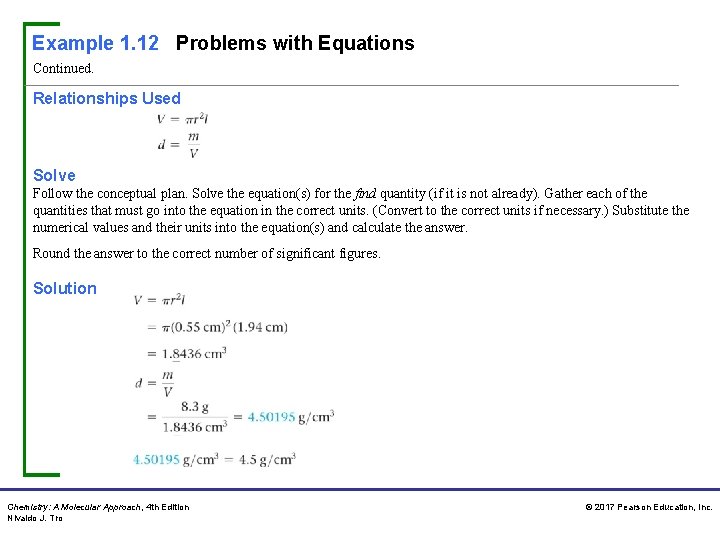
Example 1. 12 Problems with Equations Continued. Relationships Used Solve Follow the conceptual plan. Solve the equation(s) for the find quantity (if it is not already). Gather each of the quantities that must go into the equation in the correct units. (Convert to the correct units if necessary. ) Substitute the numerical values and their units into the equation(s) and calculate the answer. Round the answer to the correct number of significant figures. Solution Chemistry: A Molecular Approach, 4 th Edition Nivaldo J. Tro © 2017 Pearson Education, Inc.
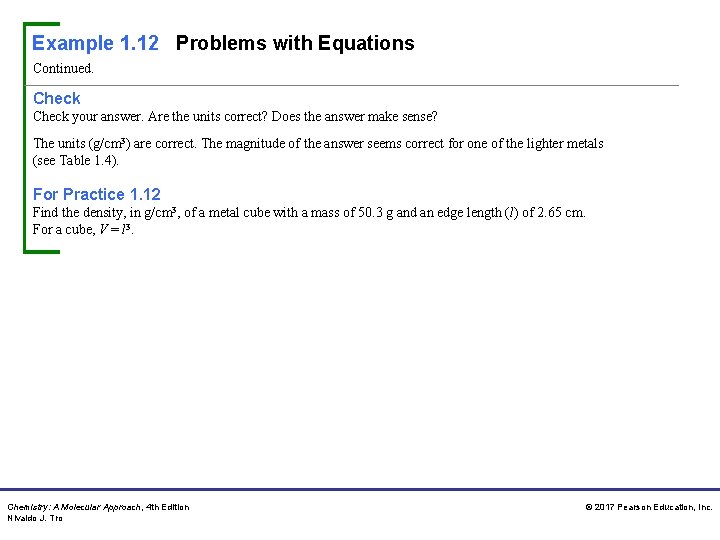
Example 1. 12 Problems with Equations Continued. Check your answer. Are the units correct? Does the answer make sense? The units (g/cm 3) are correct. The magnitude of the answer seems correct for one of the lighter metals (see Table 1. 4). For Practice 1. 12 Find the density, in g/cm 3, of a metal cube with a mass of 50. 3 g and an edge length (l) of 2. 65 cm. For a cube, V = l 3. Chemistry: A Molecular Approach, 4 th Edition Nivaldo J. Tro © 2017 Pearson Education, Inc.