
The Pi XL Club The Pi XL Club
The Pi. XL Club The Pi. XL Club The Pi. XL Club The Pi. XL Club The Pi. XL Club The Pi. XL Club The Pi. XL Club The Pi. XL Club The Pi. XL Club The Pi. XL Club The Pi. XL Club The Pi. XL Club The Pi. XL Club The Pi. XL Club The Pi. XL Club The Pi. XL Club The Pi. XL Club The Pi. XL Club The Pi. XL Club The Pi. XL Club The Pi. XL Club The Pi. XL Club The Pi. XL Club The Pi. XL Club The Pi. XL Club The Pi. XL Club The Pi. XL Club The Pi. XL Club The Pi. XL Club The Pi. XL Club The Pi. XL Club The Pi. XL Club The Pi. XL Club The Pi. XL Club The Pi. XL Club The This resource is strictly for the use of member schools for as long as they remain members of The Pi. XL Club. It may not be copied, sold nor transferred to Pi. XL Club The Pi. XL Club The a third party or used by the school after membership ceases. Until such time it may be freely used within the member school. Pi. XL Club The Pi. XL Club The Pi. XL Club The All opinions and contributions are those of the authors. The contents of this resource are not connected with nor endorsed by any other company, Pi. XL Club The Pi. XL Club The organisation or institution. Pi. XL Club The Pi. XL Club The Pi. XL Club The Pi. XL Club The www. pixl. org. uk The Pi. XL Club Ltd, Company number 07321607 Pi. XL Club The Pi. XL Club The Pi. XL Club The Pi. XL Club The Pi. XL Know. IT! GCSE Chemistry AQA Topic – Quantitative chemistry © Copyright The Pi. XL Club Ltd, 2017
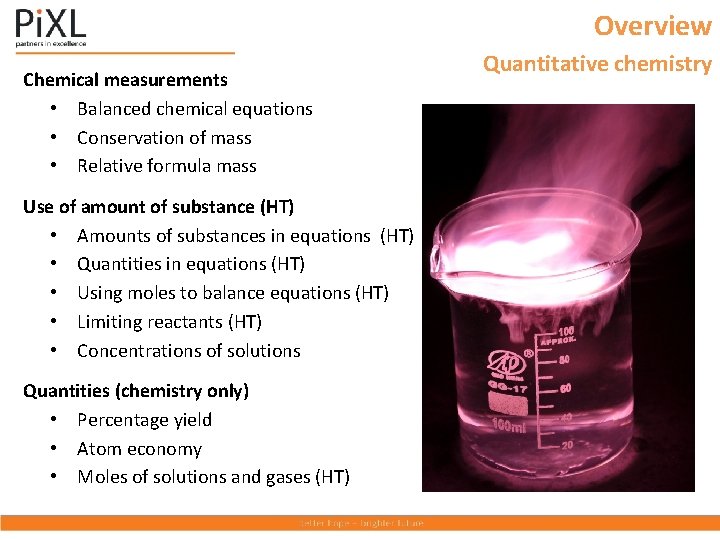
Overview Chemical measurements • Balanced chemical equations • Conservation of mass • Relative formula mass Use of amount of substance (HT) • Amounts of substances in equations (HT) • Quantities in equations (HT) • Using moles to balance equations (HT) • Limiting reactants (HT) • Concentrations of solutions Quantities (chemistry only) • Percentage yield • Atom economy • Moles of solutions and gases (HT) Quantitative chemistry
Learn. IT! Know. IT! Chemical Measurements PART 1 • Balanced chemical equations • Conservation of mass
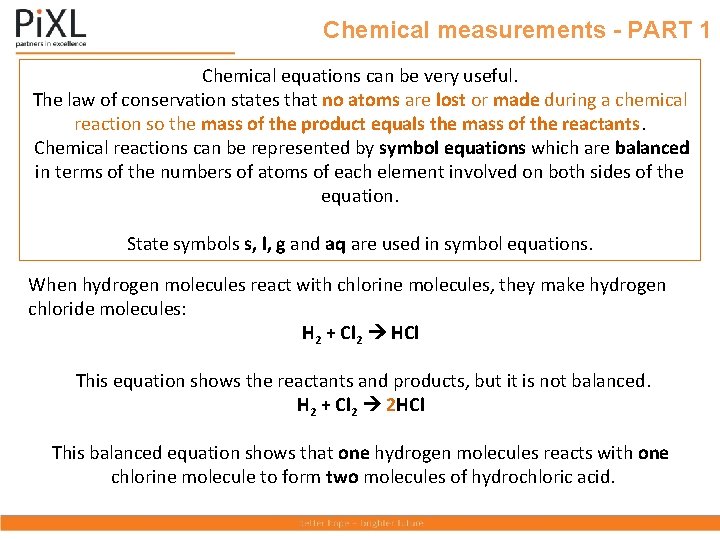
Chemical measurements - PART 1 Chemical equations can be very useful. The law of conservation states that no atoms are lost or made during a chemical reaction so the mass of the product equals the mass of the reactants. Chemical reactions can be represented by symbol equations which are balanced in terms of the numbers of atoms of each element involved on both sides of the equation. State symbols s, l, g and aq are used in symbol equations. When hydrogen molecules react with chlorine molecules, they make hydrogen chloride molecules: H 2 + Cl 2 HCl This equation shows the reactants and products, but it is not balanced. H 2 + Cl 2 2 HCl This balanced equation shows that one hydrogen molecules reacts with one chlorine molecule to form two molecules of hydrochloric acid.
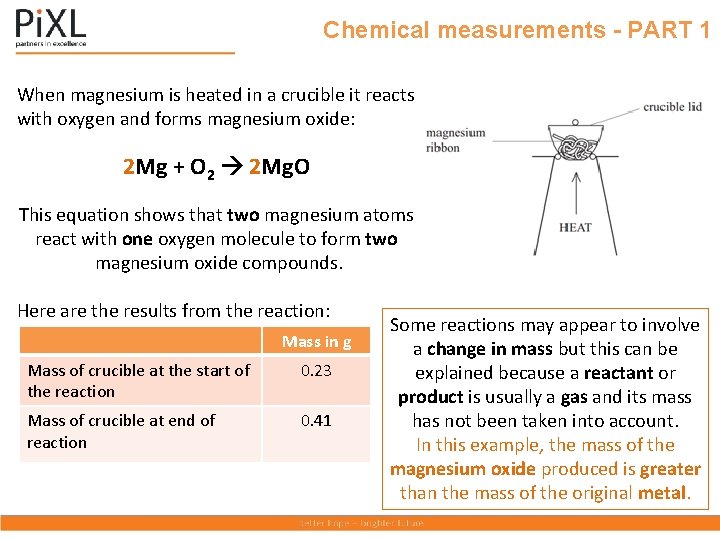
Chemical measurements - PART 1 When magnesium is heated in a crucible it reacts with oxygen and forms magnesium oxide: 2 Mg + O 2 2 Mg. O This equation shows that two magnesium atoms react with one oxygen molecule to form two magnesium oxide compounds. Here are the results from the reaction: Mass in g Mass of crucible at the start of the reaction 0. 23 Mass of crucible at end of reaction 0. 41 Some reactions may appear to involve a change in mass but this can be explained because a reactant or product is usually a gas and its mass has not been taken into account. In this example, the mass of the magnesium oxide produced is greater than the mass of the original metal.
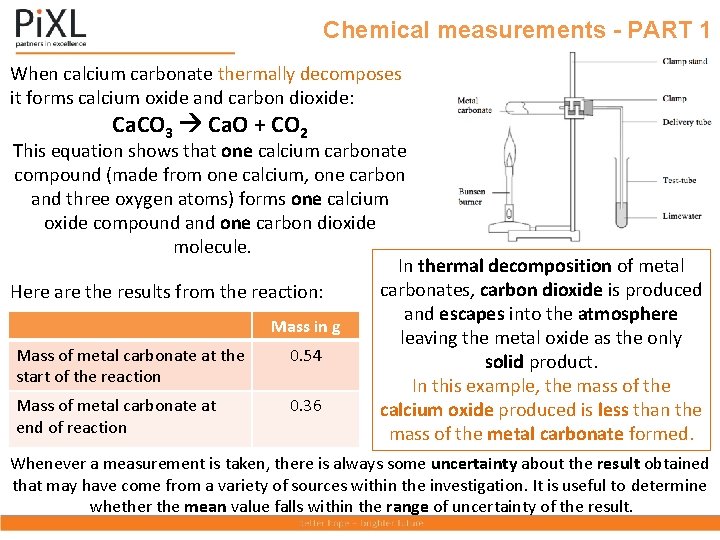
Chemical measurements - PART 1 When calcium carbonate thermally decomposes it forms calcium oxide and carbon dioxide: Ca. CO 3 Ca. O + CO 2 This equation shows that one calcium carbonate compound (made from one calcium, one carbon and three oxygen atoms) forms one calcium oxide compound and one carbon dioxide molecule. In thermal decomposition of metal carbonates, carbon dioxide is produced Here are the results from the reaction: and escapes into the atmosphere Mass in g leaving the metal oxide as the only Mass of metal carbonate at the 0. 54 solid product. start of the reaction In this example, the mass of the Mass of metal carbonate at 0. 36 calcium oxide produced is less than the end of reaction mass of the metal carbonate formed. Whenever a measurement is taken, there is always some uncertainty about the result obtained that may have come from a variety of sources within the investigation. It is useful to determine whether the mean value falls within the range of uncertainty of the result.
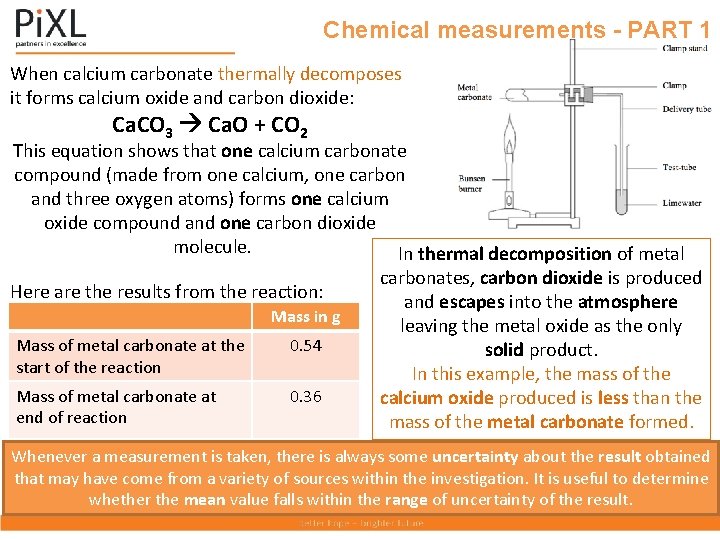
Chemical measurements - PART 1 When calcium carbonate thermally decomposes it forms calcium oxide and carbon dioxide: Ca. CO 3 Ca. O + CO 2 This equation shows that one calcium carbonate compound (made from one calcium, one carbon and three oxygen atoms) forms one calcium oxide compound and one carbon dioxide molecule. In thermal decomposition of metal Here are the results from the reaction: Mass in g Mass of metal carbonate at the start of the reaction 0. 54 Mass of metal carbonate at end of reaction 0. 36 carbonates, carbon dioxide is produced and escapes into the atmosphere leaving the metal oxide as the only solid product. In this example, the mass of the calcium oxide produced is less than the mass of the metal carbonate formed. Whenever a measurement is taken, there is always some uncertainty about the result obtained that may have come from a variety of sources within the investigation. It is useful to determine whether the mean value falls within the range of uncertainty of the result.
Question. IT! Chemical Measurements PART 1 • Balanced chemical equations • Conservation of mass
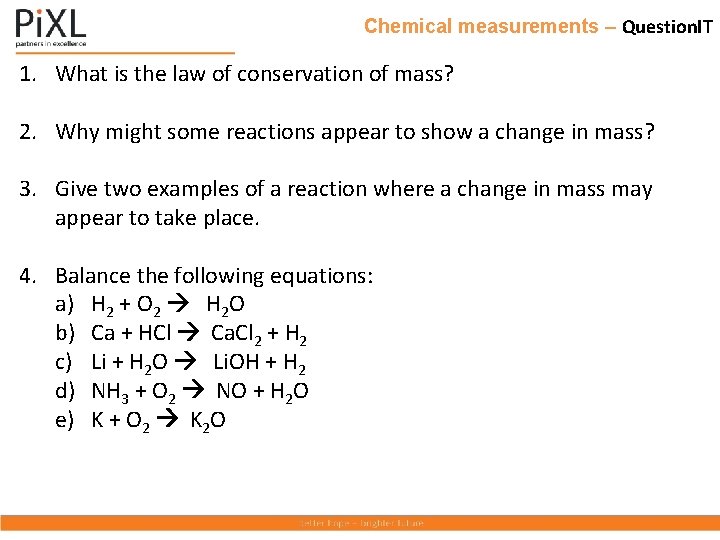
Chemical measurements – Question. IT 1. What is the law of conservation of mass? 2. Why might some reactions appear to show a change in mass? 3. Give two examples of a reaction where a change in mass may appear to take place. 4. Balance the following equations: a) H 2 + O 2 H 2 O b) Ca + HCl Ca. Cl 2 + H 2 c) Li + H 2 O Li. OH + H 2 d) NH 3 + O 2 NO + H 2 O e) K + O 2 K 2 O
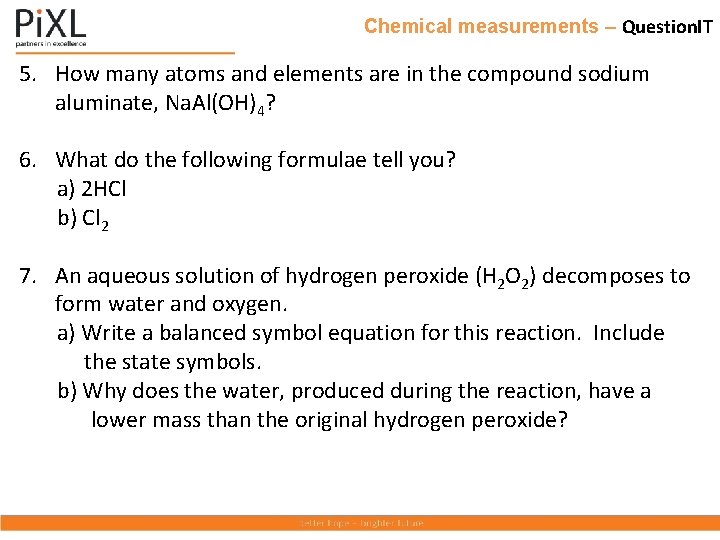
Chemical measurements – Question. IT 5. How many atoms and elements are in the compound sodium aluminate, Na. Al(OH)4? 6. What do the following formulae tell you? a) 2 HCl b) Cl 2 7. An aqueous solution of hydrogen peroxide (H 2 O 2) decomposes to form water and oxygen. a) Write a balanced symbol equation for this reaction. Include the state symbols. b) Why does the water, produced during the reaction, have a lower mass than the original hydrogen peroxide?
Answer. IT! Chemical Measurements PART 1 • Balanced chemical equations • Conservation of mass
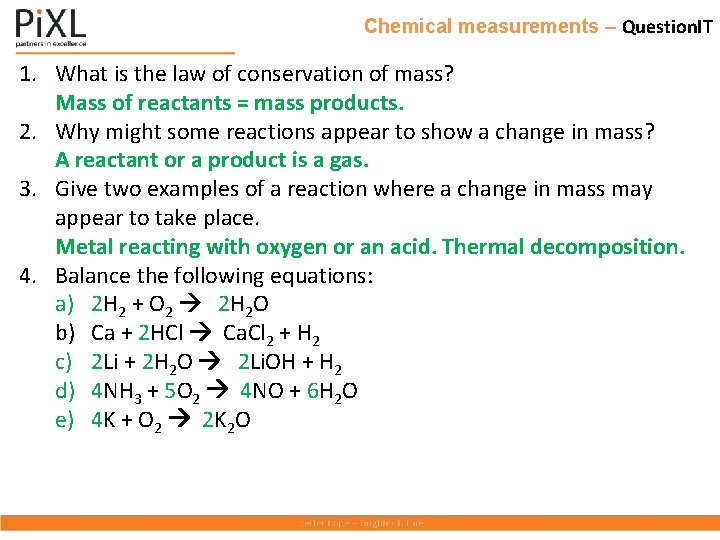
Chemical measurements – Question. IT 1. What is the law of conservation of mass? Mass of reactants = mass products. 2. Why might some reactions appear to show a change in mass? A reactant or a product is a gas. 3. Give two examples of a reaction where a change in mass may appear to take place. Metal reacting with oxygen or an acid. Thermal decomposition. 4. Balance the following equations: a) 2 H 2 + O 2 2 H 2 O b) Ca + 2 HCl Ca. Cl 2 + H 2 c) 2 Li + 2 H 2 O 2 Li. OH + H 2 d) 4 NH 3 + 5 O 2 4 NO + 6 H 2 O e) 4 K + O 2 2 K 2 O
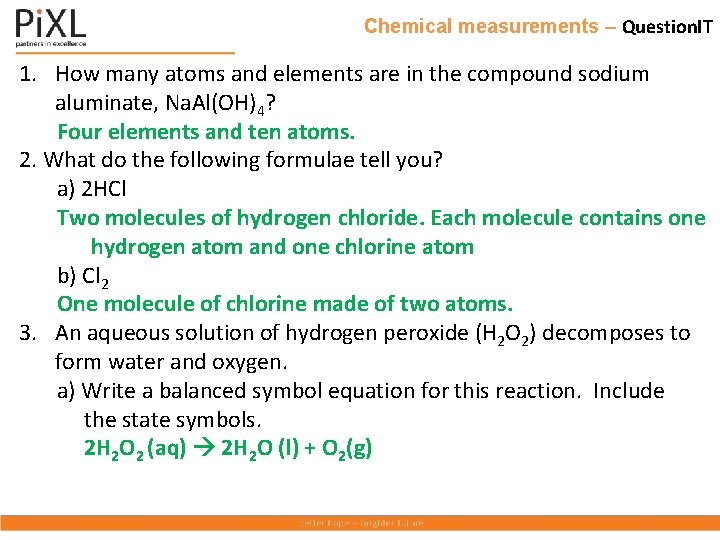
Chemical measurements – Question. IT 1. How many atoms and elements are in the compound sodium aluminate, Na. Al(OH)4? Four elements and ten atoms. 2. What do the following formulae tell you? a) 2 HCl Two molecules of hydrogen chloride. Each molecule contains one hydrogen atom and one chlorine atom b) Cl 2 One molecule of chlorine made of two atoms. 3. An aqueous solution of hydrogen peroxide (H 2 O 2) decomposes to form water and oxygen. a) Write a balanced symbol equation for this reaction. Include the state symbols. 2 H 2 O 2 (aq) 2 H 2 O (l) + O 2(g)
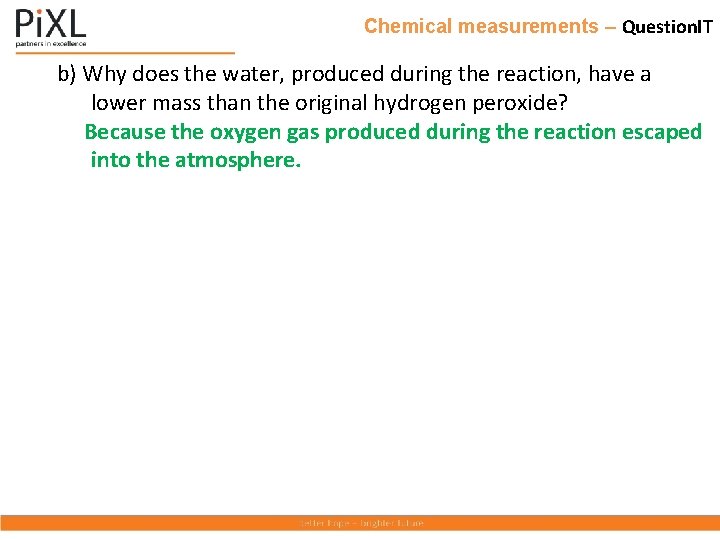
Chemical measurements – Question. IT b) Why does the water, produced during the reaction, have a lower mass than the original hydrogen peroxide? Because the oxygen gas produced during the reaction escaped into the atmosphere.
Learn. IT! Know. IT! Chemical Measurements PART 2 • Relative formula mass
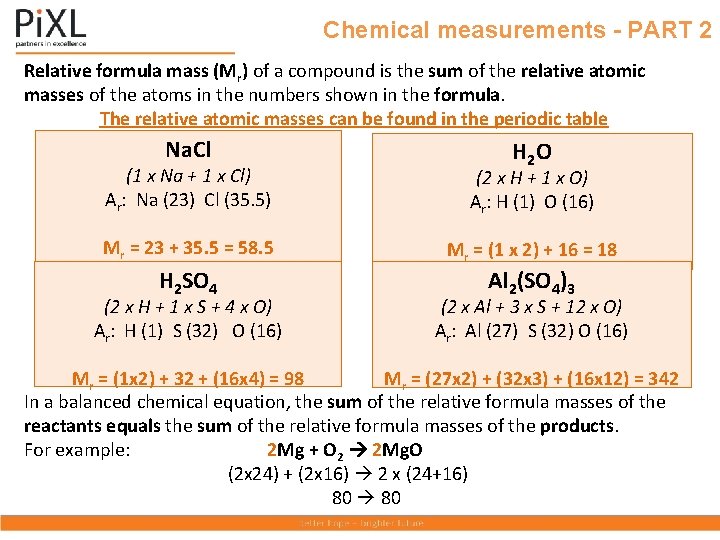
Chemical measurements - PART 2 Relative formula mass (Mr) of a compound is the sum of the relative atomic masses of the atoms in the numbers shown in the formula. The relative atomic masses can be found in the periodic table Na. Cl H 2 O (1 x Na + 1 x Cl) Ar: Na (23) Cl (35. 5) (2 x H + 1 x O) Ar: H (1) O (16) Mr = 23 + 35. 5 = 58. 5 Mr = (1 x 2) + 16 = 18 H 2 SO 4 (2 x H + 1 x S + 4 x O) Ar: H (1) S (32) O (16) Al 2(SO 4)3 (2 x Al + 3 x S + 12 x O) Ar: Al (27) S (32) O (16) Mr = (1 x 2) + 32 + (16 x 4) = 98 Mr = (27 x 2) + (32 x 3) + (16 x 12) = 342 In a balanced chemical equation, the sum of the relative formula masses of the reactants equals the sum of the relative formula masses of the products. For example: 2 Mg + O 2 2 Mg. O (2 x 24) + (2 x 16) 2 x (24+16) 80
Question. IT! Chemical Measurements PART 2 • Relative formula mass
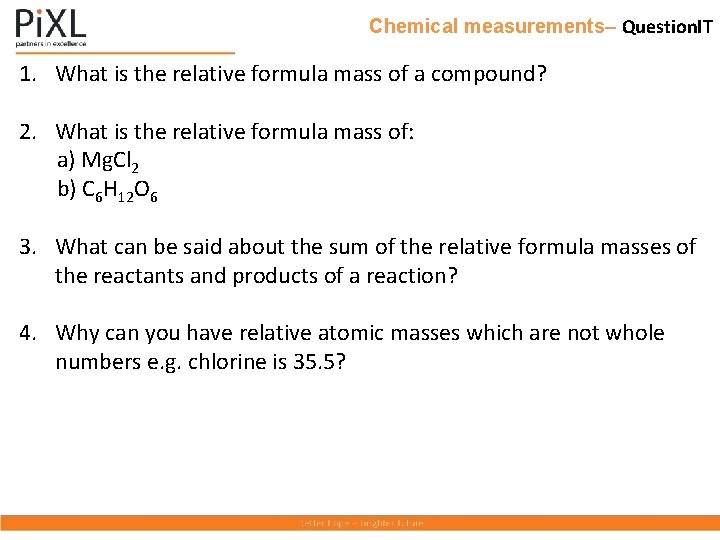
Chemical measurements– Question. IT 1. What is the relative formula mass of a compound? 2. What is the relative formula mass of: a) Mg. Cl 2 b) C 6 H 12 O 6 3. What can be said about the sum of the relative formula masses of the reactants and products of a reaction? 4. Why can you have relative atomic masses which are not whole numbers e. g. chlorine is 35. 5?
Answer. IT! Chemical Measurements PART 2 • Relative formula mass
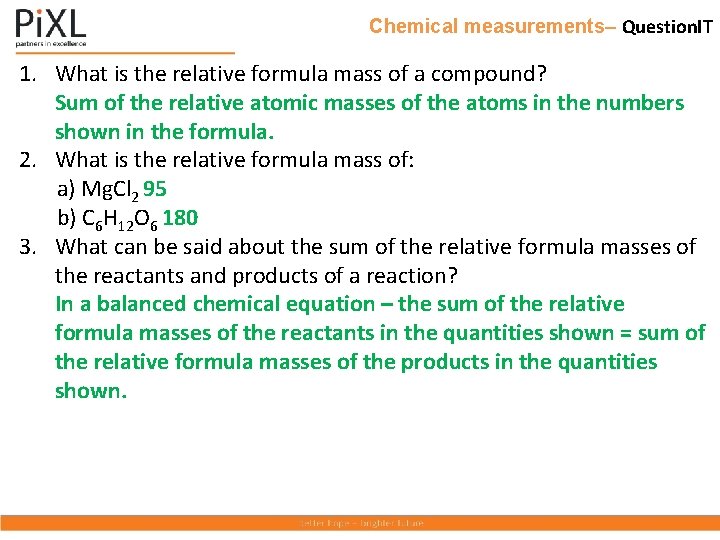
Chemical measurements– Question. IT 1. What is the relative formula mass of a compound? Sum of the relative atomic masses of the atoms in the numbers shown in the formula. 2. What is the relative formula mass of: a) Mg. Cl 2 95 b) C 6 H 12 O 6 180 3. What can be said about the sum of the relative formula masses of the reactants and products of a reaction? In a balanced chemical equation – the sum of the relative formula masses of the reactants in the quantities shown = sum of the relative formula masses of the products in the quantities shown.
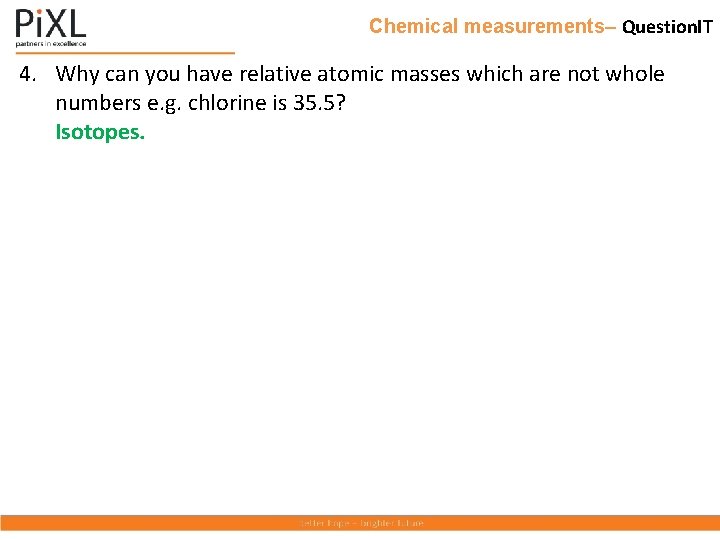
Chemical measurements– Question. IT 4. Why can you have relative atomic masses which are not whole numbers e. g. chlorine is 35. 5? Isotopes.

Learn. IT! Know. IT! Use of amount of substance PART 1 • • • Moles (HT) Amounts of substances in equations (HT) Quantities in equations (HT) Using moles to balance equations (HT) Limiting reactants (HT)
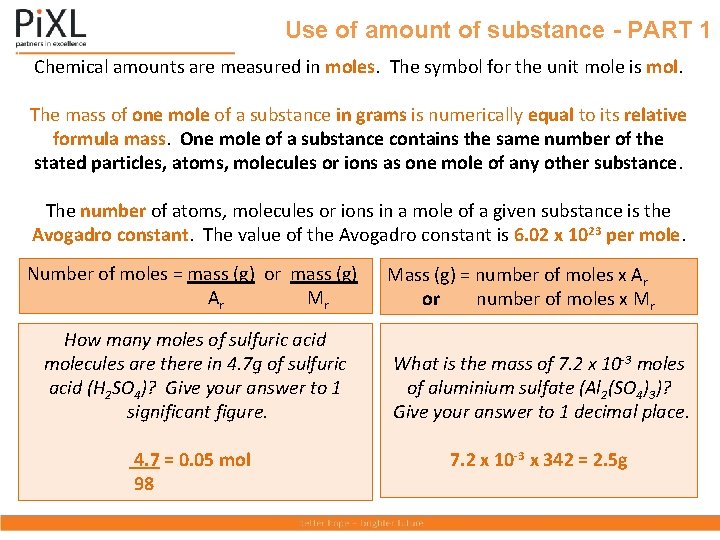
Use of amount of substance - PART 1 Chemical amounts are measured in moles. The symbol for the unit mole is mol. The mass of one mole of a substance in grams is numerically equal to its relative formula mass. One mole of a substance contains the same number of the stated particles, atoms, molecules or ions as one mole of any other substance. The number of atoms, molecules or ions in a mole of a given substance is the Avogadro constant. The value of the Avogadro constant is 6. 02 x 1023 per mole. Number of moles = mass (g) or mass (g) Ar Mr How many moles of sulfuric acid molecules are there in 4. 7 g of sulfuric acid (H 2 SO 4)? Give your answer to 1 significant figure. 4. 7 = 0. 05 mol 98 Mass (g) = number of moles x Ar or number of moles x Mr What is the mass of 7. 2 x 10 -3 moles of aluminium sulfate (Al 2(SO 4)3)? Give your answer to 1 decimal place. 7. 2 x 10 -3 x 342 = 2. 5 g
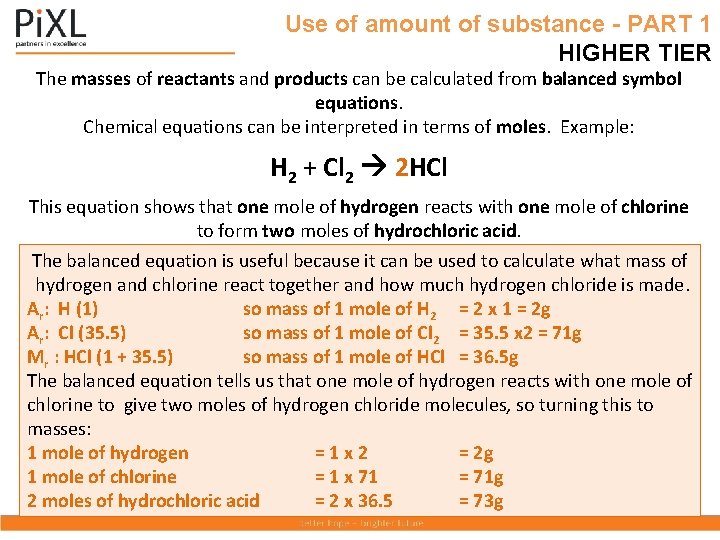
Use of amount of substance - PART 1 HIGHER TIER The masses of reactants and products can be calculated from balanced symbol equations. Chemical equations can be interpreted in terms of moles. Example: H 2 + Cl 2 2 HCl This equation shows that one mole of hydrogen reacts with one mole of chlorine to form two moles of hydrochloric acid. The balanced equation is useful because it can be used to calculate what mass of hydrogen and chlorine react together and how much hydrogen chloride is made. Ar: H (1) so mass of 1 mole of H 2 = 2 x 1 = 2 g Ar: Cl (35. 5) so mass of 1 mole of Cl 2 = 35. 5 x 2 = 71 g Mr : HCl (1 + 35. 5) so mass of 1 mole of HCl = 36. 5 g The balanced equation tells us that one mole of hydrogen reacts with one mole of chlorine to give two moles of hydrogen chloride molecules, so turning this to masses: 1 mole of hydrogen = 1 x 2 = 2 g 1 mole of chlorine = 1 x 71 = 71 g 2 moles of hydrochloric acid = 2 x 36. 5 = 73 g
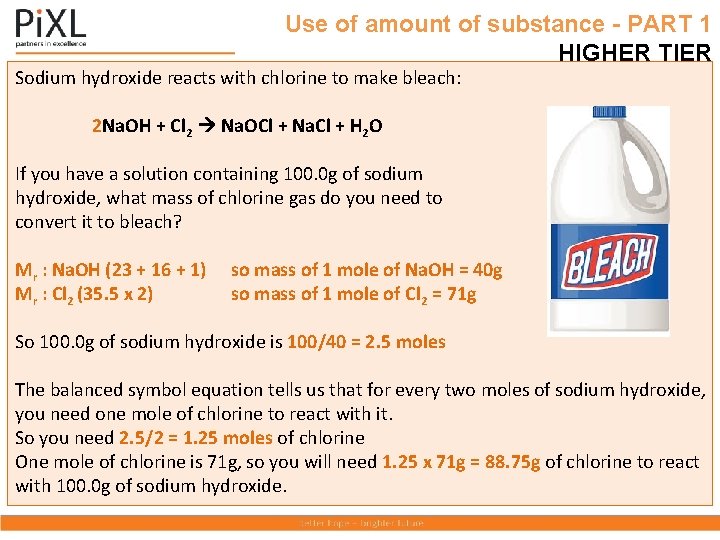
Use of amount of substance - PART 1 HIGHER TIER Sodium hydroxide reacts with chlorine to make bleach: 2 Na. OH + Cl 2 Na. OCl + Na. Cl + H 2 O If you have a solution containing 100. 0 g of sodium hydroxide, what mass of chlorine gas do you need to convert it to bleach? Mr : Na. OH (23 + 16 + 1) Mr : Cl 2 (35. 5 x 2) so mass of 1 mole of Na. OH = 40 g so mass of 1 mole of Cl 2 = 71 g So 100. 0 g of sodium hydroxide is 100/40 = 2. 5 moles The balanced symbol equation tells us that for every two moles of sodium hydroxide, you need one mole of chlorine to react with it. So you need 2. 5/2 = 1. 25 moles of chlorine One mole of chlorine is 71 g, so you will need 1. 25 x 71 g = 88. 75 g of chlorine to react with 100. 0 g of sodium hydroxide.
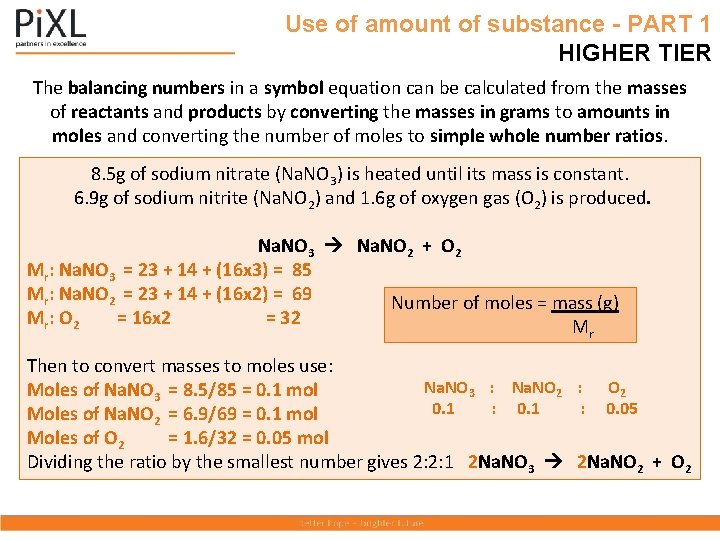
Use of amount of substance - PART 1 HIGHER TIER The balancing numbers in a symbol equation can be calculated from the masses of reactants and products by converting the masses in grams to amounts in moles and converting the number of moles to simple whole number ratios. 8. 5 g of sodium nitrate (Na. NO 3) is heated until its mass is constant. 6. 9 g of sodium nitrite (Na. NO 2) and 1. 6 g of oxygen gas (O 2) is produced. Na. NO 3 Na. NO 2 + O 2 Mr: Na. NO 3 = 23 + 14 + (16 x 3) = 85 Mr: Na. NO 2 = 23 + 14 + (16 x 2) = 69 Number of moles = mass (g) Mr: O 2 = 16 x 2 = 32 M r Then to convert masses to moles use: Na. NO 3 : Na. NO 2 : O 2 Moles of Na. NO 3 = 8. 5/85 = 0. 1 mol 0. 1 : 0. 05 Moles of Na. NO 2 = 6. 9/69 = 0. 1 mol Moles of O 2 = 1. 6/32 = 0. 05 mol Dividing the ratio by the smallest number gives 2: 2: 1 2 Na. NO 3 2 Na. NO 2 + O 2
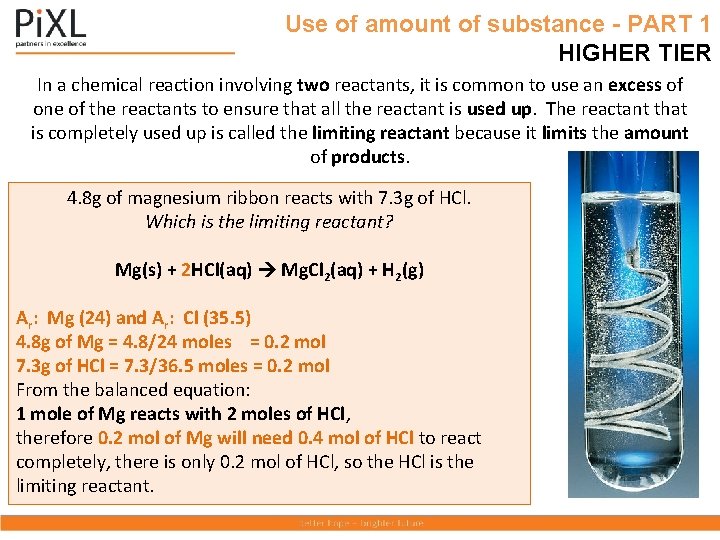
Use of amount of substance - PART 1 HIGHER TIER In a chemical reaction involving two reactants, it is common to use an excess of one of the reactants to ensure that all the reactant is used up. The reactant that is completely used up is called the limiting reactant because it limits the amount of products. 4. 8 g of magnesium ribbon reacts with 7. 3 g of HCl. Which is the limiting reactant? Mg(s) + 2 HCl(aq) Mg. Cl 2(aq) + H 2(g) Ar: Mg (24) and Ar: Cl (35. 5) 4. 8 g of Mg = 4. 8/24 moles = 0. 2 mol 7. 3 g of HCl = 7. 3/36. 5 moles = 0. 2 mol From the balanced equation: 1 mole of Mg reacts with 2 moles of HCl, therefore 0. 2 mol of Mg will need 0. 4 mol of HCl to react completely, there is only 0. 2 mol of HCl, so the HCl is the limiting reactant.
Question. IT! Use of amount of substance PART 1 • Moles (HT) • Amounts of substances in equations (HT) • Quantities in equations (HT) • Using moles to balance equations (HT) • Limiting reactants (HT)
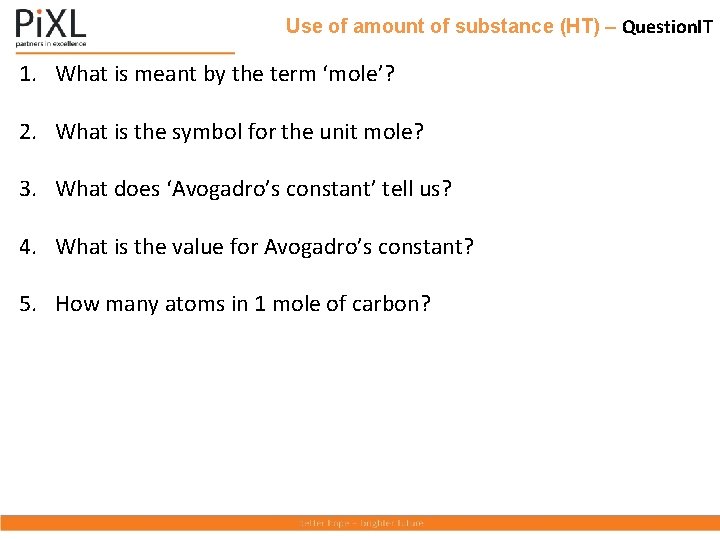
Use of amount of substance (HT) – Question. IT 1. What is meant by the term ‘mole’? 2. What is the symbol for the unit mole? 3. What does ‘Avogadro’s constant’ tell us? 4. What is the value for Avogadro’s constant? 5. How many atoms in 1 mole of carbon?
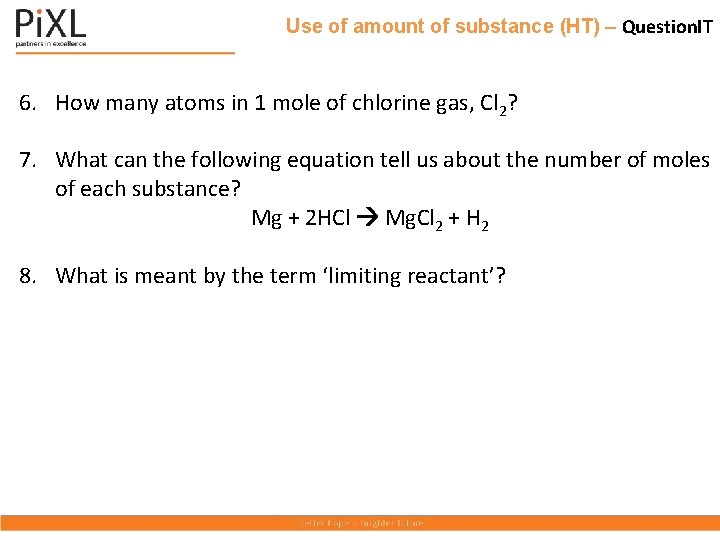
Use of amount of substance (HT) – Question. IT 6. How many atoms in 1 mole of chlorine gas, Cl 2? 7. What can the following equation tell us about the number of moles of each substance? Mg + 2 HCl Mg. Cl 2 + H 2 8. What is meant by the term ‘limiting reactant’?
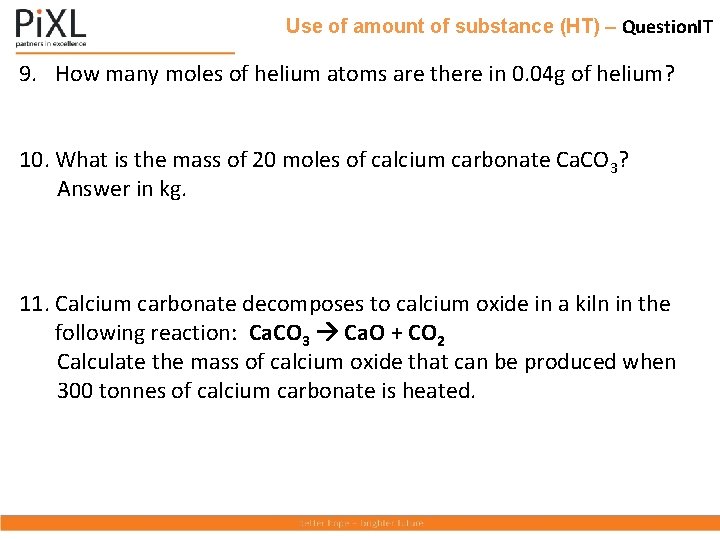
Use of amount of substance (HT) – Question. IT 9. How many moles of helium atoms are there in 0. 04 g of helium? 10. What is the mass of 20 moles of calcium carbonate Ca. CO 3? Answer in kg. 11. Calcium carbonate decomposes to calcium oxide in a kiln in the following reaction: Ca. CO 3 Ca. O + CO 2 Calculate the mass of calcium oxide that can be produced when 300 tonnes of calcium carbonate is heated.
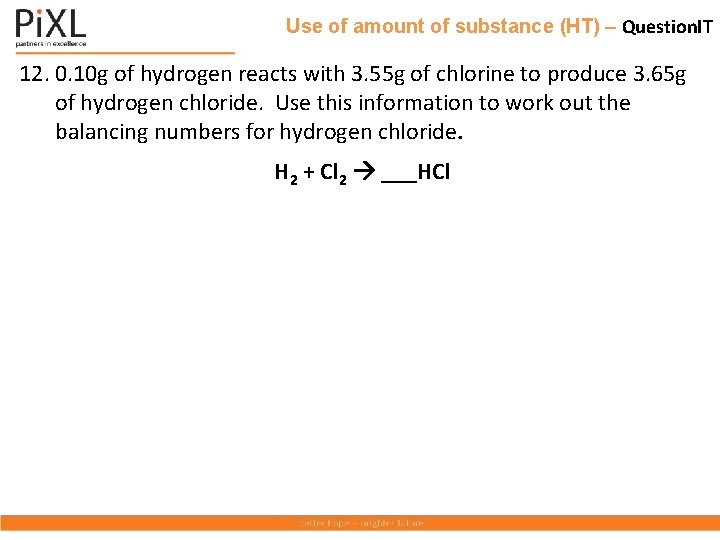
Use of amount of substance (HT) – Question. IT 12. 0. 10 g of hydrogen reacts with 3. 55 g of chlorine to produce 3. 65 g of hydrogen chloride. Use this information to work out the balancing numbers for hydrogen chloride. H 2 + Cl 2 ___HCl
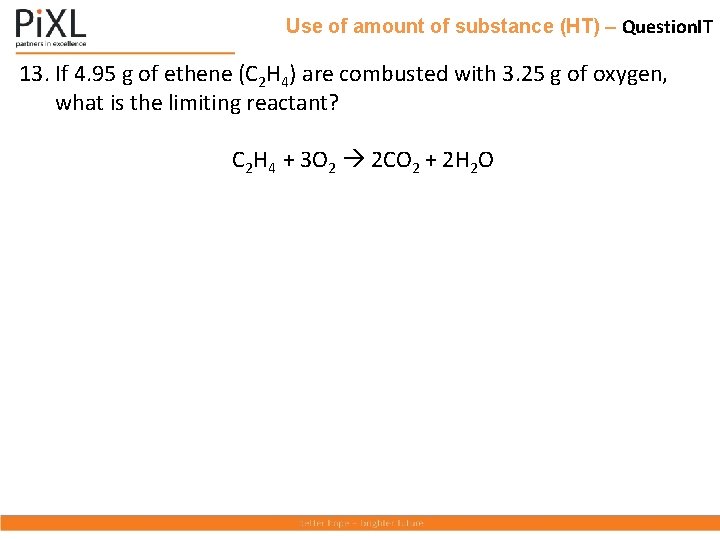
Use of amount of substance (HT) – Question. IT 13. If 4. 95 g of ethene (C 2 H 4) are combusted with 3. 25 g of oxygen, what is the limiting reactant? C 2 H 4 + 3 O 2 2 CO 2 + 2 H 2 O
Answer. IT! Use of amount of substance PART 1 • • • Moles (HT) Amounts of substances in equations (HT) Quantities in equations (HT) Using moles to balance equations (HT) Limiting reactants (HT)
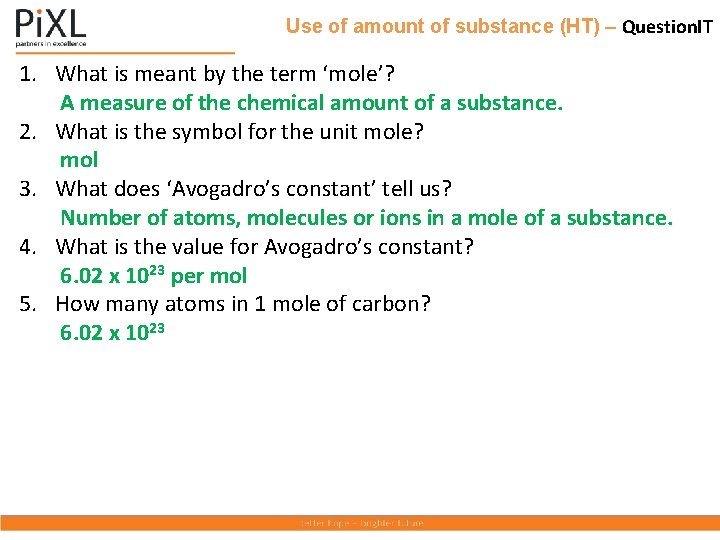
Use of amount of substance (HT) – Question. IT 1. What is meant by the term ‘mole’? A measure of the chemical amount of a substance. 2. What is the symbol for the unit mole? mol 3. What does ‘Avogadro’s constant’ tell us? Number of atoms, molecules or ions in a mole of a substance. 4. What is the value for Avogadro’s constant? 6. 02 x 1023 per mol 5. How many atoms in 1 mole of carbon? 6. 02 x 1023
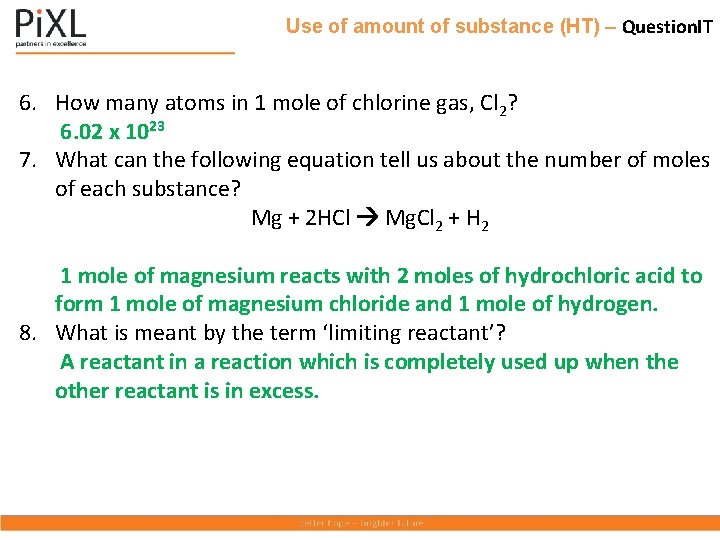
Use of amount of substance (HT) – Question. IT 6. How many atoms in 1 mole of chlorine gas, Cl 2? 6. 02 x 1023 7. What can the following equation tell us about the number of moles of each substance? Mg + 2 HCl Mg. Cl 2 + H 2 1 mole of magnesium reacts with 2 moles of hydrochloric acid to form 1 mole of magnesium chloride and 1 mole of hydrogen. 8. What is meant by the term ‘limiting reactant’? A reactant in a reaction which is completely used up when the other reactant is in excess.
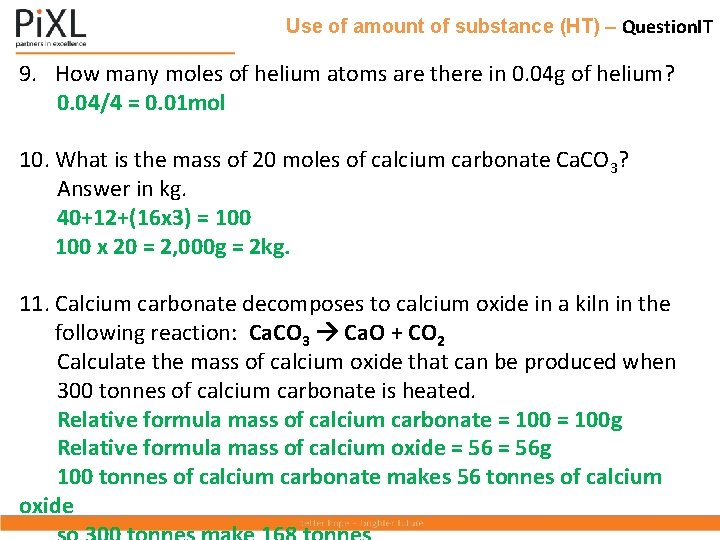
Use of amount of substance (HT) – Question. IT 9. How many moles of helium atoms are there in 0. 04 g of helium? 0. 04/4 = 0. 01 mol 10. What is the mass of 20 moles of calcium carbonate Ca. CO 3? Answer in kg. 40+12+(16 x 3) = 100 x 20 = 2, 000 g = 2 kg. 11. Calcium carbonate decomposes to calcium oxide in a kiln in the following reaction: Ca. CO 3 Ca. O + CO 2 Calculate the mass of calcium oxide that can be produced when 300 tonnes of calcium carbonate is heated. Relative formula mass of calcium carbonate = 100 g Relative formula mass of calcium oxide = 56 g 100 tonnes of calcium carbonate makes 56 tonnes of calcium oxide
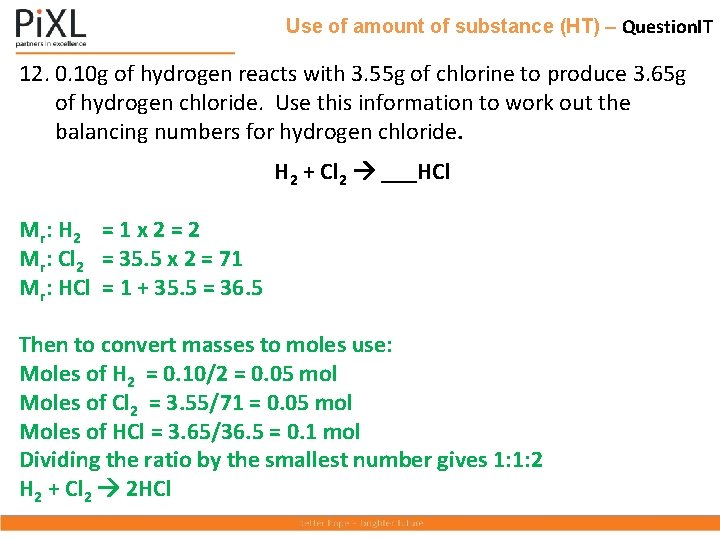
Use of amount of substance (HT) – Question. IT 12. 0. 10 g of hydrogen reacts with 3. 55 g of chlorine to produce 3. 65 g of hydrogen chloride. Use this information to work out the balancing numbers for hydrogen chloride. H 2 + Cl 2 ___HCl Mr: H 2 = 1 x 2 = 2 Mr: Cl 2 = 35. 5 x 2 = 71 Mr: HCl = 1 + 35. 5 = 36. 5 Then to convert masses to moles use: Moles of H 2 = 0. 10/2 = 0. 05 mol Moles of Cl 2 = 3. 55/71 = 0. 05 mol Moles of HCl = 3. 65/36. 5 = 0. 1 mol Dividing the ratio by the smallest number gives 1: 1: 2 H 2 + Cl 2 2 HCl
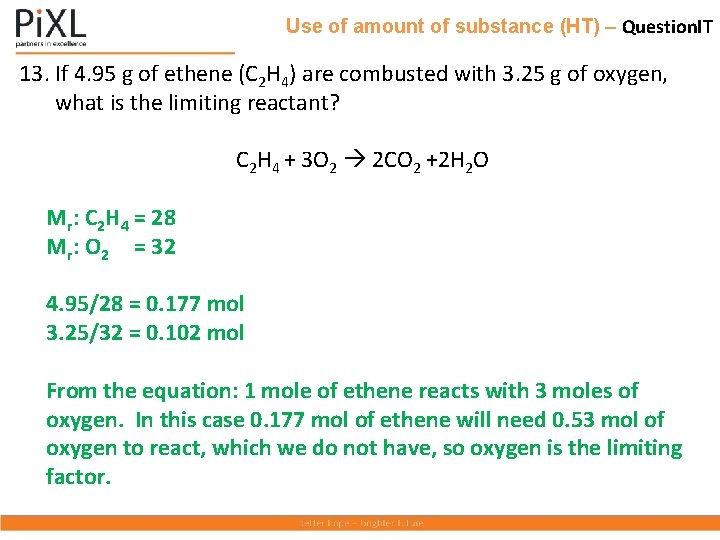
Use of amount of substance (HT) – Question. IT 13. If 4. 95 g of ethene (C 2 H 4) are combusted with 3. 25 g of oxygen, what is the limiting reactant? C 2 H 4 + 3 O 2 2 CO 2 +2 H 2 O Mr: C 2 H 4 = 28 Mr: O 2 = 32 4. 95/28 = 0. 177 mol 3. 25/32 = 0. 102 mol From the equation: 1 mole of ethene reacts with 3 moles of oxygen. In this case 0. 177 mol of ethene will need 0. 53 mol of oxygen to react, which we do not have, so oxygen is the limiting factor.

Learn. IT! Know. IT! Use of amount of substance PART 2 • Concentration of solutions
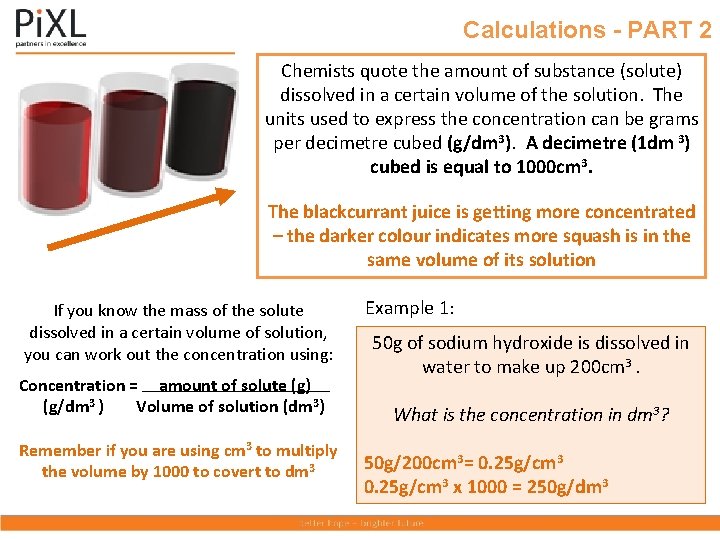
Calculations - PART 2 Chemists quote the amount of substance (solute) dissolved in a certain volume of the solution. The units used to express the concentration can be grams per decimetre cubed (g/dm 3). A decimetre (1 dm 3) cubed is equal to 1000 cm 3. The blackcurrant juice is getting more concentrated – the darker colour indicates more squash is in the same volume of its solution If you know the mass of the solute dissolved in a certain volume of solution, you can work out the concentration using: Concentration = amount of solute (g) (g/dm 3 ) Volume of solution (dm 3) Remember if you are using cm 3 to multiply the volume by 1000 to covert to dm 3 Example 1: 50 g of sodium hydroxide is dissolved in water to make up 200 cm 3. What is the concentration in dm 3? 50 g/200 cm 3= 0. 25 g/cm 3 x 1000 = 250 g/dm 3
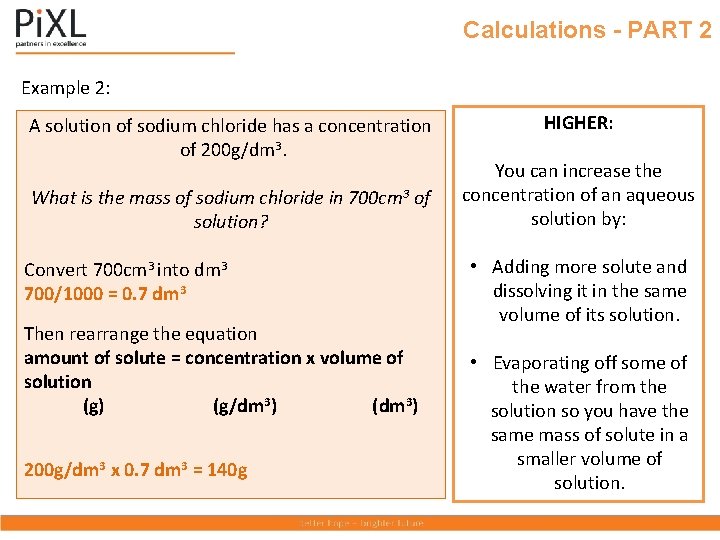
Calculations - PART 2 Example 2: A solution of sodium chloride has a concentration of 200 g/dm 3. What is the mass of sodium chloride in 700 cm 3 of solution? Convert 700 cm 3 into dm 3 700/1000 = 0. 7 dm 3 Then rearrange the equation amount of solute = concentration x volume of solution (g) (g/dm 3) (dm 3) 200 g/dm 3 x 0. 7 dm 3 = 140 g HIGHER: You can increase the concentration of an aqueous solution by: • Adding more solute and dissolving it in the same volume of its solution. • Evaporating off some of the water from the solution so you have the same mass of solute in a smaller volume of solution.

Question. IT! Use of amount of substance PART 2 • Concentration of solutions
Use of amount of substance – Question. IT 1. What units can be used for the concentration of a solution? 2. What does dm 3 mean? 3. Give the equation for calculating concentration from the mass of substance and volume of solution. 4. HT Only: How can you increase the concentration of an aqueous solution?
Use of amount of substance – Question. IT 5. Calculate the concentration in g/dm 3 for 50 g of sodium chloride in 2. 5 dm 3 of water. 6. Calculate the concentration in g/dm 3 of 1. 4 g of potassium carbonate in 855 cm 3 of water. 7. A teacher has a solution of lithium fluoride with a concentration of 72. 6 g/dm 3. Calculate the mass of lithium fluoride dissolved in 25. 0 cm 3 of solution.
Answer. IT! Use of amount of substance PART 2 • Concentration of solutions
Use of amount of substance – Question. IT 1. What units can be used for the concentration of a solution? g/dm 3 2. What does dm 3 mean? 1000 cm 3 3. Give the equation for calculating concentration from the mass of substance and volume of solution. Concentration = mass ÷ volume 4. HT Only: How can you increase the concentration of an aqueous solution? Add more solute and dissolve in the same volume of water; evaporate off some of the water/decrease the volume of water
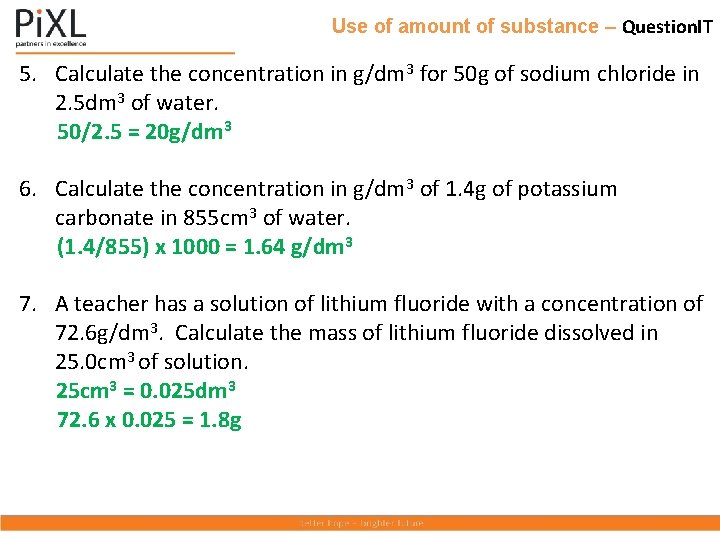
Use of amount of substance – Question. IT 5. Calculate the concentration in g/dm 3 for 50 g of sodium chloride in 2. 5 dm 3 of water. 50/2. 5 = 20 g/dm 3 6. Calculate the concentration in g/dm 3 of 1. 4 g of potassium carbonate in 855 cm 3 of water. (1. 4/855) x 1000 = 1. 64 g/dm 3 7. A teacher has a solution of lithium fluoride with a concentration of 72. 6 g/dm 3. Calculate the mass of lithium fluoride dissolved in 25. 0 cm 3 of solution. 25 cm 3 = 0. 025 dm 3 72. 6 x 0. 025 = 1. 8 g

Learn. IT! Know. IT! Yield and atom economy CHEMISTRY ONLY • Percentage yield • Atom economy
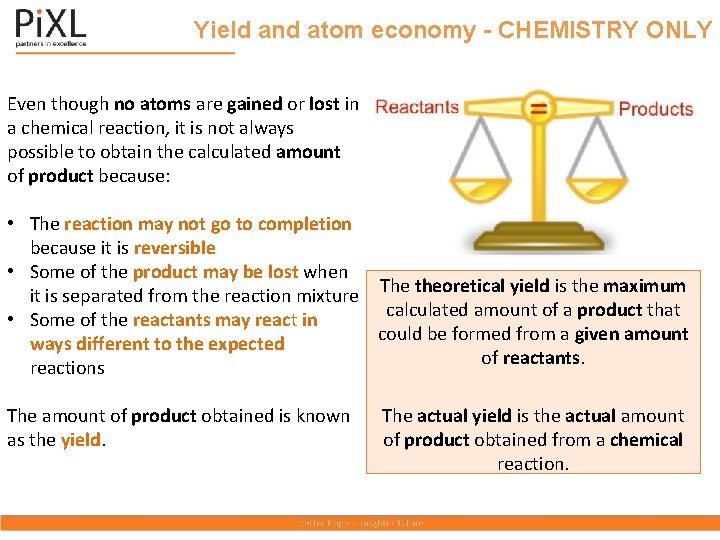
Yield and atom economy - CHEMISTRY ONLY Even though no atoms are gained or lost in a chemical reaction, it is not always possible to obtain the calculated amount of product because: • The reaction may not go to completion because it is reversible • Some of the product may be lost when The theoretical yield is the maximum it is separated from the reaction mixture calculated amount of a product that • Some of the reactants may react in could be formed from a given amount ways different to the expected of reactants. reactions The amount of product obtained is known as the yield. The actual yield is the actual amount of product obtained from a chemical reaction.
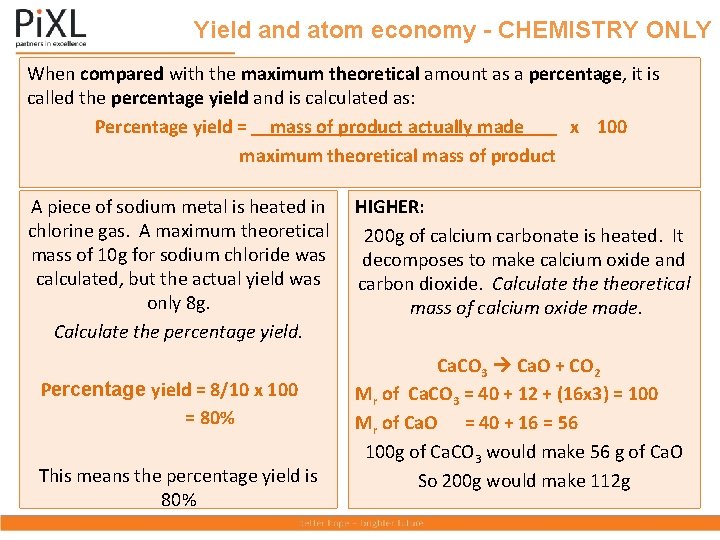
Yield and atom economy - CHEMISTRY ONLY When compared with the maximum theoretical amount as a percentage, it is called the percentage yield and is calculated as: Percentage yield = mass of product actually made x 100 maximum theoretical mass of product A piece of sodium metal is heated in chlorine gas. A maximum theoretical mass of 10 g for sodium chloride was calculated, but the actual yield was only 8 g. Calculate the percentage yield. Percentage yield = 8/10 x 100 = 80% This means the percentage yield is 80% HIGHER: 200 g of calcium carbonate is heated. It decomposes to make calcium oxide and carbon dioxide. Calculate theoretical mass of calcium oxide made. Ca. CO 3 Ca. O + CO 2 Mr of Ca. CO 3 = 40 + 12 + (16 x 3) = 100 Mr of Ca. O = 40 + 16 = 56 100 g of Ca. CO 3 would make 56 g of Ca. O So 200 g would make 112 g
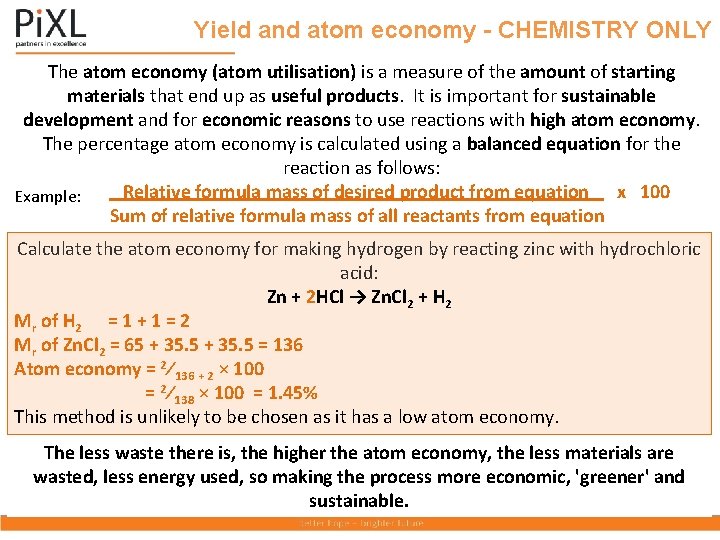
Yield and atom economy - CHEMISTRY ONLY The atom economy (atom utilisation) is a measure of the amount of starting materials that end up as useful products. It is important for sustainable development and for economic reasons to use reactions with high atom economy. The percentage atom economy is calculated using a balanced equation for the reaction as follows: Relative formula mass of desired product from equation x 100 Example: Sum of relative formula mass of all reactants from equation Calculate the atom economy for making hydrogen by reacting zinc with hydrochloric acid: Zn + 2 HCl → Zn. Cl 2 + H 2 Mr of H 2 = 1 + 1 = 2 Mr of Zn. Cl 2 = 65 + 35. 5 = 136 Atom economy = 2∕ 136 + 2 × 100 = 2∕ 138 × 100 = 1. 45% This method is unlikely to be chosen as it has a low atom economy. The less waste there is, the higher the atom economy, the less materials are wasted, less energy used, so making the process more economic, 'greener' and sustainable.
Question. IT! Yield and atom economy PART 1 CHEMISTRY ONLY • Percentage yield • Atomy economy
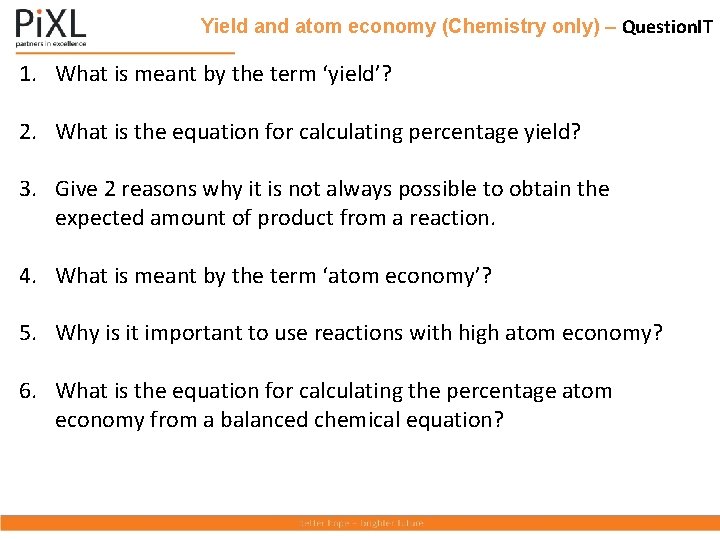
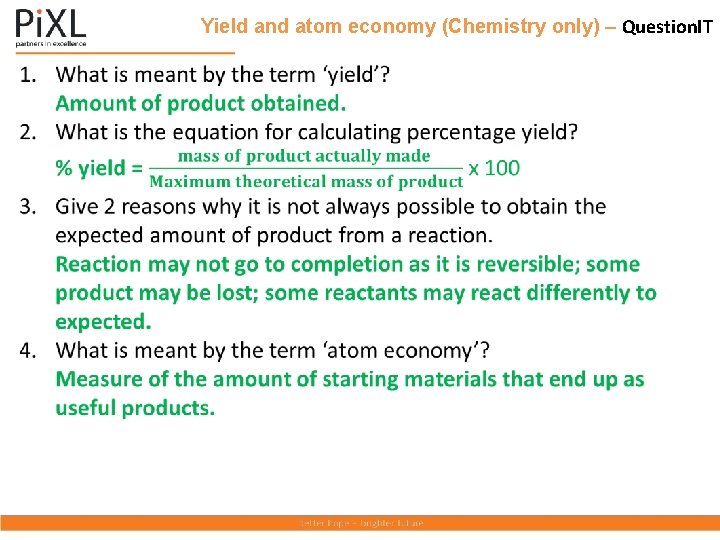
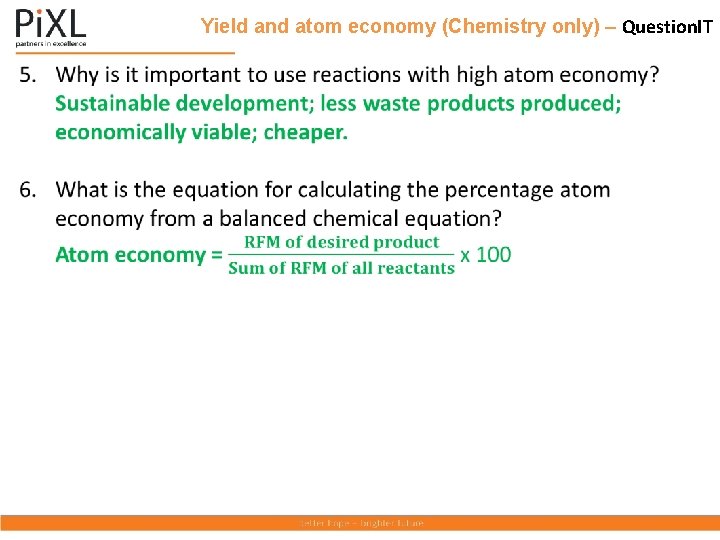
Yield and atom economy (Chemistry only) – Question. IT 1. What is meant by the term ‘yield’? 2. What is the equation for calculating percentage yield? 3. Give 2 reasons why it is not always possible to obtain the expected amount of product from a reaction. 4. What is meant by the term ‘atom economy’? 5. Why is it important to use reactions with high atom economy? 6. What is the equation for calculating the percentage atom economy from a balanced chemical equation?
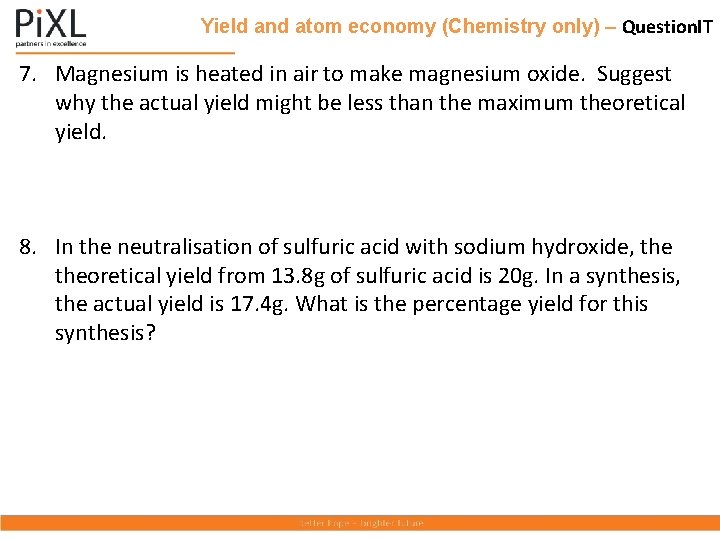
Yield and atom economy (Chemistry only) – Question. IT 7. Magnesium is heated in air to make magnesium oxide. Suggest why the actual yield might be less than the maximum theoretical yield. 8. In the neutralisation of sulfuric acid with sodium hydroxide, theoretical yield from 13. 8 g of sulfuric acid is 20 g. In a synthesis, the actual yield is 17. 4 g. What is the percentage yield for this synthesis?
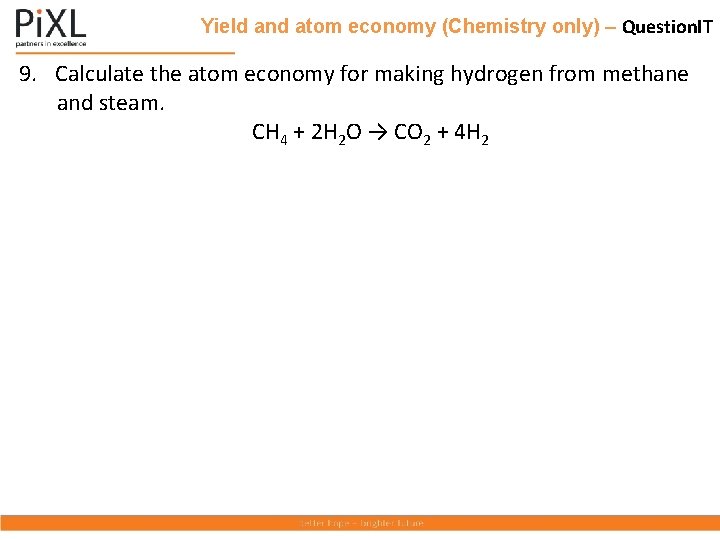
Yield and atom economy (Chemistry only) – Question. IT 9. Calculate the atom economy for making hydrogen from methane and steam. CH 4 + 2 H 2 O → CO 2 + 4 H 2
Answer. IT! Yield and atom economy PART 1 CHEMISTRY ONLY • Percentage yield • Atomy economy
Yield and atom economy (Chemistry only) – Question. IT
Yield and atom economy (Chemistry only) – Question. IT
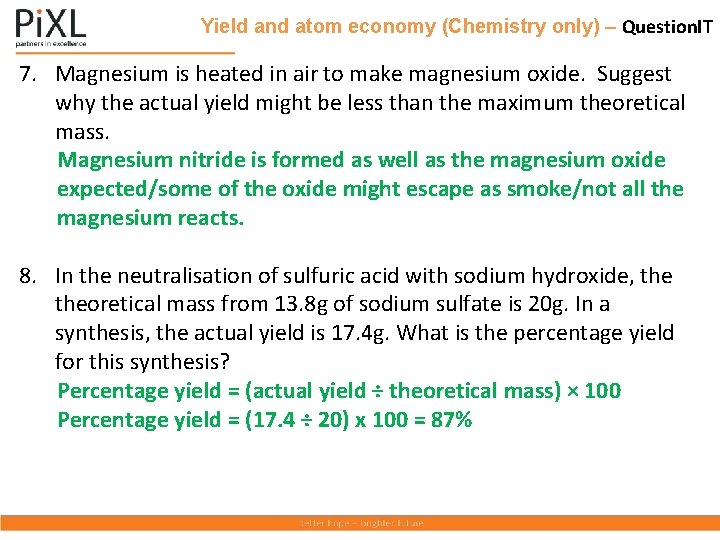
Yield and atom economy (Chemistry only) – Question. IT 7. Magnesium is heated in air to make magnesium oxide. Suggest why the actual yield might be less than the maximum theoretical mass. Magnesium nitride is formed as well as the magnesium oxide expected/some of the oxide might escape as smoke/not all the magnesium reacts. 8. In the neutralisation of sulfuric acid with sodium hydroxide, theoretical mass from 13. 8 g of sodium sulfate is 20 g. In a synthesis, the actual yield is 17. 4 g. What is the percentage yield for this synthesis? Percentage yield = (actual yield ÷ theoretical mass) × 100 Percentage yield = (17. 4 ÷ 20) x 100 = 87%
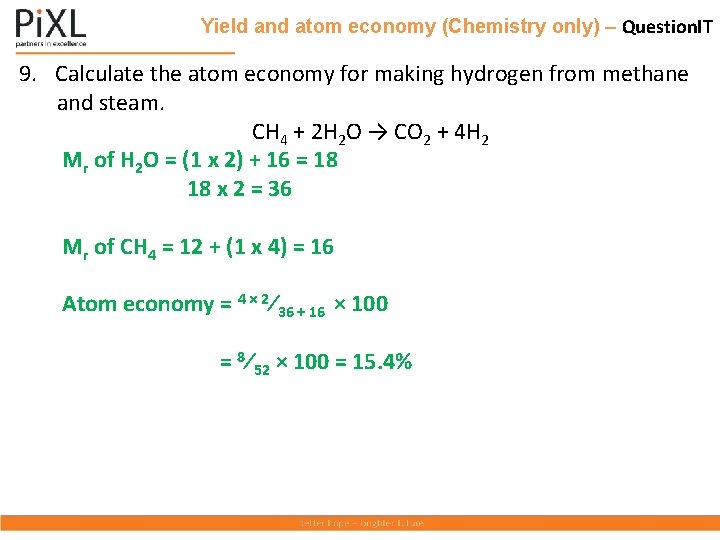
Yield and atom economy (Chemistry only) – Question. IT 9. Calculate the atom economy for making hydrogen from methane and steam. CH 4 + 2 H 2 O → CO 2 + 4 H 2 Mr of H 2 O = (1 x 2) + 16 = 18 18 x 2 = 36 Mr of CH 4 = 12 + (1 x 4) = 16 Atom economy = 4 × 2∕ 36 + 16 × 100 = 8∕ 52 × 100 = 15. 4%

Learn. IT! Know. IT! Quantities CHEMISTRY ONLY • Moles of solution and gases (HT)
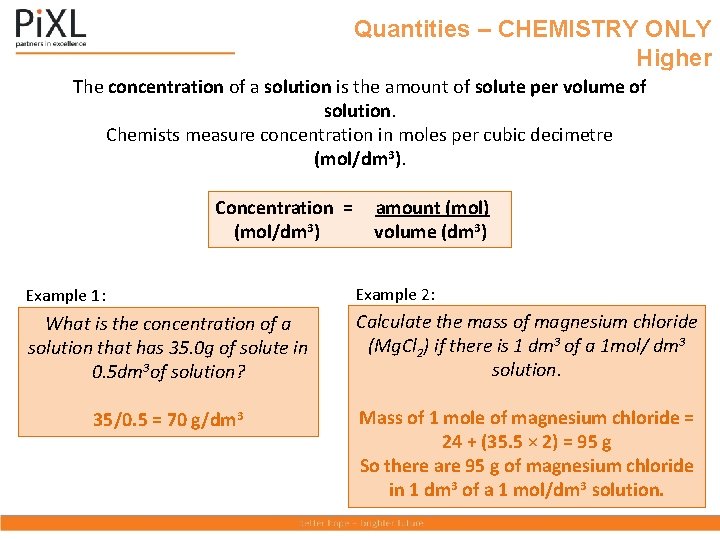
Quantities – CHEMISTRY ONLY Higher The concentration of a solution is the amount of solute per volume of solution. Chemists measure concentration in moles per cubic decimetre (mol/dm 3). Concentration = amount (mol) (mol/dm 3) volume (dm 3) Example 1: Example 2: What is the concentration of a solution that has 35. 0 g of solute in 0. 5 dm 3 of solution? Calculate the mass of magnesium chloride (Mg. Cl 2) if there is 1 dm 3 of a 1 mol/ dm 3 solution. 35/0. 5 = 70 g/dm 3 Mass of 1 mole of magnesium chloride = 24 + (35. 5 × 2) = 95 g So there are 95 g of magnesium chloride in 1 dm 3 of a 1 mol/dm 3 solution.
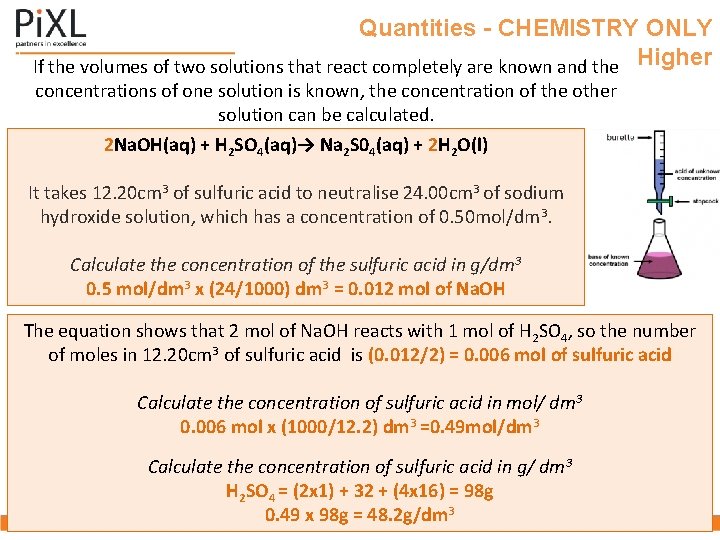
Quantities - CHEMISTRY ONLY If the volumes of two solutions that react completely are known and the Higher concentrations of one solution is known, the concentration of the other solution can be calculated. 2 Na. OH(aq) + H 2 SO 4(aq)→ Na 2 S 04(aq) + 2 H 2 O(l) It takes 12. 20 cm 3 of sulfuric acid to neutralise 24. 00 cm 3 of sodium hydroxide solution, which has a concentration of 0. 50 mol/dm 3. Calculate the concentration of the sulfuric acid in g/dm 3 0. 5 mol/dm 3 x (24/1000) dm 3 = 0. 012 mol of Na. OH The equation shows that 2 mol of Na. OH reacts with 1 mol of H 2 SO 4, so the number of moles in 12. 20 cm 3 of sulfuric acid is (0. 012/2) = 0. 006 mol of sulfuric acid Calculate the concentration of sulfuric acid in mol/ dm 3 0. 006 mol x (1000/12. 2) dm 3 =0. 49 mol/dm 3 Calculate the concentration of sulfuric acid in g/ dm 3 H 2 SO 4 = (2 x 1) + 32 + (4 x 16) = 98 g 0. 49 x 98 g = 48. 2 g/dm 3
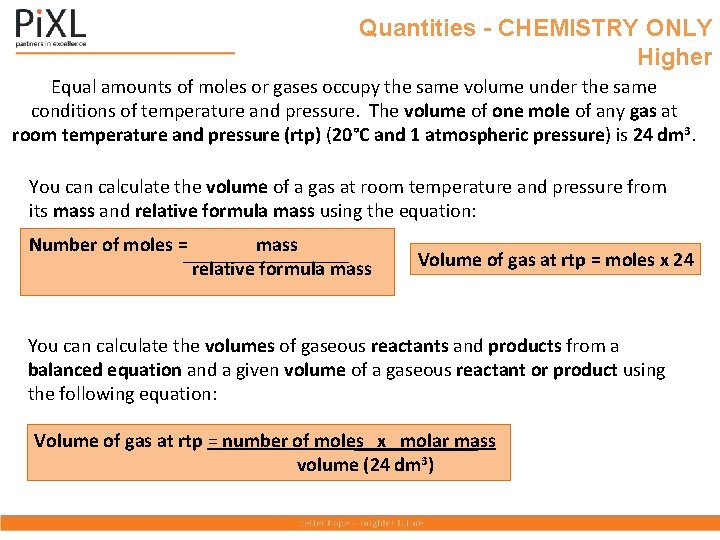
Quantities - CHEMISTRY ONLY Higher Equal amounts of moles or gases occupy the same volume under the same conditions of temperature and pressure. The volume of one mole of any gas at room temperature and pressure (rtp) (20°C and 1 atmospheric pressure) is 24 dm 3. You can calculate the volume of a gas at room temperature and pressure from its mass and relative formula mass using the equation: Number of moles = mass relative formula mass Volume of gas at rtp = moles x 24 You can calculate the volumes of gaseous reactants and products from a balanced equation and a given volume of a gaseous reactant or product using the following equation: Volume of gas at rtp = number of moles x molar mass volume (24 dm 3)
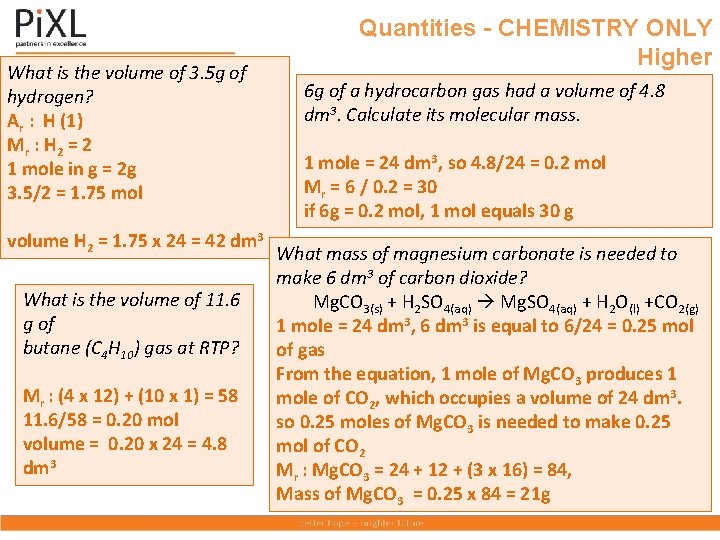
What is the volume of 3. 5 g of hydrogen? Ar : H (1) Mr : H 2 = 2 1 mole in g = 2 g 3. 5/2 = 1. 75 mol volume H 2 = 1. 75 x 24 = 42 dm 3 What is the volume of 11. 6 g of butane (C 4 H 10) gas at RTP? Mr : (4 x 12) + (10 x 1) = 58 11. 6/58 = 0. 20 mol volume = 0. 20 x 24 = 4. 8 dm 3 Quantities - CHEMISTRY ONLY Higher 6 g of a hydrocarbon gas had a volume of 4. 8 dm 3. Calculate its molecular mass. 1 mole = 24 dm 3, so 4. 8/24 = 0. 2 mol Mr = 6 / 0. 2 = 30 if 6 g = 0. 2 mol, 1 mol equals 30 g What mass of magnesium carbonate is needed to make 6 dm 3 of carbon dioxide? Mg. CO 3(s) + H 2 SO 4(aq) Mg. SO 4(aq) + H 2 O(l) +CO 2(g) 1 mole = 24 dm 3, 6 dm 3 is equal to 6/24 = 0. 25 mol of gas From the equation, 1 mole of Mg. CO 3 produces 1 mole of CO 2, which occupies a volume of 24 dm 3. so 0. 25 moles of Mg. CO 3 is needed to make 0. 25 mol of CO 2 Mr : Mg. CO 3 = 24 + 12 + (3 x 16) = 84, Mass of Mg. CO 3 = 0. 25 x 84 = 21 g
Question. IT! Quantities CHEMISTRY ONLY • Moles of solution and gases (HT)
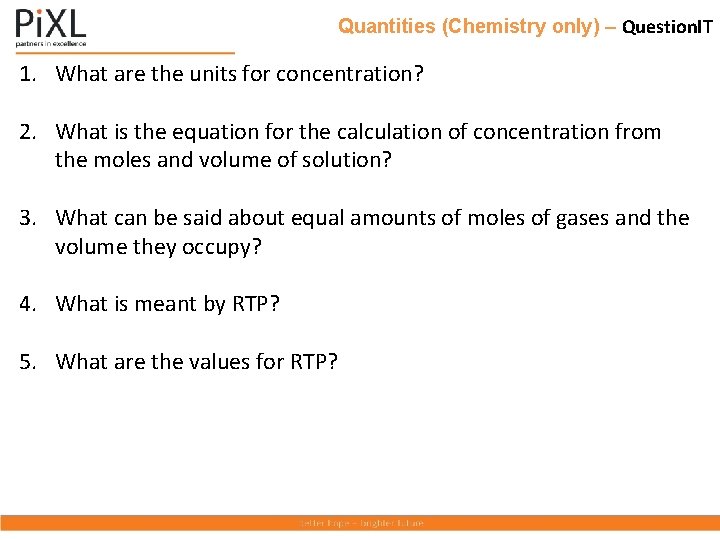
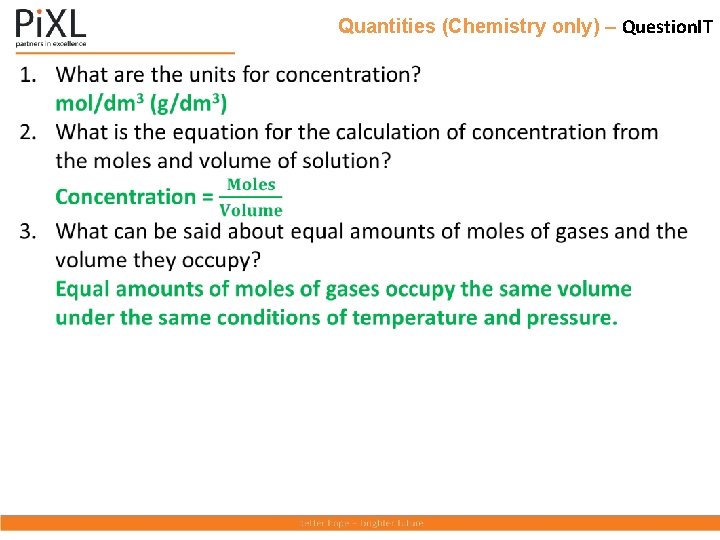
Quantities (Chemistry only) – Question. IT 1. What are the units for concentration? 2. What is the equation for the calculation of concentration from the moles and volume of solution? 3. What can be said about equal amounts of moles of gases and the volume they occupy? 4. What is meant by RTP? 5. What are the values for RTP?
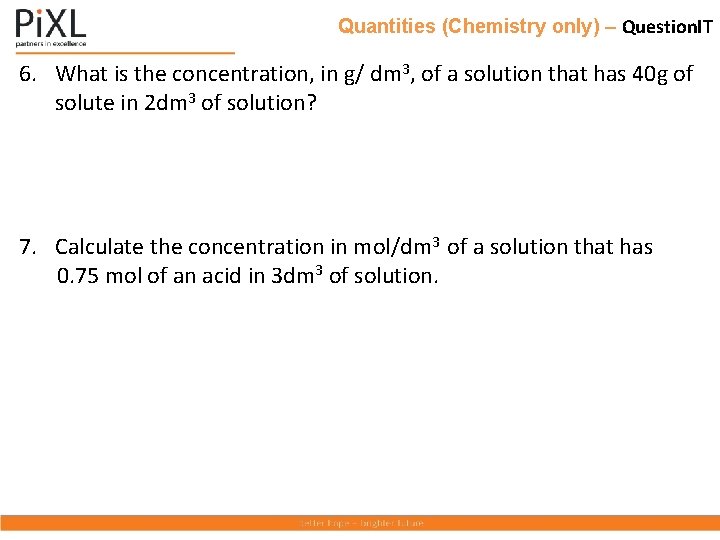
Quantities (Chemistry only) – Question. IT 6. What is the concentration, in g/ dm 3, of a solution that has 40 g of solute in 2 dm 3 of solution? 7. Calculate the concentration in mol/dm 3 of a solution that has 0. 75 mol of an acid in 3 dm 3 of solution.
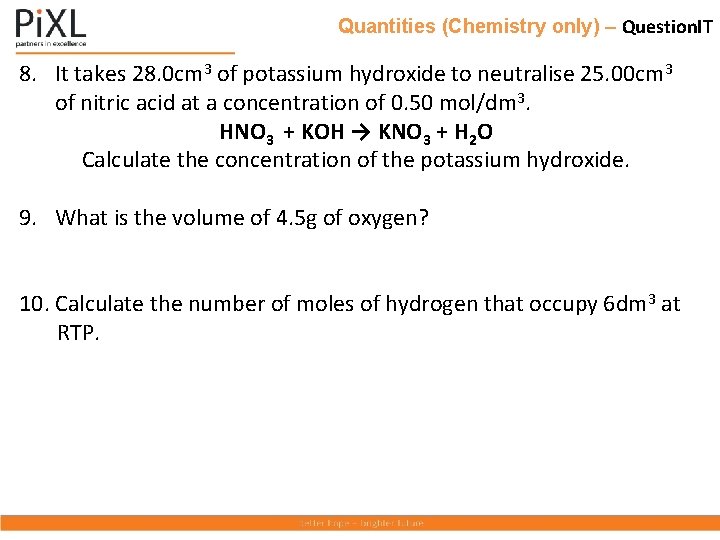
Quantities (Chemistry only) – Question. IT 8. It takes 28. 0 cm 3 of potassium hydroxide to neutralise 25. 00 cm 3 of nitric acid at a concentration of 0. 50 mol/dm 3. HNO 3 + KOH → KNO 3 + H 2 O Calculate the concentration of the potassium hydroxide. 9. What is the volume of 4. 5 g of oxygen? 10. Calculate the number of moles of hydrogen that occupy 6 dm 3 at RTP.
Answer. IT! Quantities CHEMISTRY ONLY • Moles of solution and gases (HT)
Quantities (Chemistry only) – Question. IT
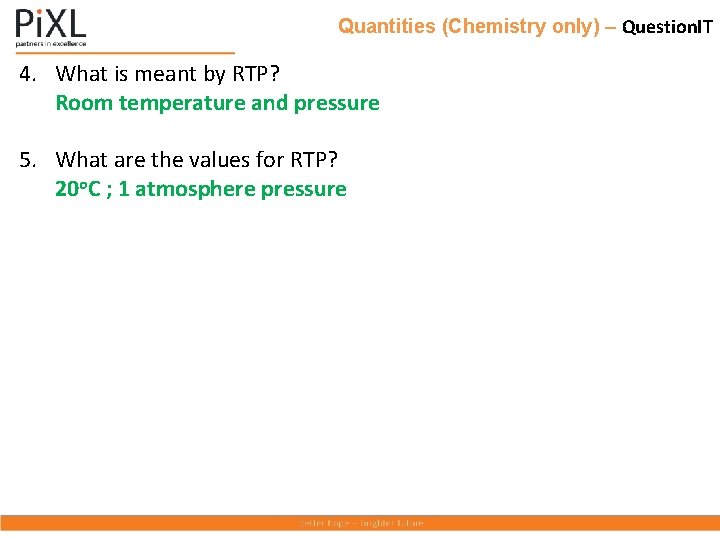
Quantities (Chemistry only) – Question. IT 4. What is meant by RTP? Room temperature and pressure 5. What are the values for RTP? 20 o. C ; 1 atmosphere pressure
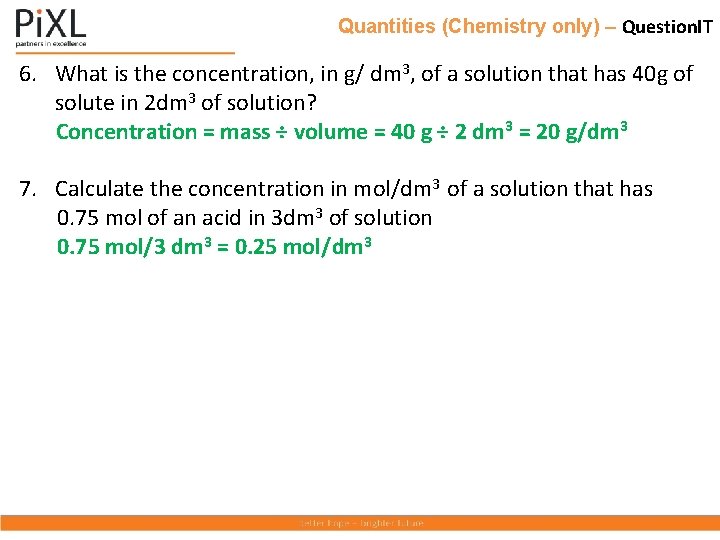
Quantities (Chemistry only) – Question. IT 6. What is the concentration, in g/ dm 3, of a solution that has 40 g of solute in 2 dm 3 of solution? Concentration = mass ÷ volume = 40 g ÷ 2 dm 3 = 20 g/dm 3 7. Calculate the concentration in mol/dm 3 of a solution that has 0. 75 mol of an acid in 3 dm 3 of solution 0. 75 mol/3 dm 3 = 0. 25 mol/dm 3
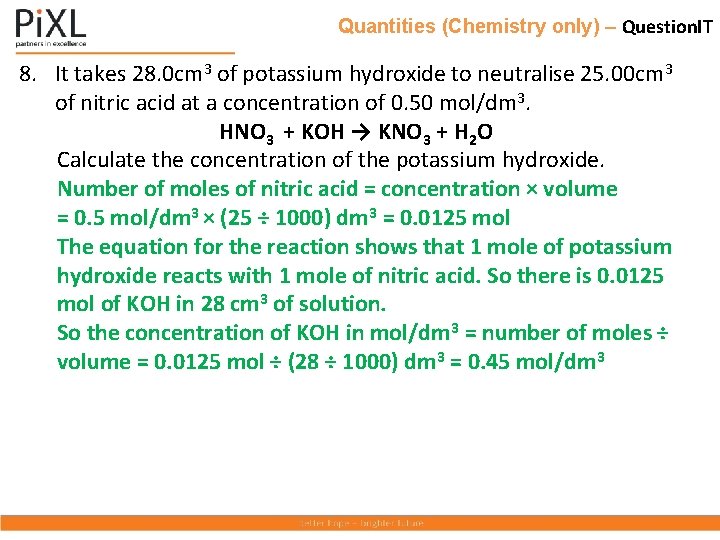
Quantities (Chemistry only) – Question. IT 8. It takes 28. 0 cm 3 of potassium hydroxide to neutralise 25. 00 cm 3 of nitric acid at a concentration of 0. 50 mol/dm 3. HNO 3 + KOH → KNO 3 + H 2 O Calculate the concentration of the potassium hydroxide. Number of moles of nitric acid = concentration × volume = 0. 5 mol/dm 3 × (25 ÷ 1000) dm 3 = 0. 0125 mol The equation for the reaction shows that 1 mole of potassium hydroxide reacts with 1 mole of nitric acid. So there is 0. 0125 mol of KOH in 28 cm 3 of solution. So the concentration of KOH in mol/dm 3 = number of moles ÷ volume = 0. 0125 mol ÷ (28 ÷ 1000) dm 3 = 0. 45 mol/dm 3
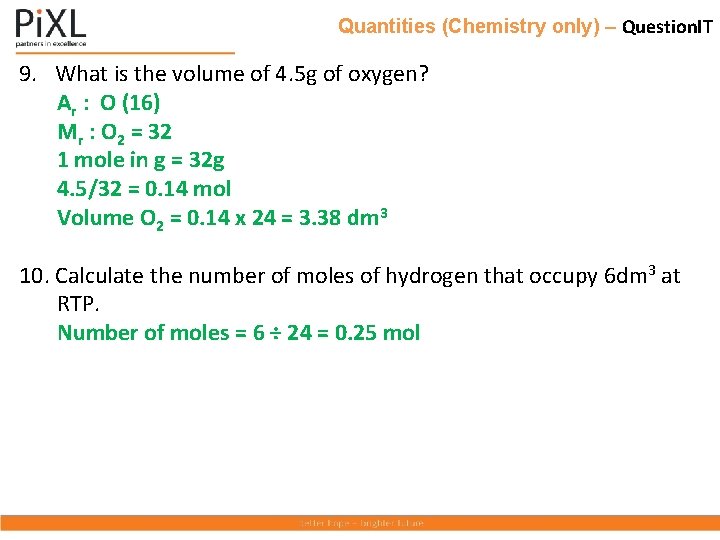
Quantities (Chemistry only) – Question. IT 9. What is the volume of 4. 5 g of oxygen? Ar : O (16) Mr : O 2 = 32 1 mole in g = 32 g 4. 5/32 = 0. 14 mol Volume O 2 = 0. 14 x 24 = 3. 38 dm 3 10. Calculate the number of moles of hydrogen that occupy 6 dm 3 at RTP. Number of moles = 6 ÷ 24 = 0. 25 mol
- Slides: 76