Evaluating the Economy Pick up a worksheet off
- Slides: 9
Evaluating the Economy Pick up a worksheet off of the cart and a book. Page 352 Complete Quiz Reivew 12. 1
GDP—The Measure of National Output • Macroeconomics uses a comprehensive set of measures in the National Income and Product Accounts (NIPA). • The most comprehensive measure of national output is gross domestic product (GDP). • To get current GDP, multiply all of the final goods and services produced in a 12 -month period by their prices, and then add them up. • GDP per capita is determined by dividing the real GDP by the population. • GDP does not provide information about composition of output, quality of life impacts, nonmarket activities, or improved product quality. • GDP does not measure welfare, but appears to contribute to our well -being.
Measures of National Income • Gross national product (GNP) is a measure of the country’s total national income—the dollar value of all finals goods, services, and structures produced in one year with labor and property supplied by a country’s residents. • Net national product (NNP) is the GNP minus depreciation. • National income (NI) is the income that is left after all taxes except corporate profits tax are subtracted from the NNP. • Personal income (PI) equals the total amount of income that goes to consumers before income taxes are subtracted. • Disposable personal income (DPI) is the total income that goes to consumers after personal income taxes are subtracted.
Economic Sectors and Circular Flows • Economic sectors include the consumer, investment, government, and net foreign sectors. • The consumer sector consists of all the people who live in households and receives its income in the form of disposable personal income. • The investment sector consists of proprietorships, partnerships, and corporations that produce the nation’s output. • The government, or public, sector includes all local, state, and federal levels of government. • The net foreign sector includes all consumers and producers outside the United States. • The output-expenditure model says that the GDP is equal to the sum of aggregate demand for output by the consumer, investment, government, and net foreign sectors.
Population in the United States • Every 10 years, an official census is taken to count people in the United States. • The Census Bureau was formed in 1902 and now works year round. • Although the population of the United States has grown since 1790, the rate of growth has slowly declined. • In the 1970 s, the population began to shift toward the western and southern parts of the United States. • The center of population has moved from 23 miles east of Baltimore, Maryland, in 1970 to 2. 7 miles northeast of Plato, Missouri, in 2010. • Population growth and shifts in population can put more or different demands on existing resources.
Projected Population Trends • As more baby boomers reach their retirement years, they will place a heavy burden on the younger and relatively smaller working population. • Women tend to outlive men. • The Census Bureau makes projections for racial and ethnic groups. • The three major factors that affect population growth are fertility rate, life expectancy, and net immigration. • As the age composition of the future population changes, needs and demands will change as well.
Poverty • People are classified as living in poverty if their incomes fall below a predetermined level called the poverty threshold. • The most recent official poverty rate was 15. 0 percent, which is considerably lower than it was in the early 1960 s when President Johnson unleashed his “war on poverty. ” • A Lorenz curve is used to show much the actual distribution of income differs from an equal distribution among the five quintiles.
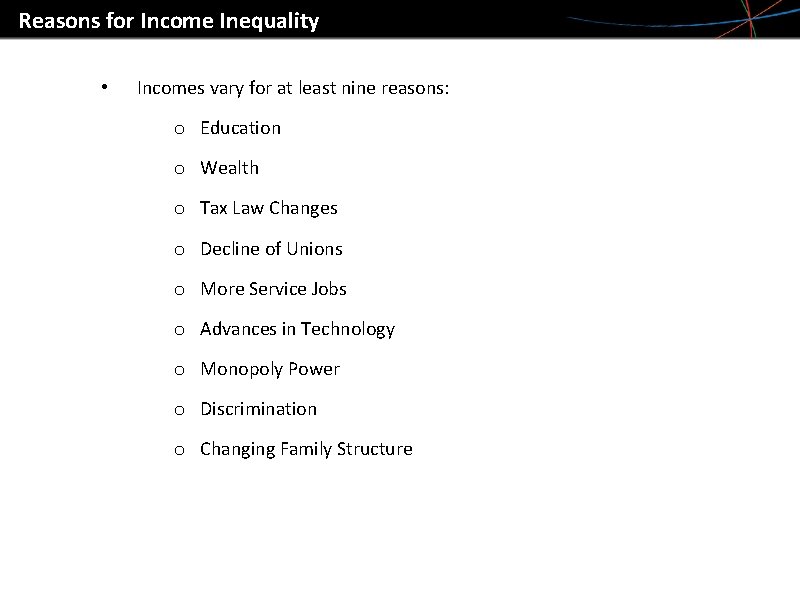
Reasons for Income Inequality • Incomes vary for at least nine reasons: o Education o Wealth o Tax Law Changes o Decline of Unions o More Service Jobs o Advances in Technology o Monopoly Power o Discrimination o Changing Family Structure
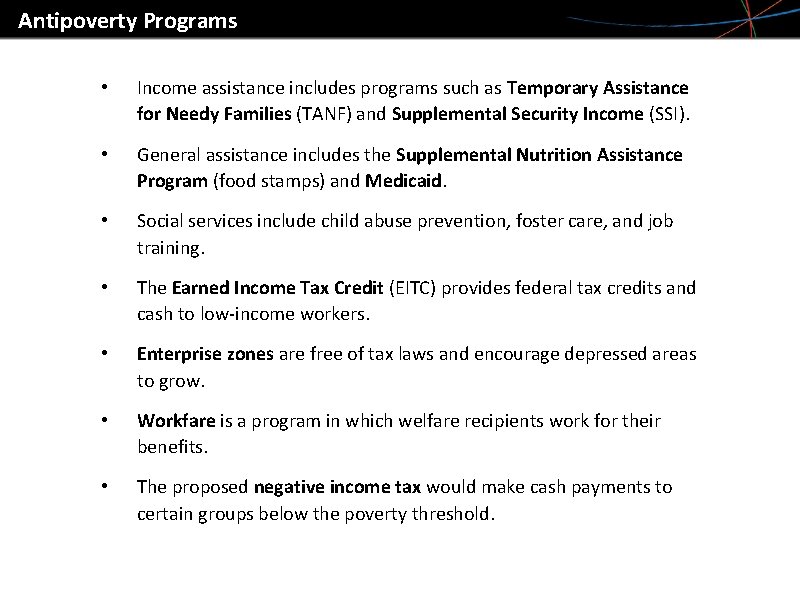
Antipoverty Programs • Income assistance includes programs such as Temporary Assistance for Needy Families (TANF) and Supplemental Security Income (SSI). • General assistance includes the Supplemental Nutrition Assistance Program (food stamps) and Medicaid. • Social services include child abuse prevention, foster care, and job training. • The Earned Income Tax Credit (EITC) provides federal tax credits and cash to low-income workers. • Enterprise zones are free of tax laws and encourage depressed areas to grow. • Workfare is a program in which welfare recipients work for their benefits. • The proposed negative income tax would make cash payments to certain groups below the poverty threshold.