Evaluating Individuals Charged with Child Pornography Possession Alex







- Slides: 51
Evaluating Individuals Charged with Child Pornography Possession Alex Rodrigues, Psy. D. , & Jennifer Tippet, Psy. D. MARATSA Conference May 17, 2019
Warning This presentation does not contain any child pornographic images. The images used are readily available on publicly accessible Internet search engines. However, the images displayed may be incongruent with one’s risk management plan. Consequently, concerned parties may wish to excuse themselves for the initial portion of the presentation to ensure they are acting in accordance with their respective guidelines.
Learning Objectives • Identify how child pornography possessors (CPP) differ from traditional contact sexual offending. • Recognize the challenges applying sexual recidivism instruments in CPP cases. • Identify the recidivism rates for CPP. • Identify how to approach CPP evaluations.
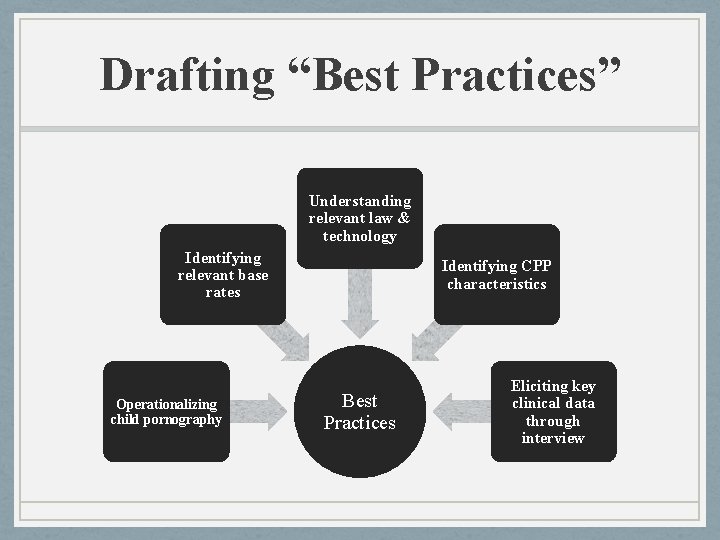
Drafting “Best Practices” Understanding relevant law & technology Identifying relevant base rates Operationalizing child pornography Identifying CPP characteristics Best Practices Eliciting key clinical data through interview
Child Pornography Possessors
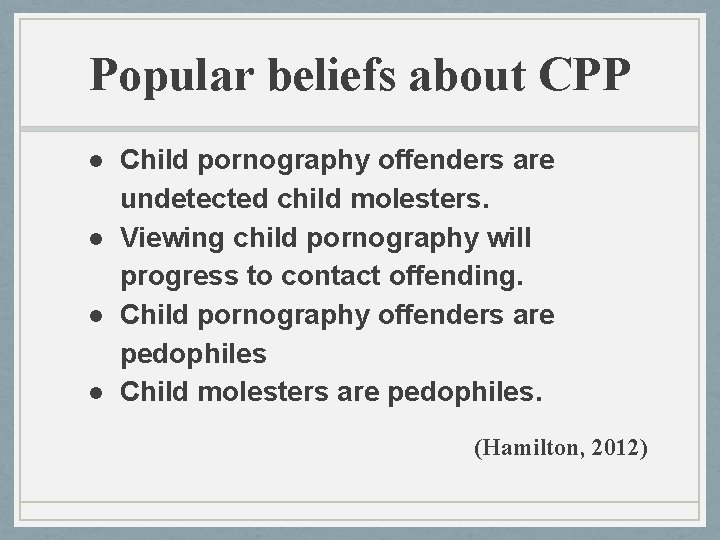
Popular beliefs about CPP ● Child pornography offenders are undetected child molesters. ● Viewing child pornography will progress to contact offending. ● Child pornography offenders are pedophiles ● Child molesters are pedophiles. (Hamilton, 2012)
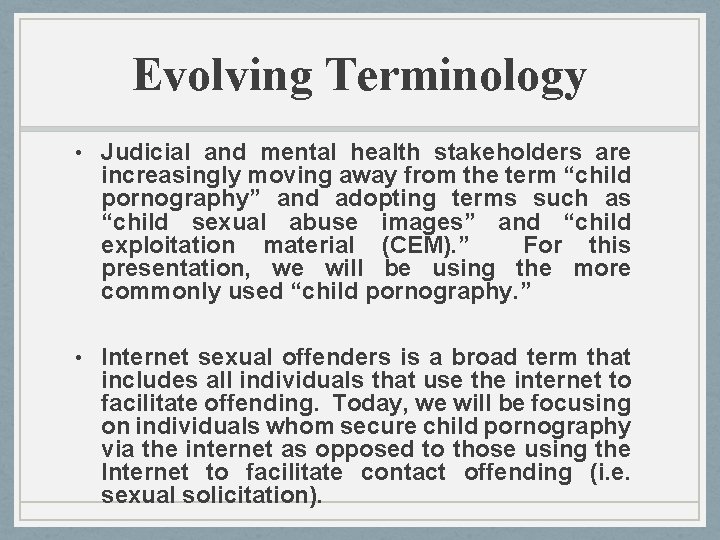
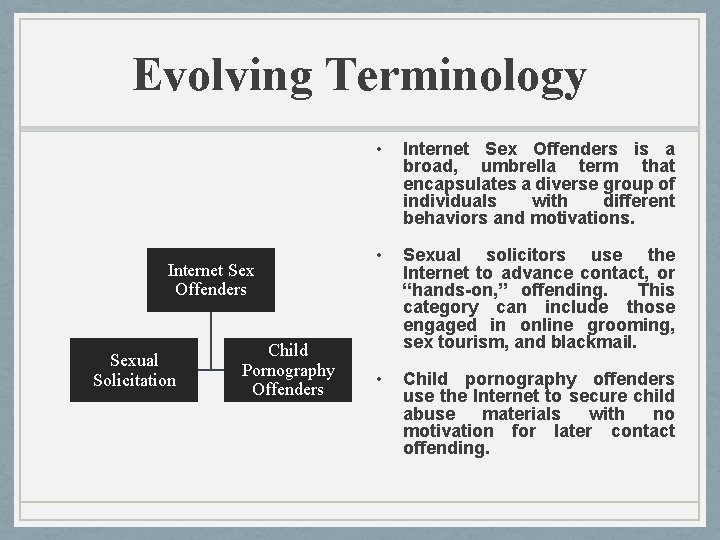
Evolving Terminology • Judicial and mental health stakeholders are increasingly moving away from the term “child pornography” and adopting terms such as “child sexual abuse images” and “child exploitation material (CEM). ” For this presentation, we will be using the more commonly used “child pornography. ” • Internet sexual offenders is a broad term that includes all individuals that use the internet to facilitate offending. Today, we will be focusing on individuals whom secure child pornography via the internet as opposed to those using the Internet to facilitate contact offending (i. e. sexual solicitation).
Evolving Terminology Internet Sex Offenders Sexual Solicitation Child Pornography Offenders • Internet Sex Offenders is a broad, umbrella term that encapsulates a diverse group of individuals with different behaviors and motivations. • Sexual solicitors use the Internet to advance contact, or “hands-on, ” offending. This category can include those engaged in online grooming, sex tourism, and blackmail. • Child pornography offenders use the Internet to secure child abuse materials with no motivation for later contact offending.
Why care? Taylor & Quayle (2003) • It involves a child being abused to produce it. • The viewer is abetting the production of such an illegal act. • The medium preserves images indefinitely and this has lasting ramifications for those pictured. • By encouraging fantasy, we may be concerned about fantasy precipitating physical offending. • Child pornography may be employed as part of the grooming process.
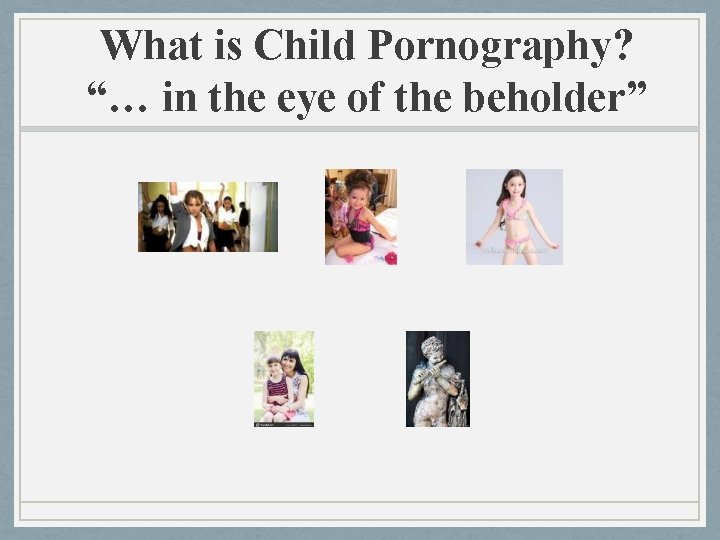
What is Child Pornography? “… in the eye of the beholder”
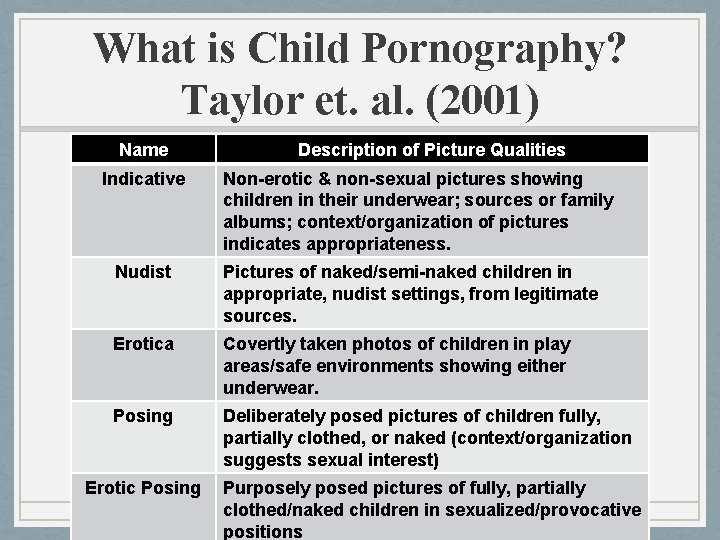
What is Child Pornography? Taylor et. al. (2001) Name Indicative Description of Picture Qualities Non-erotic & non-sexual pictures showing children in their underwear; sources or family albums; context/organization of pictures indicates appropriateness. Nudist Pictures of naked/semi-naked children in appropriate, nudist settings, from legitimate sources. Erotica Covertly taken photos of children in play areas/safe environments showing either underwear. Posing Deliberately posed pictures of children fully, partially clothed, or naked (context/organization suggests sexual interest) Erotic Posing Purposely posed pictures of fully, partially clothed/naked children in sexualized/provocative positions
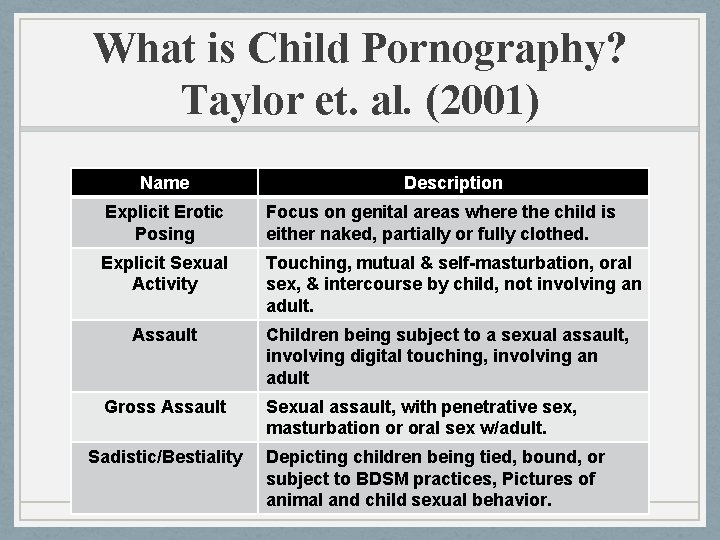
What is Child Pornography? Taylor et. al. (2001) Name Description Explicit Erotic Posing Focus on genital areas where the child is either naked, partially or fully clothed. Explicit Sexual Activity Touching, mutual & self-masturbation, oral sex, & intercourse by child, not involving an adult. Assault Gross Assault Sadistic/Bestiality Children being subject to a sexual assault, involving digital touching, involving an adult Sexual assault, with penetrative sex, masturbation or oral sex w/adult. Depicting children being tied, bound, or subject to BDSM practices, Pictures of animal and child sexual behavior.
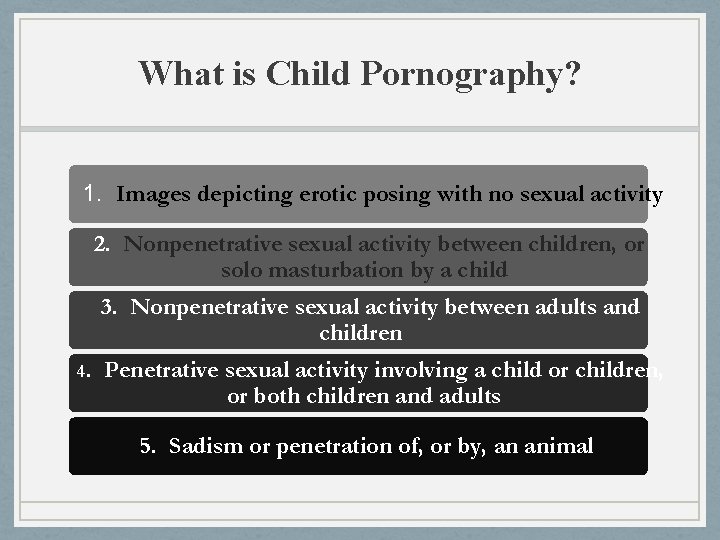
What is Child Pornography? 1. Images depicting erotic posing with no sexual activity 2. Nonpenetrative sexual activity between children, or solo masturbation by a child 3. Nonpenetrative sexual activity between adults and children 4. Penetrative sexual activity involving a child or children, or both children and adults 5. Sadism or penetration of, or by, an animal
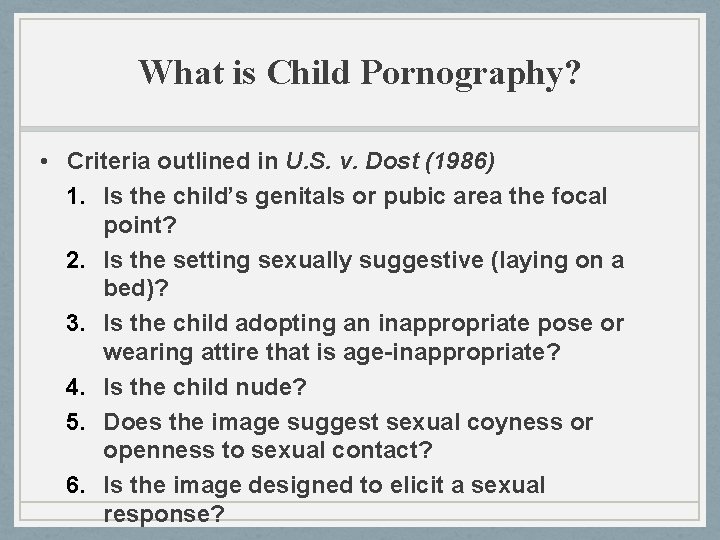
What is Child Pornography? • Criteria outlined in U. S. v. Dost (1986) 1. Is the child’s genitals or pubic area the focal point? 2. Is the setting sexually suggestive (laying on a bed)? 3. Is the child adopting an inappropriate pose or wearing attire that is age-inappropriate? 4. Is the child nude? 5. Does the image suggest sexual coyness or openness to sexual contact? 6. Is the image designed to elicit a sexual response?
What is Child Pornography? • Distinguishing a child from an adolescent 1. Small body size 2. Waist to hip ratios close to one 3. High-head to body ratio 4. Low body fat distribution 5. Neotenous facial features 6. Smooth, hairless skin 7. Immature appearance of the genitals (Seto, 2008)
Rule 34 of the Internet: If it exists, there is porn of it. If there isn’t, there will be.
The Internet • Advances in technology have allowed for faster production and dissemination of child pornography. • The “Triple-A Engine” (Cooper, 1998) • Accessibility • Affordability • Anonymity
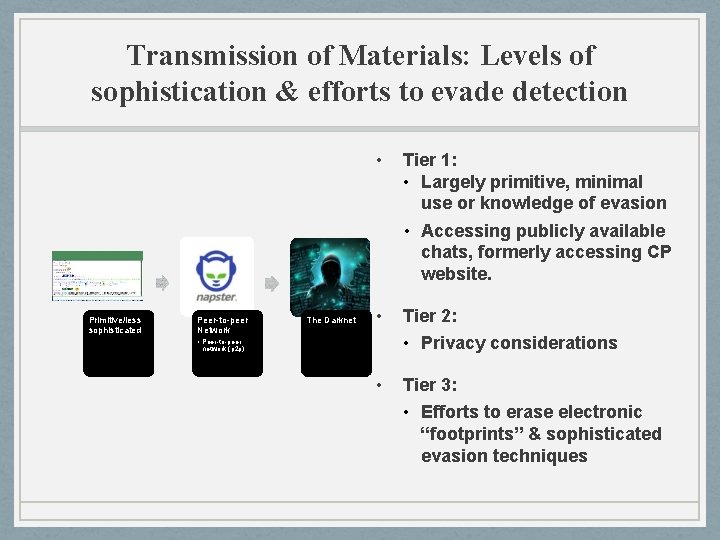
Transmission of Materials: Levels of sophistication & efforts to evade detection • Tier 1: • Largely primitive, minimal use or knowledge of evasion • Accessing publicly available chats, formerly accessing CP website. Primitive/less sophisticated Peer-to-peer Network The Darknet • Tier 2: • Privacy considerations • Peer-to-peer network (p 2 p) • Tier 3: • Efforts to erase electronic “footprints” & sophisticated evasion techniques
Prevalence: How much is out there? • Analysis of one website on Tor found that it hosted approximately 1. 3 million images • Approximately 200, 000 registered users total; 100, 000 individuals had accessed the site during a 12 -day period • On one popular P 2 P site, more than threequarters of a million computers located in more than 100 different countries during one year; of these 32% were in the US
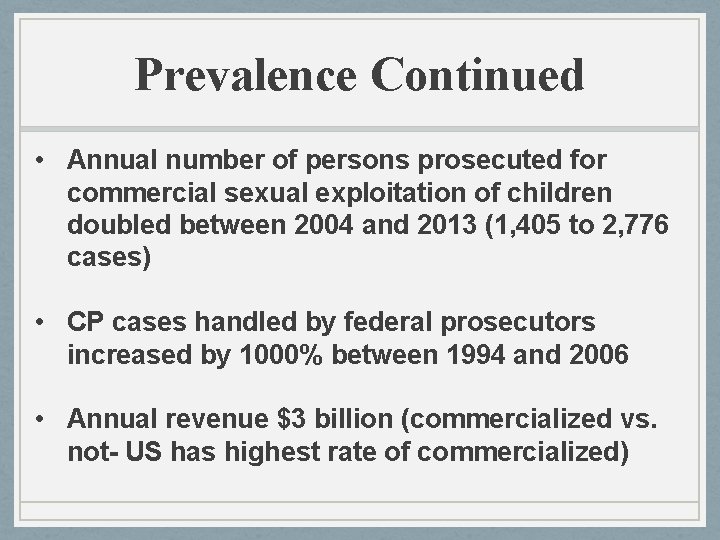
Prevalence Continued • Annual number of persons prosecuted for commercial sexual exploitation of children doubled between 2004 and 2013 (1, 405 to 2, 776 cases) • CP cases handled by federal prosecutors increased by 1000% between 1994 and 2006 • Annual revenue $3 billion (commercialized vs. not- US has highest rate of commercialized)
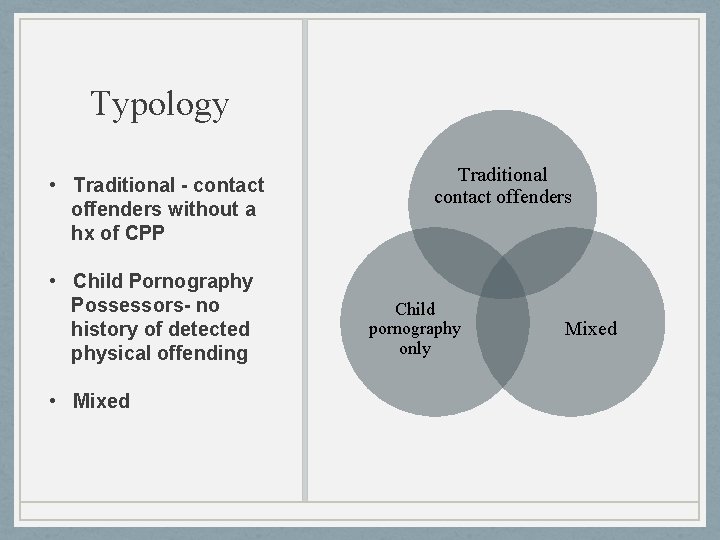
Typology • Traditional - contact offenders without a hx of CPP • Child Pornography Possessors- no history of detected physical offending • Mixed Traditional contact offenders Child pornography only Mixed
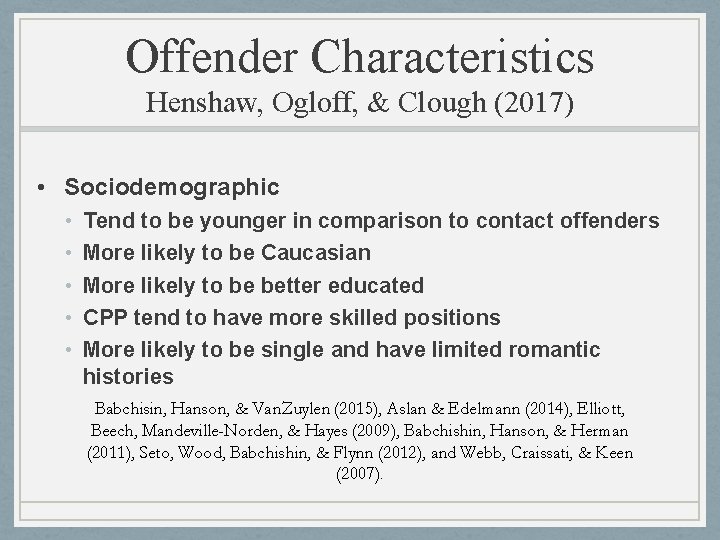
Offender Characteristics Henshaw, Ogloff, & Clough (2017) • Sociodemographic • • • Tend to be younger in comparison to contact offenders More likely to be Caucasian More likely to be better educated CPP tend to have more skilled positions More likely to be single and have limited romantic histories Babchisin, Hanson, & Van. Zuylen (2015), Aslan & Edelmann (2014), Elliott, Beech, Mandeville-Norden, & Hayes (2009), Babchishin, Hanson, & Herman (2011), Seto, Wood, Babchishin, & Flynn (2012), and Webb, Craissati, & Keen (2007).
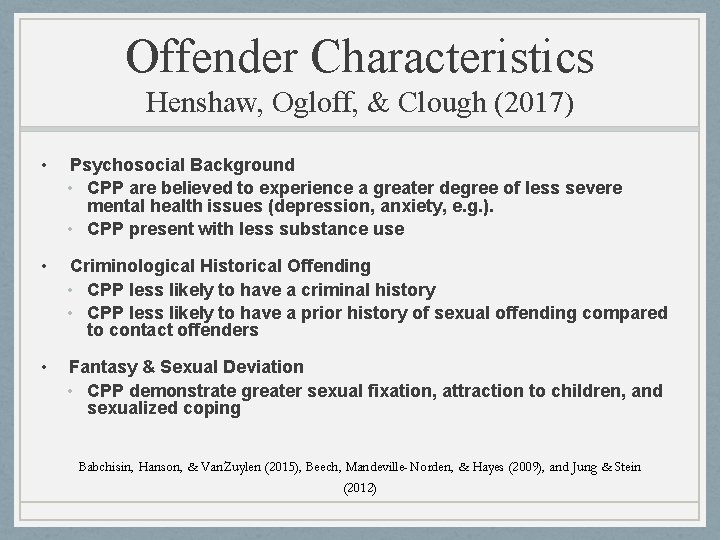
Offender Characteristics Henshaw, Ogloff, & Clough (2017) • Psychosocial Background • CPP are believed to experience a greater degree of less severe mental health issues (depression, anxiety, e. g. ). • CPP present with less substance use • Criminological Historical Offending • CPP less likely to have a criminal history • CPP less likely to have a prior history of sexual offending compared to contact offenders • Fantasy & Sexual Deviation • CPP demonstrate greater sexual fixation, attraction to children, and sexualized coping Babchisin, Hanson, & Van. Zuylen (2015), Beech, Mandeville-Norden, & Hayes (2009), and Jung & Stein (2012)
Offender Characteristics Henshaw, Ogloff, & Clough (2017) • Psychological • CPP demonstrate greater empathy toward victims, evidence less psychopathic traits, and less general cognitive distortions. • Interpersonal & Affective Deficits • CPPS demonstrate comparable levels of mood disorder, but experience greater loneliness, passivity, and limited self esteem. Babchisin, Hanson, & Van. Zuylen (2015), Beech, Mandeville-Norden, & Hayes (2009), Meridan, Curtis, Thakker, Wilson and Boer (2014), and Howitt and Sheldon (2007).
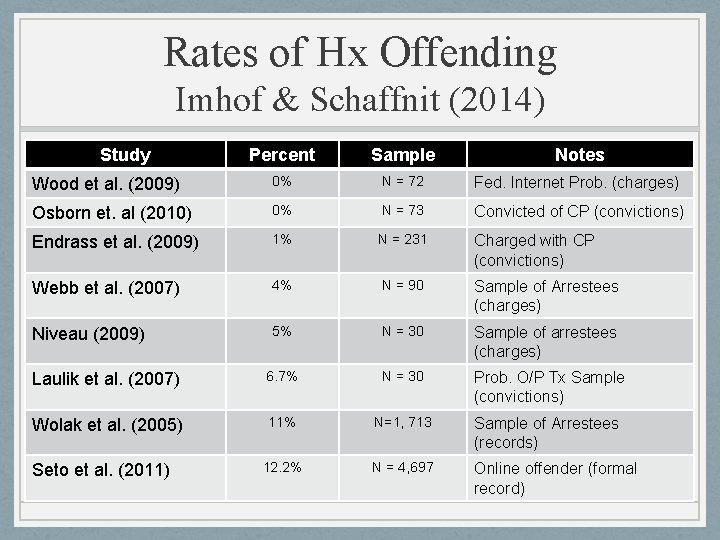
Rates of Hx Offending Imhof & Schaffnit (2014) Study Percent Sample Notes Wood et al. (2009) 0% N = 72 Fed. Internet Prob. (charges) Osborn et. al (2010) 0% N = 73 Convicted of CP (convictions) Endrass et al. (2009) 1% N = 231 Charged with CP (convictions) Webb et al. (2007) 4% N = 90 Sample of Arrestees (charges) Niveau (2009) 5% N = 30 Sample of arrestees (charges) Laulik et al. (2007) 6. 7% N = 30 Prob. O/P Tx Sample (convictions) Wolak et al. (2005) 11% N=1, 713 Sample of Arrestees (records) 12. 2% N = 4, 697 Online offender (formal record) Seto et al. (2011)
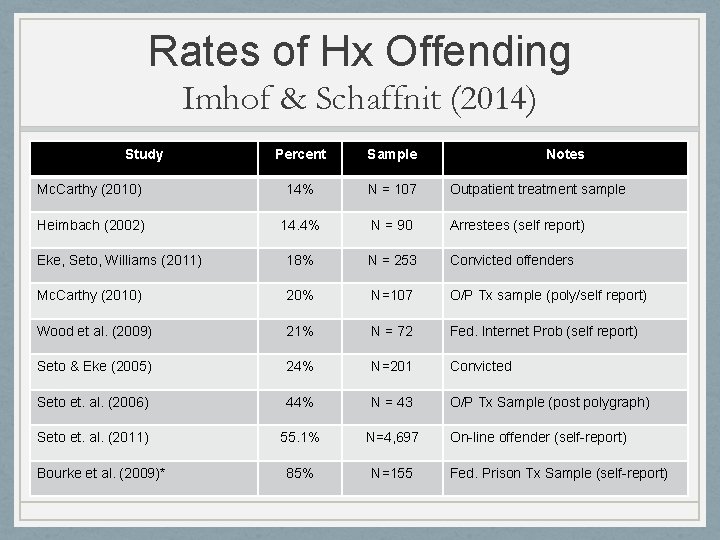
Rates of Hx Offending Imhof & Schaffnit (2014) Study Percent Sample Mc. Carthy (2010) 14% N = 107 Outpatient treatment sample Heimbach (2002) 14. 4% N = 90 Arrestees (self report) Eke, Seto, Williams (2011) 18% N = 253 Convicted offenders Mc. Carthy (2010) 20% N=107 O/P Tx sample (poly/self report) Wood et al. (2009) 21% N = 72 Fed. Internet Prob (self report) Seto & Eke (2005) 24% N=201 Convicted Seto et. al. (2006) 44% N = 43 O/P Tx Sample (post polygraph) Seto et. al. (2011) 55. 1% N=4, 697 85% N=155 Bourke et al. (2009)* Notes On-line offender (self-report) Fed. Prison Tx Sample (self-report)
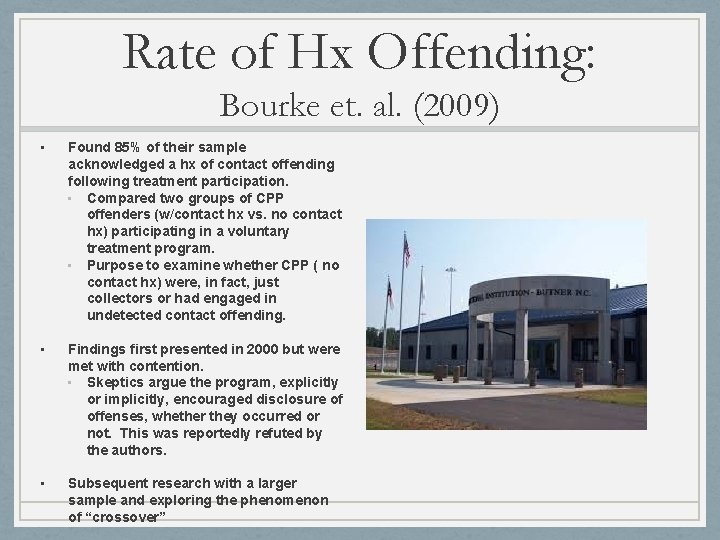
Rate of Hx Offending: Bourke et. al. (2009) • Found 85% of their sample acknowledged a hx of contact offending following treatment participation. • Compared two groups of CPP offenders (w/contact hx vs. no contact hx) participating in a voluntary treatment program. • Purpose to examine whether CPP ( no contact hx) were, in fact, just collectors or had engaged in undetected contact offending. • Findings first presented in 2000 but were met with contention. • Skeptics argue the program, explicitly or implicitly, encouraged disclosure of offenses, whether they occurred or not. This was reportedly refuted by the authors. • Subsequent research with a larger sample and exploring the phenomenon of “crossover”
Rate of Hx Offending: Bourke et. al. (2009) • Contact hx findings: • 85% of sample admitted a hx of contact offending • Pre-treatment 40 identified contact offenders Posttreatment 131 identified contact offenders (59% increase). • 1, 777 identified victims, with each offender averaging 13 victims • Crossover findings: • Considerable “crossover” demonstrated by offender, including age and gender. • Raises the possibility that CPP do not represent a “new” type of sexual offender.
Rate of Hx Offending Bourke et. al. (2009) Study criticisms • • • Child pornography was defined as viewing any minor, regardless if the content included prepubescent, or post pubescent minors. Study may not be representative of the population as a whole, as the site was the only one of its kind at the time (Seto, 2008). Hypothesized that offenders were encouraged to disclose offenses, regardless if they had.
Rate of Hx Offending Bourke et. al. (2009) “Some individuals have misused the results [of the Butner Study]… to fuel the argument that the majority of [child pornography] offenders are indeed contact sexual offenders and, therefore, dangerous predators. The incident of contact sexual crimes among [child pornography] offenders, as we reported in our studies, is important and worthy of considerable empirical examination. However, it is not a conclusive finding that can be generalized to all offenders. Notwithstanding, some individuals in law enforcement are tempted to rely on a biased interpretation of our study (i. e. , to prove that the majority of [child pornography] offenders are child molesters). ” (Hamilton, 2012)
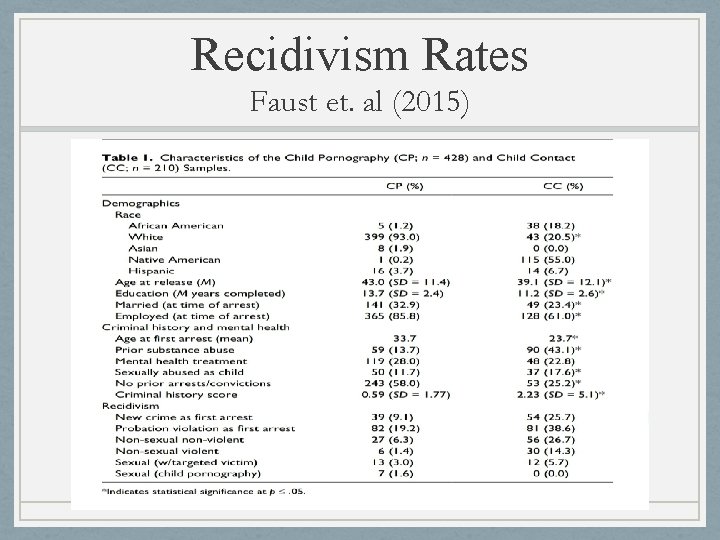
Recidivism Rates Faust et. al (2015)
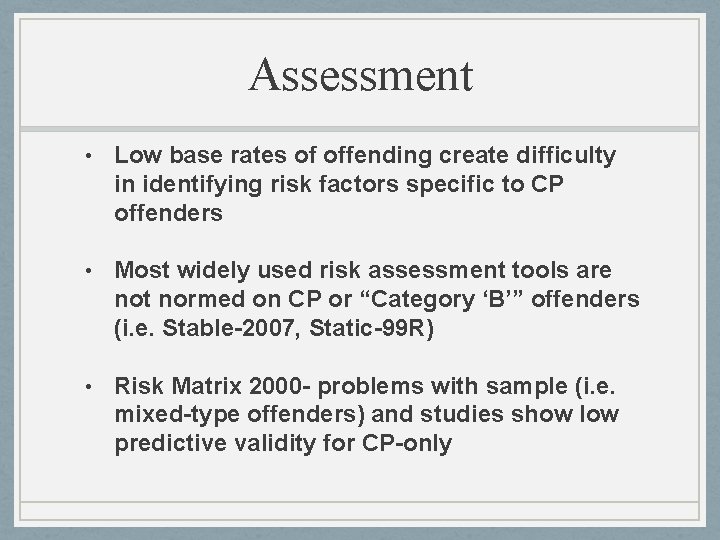
Assessment • Low base rates of offending create difficulty in identifying risk factors specific to CP offenders • Most widely used risk assessment tools are not normed on CP or “Category ‘B’” offenders (i. e. Stable-2007, Static-99 R) • Risk Matrix 2000 - problems with sample (i. e. mixed-type offenders) and studies show low predictive validity for CP-only
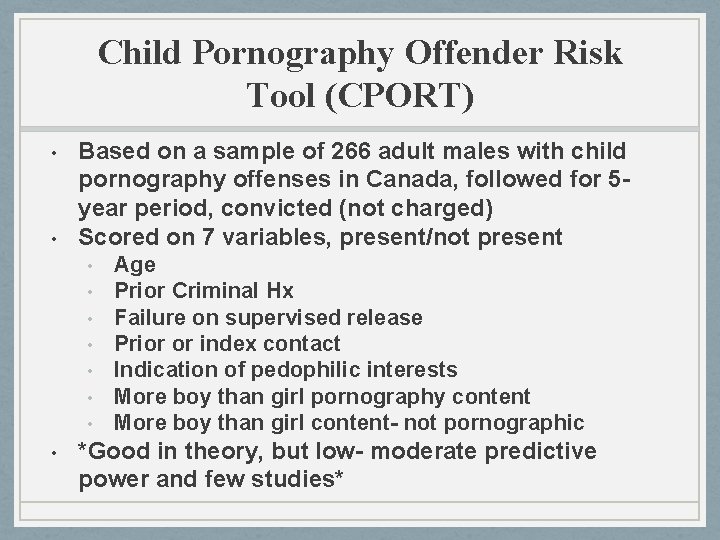
Child Pornography Offender Risk Tool (CPORT) • • Based on a sample of 266 adult males with child pornography offenses in Canada, followed for 5 year period, convicted (not charged) Scored on 7 variables, present/not present • • Age Prior Criminal Hx Failure on supervised release Prior or index contact Indication of pedophilic interests More boy than girl pornography content More boy than girl content- not pornographic *Good in theory, but low- moderate predictive power and few studies*
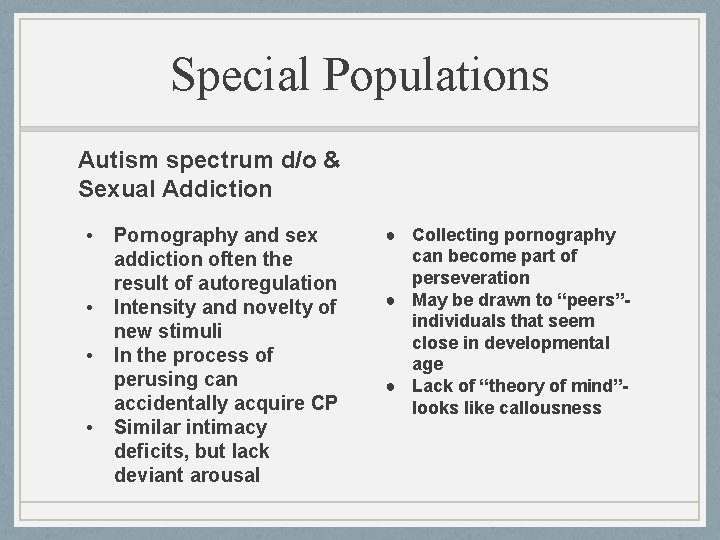
Special Populations Autism spectrum d/o & Sexual Addiction • • Pornography and sex addiction often the result of autoregulation Intensity and novelty of new stimuli In the process of perusing can accidentally acquire CP Similar intimacy deficits, but lack deviant arousal ● Collecting pornography can become part of perseveration ● May be drawn to “peers”individuals that seem close in developmental age ● Lack of “theory of mind”looks like callousness
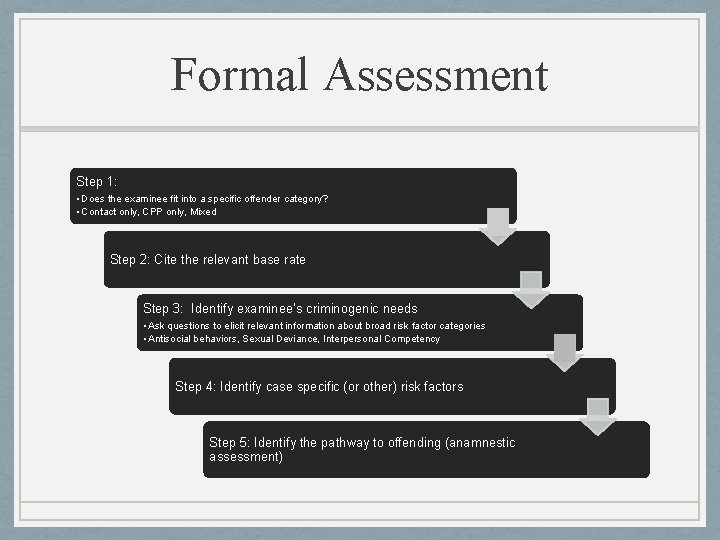
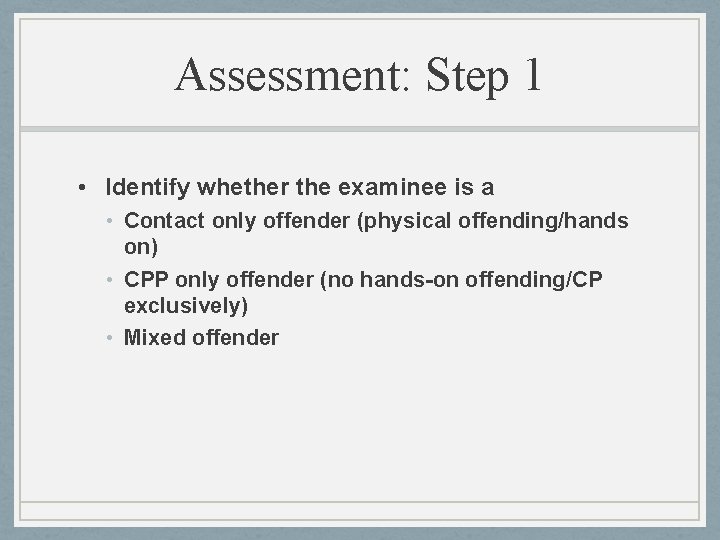
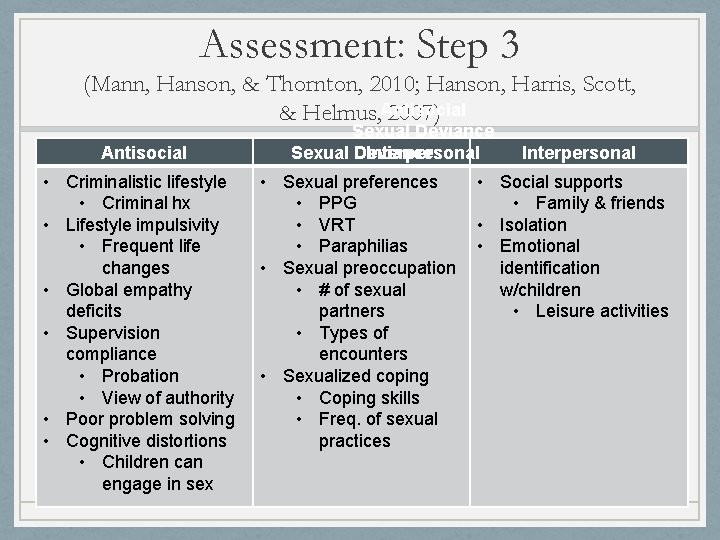
Formal Assessment Step 1: • Does the examinee fit into a specific offender category? • Contact only, CPP only, Mixed Step 2: Cite the relevant base rate Step 3: Identify examinee’s criminogenic needs • Ask questions to elicit relevant information about broad risk factor categories • Antisocial behaviors, Sexual Deviance, Interpersonal Competency Step 4: Identify case specific (or other) risk factors Step 5: Identify the pathway to offending (anamnestic assessment)
Assessment: Step 1 • Identify whether the examinee is a • Contact only offender (physical offending/hands on) • CPP only offender (no hands-on offending/CP exclusively) • Mixed offender
Assessment: Step 2 & 3 • Step 2 • Consult the reference group’s recidivism rate • Step 3 • Review the broad category risk factors
Assessment: Step 3 (Mann, Hanson, & Thornton, 2010; Hanson, Harris, Scott, & Helmus, Antisocial 2007) Antisocial • Criminalistic lifestyle • Criminal hx • Lifestyle impulsivity • Frequent life changes • Global empathy deficits • Supervision compliance • Probation • View of authority • Poor problem solving • Cognitive distortions • Children can engage in sex Sexual Deviance Interpersonal • Sexual preferences • PPG • VRT • Paraphilias • Sexual preoccupation • # of sexual partners • Types of encounters • Sexualized coping • Coping skills • Freq. of sexual practices Interpersonal • Social supports • Family & friends • Isolation • Emotional identification w/children • Leisure activities
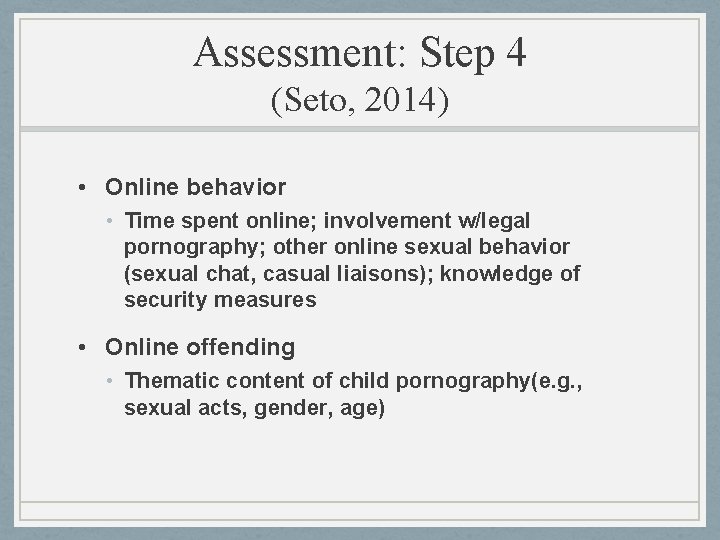
Assessment: Step 4 (Seto, 2014) • Online behavior • Time spent online; involvement w/legal pornography; other online sexual behavior (sexual chat, casual liaisons); knowledge of security measures • Online offending • Thematic content of child pornography(e. g. , sexual acts, gender, age)
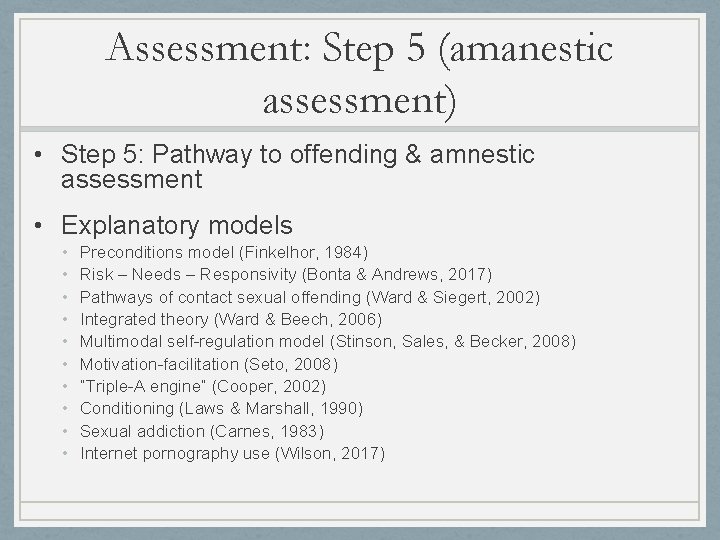
Assessment: Step 5 (amanestic assessment) • Step 5: Pathway to offending & amnestic assessment • Explanatory models • • • Preconditions model (Finkelhor, 1984) Risk – Needs – Responsivity (Bonta & Andrews, 2017) Pathways of contact sexual offending (Ward & Siegert, 2002) Integrated theory (Ward & Beech, 2006) Multimodal self-regulation model (Stinson, Sales, & Becker, 2008) Motivation-facilitation (Seto, 2008) “Triple-A engine” (Cooper, 2002) Conditioning (Laws & Marshall, 1990) Sexual addiction (Carnes, 1983) Internet pornography use (Wilson, 2017)
Contact Information Dr. Alex Rodrigues (631) 806 6117 alexrodrigues. psyd@gmail. com psychologicalinsight. com Dr. Jennifer Tippet (720) 295 2759 Drjennifertippett@gmail. com
Aslan, D. , & Edelmann, R. (2014). Demographic and offense characteristics: A comparison of sex offenders convicted of possessing indecent images of children, committing contact sex offences or both offences. The Journal of Forensic Psychiatry & Psychology, 25, 121134. Babchishin, K. M. , Hanson, R. K. , & Herman, C. A. (2011). The characteristics of online sex offenders: A meta-analysis. Sexual Abuse: A Journal of Research and Treatment, 23, 92 -123. Babchishin, Kelly & Hanson, R. Karl & Van. Zuylen, Heather. (2014). Online Child Pornography Offenders are Different: A Meta-analysis of the Characteristics of Online and Offline Sex Offenders Against Children. Archives of sexual behavior. Bonta, J. , & Andrews, D. A. (2017). The psychology of criminal conduct. Bourke, M. L. , & Hernandez, A. E. (2009). The 'Butner Study' redux: A report of the incidence of hands-on child victimization by child pornography offenders. Journal of Family Violence, 24(3), 183 -191.
Carnes, P. (1983). Out of the shadows: Understanding sexual addiction. Minneapolis, MN: Compcare. Cooper, AL. (1998). Sexuality and the Internet: Surfing into the New Millennium. Cyber. Psychology & Behavior. 1. 10. Elliott, I. A. , Beech, A. R. , Mandeville-Norden, R. & Hayes, E. (2009). Psychological Profiles of Internet sexual offenders: Comparison with contact sexual offenders. Sexual Abuse: A Journal of Research and Treatment, 21, 76 -92. Eke, A. , Seto, M. , & Williams, J. (2011). Examining the criminal history and future offending of child pornography offenders: An extended prospective follow-up study. Law and Human Behavior, 35, 466 -478. Endrass, J. , Urbaniok, F. , Hammermeister, L. C. , Benz, C. , Elbert, T. , Laubacher, A. , & Rossegger, A. (2009). The consumption of internet child pornography and violent sex offending. BMC Psychiatry, 9, 1 -7.
Endrass, J. , Urbaniok, F. , Hammermeister, L. C. , Benz, C. , Elbert, T. , Laubacher, A. , & Rossegger, A. (2009). The consumption of internet child pornography and violent sex offending. BMC Psychiatry, 9, 1 -7. Faust, E. , Bickart, W. , Renaud, C. , & Camp, S. (2015). Child Pornography Possessors and Child Contact Sex Offenders: A Multilevel Comparison of Demographic Characteristics and Rates of Recidivism. Sexual Abuse: A Journal of Research and Treatment, 27(5), 460 -478 Finkelhor, D. (1984). Child sexual abuse: New theory and research. New York, NY: Free Press. Hamilton, M. (2012). The Child Pornography Crusade And Its Net. Widening Effect. Cardozo Law Review, 33(4), 1679 -1732. Retrieved May 1, 2019.
Hanson, R. K. , Harris, A. J. R. , Scott, T. -L. , & Helmus, L. (2007). Assessing the risk of sexual offenders on community supervision: The Dynamic Supervision Project (User report, Corrections research). Ottawa, ON, Canada: Public Safety Canada. Heimbach, M. J. (2002, May) Internet Child Pornography, Congressional Testimony before the Subcommittee on Crime, Terrorism, and Homeland Security, Committee on the Judiciary United States House of Representatives. Henshaw, M. , Ogloff, J. R. P. , & Clough, J. A. (2017). Looking Beyond the Screen: A Critical Review of the Literature on the Online Child Pornography Offender. Sexual Abuse, 29(5), 416– 445. https: //doi. org/10. 1177/1079063215603690 Howitt, D. , & Sheldon, K. (2007). The role of cognitive distortions in paedophilic offending: Internet and contact offenders compared. Psychology, Crime & Law, 13, 469 -486. Imhof, E. , & Schaffnit, A. (2014, March) Assessing Child Pornography Offenders. Society of Personality Assessment Conference, Alexandria, VA.
Jung, S. , & Stein, S. (2012). An examination of judicial sentencing decisions in child pornography and child molestations cases in Canada. Journal of Criminal Psychology, 2(1), 38 -50. Laulik, S. , Allam, J. , & Sheridan, L. (2007). An investigation into maladaptive personality functioning in internet sex offenders. Psychology, Crime, & Law, 13, 523 -535. Laws, D. R. , & Marshall, W. L. (1990). A conditioning theory of etiology and maintenance of deviant sexual preference and behavior. In W. L. , Marshall, D. R. Laws, & H. E. , Barbaree (Eds. ), Handbook of sexual assault: Issues theories, and treatment of the offender (pp. 209229). New York, NY: Plenum. Magaletta, P. R. , Faust, E. , Bickart, W. , & Mc. Learen, A. M. (2014). Exploring Clinical and Personality Characteristics of Adult Male Internet-Only Child Pornography Offenders. International Journal of Offender Therapy and Comparative Criminology, 58(2), 137– 153.
Mahoney, J. (2009). Asperger’s Syndrome and the Criminal Law: The Special Case of Child Pornography. Mc. Carthy, J. (2010). Internet sexual activity: A comparison between contact and non-contact child pornography offenders. Journal of Sexual Aggression, 16, 181 -195. Meridan, H. L. , Curtis, C. , Thakker, J. , Wilson, N. & Boer, D. P. (2014). The endorsement of cognitive distortions: Comparing child pornography offenders and contact sex offenders. Psychology, Crime, & Law, 20, 971 -993. Niveau, G. (2010). Cyber-pedocriminality: Characteristics of a sample of child pornography offenders. Child Abuse & Neglect, 34, 570 -575. Osborn, J. , Elliott, I. , Middleton, D. , Beech, A. (2010). The use of actuarial risk assessment measures with UK internet child pornography offenders. Journal of Aggression, Conflict, and Peace Research, 2, 16 -24.
Seto, M. C. , Cantor, J. M. , & Blanchard, R. (2006). Child pornography offenses are a valid diagnostic indicator of pedophilia. Journal of Abnormal Psychology, 115(3), 610 -615. Seto, M. & Eke, A. (2005). The Criminal Histories and Later Offending of Child Pornography Offenders. Sexual Abuse: A Journal of Research and Treatment, 17, 201 -210. Seto, M. , Hanson, K. , & Babchishin, K. (2011). Contact sexual offending by men with online sexaul offenses. Sexual Abuse: A Journal of Research and Treatment, 23, 3 -6. Seto, M. C. , Wood, J. M. , Babchishin, K. M. , & Flynn, S. (2012). Online solicitation offenders are different from child pornography offenders and lower risk contact sexual offenders. Law and Human Behavior, 36, 320 -330. Stinson, J. D. , Sales, B. D. , & Becker, J. V. (2008). Sex offending: Causal theories to inform research, prevention, and treatment. Washington, DC: American Psychological Association.
Taylor, M. , Holland, G. and Quayle, E. (2001). “Typology of paedophile picture collections’, The Police Journal, 74(2), 97 -107. United States v. Dost, 636 F. Supp. 828 (S. D. Cal. 1986) Ward, T. , & Beech, A. R. (2006). An integrated theory of sexual offending. Aggression and Violent Behavior, 11, 44 -63. Wakeling, H. C. , Howard, P. , & Barnett, G. (2011). Comparing the Validity of the RM 2000 Scales and OGRS 3 for Predicting Recidivism by Internet Sexual Offenders. Sexual Abuse, 23(1), 146– 168. Ward, T. Siegert, R. J. (2002) Toward a comprehensive theory of child sexual abuse: A theory knitting perspective. Psychology, Crime, and Law, 9, 197 -248.
Webb, L. , Craissati, J. , & Keen, S. (2007). Characteristics of Internet child pornography offenders: A comparison with child molesters. Sexual Abuse: A Journal of Research and Treatment, 19, 449 -465. Wilson, G. (2017). Your brain on porn: Internet pornography and the emerging science of addiction. Margate, Kent, United Kingdom: Commonwealth Publishing. Wolak, J. , Finkelhor, D. , & Mitchell, K. (2011). Child Pornography Possessors: Trends in Offender and Case Characteristics. Sexual Abuse: A Journal of Research and Treatment, 23(1), 22 -42. Wolak, Liberatore, & Levine. (2014). Measuring a year of child pornography trafficking by U. S. computers on a peer-to-peer network. Child Abuse & Neglect, 38(2), 347 -356.