EU DATATHON 2017 Joint Research Centre JRC Data
- Slides: 18
EU DATATHON 2017 Joint Research Centre (JRC) Data Catalogue Datasets and Challenges 1. Global Human Settlements Layer (GHSL) datasets description 2. Alternative Fuels and BIOenergy (ALF-BIO) challenge (mobile app) 3. JRC Catalogue challenge (automatic dataset categorization) Lorenzino Vaccari (JRC Data Catalogue), Aneta Florczyk (GHSL), Jacopo Giuntoli (ALF-BIO), Alessandro Dalla. Benetta (JRC Data Catalogue), Chrisa Tsinaraki (JRC Data Catalogue) 28/09/2017
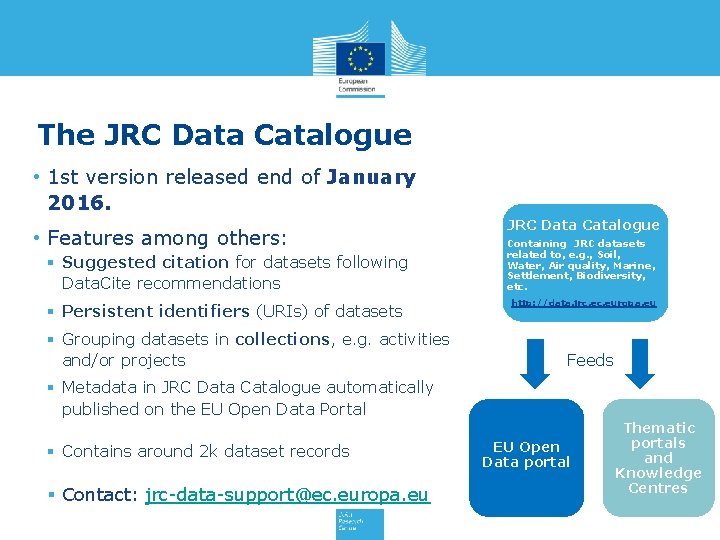
The JRC Data Catalogue • 1 st version released end of January 2016. • Features among others: § Suggested citation for datasets following Data. Cite recommendations § Persistent identifiers (URIs) of datasets § Grouping datasets in collections, e. g. activities and/or projects JRC Data Catalogue Containing JRC datasets related to, e. g. , Soil, Water, Air quality, Marine, Settlement, Biodiversity, etc. http: //data. jrc. europa. eu Feeds § Metadata in JRC Data Catalogue automatically published on the EU Open Data Portal § Contains around 2 k dataset records § Contact: jrc-data-support@ec. europa. eu EU Open Data portal Thematic portals and Knowledge Centres
1. GHSL Datasets description
Summary • Datasets: Global Human Settlement Layer (GHSL) • Contact: aneta. florczyk@ec. europa. eu • Team: Tomas Kemper, Martino Pesaresi, Donato Airaghi, Christina Corbane, Daniele Ehrlich, Aneta Florczyk, Sergio Freire, Luca Maffenini, Michele Melchiorri, Panagiotis Politis, Filip Sabo, Marcello Schiavina , Pierpaolo Tommasi, Luigi Zanchetta
Context GHSL project produces new global spatial information, evidence-based analytics, and knowledge describing the human presence in the planet. The project produces thematic information and evidence-based analytical knowledge supporting the implementation of: • • EU Cohesion Policy - to reduce economic and social disparities between regions in Europe. Urban Agenda for the EU - an integrated and coordinated approach to deal with the urban dimension of EU and national policies and legislation. • Post-2015 international frameworks: • • Sustainable Development Goals Global Urban Agenda Climate Change Sendai Framework for Disaster Risk Reduction. Also, the project supports international scientific partnerships facilitating science-policy interface in the frame of the GEO Human Planet Initiative.
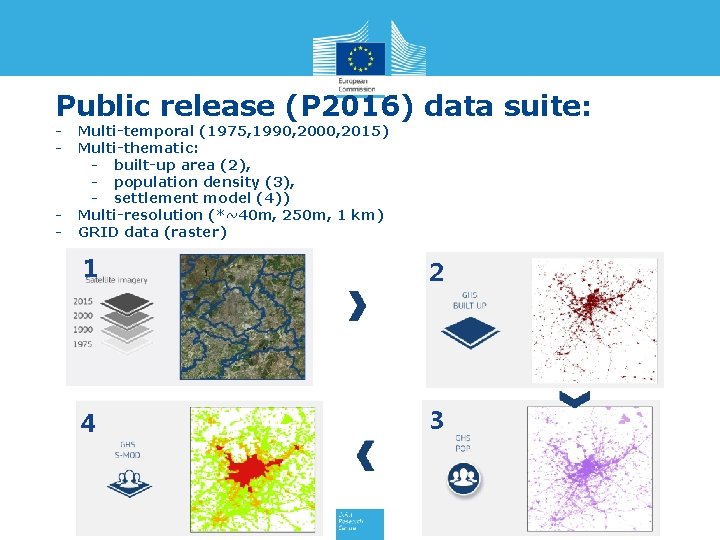
Public release (P 2016) data suite: - - Multi-temporal (1975, 1990, 2000, 2015) Multi-thematic: - built-up area (2), - population density (3), - settlement model (4)) Multi-resolution (*~40 m, 250 m, 1 km) GRID data (raster) 1 2 4 3
Datasets and Examples GHSL website http: //ghsl. jrc. europa. eu/ Documentation and resources are available on the JRC data catalogue and the EU ODP: • P 2016 Datasets available at: https: //data. europa. eu/euodp/dataset? q=GHSL • GHSL BUILT https: //data. europa. eu/euodp/dataset/jrc-ghslghs_built_ldsmt_globe_r 2015 b • GHSL POP https: //data. europa. eu/euodp/dataset/jrc-ghslghs_pop_gpw 4_globe_r 2015 a • GHS SMOD https: //data. europa. eu/euodp/dataset/jrc-ghslghs_smod_pop_globe_r 2016 a Examples of application: • Testing of Degree of urbanisation: http: //ghsl. jrc. europa. eu/CFS. php • World Population Density http: //luminocity 3 d. org/World. Pop. Den/
2. ALF-BIO challenge: mobile app
Summary • Context: Promoting sustainable bioenergy and biofuels; carbon footprint of bioenergy pathways according to the Renewable Energy Directive. • Challenge: The challenge is to design a mobile app or a web-tool to visualize and customize the carbon footprint calculations for biofuels and bioenergy found in the proposal for a recast of the Renewable Energy Directive (annex V and annex VI). • Contact: jacopo. giuntoli@ec. europa. eu • Team: Jacopo Giuntoli, Luisa Marelli, Robert Edwards, Monica Padella, Adrian O'Connell
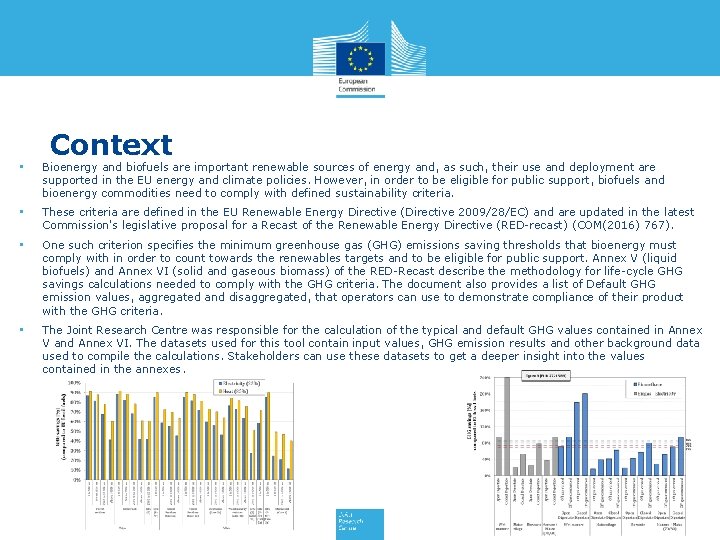
Context • Bioenergy and biofuels are important renewable sources of energy and, as such, their use and deployment are supported in the EU energy and climate policies. However, in order to be eligible for public support, biofuels and bioenergy commodities need to comply with defined sustainability criteria. • These criteria are defined in the EU Renewable Energy Directive (Directive 2009/28/EC) and are updated in the latest Commission's legislative proposal for a Recast of the Renewable Energy Directive (RED-recast) (COM(2016) 767). • One such criterion specifies the minimum greenhouse gas (GHG) emissions saving thresholds that bioenergy must comply with in order to count towards the renewables targets and to be eligible for public support. Annex V (liquid biofuels) and Annex VI (solid and gaseous biomass) of the RED-Recast describe the methodology for life-cycle GHG savings calculations needed to comply with the GHG criteria. The document also provides a list of Default GHG emission values, aggregated and disaggregated, that operators can use to demonstrate compliance of their product with the GHG criteria. • The Joint Research Centre was responsible for the calculation of the typical and default GHG values contained in Annex V and Annex VI. The datasets used for this tool contain input values, GHG emission results and other background data used to compile the calculations. Stakeholders can use these datasets to get a deeper insight into the values contained in the annexes.
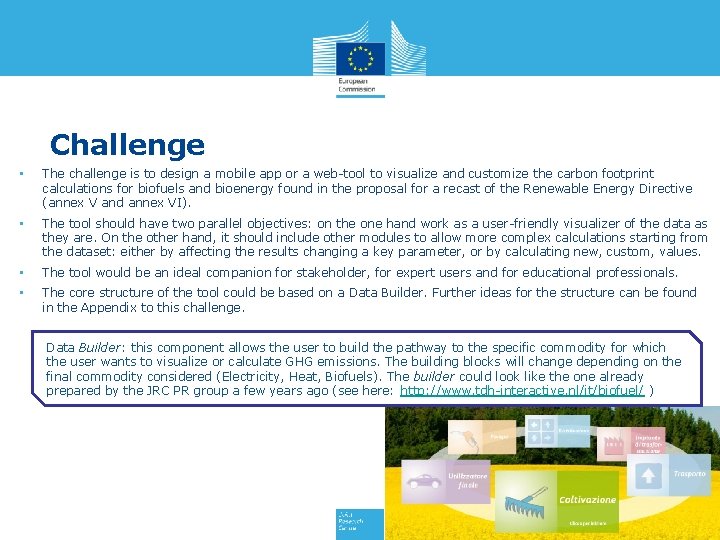
Challenge • The challenge is to design a mobile app or a web-tool to visualize and customize the carbon footprint calculations for biofuels and bioenergy found in the proposal for a recast of the Renewable Energy Directive (annex V and annex VI). • The tool should have two parallel objectives: on the one hand work as a user-friendly visualizer of the data as they are. On the other hand, it should include other modules to allow more complex calculations starting from the dataset: either by affecting the results changing a key parameter, or by calculating new, custom, values. • The tool would be an ideal companion for stakeholder, for expert users and for educational professionals. • The core structure of the tool could be based on a Data Builder. Further ideas for the structure can be found in the Appendix to this challenge. Data Builder: this component allows the user to build the pathway to the specific commodity for which the user wants to visualize or calculate GHG emissions. The building blocks will change depending on the final commodity considered (Electricity, Heat, Biofuels). The builder could look like the one already prepared by the JRC PR group a few years ago (see here: http: //www. tdh-interactive. nl/it/biofuel/ )
Datasets and tools • Source datasets (formatted) are available here: • Solid and gaseous: https: //data. europa. eu/euodp/dataset/jrc-alf-biobioenergy_jrc_annexvi_com 2016 -767_v 1_july 17 • Liquid biofuels: https: //data. europa. eu/euodp/dataset/jrc-alf -biofuels_jrc_annexv_com 2016 -767_v 1_july 17 • Unformatted source datasets will/can be made available. • A similar but more simplified tool was produced in the past and it can be seen here: http: //www. tdh-interactive. nl/test/biofuel/. Source code for the tool is not available. • No preference for the programming language or charting tools. Either mobile app or web-tool are welcome.
3. JRC Data Catalogue challenge: Automatic Dataset Categorization
Summary • Context: Automatic classification of datasets. • Challenge: The challenge is to categorize datasets accordingly to a given thesaurus. • Contact: jrc-data-support@ec. europa. eu • Team: Anders Friis-Christensen, Alessandro Dalla Benetta, Andrea Perego, Lorenzino Vaccari, Chrisa Tsinaraki
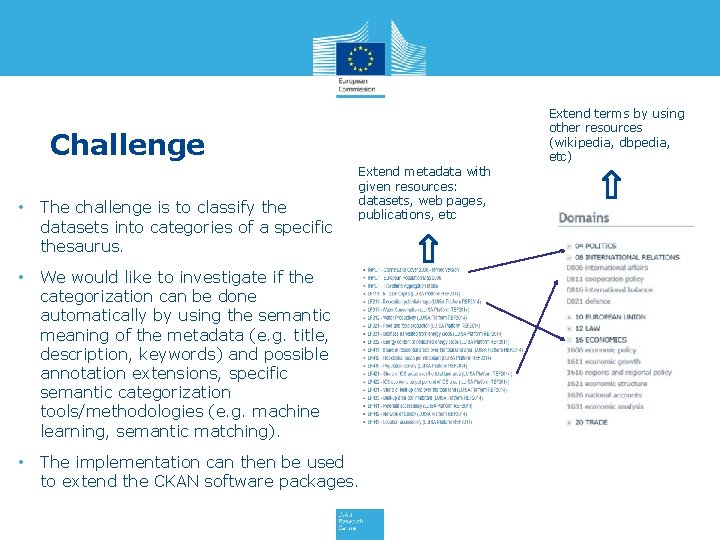
Extend terms by using other resources (wikipedia, dbpedia, etc) Challenge Extend metadata with given resources: datasets, web pages, publications, etc • The challenge is to classify the datasets into categories of a specific thesaurus. • We would like to investigate if the categorization can be done automatically by using the semantic meaning of the metadata (e. g. title, description, keywords) and possible annotation extensions, specific semantic categorization tools/methodologies (e. g. machine learning, semantic matching). • The implementation can then be used to extend the CKAN software packages.
Our test case - Datasets: JRC Data Catalogue Datasets Thesaurus: JRC Science Area (10 categories) Methodology: semantic matching Tool: Dandelion • • text classification API reference: https: //dandelion. eu/docs/api/datatxt/cl/v 1/ Users-defined classifiers example: https: //dandelion. eu/docs/api/datatxt/cl/models/v 1/ - Results: f-measure ~ 0. 3 - Notes: - each category should be described by weight-keywords or wikipedia pages. The user is allowed to classify the datasets by the science areas, where each datasets should be related to one or more areas. We made a golden set of 40 datasets, based on an internal user manual classification.
Datasets and tools Source datasets are available on JRC DATA CATALOGUE: • Datasets list available at: https: //data. jrc. europa. eu/api/3/action/package_list • Dataset details available at: https: //data. jrc. europa. eu/api/3/action/package_show? id=<datasets_id> • CKAN API reference available at: http: //docs. ckan. org/en/ckan-2. 7. 0/api/ Example of tool for semantic classification: • Dandelion text classification API reference: https: //dandelion. eu/docs/api/datatxt/cl/v 1/ • Dandelion Users-defined classifiers example: https: //dandelion. eu/docs/api/datatxt/cl/models/v 1/
Interesting thesauri 1. Euro. Voc page on the OP's MDR, which includes mappings between Euro. Voc and other commonly used thesauri: http: //publications. europa. eu/mdr/eurovoc/. They are also available from the ODP: https: //data. europa. eu/euodp/dataset/eurovoc 2. The thesauri mapped to Euro. Voc in point #1 above can also all be suitable candidates 3. The data themes defined in the framework of DCAT-AP: http: //publications. europa. eu/mdr/authority/data-theme/ 4. Possibly, to perform the categorization, the mappings between INSPIRE themes, ISO topic categories and the data themes at point #3, developed in the framework of Geo. DCAT-AP can be used: https: //webgate. ec. europa. eu/CITnet/stash/projects/ODCKAN/repos/i so-19139 -to-dcat-ap/browse/alignments