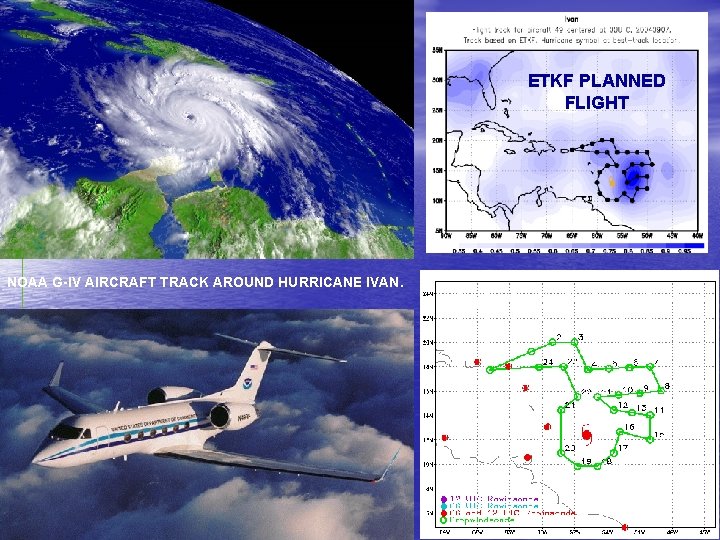
ETKF PLANNED FLIGHT NOAA GIV AIRCRAFT TRACK AROUND
- Slides: 14
ETKF PLANNED FLIGHT NOAA G-IV AIRCRAFT TRACK AROUND HURRICANE IVAN. ACTUAL G-IV FLIGHT
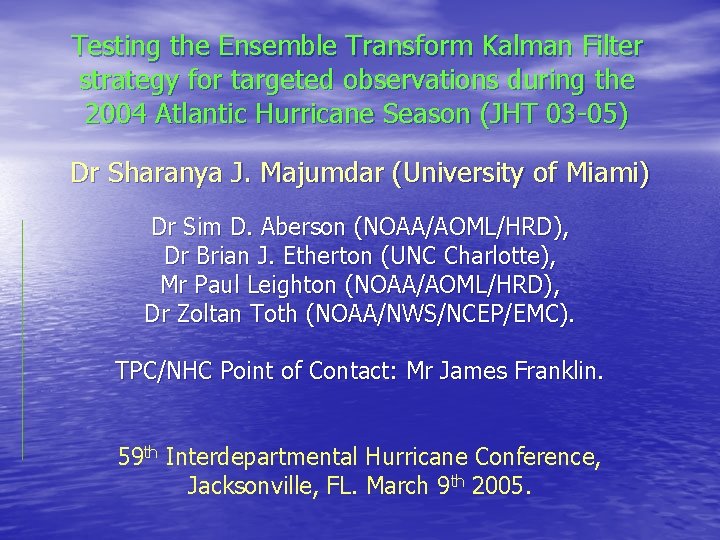
Testing the Ensemble Transform Kalman Filter strategy for targeted observations during the 2004 Atlantic Hurricane Season (JHT 03 -05) Dr Sharanya J. Majumdar (University of Miami) Dr Sim D. Aberson (NOAA/AOML/HRD), Dr Brian J. Etherton (UNC Charlotte), Mr Paul Leighton (NOAA/AOML/HRD), Dr Zoltan Toth (NOAA/NWS/NCEP/EMC). TPC/NHC Point of Contact: Mr James Franklin. 59 th Interdepartmental Hurricane Conference, Jacksonville, FL. March 9 th 2005.
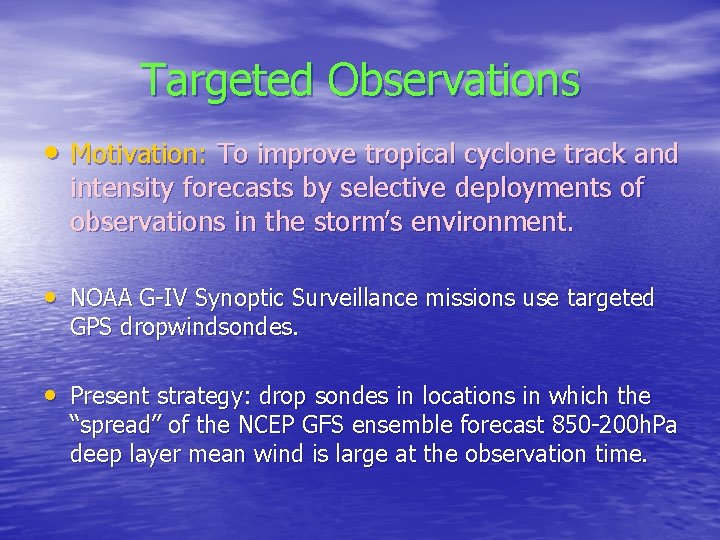
Targeted Observations • Motivation: To improve tropical cyclone track and intensity forecasts by selective deployments of observations in the storm’s environment. • NOAA G-IV Synoptic Surveillance missions use targeted GPS dropwindsondes. • Present strategy: drop sondes in locations in which the “spread” of the NCEP GFS ensemble forecast 850 -200 h. Pa deep layer mean wind is large at the observation time.
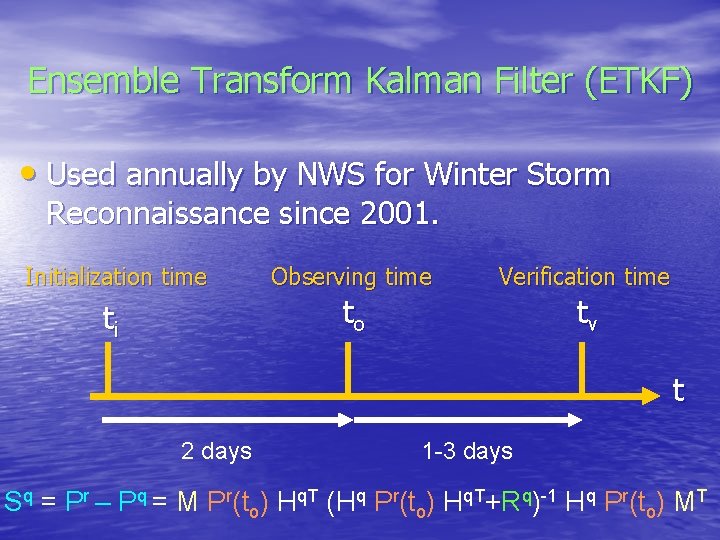
Ensemble Transform Kalman Filter (ETKF) • Used annually by NWS for Winter Storm Reconnaissance since 2001. Initialization time ti Observing time to Verification time tv t 2 days 1 -3 days Sq = Pr – Pq = M Pr(to) Hq. T (Hq Pr(to) Hq. T+Rq)-1 Hq Pr(to) MT
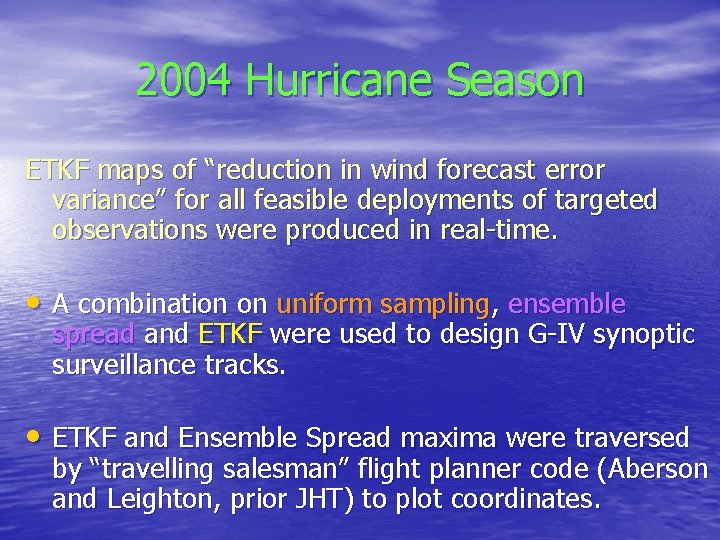
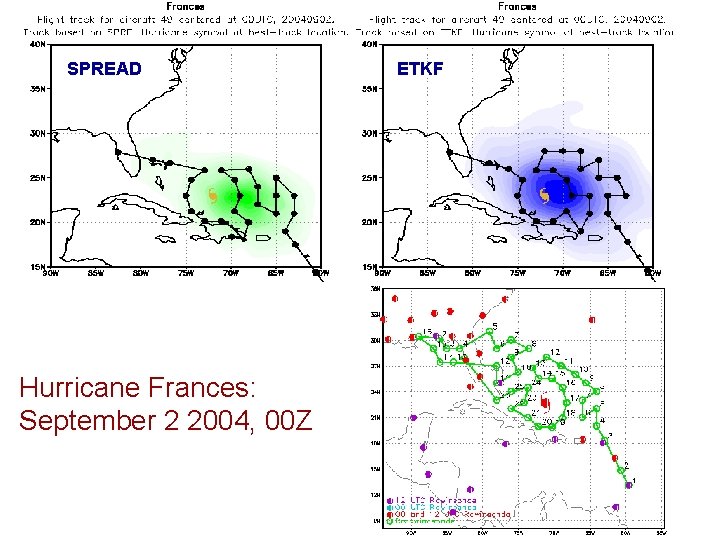
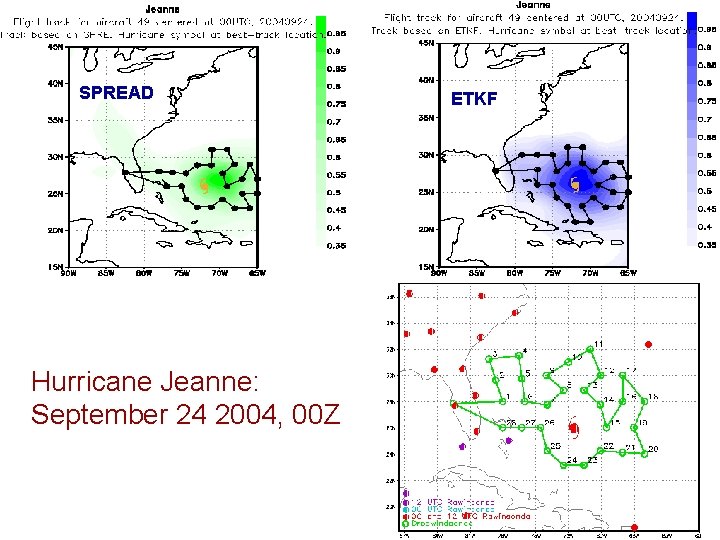
2004 Hurricane Season ETKF maps of “reduction in wind forecast error variance” for all feasible deployments of targeted observations were produced in real-time. • A combination on uniform sampling, ensemble spread and ETKF were used to design G-IV synoptic surveillance tracks. • ETKF and Ensemble Spread maxima were traversed by “travelling salesman” flight planner code (Aberson and Leighton, prior JHT) to plot coordinates.
SPREAD Hurricane Frances: September 2 2004, 00 Z ETKF
SPREAD Hurricane Jeanne: September 24 2004, 00 Z ETKF
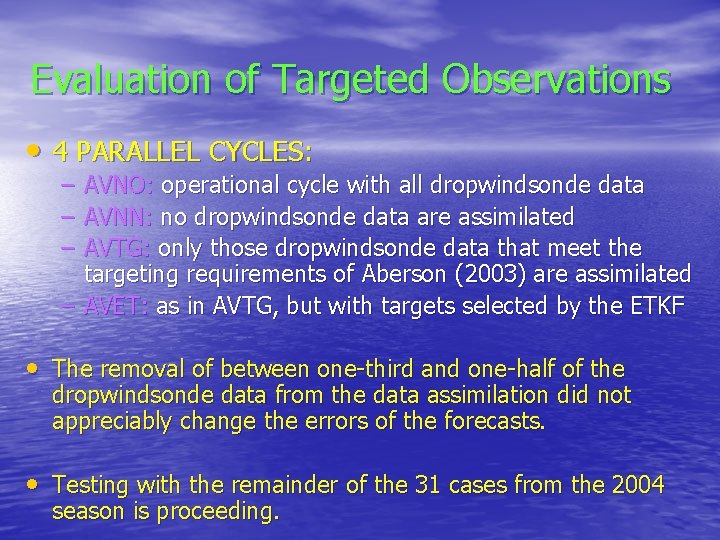
Evaluation of Targeted Observations • 4 PARALLEL CYCLES: – AVNO: operational cycle with all dropwindsonde data – AVNN: no dropwindsonde data are assimilated – AVTG: only those dropwindsonde data that meet the targeting requirements of Aberson (2003) are assimilated – AVET: as in AVTG, but with targets selected by the ETKF • The removal of between one-third and one-half of the dropwindsonde data from the data assimilation did not appreciably change the errors of the forecasts. • Testing with the remainder of the 31 cases from the 2004 season is proceeding.
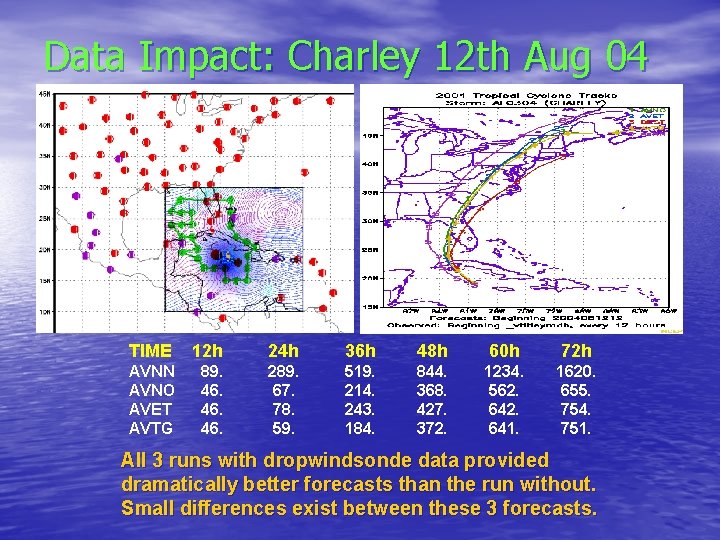
Data Impact: Charley 12 th Aug 04 TIME 12 h 24 h 36 h 48 h 60 h 72 h AVNN AVNO AVET AVTG 89. 46. 46. 289. 67. 78. 59. 519. 214. 243. 184. 844. 368. 427. 372. 1234. 562. 641. 1620. 655. 754. 751. All 3 runs with dropwindsonde data provided dramatically better forecasts than the run without. Small differences exist between these 3 forecasts.
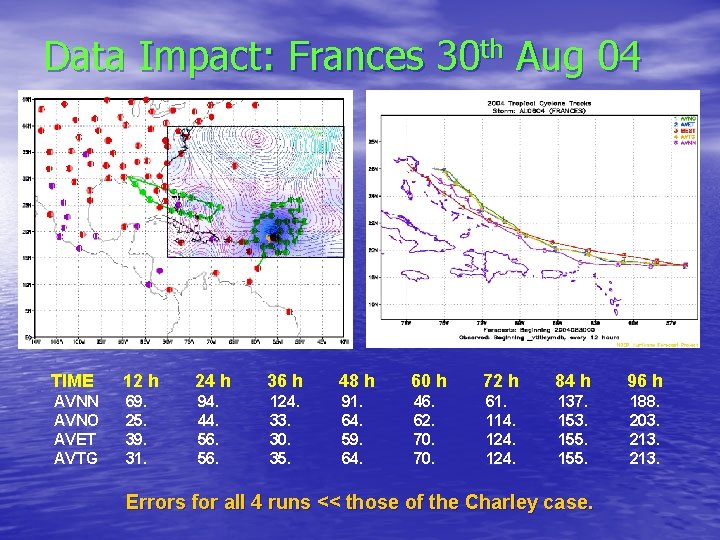
Data Impact: Frances 30 th Aug 04 TIME 12 h 24 h 36 h 48 h 60 h 72 h 84 h 96 h AVNN AVNO AVET AVTG 69. 25. 39. 31. 94. 44. 56. 124. 33. 30. 35. 91. 64. 59. 64. 46. 62. 70. 61. 114. 124. 137. 153. 155. 188. 203. 213. Errors for all 4 runs << those of the Charley case.
Extensions • 1. Guidance on DOTSTAR typhoon surveillance (Chun-Chieh Wu, National Taiwan University) • 2. Comparison with targeted Singular Vectors from ECMWF and NOGAPS
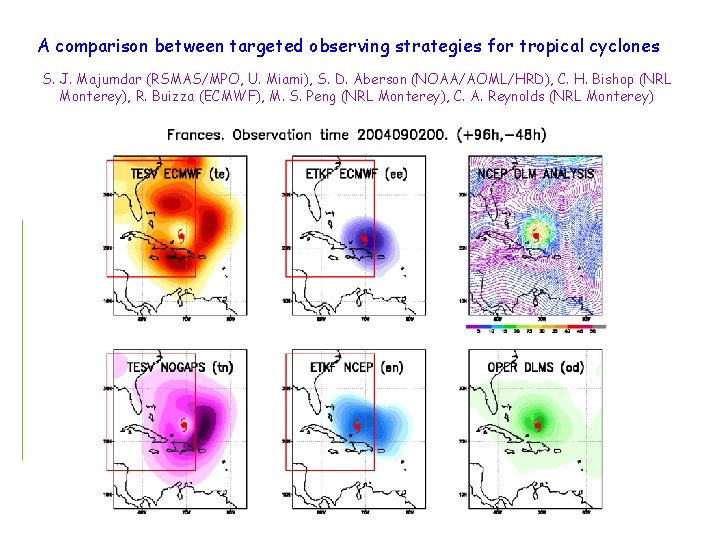
A comparison between targeted observing strategies for tropical cyclones S. J. Majumdar (RSMAS/MPO, U. Miami), S. D. Aberson (NOAA/AOML/HRD), C. H. Bishop (NRL Monterey), R. Buizza (ECMWF), M. S. Peng (NRL Monterey), C. A. Reynolds (NRL Monterey)
Summary ETKF provides a theoretical improvement over ensemble spread as an objective targeted observing strategy. In practice, ETKF guidance is often very similar to ensemble spread guidance (70% of cases) End-to-end product has been created, from input of surveillance time to output of ETKF sensitivity map and automated flight track.
To be completed • Continued evaluation of data impact from 2004 season. Preliminary results are promising. • Quantitative tests of ETKF’s ability to predict signal variance and reduction in forecast error variance. • Automate ETKF at EMC for use in 2005 season. • Investigation of problems with Ivan forecasts. • Results will continue to be disseminated on http: //www. aoml. noaa. gov/hrd/data_sub/assessment. html and http: //orca. rsmas. miami. edu/~majumdar/tc/