Ethics in Nanoscience and Technologies Mary Gulumian NIOH
- Slides: 28
Ethics in Nanoscience and Technologies Mary Gulumian NIOH University of the Witwatersrand Mary. G@nioh. ac. za HSRC Policy Dialogue HSRC and Nabio Consulting HIV and TB Nanomedicine in the 4 IR Policy Dialogue 2019 Nanomedicine Era: Exploring nanotechnology applications in medicine of HIV/AIDS and TB 29 October 2019
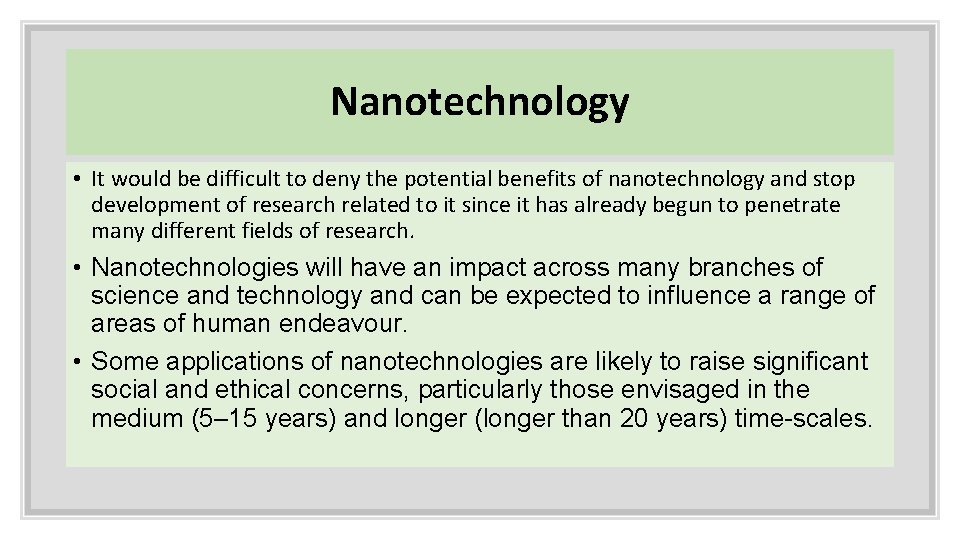
Nanotechnology • It would be difficult to deny the potential benefits of nanotechnology and stop development of research related to it since it has already begun to penetrate many different fields of research. • Nanotechnologies will have an impact across many branches of science and technology and can be expected to influence a range of areas of human endeavour. • Some applications of nanotechnologies are likely to raise significant social and ethical concerns, particularly those envisaged in the medium (5– 15 years) and longer (longer than 20 years) time-scales.
• However, given the difficulty of predicting any but the most short-term applications of nanotechnologies, evaluating long-term social or ethical impacts is a huge challenge. • Like many technologies, its introduction and implementation raise serious societal and ethical issues, both for the scientists who are developing this technology and for the members of the public who may benefit from or be exposed to it.
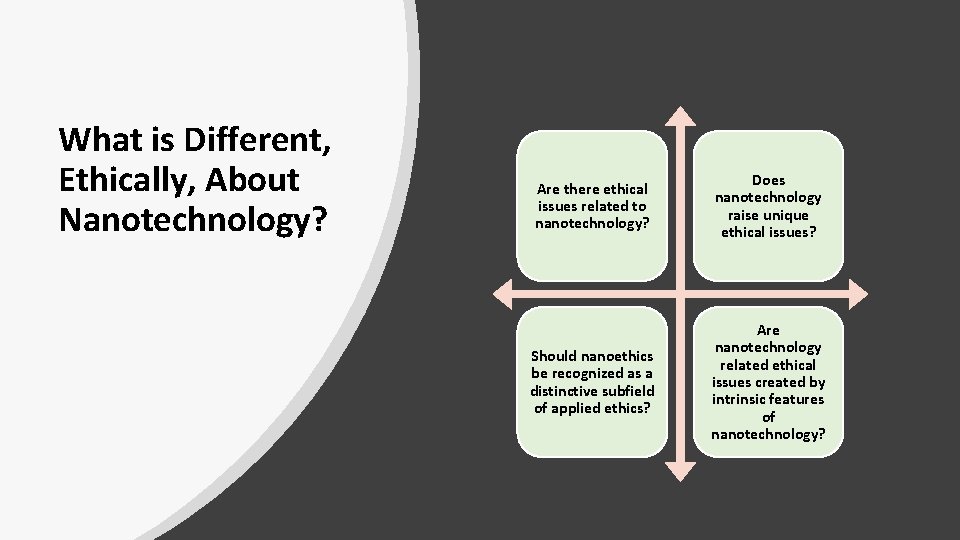
What is Different, Ethically, About Nanotechnology? Are there ethical issues related to nanotechnology? Does nanotechnology raise unique ethical issues? Should nanoethics be recognized as a distinctive subfield of applied ethics? Are nanotechnology related ethical issues created by intrinsic features of nanotechnology?
Does nanotechnology raise unique ethical issues? • Ethical issues related to nanotechnology are ethical issues related to: • Nanotechnology R&D • Manufacturing activity • Use of nanotechnology materials and final products. • For example, consider the matter of nanotechnology researcher conduct when working with a material newly available at the nano-scale, and the matter of regulatory administrator conduct when a new nanotechnology product, believed by experts to pose a substantial but publicly unrecognized or underappreciated risk of harm to humans, is under consideration for release to the market place. • Both matters qualify as ethical issues related to nanotechnology and are appropriate targets of ethical scrutiny. • None of these issues, or any other with which the writer is familiar, is qualitatively new and raised by nanotechnology.
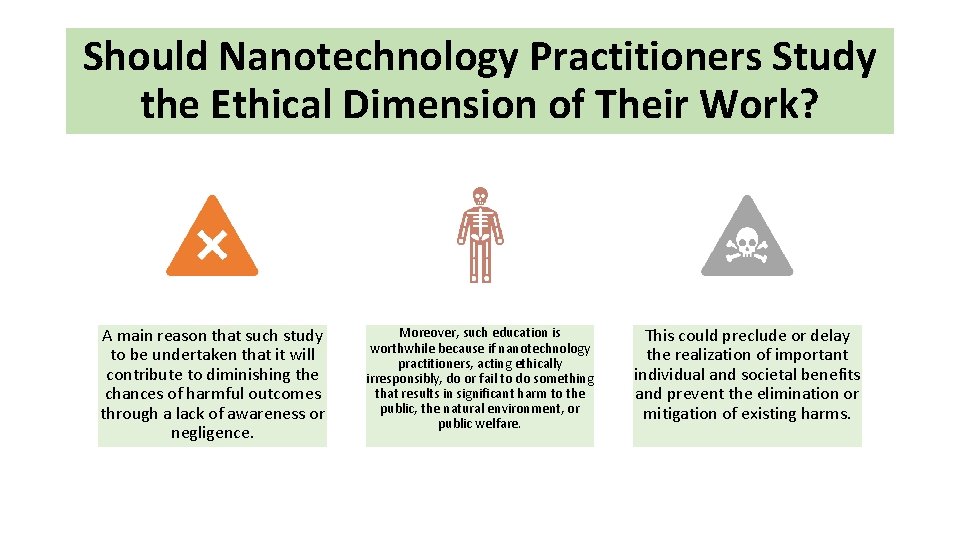
Should Nanotechnology Practitioners Study the Ethical Dimension of Their Work? A main reason that such study to be undertaken that it will contribute to diminishing the chances of harmful outcomes through a lack of awareness or negligence. Moreover, such education is worthwhile because if nanotechnology practitioners, acting ethically irresponsibly, do or fail to do something that results in significant harm to the public, the natural environment, or public welfare. This could preclude or delay the realization of important individual and societal benefits and prevent the elimination or mitigation of existing harms.
• It should be pointed out that the purpose of education about ethical issues related to science and engineering in society is threefold: • to alert present and future practitioners in these fields to the full range of harms that irresponsible technical practices, decisions, and actions can cause; • to provide tools for thinking systematically, non-superficially, and criticallyanalytically about ethical issues related to science and engineering; and • to eliminate the classic excuse of those previously denied such exposure: that they were unaware that there were important ethical issues in a particular domain of technical practice.
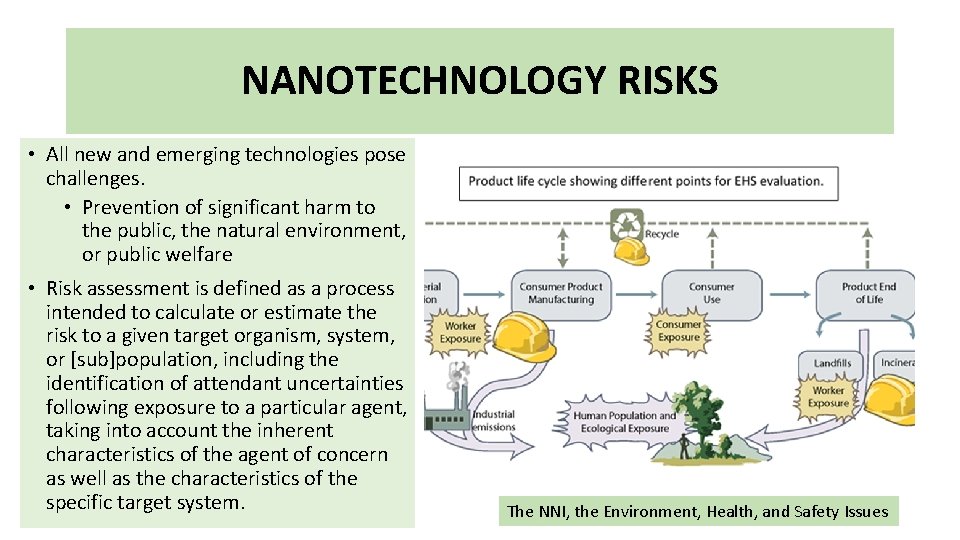
NANOTECHNOLOGY RISKS • All new and emerging technologies pose challenges. • Prevention of significant harm to the public, the natural environment, or public welfare • Risk assessment is defined as a process intended to calculate or estimate the risk to a given target organism, system, or [sub]population, including the identification of attendant uncertainties following exposure to a particular agent, taking into account the inherent characteristics of the agent of concern as well as the characteristics of the specific target system. The NNI, the Environment, Health, and Safety Issues
• Toxic effects of nanoparticles on health despite the many benefits of nanotechnology, some studies indicate that certain nanoparticles may cause adverse effects because of their small size and unique properties. Toxic effects of nanoparticles • Indeed, their size makes them highly mobile in both the human body and the environment. • Nanomaterials can enter human tissues through several ports via the lungs after inhalation, through the digestive system, and possibly through the skin. • Systemic distribution of nanoparticles has been demonstrated after inhalation and oral uptake and nanoparticles have been found to cross the blood brain barrier, reaching the olfactory bulb and the cerebellum. • Many of the artificially manufactured nanoparticles are made of non-biodegradable pollutants, such as carbon black and metals, and the long-term behaviour of such substances is not known.
• A variety of exposure paths are possible. At the workplace, workers can be exposed during the production process (laboratory, factory), use of products, transport, storage or waste treatment. Exposure to Nanomaterials • The release of (fixed) nanomaterials during the products’ life cycle might affect consumer’s health. Nanomaterials might be released everywhere (at the workplace, in the general environment, at home), affecting workers and/or consumers. • Due to the environmental uptake, nanomaterials might also affect the environment (soil, water, air, flora and fauna). The environmental contamination again might affect people’s health.
Should Nanotechnology Practitioners Study the Ethical Dimension of Their Work? • Such education is worthwhile because if nanotechnology practitioners, acting ethically irresponsibly, do or fail to do something that results in significant harm to the public, the natural environment, or public welfare, the contemporary research enterprise of nanotechnology could suffer a funding backlash from the public.
ETHICAL AND SOCIAL IMPLICATIONS OF NANOTECHNOLOGY • To support sustainable, ethical, and economic nanotechnological development, it is imperative that we educate all nanotechnology stakeholders about the shortterm and long-term benefits, limitations, and risks of nanotechnology. • Therefore, Nanotechnology risk assessment methods and protocols need to be developed and implemented by the regulatory bodies.
Regulating for Safety • It should come as no surprise that the question of safety has emerged as the first nanotech issue around which diverse stakeholders and observers can coalesce. • Environmental activists worry about the damage that nanostructured materials could inflict on the natural world. • Consumer groups worry that nanoparticles might cause cancer or have other adverse health effects. • Business leaders worry that unfounded fears could lead to public rejection of nanotech products.
Who, if anyone, should regulate nanotechnology ? • As with any new technology, the question of whethere should be regulation of nanotechnology is an important one that needs to be resolved early in its lifecycle. • First, one must ask whether nanotechnology should be subject to comprehensive or more limited subject matter regulation or be left largely unregulated. • Second, one must ask if the level of regulation should be different depending on whether the activity at issue is research and development or commercial deployment. • Third, because certain types of nanotechnology are likely already subject to various decentralized regulatory regimes, a subsidiary question is whether regulation of nanotechnology should be centralized in one agency or continue to be decentralized. • Finally, there is the question of whether self-regulation, governmental regulation, or a mixture of the two is the best approach.
Are Ethical Issues Related to Nanotechnology Created by Features of Nanotechnology? • Some of the (non-unique kinds of) ethical issues related to nanotechnology identified to date are partly attributable to characteristic features or aspects of nanotechnology phenomena and products, e. g. , the fact that nano-materials and nano-products are extraordinarily small in physical scale. • However, all of the currently identified or projected ethical issues related to nanotechnology are no less attributable to be dependent on features of the existing societal contexts in which nanotechnology R&D work is done and in which its fruits are exploited.
• Nanotechnology has the potential to transform medicine, enabling new diagnostic and therapeutic capabilities that could “fundamentally alter patient-doctor relationships, the management of illnesses, and medical culture in general”. Biomedical Applications of nanotechnology • The simplest way to distinguish categories of nanomedical interventions is to differentiate “diagnostic nanomedicine” from “therapeutic nanomedicine. ” • Diagnostic nanomedicine can include a wide range of interventions, from monitoring changes in blood chemistry, alterations in DNA, or tissue aberrations. • Therapeutic nanomedicine includes a wide range of interventions—from nanopharmacology to nanobased medical devices, or nanodrugs to nanomaterials used for bone grafts or other body implants.
• The main aim of any drug delivery system, whether it is nanoscale or not, is to deliver to a patient the correct dose of an active agent to a specific disease or tissue site while simultaneously minimizing toxic side effects and optimizing therapeutic benefit. • This is mostly unachievable via conventional small-molecule formulations and drug delivery systems. • The potential to do so may be greater now via nanodrugs.
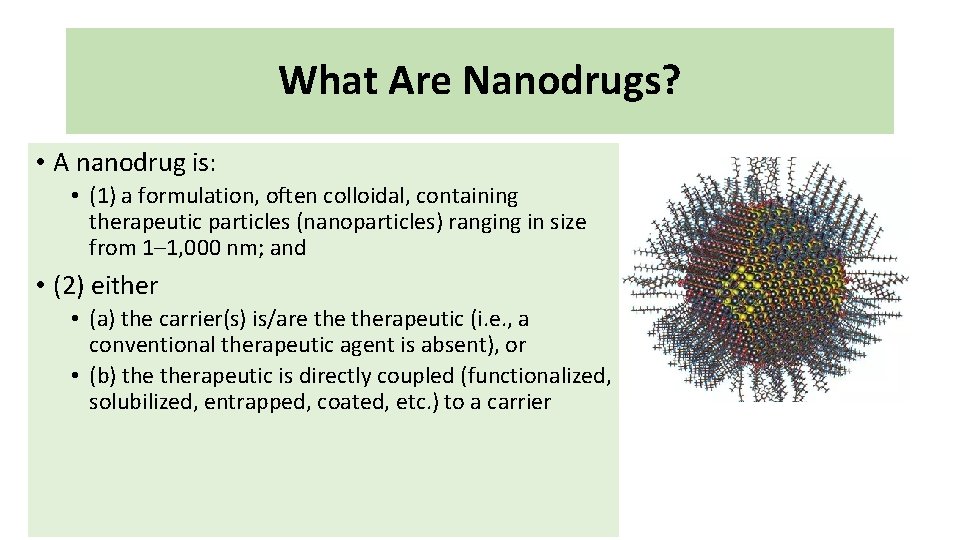
What Are Nanodrugs? • A nanodrug is: • (1) a formulation, often colloidal, containing therapeutic particles (nanoparticles) ranging in size from 1– 1, 000 nm; and • (2) either • (a) the carrier(s) is/are therapeutic (i. e. , a conventional therapeutic agent is absent), or • (b) therapeutic is directly coupled (functionalized, solubilized, entrapped, coated, etc. ) to a carrier
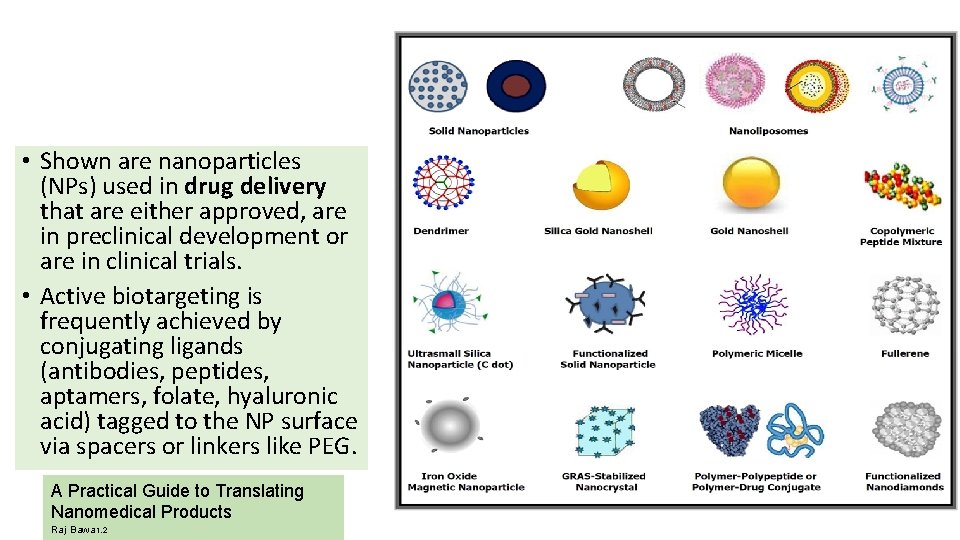
• Shown are nanoparticles (NPs) used in drug delivery that are either approved, are in preclinical development or are in clinical trials. • Active biotargeting is frequently achieved by conjugating ligands (antibodies, peptides, aptamers, folate, hyaluronic acid) tagged to the NP surface via spacers or linkers like PEG. A Practical Guide to Translating Nanomedical Products Raj Bawa 1, 2
Main concern • However, what is seen is an overwhelming increase in empirical approaches that tend to find exaggerated in vivo biomedical applications for a broad range of emerging and poorly characterized multifunctional, hybrid, or nonbiodegradable nanomaterials (e. g. , carbon nanotubes (CNTs), quantum dots, graphene oxide, and certain metallic nanoparticles) that present toxicity and safety concerns
Therefore: • Extensive preclinical and clinical testing is needed prior to application of nanomedicine products in the three relevant areas of diagnosis, prevention, and treatment of disease, yet many aspects of NMs, including their toxicological, pharmacological, and immunological properties, have entered the scientific exploration only recently. • Early safety studies are exceedingly needed to define whether the risk to benefit displayed by a specific nanomedicine is acceptable for the proposed use, thus determining if that nanotechnology will have the promise for further development in a clinical application.
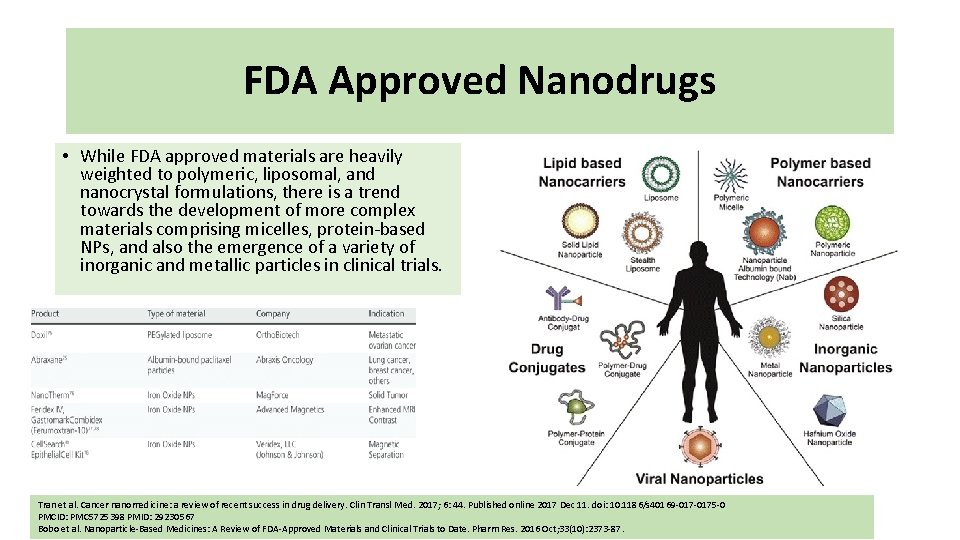
FDA Approved Nanodrugs • While FDA approved materials are heavily weighted to polymeric, liposomal, and nanocrystal formulations, there is a trend towards the development of more complex materials comprising micelles, protein-based NPs, and also the emergence of a variety of inorganic and metallic particles in clinical trials. Tran et al. Cancer nanomedicine: a review of recent success in drug delivery. Clin Transl Med. 2017; 6: 44. Published online 2017 Dec 11. doi: 10. 1186/s 40169 -0175 -0 PMCID: PMC 5725398 PMID: 29230567 Bobo et al. Nanoparticle-Based Medicines: A Review of FDA-Approved Materials and Clinical Trials to Date. Pharm Res. 2016 Oct; 33(10): 2373 -87.
Ethical issues in Nanomedicine • Currently, the ethical considerations involved in nanomedicine are related to: • risk assessment in general, • somatic-cell versus germline-cell therapy, • risk management of engineered nanomaterials, • the toxicity of nanoparticles and nanomedicine, • Immunotoxicity. • uncontrolled function and self-assembly of nanoparticles. • For instance, recently, the identification of cytotoxicity of nanoparticles toward mammalian germline stems cells has aroused great concern over the biosafety of nanomaterials.
Immune Aspects of Nanodrugs • The clinical application of nanodrugs and nanocarriers is dogged by safety and toxicity concerns, especially about their long-term use. • Immunogenicity of nanodrugs may result from a unique combination of physicochemical properties, such as shape, size, surface charge, porosity, reactivity, and composition. • Many nanodrugs are engineered to break tissue physiological barriers for entry and to escape immune surveillance, thereby persisting in body fluids and delivering their active pharmaceutical ingredients (APIs). However, this persistence in the body may trigger immune responses.
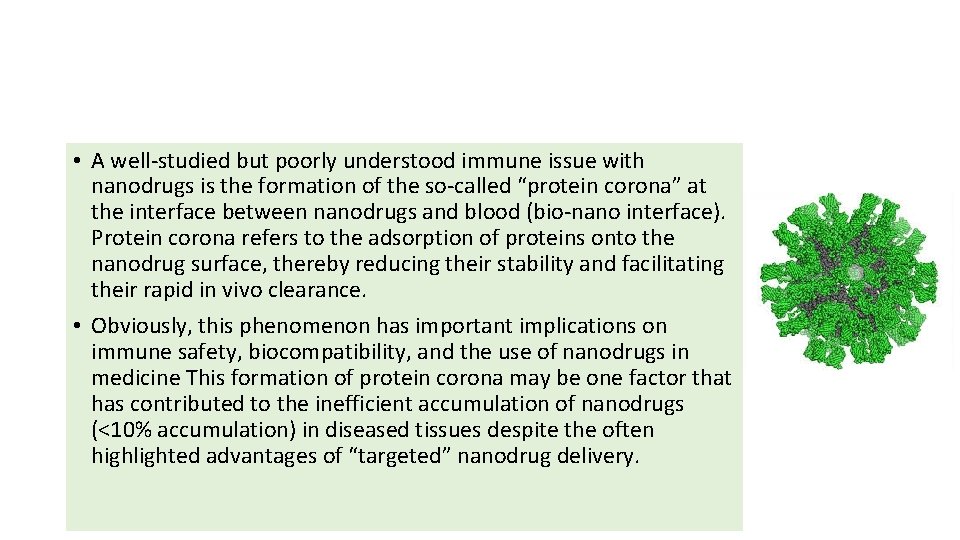
• A well-studied but poorly understood immune issue with nanodrugs is the formation of the so-called “protein corona” at the interface between nanodrugs and blood (bio-nano interface). Protein corona refers to the adsorption of proteins onto the nanodrug surface, thereby reducing their stability and facilitating their rapid in vivo clearance. • Obviously, this phenomenon has important implications on immune safety, biocompatibility, and the use of nanodrugs in medicine This formation of protein corona may be one factor that has contributed to the inefficient accumulation of nanodrugs (<10% accumulation) in diseased tissues despite the often highlighted advantages of “targeted” nanodrug delivery.
• Often, intravenously administered therapeutics (certain nanodrugs, biologics, NBCDs, etc. ) prime the immune system, leading to adverse reactions and/or the loss of efficacy of the drug product. • It is now well established that these therapeutics may provoke “hypersensitivity reactions” (HSRs), also known as “infusion” or “anaphylactoid” reactions.
• Three main fronts of activity are needed to address ethical issues in nanotechnology: • Incorporating ethics research into nano research and development enterprises; • Devising mechanisms to involve the public so that their perspectives and concerns feed back into research and development; and • Initiating educational efforts at every level addressing both technical aspects and ethics and social implications aspects. • Ethical reflections must accompany research every step of the way, and this should be a defining feature of nanotechnology, not just a statement about how ethical issues should be addressed. The way forward
• It is important to proactively address the ethical, social and regulatory aspects of nanomedicine to minimize its adverse impacts on the environment and public health and to avoid a public backlash. • At present, the most significant ethical issues relating to nanomedicine involve risk assessment, risk management, and risk communication in clinical trials. • Therefore, educating members of society about the benefits and risks of nanomedicine is important to gain and maintain public support. • Ethical principles in biological researches should be implemented in all three stages: • Prevention, • Diagnosis and • Treatment The way forward: Nanomedicine