ESSnet on Standardisation Framework of the planned standardisation

- Slides: 16
ESSnet on Standardisation Framework of the planned standardisation process in the ESS Csaba Ábry Coordinator of the ESSnet on Standardisation http: //www. cros-portal. eu/content/standardisation Methodology Department Hungarian Central Statistical Office www. ksh. hu E-mail: csaba. abry@ksh. hu Telephone: (+36 -1) 345 -6517 Task Force on Implementation of Metadata Standards Luxembourg, 7 th-8 th October, 2014 1
Introduction ESSnet on Standardisation Scope of work: Actions of practical implementation for the envisaged standardisation system in the ESS, based on the recommendations of the Sponsorship on Standardisation Main areas of work: Inventory of normative documents (legal acts, standards, other normative documents) Planned standardisation process for the ESS Impact assessment Business Architecture-related activities 2
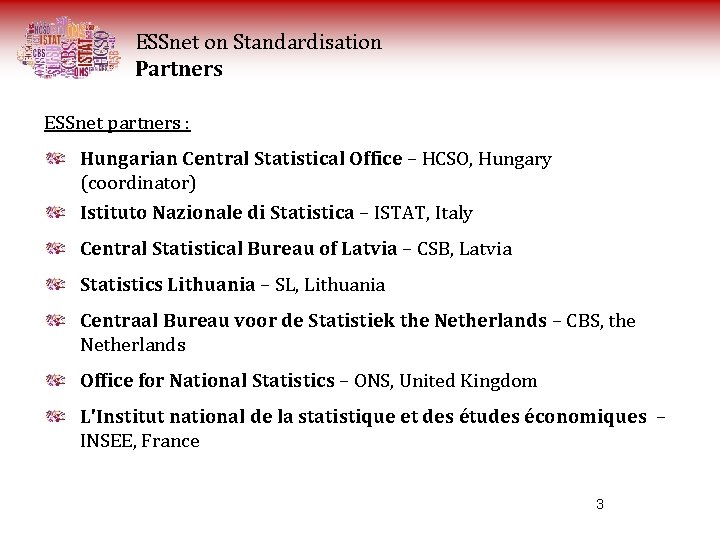
ESSnet on Standardisation Partners ESSnet partners : Hungarian Central Statistical Office – HCSO, Hungary (coordinator) Istituto Nazionale di Statistica – ISTAT, Italy Central Statistical Bureau of Latvia – CSB, Latvia Statistics Lithuania – SL, Lithuania Centraal Bureau voor de Statistiek the Netherlands – CBS, the Netherlands Office for National Statistics – ONS, United Kingdom L'Institut national de la statistique et des études économiques – INSEE, France 3
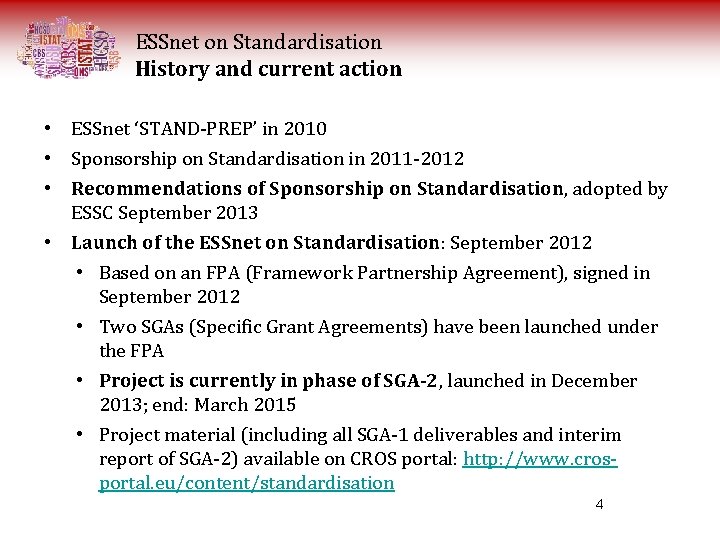
ESSnet on Standardisation History and current action • ESSnet ‘STAND-PREP’ in 2010 • Sponsorship on Standardisation in 2011 -2012 • Recommendations of Sponsorship on Standardisation, adopted by ESSC September 2013 • Launch of the ESSnet on Standardisation: September 2012 • Based on an FPA (Framework Partnership Agreement), signed in September 2012 • Two SGAs (Specific Grant Agreements) have been launched under the FPA • Project is currently in phase of SGA-2, launched in December 2013; end: March 2015 • Project material (including all SGA-1 deliverables and interim report of SGA-2) available on CROS portal: http: //www. crosportal. eu/content/standardisation 4
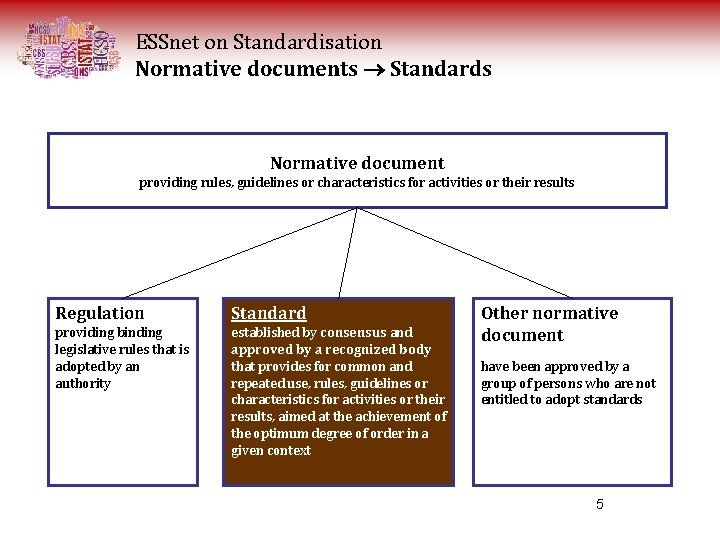
ESSnet on Standardisation Normative documents Standards Normative document providing rules, guidelines or characteristics for activities or their results Regulation Standard providing binding legislative rules that is adopted by an authority established by consensus and approved by a recognized body that provides for common and repeated use, rules, guidelines or characteristics for activities or their results, aimed at the achievement of the optimum degree of order in a given context Other normative document have been approved by a group of persons who are not entitled to adopt standards 5
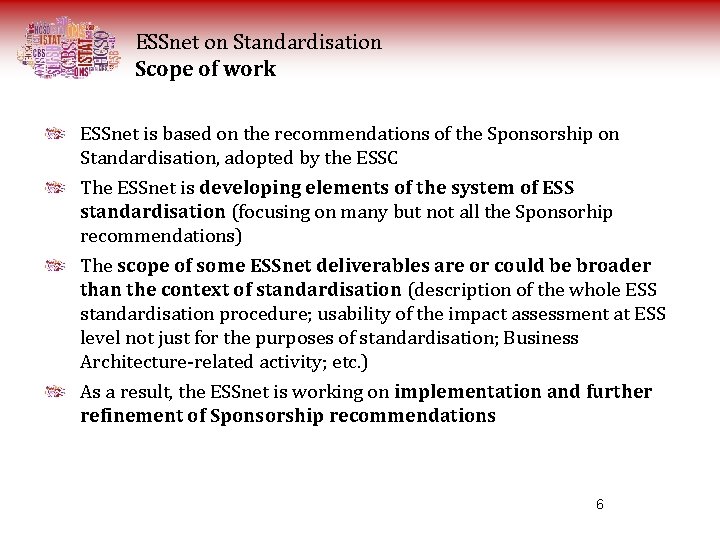
ESSnet on Standardisation Scope of work ESSnet is based on the recommendations of the Sponsorship on Standardisation, adopted by the ESSC The ESSnet is developing elements of the system of ESS standardisation (focusing on many but not all the Sponsorhip recommendations) The scope of some ESSnet deliverables are or could be broader than the context of standardisation (description of the whole ESS standardisation procedure; usability of the impact assessment at ESS level not just for the purposes of standardisation; Business Architecture-related activity; etc. ) As a result, the ESSnet is working on implementation and further refinement of Sponsorship recommendations 6
Planned standardisation process for the ESS (current ongoing work in SGA-2) 7
Planned standardisation process for the ESS Governance & Process • Motivation is to have a process in place to have ESS standards • The process is not in place yet. Final refinement of the process is currently carried out by the ESSnet. • High-level decisions are required to set the governance of the standardisation in the ESS • The Task Force on Standardisation (made of representatives from Eurostat, ES, FR, HU, IT, NL and UK) is presently working on a "standardisation package" (governance structure together with the standardisation procedure) which will be submitted first to the DIME (Directors of Methodology) and ultimately to the ESSC • Aim: present the final product at the February 2015 meeting of the ESSC 8
Planned standardisation process for the ESS Main principles • Five principles of the standardisation: • Consensus • Transparency and openness • Balance • Due process • Proportionality • Main focus: the standardisation process guarantees that all ESS standards are developed according to the principles (it is not an adhoc decision anymore to call a normative document „standard”) • Every ESS standard has to go through this process • Basically, there are no ESS standards today (as there is no standardisation process) • It is a framework: it might be that a normative document adopted by other bodies (e. g. SDMX, etc. ) does not have to go through the whole process („fast track” solution – topic for future work) 9
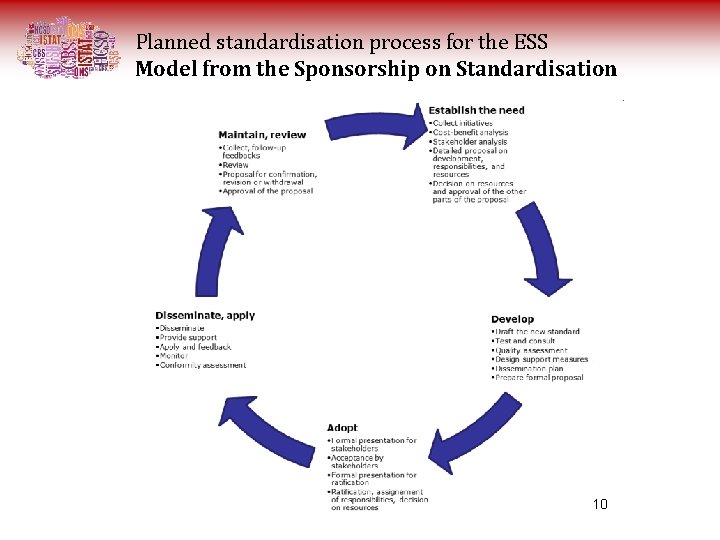
Planned standardisation process for the ESS Model from the Sponsorship on Standardisation 10
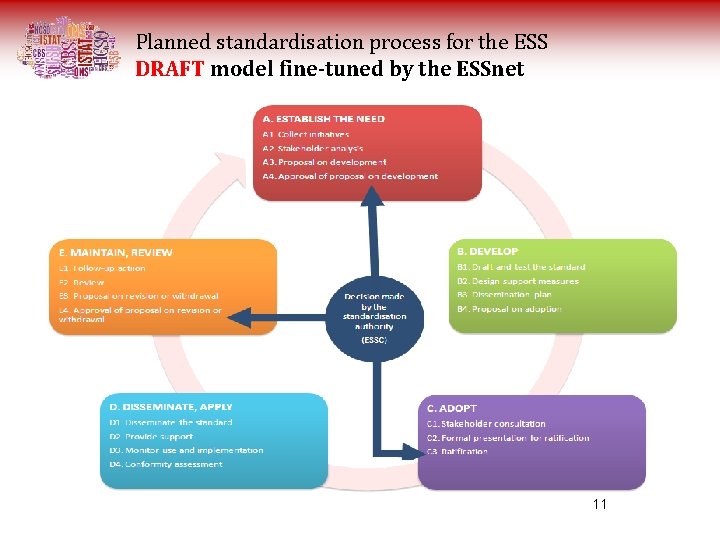
Planned standardisation process for the ESS DRAFT model fine-tuned by the ESSnet 11
Planned standardisation process for the ESS Additional key issues The standardisation process-related work of the ESSnet is not focusing on the process only but also on other issues linked to the process; namely: • identify the bodies involved in the process (key roles: standardisation authority, permanent body for ESS standardisation). Focus: who is doing what in the process • set the connections between the inventory and the process (inventory used as input or something is recorded in the inventory) • identify the outputs produced in the process • describe the connections between the activities of the process These will also be provided by the ESSnet 12
Planned standardisation process for the ESS Relevance to ESMS and similar normative documents „Today”: there is no procedure no „obligation” to follow the process. It can be followed on a voluntary basis. After the standardisation process in place: the development (or revision) procedure of the ESS standard needs to follow the standard-making process: • with all the relevant activities of the process carried out • impact assessment (cost-benefit analysis) carried out as defined in the model (ongoing work in the ESSnet) • with all the outputs produced • with the involvement of bodies (especially the standardisation authority [ESSC] and the permanent body for ESS standardisation [governance issue]) 13
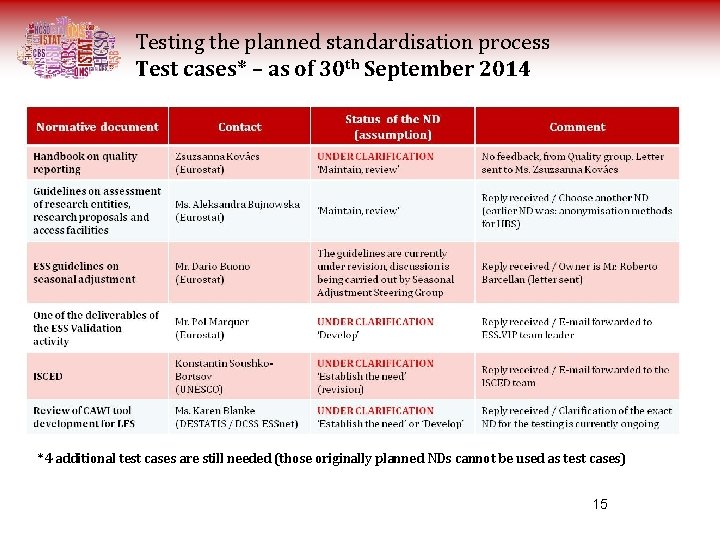
Planned standardisation process for the ESSnet deadlines End of October 2014 – Finalised structure and content of the standardisation process. ESSnet will make this version available for the Task Force on Standardisation Between November 2014 and March 2015 – Conduct test cases for testing the standardisation process and further fine-tune the process of standardisation, if needed 13 th March 2015 – Final fine-tuned standardisation process disseminated as ESSnet deliverable 14
Testing the planned standardisation process Test cases* – as of 30 th September 2014 *4 additional test cases are still needed (those originally planned NDs cannot be used as test cases) 15
Thank you for your attention! ESSnet on Standardisation on CROS portal: http: //www. cros-portal. eu/content/standardisation Csaba Ábry Methodology Department Hungarian Central Statistical Office www. ksh. hu E-mail: csaba. abry@ksh. hu Telephone: (+36 -1) 345 -6517 16