EUROPEAN COMMITTEE FOR STANDARDISATION COMIT EUROPEN DE NORMALISATION

- Slides: 17
EUROPEAN COMMITTEE FOR STANDARDISATION COMITÉ EUROPÉEN DE NORMALISATION EUROPÄISCHES KOMITEE FÜR NORMUNG Relation between Energy Performance in Buildings to Building Automation, Controls (BACS) and Building Management (BM) standardised by CEN/TC 247 M. Schumacher cen-tc 247_workshop-1. 4. 03 TC 247
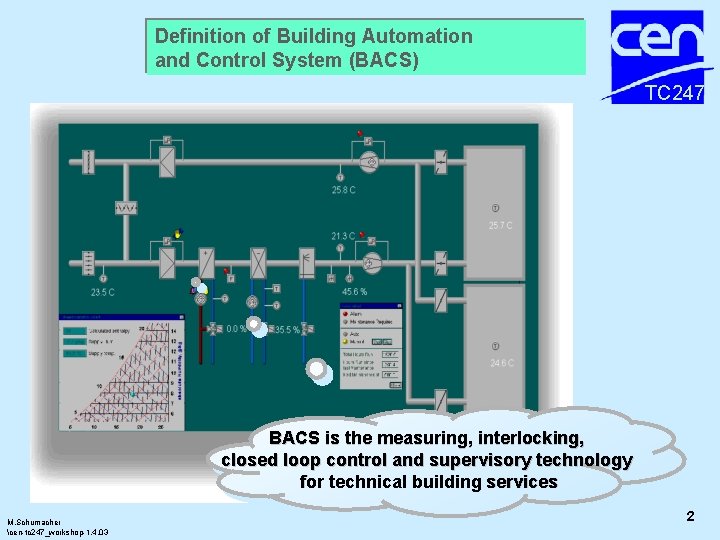
Definition of Building Automation and Control System (BACS) TC 247 BACS is the measuring, interlocking, closed loop control and supervisory technology for technical building services M. Schumacher cen-tc 247_workshop-1. 4. 03 2
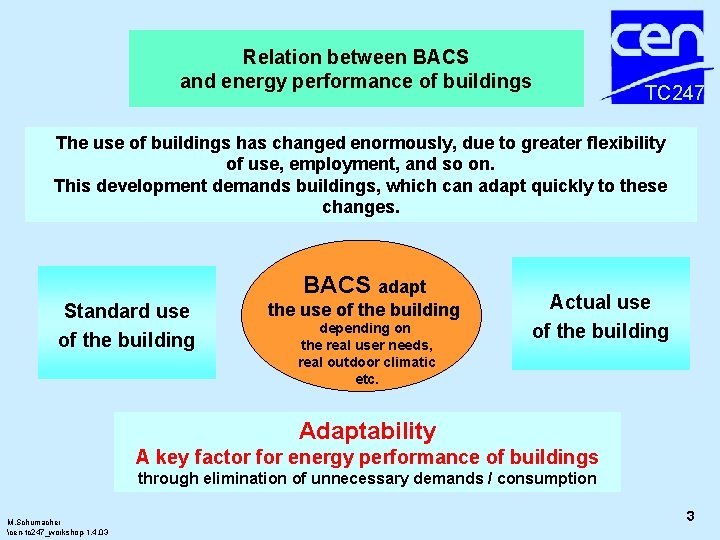
Relation between BACS and energy performance of buildings TC 247 The use of buildings has changed enormously, due to greater flexibility of use, employment, and so on. This development demands buildings, which can adapt quickly to these changes. BACS adapt Standard use of the building the use of the building depending on the real user needs, real outdoor climatic etc. Actual use of the building Adaptability A key factor for energy performance of buildings through elimination of unnecessary demands / consumption M. Schumacher cen-tc 247_workshop-1. 4. 03 3
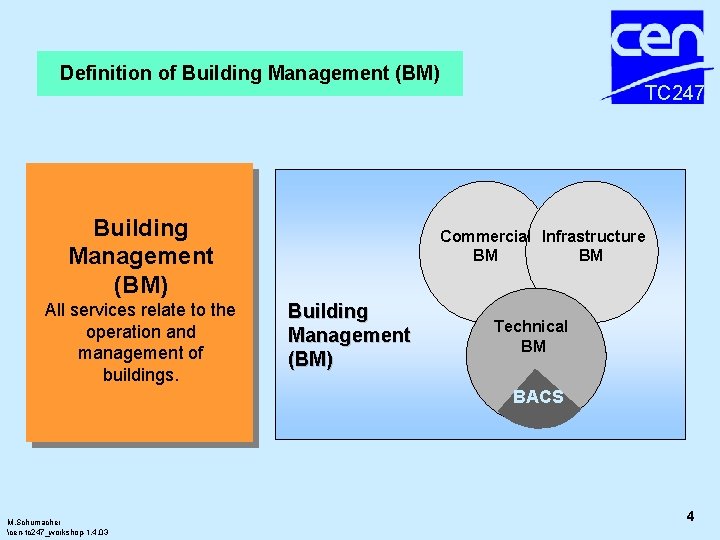
Definition of Building Management (BM) All services relate to the operation and management of buildings. TC 247 Commercial Infrastructure BM BM Building Management (BM) Technical BM BACS M. Schumacher cen-tc 247_workshop-1. 4. 03 4
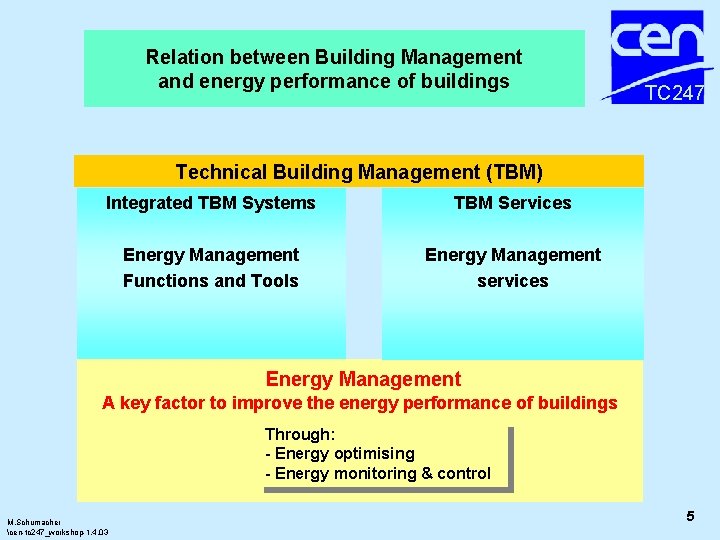
Relation between Building Management and energy performance of buildings TC 247 Technical Building Management (TBM) Integrated TBM Systems TBM Services Energy Management Functions and Tools Energy Management services Energy Management A key factor to improve the energy performance of buildings Through: - Energy optimising - Energy monitoring & control M. Schumacher cen-tc 247_workshop-1. 4. 03 5
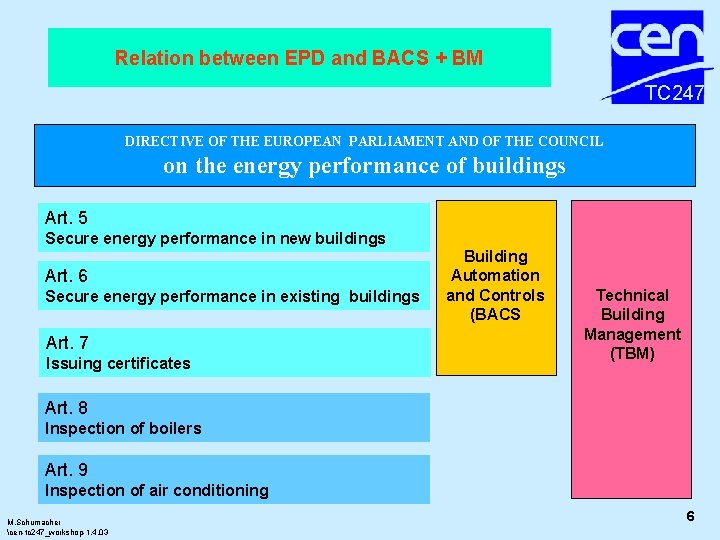
Relation between EPD and BACS + BM TC 247 DIRECTIVE OF THE EUROPEAN PARLIAMENT AND OF THE COUNCIL on the energy performance of buildings Art. 5 Secure energy performance in new buildings Art. 6 Secure energy performance in existing buildings Art. 7 Issuing certificates Building Automation and Controls (BACS Technical Building Management (TBM) Art. 8 Inspection of boilers Art. 9 Inspection of air conditioning M. Schumacher cen-tc 247_workshop-1. 4. 03 6
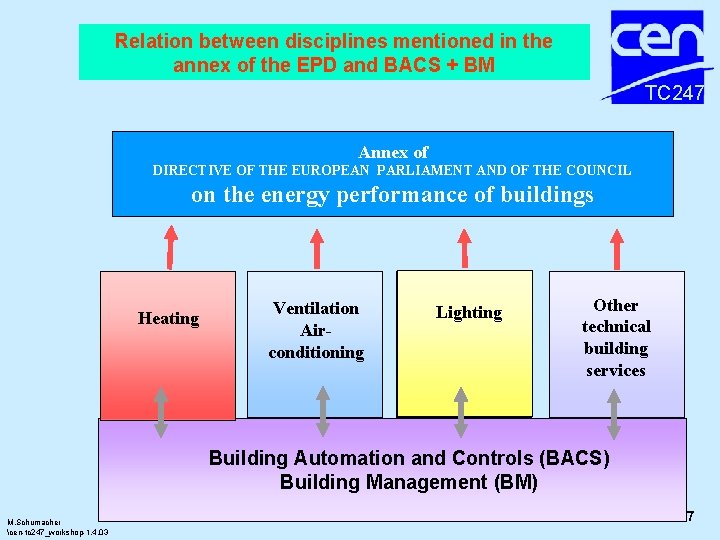
Relation between disciplines mentioned in the annex of the EPD and BACS + BM TC 247 Annex of DIRECTIVE OF THE EUROPEAN PARLIAMENT AND OF THE COUNCIL on the energy performance of buildings Heating Ventilation Airconditioning Lighting Other technical building services Building Automation and Controls (BACS) Building Management (BM) M. Schumacher cen-tc 247_workshop-1. 4. 03 7
Technical Committee CEN/TC 247 Since 1990 CEN/TC 247 is in charge of developing European standards for Building Automation, Controls and Building Management in accordance with its scope M. Schumacher cen-tc 247_workshop-1. 4. 03 8
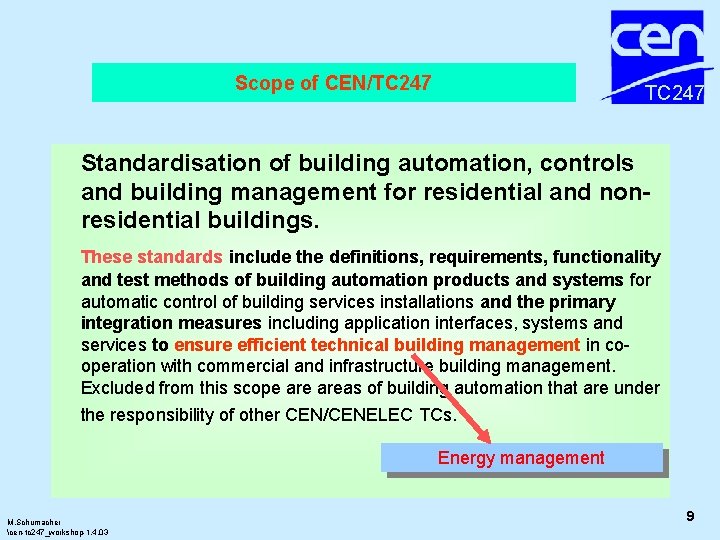
Scope of CEN/TC 247 Standardisation of building automation, controls and building management for residential and nonresidential buildings. These standards include the definitions, requirements, functionality and test methods of building automation products and systems for automatic control of building services installations and the primary integration measures including application interfaces, systems and services to ensure efficient technical building management in cooperation with commercial and infrastructure building management. Excluded from this scope areas of building automation that are under the responsibility of other CEN/CENELEC TCs. Energy management M. Schumacher cen-tc 247_workshop-1. 4. 03 9
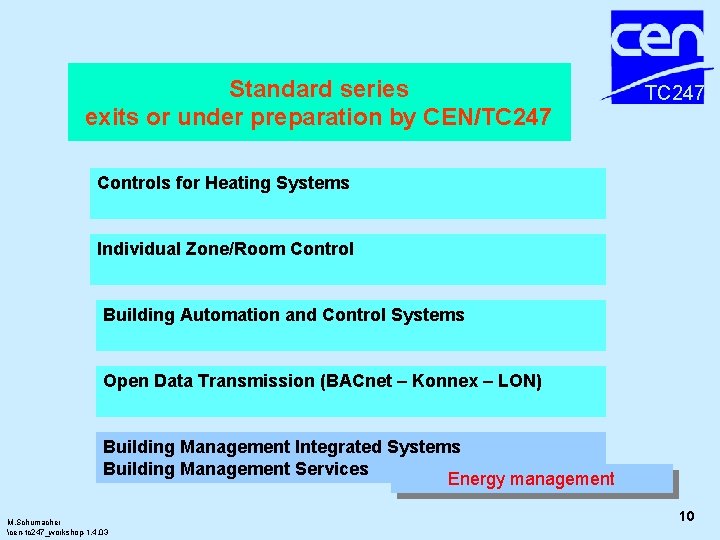
Standard series exits or under preparation by CEN/TC 247 Controls for Heating Systems Individual Zone/Room Control Building Automation and Control Systems Open Data Transmission (BACnet – Konnex – LON) Building Management Integrated Systems Building Management Services Energy management M. Schumacher cen-tc 247_workshop-1. 4. 03 10
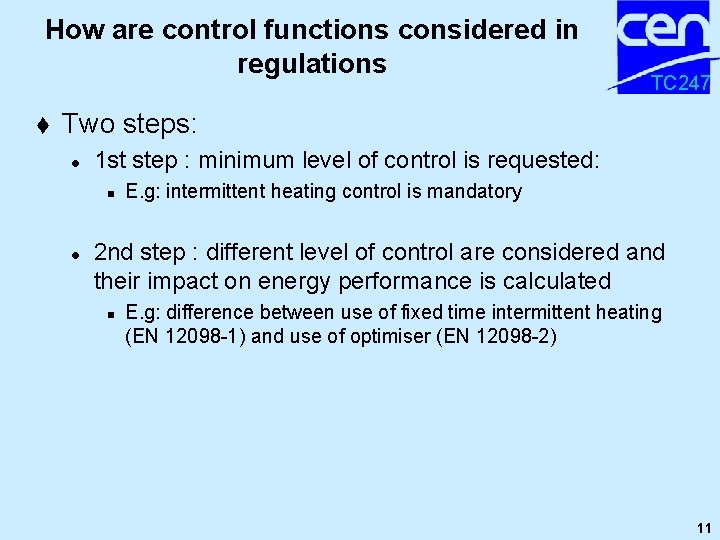
How are control functions considered in regulations t TC 247 Two steps: l 1 st step : minimum level of control is requested: n l E. g: intermittent heating control is mandatory 2 nd step : different level of control are considered and their impact on energy performance is calculated n E. g: difference between use of fixed time intermittent heating (EN 12098 -1) and use of optimiser (EN 12098 -2) 11
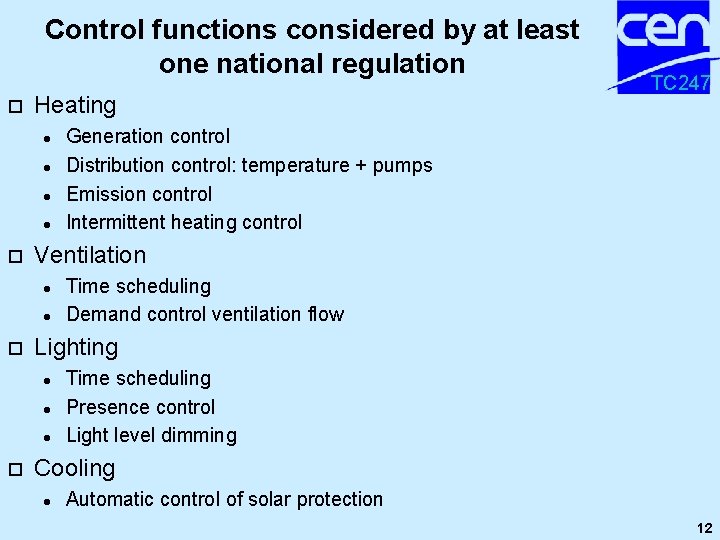
Control functions considered by at least one national regulation ¨ Heating l l ¨ l Time scheduling Demand control ventilation flow Lighting l l l ¨ Generation control Distribution control: temperature + pumps Emission control Intermittent heating control Ventilation l ¨ TC 247 Time scheduling Presence control Light level dimming Cooling l Automatic control of solar protection 12
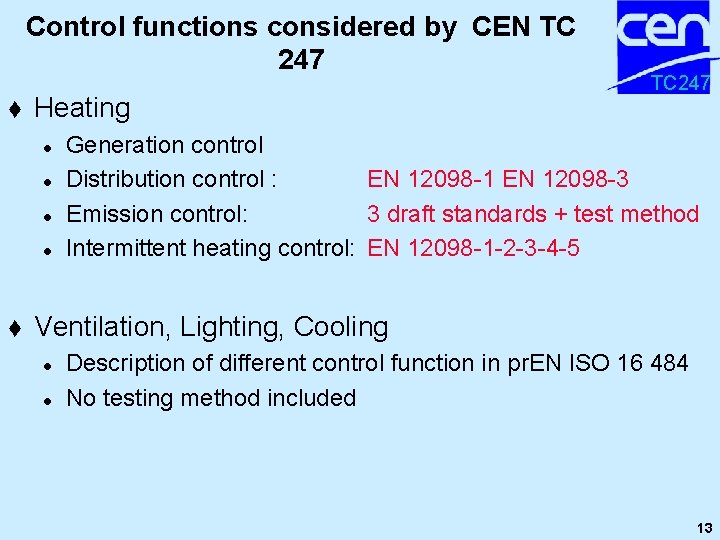
Control functions considered by CEN TC 247 t Heating l l t TC 247 Generation control Distribution control : EN 12098 -1 EN 12098 -3 Emission control: 3 draft standards + test method Intermittent heating control: EN 12098 -1 -2 -3 -4 -5 Ventilation, Lighting, Cooling l l Description of different control function in pr. EN ISO 16 484 No testing method included 13
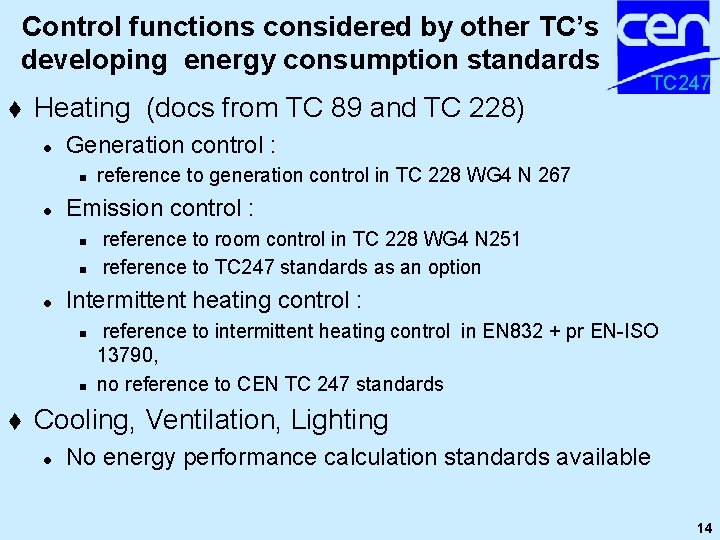
Control functions considered by other TC’s developing energy consumption standards t Heating (docs from TC 89 and TC 228) l Generation control : n l n reference to room control in TC 228 WG 4 N 251 reference to TC 247 standards as an option Intermittent heating control : n n t reference to generation control in TC 228 WG 4 N 267 Emission control : n l TC 247 reference to intermittent heating control in EN 832 + pr EN-ISO 13790, no reference to CEN TC 247 standards Cooling, Ventilation, Lighting l No energy performance calculation standards available 14
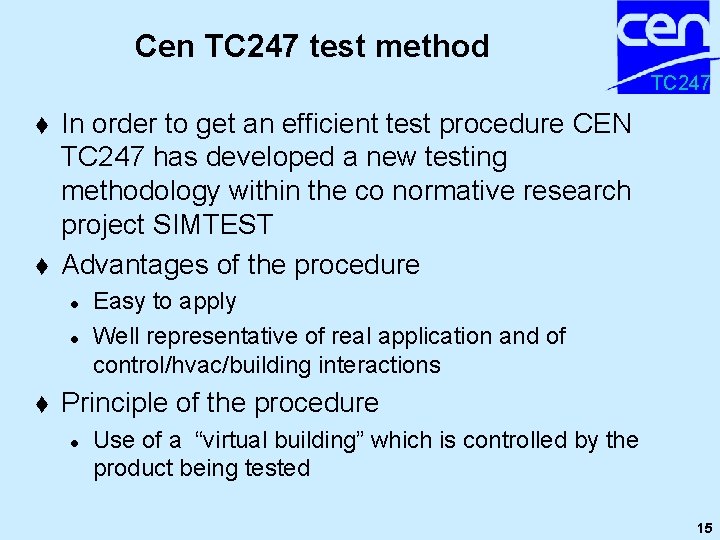
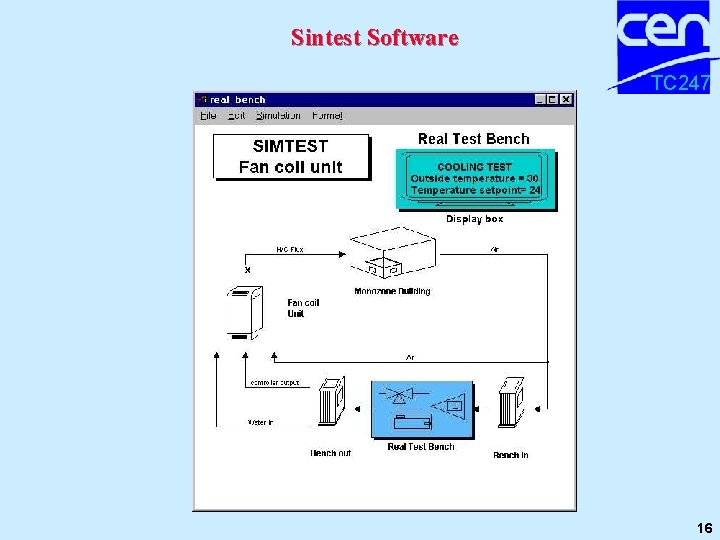
Cen TC 247 test method TC 247 t t In order to get an efficient test procedure CEN TC 247 has developed a new testing methodology within the co normative research project SIMTEST Advantages of the procedure l l t Easy to apply Well representative of real application and of control/hvac/building interactions Principle of the procedure l Use of a “virtual building” which is controlled by the product being tested 15
Sintest Software TC 247 16
Prospective to apply Energy Performance Directive t For TC 89, 156, 228 ? l t Develop standards including the energy flows not already covered: lighting, ventilation, cooling… For TC 247 l t TC 247 Develop standards to assess the performance of the control of lighting, ventilation, cooling… For TC 89, 156, 228… in coordination with TC 247 l Define how to make coordination between these two groups of standards 17