Ernest Hemingway Khantsaratsyan Inna Mikheeva Varvara Ivanova Anna

- Slides: 26
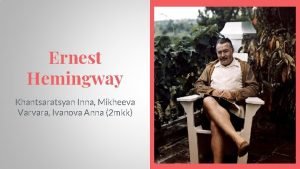
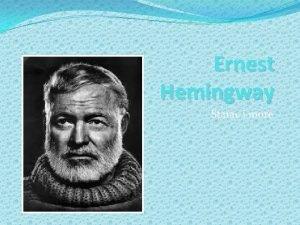
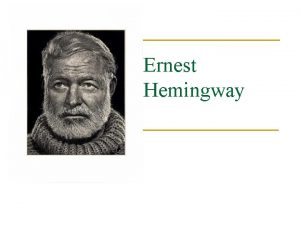
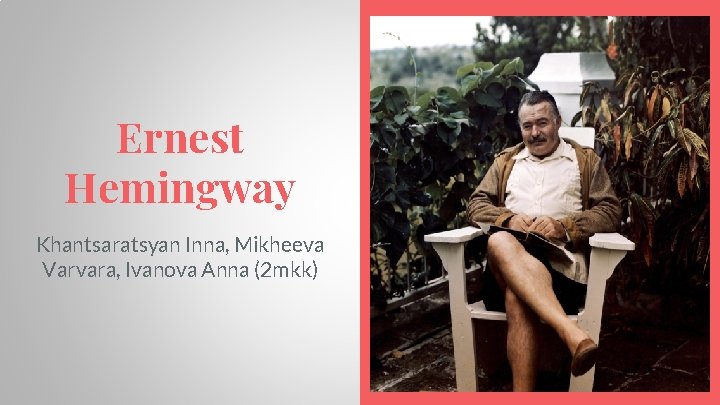
Ernest Hemingway Khantsaratsyan Inna, Mikheeva Varvara, Ivanova Anna (2 mkk)
Modernist movement 1. The change of peoples’ worldviews → people demanding for honesty, rectitude and simplicity in literature; 2. Hence, in the 20 th century Modernism started to evolve; 3. Modernist → searching for new forms, → looking for an accurate response to a much-changed world; 1. The main features: the rejection of sentiments, irrelevant ideas, moral values and gender roles; symbolism; focus on an individual character, on thoughts and reflections, the bare consciousness of the main character (not the plot itself);
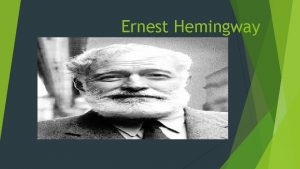
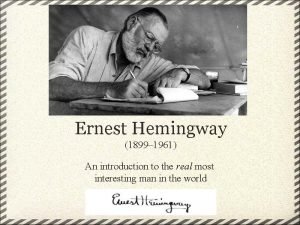
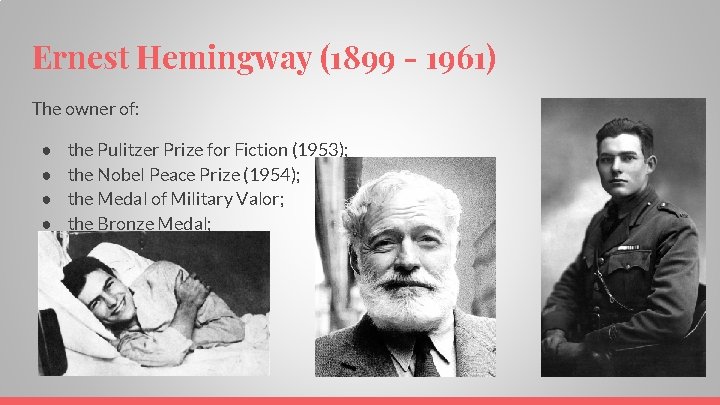
Ernest Hemingway (1899 - 1961) The owner of: ● ● the Pulitzer Prize for Fiction (1953); the Nobel Peace Prize (1954); the Medal of Military Valor; the Bronze Medal;
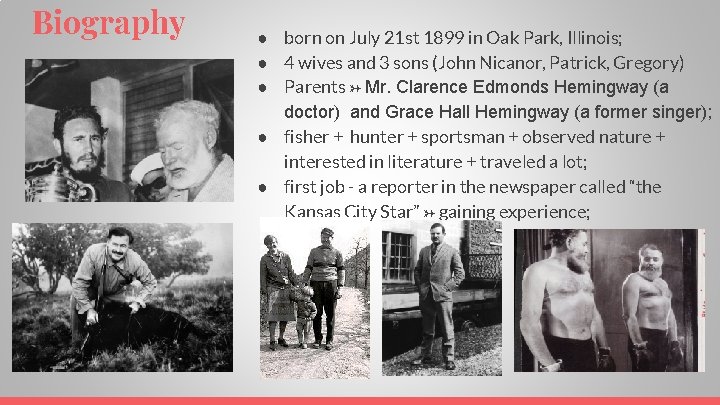
Biography ● born on July 21 st 1899 in Oak Park, Illinois; ● 4 wives and 3 sons (John Nicanor, Patrick, Gregory) ● Parents → Mr. Clarence Edmonds Hemingway (a doctor) and Grace Hall Hemingway (a former singer); ● fisher + hunter + sportsman + observed nature + interested in literature + traveled a lot; ● first job - a reporter in the newspaper called “the Kansas City Star” → gaining experience;
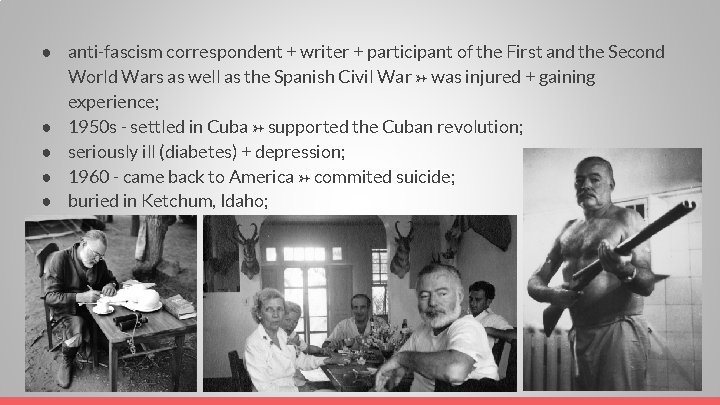
● anti-fascism correspondent + writer + participant of the First and the Second World Wars as well as the Spanish Civil War → was injured + gaining experience; ● 1950 s - settled in Cuba → supported the Cuban revolution; ● seriously ill (diabetes) + depression; ● 1960 - came back to America → commited suicide; ● buried in Ketchum, Idaho;
Style and major themes ● succinct, simple, direct, unadorned and telegraphic style lacking adjectives; ● honesty; ● three main principles: 1)never to write if one has nothing to say; 2) to write about well-known things; 3) and only if one cannot help it; ● major themes: nature, death, fatalistic heroism, disillusionment or depression, masculinity, ambivalence, animals as symbols; ● types of characters: 1) people altered by their World War I experiences (detached, cynical), 2) emotionally needy and simple, plainspoken individuals of direct emotions (find fulfillment in fishing, bullfighting or other physical activities)
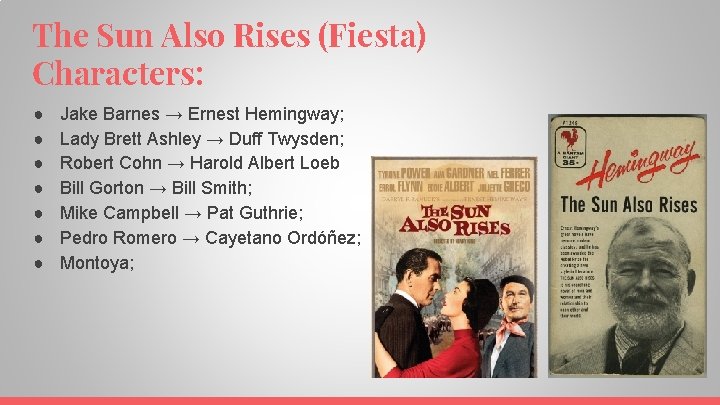
The Sun Also Rises (Fiesta) Characters: ● ● ● ● Jake Barnes → Ernest Hemingway; Lady Brett Ashley → Duff Twysden; Robert Cohn → Harold Albert Loeb Bill Gorton → Bill Smith; Mike Campbell → Pat Guthrie; Pedro Romero → Cayetano Ordóñez; Montoya;
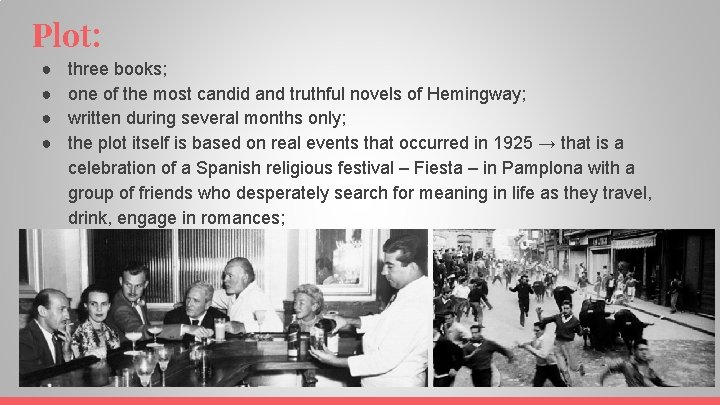
Plot: ● ● three books; one of the most candid and truthful novels of Hemingway; written during several months only; the plot itself is based on real events that occurred in 1925 → that is a celebration of a Spanish religious festival – Fiesta – in Pamplona with a group of friends who desperately search for meaning in life as they travel, drink, engage in romances;
Analysis (+ major themes + symbols): ● "You are all a lost generation. " (Gertrude Stein) ● "One generation passeth away, and another generation cometh; but the earth abideth forever. . . The sun also ariseth, and the sun goeth down, and hasteth to the place where he arose. . . The wind goeth toward the south, and turneth about unto the north; it whirleth about continually, and the wind returneth again according to his circuits. . All the rivers run into the sea; yet the sea is not full; unto the place from whence the rivers come, thither they return again. " (Ecclesiastes)
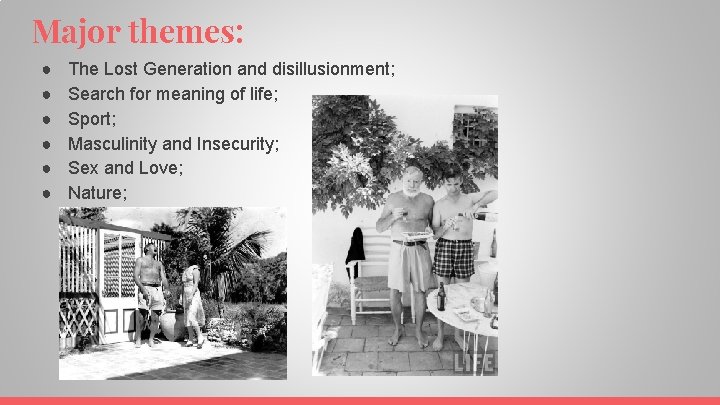
Major themes: ● ● ● The Lost Generation and disillusionment; Search for meaning of life; Sport; Masculinity and Insecurity; Sex and Love; Nature;
Symbols: ● ● ● ● ● Bulls → passion, physicality, energy, and freedom; bull fighting → sex; bullfighter → passionate love and sex; wine is a symbol of rejuvenation and stimulates creativity; ocean → purification and relief; river → relieve and strength; bathe → desire to purify; Paris (color: Dark, Red, and Green) → the reawakening of the senses; the landscape of Burguete (color: Brown, White, and Green) → the change of the atmosphere in the country.
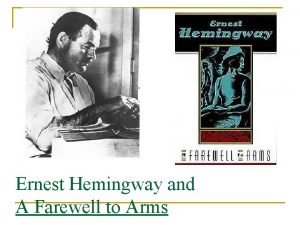
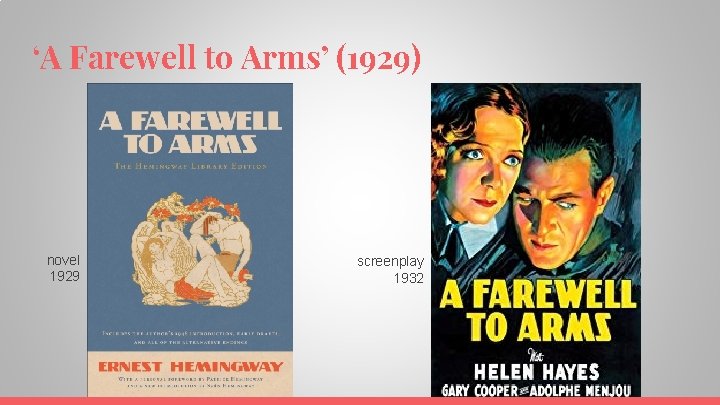
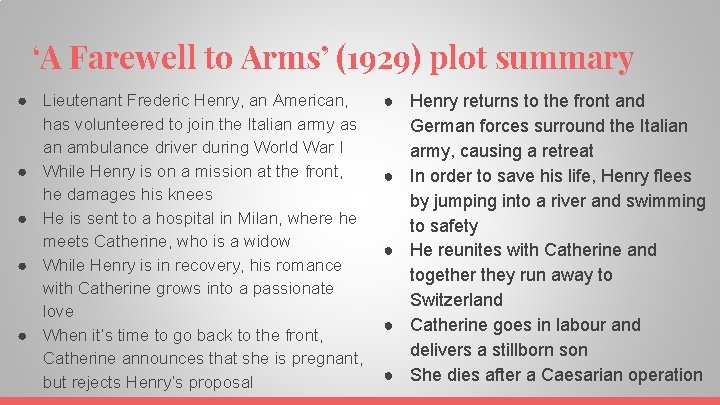
‘A Farewell to Arms’ (1929) novel 1929 screenplay 1932
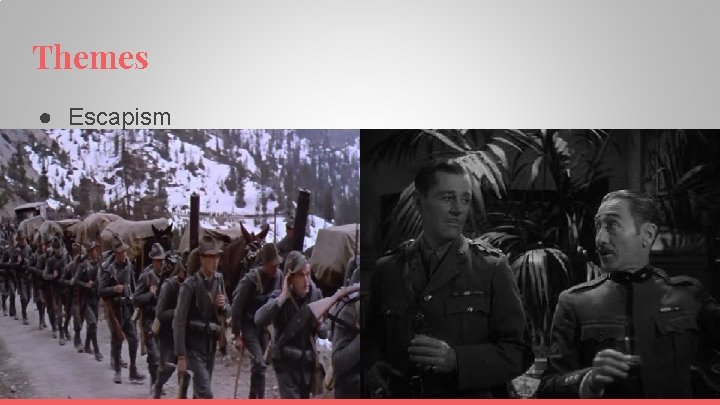
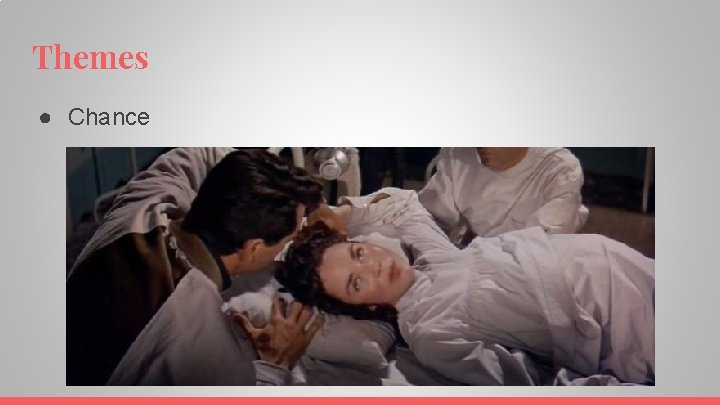
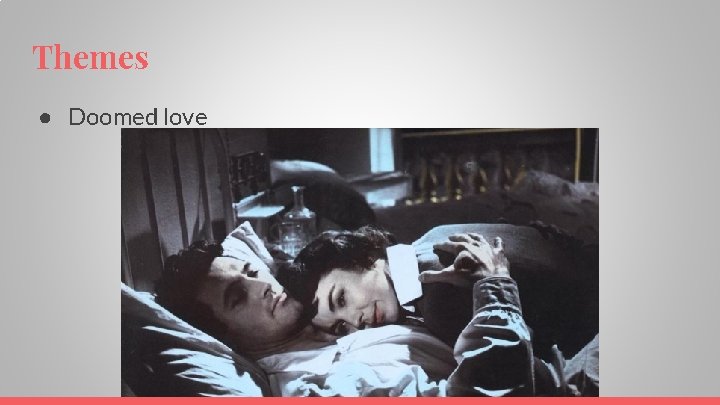
‘A Farewell to Arms’ (1929) plot summary ● Lieutenant Frederic Henry, an American, has volunteered to join the Italian army as an ambulance driver during World War I ● While Henry is on a mission at the front, he damages his knees ● He is sent to a hospital in Milan, where he meets Catherine, who is a widow ● While Henry is in recovery, his romance with Catherine grows into a passionate love ● When it’s time to go back to the front, Catherine announces that she is pregnant, but rejects Henry’s proposal ● Henry returns to the front and German forces surround the Italian army, causing a retreat ● In order to save his life, Henry flees by jumping into a river and swimming to safety ● He reunites with Catherine and together they run away to Switzerland ● Catherine goes in labour and delivers a stillborn son ● She dies after a Caesarian operation
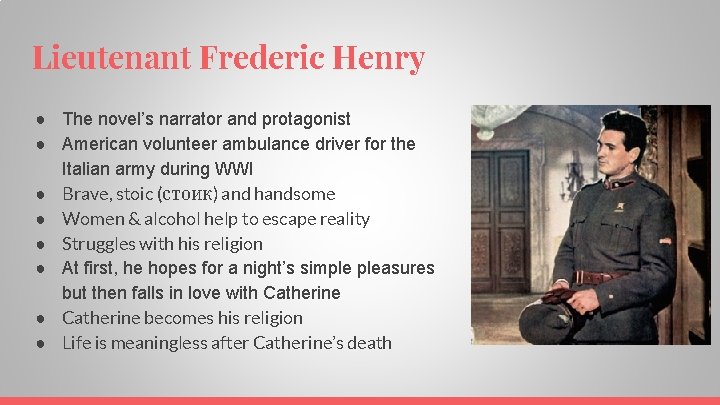
Lieutenant Frederic Henry ● The novel’s narrator and protagonist ● American volunteer ambulance driver for the Italian army during WWI ● Brave, stoic (стоик) and handsome ● Women & alcohol help to escape reality ● Struggles with his religion ● At first, he hopes for a night’s simple pleasures but then falls in love with Catherine ● Catherine becomes his religion ● Life is meaningless after Catherine’s death
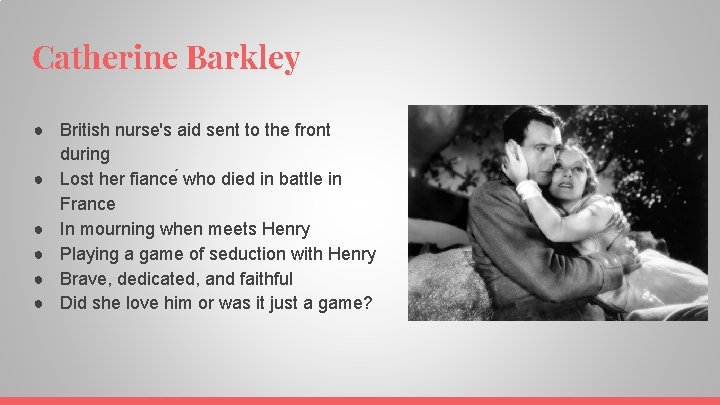
Catherine Barkley ● British nurse's aid sent to the front during ● Lost her fiance who died in battle in France ● In mourning when meets Henry ● Playing a game of seduction with Henry ● Brave, dedicated, and faithful ● Did she love him or was it just a game?
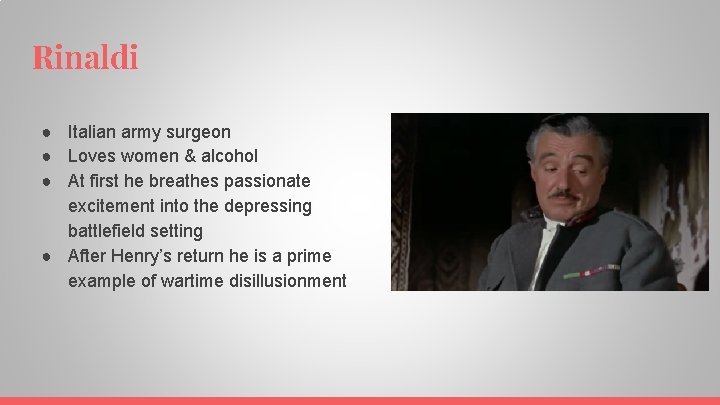
Rinaldi ● Italian army surgeon ● Loves women & alcohol ● At first he breathes passionate excitement into the depressing battlefield setting ● After Henry’s return he is a prime example of wartime disillusionment
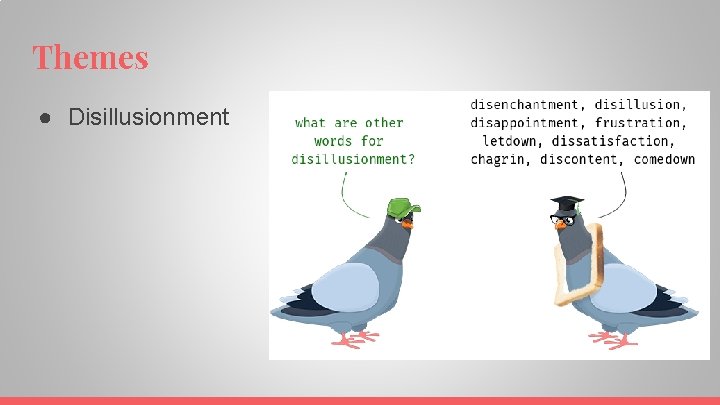
Themes ● Disillusionment
Themes ● Escapism
Themes ● Chance
Themes ● Doomed love
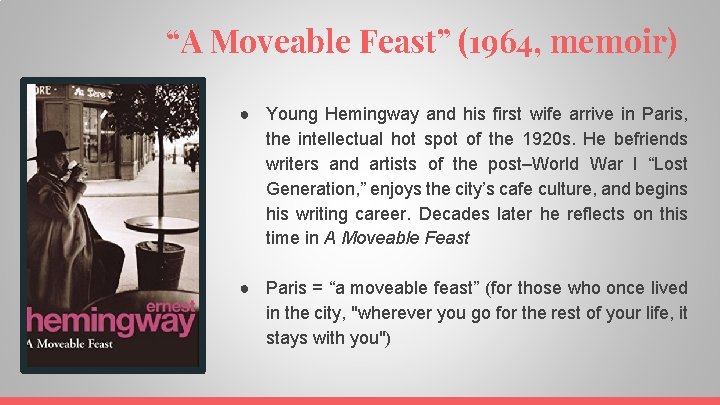
“A Moveable Feast” (1964, memoir) ● Young Hemingway and his first wife arrive in Paris, the intellectual hot spot of the 1920 s. He befriends writers and artists of the post–World War I “Lost Generation, ” enjoys the city’s cafe culture, and begins his writing career. Decades later he reflects on this time in A Moveable Feast ● Paris = “a moveable feast” (for those who once lived in the city, "wherever you go for the rest of your life, it stays with you")
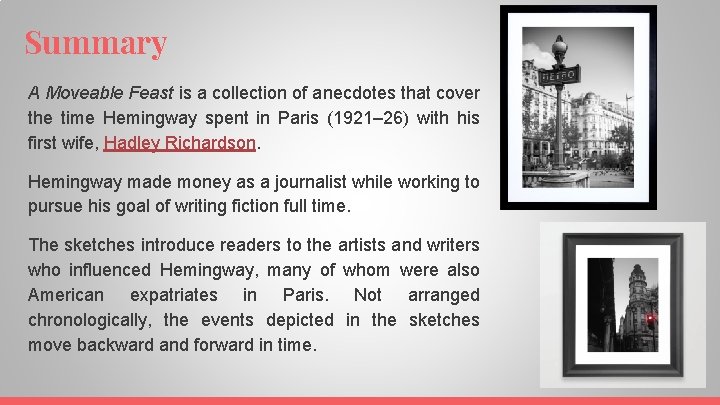
Summary A Moveable Feast is a collection of anecdotes that cover the time Hemingway spent in Paris (1921– 26) with his first wife, Hadley Richardson. Hemingway made money as a journalist while working to pursue his goal of writing fiction full time. The sketches introduce readers to the artists and writers who influenced Hemingway, many of whom were also American expatriates in Paris. Not arranged chronologically, the events depicted in the sketches move backward and forward in time.
Main Characters - Ernest Hemingway - Hadley Richardson (his wife) - Gertrude Stein (his mentor and friend) - F. Scott Fitzgerald (his fellow writer)
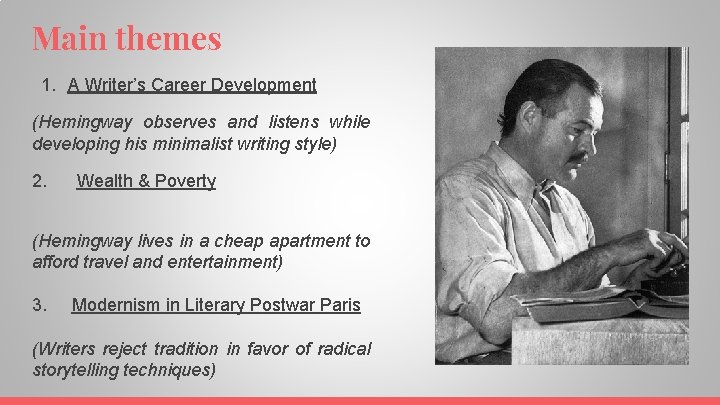
Main themes 1. A Writer’s Career Development (Hemingway observes and listens while developing his minimalist writing style) 2. Wealth & Poverty (Hemingway lives in a cheap apartment to afford travel and entertainment) 3. Modernism in Literary Postwar Paris (Writers reject tradition in favor of radical storytelling techniques)
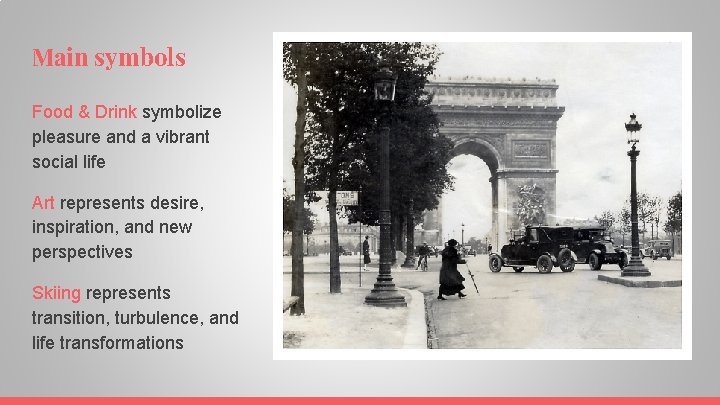
Main symbols Food & Drink symbolize pleasure and a vibrant social life Art represents desire, inspiration, and new perspectives Skiing represents transition, turbulence, and life transformations
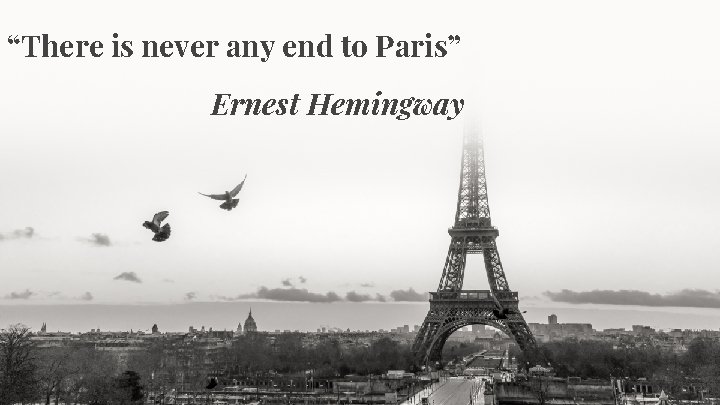
“There is never any end to Paris” Ernest Hemingway