Equity and Distance Education Synchronous vs Asynchronous Instruction
- Slides: 17
Equity and Distance Education – Synchronous vs Asynchronous Instruction Julie Bruno, OERI Communications Lead, Sierra College Jennifer Paris, OERI Regional Lead, College of the Canyons
Description “Traditional” distance education emphasizes a 24/7 educational experience with learning happening at the student’s convenience. “Temporary remote instruction” resulted in a new take on teaching at a distance – with many faculty choosing to teach synchronously. If your true goal is establishing an equitable learning environment, which modality should you choose? Join us for a robust discussion of the pros and cons of both approaches.
Overview • Clarifying • Synchronous vs. Asynchronous • Traditional online vs. Temporary remote • Qualities of different distance education modalities • Discussion on equity • What’s Next?
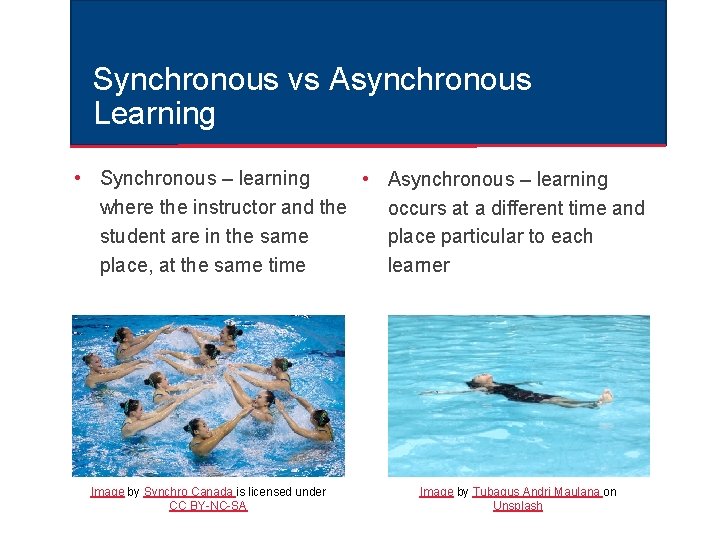
Synchronous vs Asynchronous Learning • Synchronous – learning • Asynchronous – learning where the instructor and the occurs at a different time and student are in the same place particular to each place, at the same time learner Image by Synchro Canada is licensed under CC BY-NC-SA Image by Tubagus Andri Maulana on Unsplash
Distance Education: Then & Now • Traditional Online • Prior approval to be offered online • Required training for instructors • Temporary Remote Instruction • Blanket or emergency/provisional approval • May have lessened training requirements • What this looked/looks varies at each college and in each term
To Frame Our Discussion: Finding a Common Ground • Terminology • Asynchronous – fully online • Synchronous – not covering content in LMS, required virtual meeting for entire class time • Combination of both – some content in LMS and some required virtual meeting • Qualities rather than pros and cons
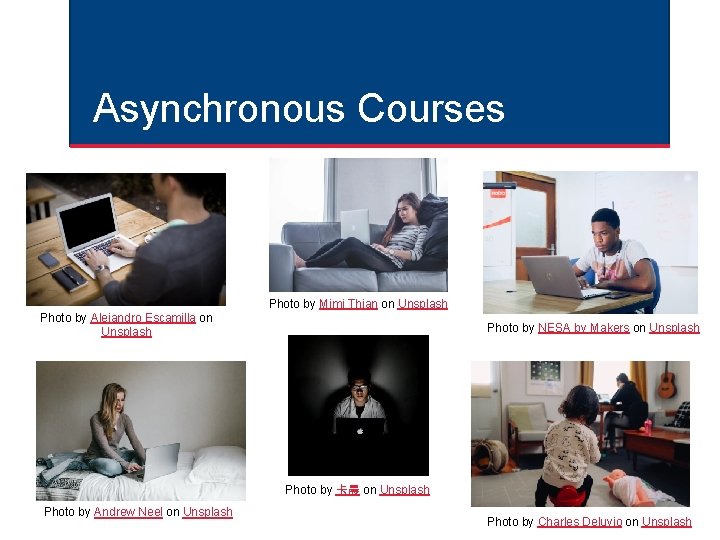
Asynchronous Courses Photo by Mimi Thian on Unsplash Photo by Alejandro Escamilla on Unsplash Photo by NESA by Makers on Unsplash Photo by 卡晨 on Unsplash Photo by Andrew Neel on Unsplash Photo by Charles Deluvio on Unsplash
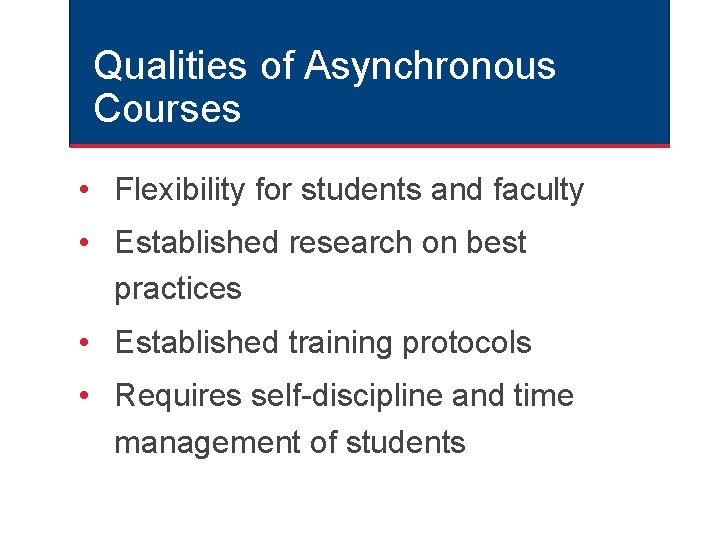
Qualities of Asynchronous Courses • Flexibility for students and faculty • Established research on best practices • Established training protocols • Requires self-discipline and time management of students
Qualities of Asynchronous Courses cont. • Good design is time-consuming, but imperative to quality • Students may struggle if unfamiliar with technology and/or expectations • Faculty must maintain regular and effective contact
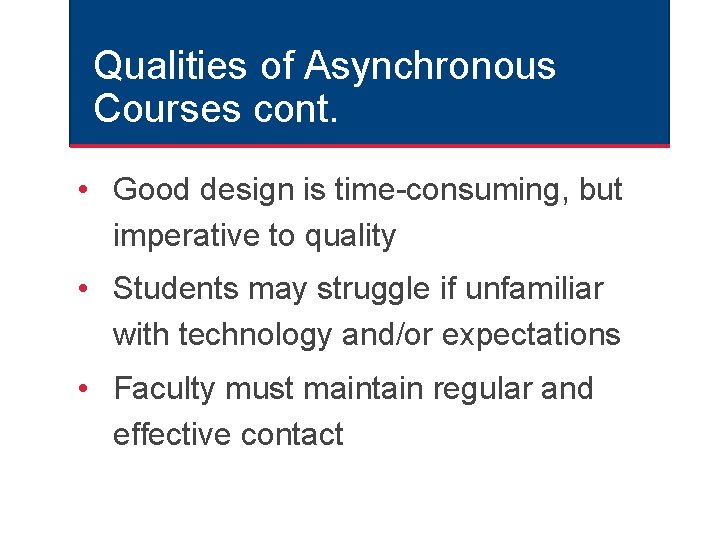
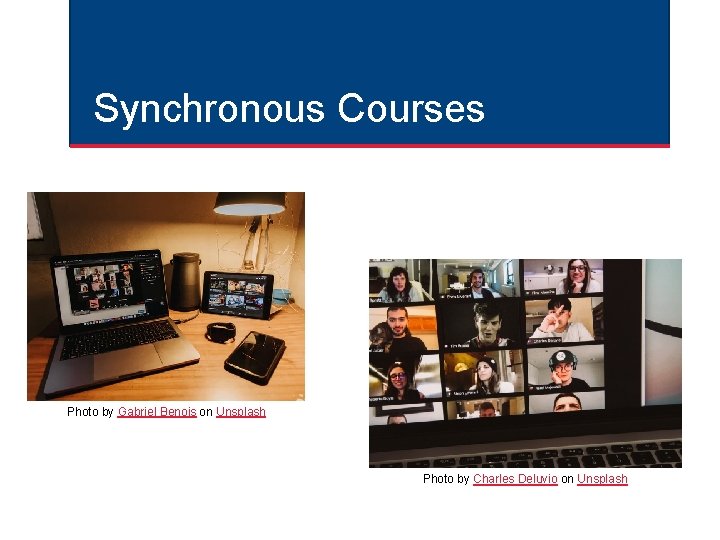
Synchronous Courses Photo by Gabriel Benois on Unsplash Photo by Charles Deluvio on Unsplash
Qualities of Synchronous Courses • Set time students and faculty must commit to • Allows for instant communication and interaction • Seeing/hearing others may feel more like face-to-face classes
Qualities of Synchronous Courses cont. • Requires faculty to develop skillset to make classes engaging • Lack of established best practices • Not addressed in most trainings for teaching online • Technology being used is often unfamiliar with students and faculty
Qualities of Synchronous Courses cont. • Requires dedicated space for camera and mic to be on • Zoom fatigue • Technical issues (access to wifi, bandwidth, etc. ) can prevent access to students and faculty
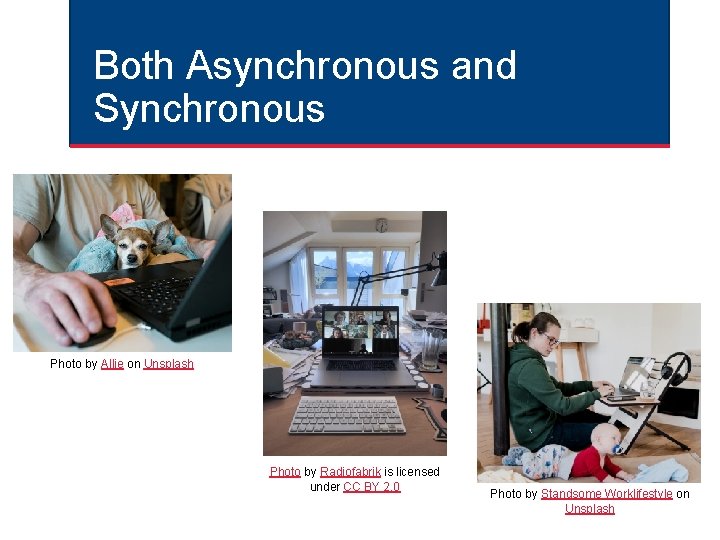
Both Asynchronous and Synchronous Photo by Allie on Unsplash Photo by Radiofabrik is licensed under CC BY 2. 0 Photo by Standsome Worklifestyle on Unsplash
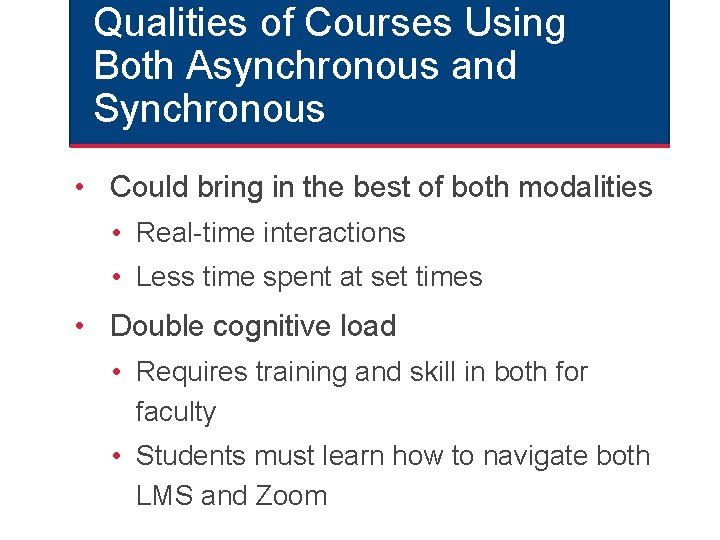
Qualities of Courses Using Both Asynchronous and Synchronous • Could bring in the best of both modalities • Real-time interactions • Less time spent at set times • Double cognitive load • Requires training and skill in both for faculty • Students must learn how to navigate both LMS and Zoom
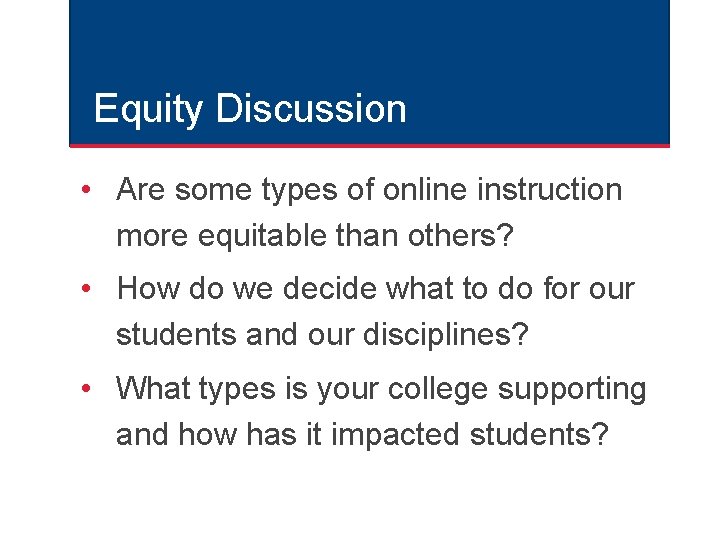
Equity Discussion • Are some types of online instruction more equitable than others? • How do we decide what to do for our students and our disciplines? • What types is your college supporting and how has it impacted students?
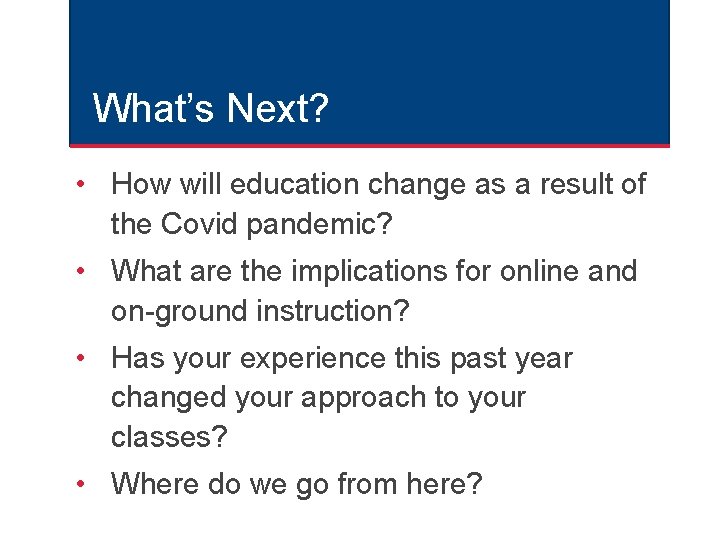
What’s Next? • How will education change as a result of the Covid pandemic? • What are the implications for online and on-ground instruction? • Has your experience this past year changed your approach to your classes? • Where do we go from here?