
Concurrent C SYNCHRONOUS VS ASYNCHRONOUS PROGRAMMING TASKS C



- Slides: 48
Concurrent C# SYNCHRONOUS VS. ASYNCHRONOUS PROGRAMMING, TASKS, C# 4. 5 FEATURES ASYNC AND AWAIT
Table of Contents (1) • Current Synchronous Programming Problems • CPU-demanding tasks • Resource access • The "Free Lunch" Is Over • Clock Speed Limitations • Asynchronous Programming • Benefits • Difficulties 2
Table of Contents (2) • Parallel Processing and Concurrency in. NET Threading • Tasks • • Data Parallelism • Using the Tasks. Parallel Class and PLINQ • Task Parallelism Task Overview • Creating and Running Tasks • Exceptions in Tasks • • Using async and await with Tasks 3
Synchronous Programming
Synchronous Programming • Executing program components sequentially • i. e. "Sequential programming" • Actions happen one after another • Uses a single thread of a single process • Components wait for previous components to finish • Program resources are accessible at all points 5
Synchronous Programming Problems • If one component blocks, entire program blocks • UI may become unresponsive • No utilization of multi-core systems • CPU demanding tasks delay execution of all other tasks • Accessing resources blocks entire program • Especially problematic with web resources 6
Synchronous Programming Problems • Resource access problems • Resources may be large While loading, UI blocks • Program stops responding • • Resources may be web-based Slow connections mean slow loading • Server may hang • • While accessing, sync programs stop all other operations 7
Resource Access Problems LIVE DEMO
Synchronous Programming Problems • CPU-demanding tasks problems • CPU-demanding problems will freeze the program • • Program stops responding Some CPU-demanding tasks are many smaller, independent tasks • Sync programming must sequentially go through them 9
CPU-demanding Tasks Problems LIVE DEMO
The "Free Lunch" Is Over RECENT LIMITATIONS IN CLOCK SPEED, TRANSISTORS AND MOORE'S LAW
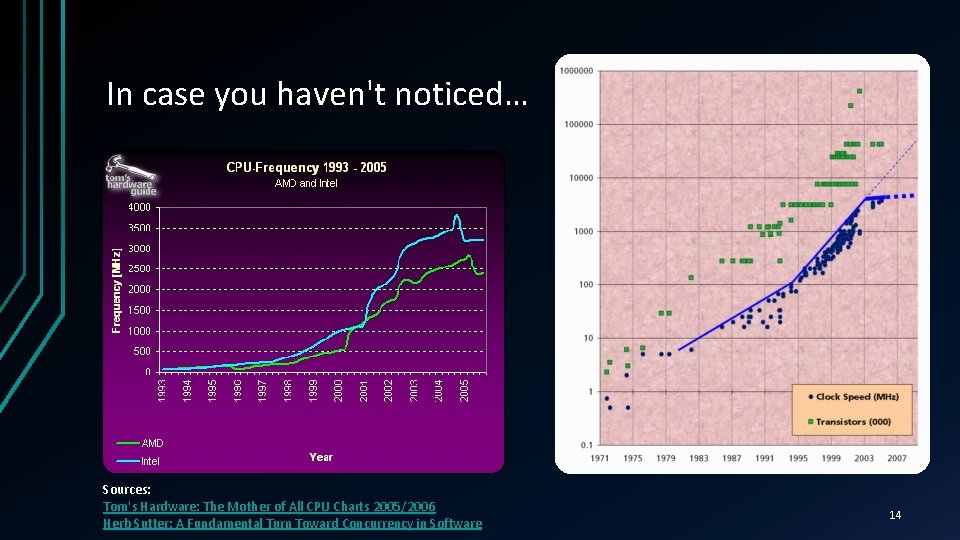
"Free Lunch" • "Tomorrow's processors will have even more throughput" • "Today's applications are increasingly throttled by factors other than CPU throughput and memory speed" • In short, computational power is expected to grow • Code is expected to run better on new hardware • So, you can write code however you like (sequentially) and better hardware will run it better? 12
13
In case you haven't noticed… Sources: Tom's Hardware: The Mother of All CPU Charts 2005/2006 Herb Sutter: A Fundamental Turn Toward Concurrency in Software 14
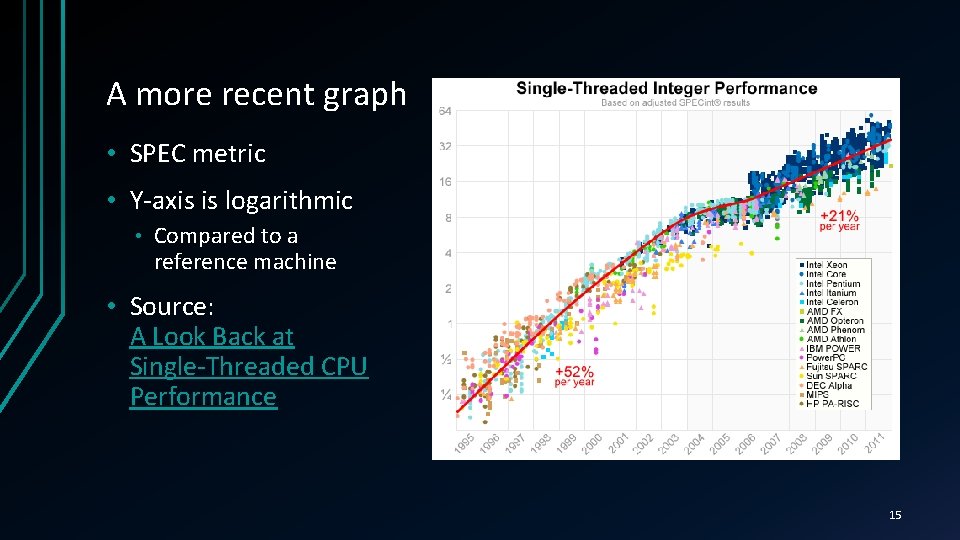
A more recent graph • SPEC metric • Y-axis is logarithmic • Compared to a reference machine • Source: A Look Back at Single-Threaded CPU Performance 15
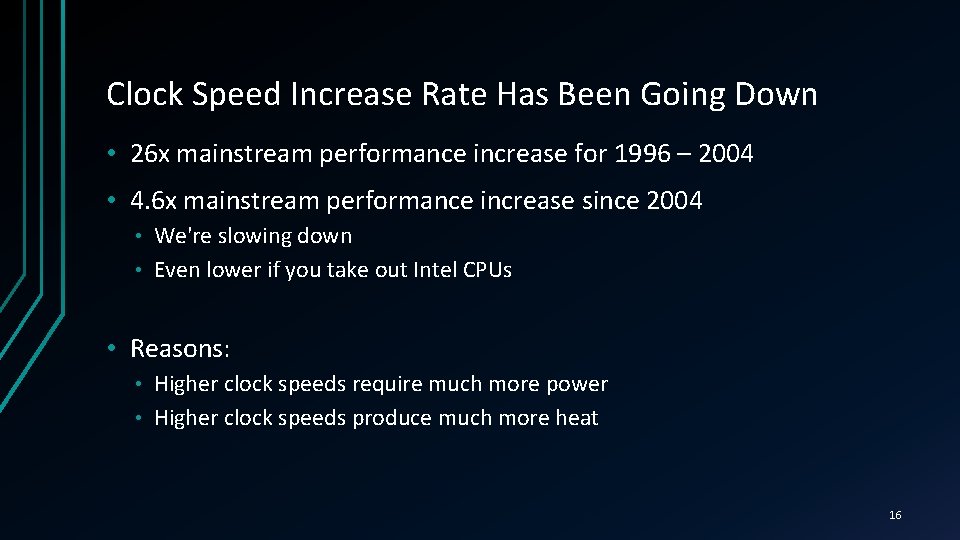
Clock Speed Increase Rate Has Been Going Down • 26 x mainstream performance increase for 1996 – 2004 • 4. 6 x mainstream performance increase since 2004 We're slowing down • Even lower if you take out Intel CPUs • • Reasons: Higher clock speeds require much more power • Higher clock speeds produce much more heat • 16
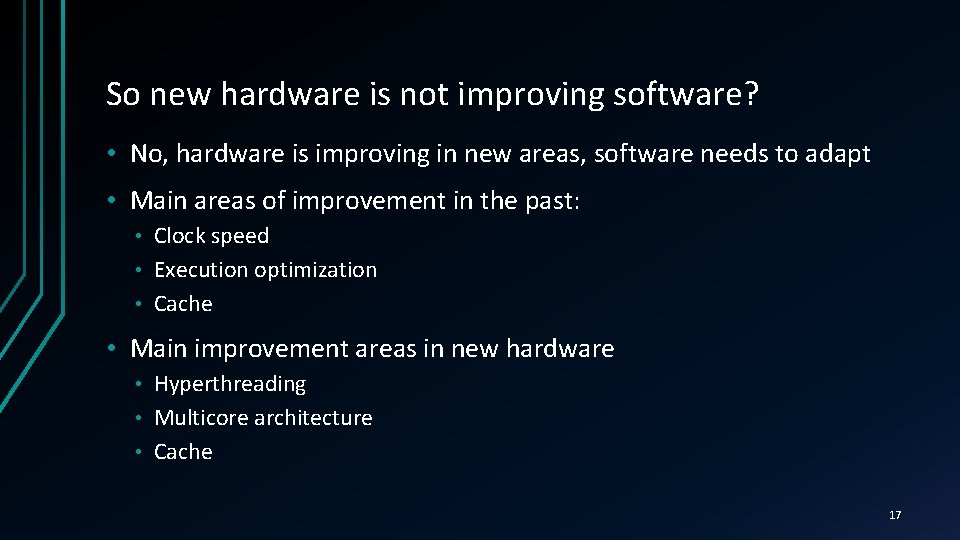
So new hardware is not improving software? • No, hardware is improving in new areas, software needs to adapt • Main areas of improvement in the past: Clock speed • Execution optimization • Cache • • Main improvement areas in new hardware Hyperthreading • Multicore architecture • Cache • 17
Asynchronous Programming UTILIZING NEW IMPROVEMENTS IN HARDWARE
Asynchronous Programming • Program components can execute in parallel • Some actions run alongside other actions • Each action happens in a separate thread • Independent components don't wait for each other • Program resources shared between threads • If one thread uses a resources, others shouldn't use it 19
Asynchronous Programming Benefits • Benefits of Async Programming If component blocks, other components still run • Until they need a resource from blocked component • UI runs separately • • • Always responsive Utilization of multi-core systems • Each core executes one or several threads CPU demanding tasks on "background" threads • Resource access runs on "background" threads • 20
Asynchronous Programming Difficulties • Hard to imagine which code parts run at specific time • Hard to notify a "component" has executed • So far, callbacks were the way • Have to protect resources One thread uses a resources • Other threads must wait for the resource • Hard to synchronize resource access • Deadlocks can occur • 21
Parallel Processing and Concurrency in. NET BROAD VIEW ON THE CONCURRENCY APIS
Parallel Processing and Concurrency in. NET • The. NET framework has introduced several concurrency approaches over the years Managed Threading • Asynchronous Programming Model (APM) • Event-based Asynchronous Pattern (EAP) • Task-based Asynchronous Pattern (TAP) • 23
Parallel Processing an Concurrency in. NET • Managed Threading provides low-level thread operations • Some features still in use, but the approach is generally too low-level • APM and EAP are high-level APIs, but are now legacy • The recommended approach is TAP • TAP also integrates with new. NET language features 24
Task-based Asynchronous Programming • Asynchronous operations are represented through Tasks • A task is "work" that will be done in the future • The API manages treads • the programmer doesn't need to worry about Thread Pools and Thread management • The framework decides how to place Tasks on threads 25
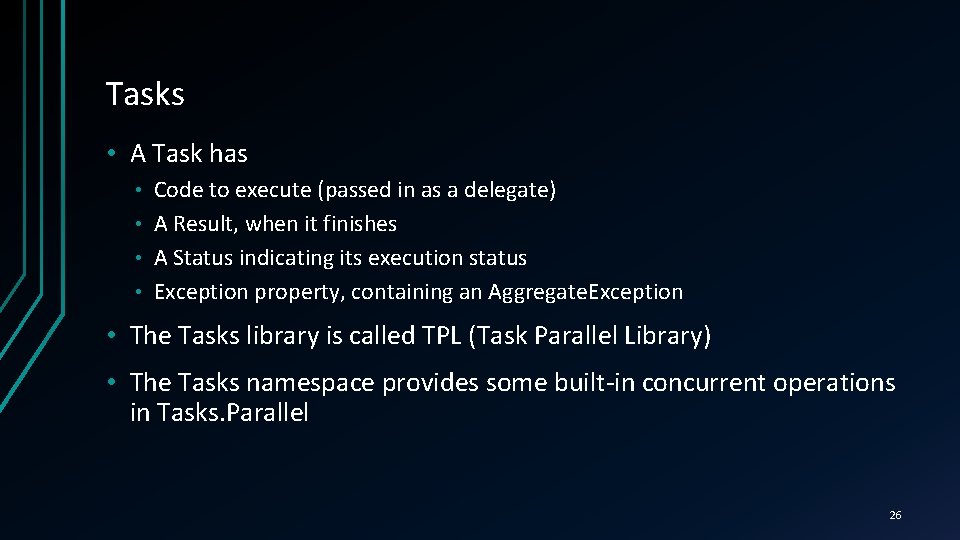
Tasks • A Task has Code to execute (passed in as a delegate) • A Result, when it finishes • A Status indicating its execution status • Exception property, containing an Aggregate. Exception • • The Tasks library is called TPL (Task Parallel Library) • The Tasks namespace provides some built-in concurrent operations in Tasks. Parallel 26
Data Parallelism USING THE BUILT-IN CONCURRENCY FROM THE TPL
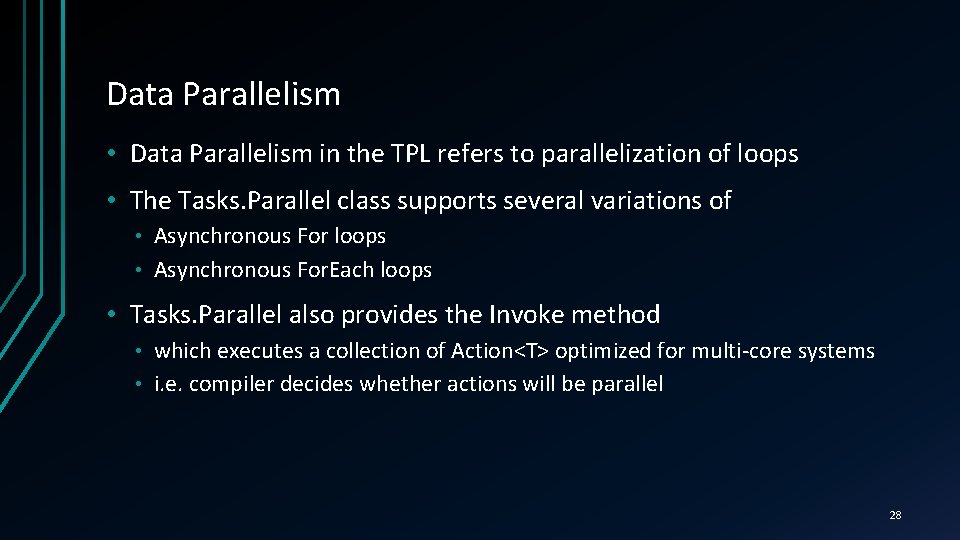
Data Parallelism • Data Parallelism in the TPL refers to parallelization of loops • The Tasks. Parallel class supports several variations of Asynchronous For loops • Asynchronous For. Each loops • • Tasks. Parallel also provides the Invoke method which executes a collection of Action<T> optimized for multi-core systems • i. e. compiler decides whether actions will be parallel • 28
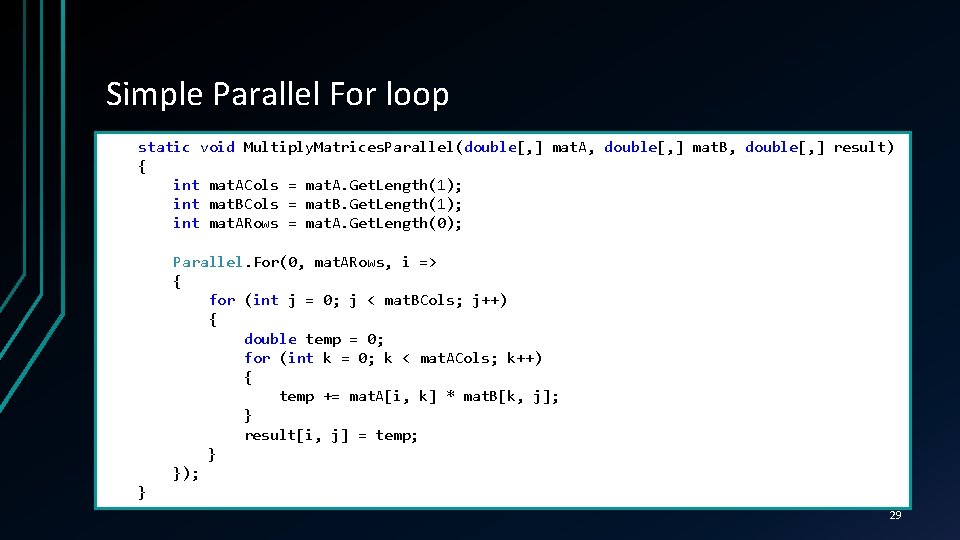
Simple Parallel For loop static void Multiply. Matrices. Parallel(double[, ] mat. A, double[, ] mat. B, double[, ] result) { int mat. ACols = mat. A. Get. Length(1); int mat. BCols = mat. B. Get. Length(1); int mat. ARows = mat. A. Get. Length(0); Parallel. For(0, mat. ARows, i => { for (int j = 0; j < mat. BCols; j++) { double temp = 0; for (int k = 0; k < mat. ACols; k++) { temp += mat. A[i, k] * mat. B[k, j]; } result[i, j] = temp; } }); } 29
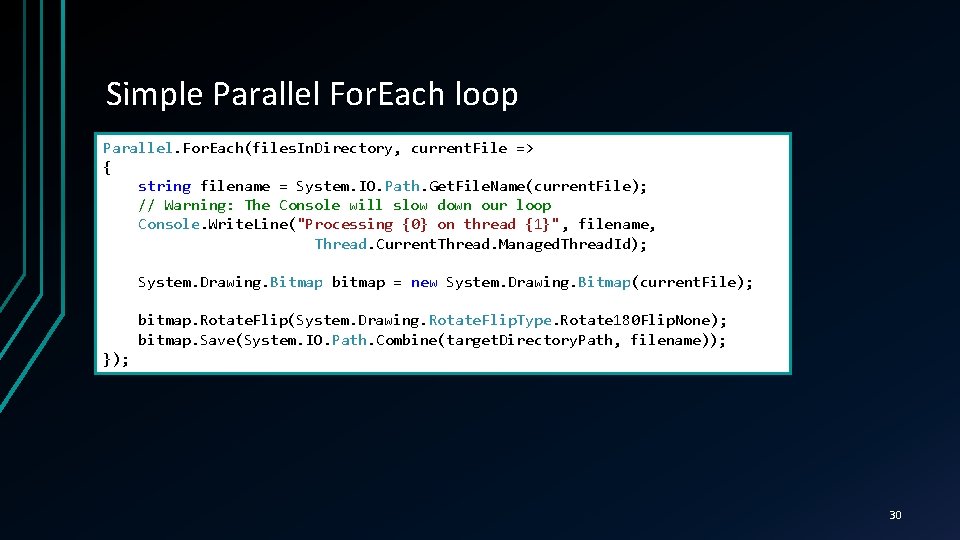
Simple Parallel For. Each loop Parallel. For. Each(files. In. Directory, current. File => { string filename = System. IO. Path. Get. File. Name(current. File); // Warning: The Console will slow down our loop Console. Write. Line("Processing {0} on thread {1}", filename, Thread. Current. Thread. Managed. Thread. Id); System. Drawing. Bitmap bitmap = new System. Drawing. Bitmap(current. File); bitmap. Rotate. Flip(System. Drawing. Rotate. Flip. Type. Rotate 180 Flip. None); bitmap. Save(System. IO. Path. Combine(target. Directory. Path, filename)); }); 30
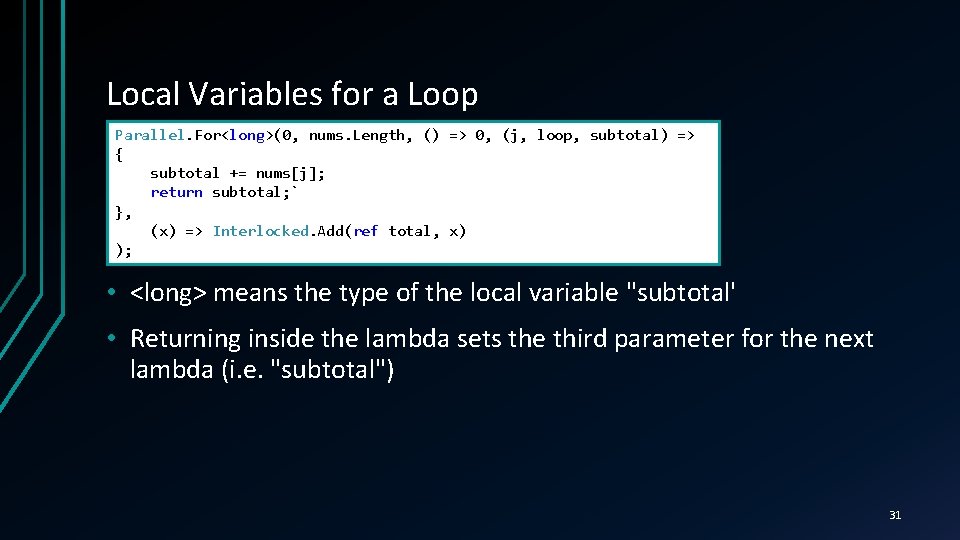
Local Variables for a Loop Parallel. For<long>(0, nums. Length, () => 0, (j, loop, subtotal) => { subtotal += nums[j]; return subtotal; ` }, (x) => Interlocked. Add(ref total, x) ); • <long> means the type of the local variable "subtotal' • Returning inside the lambda sets the third parameter for the next lambda (i. e. "subtotal") 31
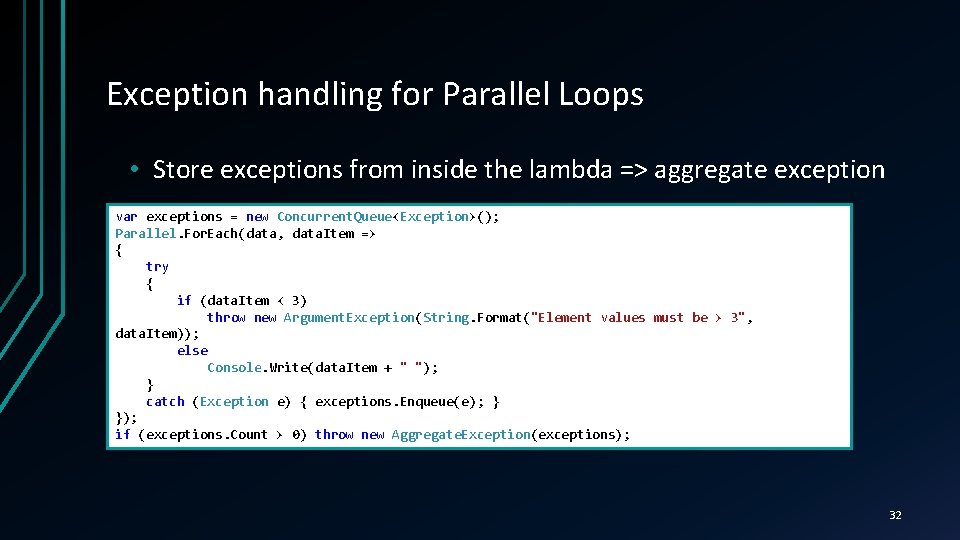
Exception handling for Parallel Loops • Store exceptions from inside the lambda => aggregate exception var exceptions = new Concurrent. Queue<Exception>(); Parallel. For. Each(data, data. Item => { try { if (data. Item < 3) throw new Argument. Exception(String. Format("Element values must be > 3", data. Item)); else Console. Write(data. Item + " "); } catch (Exception e) { exceptions. Enqueue(e); } }); if (exceptions. Count > 0) throw new Aggregate. Exception(exceptions); 32
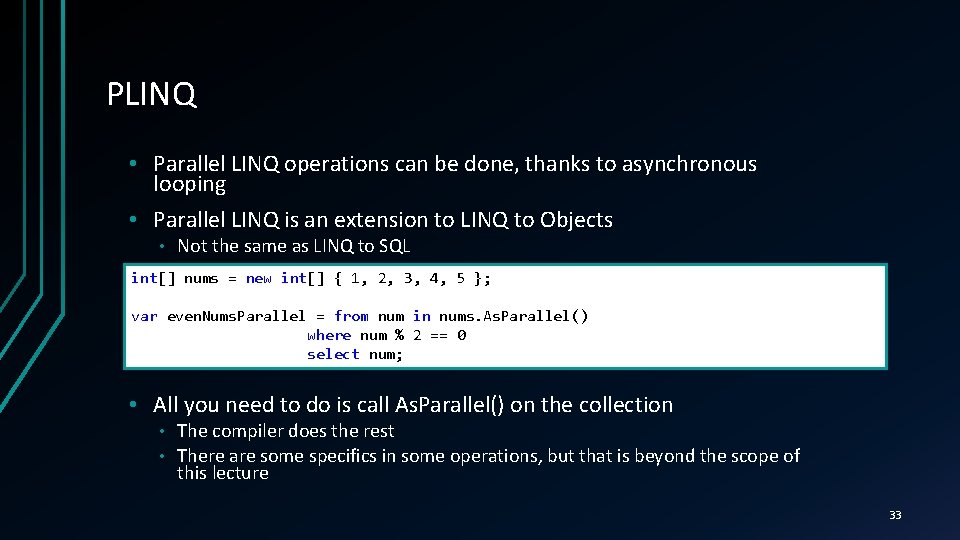
PLINQ • Parallel LINQ operations can be done, thanks to asynchronous looping • Parallel LINQ is an extension to LINQ to Objects • Not the same as LINQ to SQL int[] nums = new int[] { 1, 2, 3, 4, 5 }; var even. Nums. Parallel = from num in nums. As. Parallel() where num % 2 == 0 select num; • All you need to do is call As. Parallel() on the collection The compiler does the rest • There are some specifics in some operations, but that is beyond the scope of this lecture • 33
Task Parallelism THE. NET 4. 0 APPROACH TO PARALLEL OPERATIONS
Task Parallelism • As we mentioned, Tasks are high-level representation of work on Threads • A task does not always have its own thread (that is for the runtime to decide) • There are several fundamental Task operations Creating and Running • Continuing a task (i. e. attaching a chain of operations) • Handling Exceptions • Progress Reporting (optional) • 35
Creating and Running Tasks • Several methods to create a task Task constructor • Task. Run factory method • Tasks. Task. Factory factory class • • Various methods for task creation • Using Task constructor Task is created, callback is defined • Task is not executed – user has to call Run() method • Useful for detailed construction of the Task • 36
Creating and Running Tasks (2) • Using Task. Run() static factory method Receives a delegate to execute • Returns a new Task • The Task begins execution • Has some customization parameters, but not much • • Task. Factory approach Allows a lot of Task customization • Scheduling, Grouping tasks, etc. • 37
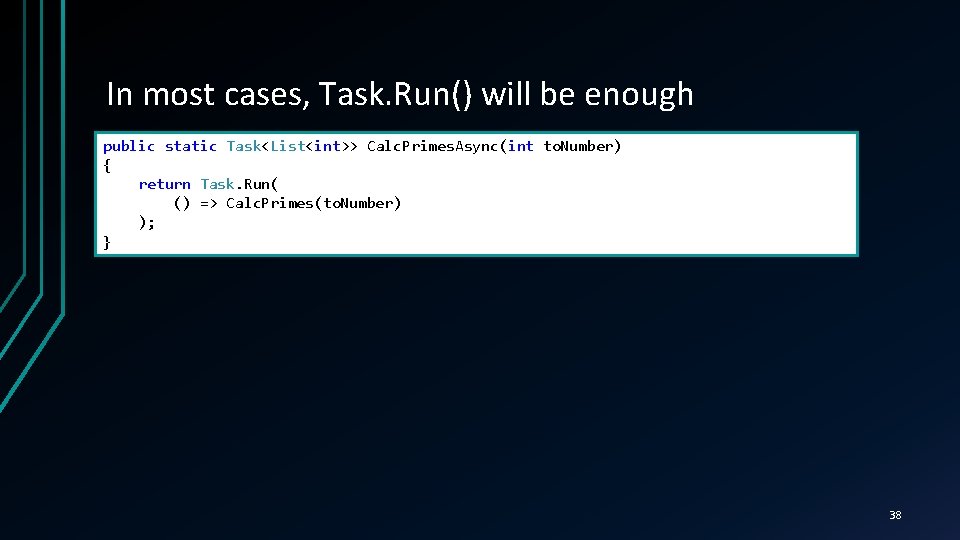
In most cases, Task. Run() will be enough public static Task<List<int>> Calc. Primes. Async(int to. Number) { return Task. Run( () => Calc. Primes(to. Number) ); } 38
Creating Tasks with Task. Run() LIVE DEMO
Task Continuation and Returning Values • One way to get a value from a Task is to check the Result property • Warning: this is a blocking operation • Another way to transfer values is to use Continue. With to call a method with the result • This does not guarantee Continue. With will execute in the same context! 40
Async Programming with C# • Problems with callbacks Code becomes hard to track • Exceptions are not propagated properly • Thread context is not saved • • i. e. a callback defined in one thread is not guaranteed to work on same thread 41
Async Programming with C# • Thread context problem example: UI thread attaches a callback to a calculation method • Callback should prints results in a List. View • Calculation method completes -> callback is run • • • But not on UI thread The callback has no access to the UI thread's resources and we get a "wrong thread" exception 42
Tasks with async & await THE C# 5 APPROACH TO ASYNCHRONOUS PROGRAMMING
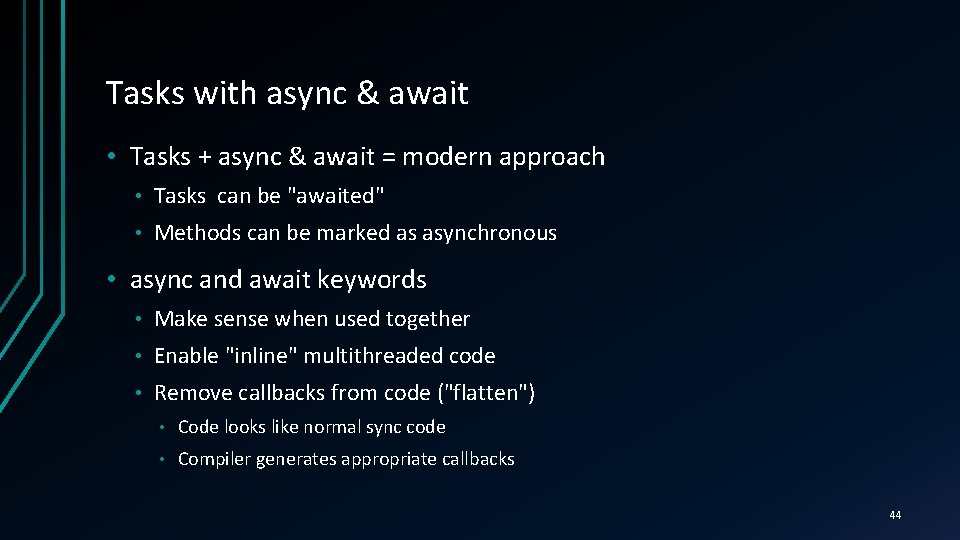
Tasks with async & await • Tasks + async & await = modern approach • Tasks can be "awaited" • Methods can be marked as asynchronous • async and await keywords • Make sense when used together • Enable "inline" multithreaded code • Remove callbacks from code ("flatten") • Code looks like normal sync code • Compiler generates appropriate callbacks 44
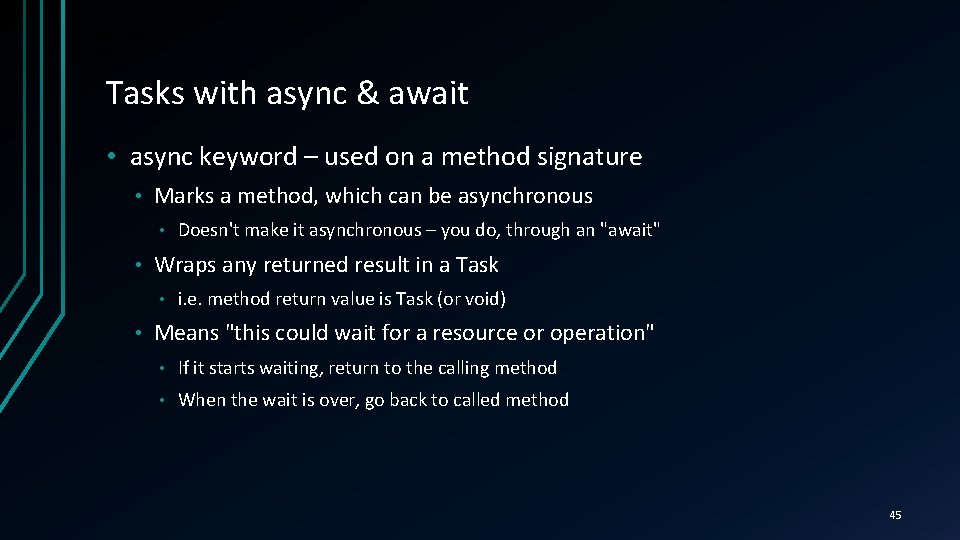
Tasks with async & await • async keyword – used on a method signature • Marks a method, which can be asynchronous • • Wraps any returned result in a Task • • Doesn't make it asynchronous – you do, through an "await" i. e. method return value is Task (or void) Means "this could wait for a resource or operation" • If it starts waiting, return to the calling method • When the wait is over, go back to called method 45
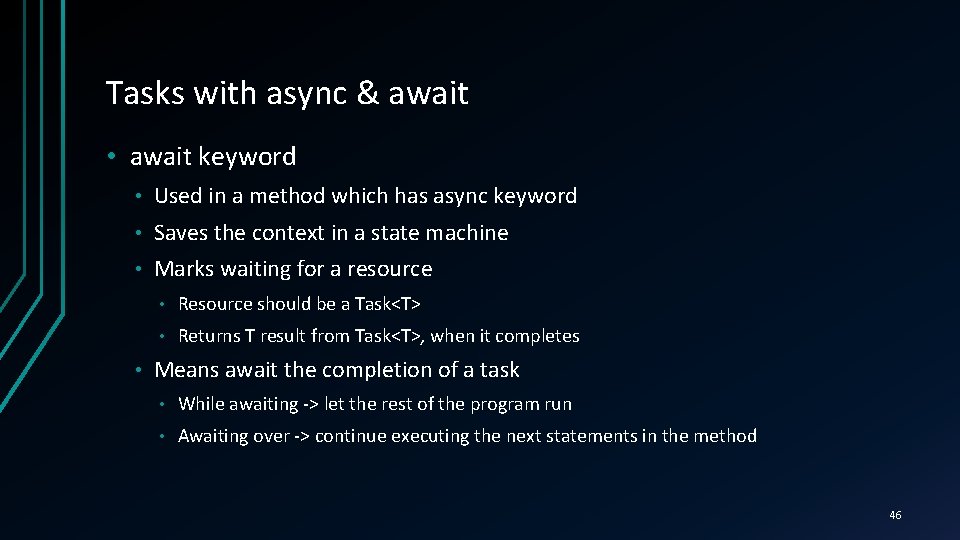
Tasks with async & await • await keyword • Used in a method which has async keyword • Saves the context in a state machine • Marks waiting for a resource • • Resource should be a Task<T> • Returns T result from Task<T>, when it completes Means await the completion of a task • While awaiting -> let the rest of the program run • Awaiting over -> continue executing the next statements in the method 46
Tasks with async & await LIVE DEMO
Questions? 48