Environmental Health II Toxicology ShuChi Chang Ph D

- Slides: 27
Environmental Health II. Toxicology Shu-Chi Chang, Ph. D. , P. E. , P. A. Assistant Professor 1 and Division Chief 2 1 Department of Environmental Engineering 2 Division of Occupational Safety and Health, Center for Environmental Protection and Occupational Safety and Health National Chung Hsing University
Outline n n Short history Toxicology n n n n n Source of information Pathways of exposure and excretion Conventional tests Multiple chemical sensitivity Endpoints of toxicological evaluations Molecular toxicology Exploration of animal data Establishing exposure limit Applying toxicological data to the environment
Short history about EH n “Silent spring” by Rachel Carson in 1962 n Major effects n n n Awareness of the destruction of indiscriminate use of chemicals Environmental laws were made in 1970’s “Our Stolen Future” Are We Threatening our Fertility, Intelligence, and Survival? - by Dianne Dumanoski, et al. in 1997 n Major effects n n Awareness of the endocrine disruption caused by chemicals Inspired the research on Green Chemistry and Environmental Hormones
Toxicology n Chemical usage n n n 70, 000 in common use and adding 200~1, 000 annually Information is very limited especially when exposed to numerous different chemicals Toxicology is both a science and an art. n Data gathering and projection
Source of information n n Epidemiological studies (next session) An array of lab studies n n In the past, toxic agents on animals as complete organisms Now, exploring the responses and effects of chemicals at the molecular level.
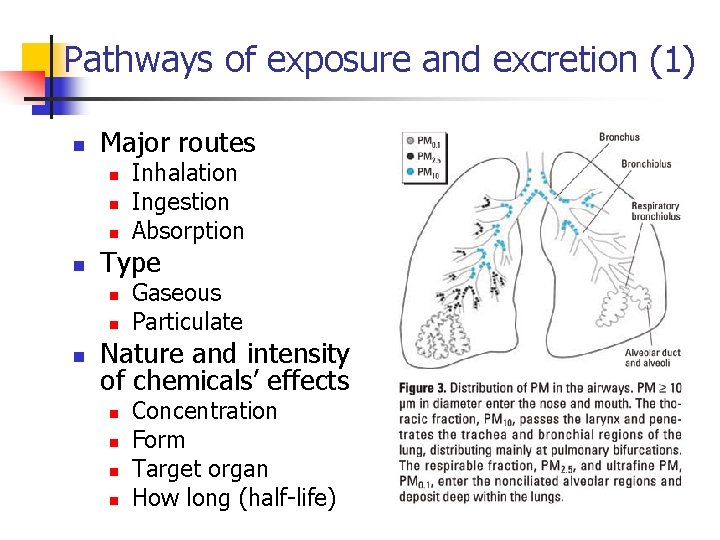
Pathways of exposure and excretion (1) n Major routes n n Type n n n Inhalation Ingestion Absorption Gaseous Particulate Nature and intensity of chemicals’ effects n n Concentration Form Target organ How long (half-life)
Pathways of exposure and excretion (2) n Absorbed chemicals n n n Biological transformation Bioactivation Principal means of excretion n n Urine Liver lungs Sweat glands (less important) Note that GI is not a major route
Pathways of exposure and excretion (3) n Effects n n n Reversible and irreversible Could be acute or delayed: carcinogenesis Allergic reactions Other factors: species and strains, age, sex, and nutritional and hormone status. Physical factors: temperature, humidity, light cycles Social factors
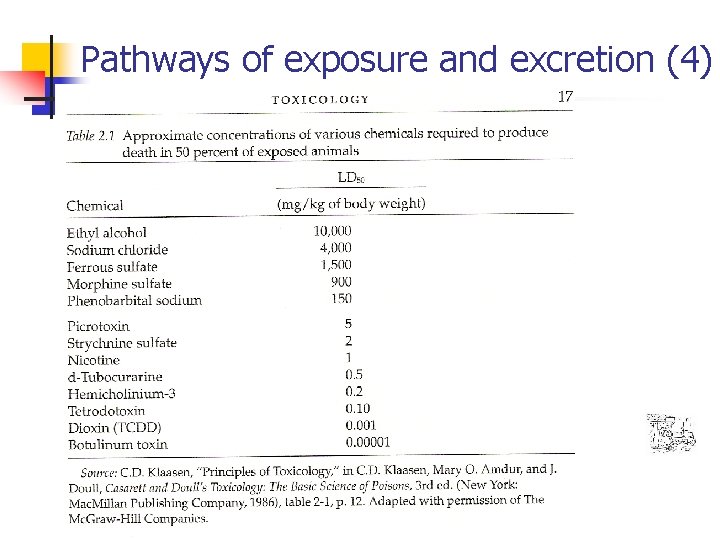
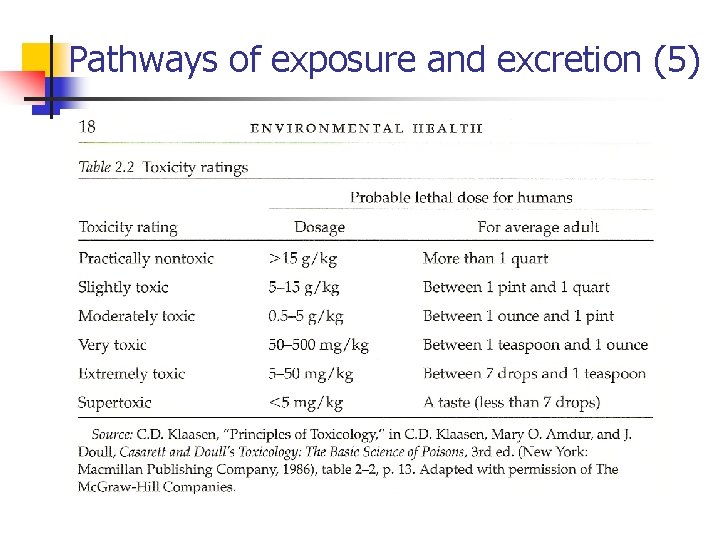
Pathways of exposure and excretion (4)
Pathways of exposure and excretion (5)
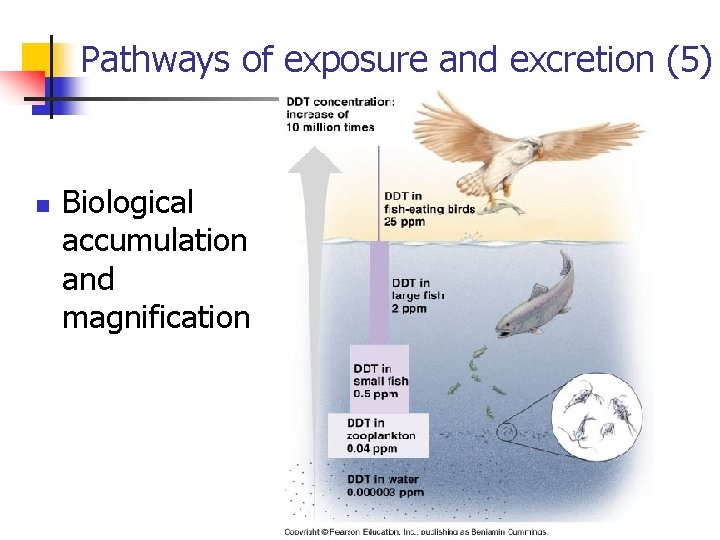
Pathways of exposure and excretion (5) n Biological accumulation and magnification
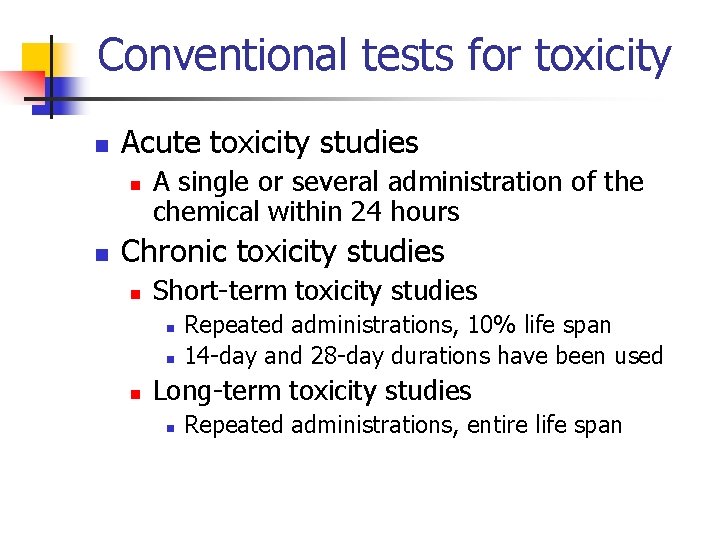
Conventional tests for toxicity n Acute toxicity studies n n A single or several administration of the chemical within 24 hours Chronic toxicity studies n Short-term toxicity studies n n n Repeated administrations, 10% life span 14 -day and 28 -day durations have been used Long-term toxicity studies n Repeated administrations, entire life span
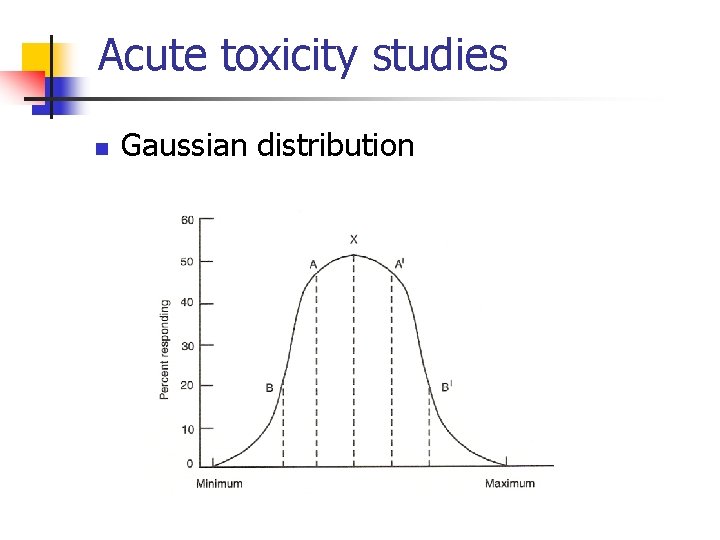
Acute toxicity studies n Gaussian distribution
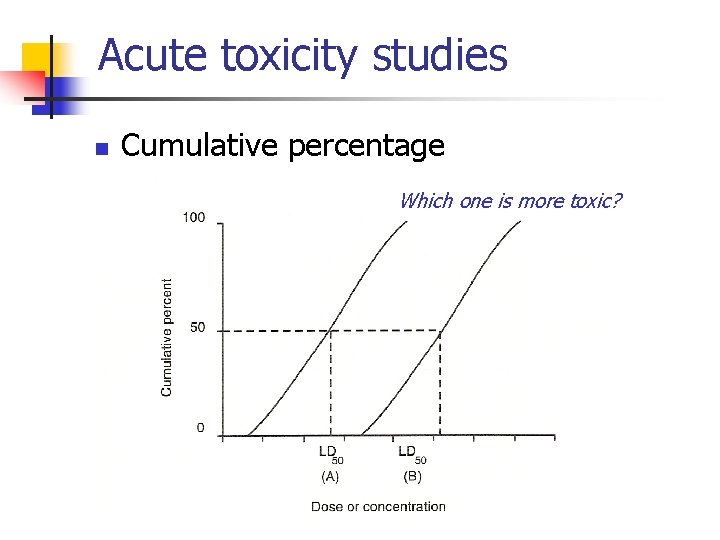
Acute toxicity studies n Cumulative percentage Which one is more toxic?
Acute toxicity studies n n LD 50: Lethal dose for half of the exposed population within a certain period of time. Synergistic and antagonistic effects
Short-term and long-term tests n Short-term n n n For more realistic situation Usually two or more species Most often rats and dogs Three levels of doses Long-term n n “Acceptable intake”, “ no observed adverse effect level” Body weight, body size, food consumption Lab tests: hematological tests Postmortem examination: histological examinations, may measure the size of different organs.
Outcomes n Typical n n n Target organs Effects Dose-effect and dose-response relationships Maximum tolerated dose Some may not be observed n n n Reproduction Disease Decreased longevity
Multiple chemical sensitivity n n Trace concentrations of a combination of chemicals Difficult to confirm n n Observations in the past n n No observable adverse effect One or only a few target organs No difference in the nature of response Now for multiple chemical sensitivity n n Symptoms are usually subjective Exposure levels are orders of magnitude lower Symptoms appeared to have no relationship to known effects No apparent safe level Multiple organ systems Individual difference in responses US Agency for Toxic Substances and Disease Registry (ATSDR) developed “Guidance Manual for the Assessment of Joint Toxic Action of Chemical Mixtures”
Endpoints of Toxicological Evaluations n Carcinogenesis n n n Reproductive toxicity Developmental toxicity n n n Embryo, fetal death, growth retardation, malformation Thalidomide case Neurotoxicity n n Initiator and promoter Activation of mutation of oncogenes or the inactivation of suppressor genes Ames test Cognitive, sensory, motor impairment Immunotoxicity n n Suppress the immune function: AIDS Chemical AIDS
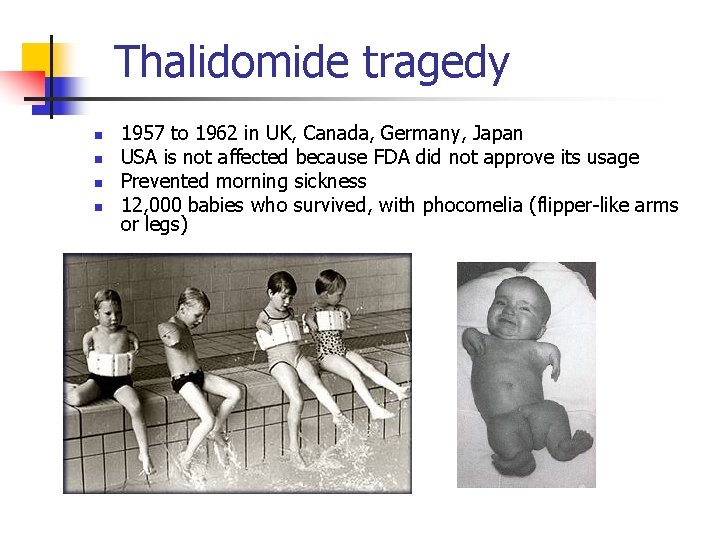
Thalidomide tragedy n n 1957 to 1962 in UK, Canada, Germany, Japan USA is not affected because FDA did not approve its usage Prevented morning sickness 12, 000 babies who survived, with phocomelia (flipper-like arms or legs)
Molecular toxicity n n n Need to understand the fundamental mechanisms Endpoints = Marker or indicators that signal the interaction in biological systems. Three types of markers n n Are a measure of response or dose Signal effects Are indicative of susceptibility Biomarkers enabled the use of DNA array for toxicological studies.
Extrapolation of animal data n Two kinds n n n Extrapolation from small animals to human From much higher dose within shorter time to much lower dose for long-term exposure Linear relationship (common assumption) n May not be appropriate for dioxin, thyroidtype carcinogens, nitrolotriacetic acid, etc.
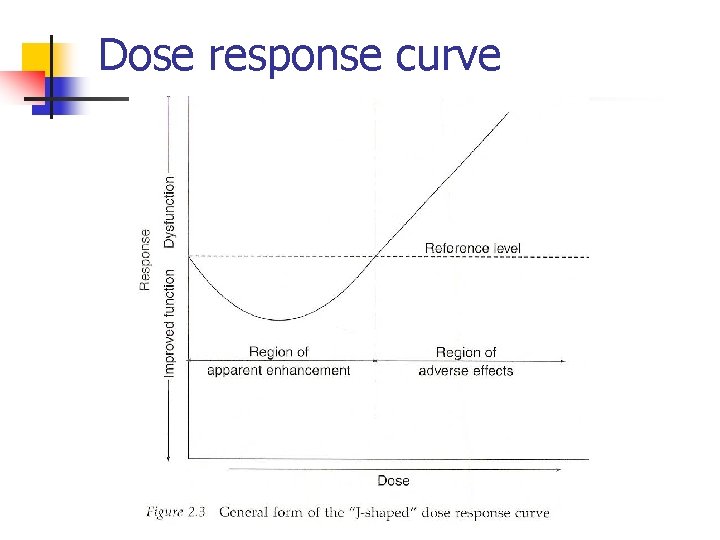
Dose response curve
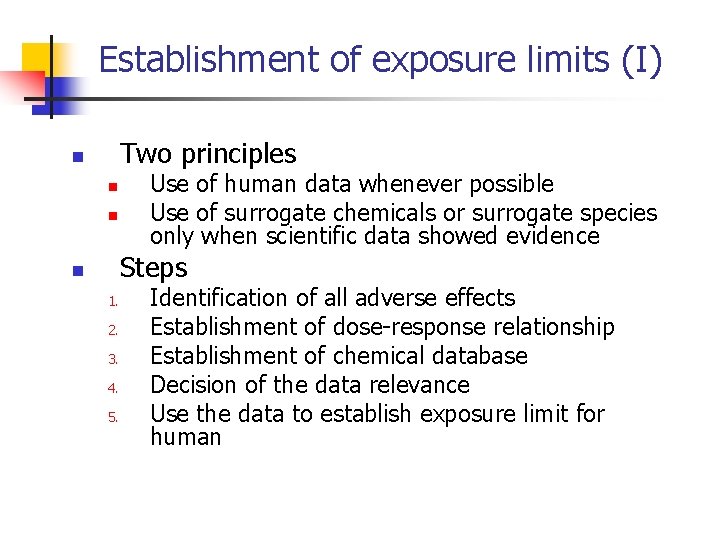
Establishment of exposure limits (I) Two principles n n n Use of human data whenever possible Use of surrogate chemicals or surrogate species only when scientific data showed evidence Steps n 1. 2. 3. 4. 5. Identification of all adverse effects Establishment of dose-response relationship Establishment of chemical database Decision of the data relevance Use the data to establish exposure limit for human
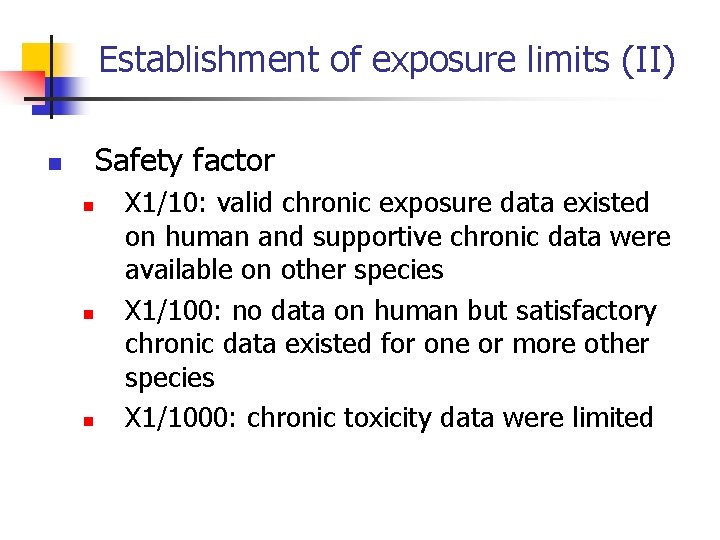
Establishment of exposure limits (II) Safety factor n n X 1/10: valid chronic exposure data existed on human and supportive chronic data were available on other species X 1/100: no data on human but satisfactory chronic data existed for one or more other species X 1/1000: chronic toxicity data were limited
Applying toxicological data to the environment n Complications n n n Different species or different groups of the same species may have different effects Some populations may occur in more than one form Synergistic and antagonistic Indirect effects may be greater that direct ones Nonlethal chemicals may have considerable ecological impact. Species other than human?
General Outlook n Most carcinogens found by epidemiological studies or by physicians n n n Cellular and molecular approaches Earthworms instead of rats and dogs Data and resources n n SARA ATSDR and USEPA n n n National Priority List Pocket guide to chemical hazards Database Carcinogenicity (<20%), epidemiology (<10%), teratogenesis (<10%) Be aware of natural toxic chemicals