English Literature Film Class Tue 3 Thu 1
- Slides: 52
English Literature & Film Class: Tue 3, Thu 1, 2(402 College of Humanities) Prof. Jeongho Kim 063 -270 -3214, 010 -3672 -2709 jhk 3214@hanmail. net http: //home. chonbuk. ac. kr/jhk 3214
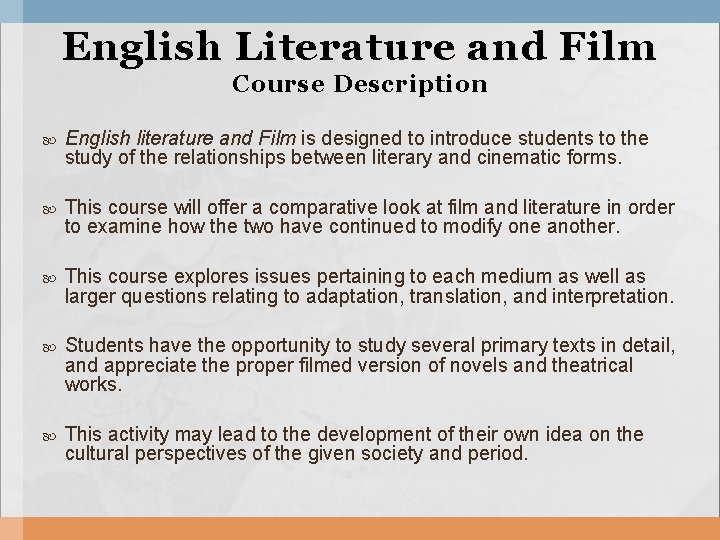
English Literature and Film Course Description English literature and Film is designed to introduce students to the study of the relationships between literary and cinematic forms. This course will offer a comparative look at film and literature in order to examine how the two have continued to modify one another. This course explores issues pertaining to each medium as well as larger questions relating to adaptation, translation, and interpretation. Students have the opportunity to study several primary texts in detail, and appreciate the proper filmed version of novels and theatrical works. This activity may lead to the development of their own idea on the cultural perspectives of the given society and period.
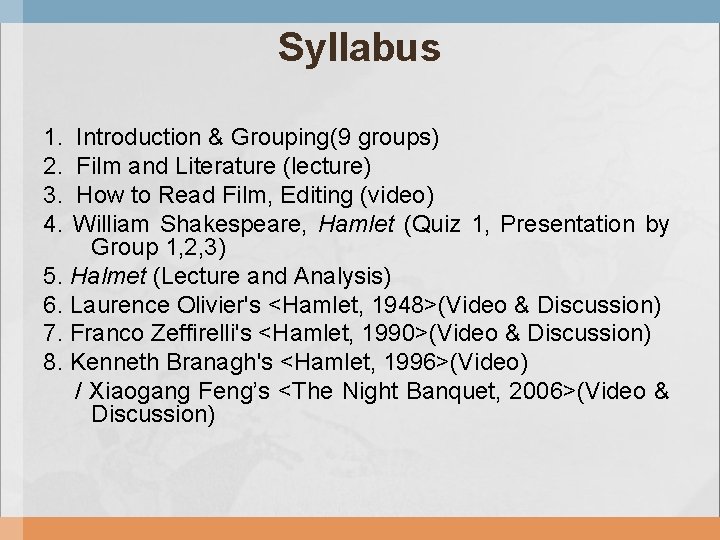
Syllabus 1. Introduction & Grouping(9 groups) 2. Film and Literature (lecture) 3. How to Read Film, Editing (video) 4. William Shakespeare, Hamlet (Quiz 1, Presentation by Group 1, 2, 3) 5. Halmet (Lecture and Analysis) 6. Laurence Olivier's <Hamlet, 1948>(Video & Discussion) 7. Franco Zeffirelli's <Hamlet, 1990>(Video & Discussion) 8. Kenneth Branagh's <Hamlet, 1996>(Video) / Xiaogang Feng’s <The Night Banquet, 2006>(Video & Discussion)
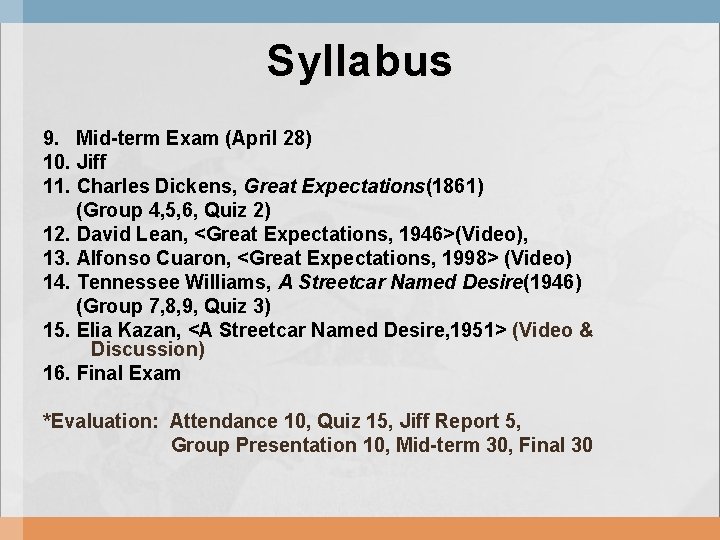
Syllabus 9. Mid-term Exam (April 28) 10. Jiff 11. Charles Dickens, Great Expectations(1861) (Group 4, 5, 6, Quiz 2) 12. David Lean, <Great Expectations, 1946>(Video), 13. Alfonso Cuaron, <Great Expectations, 1998> (Video) 14. Tennessee Williams, A Streetcar Named Desire(1946) (Group 7, 8, 9, Quiz 3) 15. Elia Kazan, <A Streetcar Named Desire, 1951> (Video & Discussion) 16. Final Exam *Evaluation: Attendance 10, Quiz 15, Jiff Report 5, Group Presentation 10, Mid-term 30, Final 30
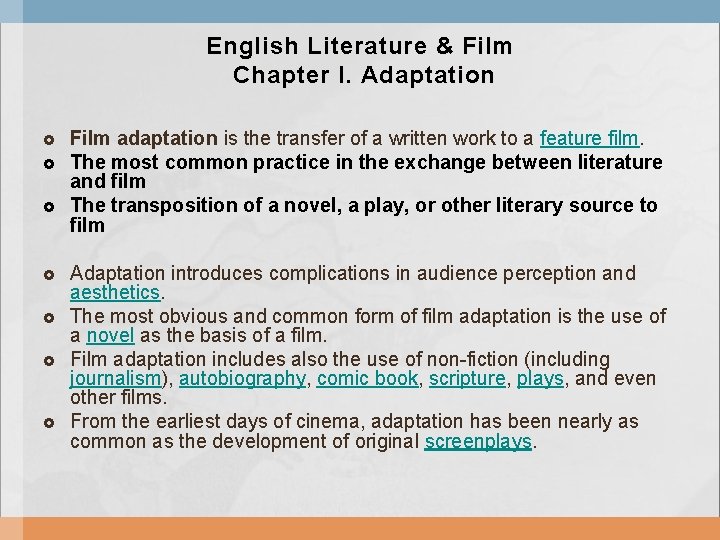
English Literature & Film Chapter I. Adaptation Film adaptation is the transfer of a written work to a feature film. The most common practice in the exchange between literature and film The transposition of a novel, a play, or other literary source to film Adaptation introduces complications in audience perception and aesthetics. The most obvious and common form of film adaptation is the use of a novel as the basis of a film. Film adaptation includes also the use of non-fiction (including journalism), autobiography, comic book, scripture, plays, and even other films. From the earliest days of cinema, adaptation has been nearly as common as the development of original screenplays.
English Literature & Film Chapter I. Adaptation Film adaptation is the transfer of a written work to a feature film. The most common practice in the exchange between literature and film The transposition of a novel, a play, or other literary source to film Adaptation introduces complications in audience perception and aesthetics. The most obvious and common form of film adaptation is the use of a novel as the basis of a film. Film adaptation includes also the use of non-fiction (including journalism), autobiography, comic book, scripture, plays, and even other films. From the earliest days of cinema, adaptation has been nearly as common as the development of original screenplays.
English Literature & Film Chapter I. Adaptation Fidelity: Five questions in determining how faithful the film adaptation is -To what extent are the details of settings and plot retained or recreated? -Do the nuance and complexity of the characters survive adaptation? -Are themes and ideas of the source communicated in the adaptation? -Does a different historical or cultural context alter the original? -Does the change in the material change the meaning of the work?
English Literature & Film Chapter I. Adaptation Elision and interpolation Elision is nearly mandatory and might be inevitable Film adaptations will also interpolate scenes or invent characters. As Sergei Eisenstein pointed out in his landmark essay on Charles Dickens, films most readily adapt novels with externalities and physical description.
English Literature & Film Chapter I. Adaptation Interpretation as adaptation Adaptation is a form of criticism and recreation, as well as translation. Change in adaptation is essential and practically unavoidable, mandated both by the constraints of time and medium, but how much is always a balance. What a film adaptation does is change to fit (literally, adapt), and the film must be accurate to either the effect (aesthetics) of a novel or theme of the novel or the message of the novel and that the film maker must introduce changes where necessary to fit the demands of time and to maximize faithfulness along one of these axes.
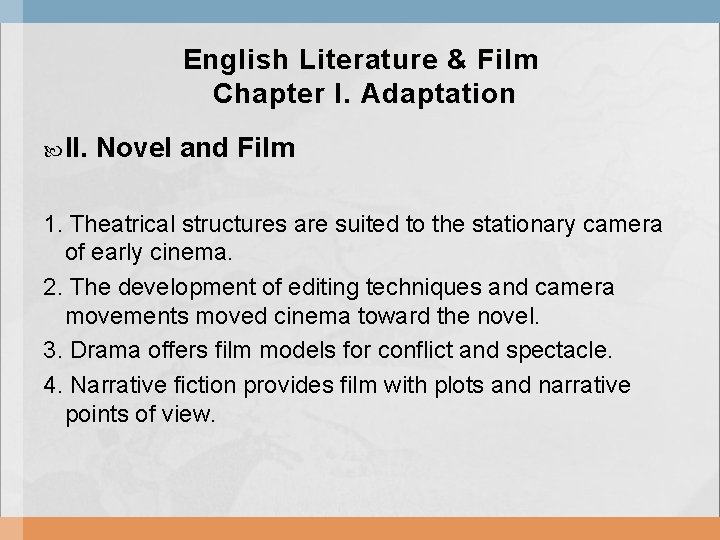
English Literature & Film Chapter I. Adaptation II. Novel and Film 1. Theatrical structures are suited to the stationary camera of early cinema. 2. The development of editing techniques and camera movements moved cinema toward the novel. 3. Drama offers film models for conflict and spectacle. 4. Narrative fiction provides film with plots and narrative points of view.
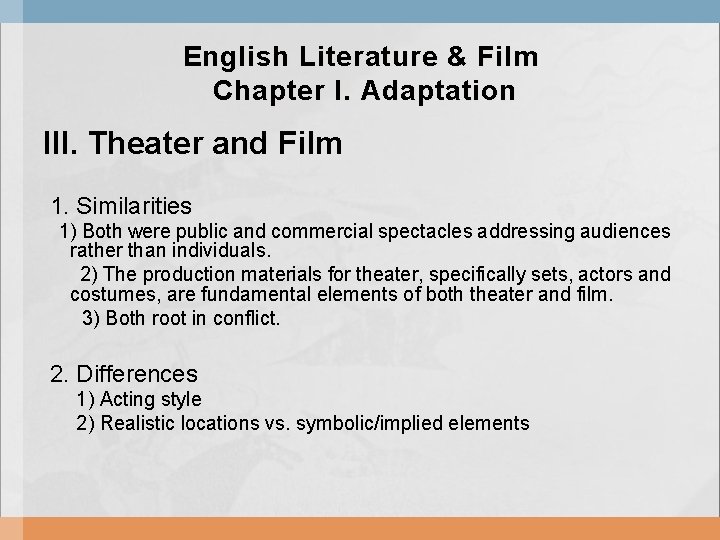
English Literature & Film Chapter I. Adaptation III. Theater and Film 1. Similarities 1) Both were public and commercial spectacles addressing audiences rather than individuals. 2) The production materials for theater, specifically sets, actors and costumes, are fundamental elements of both theater and film. 3) Both root in conflict. 2. Differences 1) Acting style 2) Realistic locations vs. symbolic/implied elements
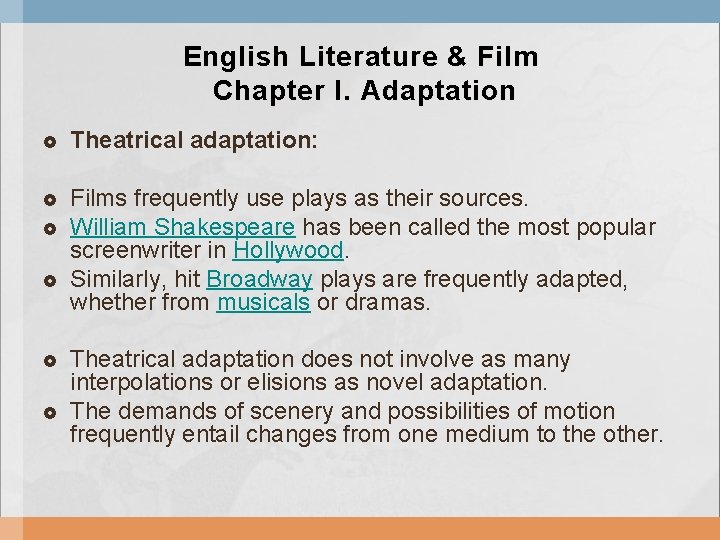
English Literature & Film Chapter I. Adaptation Theatrical adaptation: Films frequently use plays as their sources. William Shakespeare has been called the most popular screenwriter in Hollywood. Similarly, hit Broadway plays are frequently adapted, whether from musicals or dramas. Theatrical adaptation does not involve as many interpolations or elisions as novel adaptation. The demands of scenery and possibilities of motion frequently entail changes from one medium to the other.
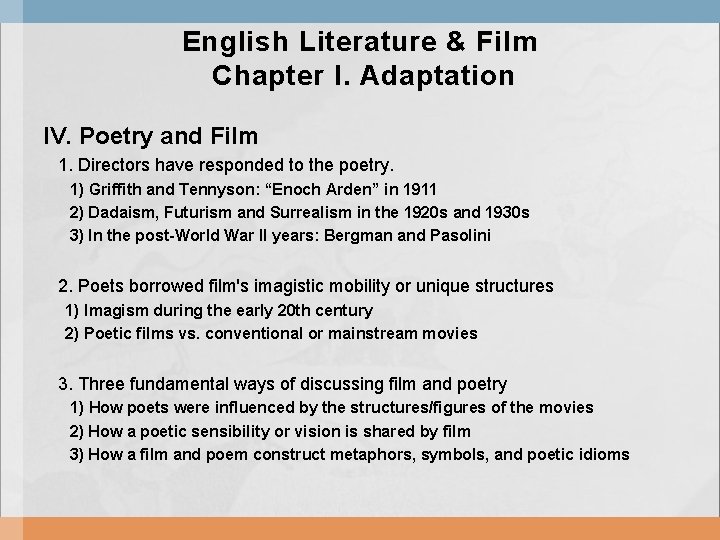
English Literature & Film Chapter I. Adaptation IV. Poetry and Film 1. Directors have responded to the poetry. 1) Griffith and Tennyson: “Enoch Arden” in 1911 2) Dadaism, Futurism and Surrealism in the 1920 s and 1930 s 3) In the post-World War II years: Bergman and Pasolini 2. Poets borrowed film's imagistic mobility or unique structures 1) Imagism during the early 20 th century 2) Poetic films vs. conventional or mainstream movies 3. Three fundamental ways of discussing film and poetry 1) How poets were influenced by the structures/figures of the movies 2) How a poetic sensibility or vision is shared by film 3) How a film and poem construct metaphors, symbols, and poetic idioms
English Literature & Film Chapter I. Adaptation VII. Adaptations from other sources: Documentary films Many films have been made from epic poetry. Homer's works have been adapted multiple times in several nations. Greek mythology and the Bible have been adapted frequently. Reverse adaptation: Popular films have been adapted into both novels and plays.
English Literature & Film Chapter II. How to Read Film I. Mise-en-Scene 1. Definition: “Putting into the scene“ --The aspects of film that overlap with theatre 1) What is photographed by the camera 2) 'Realistic' technique whereby meaning is conveyed through the relationship of things visible within a single shot. 3) Composition is extremely important. 4) The way people stand move in relation to each other is important. 5) Long shots and long takes are characteristic.
English Literature & Film Chapter II. How to Read Film 2. Aspects of Mise-en-scene -Setting -Costume & Make-up -Lighting -Staging (Movement & Acting) -Screen space -Screen time 3. Varieties of Mise-en-scene -Classical vs. Modern -Ordinary vs. Extraordinary
English Literature & Film Chapter II. How to Read Film II. Cinematography 1. Definition -Writing in movement -Everything that done with camera -Not what is filmed (mise-en-scene), but how is filmed 2. Aspects of cinematography -Qualities of the photographic image -Framing (Angle, Level, Height, Distance) -Camera movements (Pan, Tilt, Tracking, Crane) -Duration (Long take)
English Literature & Film Chapter II. How to Read Film Camera Techniques: Distance and Angle -Long shot: Shot which shows all or most of a fairly large subject (for example, a person) and usually much of the surroundings. -Establishing shot. Opening shot or sequence, frequently an exterior 'General View' as an Extreme Long Shot (ELS). Used to set the scene. -Medium shots. The setting can still be seen. The lower frame line passes through the chest of the actor. Medium shots are frequently used for the tight presentation of two actors (the two shot), or with dexterity three (the three shot). -Close-up. A picture which shows a fairly small part of the scene, such as a character's face, in great detail so that it fills the screen. It abstracts the subject from a context.
English Literature & Film Chapter II. How to Read Film Angle of shot: -The direction and height from which the camera takes the scene. -The convention is that subjects should be shot from eye-level only. -In a high angle the camera looks down at a character, making the viewer feel more powerful than him or her, or suggesting an air of detachment. -A low angle shot places camera below the character, exaggerating his or her importance. Point-of-view shot (POV). A shot made from a camera position close to the line of sight of a performer who is to be watching the action shown in the point-of-view shot.
English Literature & Film Chapter II. How to Read Film Camera Techniques: Movement Zoom. The subject is magnified, and attention is concentrated on details previously invisible as the shot tightens (contrast tracking). It may be used to surprise the viewer. Surveying pan. The camera slowly searches the scene: may build to a climax or anticlimax. Tilt. A vertical movement of the camera - up or down- while the camera mounting stays fixed. Crab. The camera moves (crabs) right or left.
English Literature & Film Chapter II. How to Read Film Tracking (dollying). Tracking involves the camera itself being moved smoothly towards or away from the subject (contrast with zooming). Tracking in (like zooming) draws the viewer into a closer, more intense relationship with the subject; moving away tends to create emotional distance. Tracking back tends to divert attention to the edges of the screen. The speed of tracking may affect the viewer's mood. Rapid tracking (especially tracking in) is exciting; tracking back relaxes interest. Hand-held camera. A hand-held camera can produce a jerky, bouncy, unsteady image which may create a sense of immediacy or chaos. Its use is a form of subjective treatment.
English Literature & Film Chapter II. How to Read Film Manipulating Time Screen time: a period of time represented by events within a film (e. g. a day, a week). Subjective time: The time experienced or felt by a character in a film, as revealed through camera movement and editing (e. g. when a frightened person's flight from danger is prolonged). Compressed time: The compression of time between sequences or scenes, and within scenes. This is the most frequent manipulation of time in films: it is achieved with cuts or dissolves. Long take: A single shot (or take, or run of the camera) which lasts for a relatively lengthy period of time. The long take has an 'authentic' feel since it is not inherently dramatic.
English Literature & Film Chapter II. How to Read Film Simultaneous time: Events in different places can be presented as occurring at the same moment, by parallel editing or cross-cutting, by multiple images or splitscreen. Slow motion: Action which takes place on the screen at a slower rate than the rate at which the action took place before the camera. a) to make a fast action visible b) to make a familiar action strange c) to emphasize a dramatic moment
English Literature & Film Chapter II. How to Read Film Accelerated motion: a) to make a slow action visible b) to make a familiar action funny c) to increase thrill of speed. . Flashback: A break in the chronology of a narrative in which events from the past are disclosed to the viewer. Flashforward: Much less common than the flashback. Not normally associated with a particular character. Associated with objective treatments.
English Literature & Film Chapter II. How to Read Film Extended or expanded time/overlapping action. -The expansion of time can be accomplished by intercutting a series of shots, or by filming the action from different angles and editing them together. -Part of an action may be repeated from another viewpoint -The technique may be used unobtrusively to stretch time, perhaps to exaggerate, for dramatic effect, the time taken to walk down a corridor.
English Literature & Film Chapter II. How to Read Film Use of Sound Commentary/voice-over narration. -To introduce particular parts of a program; -to add extra information not evident from the picture; -to interpret the images for the audience from a particular point of view; -to link parts of a sequence or program together.
English Literature & Film Chapter II. How to Read Film Sound effects Music helps to establish a sense of the pace of the accompanying scene. The rhythm of music usually dictates the rhythm of the cuts. Background music is asynchronous music which accompanies a film. It is not normally intended to be noticeable. Foreground music is often synchronous music which finds its source within the screen events (e. g. from a radio, TV, stereo or musicians in the scene). Silence. The juxtaposition of an image and silence can frustrate expectations, provoke odd, self-conscious responses, intensify our attention, make us apprehensive, or make us feel dissociated from reality.
English Literature & Film Chapter II. How to Read Film III. Editing Definition: -The relation of shot to shot -Putting together individual pieces of film to create a larger structure Techniques: Cut. Sudden change of shot from one viewpoint or location to another. On television cuts occur on average about every 7 or 8 seconds. Cutting may: -change the scene; -compress time; -vary the point of view; or -build up an image or idea.
English Literature & Film Chapter II. How to Read Film Jump cut. Abrupt switch from one scene to another which may be used deliberately to make a dramatic point. Sometimes boldly used to begin or end action. Alternatively, it may be result of poor pictorial continuity, perhaps from deleting a section. Motivated cut. Cut made just at the point where what has occurred makes the viewer immediately want to see something which is not currently visible (causing us, for instance, to accept compression of time). A typical feature is the shot/reverse shot technique (cuts coinciding with changes of speaker).
English Literature & Film Chapter II. How to Read Film Cutting rate. Frequent cuts may be used as deliberate interruptions to shock, surprise or emphasize. Cutting rhythm. A cutting rhythm may be progressively shortened to increase tension. Cutting rhythm may create an exciting, lyrical or staccato effect in the viewer. Cutaway/cutaway shot (CA). A bridging, intercut shot between two shots of the same subject. It represents a secondary activity occurring at the same time as the main action.
English Literature & Film Chapter II. How to Read Film Fade, dissolve (mix). -Both fades and dissolves are gradual transitions between shots. In a fade the picture gradually appears from (fades in) or disappears to (fades out) a blank screen. -A dissolve (or mix) involves fading out one picture while fading up another on top of it. The impression is of an image merging into and then becoming another. A slow mix usually suggests differences in time and place. Superimpositions. Two of more images placed directly over each other (e. g. and eye and a camera lens to create a visual metaphor).
English Literature & Film Chapter II. How to Read Film Wipe. An optical effect marking a transition between two shots. It appears to supplant an image by wiping it off the screen Inset. An inset is a special visual effect whereby a reduced shot is superimposed on the main shot. Often used to reveal a close-up detail of the main shot. Split screen. The division of the screen into parts which can show the viewer several images at the same time (sometimes the same action from slightly different perspectives, sometimes similar actions at different times). This can convey the excitement and frenzy of certain activities, but it can also overload the viewer.
English Literature & Film Chapter II. How to Read Film Narrative style Subjective treatment. the camera is addressed directly or when it imitates the viewpoint or movement of a character. We may be shown not only what a character sees, but how he or she sees it. A temporary 'first-person' use of camera as the character can be effective in conveying unusual states of mind or powerful experiences, such as dreaming, remembering, or moving very fast. Moving the camera (or zooming) is a subjective camera effect, especially if the movement is not gradual or smooth. Objective treatment. The 'objective point of view' involves treating the viewer as an observer. A major example is the 'privileged point of view' which involves watching from omniscient vantage points.
English Literature & Film Chapter II. How to Read Film Parallel development/parallel editing/crosscutting. -An intercut sequence of shots in which the camera shifts back and forth between one scene and another. -Two distinct but related events seem to be happening at approximately the same time. A chase is a good example. -Each scene serves as a cutaway for the other and adds tension and excitement to dramatic action.
English Literature & Film Chapter II. How to Read Film Invisible Editing This is the omniscient style of the realist feature films developed in Hollywood. The 'seamlessness' convinces us of its 'realism‘. Its devices include: the use of matched cuts (rather than jump cuts); motivated cuts; changes of shot through camera movement; long takes; the use of the sound bridge; parallel development.
English Literature & Film Chapter III. The Author/Auteur Theory 1. Principles of Auteurism 1) Directors as authors of their films 2) Dimension of the auteurial signature -Semantic: meanings, themes -Formal: style, mise-en-scene 2. Limitations of theory 1) Film as a collaborative art 2) Nature of studio system in classic era, and of Hollywood production today 3) The death of the Author (Roland Barthes)/The birth of the Reader
Hamlet Topics for discussion 1. The establishing shots/scenes 2. The presentation of the ghost 3. Women characters(Gertrude, Ophelia, Wan, Qing) 4. In Olivier's film: lots of fog, odd lighting, and a heavily filtered voice. The Ghost is in full armor, as stated in the text, which makes it even harder to do much in the way of acting. -In Zeffirelli’s film: a most touching presentation of the Ghost. -Departing from the text's description of the Ghost in full armor, including helmet, Scofield is basically in pilgrim's robes. -The ghost’s face: Lines of care, of sorrow, of anguish. We see boundless regret as well as boundless love for his son; in Hamlet's eyes we see a combination of horror, sadness, and love. It is a scene of exquisite tenderness. -Right in this scene lies the key strength of the Zeffirelli film. Just as we see the love the Ghost bears for his son as well as his wayward queen, we also see that Hamlet reciprocates that love. It shows a portrait of sorrow and love that provides a legitimate impetus for the following action. -In Branagh’s film: to shoot the scenes with the Ghost as though they were from a horror movie. Branagh was trying to emphasize the political aspects of the play--most of which usually fly out the window along with Fortinbras. Camerawork: Using a low, handheld camera to track Hamlet running through the woods is right out of a horror movie.
Great Expectations Pip as a narrator and a character How are different aspects of his personality revealed by his telling of his story and by his participation in the story itself ? 1. Pip’s story—the story of the novel: -traces his development through the events of his early life -his narration, however, written years after the end of the story, is a product of his character as it exists after the events of the story. -Pip’s narration thus reveals the psychological endpoint of his development in the novel. 2. Pip’s behavior as a character -often reveals only part of the story—he treats Joe coldly, for instance—while his manner as a narrator completes that story
Great Expectations 3. Pip’s narration evokes evoke its subjects effectively: -Pip’s childhood is narrated in a much more childlike voice than his adult years 4. Pip’s narration reinforces particular aspects of his character: -we know from his actions that Pip is somewhat selfcentered but sympathetic at heart to others. -Pip’s later narration of his relationships with others tends to reflect those qualities(ex. Pip is disgusted by Magwitch and describes him solely in negative terms; as his affection for Magwitch grows, the descriptive terms he chooses to apply to the convict become much more positive. )
Great Expectations Social Class in Great Expectations -What lessons does Pip learn from his experience as a wealthy gentleman? -How is theme of social class central to the novel? 1. One way to see Pip’s development, and the development of many of the other characters in Great Expectations, is as an attempt to learn to value other human beings: Pip must learn how to value Joe and Magwitch, Estella must learn how to value Pip, and so on. 2. Throughout the novel, social class provides an arbitrary, external standard of value by which the characters (particularly Pip) judge one another.
Great Expectations 3. At first, high social class is associated with romantic qualities such as luxury and education and it is an immediately attractive standard of value for Pip. 4. After he is elevated to the status of gentleman, though, Pip begins to see social class for what it is: an unjust, capricious standard that is largely incompatible with his own morals. There is simply no reason why Bentley Drummle should be valued above Joe, and Pip senses that fact. 5. The most important lesson Pip learns in the novel—and perhaps the most important theme in Great Expectations—is that no external standard of value can replace the judgments of one’s own conscience. Characters such as Joe and Biddy know this instinctively; for Pip, it is a long, hard lesson, the learning of which makes up much of the book.
Great Expectations Guilt in the Novel -Throughout the novel, Pip is plagued by powerful feelings of guilt and shame, and everywhere he goes he tends to encounter symbols of justice—handcuffs, gallows, prisons, and courtrooms. -What is the role of guilt in the novel? -What does it mean to be “innocent”?
Great Expectations 1. At the beginning of the novel, Pip’s feelings of conscience are determined largely by his fear of what others might think. 2. He has strong feelings of guilt but an inadequate system by which to judge right and wrong; unable to determine the value of his own actions, he feels guilty even when he does the right thing. 3. He acts with compassion and sympathy when he helps the convict, but he nevertheless feels deeply guilty and imagines that the police are waiting to take him away.
Great Expectations 4. As the novel progresses, Pip comes closer to trusting his own feelings; when he helps Magwitch at the end of the novel, he feels no guilt, only love. 5. Pip’s wholehearted commitment to helping Magwitch contrasts powerfully with his childhood fear of police. 6. It shows that, though he continues to be very hard on his own shortcomings, Pip has moved closer to a reliance on his own inner conscience—which is the only way, as Joe and Biddy show, that a character can truly be “innocent. ”
Great Expectations Themes: 1. The moral theme of Great Expectations: affection, loyalty, and conscience are more important than social advancement, wealth, and class. 2. Dickens establishes theme and shows Pip learning this lesson, largely by exploring ideas of ambition and selfimprovement. 3. At heart, Pip is an idealist; whenever he can conceive of something that is better than what he already has, he immediately desires to obtain the improvement. When he sees Satis House, he longs to be a wealthy gentleman; when he thinks of his moral shortcomings, he longs to be good; when he realizes that he cannot read, he longs to learn how. 4. Pip’s desire for self-improvement is the main source of the novel’s title: because he believes in the possibility of advancement in life, he has “great expectations” about his future.
Great Expectations 4. Ambition and self-improvement take three forms in Great Expectations—moral, social, and educational. 1) Pip desires moral self-improvement. 2) Pip desires social self-improvement: In love with Estella, he longs to become a member of her social class, and he entertains fantasies of becoming a gentleman. Significantly, Pip’s life as a gentleman is no more satisfying—and certainly no more moral—than his previous life as a blacksmith’s apprentice. 3) Pip desires educational improvement. He thinks that a full education is a requirement of being a gentleman. Ultimately, through the examples of Joe, Biddy, and Magwitch, Pip learns that social and educational improvement are irrelevant to one’s real worth and that conscience and affection are to be valued above education and social standing.
Great Expectations Social Class 1. Throughout Great Expectations, Dickens explores the class system of Victorian England, ranging from the most wretched criminals (Magwitch) to the poor peasants of the marsh country (Joe and Biddy) to the middle class (Pumblechook) to the very rich (Miss Havisham). 2. The theme of social class is central to the novel’s plot and to the ultimate moral theme. 3. The class system in the novel is based on the post-Industrial Revolution model of Victorian England. -Dickens generally ignores the nobility and the hereditary aristocracy in favor of characters whose fortunes have been earned through commerce. -Even Miss Havisham’s fortune was made through the brewery that is still connected to her manor. -By connecting theme of social class to the idea of work and self-advancement, Dickens subtly reinforces the novel’s theme of ambition and self-improvement.
Great Expectations Crime, Guilt, and Innocence 1. In general, just as social class becomes a superficial standard of value that Pip must learn to look beyond in finding a better way to live his life. He gradually learns to look beyond to trust his inner conscience. 2. As Pip has learned to trust his conscience and to value Magwitch’s inner character, he has replaced an external standard of value with an internal one.
Great Expectations Motifs 1. Doubles 1)From the earliest scenes of the novel to the last, nearly every element of Great Expectations is mirrored or doubled at some other point in the book. -Two convicts on the marsh (Magwitch and Compeyson) -Two invalids (Mrs. Joe and Miss Havisham) -Two young women who interest Pip (Biddy and Estella) -Two secret benefactors(Magwitch amd Pip) -Two adults who seek to mold children after their own purposes(Magwitch and Miss Havisham) -A Well-born woman and a common man(Miss Havisham and Compeyson; Estella and Pip)
Great Expectations Symbols Satis House -Dickens creates a magnificent Gothic setting whose various elements symbolize Pip’s romantic perception of the upper class and many other themes of the book. -On her decaying body, Miss Havisham’s wedding dress becomes an ironic symbol of death and degeneration. The wedding dress and the wedding feast symbolize Miss Havisham’s past, and the stopped clocks throughout the house symbolize her determined attempt to freeze time by refusing to change anything from the way it was when she was jilted on her wedding day. -The crumbling, dilapidated stones of the house, as well as the darkness and dust that pervade it, symbolize the general decadence of the lives of its inhabitants and of the upper class as a whole.
Great Expectations The Mists The mists are used several times to symbolize danger and uncertainty. -As a child, Pip brings Magwitch a file and food in these mists; whenever Pip goes into the mists, something dangerous is likely to happen. -Significantly, Pip must go through the mists when he travels to London shortly after receiving his fortune -The reader feels that this apparently positive development in his life may have dangerous consequences.