English Composition I CoReq Module 4 Writing In





- Slides: 31
English Composition I & Co-Req Module 4: Writing In College
Learning Outcomes • • • Identify characteristics of organically structured essays Define various rhetorical styles Examine the purpose, structure, and style of an argumentative essay Describe techniques for writing comparison essays Describe techniques for highlighting cause and effect Describe techniques for illustrating a point
Writing in College
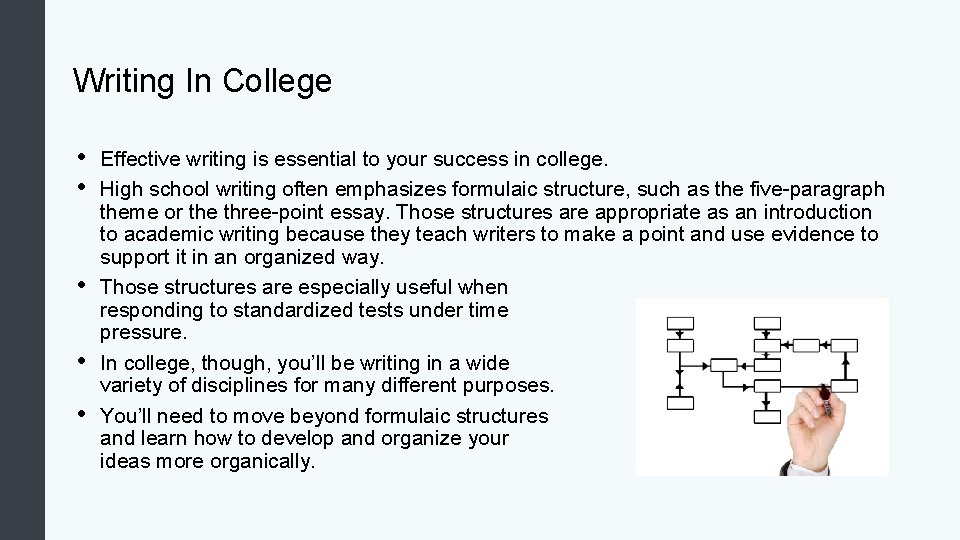
Writing In College • • • Effective writing is essential to your success in college. High school writing often emphasizes formulaic structure, such as the five-paragraph theme or the three-point essay. Those structures are appropriate as an introduction to academic writing because they teach writers to make a point and use evidence to support it in an organized way. Those structures are especially useful when responding to standardized tests under time pressure. In college, though, you’ll be writing in a wide variety of disciplines for many different purposes. You’ll need to move beyond formulaic structures and learn how to develop and organize your ideas more organically.
What to Do With Writing Assignments • • • Writing assignments can be as varied as the instructors who assign them. Some assignments are explicit about what exactly you’ll need to do, in what order, and how it will be graded. Some assignments are very open-ended, leaving you to determine the best path toward answering the project. It’s important to remember that your first resource for getting clarification about an assignment is your instructor—she or he will be very willing to talk out ideas with you, to be sure you’re prepared at each step to do well with the writing. Most writing in college will be a direct response to class materials—an assigned reading, a discussion in class, an experiment in a lab. Generally speaking, these writing tasks can be divided into three broad categories: summary assignments, defined-topic assignments, and undefined-topic assignments.
Summary Assignments Being asked to summarize a source is a common task in many types of writing. It can also seem like a straightforward task: simply restate, in shorter form, what the source says. An effective summary does the following: • reflects your accurate understanding of a source’s thesis or purpose • differentiates between major and minor ideas in a source • demonstrates your ability to identify key phrases to quote • demonstrates your ability to effectively paraphrase most of the source’s ideas • captures the tone, style, and distinguishing features of a source • does not reflect your personal opinion about the source
Defined-Topic Assignments Defined-topic writing assignments are used primarily to identify your familiarity with the subject matter. • Often, the handout or other written text explaining the assignment—what professors call the assignment prompt—will explain the purpose of the assignment, the required parameters (length, number and type of sources, referencing style, etc. ), and the criteria for evaluation. • Focus on the verbs. Look for verbs like compare, explain, justify, reflect, or the all-purpose analyze. • Put the assignment in context. Many professors think in terms of assignment sequences. • Try a free-write. A free-write is when you just write, without stopping, for a set period of time. • Ask for clarification. • Defined-topic writing assignments are used primarily to identify your familiarity with the subject matter.
Undefined Topic Where defined-topic essays demonstrate your knowledge of the content, undefinedtopic assignments are used to demonstrate your skills—your ability to perform academic research, to synthesize ideas, and to apply the various stages of the writing process. The first hurdle with this type of task is to find a focus that interests you. Don’t just pick something you feel will be “easy to write about”—that almost always turns out to be a false assumption. Instead, you’ll get the most value out of, and find it easier to work on, a topic that intrigues you personally in some way.
Organically Structured Essays • • • The five-paragraph theme has an introductory paragraph starts broadly and gradually narrows to a thesis, which readers expect to find at the very end of that paragraph. In this idealized format, thesis invokes the magic number of three: three reasons why a statement is true. Each of those reasons is explained and justified in the three body paragraphs, and then the final paragraph restates thesis before gradually getting broader. An arguable thesis gives the paper purpose. It surprises readers and draws them in. You hope your reader thinks, Huh. Why would the author come to that conclusion? and then feels compelled to read on. The body paragraphs, then, build on one another to carry out this ambitious argument. In the classic five-paragraph theme it hardly matters which of the three reasons you explain first or second. In the more organic structure, each paragraph specifically leads to the next.
Overview of Rhetorical Styles What are Rhetorical Styles? • We’ve talked earlier in the course about genres, different ways of categorizing specific types of reading. We examined the different genres of literature, textbooks, journalism, and academic writing. • Non-fiction writing can be further defined by sub-genres, sometimes referred to as the rhetorical styles, modes, or patterns, of communication. These are categories of types of writing, and they help us to anticipate the structure and purpose of the text itself.
Types of Writing There are four main types of writing: expository, persuasive, narrative, and descriptive. Expository writing is one of the most common types of writing. When an author writes in an expository style, all they are trying to do is explain a concept, imparting information from themselves to a wider audience. Expository writing does not include the author’s opinions, but focuses on accepted facts about a topic, including statistics or other evidence. Persuasive writing is the main style of writing you will use in academic papers. Narrative writing is used in almost every longer piece of writing, whether fiction or nonfiction. Descriptive writing is often found in fiction, though it can make an appearance in nonfiction as well (for example, memoirs, first-hand accounts of events, or travel guides).
Rhetorical Styles Some generally recognized rhetorical patterns include: • argumentative/persuasive: defending a certain point of view; writing that persuades • comparison (compare and contrast) • cause and effect: discusses which events lead to specific results • illustration: writing that gives examples • narration: writing that tells stories • description: a rhetorical style that uses the five senses • definition: structured around the goal of defining a term, concept, or idea; writing that tells what something means • classification and division: takes a whole and splits it up into parts and then places the divided information into various categories; writing that sorts things into groups • process: provides step-by-step directions or guidance; writing that explains how things happen
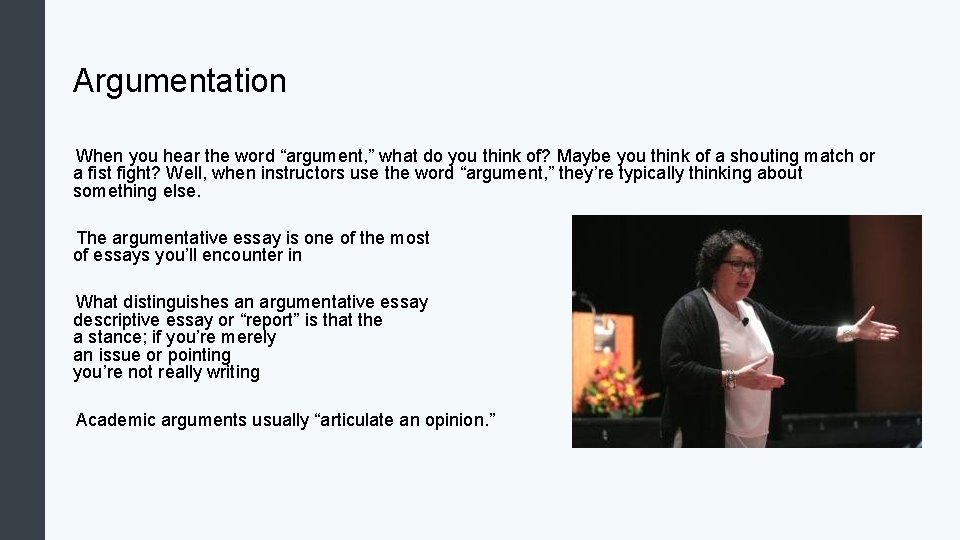
Argumentation When you hear the word “argument, ” what do you think of? Maybe you think of a shouting match or a fist fight? Well, when instructors use the word “argument, ” they’re typically thinking about something else. The argumentative essay is one of the most common types of essays you’ll encounter in college courses. What distinguishes an argumentative essay from a descriptive essay or “report” is that the argument must take a stance; if you’re merely summarizing “both sides” of an issue or pointing out the “pros and cons, ” you’re not really writing an argument. Academic arguments usually “articulate an opinion. ”
Compare and Contrast Compare and contrast is a rhetorical style that discusses the similarities and differences of two or more things: ideas, concepts, items, places, etc. This rhetorical style is one that you’ll see often as a complete essay, but you may also use it quite a lot within paragraphs of any kind of essay in which you need to make some kind of comparison to help illustrate a point. Here a few comparison and contrast techniques: • Basic Comparison • Alternating Method • Block Method • Combination Method
Cause and Effect Cause and effect is a rhetorical style that discusses which events lead to specific results. You may find that you are assigned to write a cause and effect essay for a writing class, but you might also encounter cause and effect assignments in other disciplines. There are three basic formats for writing a cause/effect essay: • Single effect with multiple causes–air pollution is the effect, and students would identify several causes. • Single cause with multiple effects–bullying is the cause, and students would establish several effects it has on children. • Causal Chain–This is a more complex format. Causal chains show a series of causes and effects.
Illustration • Illustration is a rhetorical style that uses examples to support thesis or main idea of a paragraph or essay. Illustration is most often used at the paragraph level to help illustrate or support a point, but you may also encounter illustration essays of various types in your college courses. • An illustration essay is structured around the goal of using examples to make a point in an essay. You may use various examples to support your essay, but you must make sure that your examples are relevant, strong, and properly used.
Practice Question 1 Stem A. B. C. D. Answer option
Narration
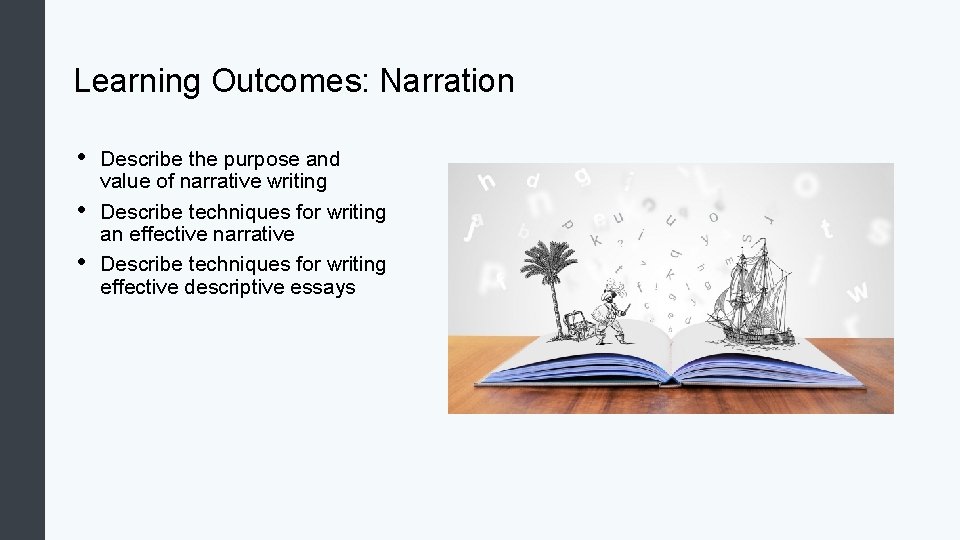
Learning Outcomes: Narration • • • Describe the purpose and value of narrative writing Describe techniques for writing an effective narrative Describe techniques for writing effective descriptive essays
Narrative Essay • Narration is a rhetorical style that basically just tells a story. Being able to convey events in a clear, descriptive, chronological order is important in many fields. Many times, in college, your professors will ask you to write paragraphs or entire essays using a narrative style. • Telling a Story • Story Sequencing • Another classic technique for narrative sequence is known as in medias res–literally, “in the middle of things. ” As you map out your plot in prewriting or experiment with during the drafting and revision process, you might find this technique a more active and exciting way to begin a story.
Narrative Essays You could think of a narrative essay as a short story. It’s called an essay, but many narrative essays are really just short stories. If you are using narration as the primary strategy in writing a paper, you will use some semblance of the following format: • Introduction • Narrative Paragraphs • Conclusion The checklist for a narrative essay: • Have a clear purpose. • Tell the story clearly and chronologically. • Make the narrative interesting. • Relate it to something larger than itself, either overtly, or covertly.
How to Write a Personal Narrative Essay You may be asked to write a personal narrative essay. To do this, you want to begin by identifying events in your life that taught you important life lessons. Here is a list of how to get started: Brainstorm to identify an event Use vivid details Use active voice/action Use passive voice Use dialogue Be consistent Use consistent verbs
Descriptive Essays Description is a rhetorical mode you’ll want in your toolbox because it places your reader in the scene you’re describing. You’ll likely relate this tool to fiction, because the best novels use description to capture our imagination. Description is equally useful in essays, especially when you are making an emotional appeal of some kind. Transporting your reader to a different place and time with sensory language can be a very convincing way to make a point. Descriptions when using abstract words or concepts are even more important than when using concrete objects.
Multimodality
Learning Outcomes: Multimodality • • Describe the five modes of communication Give examples of different modes Describe effective techniques for multi-modal writing Describe components of an effective presentation
Multimodality • The way we communicate is not simply through text or reading material, but can come in many different modes. What are the differences between a classroom lecture by your professor and his or her lecture notes? What about the differences between a group chat with your classmates and a group project meeting in the library? These situations involve considering different modes. The first step to learning how to negotiate a multimodal world is to understand what multimodality is. • A mode, quite simply, is a means of communicating. According to the New London Group, there are five modes of communication: visual, linguistic, spatial, aural, and gestural. [1]
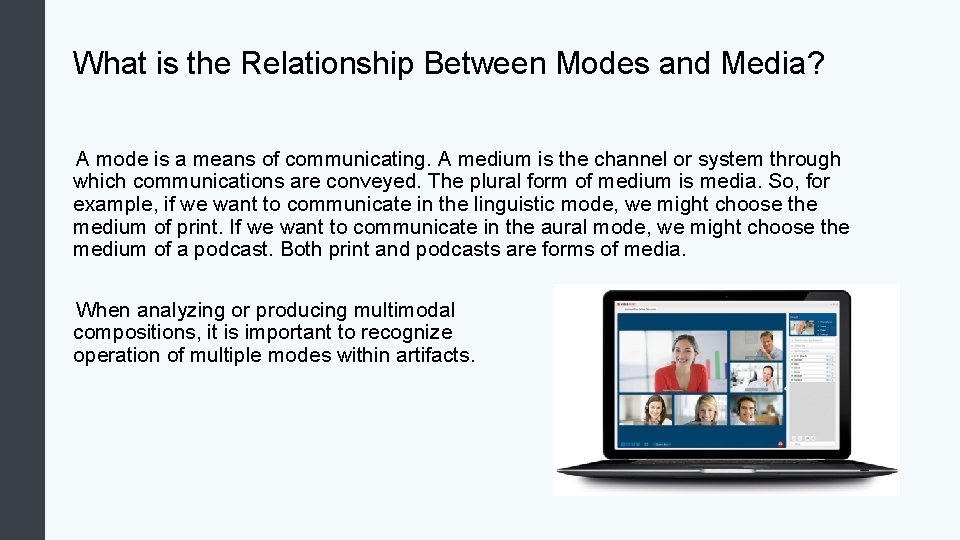
What is the Relationship Between Modes and Media? A mode is a means of communicating. A medium is the channel or system through which communications are conveyed. The plural form of medium is media. So, for example, if we want to communicate in the linguistic mode, we might choose the medium of print. If we want to communicate in the aural mode, we might choose the medium of a podcast. Both print and podcasts are forms of media. When analyzing or producing multimodal compositions, it is important to recognize the operation of multiple modes within artifacts.
The Fives Modes Visual • The visual mode refers to the images and characters that people see. Aural • The aural mode is focused on sound including, but not limited to, music, sound effects, ambient noises, silence, tone of voice in spoken language, volume of sound, emphasis, and accent. Gestural • The gestural mode “refers to the way movement is interpreted. Linguistic (or Alphabetic) • The linguistic mode refers to written or spoken words. Spatial • The spatial mode, as the name implies, refers to the arrangement of elements in space.
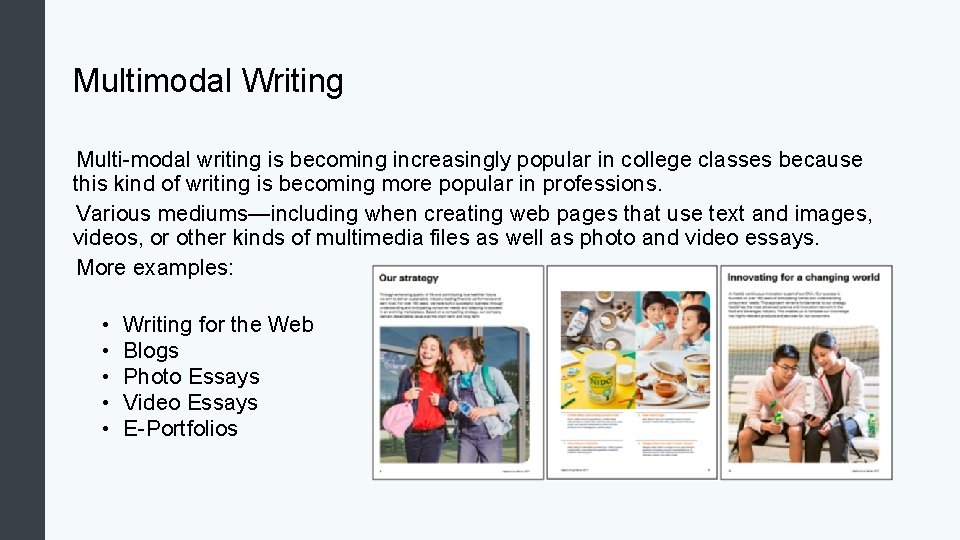
Multimodal Writing Multi-modal writing is becoming increasingly popular in college classes because this kind of writing is becoming more popular in professions. Various mediums—including when creating web pages that use text and images, videos, or other kinds of multimedia files as well as photo and video essays. More examples: • • • Writing for the Web Blogs Photo Essays Video Essays E-Portfolios
Presentations A presentation gives your audience a quick overview of important information from your work and provides your audience with some visual support for that information. Preparing for a Presentation • Remember to present your thesis statement or main idea clearly. • Provide the highlights of your evidence from your essay • Remember to address the opposition. • Use images relevant to your points as evidence. Images are powerful and are important pieces of an effective presentation. • And always cite your sources!
Quick Review • Writing often emphasizes formulaic structure, such as the five-paragraph theme or the three-point essay. • Where defined-topic essays demonstrate your knowledge of the content, undefinedtopic assignments are used to demonstrate your skills—your ability to perform academic research, to synthesize ideas, and to apply the various stages of the writing process. • There are four main types of writing: expository, persuasive, narrative, and descriptive. • Some generally recognized rhetorical patterns include argumentative/persuasive, comparison, cause and effect, illustration, narration, description, definition, classification and division, and process. • A mode, quite simply, is a means of communicating. • A presentation gives your audience a quick overview of important information from your work and provides your audience with some visual support for that information.