ENGG 2013 Unit 10 n n determinant and


- Slides: 34
ENGG 2013 Unit 10 n n determinant and an application to cryptography Feb, 2011.
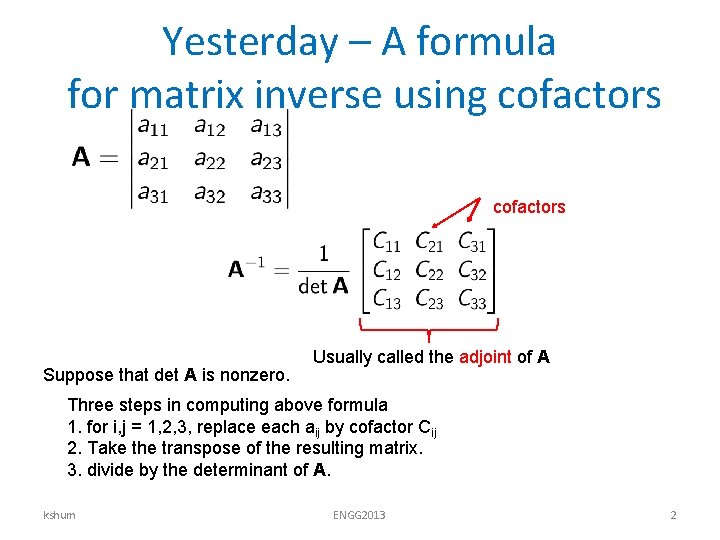
Yesterday – A formula for matrix inverse using cofactors Suppose that det A is nonzero. Usually called the adjoint of A Three steps in computing above formula 1. for i, j = 1, 2, 3, replace each aij by cofactor Cij 2. Take the transpose of the resulting matrix. 3. divide by the determinant of A. kshum ENGG 2013 2
Outline • • nxn determinant Caesar Cipher Modulo arithmetic Hill Cipher kshum ENGG 2013 3
DETERMINANT IN GENERAL kshum ENGG 2013 4
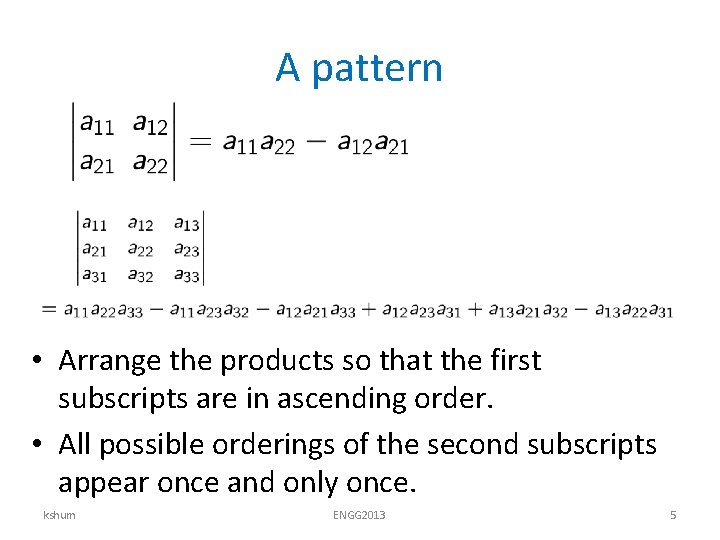
A pattern • Arrange the products so that the first subscripts are in ascending order. • All possible orderings of the second subscripts appear once and only once. kshum ENGG 2013 5
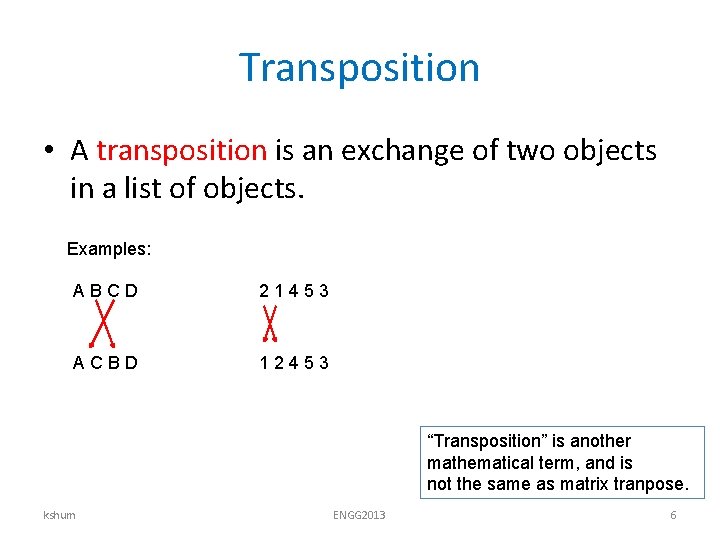
Transposition • A transposition is an exchange of two objects in a list of objects. Examples: ABCD 21453 ACBD 12453 “Transposition” is another mathematical term, and is not the same as matrix tranpose. kshum ENGG 2013 6
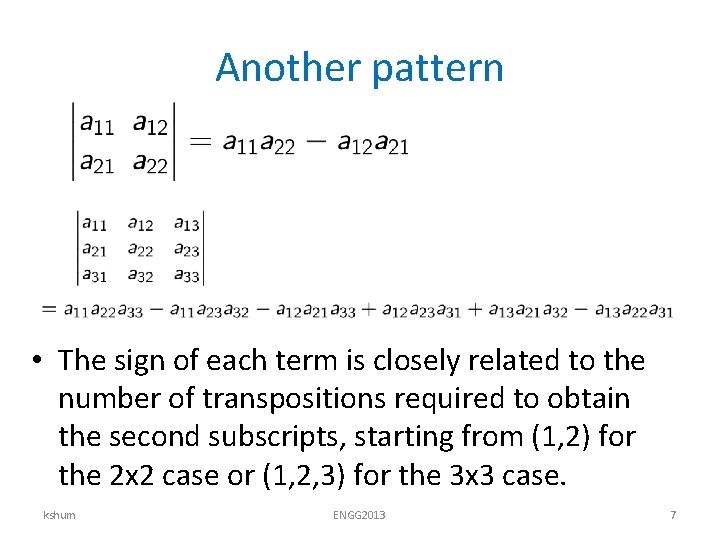
Another pattern • The sign of each term is closely related to the number of transpositions required to obtain the second subscripts, starting from (1, 2) for the 2 x 2 case or (1, 2, 3) for the 3 x 3 case. kshum ENGG 2013 7
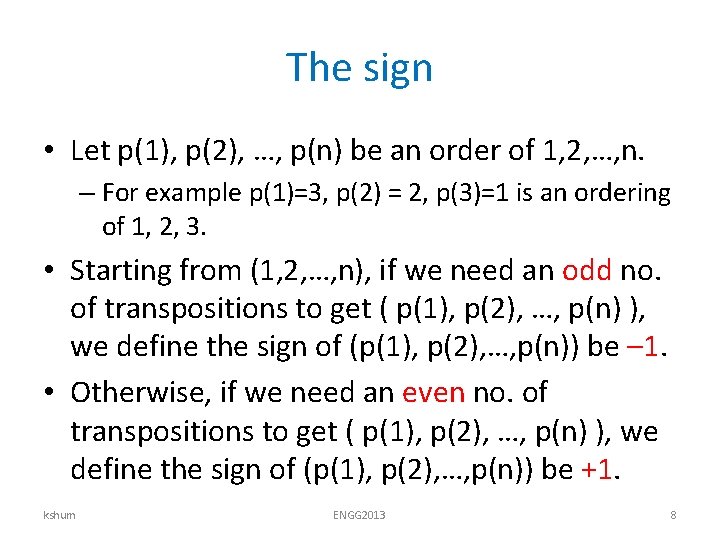
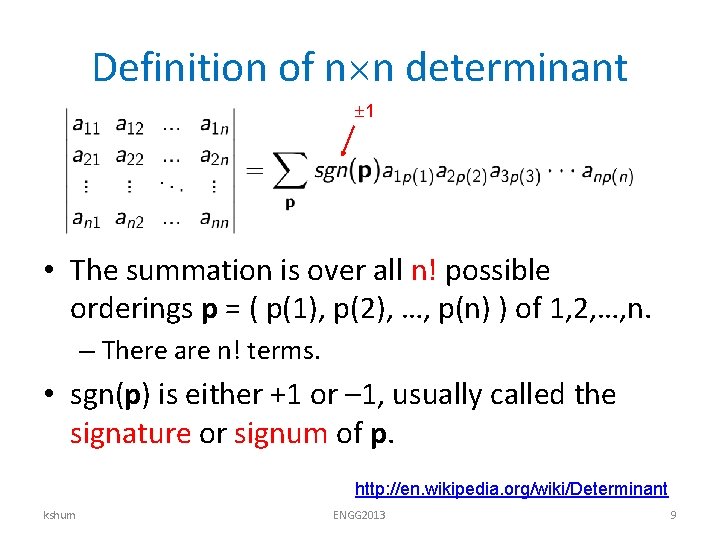
The sign • Let p(1), p(2), …, p(n) be an order of 1, 2, …, n. – For example p(1)=3, p(2) = 2, p(3)=1 is an ordering of 1, 2, 3. • Starting from (1, 2, …, n), if we need an odd no. of transpositions to get ( p(1), p(2), …, p(n) ), we define the sign of (p(1), p(2), …, p(n)) be – 1. • Otherwise, if we need an even no. of transpositions to get ( p(1), p(2), …, p(n) ), we define the sign of (p(1), p(2), …, p(n)) be +1. kshum ENGG 2013 8
Definition of n n determinant 1 • The summation is over all n! possible orderings p = ( p(1), p(2), …, p(n) ) of 1, 2, …, n. – There are n! terms. • sgn(p) is either +1 or – 1, usually called the signature or signum of p. http: //en. wikipedia. org/wiki/Determinant kshum ENGG 2013 9
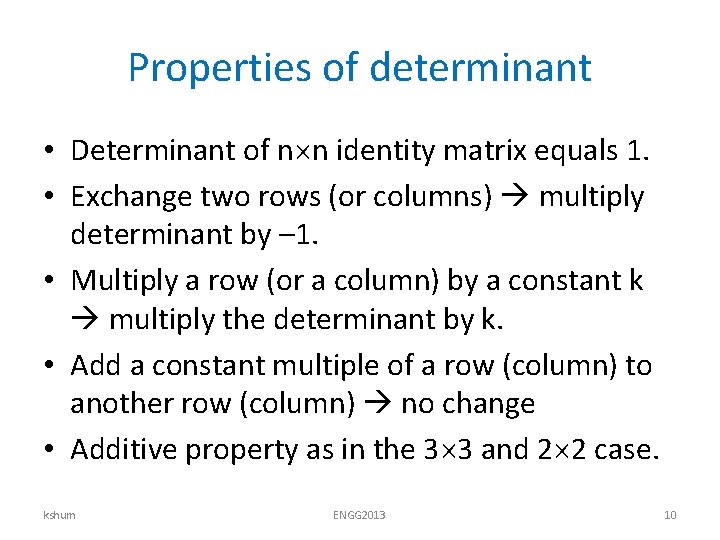
Properties of determinant • Determinant of n n identity matrix equals 1. • Exchange two rows (or columns) multiply determinant by – 1. • Multiply a row (or a column) by a constant k multiply the determinant by k. • Add a constant multiple of a row (column) to another row (column) no change • Additive property as in the 3 3 and 2 2 case. kshum ENGG 2013 10
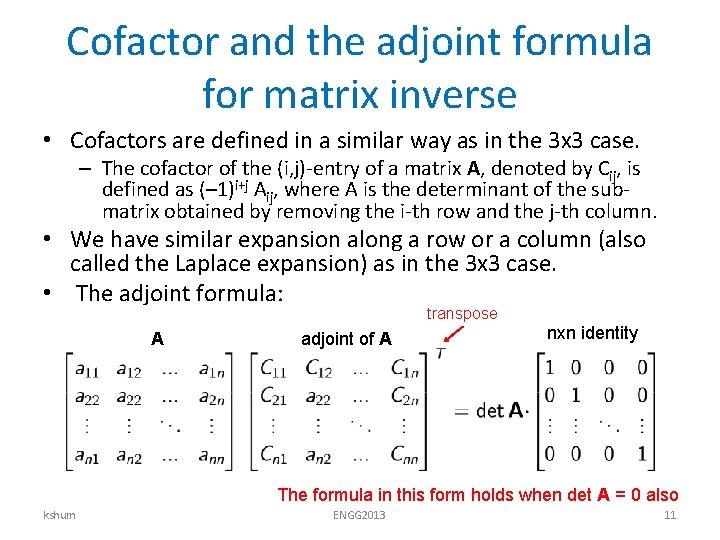
Cofactor and the adjoint formula for matrix inverse • Cofactors are defined in a similar way as in the 3 x 3 case. – The cofactor of the (i, j)-entry of a matrix A, denoted by Cij, is defined as (– 1)i+j Aij, where A is the determinant of the submatrix obtained by removing the i-th row and the j-th column. • We have similar expansion along a row or a column (also called the Laplace expansion) as in the 3 x 3 case. • The adjoint formula: transpose A adjoint of A nxn identity The formula in this form holds when det A = 0 also kshum ENGG 2013 11
CAESAR CIPHER kshum ENGG 2013 12
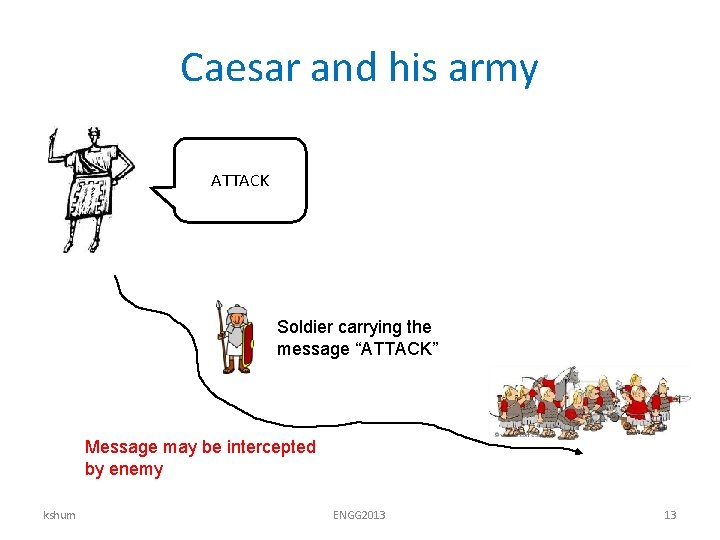
Caesar and his army ATTACK Soldier carrying the message “ATTACK” Message may be intercepted by enemy kshum ENGG 2013 13
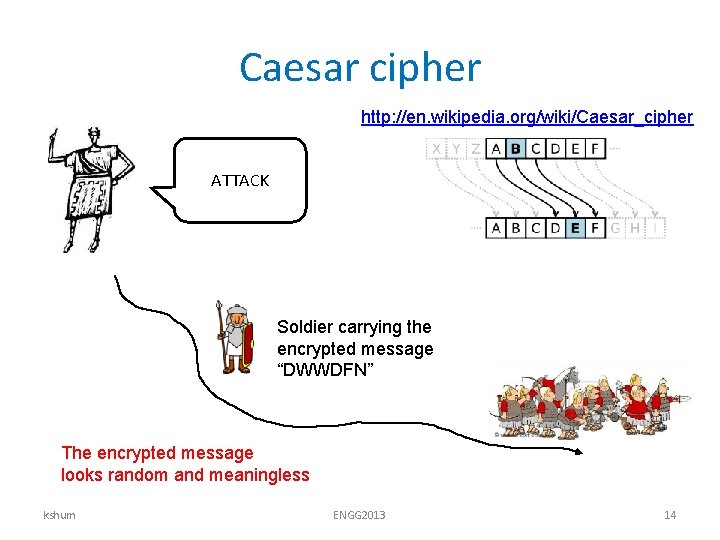
Caesar cipher http: //en. wikipedia. org/wiki/Caesar_cipher ATTACK Soldier carrying the encrypted message “DWWDFN” The encrypted message looks random and meaningless kshum ENGG 2013 14
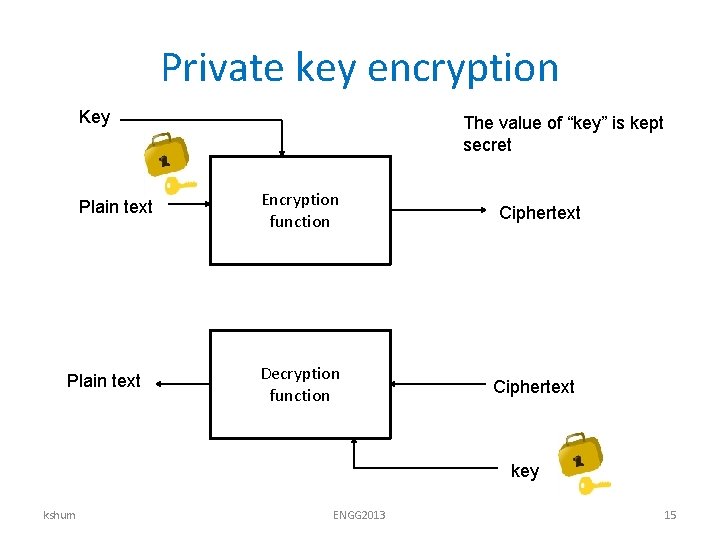
Private key encryption Key Plain text The value of “key” is kept secret Encryption function Decryption function Ciphertext key kshum ENGG 2013 15
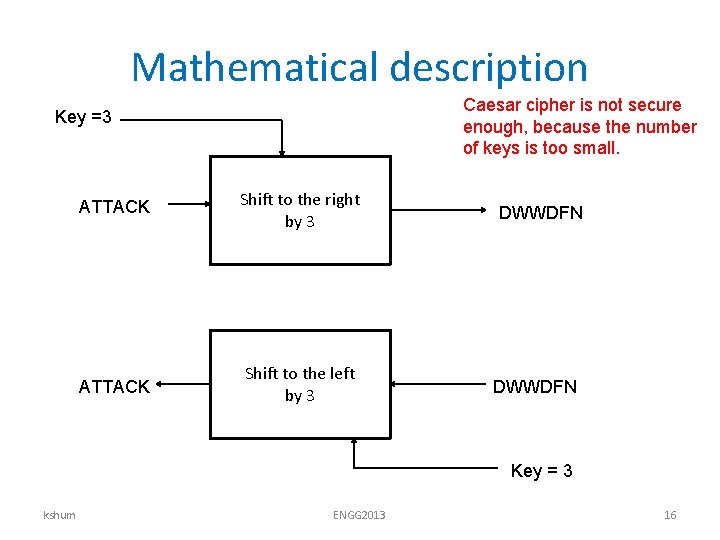
Mathematical description Caesar cipher is not secure enough, because the number of keys is too small. Key =3 ATTACK Shift to the right by 3 ATTACK Shift to the left by 3 DWWDFN Key = 3 kshum ENGG 2013 16
MODULO ARITHMETIC kshum ENGG 2013 17
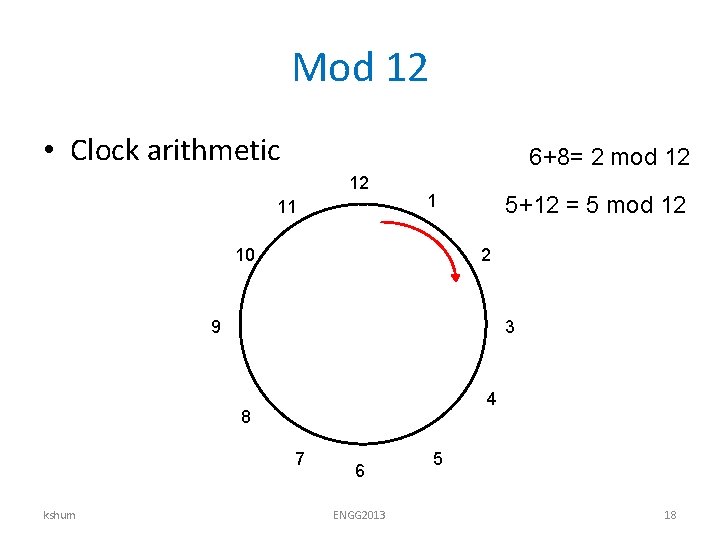
Mod 12 • Clock arithmetic 6+8= 2 mod 12 12 11 1 10 5+12 = 5 mod 12 2 9 3 4 8 7 kshum 6 ENGG 2013 5 18
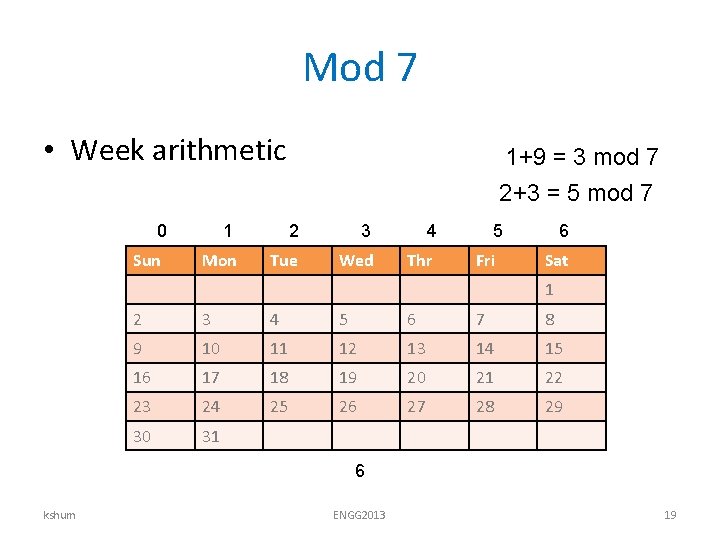
Mod 7 • Week arithmetic 0 Sun 1+9 = 3 mod 7 2+3 = 5 mod 7 1 2 3 4 Mon Tue Wed Thr 5 Fri 6 Sat 1 2 3 4 5 6 7 8 9 10 11 12 13 14 15 16 17 18 19 20 21 22 23 24 25 26 27 28 29 30 31 6 kshum ENGG 2013 19
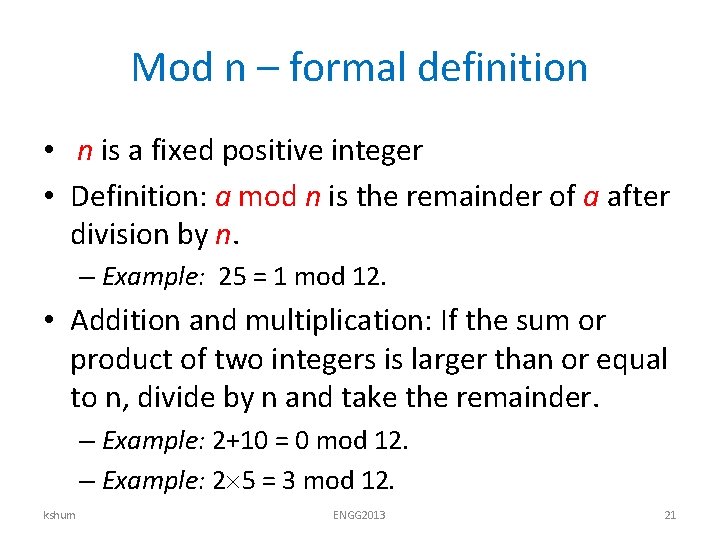
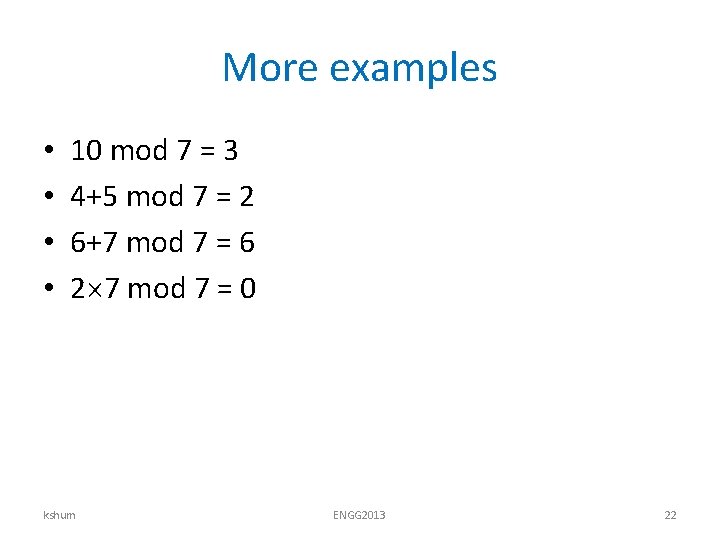
Mod n – formal definition • n is a fixed positive integer • Definition: a mod n is the remainder of a after division by n. – Example: 25 = 1 mod 12. • Addition and multiplication: If the sum or product of two integers is larger than or equal to n, divide by n and take the remainder. – Example: 2+10 = 0 mod 12. – Example: 2 5 = 3 mod 12. kshum ENGG 2013 21
More examples • • 10 mod 7 = 3 4+5 mod 7 = 2 6+7 mod 7 = 6 2 7 mod 7 = 0 kshum ENGG 2013 22
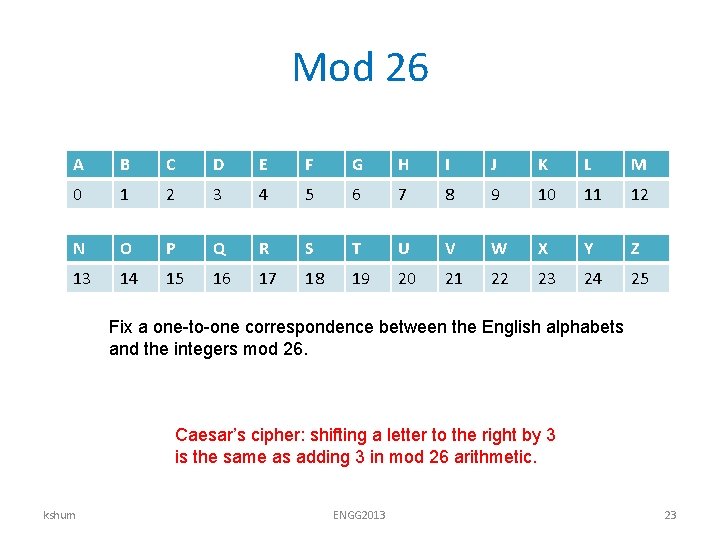
Mod 26 A B C D E F G H I J K L M 0 1 2 3 4 5 6 7 8 9 10 11 12 N O P Q R S T U V W X Y Z 13 14 15 16 17 18 19 20 21 22 23 24 25 Fix a one-to-one correspondence between the English alphabets and the integers mod 26. Caesar’s cipher: shifting a letter to the right by 3 is the same as adding 3 in mod 26 arithmetic. kshum ENGG 2013 23
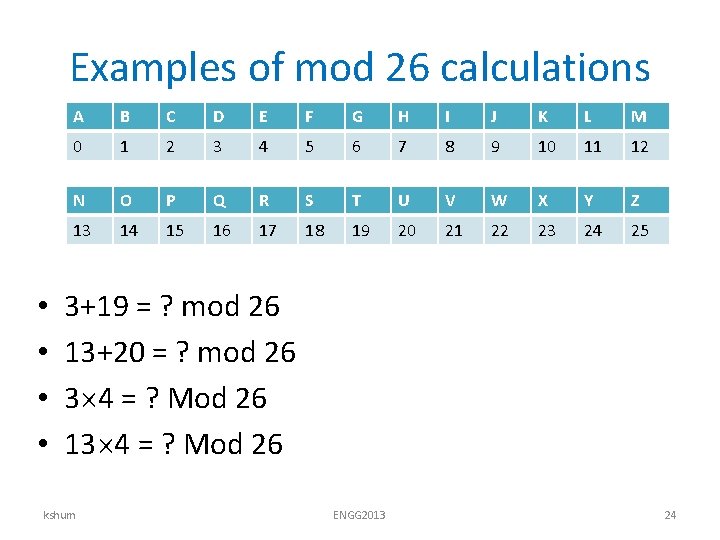
Examples of mod 26 calculations • • A B C D E F G H I J K L M 0 1 2 3 4 5 6 7 8 9 10 11 12 N O P Q R S T U V W X Y Z 13 14 15 16 17 18 19 20 21 22 23 24 25 3+19 = ? mod 26 13+20 = ? mod 26 3 4 = ? Mod 26 13 4 = ? Mod 26 kshum ENGG 2013 24
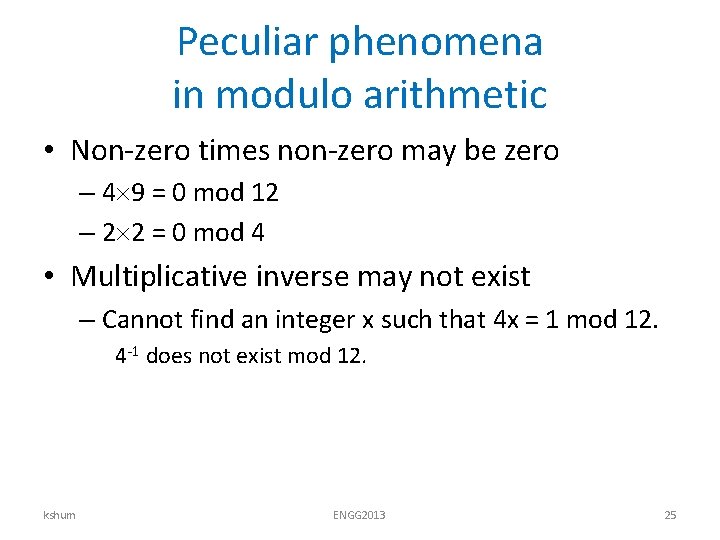
Peculiar phenomena in modulo arithmetic • Non-zero times non-zero may be zero – 4 9 = 0 mod 12 – 2 2 = 0 mod 4 • Multiplicative inverse may not exist – Cannot find an integer x such that 4 x = 1 mod 12. 4 -1 does not exist mod 12. kshum ENGG 2013 25
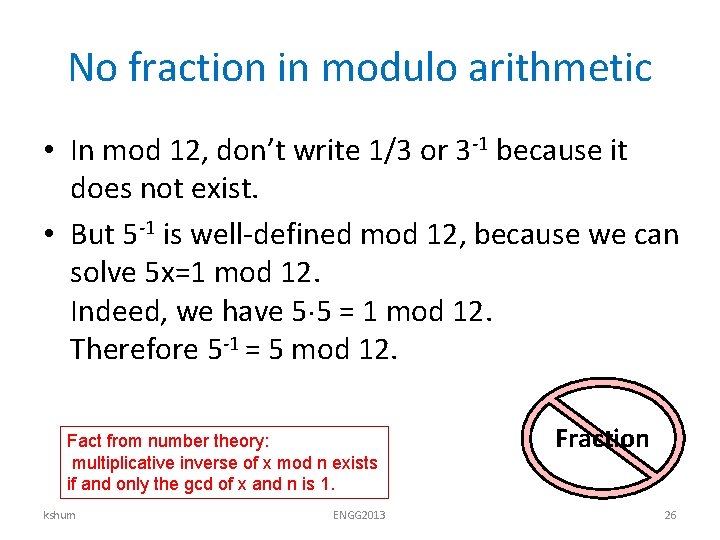
No fraction in modulo arithmetic • In mod 12, don’t write 1/3 or 3 -1 because it does not exist. • But 5 -1 is well-defined mod 12, because we can solve 5 x=1 mod 12. Indeed, we have 5 5 = 1 mod 12. Therefore 5 -1 = 5 mod 12. Fact from number theory: multiplicative inverse of x mod n exists if and only the gcd of x and n is 1. kshum ENGG 2013 Fraction 26
HILL CIPHER kshum ENGG 2013 27
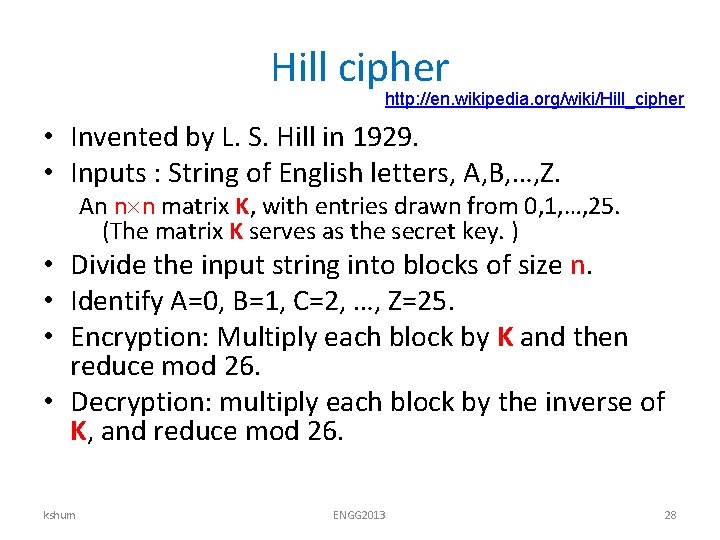
Hill cipher http: //en. wikipedia. org/wiki/Hill_cipher • Invented by L. S. Hill in 1929. • Inputs : String of English letters, A, B, …, Z. An n n matrix K, with entries drawn from 0, 1, …, 25. (The matrix K serves as the secret key. ) • Divide the input string into blocks of size n. • Identify A=0, B=1, C=2, …, Z=25. • Encryption: Multiply each block by K and then reduce mod 26. • Decryption: multiply each block by the inverse of K, and reduce mod 26. kshum ENGG 2013 28
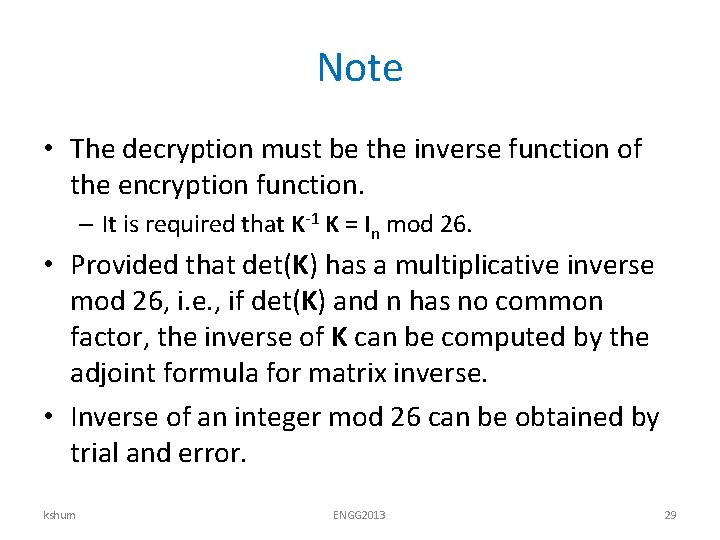
Note • The decryption must be the inverse function of the encryption function. – It is required that K-1 K = In mod 26. • Provided that det(K) has a multiplicative inverse mod 26, i. e. , if det(K) and n has no common factor, the inverse of K can be computed by the adjoint formula for matrix inverse. • Inverse of an integer mod 26 can be obtained by trial and error. kshum ENGG 2013 29
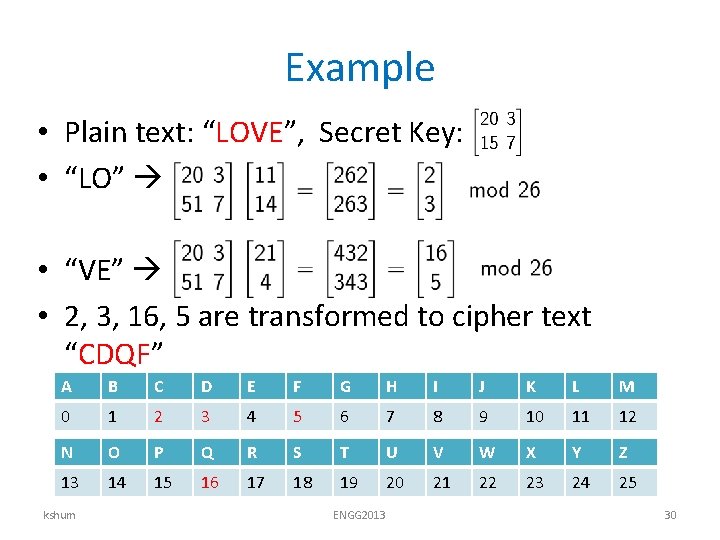
Example • Plain text: “LOVE”, Secret Key: • “LO” • “VE” • 2, 3, 16, 5 are transformed to cipher text “CDQF” A B C D E F G H I J K L M 0 1 2 3 4 5 6 7 8 9 10 11 12 N O P Q R S T U V W X Y Z 13 14 15 16 17 18 19 20 21 22 23 24 25 kshum ENGG 2013 30
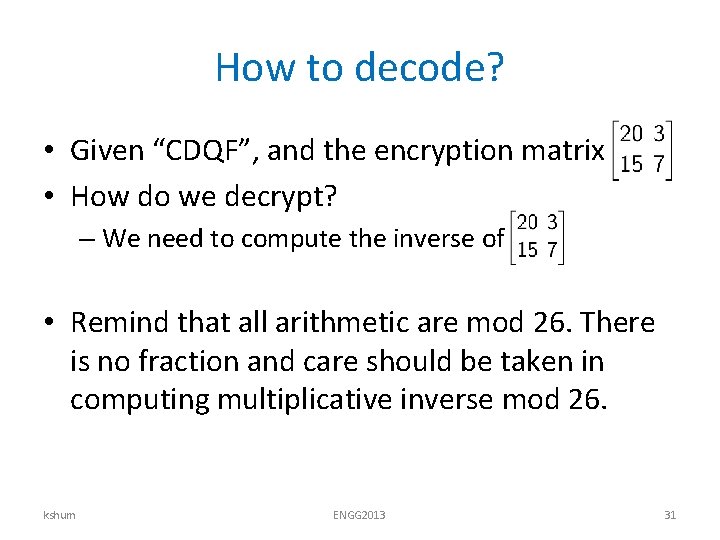
How to decode? • Given “CDQF”, and the encryption matrix • How do we decrypt? – We need to compute the inverse of • Remind that all arithmetic are mod 26. There is no fraction and care should be taken in computing multiplicative inverse mod 26. kshum ENGG 2013 31
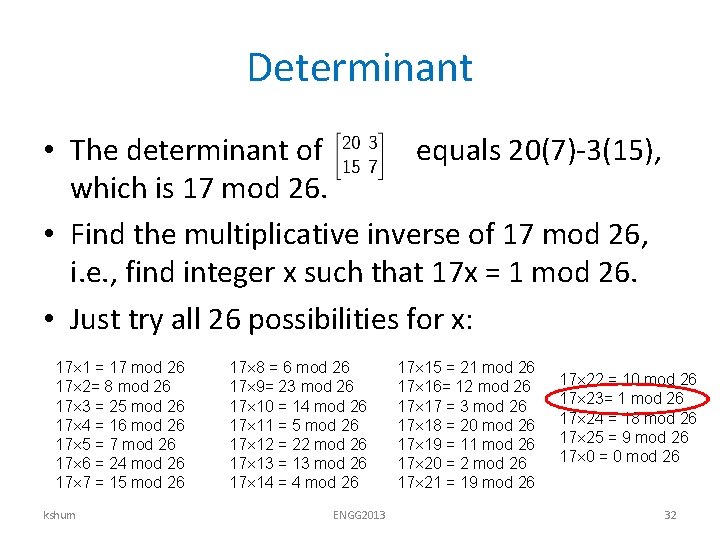
Determinant • The determinant of equals 20(7)-3(15), which is 17 mod 26. • Find the multiplicative inverse of 17 mod 26, i. e. , find integer x such that 17 x = 1 mod 26. • Just try all 26 possibilities for x: 17 1 = 17 mod 26 17 2= 8 mod 26 17 3 = 25 mod 26 17 4 = 16 mod 26 17 5 = 7 mod 26 17 6 = 24 mod 26 17 7 = 15 mod 26 kshum 17 8 = 6 mod 26 17 9= 23 mod 26 17 10 = 14 mod 26 17 11 = 5 mod 26 17 12 = 22 mod 26 17 13 = 13 mod 26 17 14 = 4 mod 26 ENGG 2013 17 15 = 21 mod 26 17 16= 12 mod 26 17 17 = 3 mod 26 17 18 = 20 mod 26 17 19 = 11 mod 26 17 20 = 2 mod 26 17 21 = 19 mod 26 17 22 = 10 mod 26 17 23= 1 mod 26 17 24 = 18 mod 26 17 25 = 9 mod 26 17 0 = 0 mod 26 32
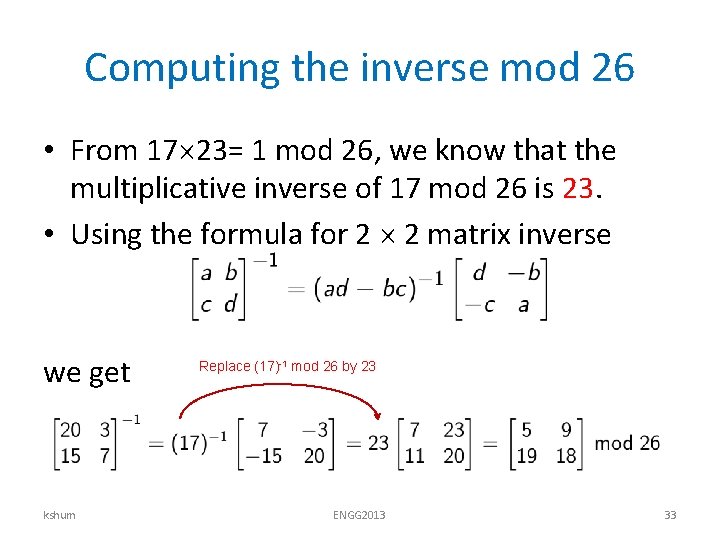
Computing the inverse mod 26 • From 17 23= 1 mod 26, we know that the multiplicative inverse of 17 mod 26 is 23. • Using the formula for 2 2 matrix inverse we get kshum Replace (17)-1 mod 26 by 23 ENGG 2013 33
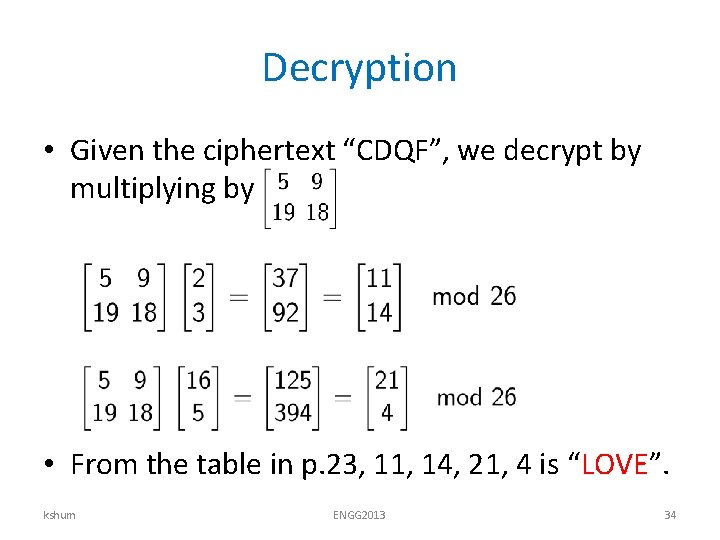
Decryption • Given the ciphertext “CDQF”, we decrypt by multiplying by • From the table in p. 23, 11, 14, 21, 4 is “LOVE”. kshum ENGG 2013 34