ELFT Training Packages for Primary Care Common Childhood
- Slides: 30
ELFT Training Packages for Primary Care ‘Common Childhood Mental Health Problems’ Dr Justin Wakefield Consultant Child & Adolescent Psychiatrist East London NHS Foundation Trust 12. 02. 2015
Definition of a “problem” • Impairing abnormalities of behaviour, emotions and relationships • ABNORMAL in relation to – – – child’s age and gender developmental stage culture persistence extent of disturbance severity and frequency • IMPAIRMENT – – causes suffering to child/distress to family social restriction impedes the child’s development effects on others
Which of these may be a problem? • A 3 -year-old soiling during the day A 7 -year-old soiling during the day • Frequent temper tantrums aged 2 Frequent temper tantrums aged 10 • Severe anxiety at leaving mother at nursery gate aged 3 Severe anxiety at leaving mother at secondary school gate aged 11
Importance of Child and Adolescent Mental Health • ½ of mental illness in adults has started before the age of 15
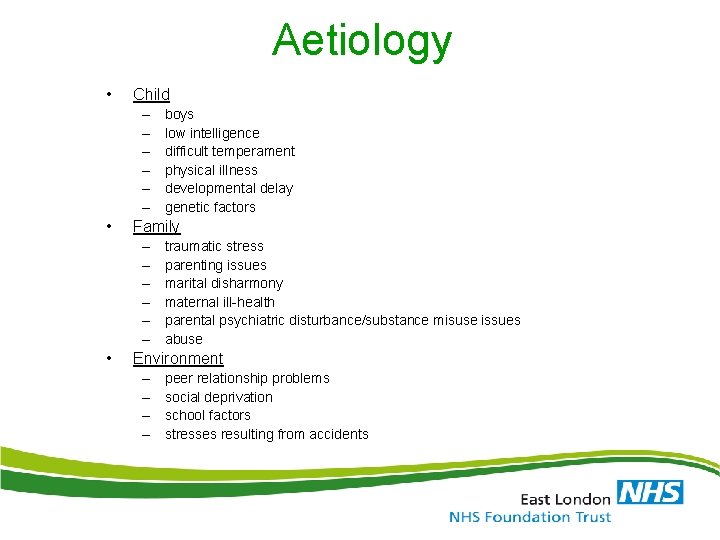
Aetiology • Child – – – • Family – – – • boys low intelligence difficult temperament physical illness developmental delay genetic factors traumatic stress parenting issues marital disharmony maternal ill-health parental psychiatric disturbance/substance misuse issues abuse Environment – – peer relationship problems social deprivation school factors stresses resulting from accidents
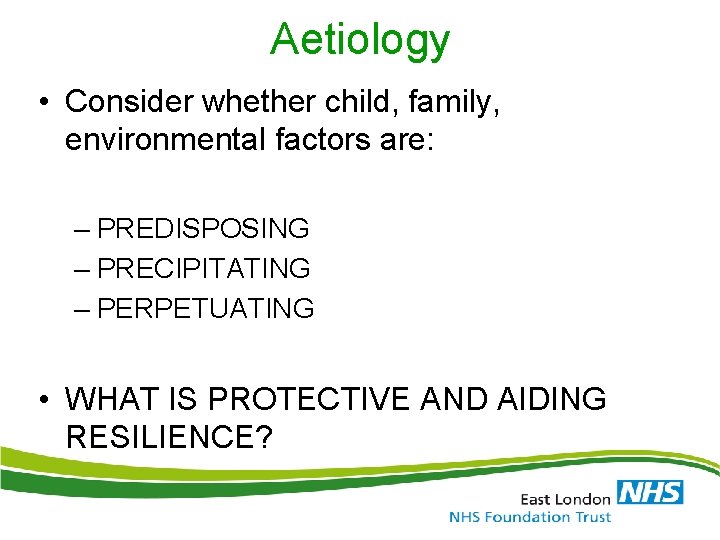
Aetiology • Consider whether child, family, environmental factors are: – PREDISPOSING – PRECIPITATING – PERPETUATING • WHAT IS PROTECTIVE AND AIDING RESILIENCE?
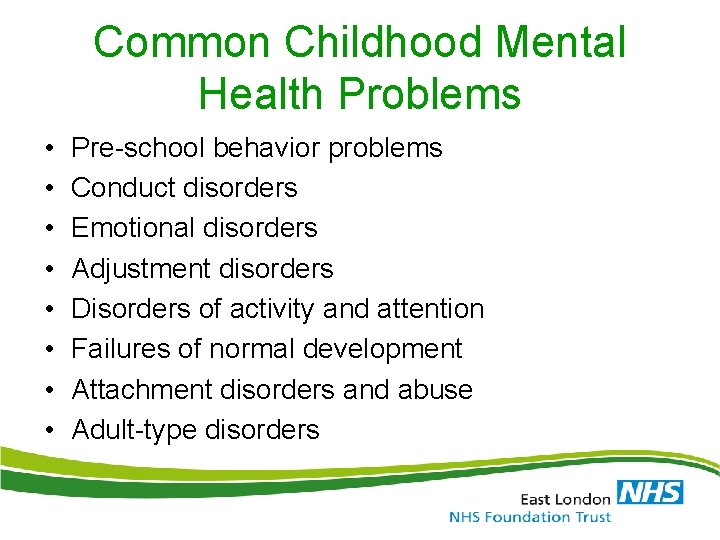
Common Childhood Mental Health Problems • • Pre-school behavior problems Conduct disorders Emotional disorders Adjustment disorders Disorders of activity and attention Failures of normal development Attachment disorders and abuse Adult-type disorders
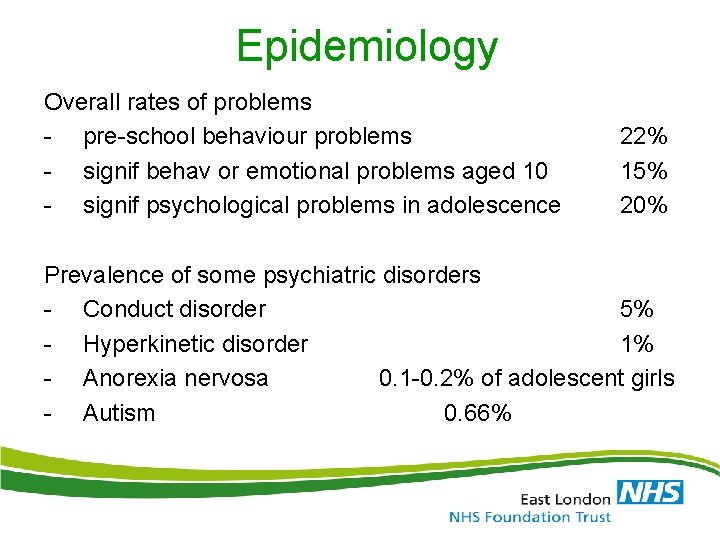
Epidemiology Overall rates of problems - pre-school behaviour problems - signif behav or emotional problems aged 10 - signif psychological problems in adolescence 22% 15% 20% Prevalence of some psychiatric disorders - Conduct disorder 5% - Hyperkinetic disorder 1% - Anorexia nervosa 0. 1 -0. 2% of adolescent girls - Autism 0. 66%
1. Pre-school behaviour problems • • Feeding and eating sleeping temper tantrums oppositional behaviour
2. Conduct disorder • Disorder of behaviour characterised by repetitive and persistent pattern of dissocial, aggressive or defiant conduct. • Not just delinquency • Problem behaviours vary with development • New NICE guidelines
Conduct disorder - under 5 s • • aggression - physical and verbal destructiveness poor attention and concentration frequent, severe tantrums
Conduct disorder - 5 -12 years • • lying stealing defiance disruption in school cruelty to animals fire setting solvent abuse
Conduct disorder - adolescence • • • truancy delinquency violence sex offences drug/alcohol/substance abuse
Conduct disorder – risk factors • • boys >> girls inner cities > rural areas socio-economic disadvantage family conflict and poor communication in the family • “difficult” temperament • Specific reading disability
3. Emotional disorders • Disturbances of mood, persistent and not in response to a single identified stressor. • Disabling • Anxiety and fearfulness • Depression
Emotional disorders - symptoms • Fears - separation anxiety; social anxiety; specific phobias • Lack of pleasure; loss of interest; hopelessness; despair; sadness; tearfulness; lack of energy • Physical symptoms - abdominal pain, headaches • Fall off in school performance
Emotional disorders – risk factors • boys = girls • no association with socio-economic status • family factors - overprotection; parental anxiety • quiet, compliant temperament • no specific educational problems
School non-attendance • • Truancy School refusal (separation anxiety) Child kept at home by parent Fear of school (eg bullying)
4. Adjustment disorders • Distress and emotional disturbance arising in a period of adaptation to a significant life change or to the consequence of a stressful life event • bereavement • divorce • physical illness
5. Attention Deficit / Hyperactivity Disorder (ADHD) • overactivity • inattention • impulsivity • early onset • pervasive and persistent • boys >>> girls
6. Failures of normal development : specific • speech and language ( receptive and expressive) • reading (dyslexia) • spelling • arithmetical skills • motor function (dyspraxia) • enuresis / encopresis
6. Failures of normal development : pervasive • Autistic spectrum disorders - impaired quality of reciprocal social interaction - impaired communication - restricted, repetitive interests • Asperger’s Syndrome
7. Attachment disorders • Marked distress and social impairment as a result of an extremely abnormal pattern of attachment, typically repeated changes of care-giver in early childhood • Reactive attachment disorder • Disinhibited attachment disorder
Abuse • • • physical (non-accidental injury) emotional sexual neglect Munchaussen Syndrome by Proxy? ? / Factitious Induced Illness (FII)
8. Adult type disorders • psychoses - schizophrenia; bipolar disorder • depression • post traumatic stress disorder • obsessive compulsive disorder • eating disorders • deliberate self harm
Assessment Main areas to cover in assessment. i) Description and history of main problems ii) Child’s peri-natal, developmental, medical, educational and social history iii) Family history including any psychological health problems and information regarding parents own experience of being parented iv) Mental state of the child v) Family communication and relationships An assessment also offers the opportunity to engage therapeutically with a family.
Formulation Following an assessment it is important to formulate the case. A formulation is a compact summary of relevant aspects of : i) presenting features ii) aetiological factors iii) diagnosis iv) management plan v) prognosis.
Diagnosis • There are two major diagnostic systems: – ICD- 10 Classification of Mental and Behavioural Disorders – DSM-5 Diagnostic and Statistical Manual of Mental Disorders • Both systems multi-axial. In ICD 10: – – – Axis III Axis IV Axis VI Clinical Syndrome Disorders of Psychological Development Mental Retardation Medical Illness Abnormalities of psychosocial environment Level of disability
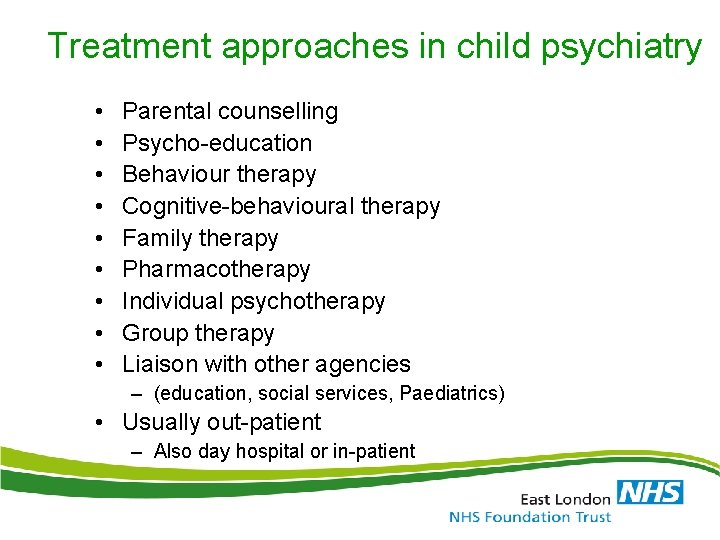
Treatment approaches in child psychiatry • • • Parental counselling Psycho-education Behaviour therapy Cognitive-behavioural therapy Family therapy Pharmacotherapy Individual psychotherapy Group therapy Liaison with other agencies – (education, social services, Paediatrics) • Usually out-patient – Also day hospital or in-patient
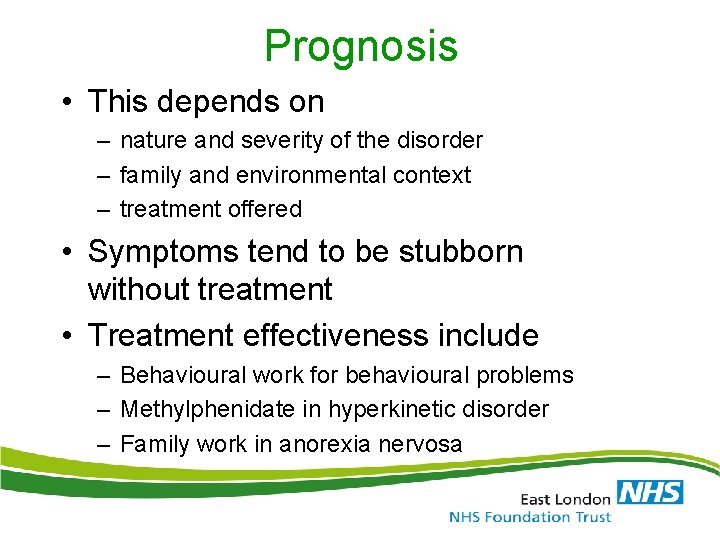
Prognosis • This depends on – nature and severity of the disorder – family and environmental context – treatment offered • Symptoms tend to be stubborn without treatment • Treatment effectiveness include – Behavioural work for behavioural problems – Methylphenidate in hyperkinetic disorder – Family work in anorexia nervosa