Educational Spotlight Adverse Event Reporting Adverse Events key

- Slides: 12
Educational Spotlight: Adverse Event Reporting
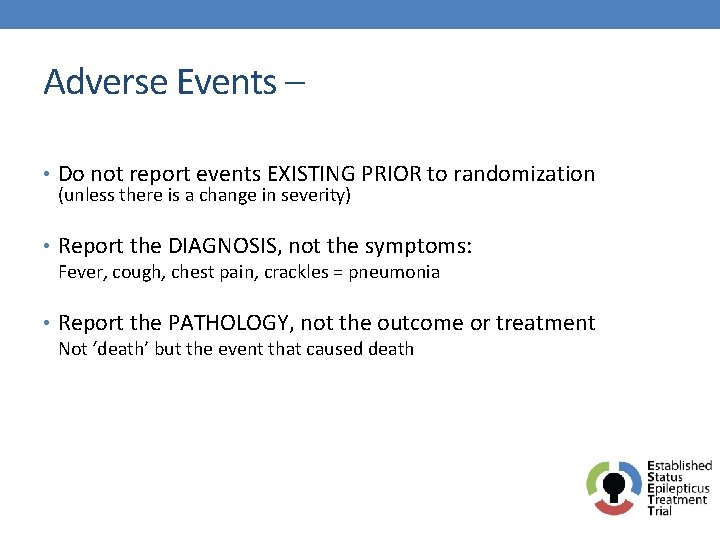
Adverse Events – key points • Do not report events EXISTING PRIOR to randomization (unless there is a change in severity) • Report the DIAGNOSIS, not the symptoms: Fever, cough, chest pain, crackles = pneumonia • Report the PATHOLOGY, not the outcome or treatment Not ‘death’ but the event that caused death CD
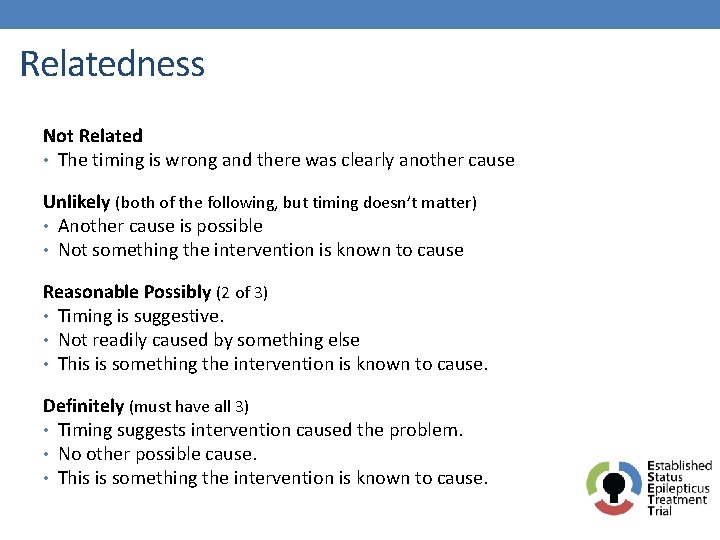
Relatedness algorithm Not Related • The timing is wrong and there was clearly another cause Unlikely (both of the following, but timing doesn’t matter) • Another cause is possible • Not something the intervention is known to cause Reasonable Possibly (2 of 3) • Timing is suggestive. • Not readily caused by something else • This is something the intervention is known to cause. Definitely (must have all 3) • Timing suggests intervention caused the problem. • No other possible cause. • This is something the intervention is known to cause. RS
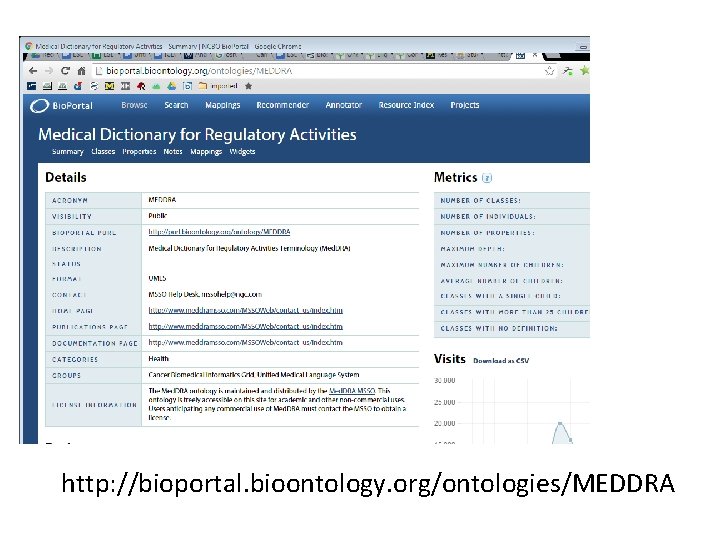
http: //bioportal. bioontology. org/ontologies/MEDDRA
“I just have to create a few loose ends for other people to clear up, and then I can out of here. ”
Write good SAE narratives Be concise but complete (not comprehensive) • Include only the pertinent PMH and HPI • Describe the event • Describe the response • Describe the outcome • And say when each of those happened Look for and respond to queries promptly
Sample narrative A 83 year old female with a history of epilepsy was found seizing and was appropriately enrolled at 18: 05 on 3/10/09. In the ED at 20: 22 she was awake and conversant. At 21: 10 she had another generalized seizure and was treated with lorazepam 2 mg IV with termination of her seizure at 21: 14. Her phenytoin level subsequently was reported to be 5. At 21: 25 she was given phenytoin 1 g IV. At admission at 22: 50 she was again awake and conversant.
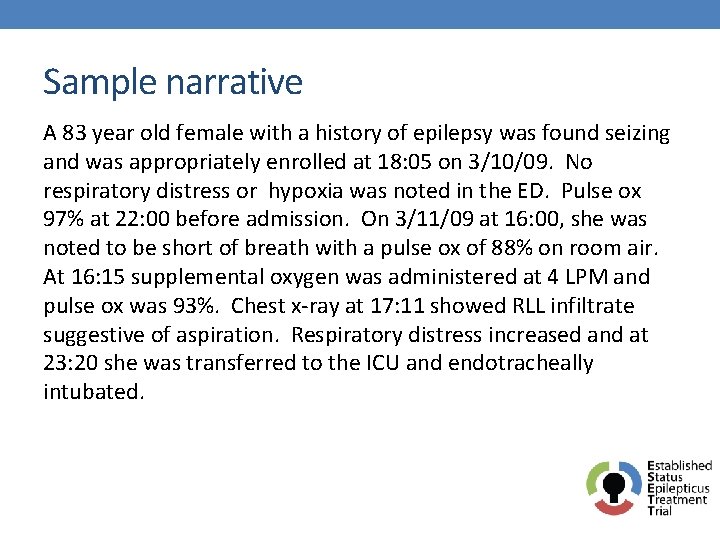
Sample narrative A 83 year old female with a history of epilepsy was found seizing and was appropriately enrolled at 18: 05 on 3/10/09. No respiratory distress or hypoxia was noted in the ED. Pulse ox 97% at 22: 00 before admission. On 3/11/09 at 16: 00, she was noted to be short of breath with a pulse ox of 88% on room air. At 16: 15 supplemental oxygen was administered at 4 LPM and pulse ox was 93%. Chest x-ray at 17: 11 showed RLL infiltrate suggestive of aspiration. Respiratory distress increased and at 23: 20 she was transferred to the ICU and endotracheally intubated.
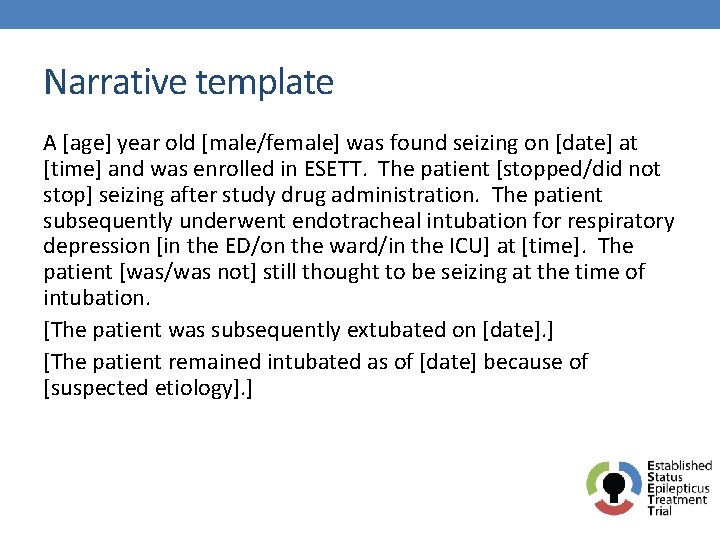
Narrative template respiratory depression A [age] year old [male/female] was found seizing on [date] at [time] and was enrolled in ESETT. The patient [stopped/did not stop] seizing after study drug administration. The patient subsequently underwent endotracheal intubation for respiratory depression [in the ED/on the ward/in the ICU] at [time]. The patient [was/was not] still thought to be seizing at the time of intubation. [The patient was subsequently extubated on [date]. ] [The patient remained intubated as of [date] because of [suspected etiology]. ] RS
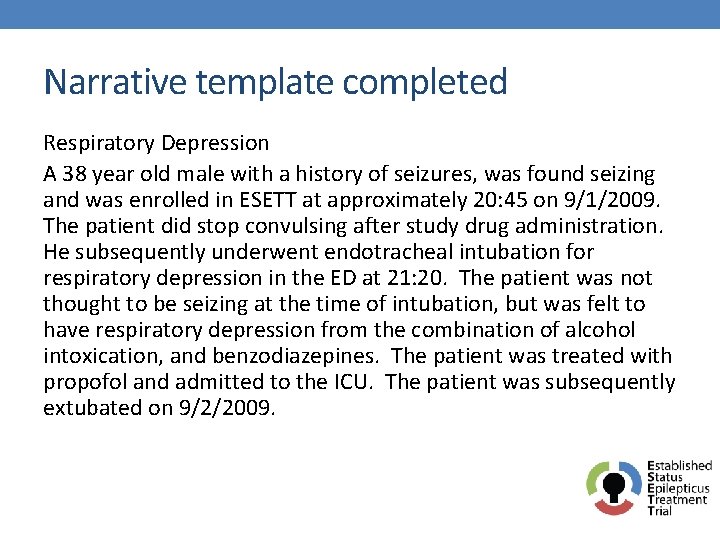
Narrative template completed Respiratory Depression A 38 year old male with a history of seizures, was found seizing and was enrolled in ESETT at approximately 20: 45 on 9/1/2009. The patient did stop convulsing after study drug administration. He subsequently underwent endotracheal intubation for respiratory depression in the ED at 21: 20. The patient was not thought to be seizing at the time of intubation, but was felt to have respiratory depression from the combination of alcohol intoxication, and benzodiazepines. The patient was treated with propofol and admitted to the ICU. The patient was subsequently extubated on 9/2/2009. RS