ECommerce Market Mechanisms Chapter 3 1 2 3
- Slides: 37
E-Commerce Market Mechanisms Chapter 3
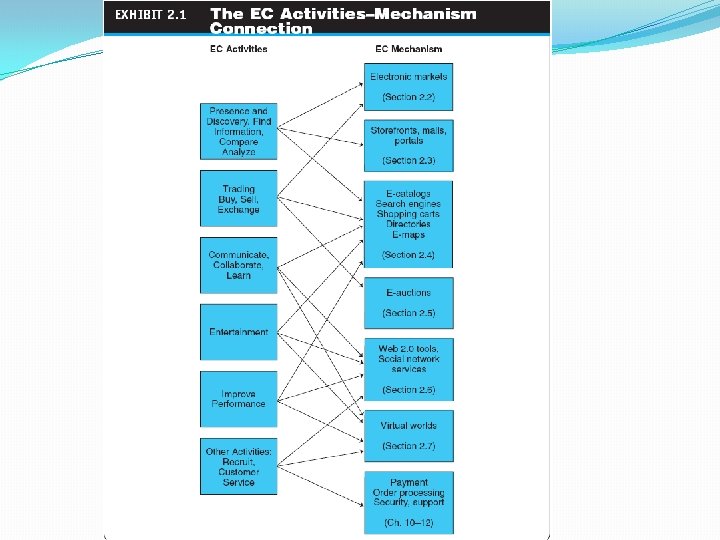
1. 2. 3. 4. 5. Describe the major electronic commerce (EC) activities and processes and the mechanisms that support them. Define e-marketplaces and list their components. List the major types of e-marketplaces and describe their features. Describe electronic catalogs, search engines, and shopping carts. Describe the major types of auctions and list their characteristics.
6. Discuss the benefits, limitations, and impacts of auctions. 7. Describe bartering and negotiating online. 8. List the major Web 2. 0 tools and their use in EC. 9. Understand virtual worlds and their use in EC. 10. Discuss competition in the digital economy. 11. Describe the impact of e-marketplaces on organizations, intermediation, and industries.
E-Marketplaces • e-marketplace An online market, usually B 2 B, in which buyers and sellers exchange goods or services; the two types of emarketplaces are private, and public. • marketspace A marketplace in which sellers and buyers exchange goods and services for money (or for other goods and services).
3 functions e- marketplaces � 1. Matching buyers and sellers � 2. Facilitating the exchanges goods , services, payment with market functions � 3. Providing institutional, infrastructure , legal. (pg. 98)
E-marketplace Components • E-MARKETPLACE COMPONENTS AND PARTICIPANTS 1. Customers: who surf web for buy goods, bargain, collection items on internet 2. Sellers : sell direct from their web sites or marketplaces 3. Digital products & physical products Goods that can be transformed to digital format and delivered over the Internet 4. Infrastructure : electronic hardware/software /network 5. Front end The portion of an e-seller’s business processes through which customers interact, including the seller’s portal, electronic catalogs, a shopping cart, a search engine, and a payment gateway
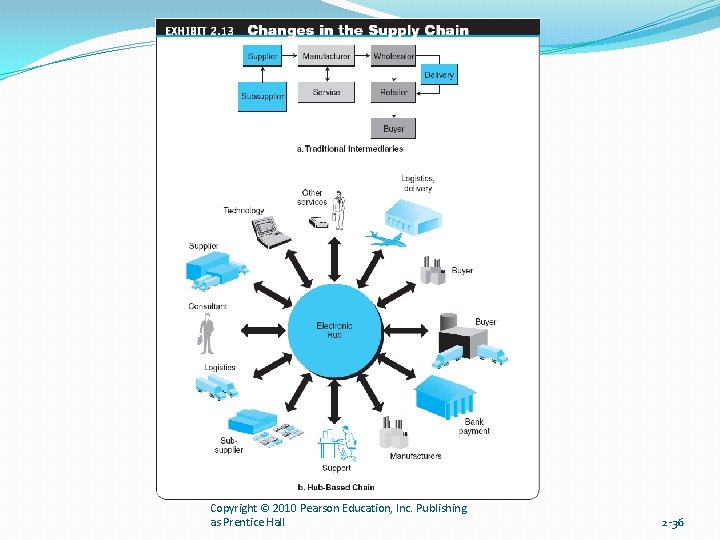
E-marketplace Components 5. Back end : The activities that support online order fulfillment, inventory management, purchasing from suppliers, payment processing, packaging, and delivery. 6. Intermediary : A third party that operates between sellers and buyers Disintermediation: Elimination of intermediaries between sellers and buyers Reintermediation : Newcomers take on new intermediary role
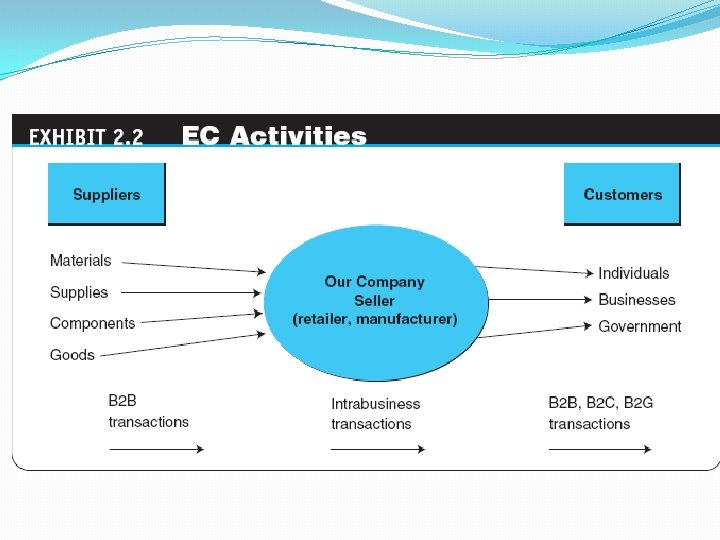
Types of e- marketplaces �Private E-Marketplaces : Owned & operated by a single company/owned by an individual organization. � sell-side e-marketplace A private e-marketplace in which one company sells either standard and/or customized products to qualified companies (One to Many) � buy-side e-marketplace A private e-marketplace in which one company makes purchases from invited suppliers (Many to one) �Public E-Marketplaces : Owned by 3 rd party (not a seller/buyer). eg: stock exchanges (Many to many)
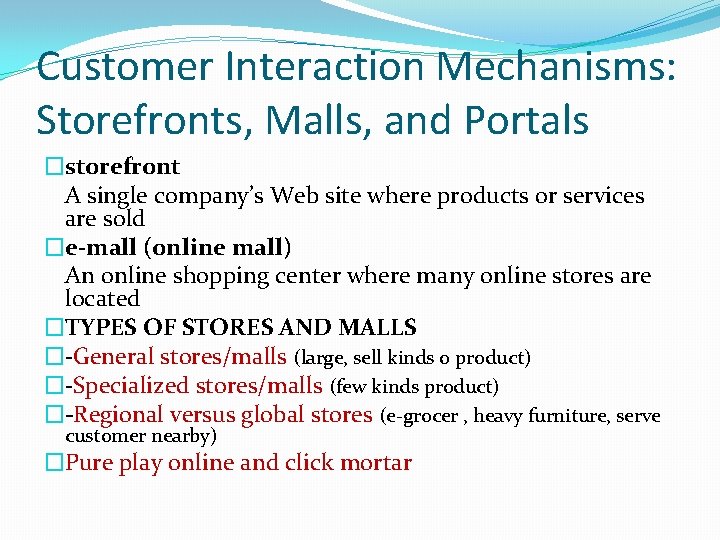
Customer Interaction Mechanisms: Storefronts, Malls, and Portals �storefront A single company’s Web site where products or services are sold �e-mall (online mall) An online shopping center where many online stores are located �TYPES OF STORES AND MALLS �-General stores/malls (large, sell kinds o product) �-Specialized stores/malls (few kinds product) �-Regional versus global stores (e-grocer , heavy furniture, serve customer nearby) �Pure play online and click mortar
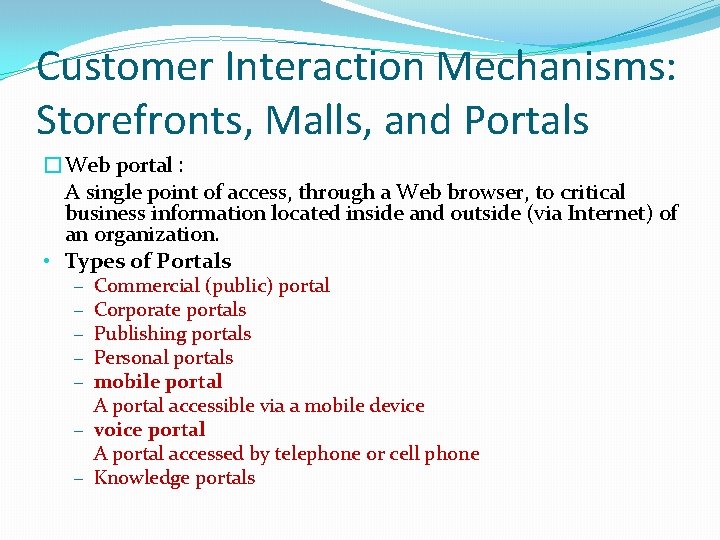
Customer Interaction Mechanisms: Storefronts, Malls, and Portals �Web portal : A single point of access, through a Web browser, to critical business information located inside and outside (via Internet) of an organization. • Types of Portals Commercial (public) portal Corporate portals Publishing portals Personal portals mobile portal A portal accessible via a mobile device – voice portal A portal accessed by telephone or cell phone – Knowledge portals – – –
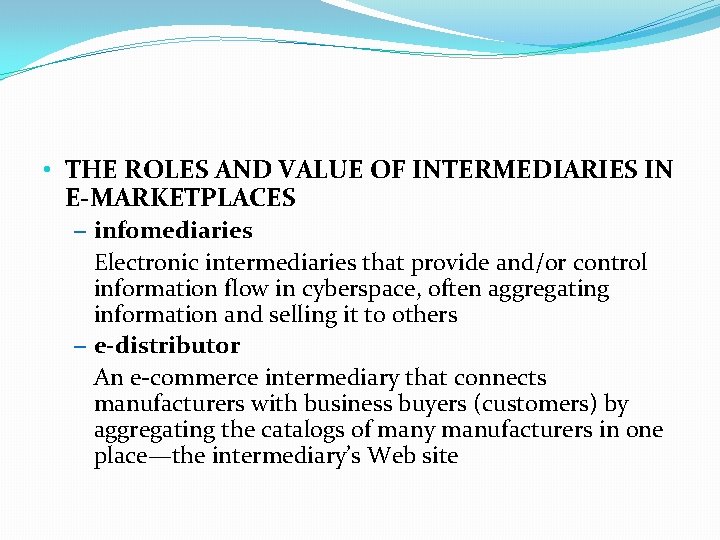
• THE ROLES AND VALUE OF INTERMEDIARIES IN E-MARKETPLACES – infomediaries Electronic intermediaries that provide and/or control information flow in cyberspace, often aggregating information and selling it to others – e-distributor An e-commerce intermediary that connects manufacturers with business buyers (customers) by aggregating the catalogs of many manufacturers in one place—the intermediary’s Web site
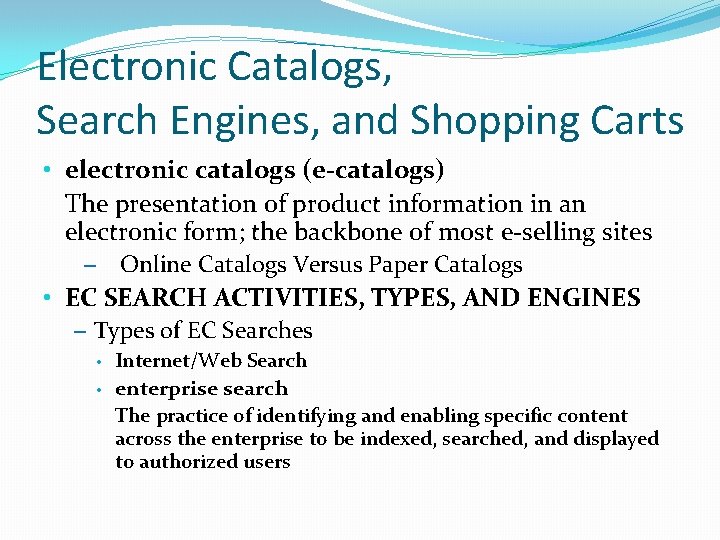
Electronic Catalogs, Search Engines, and Shopping Carts • electronic catalogs (e-catalogs) The presentation of product information in an electronic form; the backbone of most e-selling sites – Online Catalogs Versus Paper Catalogs • EC SEARCH ACTIVITIES, TYPES, AND ENGINES – Types of EC Searches • • Internet/Web Search enterprise search The practice of identifying and enabling specific content across the enterprise to be indexed, searched, and displayed to authorized users
Electronic Catalogs, Search Engines, and Shopping Carts � desktop search Search tools that search the contents of a user’s or organization’s computer files, rather than searching the Internet. The emphasis is on finding all the information that is available on the user’s PC, including Web browser histories, e-mail archives, and word-processed documents, as well as in all internal files and databases
Electronic Catalogs, Search Engines, and Shopping Carts �search engine A computer program that can access databases of Internet resources, search for specific information or keywords, and report the results �Software (Intelligent) Agents- search and match -monitor web movement, -interpreting info �Voice-Powered Search- using cell phone.
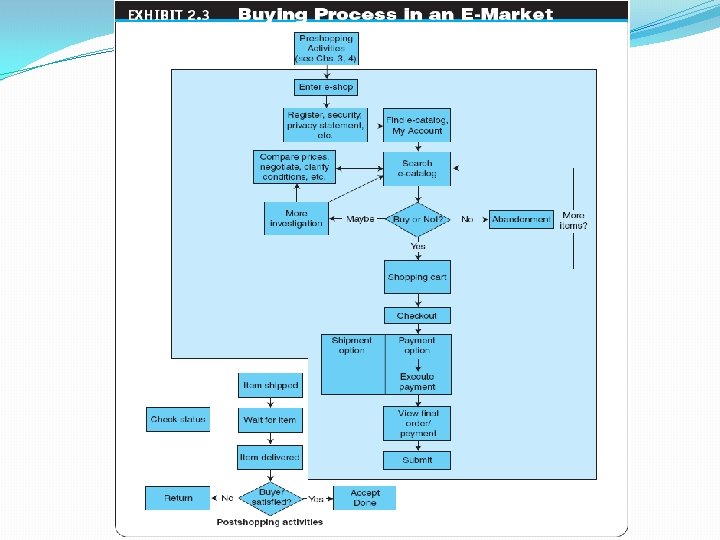
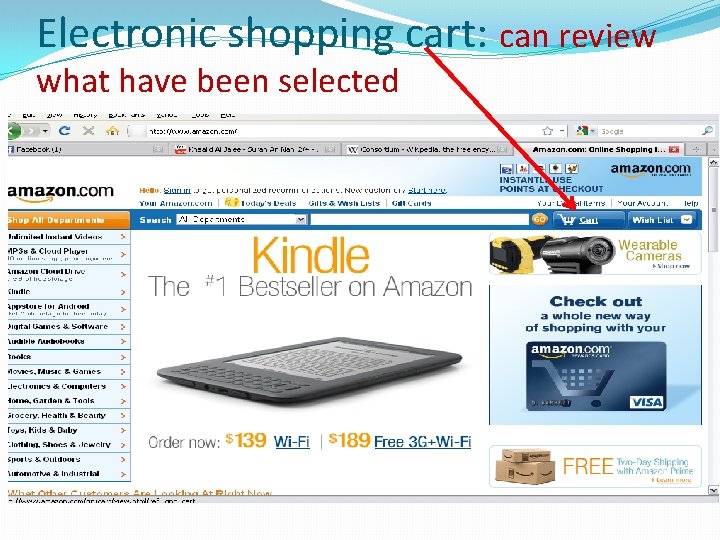
Electronic shopping cart: can review what have been selected
Auctions, Bartering, and Negotiating Online • auction A competitive process in which a seller solicits consecutive bids from buyers (forward auctions) or a buyer solicits bids from sellers (backward auctions). Prices are determined dynamically by the bids • electronic auctions (e-auctions) Auctions conducted online – Innovative Auctions Copyright © 2010 Pearson Education, Inc. Publishing as Prentice Hall 2 -19
Auctions, Bartering, and Negotiating Online �dynamic pricing Prices that change based on supply and demand relationships at any given time �One Buyer, One Seller �One Seller, Many Potential Buyers � forward auction ( 1 seller, many buyers) An auction in which a seller entertains bids from buyers. Bidders increase price sequentially Copyright © 2010 Pearson Education, Inc. Publishing as Prentice Hall 2 -20
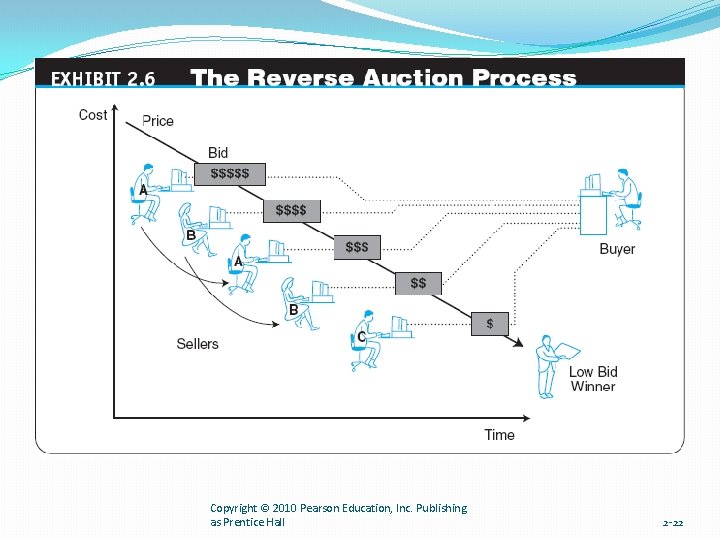
Auctions, Bartering, and Negotiating Online � reverse auction (bidding or tendering system) Auction in which the buyer places an item for bid (tender) on a request for quote (RFQ) system, potential suppliers bid on the job, with the price reducing sequentially, and the lowest bid wins; primarily a B 2 B or G 2 B mechanism (1 buyer, many potential sellers) � “name-your-own-price” model Auction model in which a would-be buyer specifies the price (and other terms) he or she is willing to pay to any willing and able seller. It is a C 2 B model that was pioneered by Priceline. com Copyright © 2010 Pearson Education, Inc. Publishing as Prentice Hall 2 -21
Copyright © 2010 Pearson Education, Inc. Publishing as Prentice Hall 2 -22
Auctions, Bartering, and Negotiating Online �Many Sellers, Many Buyers � double auction An auction in which multiple buyers and their bidding prices are matched with multiple sellers and their asking prices, considering the quantities on both sides Copyright © 2010 Pearson Education, Publishing Copyright © 2009 Pearson. Inc. Education, as Prentice Hall Inc. Publishing as Prentice Hall 2 -23
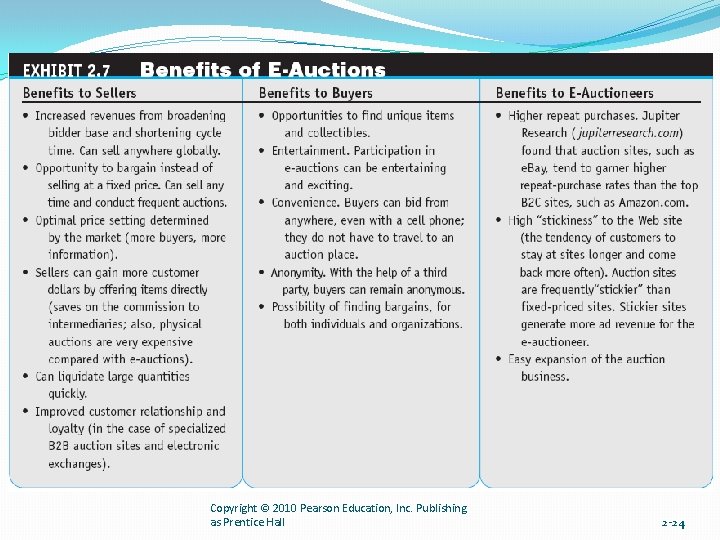
Copyright © 2010 Pearson Education, Inc. Publishing as Prentice Hall 2 -24
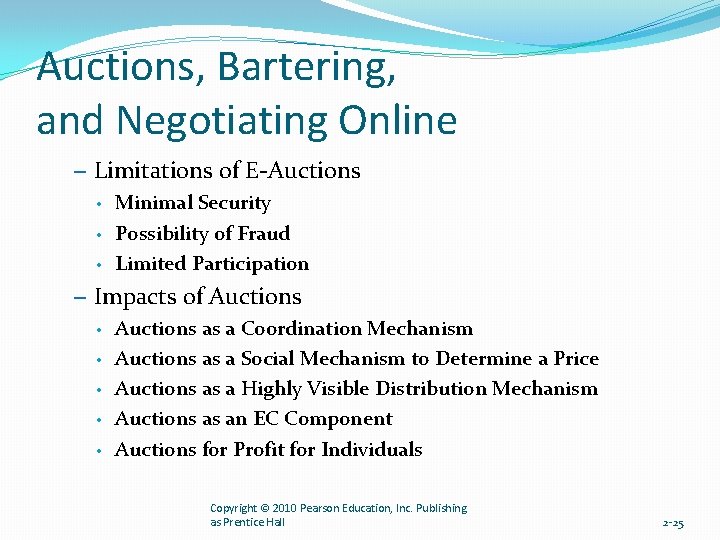
Auctions, Bartering, and Negotiating Online – Limitations of E-Auctions • Minimal Security • Possibility of Fraud • Limited Participation – Impacts of Auctions • Auctions as a Coordination Mechanism • Auctions as a Social Mechanism to Determine a Price • Auctions as a Highly Visible Distribution Mechanism • Auctions as an EC Component • Auctions for Profit for Individuals Copyright © 2010 Pearson Education, Inc. Publishing as Prentice Hall 2 -25
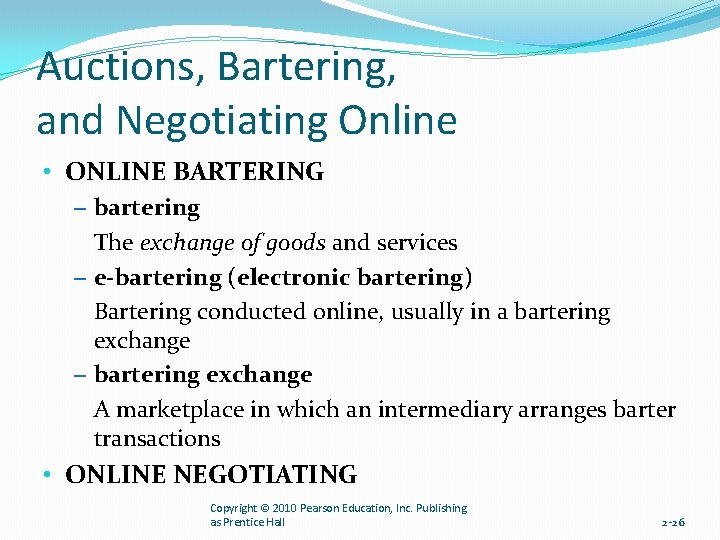
Auctions, Bartering, and Negotiating Online • ONLINE BARTERING – bartering The exchange of goods and services – e-bartering (electronic bartering) Bartering conducted online, usually in a bartering exchange – bartering exchange A marketplace in which an intermediary arranges barter transactions • ONLINE NEGOTIATING Copyright © 2010 Pearson Education, Inc. Publishing as Prentice Hall 2 -26
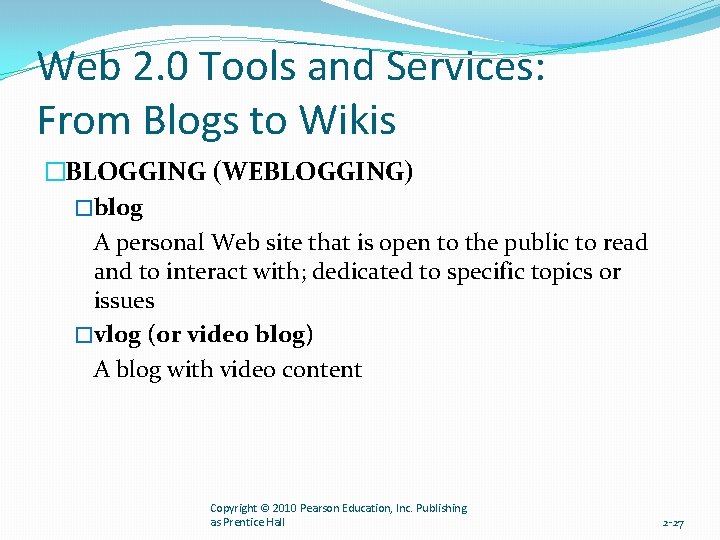
Web 2. 0 Tools and Services: From Blogs to Wikis �BLOGGING (WEBLOGGING) �blog A personal Web site that is open to the public to read and to interact with; dedicated to specific topics or issues �vlog (or video blog) A blog with video content Copyright © 2010 Pearson Education, Inc. Publishing as Prentice Hall 2 -27
Web 2. 0 Tools and Services: From Blogs to Wikis �micro-blogging A form of blogging that allows users to write messages (usually up to 140 characters) and publish them, either to be viewed by anyone or by a restricted group that can be chosen by the user. These messages can be submitted by a variety of means, including text messaging, instant messaging, e-mail, MP 3, or just on the Web Copyright © 2010 Pearson Education, Inc. Publishing as Prentice Hall 2 -28
Web 2. 0 Tools and Services: From Blogs to Wikis – Twitter – – – A free micro-blogging service that allows its users to send and read other users’ updates. tweets Text-based posts up to 140 characters in length posted to Twitter Commercial Uses of Blogs Using Blogging to Facilitate Collaboration Potential Risks of Corporate Blogs Bloggers and Politics Copyright © 2010 Pearson Education, Inc. Publishing as Prentice Hall 2 -29
Web 2. 0 Tools and Services: From Blogs to Wikis • Mechanism Aids for Web 2. 0 Tools – tag A nonhierarchical keyword or term assigned to a piece of information (such as an Internet bookmark, digital image, video clip, or any computer document) – folksonomy (collaborative tagging, social classification, social indexing, social tagging) The practice and method of collaboratively creating, classifying, and managing tags to annotate and categorize content Copyright © 2010 Pearson Education, Inc. Publishing as Prentice Hall 2 -30
Web 2. 0 Tools and Services: From Blogs to Wikis – social bookmarking Web service for sharing Internet bookmarks. The sites are a popular way to store, classify, share, and search links through the practice of folksonomy techniques on the Internet and intranets • wiki (wikilog) A blog that allows everyone to participate as a peer; anyone may add, delete, or change content Copyright © 2010 Pearson Education, Inc. Publishing as Prentice Hall 2 -31
Virtual Worlds As an Electronic Commerce Mechanism • avatars Animated computer characters that exhibit humanlike movements and behaviors • BUSINESS ACTIVITIES AND VALUE IN VIRTUAL WORLDS – Types of business activities in virtual worlds: • • • Creating and managing a virtual business Conducting regular business activities Providing services for those who build, manage, or make money with virtual properties Copyright © 2010 Pearson Education, Inc. Publishing as Prentice Hall 2 -32
Impacts of Electronic Commerce on Business Processes and Organizations �TRANSFORMING ORGANIZATIONS �Technology and Organizational Learning �The Changing Nature of Work �Disintermediation and Reintermediation � disintermediation Elimination of intermediaries between sellers and buyers � reintermediation � Disintermediated entities or newcomers take on new intermediary roles Copyright © 2010 Pearson Education, Inc. Publishing as Prentice Hall 2 -33
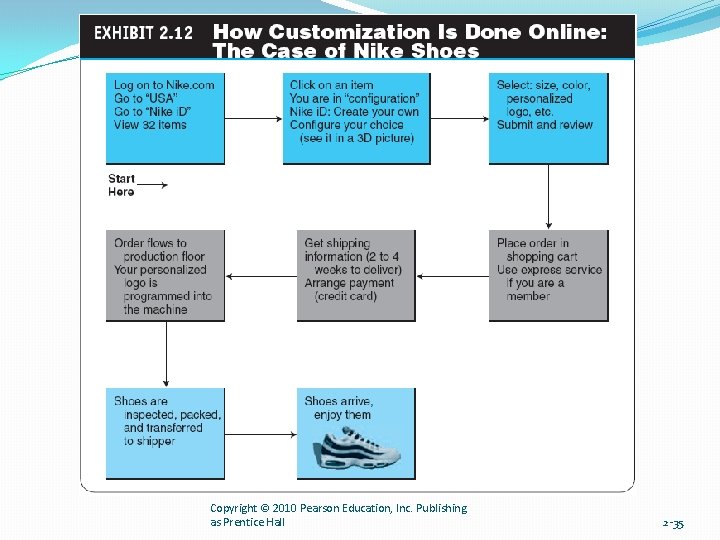
Impacts of Electronic Commerce on Business Processes and Organizations • REDEFINING ORGANIZATIONS – New and Improved Product Capabilities – mass customization A method that enables manufacturers to create specific products for each customer based on the customer’s exact needs – build-to-order (pull system) A manufacturing process that starts with an order (usually customized). Once the order is paid for, the vendor starts to fulfill it Copyright © 2010 Pearson Education, Inc. Publishing as Prentice Hall 2 -34
Copyright © 2010 Pearson Education, Inc. Publishing as Prentice Hall 2 -35
Copyright © 2010 Pearson Education, Inc. Publishing as Prentice Hall 2 -36
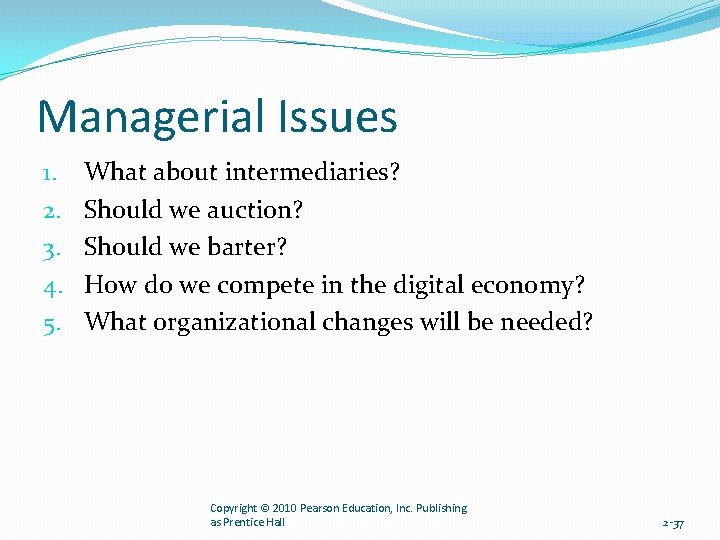
Managerial Issues 1. 2. 3. 4. 5. What about intermediaries? Should we auction? Should we barter? How do we compete in the digital economy? What organizational changes will be needed? Copyright © 2010 Pearson Education, Inc. Publishing as Prentice Hall 2 -37