Early Earth and the Origins of Life Why
- Slides: 25
Early Earth and the Origins of Life Why do we care? How old do you think Life is?
Early Earth and the Origins of Life August 26, 2011 Lecture overview: -formation of the solar system and Earth -conditions on early Earth -theories concerning the origin of life on Earth -geologic evidence for earliest life on Earth
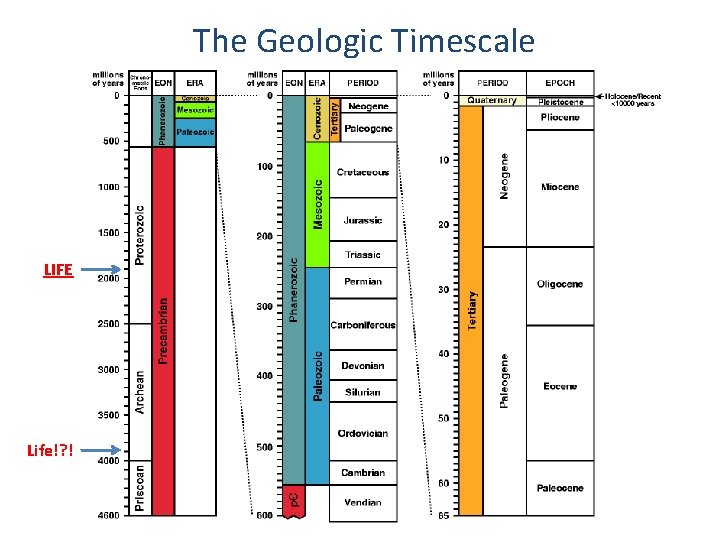
The Geologic Timescale LIFE Life!? !
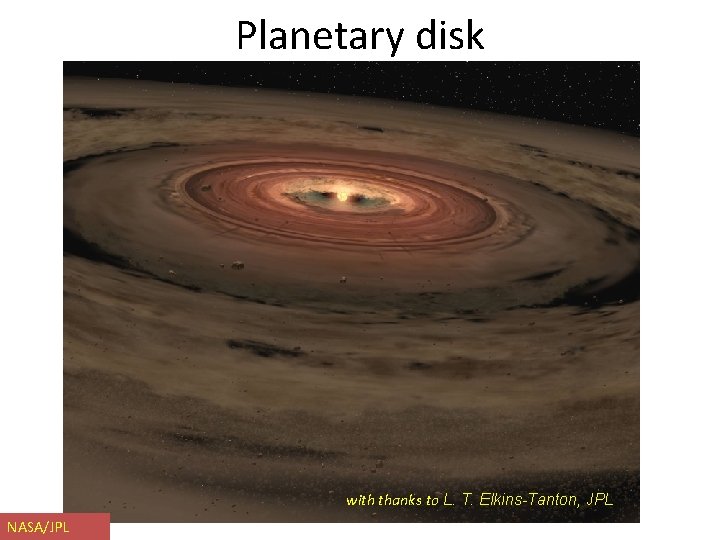
Planetary disk with thanks to L. T. Elkins-Tanton, JPL NASA/JPL
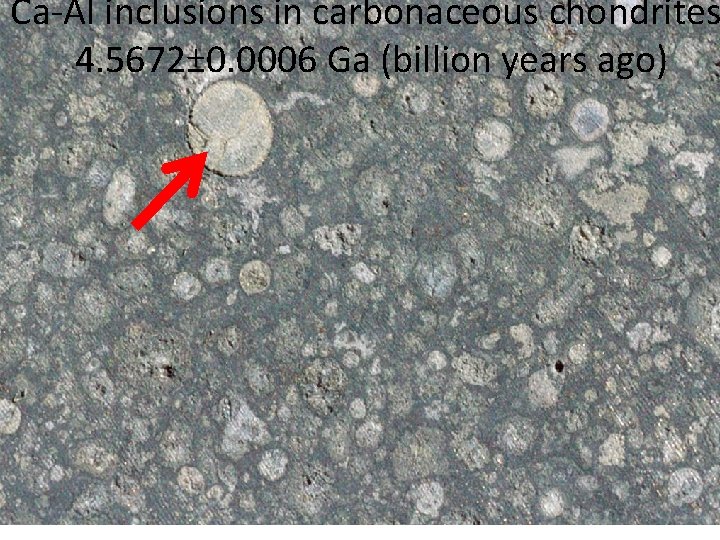
Ca-Al inclusions in carbonaceous chondrites 4. 5672± 0. 0006 Ga (billion years ago)
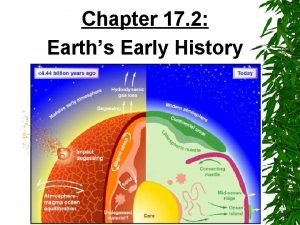
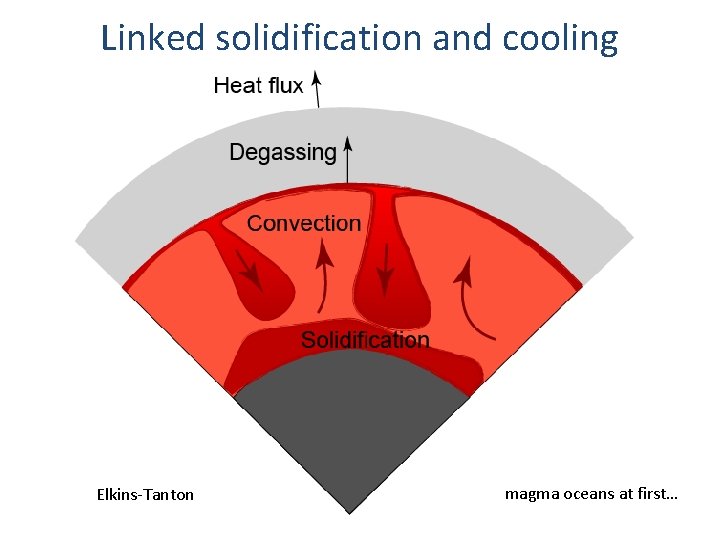
Linked solidification and cooling processes Elkins-Tanton magma oceans at first…
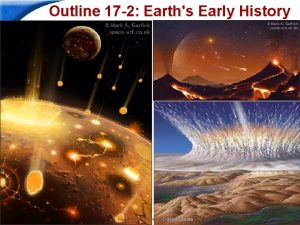
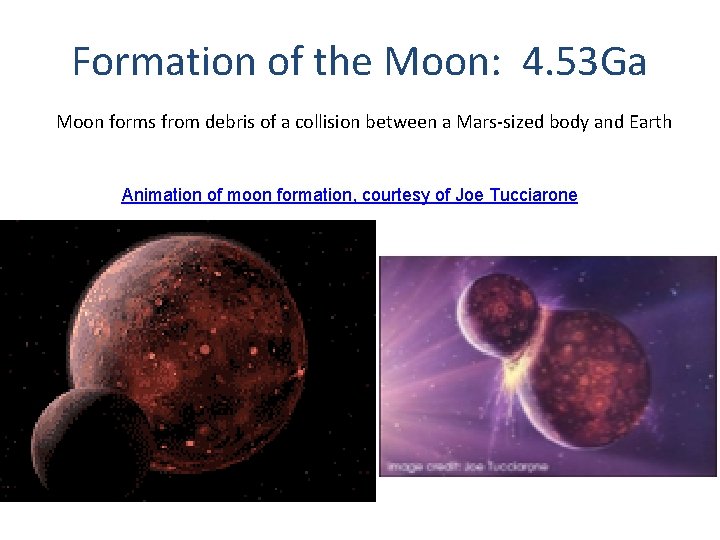
Formation of the Moon: 4. 53 Ga Moon forms from debris of a collision between a Mars-sized body and Earth Animation of moon formation, courtesy of Joe Tucciarone
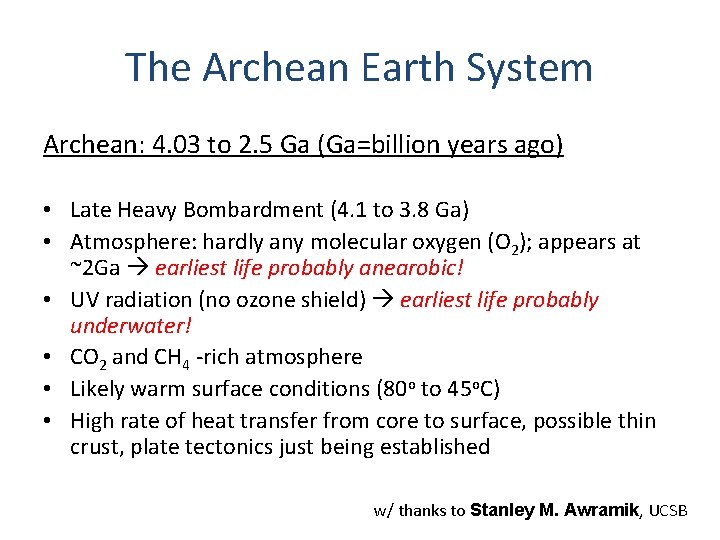
The Archean Earth System Archean: 4. 03 to 2. 5 Ga (Ga=billion years ago) • Late Heavy Bombardment (4. 1 to 3. 8 Ga) • Atmosphere: hardly any molecular oxygen (O 2); appears at ~2 Ga earliest life probably anearobic! • UV radiation (no ozone shield) earliest life probably underwater! • CO 2 and CH 4 -rich atmosphere • Likely warm surface conditions (80 o to 45 o. C) • High rate of heat transfer from core to surface, possible thin crust, plate tectonics just being established w/ thanks to Stanley M. Awramik, Awramik UCSB
Steps towards Life 1. 2. 3. 4. synthesize biomolecules (organic C, amino acids) organize them into macromolecular systems emergence of self-replicating codes of molecules (RNA) emergence of molecular evolution via natural selection after Hazen, 2006
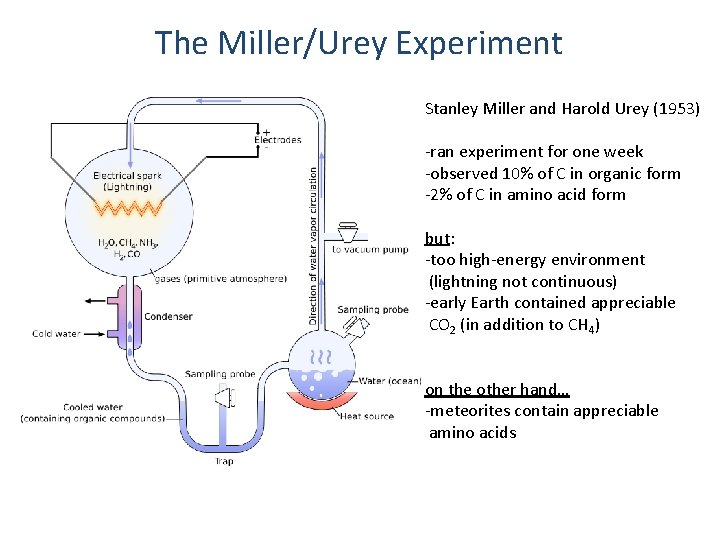
The Miller/Urey Experiment Stanley Miller and Harold Urey (1953) -ran experiment for one week -observed 10% of C in organic form -2% of C in amino acid form but: -too high-energy environment (lightning not continuous) -early Earth contained appreciable CO 2 (in addition to CH 4) on the other hand… -meteorites contain appreciable amino acids
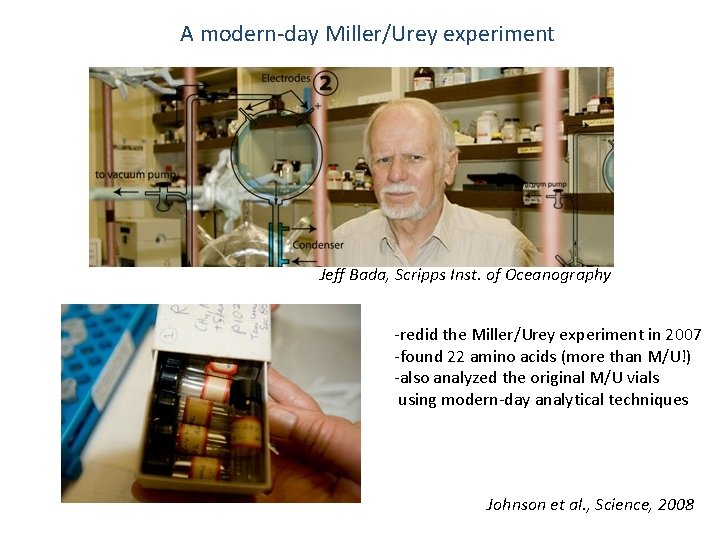
A modern-day Miller/Urey experiment Jeff Bada, Scripps Inst. of Oceanography -redid the Miller/Urey experiment in 2007 -found 22 amino acids (more than M/U!) -also analyzed the original M/U vials using modern-day analytical techniques Johnson et al. , Science, 2008
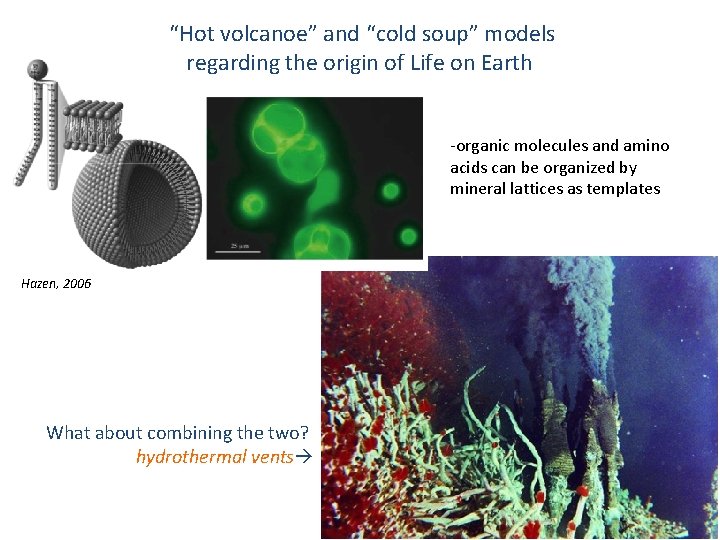
“Hot volcanoe” and “cold soup” models regarding the origin of Life on Earth -organic molecules and amino acids can be organized by mineral lattices as templates Hazen, 2006 What about combining the two? hydrothermal vents
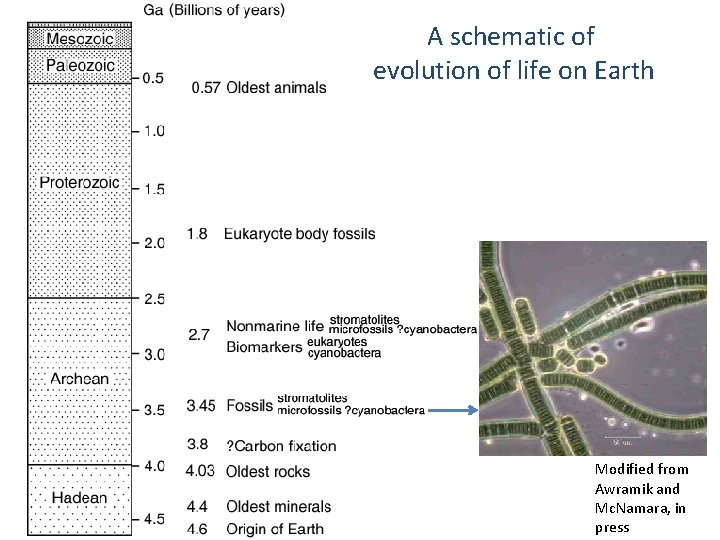
A schematic of evolution of life on Earth Modified from Awramik and Mc. Namara, in press
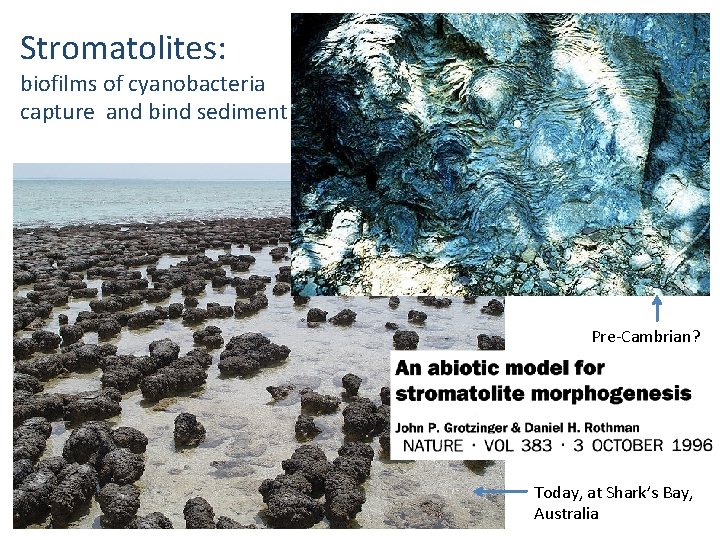
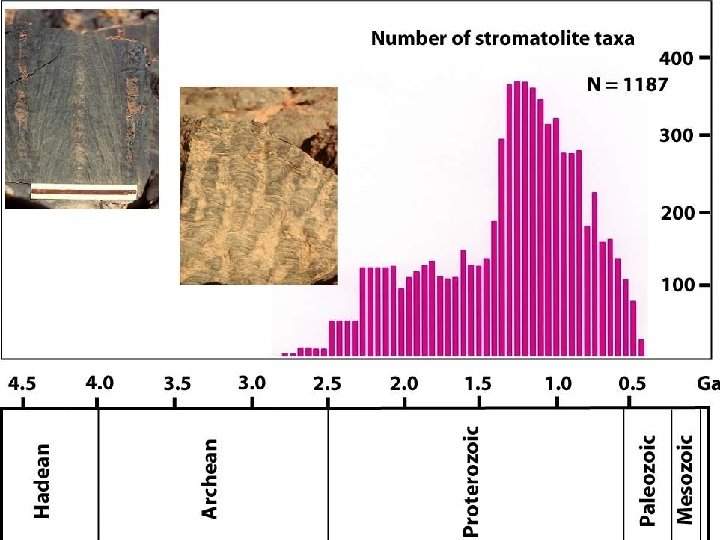
Stromatolites: biofilms of cyanobacteria capture and bind sediment Pre-Cambrian? Today, at Shark’s Bay, Australia
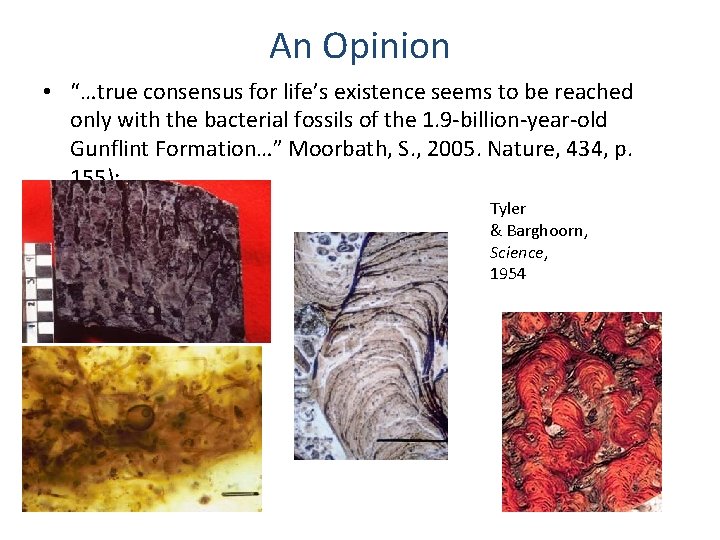
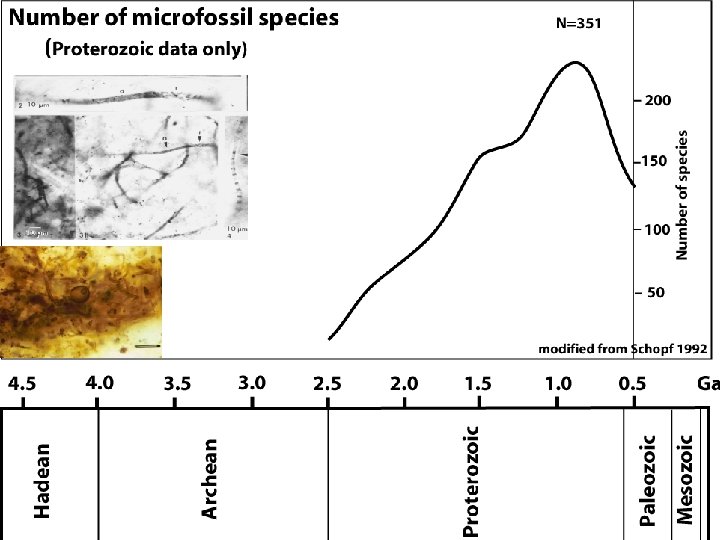
An Opinion • “…true consensus for life’s existence seems to be reached only with the bacterial fossils of the 1. 9 -billion-year-old Gunflint Formation…” Moorbath, S. , 2005. Nature, 434, p. 155): . Tyler & Barghoorn, Science, 1954
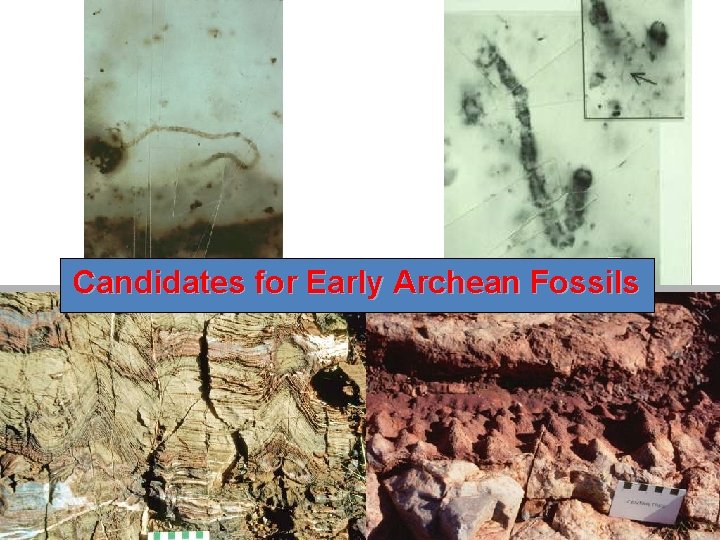
Candidates for Early Archean Fossils
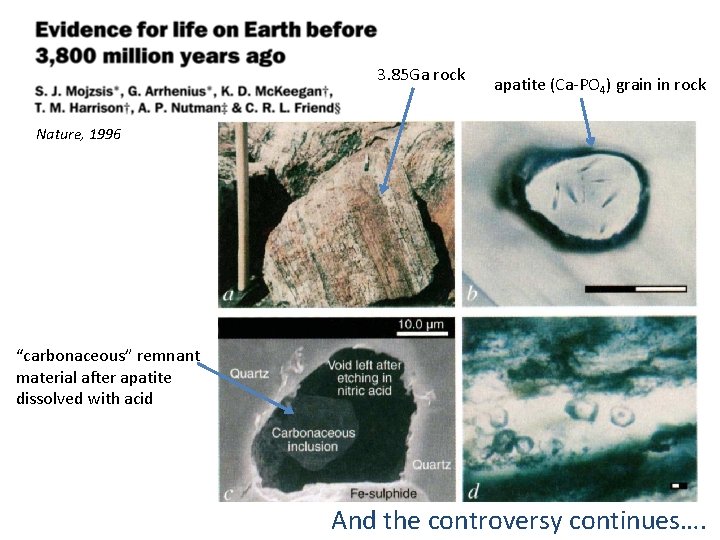
3. 85 Ga rock apatite (Ca-PO 4) grain in rock Nature, 1996 “carbonaceous” remnant material after apatite dissolved with acid And the controversy continues….
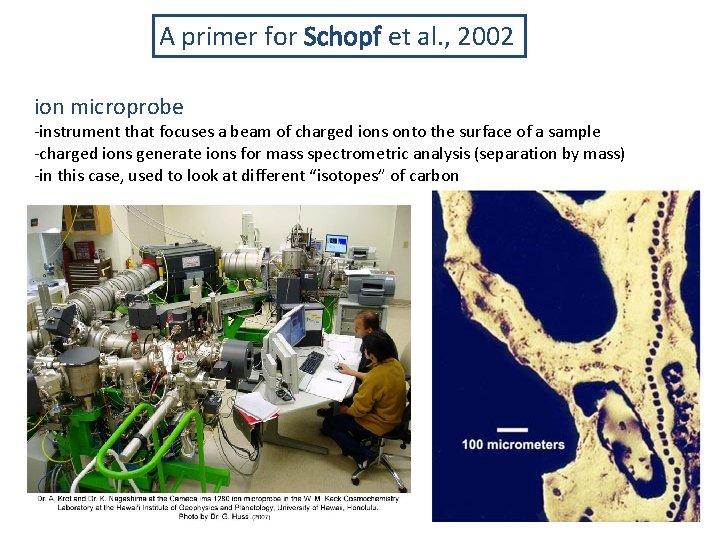
A primer for Schopf et al. , 2002 ion microprobe -instrument that focuses a beam of charged ions onto the surface of a sample -charged ions generate ions for mass spectrometric analysis (separation by mass) -in this case, used to look at different “isotopes” of carbon
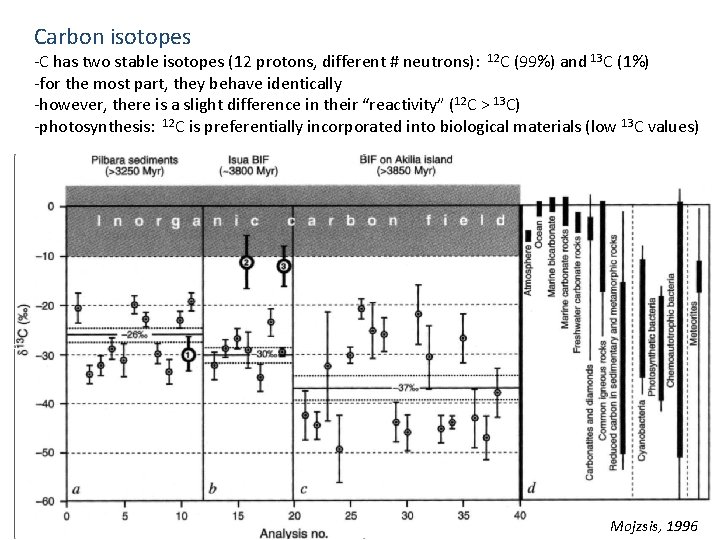
Carbon isotopes -C has two stable isotopes (12 protons, different # neutrons): 12 C (99%) and 13 C (1%) -for the most part, they behave identically -however, there is a slight difference in their “reactivity” (12 C > 13 C) -photosynthesis: 12 C is preferentially incorporated into biological materials (low 13 C values) cross-section of a leaf Mojzsis, 1996
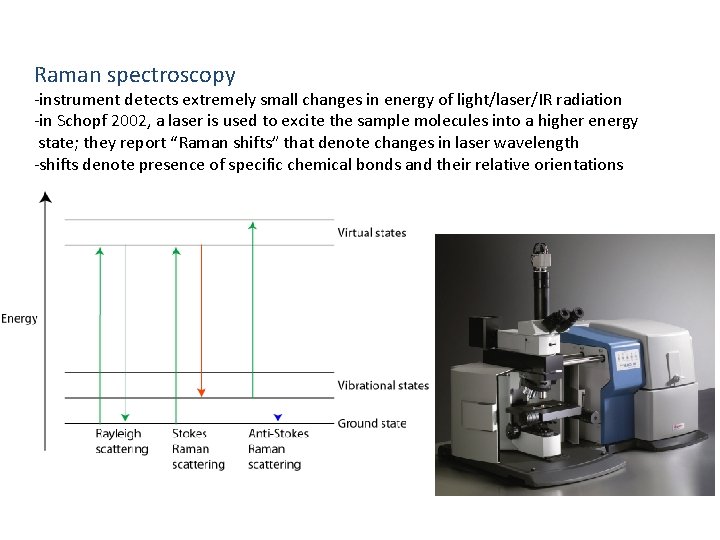
Raman spectroscopy -instrument detects extremely small changes in energy of light/laser/IR radiation -in Schopf 2002, a laser is used to excite the sample molecules into a higher energy state; they report “Raman shifts” that denote changes in laser wavelength -shifts denote presence of specific chemical bonds and their relative orientations
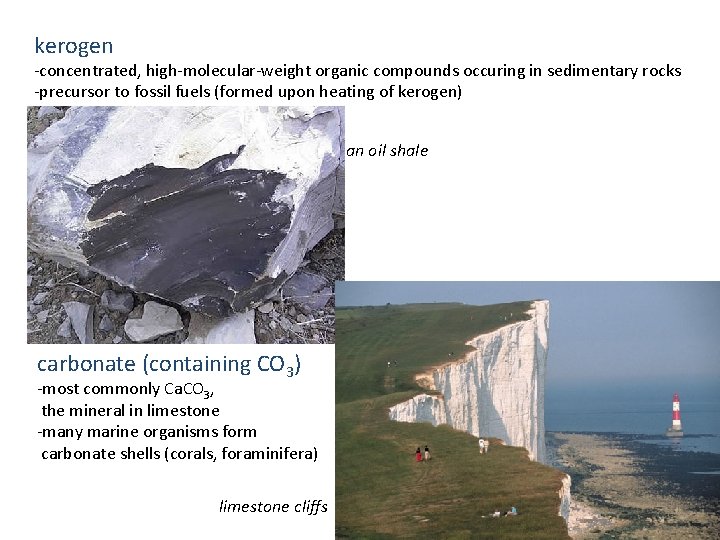
kerogen -concentrated, high-molecular-weight organic compounds occuring in sedimentary rocks -precursor to fossil fuels (formed upon heating of kerogen) an oil shale carbonate (containing CO 3) -most commonly Ca. CO 3, the mineral in limestone -many marine organisms form carbonate shells (corals, foraminifera) limestone cliffs
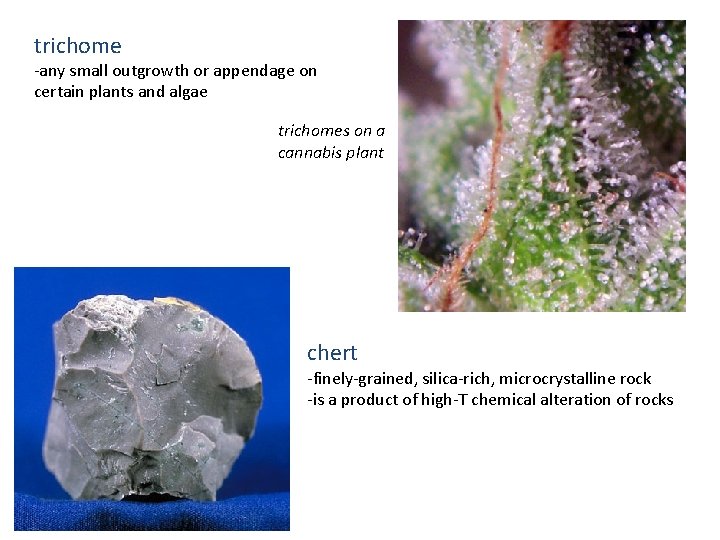
trichome -any small outgrowth or appendage on certain plants and algae trichomes on a cannabis plant chert -finely-grained, silica-rich, microcrystalline rock -is a product of high-T chemical alteration of rocks
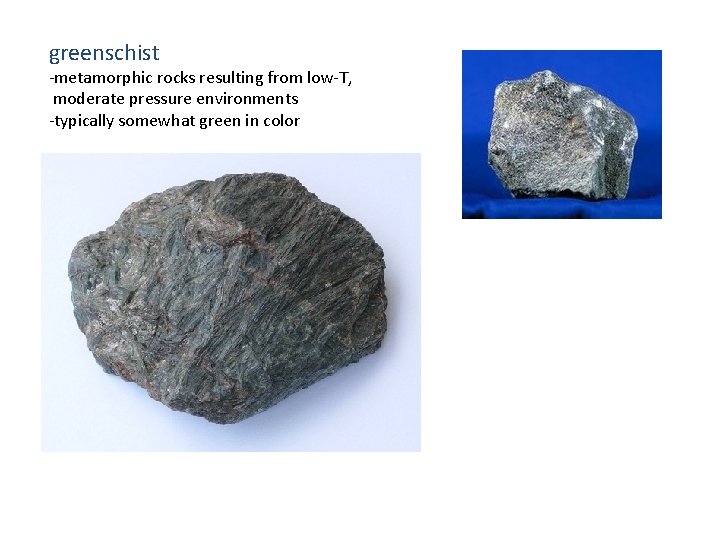
greenschist -metamorphic rocks resulting from low-T, moderate pressure environments -typically somewhat green in color